
Pulp Fiction, 1922 · page 23 of 185
Argosy All-Story Weekly, October 7, 1922 — page 23: what you’re looking at
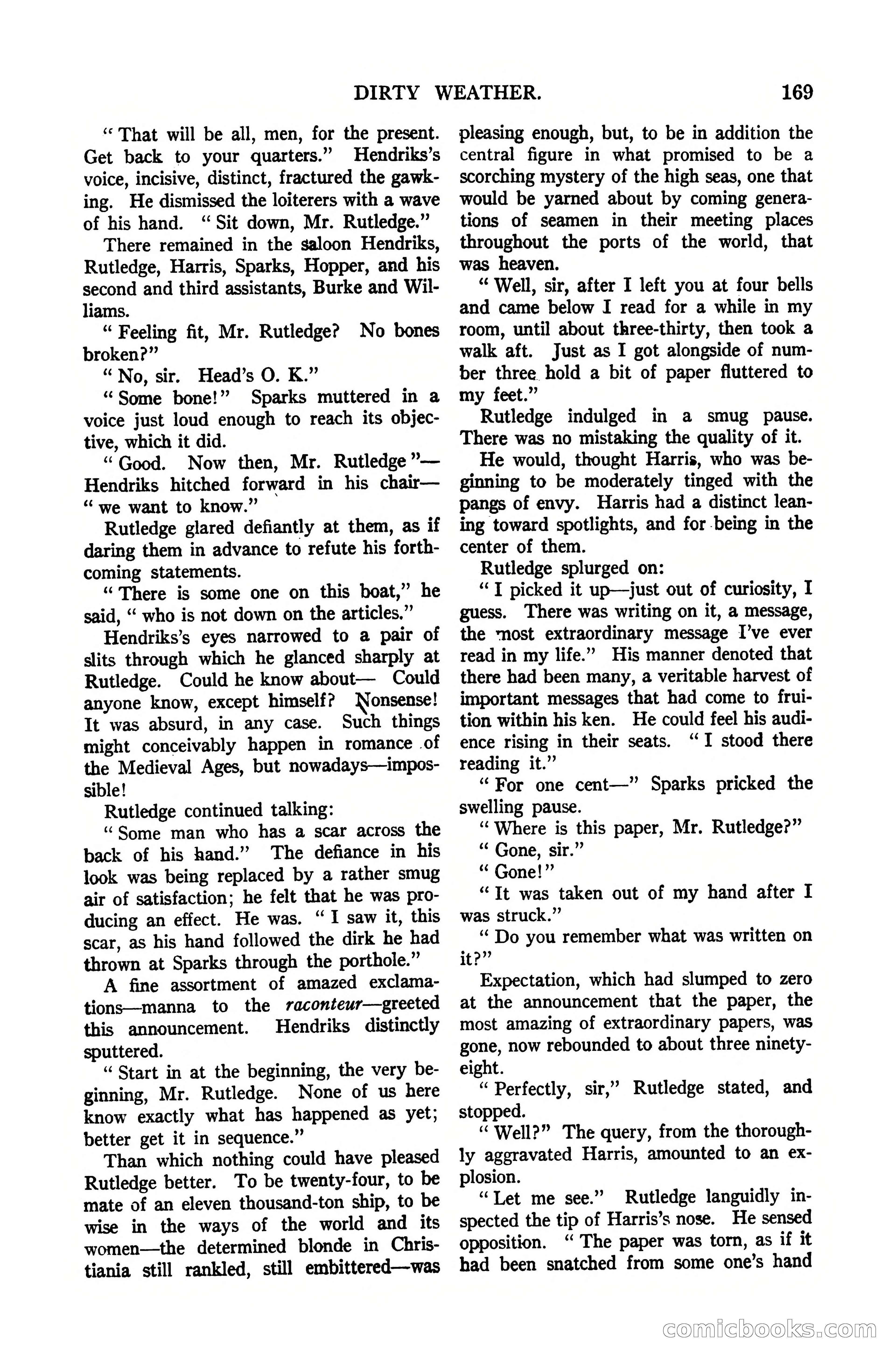
A restored page from Pulp Fiction, 1922. Page through the whole issue in the reader above.
📄 Transcribed text from this page (OCR, searchable)
Machine-transcribed from the original scan — historical spelling and the odd misread are preserved.
DIRTY WEATHER. ‘* That will be all, men, for the present. Get back to your quarters.” Hendriks’s voice, incisive, distinct, fractured the gawk- ing. He dismissed the loiterers with a wave of his hand. “Sit down, Mr. Rutledge.” There remained in the saloon Hendriks, Rutledge, Harris, Sparks, Hopper, and his second and third assistants, Burke and Wil- liams. “Feeling fit, Mr. Rutledge? No bones broken?” “No, sir. Head’s O. K.” “Some bone!” Sparks muttered in a voice just loud enough to reach its objec- tive, which it did. “Good. Now then, Mr. Rutledge ”— Hendriks hitched forward in his chair— “we want to know.” Rutledge glared defiantly at them, as if daring them in advance to refute his forth- coming statements. ‘There is some one on this boat,” he said, ‘“ who is not down on the articles,” Hendriks’s eyes narrowed to a pair of slits through which he glanced sharply at Rutledge. Could he know about— Could anyone know, except himself? Nonsense! It was absurd, in any case. Such things might conceivably happen in romance of the Medieval Ages, but nowadays—impos- sible! Rutledge continued talking: “Some man who has a scar across the back of his hand.” The defiance in his look was being replaced by a rather smug air of satisfaction; he felt that he was pro- ducing an effect. He was. “I saw it, this scar, as his hand followed the dirk he had thrown at Sparks through the porthole.” A fine assortment of amazed exclama- tions—manna to the raconteur—greeted this announcement. Hendriks distinctly sputtered. “ Start in at the beginning, the very be- ginning, Mr. Rutledge. None of us here know exactly what has happened as yet; better get it in sequence.” Than which nothing could have pleased Rutledge better. To be twenty-four, to be mate of an eleven thousand-ton ship, to be wise in the ways of the world and its women—the determined blonde in Chris- tiania still rankled, still embittered—was 169 pleasing enough, but, to be in addition the central figure in what promised to be a scorching mystery of the high seas, one that would be yarned about by coming genera- tions of seamen in their meeting places throughout the ports of the world, that was heaven. “ Well, sir, after I left you at four bells and came below I read for a while in my room, until about three-thirty, then took a walk aft. Just as I got alongside of num- ber three hold a bit of paper fluttered to my feet.” Rutledge indulged in a smug pause. There was no mistaking the quality of it. He would, thought Harris, who was be- ginning to be moderately tinged with the pangs of envy. Harris had a distinct lean- ing toward spotlights, and for being in the center of them. Rutledge splurged on: “T picked it up—just out of curiosity, I guess. There was writing on it, a message, the nost extraordinary message I’ve ever read in my life.” His manner denoted that there had been many, a veritable harvest of important messages that had come to frul- tion within his ken. He could feel his audi- ence rising in their seats. “I stood there reading it.” “For one cent—” Sparks pricked the swelling pause. ‘Where is this paper, Mr. Rutledge?” “‘ Gone, sir.” “* Gone!” “It was taken out of my hand after I was struck.” “Do you remember what was written on it?” Expectation, which had slumped to zero at the announcement that the paper, the most amazing of extraordinary papers, was gone, now rebounded to about three ninety- eight. “Perfectly, sir,’ Rutledge stated, and stopped. “Well?” The query, from the thorough- ly aggravated Harris, amounted to an ex- plosion. “Tet me see.” Rutledge languidly in- spected the tip of Harris’s nose. He sensed opposition. ‘“ The paper was torn, as if it had been snatched from some one’s hand comicboooks C©