
Pulp Fiction, 1922 · page 24 of 185
Argosy All-Story Weekly, October 7, 1922 — page 24: what you’re looking at
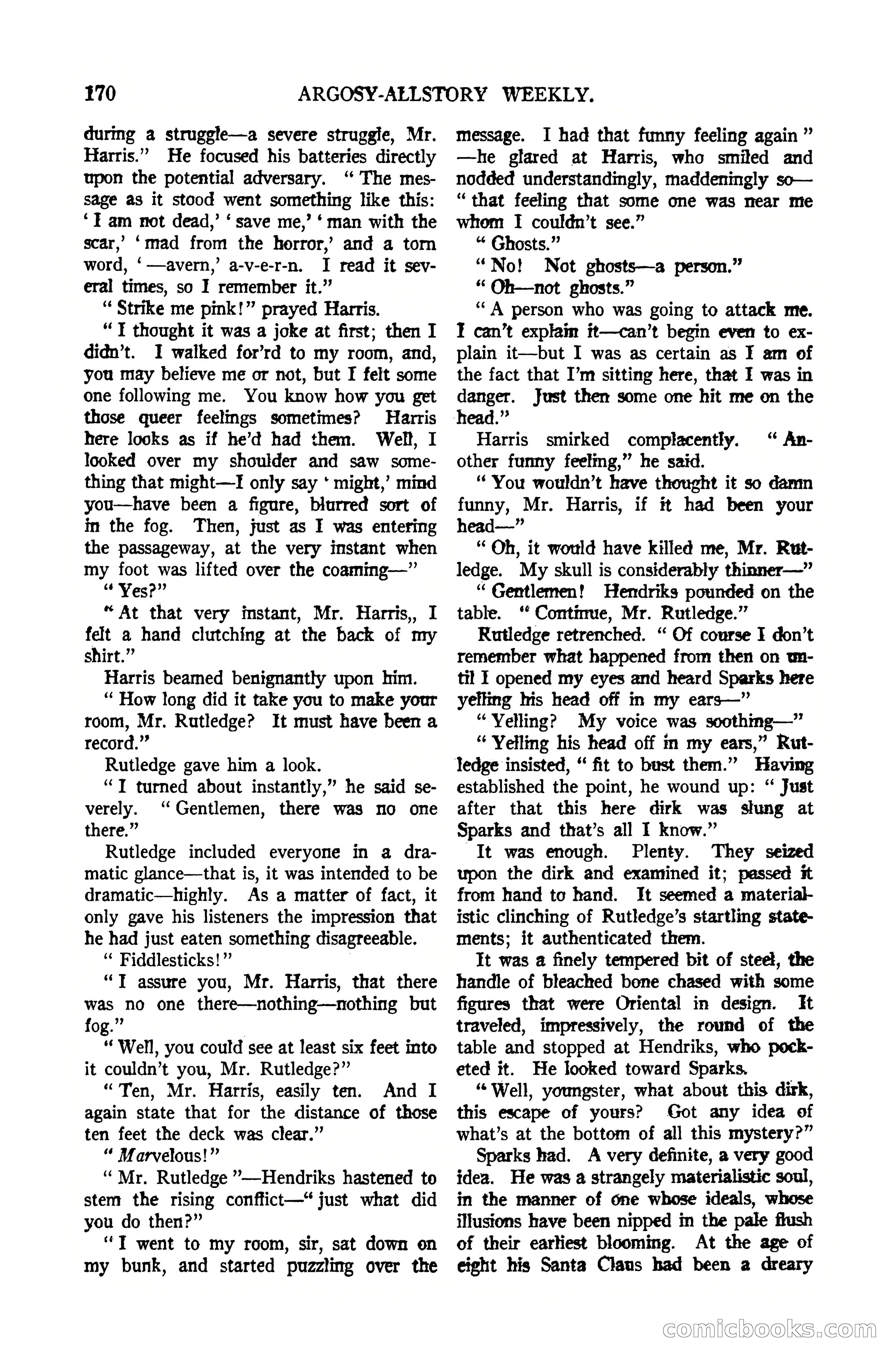
A restored page from Pulp Fiction, 1922. Page through the whole issue in the reader above.
📄 Transcribed text from this page (OCR, searchable)
Machine-transcribed from the original scan — historical spelling and the odd misread are preserved.
170 durmg a struggle—a severe struggie, Mr. Harris.” He focused his batteries directly upon the potential adversary. ‘‘ The mes- sage as it stood went something like this: ‘I am not dead,’ ‘ save me,’ ‘ man with the scar,’ ‘mad from the horror,’ and a tom word, ‘—avern,’ a-v-e-r-n. I read it sev- eral times, so I remember it.” “ Strike me pink!” prayed Harris. “TY thought it was a joke at first; then I didn’t. I walked for’rd to my room, and, you may believe me or not, but I felt some one following me. You know how you get those queer feelings sometimes? Harris here looks as if he’d had them. Weft, I looked over my shoulder and saw some- thing that might—I only say ‘ might,’ mind you—have been a figure, blurred sort of in the fog. Then, just as I was entering the passageway, at the very instant when my foot was lifted over the coaming—” 6é Yes?P”’ “At that very imstant, Mr. Harris,, I felt a hand clutching at the back of my shirt.” Harris beamed benignantly upon him. “ How long did it take you to make your room, Mr. Rutledge? It must have been a record.” Rutledge gave him a look. “IT turned about instantly,” he said se- verely. ‘‘ Gentlemen, there was no one there.” Rutledge included everyone in a dra- matic glance—that is, it was intended to be dramatic—highly. As a matter of fact, it only gave his listeners the impression that he had just eaten something disagreeable. “* Fiddlesticks! ” | “I assure you, Mr. Harris, that there was no one there—nothing—nothing but fog.” | ‘* Well, you could see at least six feet into it couldn’t you, Mr. Rutledge?” “Ten, Mr. Harris, easily ten. And I again state that for the distance of those ten feet the deck was clear.” “ Marvelous!” ‘Mr. Rutledge ”—Hendriks hastened to stem the rising conffict— just what did you do then?” ‘“‘T went to my room, sir, sat down on my bunk, and started puzzling over the ARGOSY-ALLSTORY WEEKLY. message. I had that funny feeling again ” —he glared at Harris, who smiled and nodded understandingly, maddeningly so— “that feeling that some one was near me whom I couldn’t see.” “ Ghosts.” “No! Not ghosts—a person.” “Oh—not ghosts.” ‘A person who was going to attack me. I can’t explain it—can’t begin even to ex- plain it—but I was as certain as I am of the fact that I’m sitting here, that I was in danger. Just then some one hit me on the head.” Harris smirked complacently. ‘“ An- other funny feelmg,” he said. “You wouldn’t have thought it so damn funny, Mr. Harris, if it had been your head—” “Oh, it would have killed me, Mr. Rut- ledge. My skull is considerably thinner—”’ “ Gentlemen! Hendriks pounded on the table. ‘“‘ Contnrue, Mr. Rutledge.” Rutledge retrenched. ‘“ Of course I don’t remember what happened from then on w- til I opened my eyes and heard Sparks here yelling his head off in my ears—” “Velling? My voice was soothing—” “ Yelling his head off m my ears,” Rut- ledge insisted, “ fit to bust them.” Having established the point, he wound up: “ Just after that this here dirk was slung at Sparks and that’s all I know.” It was enough. Plenty. They seized upon the dirk and examined it; passed it from hand to hand. It seemed a material- istic clinching of Rutledge’s startling state- ments; it authenticated them. It was a finely tempered bit of steet, the handle of bleached bone chased with some figures that were Oriental in design. It traveled, impressively, the round of the table and stopped at Hendriks, who pock- eted it. He looked toward Sparks. “Well, youngster, what about this dirk, this escape of yours? Got any idea of what’s at the bottom of all this mystery?” Sparks had. A very definite, a very good idea. He was a strangely materialistic soul, in the manner of one whose ideals, whose illusions have been nipped m the pale flush of their earliest blooming. At the age of eight his Santa Claus had been a dreary COMmiclboo SS C©