
Pulp Fiction, 1922 · page 25 of 185
Argosy All-Story Weekly, October 7, 1922 — page 25: what you’re looking at
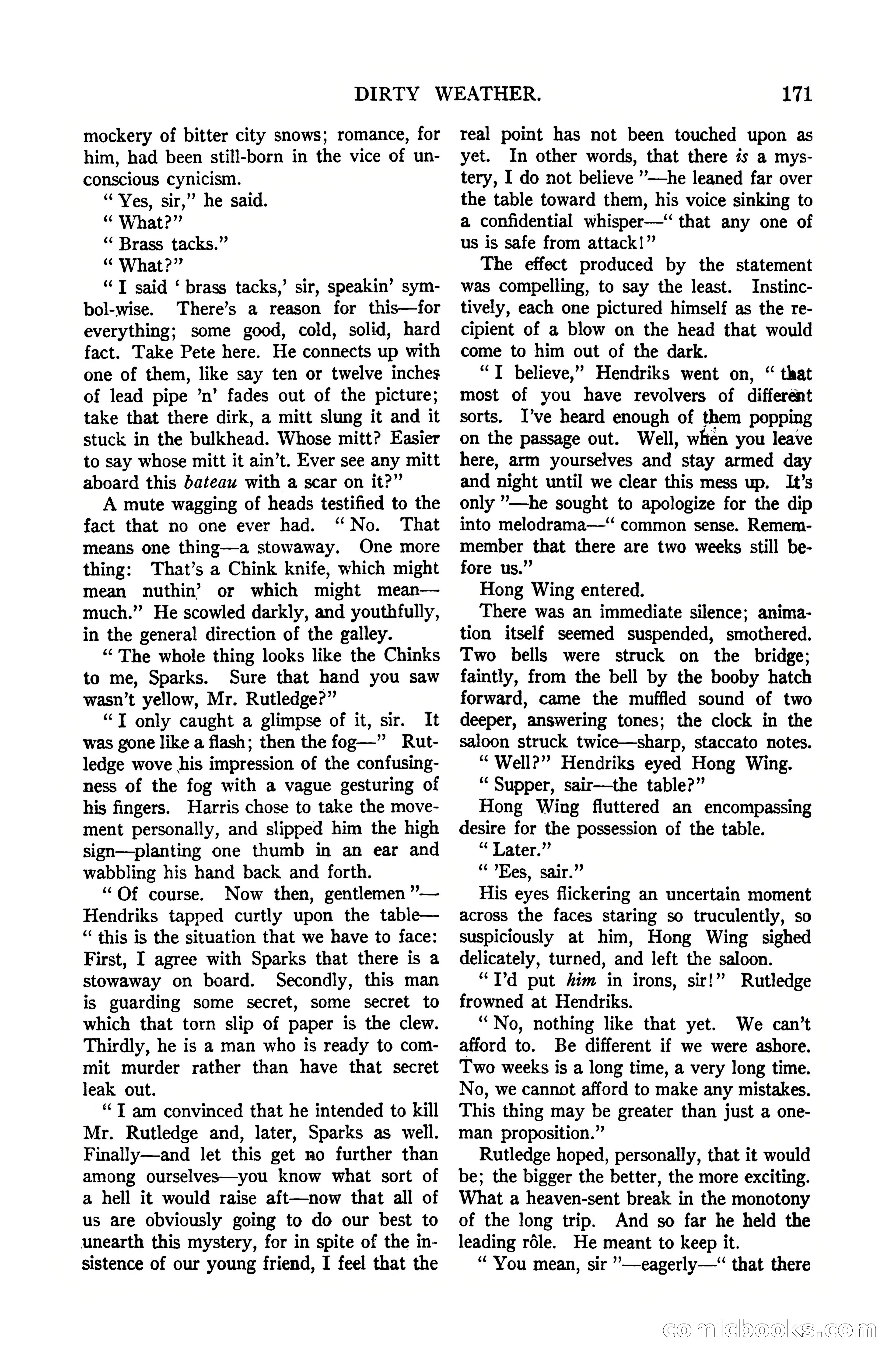
A restored page from Pulp Fiction, 1922. Page through the whole issue in the reader above.
📄 Transcribed text from this page (OCR, searchable)
Machine-transcribed from the original scan — historical spelling and the odd misread are preserved.
DIRTY WEATHER. mockery of bitter city snows; romance, for him, had been still-born in the vice of un- conscious cynicism. “Yes, sir,” he said. “¢ What?” “‘ Brass tacks.” “¢ What?” ‘“‘T said ‘ brass tacks,’ sir, speakin’ sym- bol-wise. There’s a reason for this—for everything; some good, cold, solid, hard fact. Take Pete here. He connects up with one of them, like say ten or twelve inches of lead pipe ’n’ fades out of the picture; take that there dirk, a mitt slung it and it stuck in the bulkhead. Whose mitt? Easier to say whose mitt it ain’t. Ever see any mitt aboard this bateau with a scar on it?” A mute wagging of heads testified to the fact that no one ever had. “No. That means one thing—a stowaway. One more thing: That’s a Chink knife, which might mean nuthin’ or which might mean— much.” He scowled darkly, and youthfully, in the general direction of the galley. ‘‘ The whole thing looks like the Chinks to me, Sparks. Sure that hand you saw wasn’t yellow, Mr. Rutledge?” “T only caught a glimpse of it, sir. It was gone like a flash; then the fog—” Rut- ledge wove his impression of the confusing- ness of the fog with a vague gesturing of his fingers. Harris chose to take the move- ment personally, and slipped him the high sign—planting one thumb in an ear and wabbling his hand back and forth. “Of course. Now then, gentlemen ”— Hendriks tapped curtly upon the table— ‘“ this is the situation that we have to face: First, I agree with Sparks that there is a stowaway on board. Secondly, this man is guarding some secret, some secret to which that torn slip of paper is the clew. Thirdly, he is a man who is ready to com- mit murder rather than have that secret leak out. “ T am convinced that he intended to kill Mr. Rutledge and, later, Sparks as well. Finally—and let this get mo further than among ourselves—you know what sort of a hell it would raise aft—now that all of us are obviously going to do our best to unearth this mystery, for in spite of the in- sistence of our young friend, I feel that the 171 real point has not been touched upon as yet. In other words, that there 7s a mys- tery, I do not believe ”—he leaned far over the table toward them, his voice sinking to a confidential whisper—“ that any one of us is safe from attack!” The effect produced by the statement was compelling, to say the least. Instinc- tively, each one pictured himself as the re- cipient of a blow on the head that would come to him out of the dark. “IT believe,” Hendriks went on, “ that most of you have revolvers of different sorts. I’ve heard enough of them popping on the passage out. Well, when you leave here, arm yourselves and stay armed day and night until we clear this mess up. It’s only ”’—he sought to apologize for the dip into melodrama—“ common sense. Remem- member that there are two weeks still be- fore us.” Hong Wing entered. There was an immediate silence; anima- tion itself seemed suspended, smothered. Two bells were struck on the bridge; faintly, from the bell by the booby hatch forward, came the muffled sound of two deeper, answering tones; the clock in the saloon struck twice—sharp, staccato notes. “Well?” Hendriks eyed Hong Wing. ‘“‘ Supper, sair—the table?” Hong Wing fluttered an encompassing desire for the possession of the table. “* Later.” “¢ Kes, sair.” His eyes flickering an uncertain moment across the faces staring so truculently, so suspiciously at him, Hong Wing sighed delicately, turned, and left the saloon. “Y’d put im in irons, sir!” Rutledge frowned at Hendriks. “No, nothing like that yet. We can’t afford to. Be different if we were ashore. Two weeks is a long time, a very long time. No, we cannot afford to make any mistakes. This thing may be greater than just a one- man proposition.” Rutledge hoped, personally, that it would be; the bigger the better, the more exciting. What a heaven-sent break in the monotony of the long trip. And so far he held the leading role. He meant to keep it. ‘You mean, sir ”—eagerly— that there comicboooks C©