
Pulp Fiction, 1922 · page 106 of 187
Argosy All-Story Weekly — page 106: what you’re looking at
A restored page from Pulp Fiction, 1922. Page through the whole issue in the reader above.
📄 Transcribed text from this page (OCR, searchable)
Machine-transcribed from the original scan — historical spelling and the odd misread are preserved.
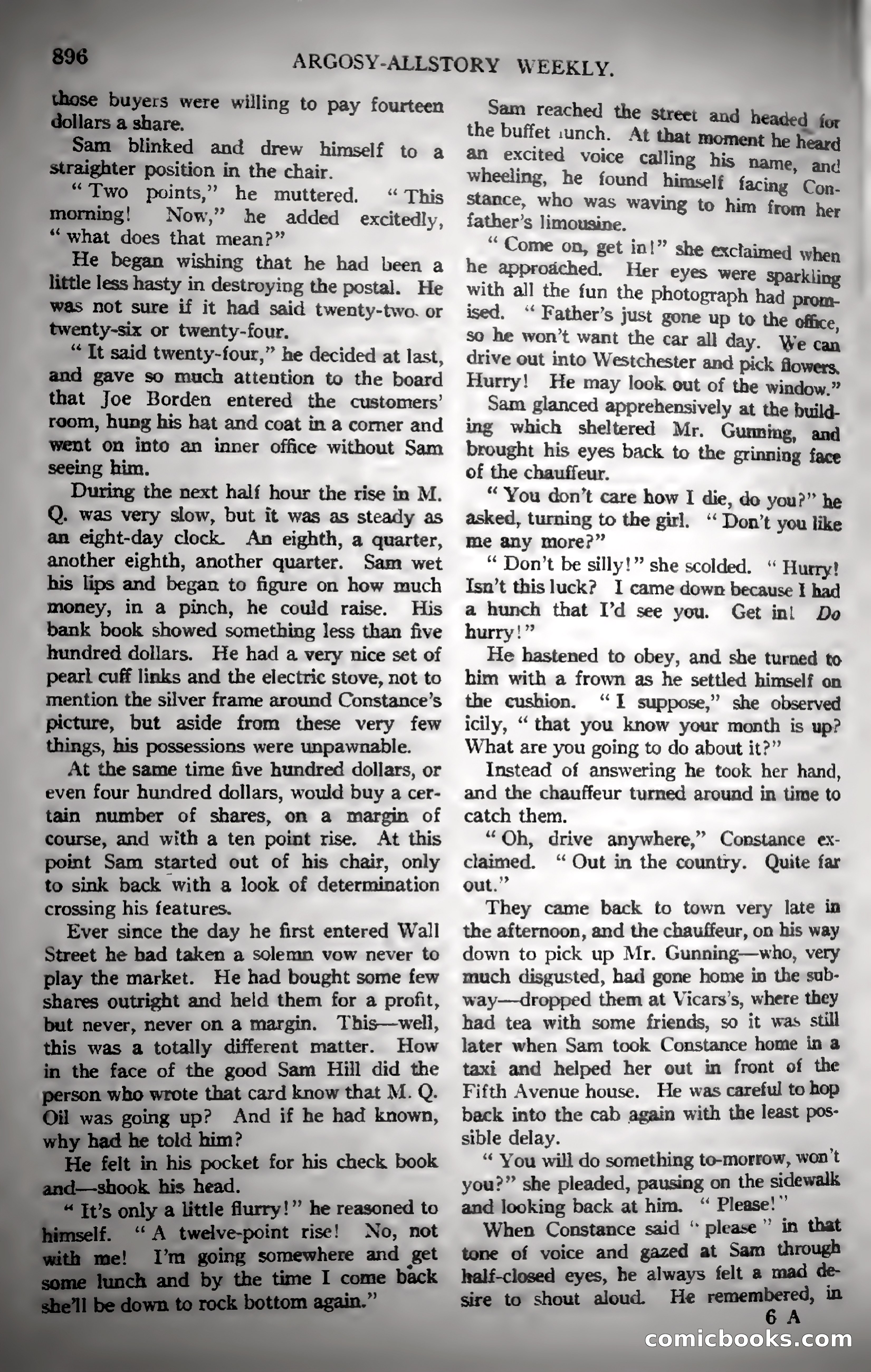
Whose buyers were willing to pay fourteen Gollars a share. _ Sam blinked and drew himself to a _ Straighter position in the chair. 4 “Two points,” he muttered. “ This moming! Now,’ he added excitedly, ““what does that mean?” He began wishing that he had been a little less hasty in destroying the postal. He was not sure if it had said twenty-two. or twenty-six or twenty-four. “It said twenty-four,” he decided at last, and gave so much attention to the board that Joe Borden entered the customers’ room, hung his hat and coat in a corner and went on into an inner office without Sam seeing him. During the next half hour the rise in M. Q. was very slow, but it was as steady as an eight-day clock. An eighth, a quarter, another eighth, another quarter. Sam wet his lips and began to figure on how much money, in a pinch, he could raise. His bank book showed something less than five hundred dollars. He had a very nice set of pearl cuff links and the electric stove, not to mention the silver frame around Constance’s picture, but aside from these very few things, his possessions were unpawnable. At the same time five hundred dollars, or even four hundred dollars, would buy a cer- tain number of shares, on a margin of course, and with a ten point rise. At this point Sam started out of his chair, only to sink back with a look of determination crossing his features. Ever since the day he first entered Wall Street he bad taken a solemn vow never to play the market. He had bought some few shares outright and held them for a profit, but never, never on a margin. This—well, this was a totally different matter. How im the face of the good Sam Hill did the person who wrote that card know that M. Q. _ Oil was going up? And if he had known, e felt in his pocket for his check book s only a little flurry!” he reasoned to “ A twelve-point rise! No, not 6¢ - ARGOSY-ALLSTORY WEEKLY. Sam reached the Street and he : the buffet 1unch. At that moment he a an excited voice calling his name, and wheeling, he found himself facing Con- stance, who was waving to him from her father’s limousine. “ Come on, get in!” she exctaimed when he approdched. Her eyes were sparkling with all the fun the photograph had prom- ised. ‘‘ Father’s just gone up to the office so he won’t want the car all day. We can drive out into Westchester and pick flowers, Hurry! He may look. out of the window.” Sam glanced apprehensively at the build- ing which sheltered Mr. Gunning, and brought his eyes back to the grinning face of the chauffeur. “You don’t care how I die, do you?” he asked, turning to the girl, “Don’t you like me any more?” “ Don’t be silly!” she scolded. ‘“ Hurry! Isn’t this luck? I came down because I had a hunch that I'd see you. Get inl Do hurry!” He hastened to obey, and she turned to him with a frown as he settled himself on the cushion. ‘I suppose,” she observed icily, “ that you know your month is up? What are you going to do about it?” Instead of answering he took her hand, and the chauffeur turned around in time to catch them. “Oh, drive anywhere,” Constance ex- claimed. ‘“ Out in the country. Quite far out.” They came back to town very late in the afternoon, and the chauffeur, on his way down to pick up Mr. Gunning—who, very much disgusted, had gone home in the sub- way—dropped them at Vicars’s, where they had tea with some friends, so it was still later when Sam took Constance home in a taxi and helped her out in front of the Fifth Avenue house. He was careful to hop back into the cab again with the least pos- sible delay. “ You will do something to-morrow, won't you?” she pleaded, pausing on the sidewalk and looking back at him. “ Please!” When Constance said * please” in that tone of voice and gazed at Sam through half-closed eyes, be always felt a mad de- sire to shout aloud. He —— ML books.com C (elo) mi