
Pulp Fiction, 1922 · page 119 of 187
Argosy All-Story Weekly — page 119: what you’re looking at
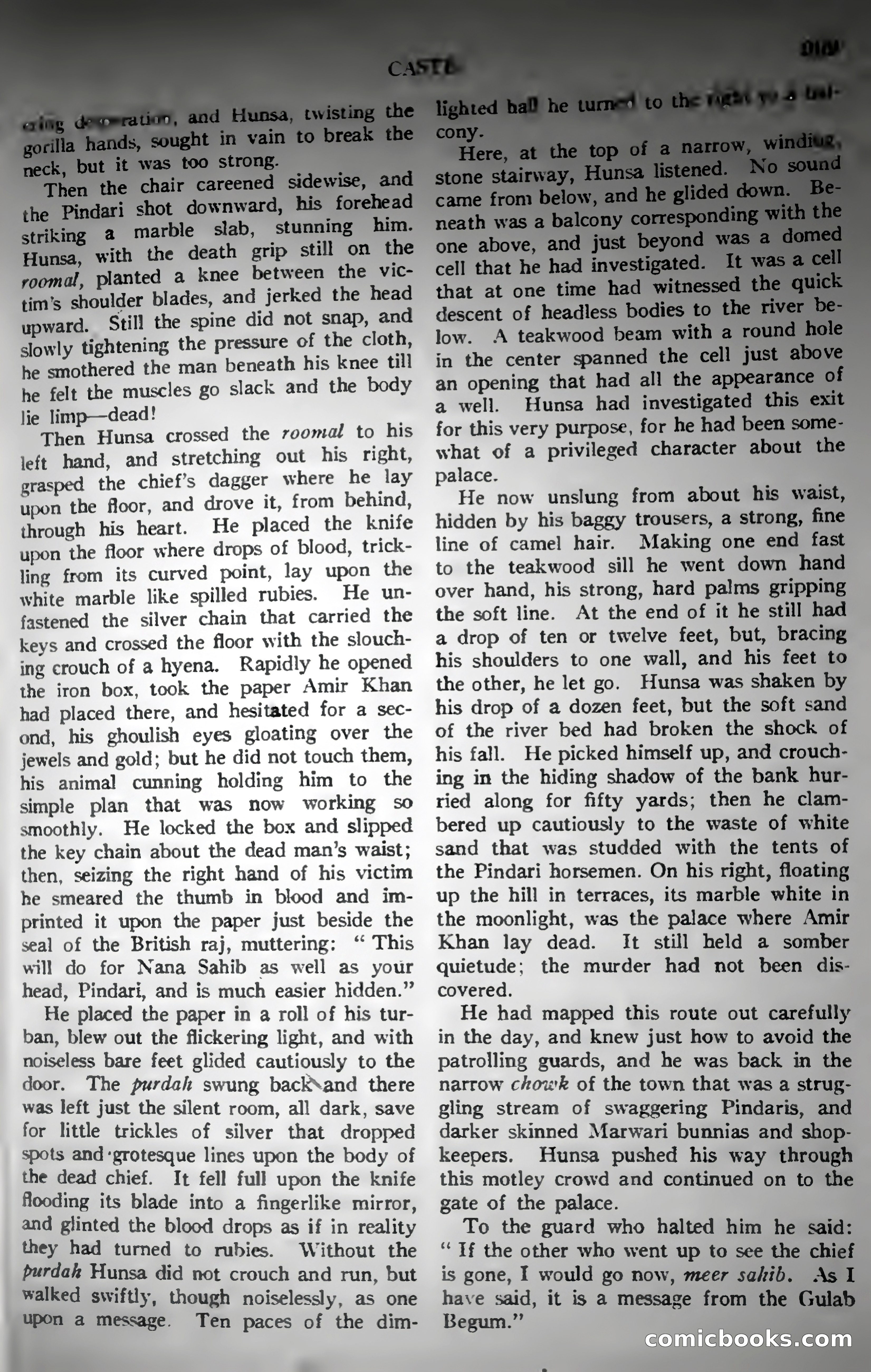
A restored page from Pulp Fiction, 1922. Page through the whole issue in the reader above.
📄 Transcribed text from this page (OCR, searchable)
Machine-transcribed from the original scan — historical spelling and the odd misread are preserved.
the ’ : striking a marble slab, stunning him. Hunsa, with the death grip still on the roomal, planted a knee between the vic- tim’s shoulder blades, and jerked the head upward. Still the spine did not snap, and slowly tightening the pressure of the cloth, he smothered the man beneath his knee till he felt the muscles go slack and the body lie limp—dead! Then Hunsa crossed the roomal to his ieft hand, and stretching out his right, grasped the chief’s dagger where he lay upon the floor, and drove it, from behind, through his heart. He placed the knife upon the floor where drops of blood, trick- ling from its curved point, lay upon the white marble like spilled rubies. He un- fastened the silver chain that carried the keys and crossed the floor with the slouch- ing crouch of a hyena. Rapidly he opened the iron box, took the paper Amir Khan had placed there, and hesitated for a sec- ond, his ghoulish eyes gloating over the jewels and gold; but he did not touch them, his animal cunning holding him to the simple plan that was now working so smoothly. He locked the box and slipped the key chain about the dead man’s waist; then, seizing the right hand of his victim he smeared the thumb in blood and im- printed it upon the paper just beside the seal of the British raj, muttering: ‘ This will do for Nana Sahib as well as your head, Pindari, and is much easier hidden.” He placed the paper in a roll of his tur- ban, blew out the flickering light, and with noiseless bare feet glided cautiously to the door. The purdah swung back\and there was left just the silent room, all dark, save for little trickles of silver that dropped spots and ‘grotesque lines upon the body of the dead chief. It fell full upon the knife Hooding its blade into a fingerlike mirror, and glinted the blood drops as if in reality they had turned to rubies. Without the purdak Hunsa did not crouch and run, but walked swiftly, though noiselessly, as one upon a message. Ten paces of the dim- Pindari shot downward, his forehead one above, and Ju: cell that he had investigz that at one time had witnes descent of headless bodies to th low. A teakwood beam with a ro in the center spanned the cell just a an opening that had all the appearance ¢ a well. Hunsa had investigated this exit — for this very purpose, for he had been some- what of a privileged character about the palace. He now unslung from about his waist, hidden by his baggy trousers, a strong, fine line of camel hair. Making one end fast to the teakwood sill he went down hand over hand, his strong, hard palms gripping the soft line. At the end of it he still had a drop of ten or twelve feet, but, bracing his shoulders to one wall, and his feet to the other, he let go. Hunsa was shaken by his drop of a dozen feet, but the soft sand of the river bed had broken the shock of his fall. He picked himself up, and crouch- ing in the hiding shadow of the bank hur- ried along for fifty yards; then he clam- bered up cautiously to the waste of white sand that was studded with the tents of the Pindari horsemen. On his right, floating up the hill in terraces, its marble white in the moonlight, was the palace where Amir Khan lay dead. {it still held a somber quietude; the murder had not been dis- covered. He had mapped this route out carefully in the day, and knew just how to avoid the patrolling guards, and he was back in the narrow chowk of the town that was a strug- gling stream of swaggering Pindaris, and darker skinned Marwari bunnias and shop- keepers. Hunsa pushed his way through this motley crowd and continued on to the gate of the palace. To the guard who halted him he said: ‘“‘ If the other who went up to see the chief is gone, I would go now, meer sahib. As I have said, it is a message from the Gulab Begum.” Cl @) m Q c b: 00 (S.C si