
Pulp Fiction, 1922 · page 126 of 187
Argosy All-Story Weekly — page 126: what you’re looking at
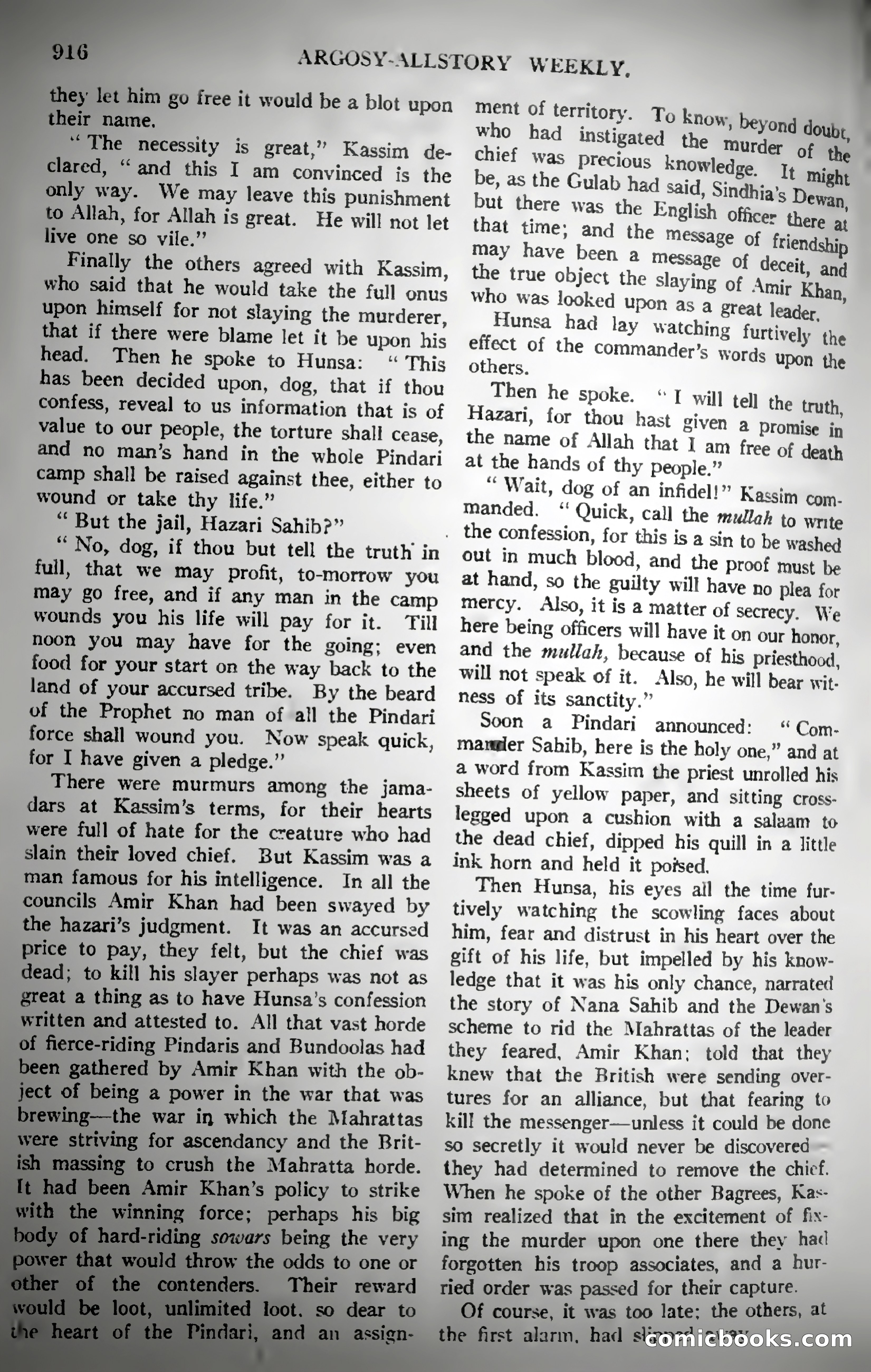
A restored page from Pulp Fiction, 1922. Page through the whole issue in the reader above.
📄 Transcribed text from this page (OCR, searchable)
Machine-transcribed from the original scan — historical spelling and the odd misread are preserved.
ey let him go free it would be a blot upon their name. _ “The necessity is great,” Kassim de- _ clared, “and this I am convinced is the _ only way. We may leave this punishment to Allah, for Allah is great. He will not let live one so vile.” Finally the others agreed with Kassim, who said that he would take the full onus upon himself for not slaying the murderer, that if there were blame let it be upon his head. Then he spoke to Hunsa: “ This has been decided upon, dog, that if thou confess, reveal to us information that is of value to our people, the torture shall cease, and no man’s hand in the whole Pindari camp shall be raised against thee, either to wound or take thy life.” “ But the jail, Hazari Sahib?” “ No, dog, if thou but tell the truth in full, that we may Profit, to-morrow you may go free, and if any man in the camp wounds you his life will pay for it. Till noon you may have for the going: even food for your start on the way back to the land of your accursed tribe. By the beard of the Prophet no man of all the Pindari force shall wound you. Now speak quick, for I have given a pledge.” There were murmurs among the jama- dars at Kassim’s terms, for their hearts were full of hate for the creature who had slain their loved chief. But Kassim was a man famous for his intelligence. In all the councils Amir Khan had been swayed by the hazari’s judgment. It was an accursed _ price to pay, they felt, but the chief was _ dead; to kill his slayer perhaps was not as great a thing as to have Hunsa’s confession 1 and attested to. All that vast horde Tiding Pindaris and Bundoolas had ered by Amir Khan with the ob- ing a power in the war that was —the war in which the Mahrattas ng for ascendancy and the Brit- ‘to crush the Mahratta horde. nir Khan’s policy to strike force; perhaps his big yvars being the very ne odds to one or ARGOSY-ALLSTORY WEEKLY, ment of territory. who had instigated the murder of chief was precious knowledge. be, as the Gulab had said, Sindhia’ but there was the English officer that time; and the message of friendch; may have been a message of deceit and the true object the Slaying of Amir khan who was looked upon as a great leader, Hunsa had lay watching furtively the effect of the commander’s words upon the others. Then he spoke. “1 will tell the truth Hazari, for thou hast given a promise in the name of Allah that ] am free of death at the hands of thy People.” “ Wait, dog of an infidel!” Kassim com- manded. ‘‘ Quick, call the mullah to write the It might S Dewan, there at . the confession, for this is a sin to be washed out in much blood, and the proof roust be at hand, so the guilty will have no plea for mercy. Also, it is a matter of secrecy. We here being officers will have it on our honor, and the mullah, because of his priesthood, will not speak of it. Also, he will bear wit- ness of its sanctity.” Soon a Pindari announced: “Com- mamgler Sahib, here is the holy one,” and at a word from Kassim the priest unrolled his sheets of yellow paper, and sitting cross- legged upon a cushion with a salaam to the dead chief, dipped his quill in a little ink horn and held it porsed., Then Hunsa, his eyes all the time fur- tively watching the scowling faces about him, fear and distrust in his heart over the gift of his life, but impelled by his know- ledge that it was his only chance, narrated the story of Nana Sahib and the Dewan’s scheme to rid the Mahrattas of the leader they feared, Amir Khan; told that they knew that the British were sending over- tures for an alliance, but that fearing to kill the messenger—unless it could be done so secretly it would never be discovered they had determined to remove the chief. When he spoke of the other Bagrees, Kas- sim realized that in the excitement of fix- ing the murder upon one there they had forgotten his troop associates, and a hur- ried order was passed for their capture. _ Of course, it was too late; the others, at first alarm, had stpiy77) To know, beyond doubr,