
Pulp Fiction, 1922 · page 128 of 187
Argosy All-Story Weekly — page 128: what you’re looking at
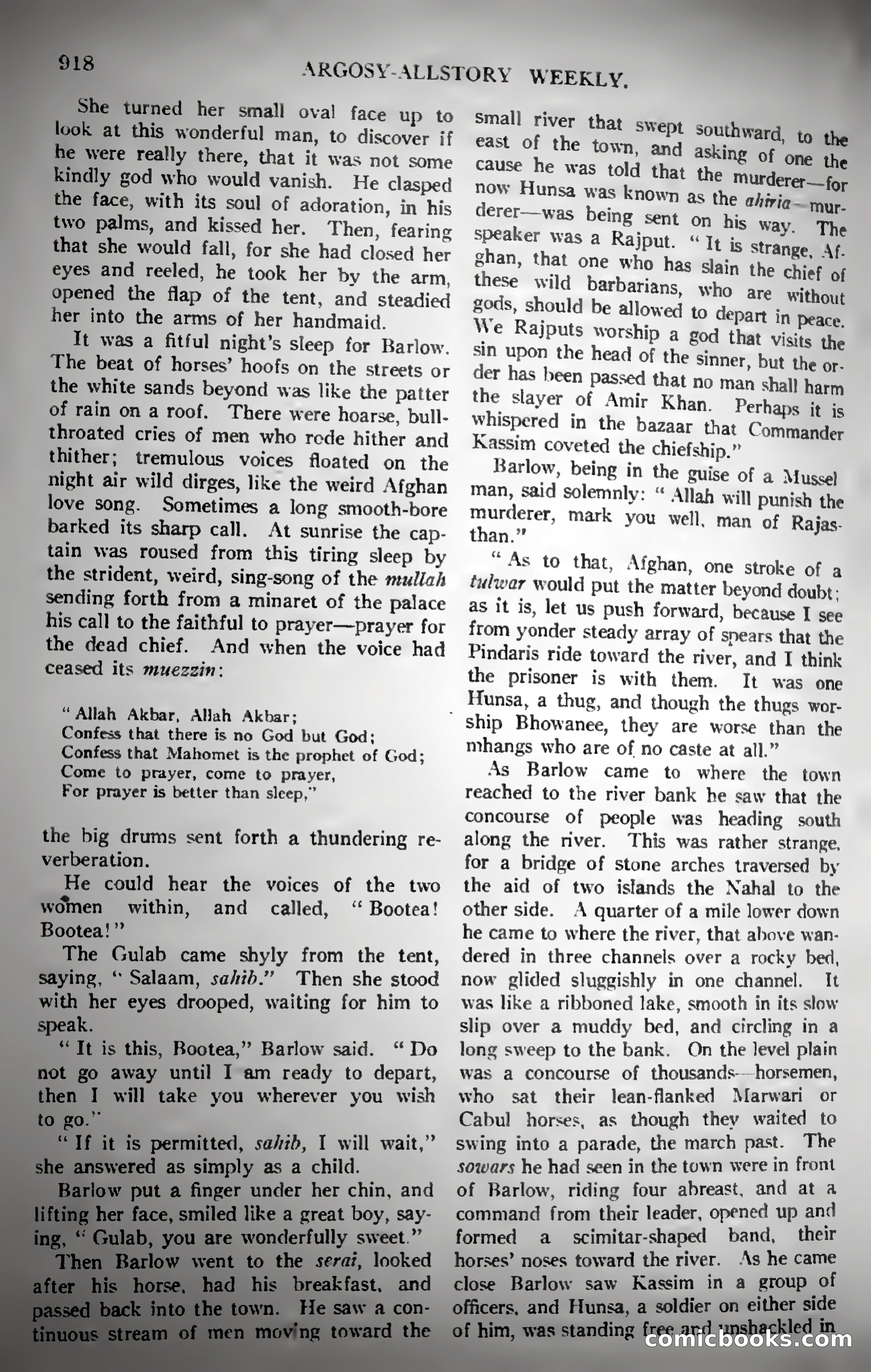
A restored page from Pulp Fiction, 1922. Page through the whole issue in the reader above.
📄 Transcribed text from this page (OCR, searchable)
Machine-transcribed from the original scan — historical spelling and the odd misread are preserved.
_ She turned her small oval look at this wonderful man, to discover if he were really there, that it was not some _ kindly god who would vanish. He clasped _ the face, with its soul of adoration, in his two palms, and kissed her. Then, fearing that she would fall, for she had closed her eyes and reeled, he took her by the arm, opened the flap of the tent, and steadied her into the arms of her handmaid. It was a fitful night’s Sleep for Barlow. The beat of horses’ hoofs on the streets or the white sands beyond was like the patter of rain on a roof. There were hoarse, bull- throated cries of men who rede hither and thither; tremulous voices floated on the night air wild dirges, like the weird Afghan love song. Sometimes a long smooth-bore barked its sharp call. At sunrise the cap- tain was roused from this tiring sleep by the strident, weird, sing-song of the muliah sending forth from a minaret of the palace his call to the faithful to prayer—prayer for the dead chief. And when the voice had ceased its muezzin: face up to “ Allah Akbar, Aah Akbar; Confess that there is no God but God; Confess that Mahomet is the prophet of God; Come to prayer, come to prayer, For prayer is better than sleep,” the big drums sent forth a thundering re- verberation. He could hear the voices of the two women within, and called, “ Bootea! Bootea!”’ ___ The Gulab came shyly from the tent, saying, “ Salaam, sahib.” Then she stood with her eyes drooped, waiting for him to t is this, Bootea,” Barlow said. ‘“ Do go away until I am ready to depart, I will take you wherever you wish S permitted, sath, I will wait,” simply as a child. inger under her chin, and ed like a great boy, say- ne serai, looked ARGOSY-ALLSTORY WEEKLY, ; € d 7 ae Small river that sWept southward, to east of the town, and asking of one th cause he was told that the murderer—for now Hunsa was known as the ahivia—myy- derer—was being sent on his way. The speaker was a Rajput. “ It j ghan, that one who has slain the chief of these wild barbarians, who are without gods, should be allowed to depart in peace We Rajputs worship a god that Visits the sin upon the head of the sinner, but the or- der has heen passed that no man shall harm the slayer of Amir Khan. Perhaps it js Whispered in the bazaar that Commander Kassim coveted the chiefship.” Barlow, being in the guise of a Mussel man, said solemnly: “ Allah will punish the murderer, mark you well, man of Rajas- than.” “ As to that, Afghan, one Stroke of a tulwar would put the matter beyond doubt: as it is, let us push forward, because I see from yonder steady array of spears that the Pindaris ride toward the river, and I think the prisoner is with them. It was one Hunsa, a thug, and though the thugs wor- the _ Ship Bhowanee, they are worse than the mthangs who are of no caste at all.” As Barlow came to where the town reached to the river bank he saw that the concourse of people was heading south along the river. This was rather strange, for a bridge of stone arches traversed by the aid of two islands the Nahal to the other side. A quarter of a mile lower down he came to where the river, that above wan- dered in three channels over a rocky bed, now glided sluggishly in one channel. It was like a ribboned lake, smooth in its slow slip over a muddy bed, and circling in a long sweep to the bank. On the level plain was a concourse of thousands-—horsemen, who sat their lean-flanked Marwari or Cabul horses, as though they waited to swing into a parade, the march past. The sowars he had seen in the town were in front of Barlow, riding four abreast, and at a command from their leader, opened up and formed a scimitar-shaped band, their horses’ noses toward the river. As he came close Barlow saw Kassim in a group of s, and Hunsa, a soldier on either side im. +> comicbooks.com