
Pulp Fiction, 1922 · page 143 of 187
Argosy All-Story Weekly — page 143: what you’re looking at
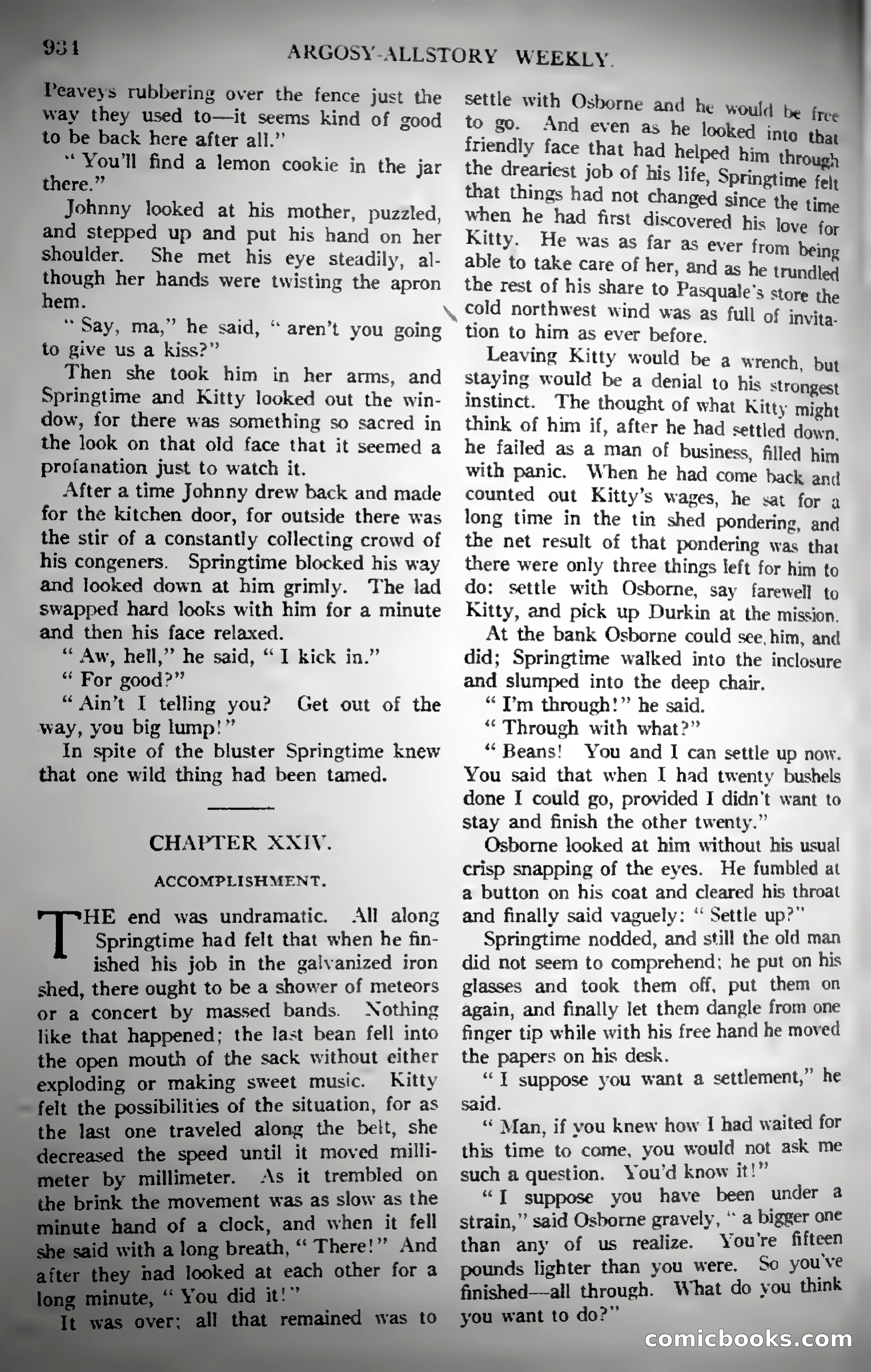
A restored page from Pulp Fiction, 1922. Page through the whole issue in the reader above.
📄 Transcribed text from this page (OCR, searchable)
Machine-transcribed from the original scan — historical spelling and the odd misread are preserved.
veys rubbering over the fence just the Way they used to—it seems kind of good _ to be back here after all.’’ _ _~ You'll find a lemon cookie in the jar there.” Johnny looked at his mother, puzzled, and stepped up and put his hand on her Shoulder. She met his eye steadily, al- though her hands were twisting the apron hem. \ “ Say, ma,” he said, “ aren’t you going to give us a kiss?” Then she took him in her arms, and Springtime and Kitty looked out the win- dow, for there was something so sacred in the look on that old face that it seemed a profanation just to watch it. After a time Johnny drew back and made for the kitchen door, for outside there was the stir of a constantly collecting crowd of his congeners. Springtime blocked his way and looked down at him grimly. The lad swapped hard looks with him for a minute and then his face relaxed. “ Aw, hell,”’ he said, “I kick in.” “For good?” “ Ain’t I telling you? way, you big lump!” In spite of the bluster Springtime knew that one wild thing had been tamed. Get out of the CHAPTER XNIV. ACCOMPLISHMENT. HE end was undramatic. All along T Springtime had felt that when he fin- ished his job in the galvanized iron ___ shed, there ought to be a shower of meteors or a concert by massed bands. Nothing that happened; the last bean fell into open mouth of the sack without either ing or making sweet music. Kitty ossibilities of the situation, for as ast one traveled along the belt, she ed the speed until it moved milli- Wlimeter. As it trembled on yement was as slow as the k, and when it fell th, “‘ There!”” And t each other for a § ARGOSY-ALLSTORY WEEKLY. . cold northwest wind was as full — to you want to do?” j so. And even as he looked Into that friendly face that had helped him thro . the dreariest job of his life, Springtime ra that things had not changed since the tim when he had first discovered his love fol Kitty. He was as far as ever from bein able to take care of her, and as he trundle the rest of his share to Pasquale’s store the ' ! of invita- tion to him as ever before. Leaving Kitty would be a wrench, but staying would be a denial to his strongest Instinct. The thought of what Kitty might think of him if, after he had settled down. he failed as a man of business, filled him with panic. When he had come back and counted out Kitty’s wages, he sat for a long time in the tin shed pondering, and the net result of that pondering was that there were only three things left for him to do: settle with Osborne, say farewell to Kitty, and pick up Durkin at the mission. At the bank Osborne could see, him, and did; Springtime walked into the inclosure and slumped into the deep chair. “ T’m through!” he said. “Through with what?” ““ Beans! You and I can settle up now. You said that when I had twenty bushels done I could go, provided I didn’t want to Stay and finish the other twenty.” Osborne looked at him without his usual crisp snapping of the eves. He fumbled at a button on his coat and cleared his throat and finally said vaguely: ‘‘ Settle up?” Springtime nodded, and still the old man did not seem to comprehend; he put on his glasses and took them off, put them on again, and finally let them dangle from one finger tip while with his free hand he moved the papers on his desk. “¥ suppose you want a settlement,” he said. “ Man, if vou knew how I had waited for this time to come, you would not ask me such a question. You'd know it!” “T suppose you have been under a strain,” said Osborne gravely, * a bigger one than any of us realize. You're fifteen pounds lighter than you were. So youve finished—all through. What do you think Eom b ee)