
Pulp Fiction, 1922 · page 146 of 187
Argosy All-Story Weekly — page 146: what you’re looking at
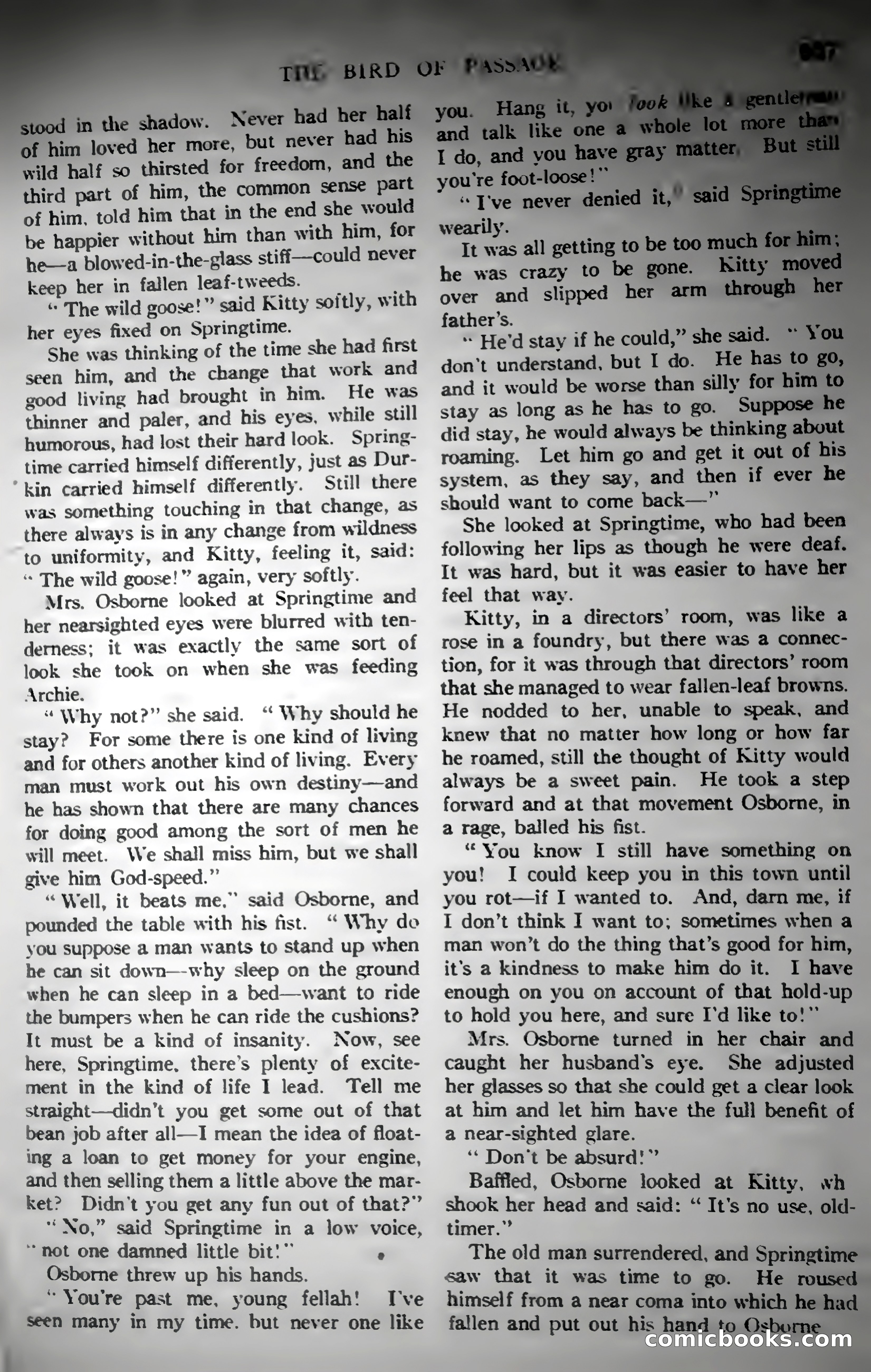
A restored page from Pulp Fiction, 1922. Page through the whole issue in the reader above.
📄 Transcribed text from this page (OCR, searchable)
Machine-transcribed from the original scan — historical spelling and the odd misread are preserved.
7 of him loved her more, ‘kin carried himself differently. stood in the shadow. Never had her wild half so thirsted for freedom, and wi ird t of him, the common sense par F fan told him that in the end she would be happier without him than with him, for he—a blowed-in-the-glass stiff—could never keep her in fallen leaf-tweeds. “ The wild goose!” said Kitty soitly, with her eyes fixed on Springtime. She was thinking of the time she had first seen him, and the change that work and good living had brought in him. He was thinner and paler, and his eyes, while still humorous, had lost their hard look. Spring- time carried himself differently, just as Dur- Still there was something touching in that change, as there always is in any change from wildness to uniformity, and Kitty, feeling it, said: “ The wild goose!” again, very softly. Mrs. Osborne looked at Springtime and her nearsighted eyes were blurred with ten- derness: it was exactly the same sort of look she took on when she was feeding Archie. “Why not?” she said. “ Why should he stay? For some there is one kind of living and for others another kind of living. Every man must work out his own destiny—and he has shown that there are many chances for doing good among the sort of men he will meet. We shall miss him, but we shall give him God-speed.”’ “Well, it beats me.” said Osborne, and pounded the table with his fist. ‘“‘ Why do you suppose a man wants to stand up when he can sit down—-why sleep on the ground when he can sleep in a bed—want to ride the bumpers when he can ride the cushions? It must be a kind of insanity. Now, see here, Springtime, there’s plenty of excite- ment in the kind of life I lead. Tell me straight—didn’t you get some out of that bean job after all—I mean the idea of float- ing a loan to get money for your engine, and then selling them a little above the mar- ket? Didn't you get any fun out of that?” “No,” said Springtime in a low voice, not one damned little bit!” . Osborne threw up his hands. “ You're past me, young fellah' I've seen many in my time. but never one like but never had his Spmeass you're foot-loose wearily. — It was all getting to be to he was crazy to be go cm * over and slipped her arm de father’s. x He'd stay if he could,” she said. don’t understand, but I do. He hast and it would be worse than silly for himt stay as long as he has to go. Suppose hi did stay, he would always be thinking about — roaming. Let him go and get it out of bis — system, as they say, and then if ever he should want to come back—” She looked at Springtime, who had been following her lips as though he were deaf. It was hard, but it was easier to have her feel that way. Kitty, in a directors’ room, was like a rose in a foundry, but there was a connec- tion, for it was through that directors’ room that she managed to wear fallen-leaf browns. He nodded to her, unable to speak, and knew that no matter how long or how far he roamed, still the thought of Kitty would always be a sweet pain. He took a step forward and at that movement Osborne, in a rage, balled his fist. “You know I still have something on you! I could keep you in this town until you rot—if I wanted to. And, darn me, if I don’t think I want to; sometimes when a man won’t do the thing that’s good for him, it's a kindness to make him do it. I have enough on you on account of that hold-up to hold you here, and sure I'd like to!” Mrs. Osborne turned in her chair and caught her husband's eye. She adjusted her glasses so that she could get a clear look at him and let him have the full benefit of a near-sighted glare. ‘* Don't be absurd!” Baffled, Osborne looked at Kitty, wh shook her head and said: “‘ It's no use, old- timer.” - The old man surrendered, and Spring saw that it was time to go. He rot himself from a near coma into which he fallen and put out his h 1d to Osborne ym DOOK @ a” ‘