
Pulp Fiction, 1922 · page 23 of 187
Argosy All-Story Weekly — page 23: what you’re looking at
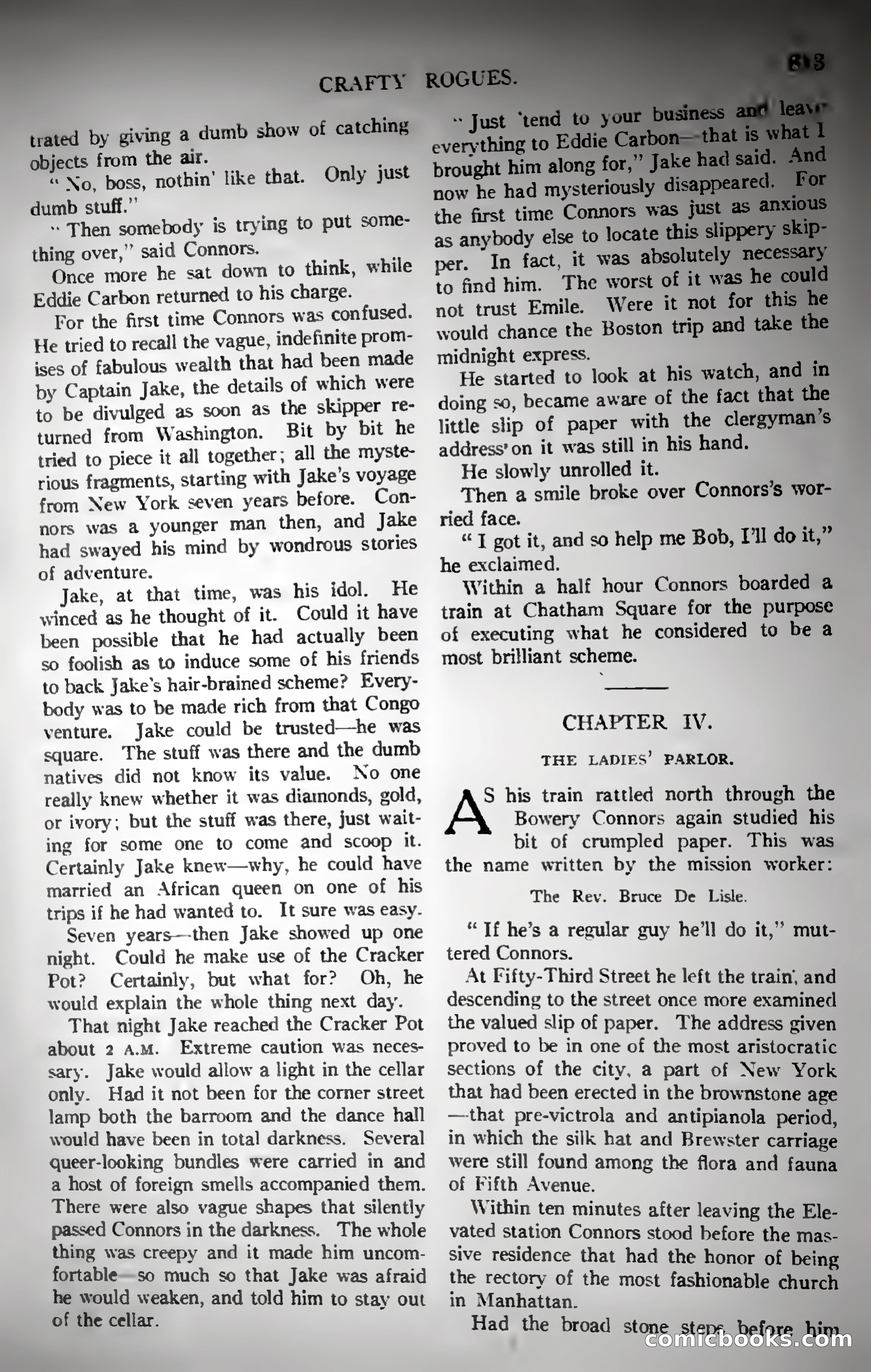
A restored page from Pulp Fiction, 1922. Page through the whole issue in the reader above.
📄 Transcribed text from this page (OCR, searchable)
Machine-transcribed from the original scan — historical spelling and the odd misread are preserved.
* :] « trated by giving a dumb show of objects from the air. “No, boss, nothin’ like that. dumb stuff.” “ Then somebody is trying to put some- thing over,” said Connors. Once more he sat down to think, while Eddie Carbon returned to his charge. For the first time Connors was confused. He tried to recall the vague, indefinite prom- ‘ses of fabulous wealth that had been made by Captain Jake, the details of which were to be divulged as soon as the skipper re- turned from Washington. Bit by bit he tried to piece it all together, all the myste- rious fragments, starting with Jake’s voyage from New York seven years before. Con- nors was a younger man then, and Jake had swayed his mind by wondrous stories of adventure. Jake, at that time, was his idol. He winced as he thought of it. Could it have been possible that he had actually been so foolish as to induce some of his friends to back Jake's hair-brained scheme? Every- body was to be made rich from that Congo venture. Jake could be trusted—he was square. The stuff was there and the dumb natives did not know its value. No one really knew whether it was diamonds, gold, or ivory; but the stuff was there, just wait- ing for some one to come and scoop it. Certainly Jake knew—why, he could have married an African queen on one of his trips if he had wanted to. It sure was easy- Seven years—-then Jake showed up one night. Could he make use of the Cracker Pot? Certainly, but what for? Oh, he would explain the whole thing next day. That night Jake reached the Cracker Pot about 2 A.M. Extreme caution was neces- sary. Jake would allow a light in the cellar only. Had it not been for the corner street lamp both the barroom and the dance hall would have been in total darkness. Several queer-looking bundles were carried in and a host of foreign smells accompanied them. There were also vague shapes that silently passed Connors in the darkness. The whole thing was creepy and it made him uncom- fortable-—-so much so that Jake was afraid he would weaken, and told him to stay out of the cellar. ‘ Only just catching brought him along fo now he had mysteriously the first time Connors was as anybody else to locate t per. In fact, it was absolut to find him. The worst of it was he not trust Emile. Were it not for tl would chance the Boston trip and take midnight express. “— He started to look at his watch, and i doing so, became aware of the fact that the little slip of paper with the clergyman’s © address’ on it was still in his hand. | He slowly unrolled it. Then a smile broke over Connors’s wor- ried face. “J got it, and so help me Bob, Pil do it,” he exclaimed. Within a half hour Connors boarded a train at Chatham Square for the purpose of executing what he considered to be a most brilliant scheme. CHAPTER IV. THE LADIES’ PARLOR. S his train rattled north through the Bowery Connors again studied his bit of crumpled paper. This was the name written by the mission worker: The Rev. Bruce De Lisle. “Tf he’s a regular guy he’ll do it,” mut- tered Connors. At Fifty-Third Street he left the train, and descending to the street once more examined the valued slip of paper. The address given proved to be in one of the most aristocratic sections of the city, a part of New York that had been erected in the brownstone age —that pre-victrola and antipianola period, in which the silk hat and Brewster carriage were still found among the flora and fauna of Fifth Avenue. Within ten minutes after leaving the Ele- vated station Connors stood before the mas- sive residence that had the honor of being the rectory of the most fashionable church in Manhattan. Had th ad the broad stone. steps. before