
Pulp Fiction, 1922 · page 79 of 187
Argosy All-Story Weekly — page 79: what you’re looking at
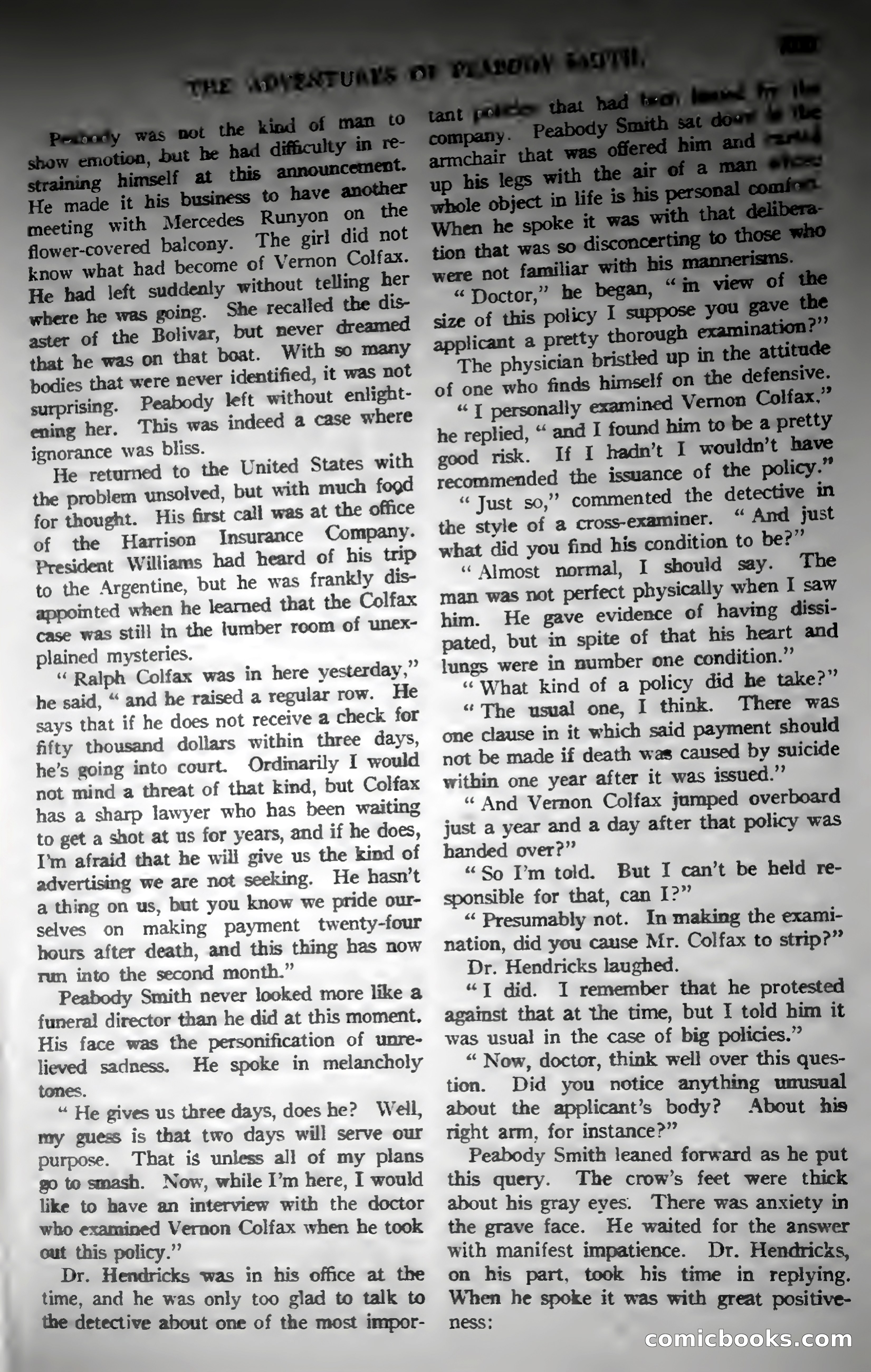
A restored page from Pulp Fiction, 1922. Page through the whole issue in the reader above.
📄 Transcribed text from this page (OCR, searchable)
Machine-transcribed from the original scan — historical spelling and the odd misread are preserved.
ati = know what had become of Vernon Colfax. He had left suddenly without telling her where he was going. She recalled the dis- aster of the Bolivar, but never dr that he was on that boat. With so many bodies that were never identified, it was not surprising. Peabody left without enlight- ening her. This was indeed a case where ignorance was bliss. He returned to the United States with the problem unsolved, but with much fogd for thought. His first call was at the office of the Harrison Insurance Company. President Williams had heard of his trip to the Argentine, but he was frankly dis- appointed when he learned that the Colfax case was still in the lumber room of unex- plained mysteries. “ Ralph Colfax was in here yesterday,” he said, “ and he raised a regular row. He says that if he does not receive a check for fifty thousand dollars within three days, he’s going into court. Ordinarily I would not mind a threat of that kind, but Colfax has a sharp lawyer who has been waiting to get a shot at us for years, and if he does, I'm afraid that he will give us the kind of advertising we are not seeking. He hasn’t a thing on us, but you know we pride our- selves on making payment twenty-four hours after death, and this thing has now run into the second month.” Peabody Smith never looked more like a funeral director than he did at this moment, His face was the personification of unre- lieved sadness. He spoke in melancholy tones. “ He gives us three days, does he? Well, my guess is that two days will serve our purpose. That is unless all of my plans go to smash. Now, while I’m here, I would like to have an interview with the doctor who examined Vernon Colfax when he took out this policy.” Dr. Hendricks was in his office at the time, and he was only too glad to talk to the detective about one of the most impor- flower-covered balcony. The girl did not ™ size of this policy I suppose applicant a pretty thorough exam The physician bristled up in the at of one who finds aii “ the iY BS “T personally exam} ernon © i he replied, “ and I found him tobe aypretty risk. If I hadn’t I wouldn't | a recommended the issuance of the policy.” “ Just so,’ commented the detective m the style of a cross-examiner. “ And just what did you find his condition to be?” “ Almost normal, I should say. The man was not perfect physically when I saw him. He gave evidence of having dissi- pated, but in spite of that his heart and lungs were in number one condition.” ‘What kind of a policy did he take?”’ “ The usual one, I think. There was one clause in it which said payment should not be made if death was caused by suicide within one year after it was issued.” “ And Vernon Colfax jumped overboard just a year and a day after that policy was handed over?”’ “So I’m told. But I can’t be held re- sponsible for that, can I?” “Presumably not. In making the exami- nation, did you cause Mr. Colfax to strip?” Dr. Hendricks laughed. “J did. I remember that he protested against that at the time, but I told him it was usual in the case of big policies.” “ Now, doctor, think well over this ques- tion. Did you notice anything umusual about the applicant’s body? About his right arm, for instance?” Peabody Smith leaned forward as he put this query. The crow’s feet were thick about his gray eves. There was anxiety in the grave face. He waited for the answer with manifest impatience. Dr. Hendricks, on his part, took his time in replying. When he spoke it was with great positive- ness: yo comicbhooks.com