
Pulp Fiction, 1868 · page 11 of 97
Ballou's Monthly Magazine, Vol. XXVII, No. 1 — page 11: what you’re looking at
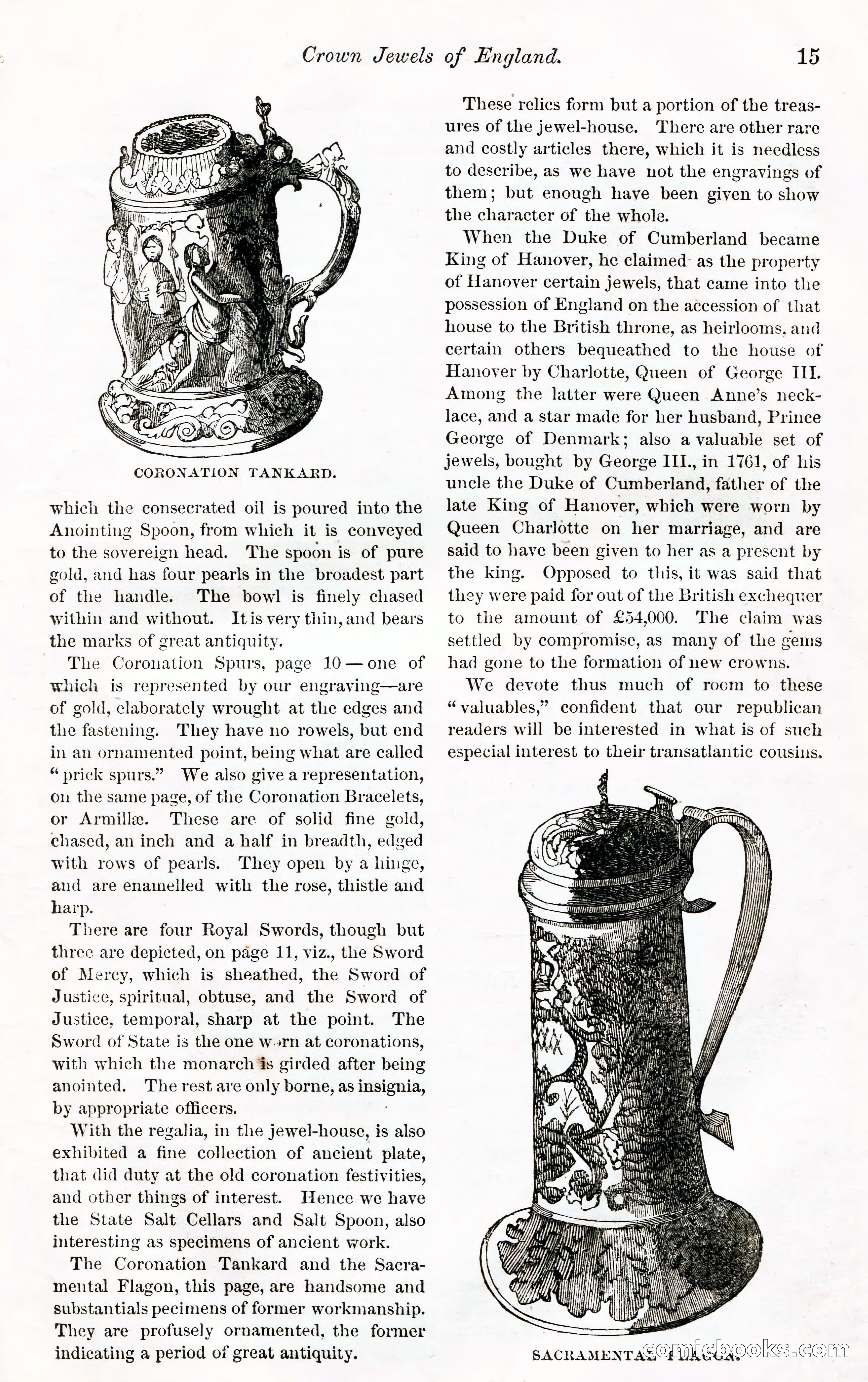
A restored page from Pulp Fiction, 1868. Page through the whole issue in the reader above.
📄 Transcribed text from this page (OCR, searchable)
Machine-transcribed from the original scan — historical spelling and the odd misread are preserved.
Crown Jewels CORONATION TANKARD. which the consecrated oil is poured into the Anointing Spoon, from which it is conveyed to the sovereign head. The spoon is of pure gold, and has four pearls in the broadest part of the handle. The bowl is finely chased within and without. Itis very thin, and bears the marks of great antiquity. The Coronation Spurs, page 10—one of which is represented by our engraving—are of gold, elaborately wrought at the edges and the fastening. They have no rowels, but end in an ornamented point, being what are called “prick spurs.” We also give a representation, on the same page, of the Coronation Bracelets, or Armille. These are of solid fine gold, chased, an inch and a half in breadth, edged with rows of pearls. They open by a hinge, and are enamelled with the rose, thistle and harp. There are four Royal Swords, though but three are depicted, on page 11, viz., the Sword of Mercy, which is sheathed, the Sword of Justice, spiritual, obtuse, and the Sword of Justice, temporal, sharp at the point. The Sword of State is the one worn at coronations, with which the monarch 4s girded after being anointed. The rest are only borne, as insignia, by appropriate officers. With the regalia, in the jewel-house, is also exhibited a fine collection of ancient plate, that did duty at the old coronation festivities, and other things of interest. Hence we have the State Salt Cellars and Salt Spoon, also interesting as specimens of ancient work. The Coronation Tankard and the Sacra- mental Flagon, this page, are handsome and substantials pecimens of former workmanship. They are profusely ornamented, the former indicating a period of great antiquity. of England. 15 These relics form but a portion of the treas- ures of the jewel-house. There are other rare and costly articles there, which it is needless to describe, as we have not the engravings of them; but enough have been given to show the character of the whole. When the Duke of Cumberland became King of Hanover, he claimed: as the property of Hanover certain jewels, that came into the possession of England on the accession of that house to the British throne, as heirlooms, and certain others bequeathed to the house of Hanover by Charlotte, Queen of George IIL. Among the latter were Queen Anne’s neck- lace, and a star made for her husband, Prince George of Denmark; also a valuable set of jewels, bought by George III., in 1761, of his uncle the Duke of Cumberland, father of the late King of Hanover, which were worn by Queen Charlotte on her marriage, and are said to have been given to her as a present by the king. Opposed to this, it was said that they were paid for out of the British exchequer to the amount of £54,000. The claim was settled by compromise, as many of the gems had gone to the formation of new crowns. We devote thus much of rocm to these “valuables,” confident that our republican readers will be interested in what is of such especial interest to their transatlantic cousins. SACRAMENT AGCHA EC QOO KS Coin