
Pulp Fiction, 1868 · page 12 of 97
Ballou's Monthly Magazine, Vol. XXVII, No. 1 — page 12: what you’re looking at
A restored page from Pulp Fiction, 1868. Page through the whole issue in the reader above.
📄 Transcribed text from this page (OCR, searchable)
Machine-transcribed from the original scan — historical spelling and the odd misread are preserved.
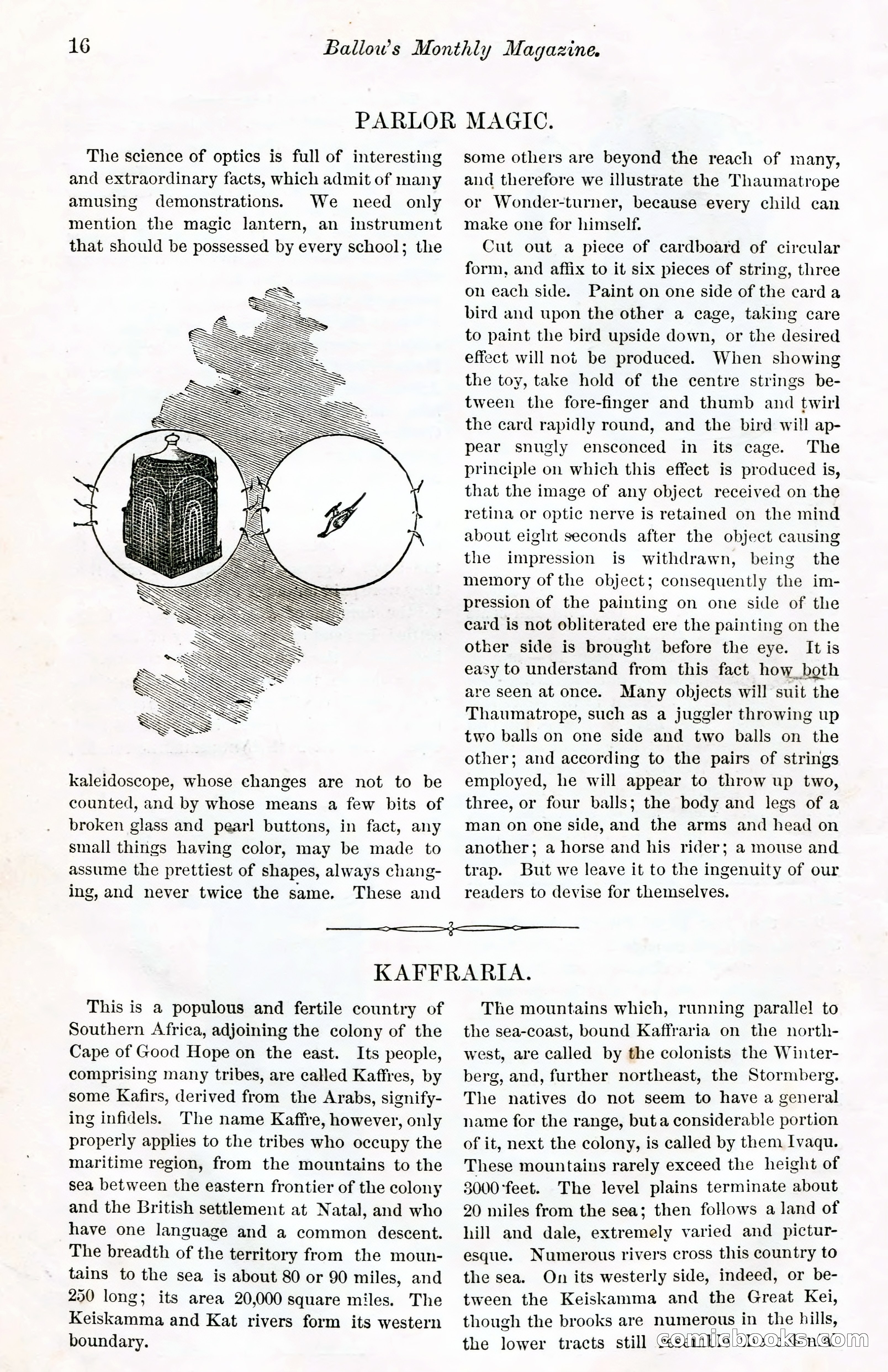
16 Ballows Monthly Magazine. PARLOR MAGIC. The science of optics is full of interesting and extraordinary facts, which admit of many amusing demonstrations. We need only mention the magic lantern, an instrument that should be possessed by every school; the kaleidoscope, whose changes are not to be counted, and by whose means a few bits of broken glass and pearl buttons, in fact, any small things having color, may be made to assume the prettiest of shapes, always chang- some others are beyond the reach of many, aud therefore we illustrate the Thaumatrope or Wonder-turner, because every child can make one for himself. Cut out a piece of cardboard of circular form, and affix to it six pieces of string, three on each side. Paint on one side of the card a bird and upon the other a cage, taking care to paint the bird upside down, or the desired effect will not be produced. When showing the toy, take hold of the centre strings be- tween the fore-finger and thumb and twirl the card rapidly round, and the bird will ap- pear snugly ensconced in its cage. The principle on which this effect is produced is, that the image of any object received on the retina or optic nerve is retained on the mind about eight seconds after the object causing the impression is withdrawn, being the memory of the object; consequently the im- pression of the painting on one side of the card is not obliterated ere the painting on the other side is brought before the eye. It is easy to understand from this fact how both are seen at once. Many objects will suit the Thaumatrope, such as a juggler throwing up two balls on one side and two balls on the other; and according to the pairs of strings employed, he will appear to throw up two, three, or four balls; the body and legs of a man on one side, and the arms and head on another; a horse and his rider; a mouse and trap. But we leave it to the ingenuity of our ing, and never twice the same. These and readers to devise for themselves. Seo KAFFRARIA. This is a populous and fertile country of Southern Africa, adjoining the colony of the Cape of Good Hope on the east. Its people, comprising many tribes, are called Kaffres, by some Kafirs, derived from the Arabs, signify- ing infidels. The name Kaffre, however, only properly applies to the tribes who occupy the maritime region, from the mountains to the sea between the eastern frontier of the colony and the British settlement at Natal, and who have one language and a common descent. The breadth of the territory from the moun- tains to the sea is about 80 or 90 miles, and 250 long; its area 20,000 square miles. The Keiskamma and Kat rivers form its western boundary. The mountains which, running paralle! to the sea-coast, bound Kaffraria on the north- west, are called by the colonists the Winter- berg, and, further northeast, the Stormberg. The natives do not seem to have a general name for the range, but a considerable portion of it, next the colony, is called by them Ivaqu. These mountains rarely exceed the height of 3000‘feet. The level plains terminate about 20 miles from the sea; then follows a land of hill and dale, extremely varied and pictur- esque. Numerous rivers cross this country to the sea. On its westerly side, indeed, or be- tween the Keiskamma and the Great Kel, though the brooks are numerous in the bills, the lower tracts still COMIGOOOKS ICO inn