
Pulp Fiction, 1868 · page 27 of 97
Ballou's Monthly Magazine, Vol. XXVII, No. 1 — page 27: what you’re looking at
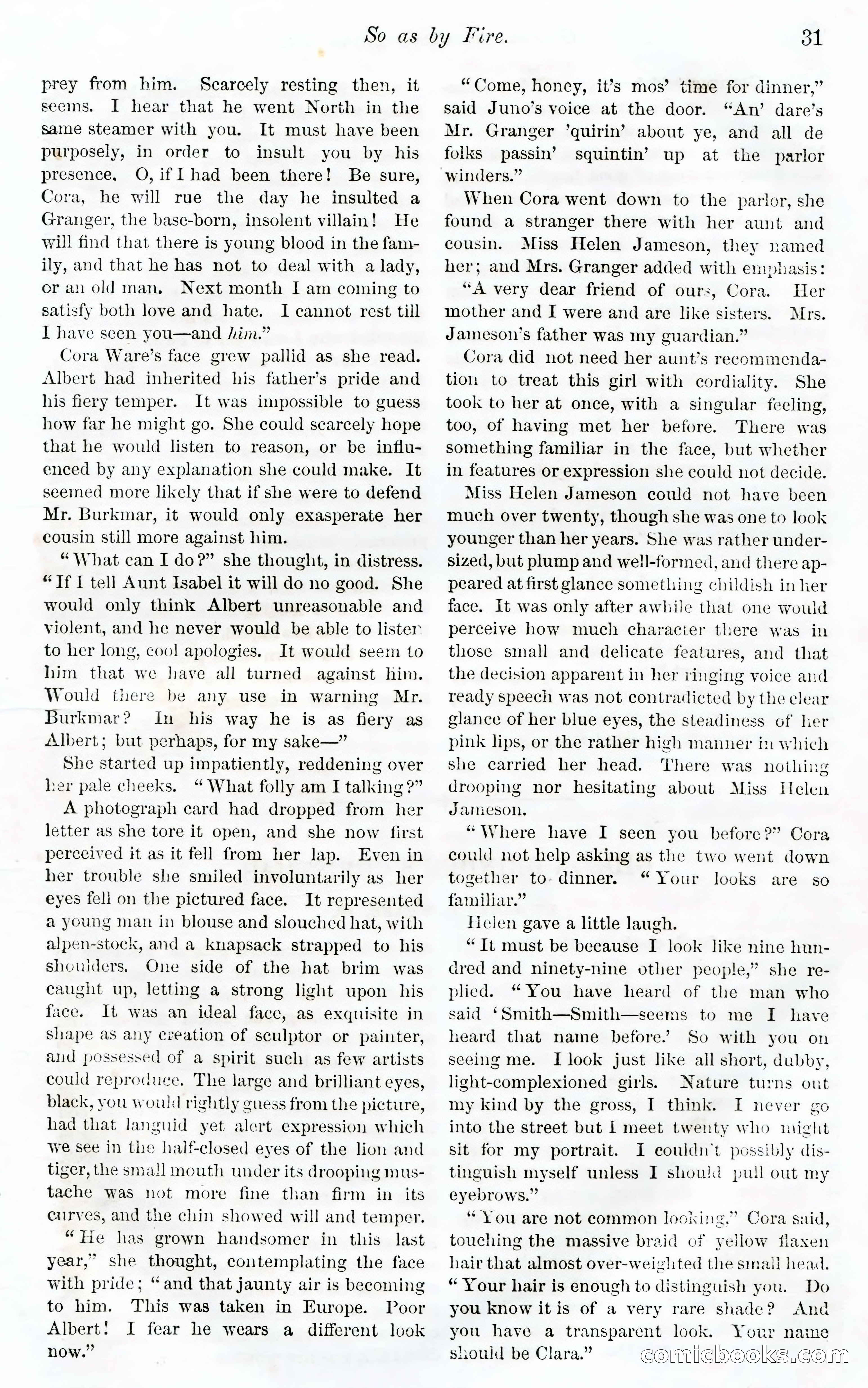
A restored page from Pulp Fiction, 1868. Page through the whole issue in the reader above.
📄 Transcribed text from this page (OCR, searchable)
Machine-transcribed from the original scan — historical spelling and the odd misread are preserved.
So as by Fire. ol prey from him. Searcely resting then, it seems. I hear that he went North in the Same steamer with you. It must have been purposely, in order to insult you by his presence. O, if Il had been there! Be sure, Cora, he will rue the day he insulted a Granger, the base-born, insolent villain! He will find that there is young blood in the fam- ily, and that he has not to deal with a lady, cr an old man, Next month I am coming to satisfy both love and hate. I cannot rest till I have seen you—and him.” Cora Ware’s face grew pallid as she read. Albert had inherited his father’s pride and his fiery temper. It was impossible to guess how far he might go. She could scarcely hope that he would listen to reason, or be influ- enced by any explanation she could make. It seemed more likely that if she were to defend Mr. Burkinar, it would only exasperate her cousin still more against him. “What can I do?” she thought, in distress. “Tf I tell Aunt Isabel it will do no good. She would only think Albert unreasonable and violent, and he never would be able to lister to her long, cool apologies. It would seem to him that we have all turned against him. Would there be any use in warning Mr. Burkmar? In his way he is as fiery as Albert; but perhaps, for my sake—” She started up impatiently, reddening over her pale cheeks. “ What folly am I talking ?” A photograph card had dropped from her letter as she tore it open, and she now first perceived it as it fell from her lap. Even in her trouble she smiled involuntarily as her eyes fell on the pictured face. It represented a young man in blouse and slouched hat, with alpen-stock, and a knapsack strapped to his shouiders. One side of the hat brim was caught up, letting a strong light upon his face. It was an ideal face, as exquisite in Shape as any creation of sculptor or painter, and possessed of a spirit such as few artists could reproduce. The large and brilliant eyes, black, you would rightly guess from the picture, had that languid yet alert expression which we see in the halfclosed eyes of the lion and tiger, the small mouth under its drooping mus- tache was not more fine than firm in its curves, and the chin showed will and temper. “Tie has grown handsomer in this last year,’ she thought, contemplating the face with pride; “and that jaunty air is becoming to him. This was taken in Europe. Poor Albert! I fear he wears a different look now.” “Come, honey, it’s mos’ time for dinner,” said Juno’s voice at the door. “An’ dare’s Mr. Granger ’quirin’ about ye, and all de folks passin’ squintin’ up at thle parlor winders.” When Cora went down to the parlor, she found a stranger there with her aunt and cousin. Miss Helen Jameson, they named her; and Mrs. Granger added with emphasis: “A very dear friend of ours, Cora. Her mother and I were and are like sisters. Mrs. Jameson’s father was my guardian.” Cora did not need her aunt’s reeommenda- tion to treat this girl with cordiality. She took to her at once, with a singular feeling, too, of having met her before. There was something familiar in the face, but whether in features or expression she could not decide. Miss Helen Jameson could not have been much over twenty, though she was one to look younger than her years. She was rather under- sized, but plump and well-formed, and there ap- peared at first glance something childish in her face. It was only after awhile that one would perceive how much characier there was in those small and delicate features, and that the decision apparent in her ringing voice and ready speech was not contradicted by the clear glance of her blue eyes, the steadiness of her pink lips, or the rather high manner in which she carried her head. There was nothing drooping nor hesitating about Miss ifelen Jameson. “Where have I seen you before?” Cora could not help asking as the two went down together to- dinner. “ Your familiar.” Iiclen gave a little laugh. “It must be because I look like nine hun- dred and ninety-nine other people,’ she re- plied. “You have heard of the man who said ‘Smith—Smith—seems to me I have heard that name before” So with you on seeing me. I look just like all short, dubby, light-complexioned girls. Nature turns out my kind by the gross, I think. I never go into the street but I meet twenty who micht sit for my portrait. I eouldn’t possibly dis- tinguish myself unless I should pull out my eyebrows.” “You are not common looking,” Cora said, touching the massive braid of yellow flaxen hair that almost over-weighted the small head. “ Your hair is enough to distinguish you. Do you know itis of a very rare shade? And you have a transparent look. Your name should be Clara.” Conilclooks.con looks are so