
Pulp Fiction, 1868 · page 28 of 97
Ballou's Monthly Magazine, Vol. XXVII, No. 1 — page 28: what you’re looking at
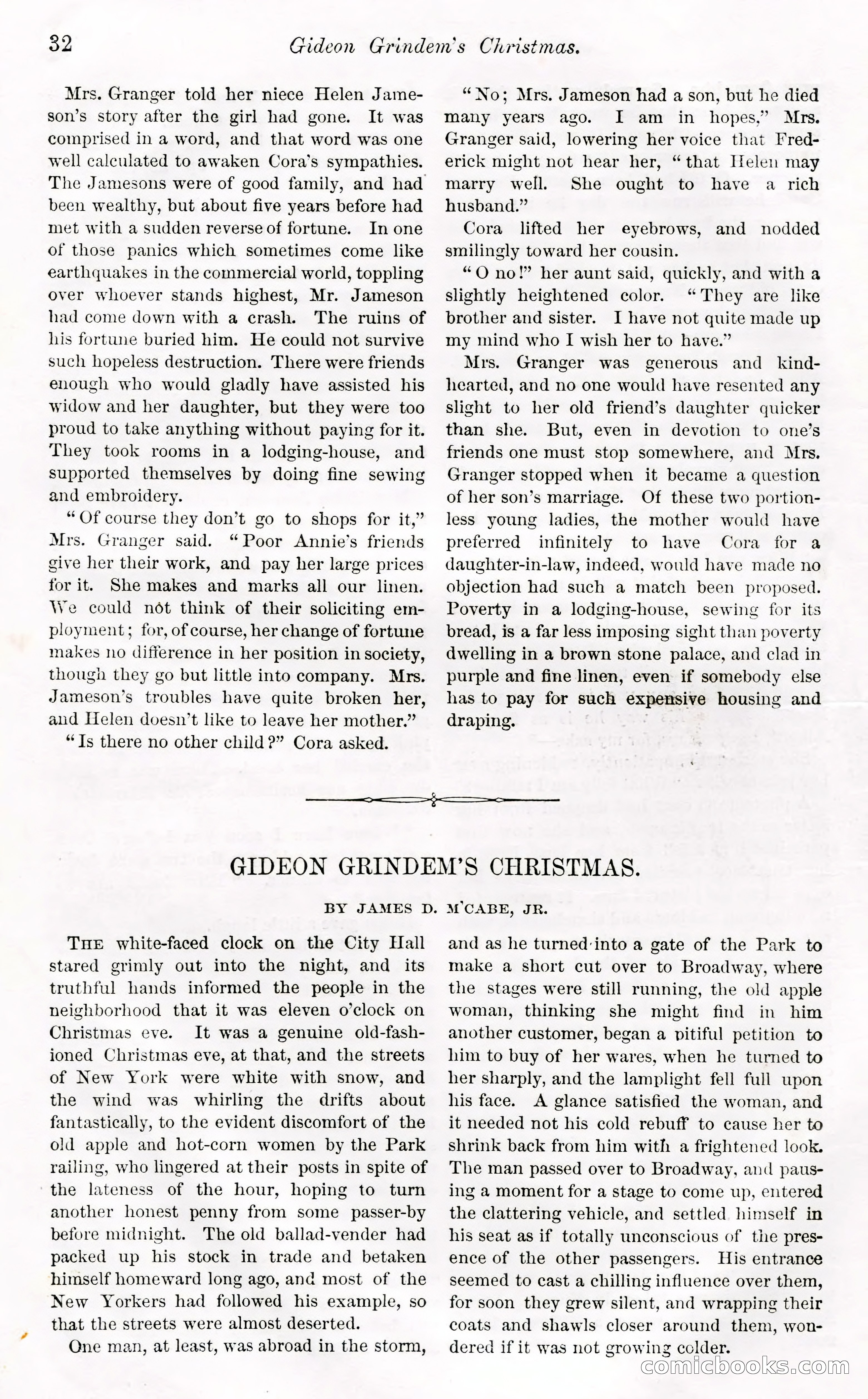
A restored page from Pulp Fiction, 1868. Page through the whole issue in the reader above.
📄 Transcribed text from this page (OCR, searchable)
Machine-transcribed from the original scan — historical spelling and the odd misread are preserved.
32 Mrs. Granger told her niece Helen Jame- son’s story after the girl had gone. It was comprised in a word, and that word was one well calculated to awaken Cora’s sympathies. The Jamesons were of good family, and had been wealthy, but about five years before had met with a sudden reverse of fortune. In one of those panics which sometimes come like earthquakes in the commercial world, toppling over whoever stands highest, Mr. Jameson had come down with a crash. The ruins of his fortune buried him. He could not survive such hopeless destruction. There were friends enough who would gladly have assisted his widow and her daughter, but they were too proud to take anything without paying for it. They took rooms in a lodging-house, and supported themselves by doing fine sewing and embroidery. “ Of course they don’t go to shops for it,” Mrs. Granger said. “Poor Annie’s friends give her their work, and pay her large prices for it. She makes and marks all our linen. We could not think of their soliciting em- ployment; for, of course, her change of fortune makes no difference in her position in society, though they go but little into company. Mrs. Jameson’s troubles have quite broken her, aud Helen doesn’t like to leave her mother.” “Ts there no other child?” Cora asked. Gideon Grindem’s Christmas. ““No; Mrs. Jameson had a son, but he died many years ago. I am in hopes,’ Mrs. Granger said, lowering her voice that Fred- erick might not hear her, “that Ifelen may marry well. She ought to have a rich husband.” Cora lifted her eyebrows, and nodded smilingly toward her cousin. “O no!” her aunt said, quickly, and with a slightly heightened color. “They are like brother and sister. I have not quite made up my mind who I wish her to have.” Mrs. Granger was generous and_ kind- hearted, and no one would have resented any slight to her old friend’s daughter quicker than she. But, even in devotion to one’s friends one must stop somewhere, and Mrs. Granger stopped when it became a question of her son’s marriage. Of these two portion- less young ladies, the mother would have preferred infinitely to have Cora for a daughter-in-law, indeed, would have made no objection had such a match been proposed. Poverty in a lodging-house, sewing for its bread, is a far less imposing sight than poverty dwelling in a brown stone palace, and clad in purple and fine linen, even if somebody else has to pay for such expensive housing and draping. SS GIDEON GRINDEM’S CHRISTMAS. BY JAMES D. Tne white-faced clock on the City Hall stared grimly out into the night, and its truthful hands informed the people in the neighborhood that it was eleven o’clock on Christmas eve. It was a genuine old-fash- ioned Christmas eve, at that, and the streets of New York were white with snow, and the wind was whirling the drifts about fantastically, to the evident discomfort of the old apple and hot-corn women by the Park railing, who lingered at their posts in spite of the lateness of the hour, hoping to turn another honest penny from some _ passer-by before midnight. The old ballad-vender had packed up his stock in trade and betaken himself homeward long ago, and most of the New Yorkers had followed his example, so that the streets were almost deserted. One man, at least, was abroad in the storm, M'CABE, JR. and as he turned into a gate of the Park to make a short cut over to Broadway, where the stages were still running, the old apple woman, thinking she might find in him another customer, began a pitiful petition to him to buy of her wares, when he turned to her sharply, and the lamplight fell full upon his face. A glance satisfied the woman, and it needed not his cold rebuff to cause her to shrink back from him with a frightened look. The man passed over to Broadway, and paus- ing a moment for a stage to come up, entered the clattering vehicle, and settled himself in his seat as if totally unconscious of the pres- ence of the other passengers. His entrance seemed to cast a chilling influence over them, for soon they grew silent, and wrapping their coats and shawls closer around them, won- dered if it was not growing colder. Conniclooolkxs Coin