
Pulp Fiction, 1868 · page 62 of 97
Ballou's Monthly Magazine, Vol. XXVII, No. 1 — page 62: what you’re looking at
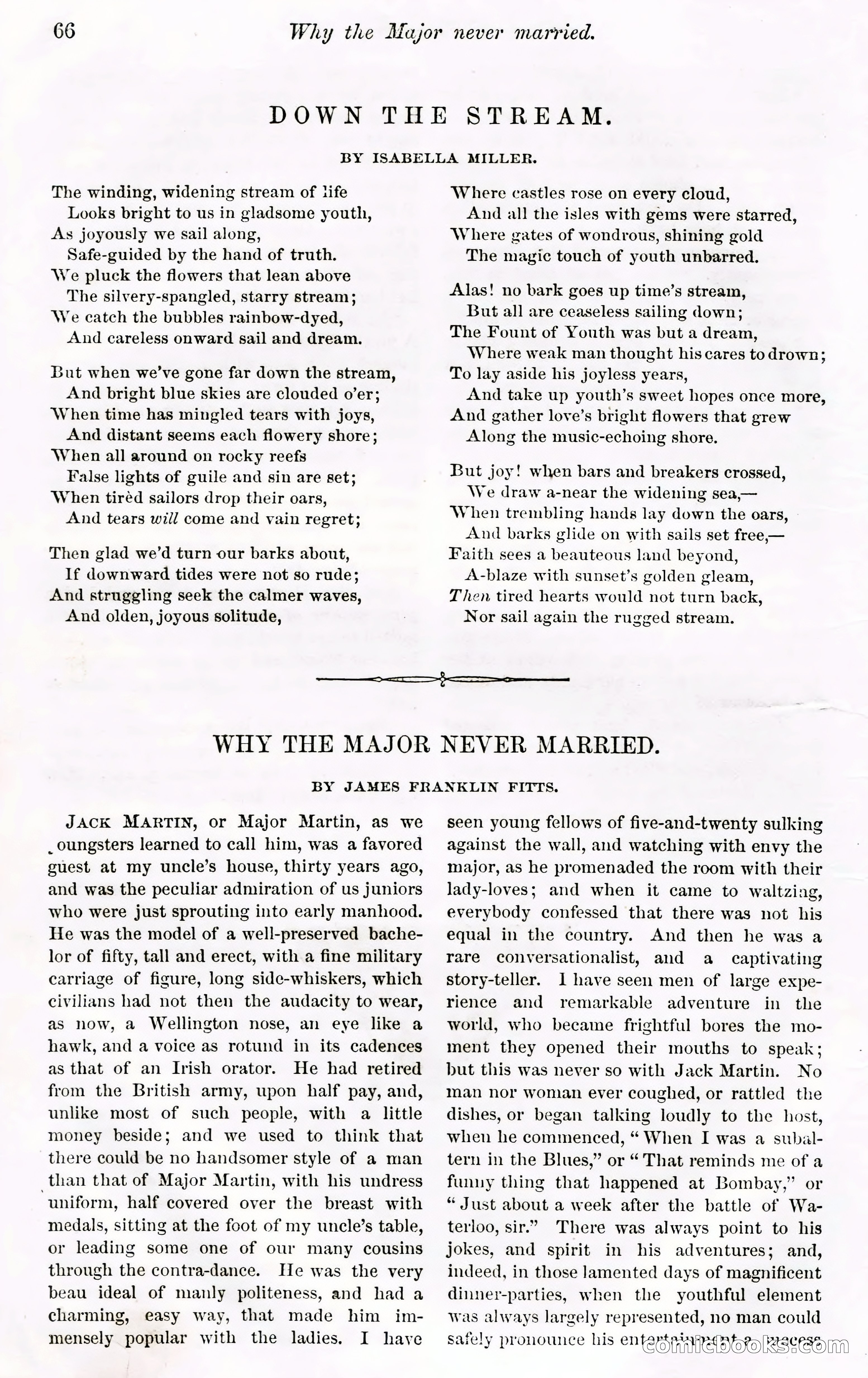
A restored page from Pulp Fiction, 1868. Page through the whole issue in the reader above.
📄 Transcribed text from this page (OCR, searchable)
Machine-transcribed from the original scan — historical spelling and the odd misread are preserved.
66 Why the Major never married. DOWN THE STREAM. BY ISABELLA MILLER. The winding, widening stream of tife Looks bright to us in gladsome youth, As joyously we sail along, Safe-guided by the hand of truth. We pluck the flowers that lean above The silvery-spangled, starry stream; We catch the bubbles rainbow-dyed, And careless onward sail and dream. But when we’ve gone far down the stream, And bright blue skies are clouded o’er; When time has mingled tears with joys, And distant seems each flowery shore; When all around on rocky reefs False lights of guile and sin are set; When tiréd sailors drop their oars, And tears will come and vain regret; Then glad we’d turn our barks about, If downward tides were not so rude; And struggling seek the calmer waves, And olden, joyous solitude, Where castles rose on every cloud, And all the isles with gems were starred, Where gates of wondrous, shining gold The magic touch of youth unbarred. Alas! no bark goes up time’s stream, But all are ceaseless sailing down; The Fount of Youth was but a dream, Where weak man thought his cares todrown; To lay aside his joyless years, And take up youth’s sweet hopes once more, And gather love’s bright flowers that grew Along the music-echoing shore. But joy! when bars and breakers crossed, We draw a-near the widening sea,— When trembling hands lay down the oars, Aud barks glide on with sails set free,— Faith sees a beauteous land beyond, A-blaze with sunset’s golden gleam, Then tired hearts would not turn back, Nor sail again the rugged stream. ——————&—[ S34 WHY THE MAJOR NEVER MARRIED. BY JAMES FRANKLIN FITTS. JACK MARTIN, or Major Martin, as we _ oungsters learned to call him, was a favored guest at my uncle’s house, thirty years ago, and was the peculiar admiration of us juniors who were just sprouting into early manhood. He was the model of a well-preserved bache- lor of fifty, tall and erect, with a fine military carriage of figure, long side-whiskers, which civilians had not then the audacity to wear, as now, a Wellington nose, an eye like a hawk, and a voice as rotund in its cadences as that of an Irish orator. He had retired from the British army, upon half pay, and, unlike most of such people, with a little money beside; and we used to think that there could be no handsomer style of a man than that of Major Martin, with his undress “uniform, half covered over the breast with medals, sitting at the foot of my uncle’s table, or leading some one of our many cousins through the contra-dance. He was the very beau ideal of manly politeness, and had a charming, easy way, that made him im- mensely popular with the ladies. I have seen young fellows of five-and-twenty sulking against the wall, and watching with envy the major, as he promenaded the room with their lady-loves; and when it came to waltzing, everybody confessed that there was not his equal in the country. And then he was a rare conversationalist, and a captivating story-teller. I have seen men of large expe- rience and remarkable adventure in the world, who became frightful bores the mo- ment they opened their mouths to speak; but this was never so with Jack Martin. No man nor woman ever coughed, or rattled the dishes, or began talking loudly to the host, when he commenced, “ When I was a subal- tern in the Blues,” or “ That reminds me of a funny thing that happened at Bombay,” or “Just about a week after the battle of Wa- terloo, sir.” There was always point to his jokes, and spirit in his adventures; and, indeed, in those lamented days of magnificent dinner-parties, when the youthful element Was always largely represented, no man could safely pronounce his OS OiMiGbOolksuGcoln