
Pulp Fiction, 1868 · page 63 of 97
Ballou's Monthly Magazine, Vol. XXVII, No. 1 — page 63: what you’re looking at
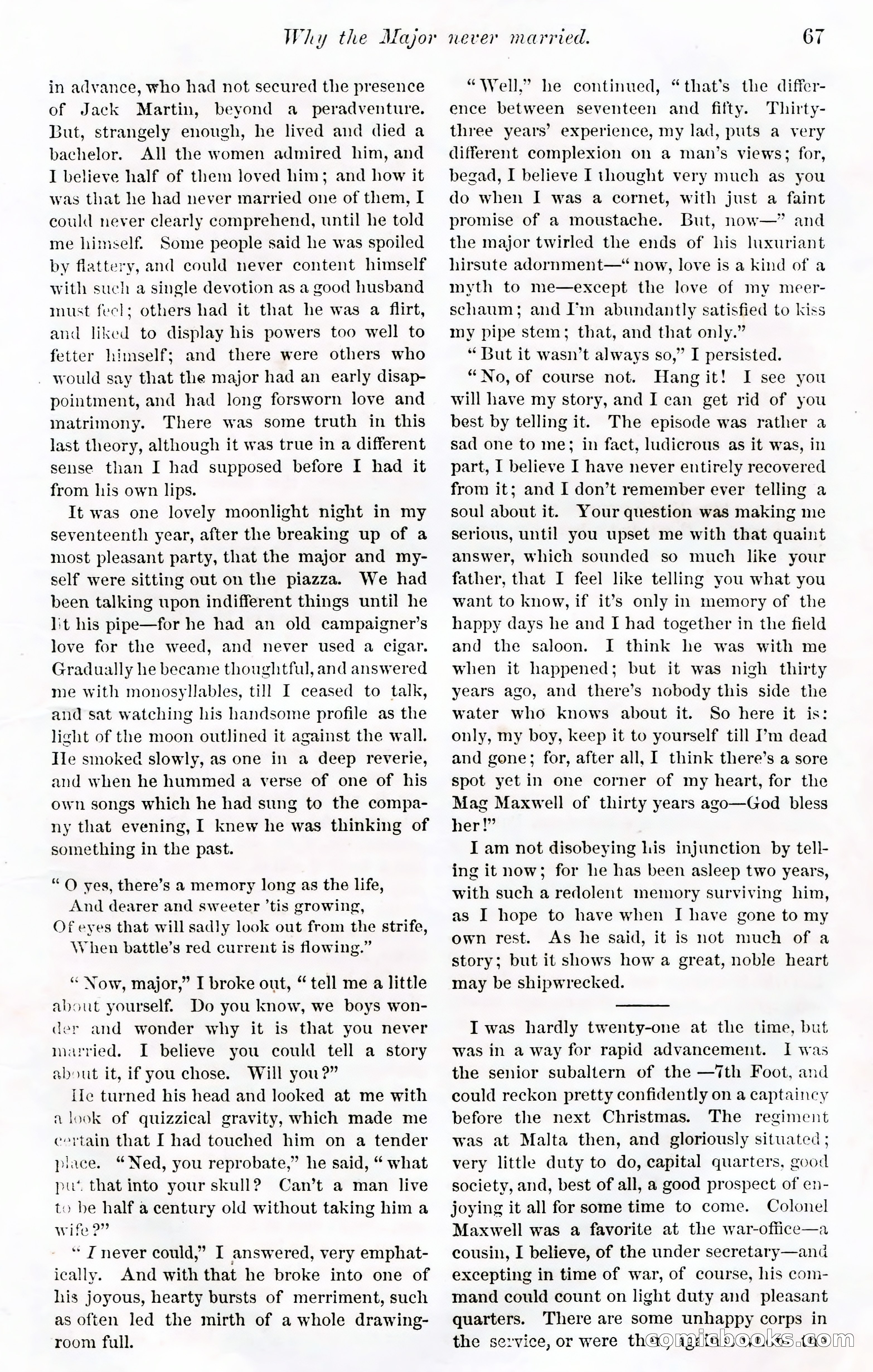
A restored page from Pulp Fiction, 1868. Page through the whole issue in the reader above.
📄 Transcribed text from this page (OCR, searchable)
Machine-transcribed from the original scan — historical spelling and the odd misread are preserved.
Why the Major in advance, who had not secured the presence of Jack Martin, beyond a_ peradventure. But, strangely enough, he lived and died a bachelor. All the women admired him, and I believe half of them loved him; and how it was that he had never married one of them, I could never clearly comprehend, until he told me himself. Some people said he was spoiled by flattery, and could never content himself with such a single devotion as a good husband must fecl; others had it that he was a flirt, and liked to display his powers too well to fetter himself; and there were others who _ would say that the major had an early disap- pointment, and had long forsworn love and matrimony. There was some truth in this last theory, although it was true in a different sense than I had supposed before I had it from his own lips. It was one lovely moonlight night in my seventeenth year, after the breaking up of a most pleasant party, that the major and my- self were sitting out on the piazza. We had been talking upon indifferent things until he lit his pipe—for he had an old campaigner’s love for the weed, and never used a cigar. Gradually he became thoughtful, and answered me with monosyllables, till I ceased to talk, and sat watching his handsome profile as the light of the moon outlined it against the wall. He smoked slowly, as one in a deep reverie, and when he hummed a verse of one of his own songs which he had sung to the compa- ny that evening, I knew he was thinking of something in the past. “O yes, there’s a memory long as the life, And dearer and sweeter ‘tis growing, Of eyes that will sadly look out from the strife, When battle’s red current is flowing.” “ Now, major,” I broke out, “ tell me a little about yourself. Do you know, we boys won- der and wonder why it is that you never married. I believe you could tell a story about it, if you chose. Will you?” Ife turned his head and looked at me with aiook of quizzical gravity, which made me certain that I had touched him on a tender piace. “Ned, you reprobate,” he said, “ what put. that into your skull? Can’t a man live to be half a century old without taking him a wife 2” * J never could,” I answered, very emphat- ically. And with that he broke into one of his joyous, hearty bursts of merriment, such as often led the mirth of a whole drawing- room full. never married. 67 “Well,” he continued, “that’s the differ- ence between seventeen and fifty. Thirty- three years’ experience, my lad, puts a very different complexion on a man’s views; for, begad, I believe I thought very much as you do when I was a cornet, with just a faint promise of a moustache. But, now—” and the major twirled the ends of his luxuriant hirsute adornment—* now, love is a kind of a myth to me—except the love of my meer- schaum; and I’m abundantly satisfied to kiss my pipe stem; that, and that only.” “ But it wasn’t always so,” I persisted. “No, of course not. Hang it! I see you will have my story, and I can get rid of you best by telling it. The episode was rather a sad one to me; in fact, ludicrous as it was, in part, I believe I have never entirely recovered from it; and I don’t remember ever telling a soul about it. Your question was making me serious, until you upset me with that quaint answer, which sounded so much like your father, that I feel like telling you what you want to know, if it’s only in memory of the happy days he and I had together in the field and the saloon. I think he was with me when it happened; but it was nigh thirty years ago, and there’s nobody this side the water who knows about it. So here it is: only, my boy, keep it to yourself till I’m dead and gone; for, after all, I think there’s a sore spot yet in one corner of my heart, for the Mag Maxwell of thirty years ago—God bless her!” I am not disobeying his injunction by tell- ing it now; for he has been asleep two years, with such a redolent memory surviving him, as I hope to have when I have gone to my own rest. As he said, it is not much of a story; but it shows how a great, noble heart may be shipwrecked. I was hardly twenty-one at the time, but was in a way for rapid advancement. I was the senior subaltern of the —7th Foot, and could reckon pretty confidently on a captaincy before the next Christmas. The regiment was at Malta then, and gloriously situated ; very little duty to do, capital quarters, good society, and, best of all, a good prospect of en- joying it all for some time to come. Colonel Maxwell was a favorite at the war-office—a cousin, I believe, of the under secretary—ana excepting in time of war, of course, his com- mand could count on light duty and pleasant quarters. There are some unhappy corps in the se:vice, or were WGOMMGIOOKS icon