
Pulp Fiction, 1868 · page 8 of 97
Ballou's Monthly Magazine, Vol. XXVII, No. 1 — page 8: what you’re looking at
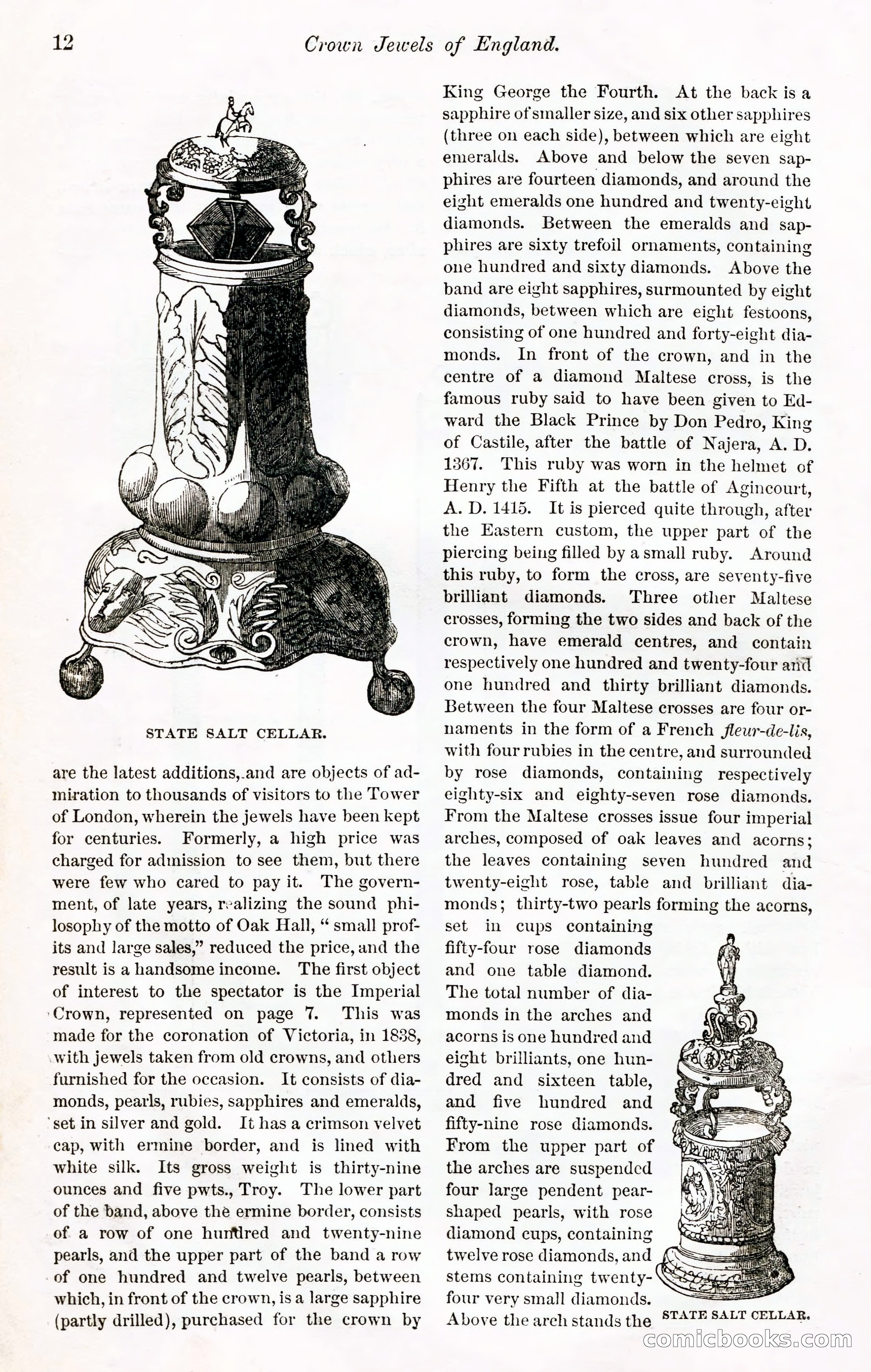
A restored page from Pulp Fiction, 1868. Page through the whole issue in the reader above.
📄 Transcribed text from this page (OCR, searchable)
Machine-transcribed from the original scan — historical spelling and the odd misread are preserved.
12 Crown STATE SALT CELLAR. are the latest additions,.and are objects of ad- miration to thousands of visitors to the Tower of London, wherein the jewels have been kept for centuries. Formerly, a high price was charged for admission to see them, but there were few who cared to pay it. The govern- ment, of late years, realizing the sound phi- losophy of the motto of Oak Hall, “ small prof- its and large sales,” reduced the price, and the result is a handsome income. The first object of interest to the spectator is the Imperial ‘Crown, represented on page 7. This was made for the coronation of Victoria, in 1838, with jewels taken from old crowns, and others furnished for the occasion. It consists of dia- monds, pearls, rubies, sapphires and emeralds, ‘set in silver and gold. It has a crimson velvet cap, with ermine border, and is lined with white silk. Its gross weight is thirty-nine ounces and five pwts., Troy. The lower part of the band, above the ermine border, consists of a row of one humntred and twenty-nine pearls, and the upper part of the band a row of one hundred and twelve pearls, between which, in front of the crown, is a large sapphire (partly drilled), purchased for the crown by Jewels of England. King George the Fourth. At the backisa sapphire of smaller size, and six other sapphires (three on each side), between which are eight emeralds. Above and below the seven sap- phires are fourteen diamonds, and around the eight emeralds one hundred and twenty-eight diamonds. Between the emeralds and sap- phires are sixty trefoil ornaments, containing one hundred and sixty diamonds. Above the band are eight sapphires, surmounted by eight diamonds, between which are eight festoons, consisting of one hundred and forty-eight dia- monds. In front of the crown, and in the centre of a diamond Maltese cross, is the famous ruby said to have been given to Ed- ward the Black Prince by Don Pedro, King of Castile, after the battle of Najera, A. D. 1367. This ruby was worn in the helmet of Henry the Fifth at the battle of Agincourt, A. D. 1415. It is pierced quite through, after the Eastern custom, the upper part of the piercing being filled by asmall ruby. Around this ruby, to form the cross, are seventy-five brilliant diamonds. Three other Maltese crosses, forming the two sides and back of the crown, have emerald centres, and contain respectively one hundred and twenty-four arid one hundred and thirty brilliant diamonds. Between the four Maltese crosses are four or- naments in the form of a French fleur-de-lis, with four rubies in the centre, and surrounded by rose diamonds, containing respectively eighty-six and eighty-seven rose diamonds. From the Maltese crosses issue four imperial arches, composed of oak leaves and acorns; the leaves containing seven hundred and twenty-eight rose, table and brilliant dia- monds; thirty-two pearls forming the acorns, set in cups containing fifty-four rose diamonds and one table diamond. The total number of dia- monds in the arches and acorns is one hundred and eight brilliants, one hun- dred and sixteen table, and five hundred and fifty-nine rose diamonds. From the upper part of the arches are suspended four large pendent pear- shaped pearls, with rose diamond cups, containing twelve rose diamonds, and stems containing twenty- four very small diamonds. — Above the areh stands the, "7*7"5+4? CELLAR. comiclbooks.€O