
Pulp Fiction, 1935 · page 113 of 132
Bill Barnes Air Adventurer, July 1935 — page 113: what you’re looking at
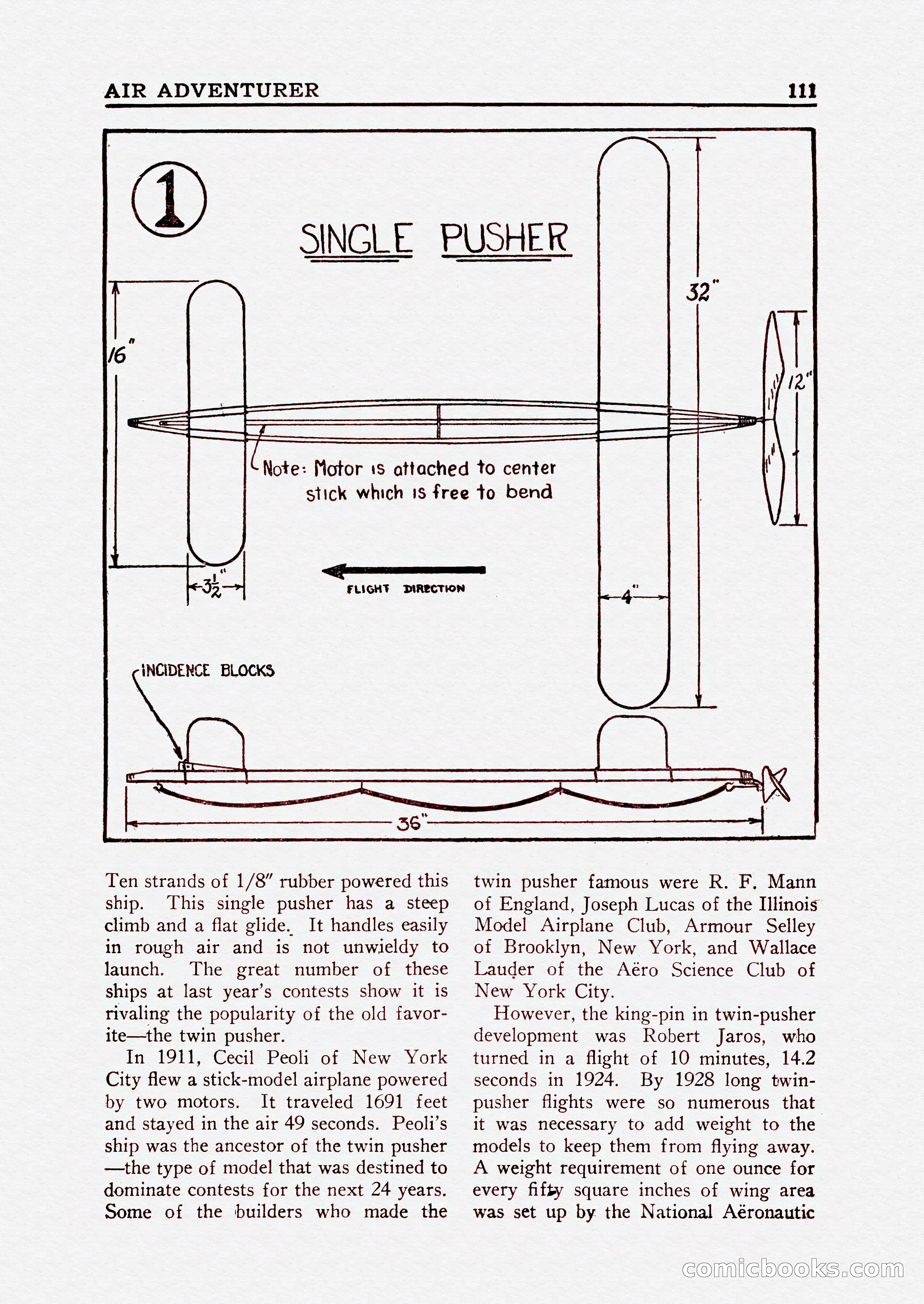
A restored page from Pulp Fiction, 1935. Page through the whole issue in the reader above.
📄 Transcribed text from this page (OCR, searchable)
Machine-transcribed from the original scan — historical spelling and the odd misread are preserved.
AIR ADVENTURER 111 SINGLE PUSHEte Note: Motor 1s attached to center stick which 1S free to bend FLIGHT DIRECTION INCIDENCE BLOCKS Ten strands of 1/8” rubber powered this ship. This single pusher has a steep climb and a flat glide. It handles easily in rough air and is not unwieldy to launch. The great number of these ships at last year’s contests show it 1s rivaling the popularity of the old favor- ite—the twin pusher. In 1911, Cecil Peoli of New York City flew a stick-model airplane powered by two motors. It traveled 1691 feet and stayed in the air 49 seconds. Peoli’s ship was the ancestor of the twin pusher —the type of model that was destined to dominate contests for the next 24 years. Some of the builders who made the twin pusher famous were R. F. Mann of England, Joseph Lucas of the Illinois’ Model Airplane Club, Armour Selley of Brooklyn, New York, and Wallace Lauder of the Aéro Science Club of New York City. However, the king-pin in twin-pusher development was Robert Jaros, who turned in a flight of 10 minutes, 14.2 seconds in 1924. By 1928 long twin- pusher flights were so numerous that. it was necessary to add weight to the models to keep them from flying away. A weight requirement of one ounce for every fifsy square inches of wing area was set up by the National Aéronautic oO COmiclboookX CO