
Pulp Fiction, 1935 · page 24 of 132
Bill Barnes Air Adventurer, July 1935 — page 24: what you’re looking at
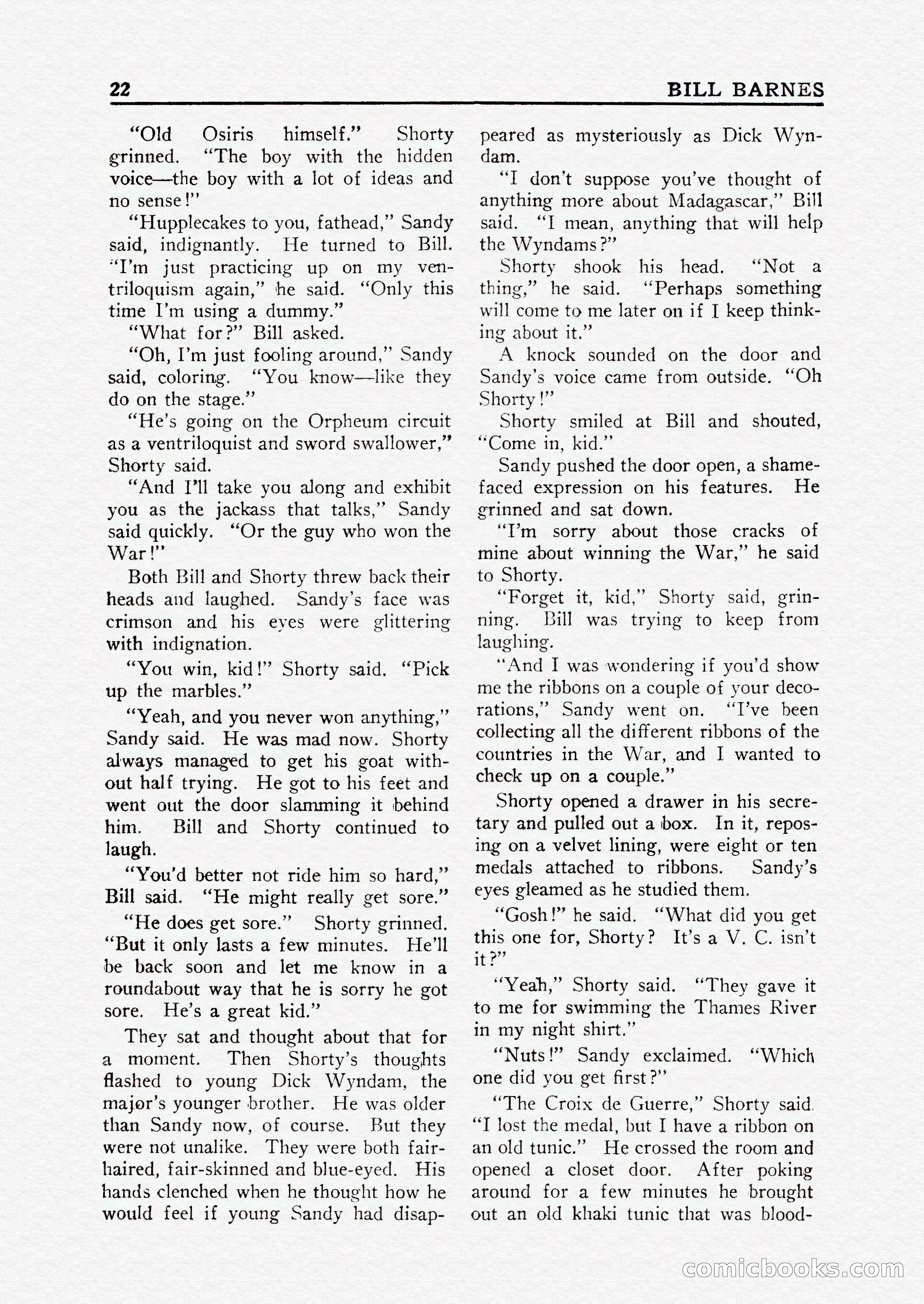
A restored page from Pulp Fiction, 1935. Page through the whole issue in the reader above.
📄 Transcribed text from this page (OCR, searchable)
Machine-transcribed from the original scan — historical spelling and the odd misread are preserved.
22 BILL BARNES “Old Osiris himself.” Shorty grinned. “The boy with the hidden voice—the boy with a lot of ideas and no sense!’’ “Hupplecakes to you, fathead,’ Sandy said, indignantly. He turned to Bill. “T’m just practicing up on my ven- triloquism again,” the said. “Only this time I’m using a dummy.” “What for?’ Bill asked. “Oh, I’m just fooling around,” Sandy said, coloring. “You know—like they do on the stage.” “He’s going on the Orpheum circuit as a ventriloquist and sword swallower,” Shorty said. “And [ll take you along and exhibit you as the jackass that talks,’’ Sandy said quickly. “Or the guy who won the War!” Both Bill and Shorty threw back their heads and laughed. Sandy’s face was crimson and his eves were glittering with indignation. “You win, kid!’ Shorty said. ‘Pick up the marbles.” “Yeah, and you never won anything,” Sandy said. He was mad now. Shorty always managed to get his goat with- out half trying. He got to his feet and went out the door slamming it behind him. Bill and Shorty continued to laugh. “You'd better not ride him so hard,” Bill said. “He might really get sore.” “He does get sore.” Shorty grinned. “But it only lasts a few minutes. He’ll be back soon and let me know in a roundabout way that he is sorry he got sore. He’s a great kid.” They sat and thought about that for a moment. Then Shorty’s thoughts flashed to young Dick Wyndam, the major’s younger brother. He was older than Sandy now, of course. But they were not unalike. They were both fair- haired, fair-skinned and blue-eyed. His hands clenched when he thought how he would feel if young Sandy had disap- peared as mysteriously as Dick Wyn- dam. “IT don’t suppose you’ve thought of anything more about Madagascar,’ Bill said. “I mean, anything that will help the Wyndams?” Shorty shook his head. “Not a thing,” he said. “Perhaps something will come to me later on if I keep think- ing about it.” A knock sounded on the door and Sandy’s voice came from outside. “Oh Shorty !” Shorty smiled at Bill and shouted, “Gomme tn, kid. - Sandy pushed the door open, a shame- faced expression on his features. He grinned and sat down. “Tm sorry about those cracks of mine about winning the War,” he said to Shorty. “Forget it, kid,” Shorty said, grin- ning. Bill was trying to keep from laughing. “And I was wondering if you’d show me the ribbons on a couple of your deco- rations,’ Sandy went on. “I’ve been collecting all the different ribbons of the countries in the War, and I wanted to check up on a couple.” Shorty opened a drawer in his secre- tary and pulled out a box. In it, repos- ing on a velvet lining, were eight or ten medals attached to ribbons. Sandy’s eyes gleamed as he studied them. “Gosh!” he said. “What did you get this one for, Shorty? It’s a V. C. isn’t We: “Yeah,” Shorty said. “They gave it to me for swimming the Thames River in my night shirt.” “Nuts!” Sandy exclaimed. one did you get first?” “The Croix de Guerre,” Shorty said. “T lost the medal, but I have a ribbon on an old tunic.’’ He crossed the room and opened a closet door. After poking around for a few minutes he brought out an old khaki tunic that was blood- “Which oO CON) Ghook CO