
A complete issue · 36 pages · 1929
Judge — April 27, 1929
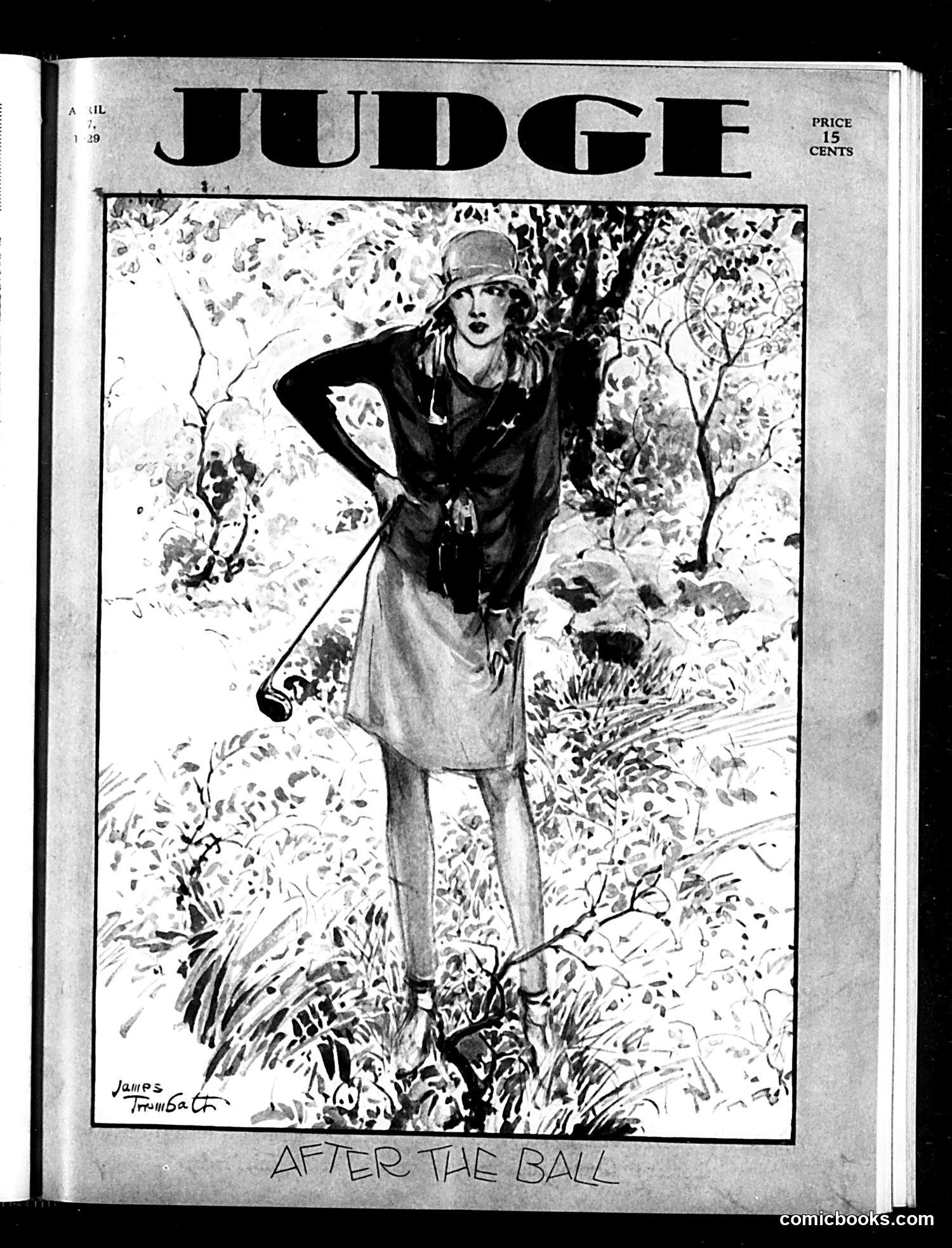
This Judge magazine cover depicts a woman in 1920s attire (cloche hat, dropped waistline dress) standing in an overgrown garden or field, appearing disheveled and exhausted. The title "After the Ball" suggests this is satirizing the aftermath of Jazz Age revelry. The cartoon likely mocks the physical and moral consequences of the era's wild partying culture—a common moralistic concern of the period. The woman's tired expression and disheveled appearance contrast sharply with the glamorous flapper lifestyle celebrated elsewhere in 1920s media. This represents Judge magazine's satirical commentary on contemporary social excess and changing mores during Prohibition and the sexual liberation of the Jazz Age.
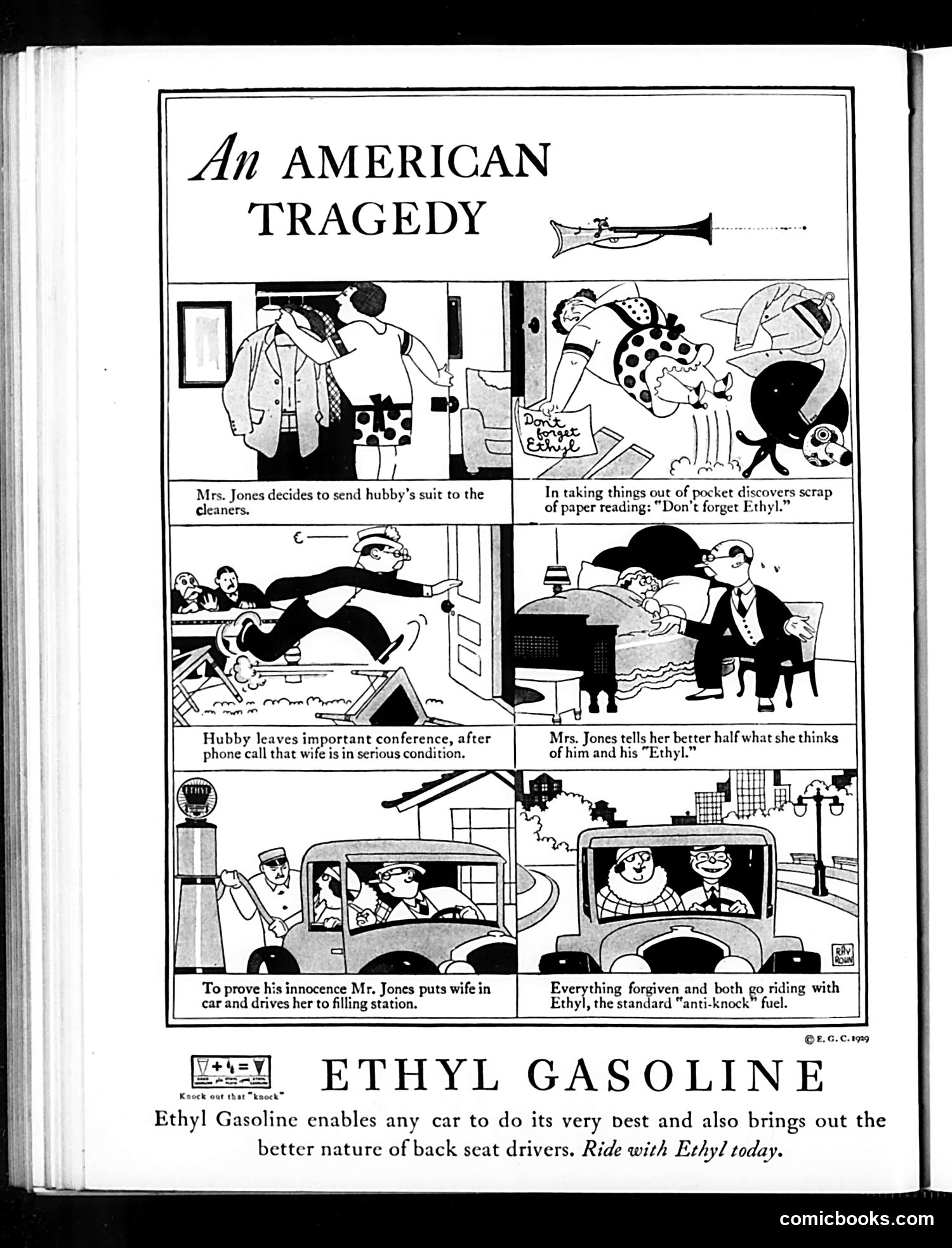
This is a 1920s advertisement disguised as satirical comic narrative. The "tragedy" follows Mr. Jones through a comedic domestic crisis: his wife sends his suit to cleaners, discovers a note reading "Don't forget Ethyl" in his pocket, suspects infidelity, and confronts him. Jones proves his innocence by taking her to a gas station—"Ethyl" refers to Ethyl Gasoline, the advertised fuel additive. The satire uses marital misunderstanding as comedic setup to promote the product. The punchline: using Ethyl fuel "brings out the better nature of back seat drivers," implying it improves car performance and, humorously, passenger behavior. This blends domestic humor with straightforward product marketing, typical of early automobile advertising that emphasized fuel quality and vehicle reliability.
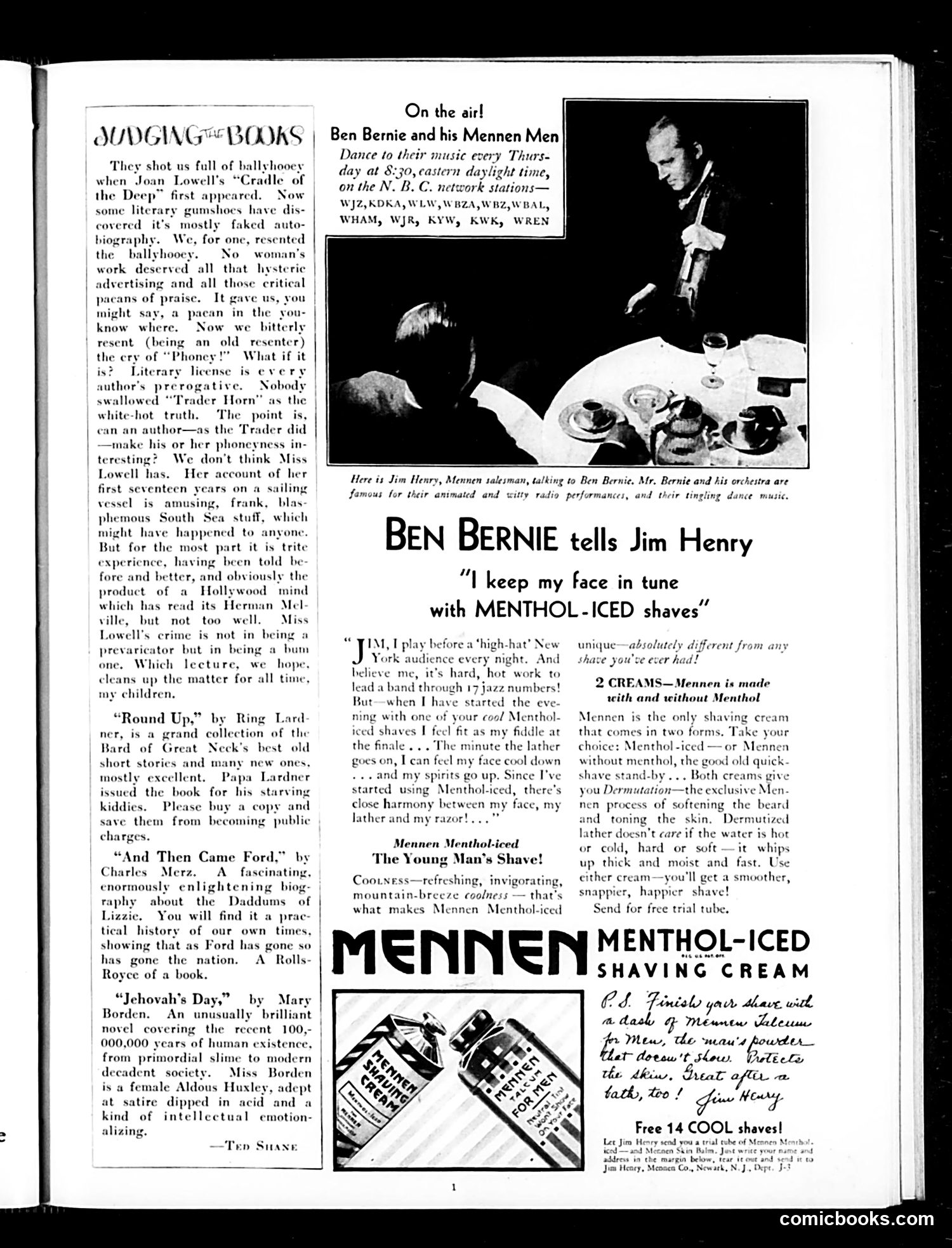
This page is primarily **advertising, not satire**. The left column contains brief book reviews under "Judging the Books," but the dominant content is a sponsored advertisement for Mennen Menthol-Iced Shaving Cream. The advertisement features bandleader **Ben Bernie** (identifiable from the caption) endorsing the product to radio personality **Jim Henry**. Bernie claims the menthol-iced shave keeps his face "in tune" for his nightly jazz performances before a "high-hat New York audience." The ad emphasizes the cooling, refreshing properties of menthol for men's grooming. A coupon offers "Free 14 COOL shaves." This represents typical 1930s celebrity endorsement advertising—leveraging Bernie's radio fame to market consumer products to male listeners.
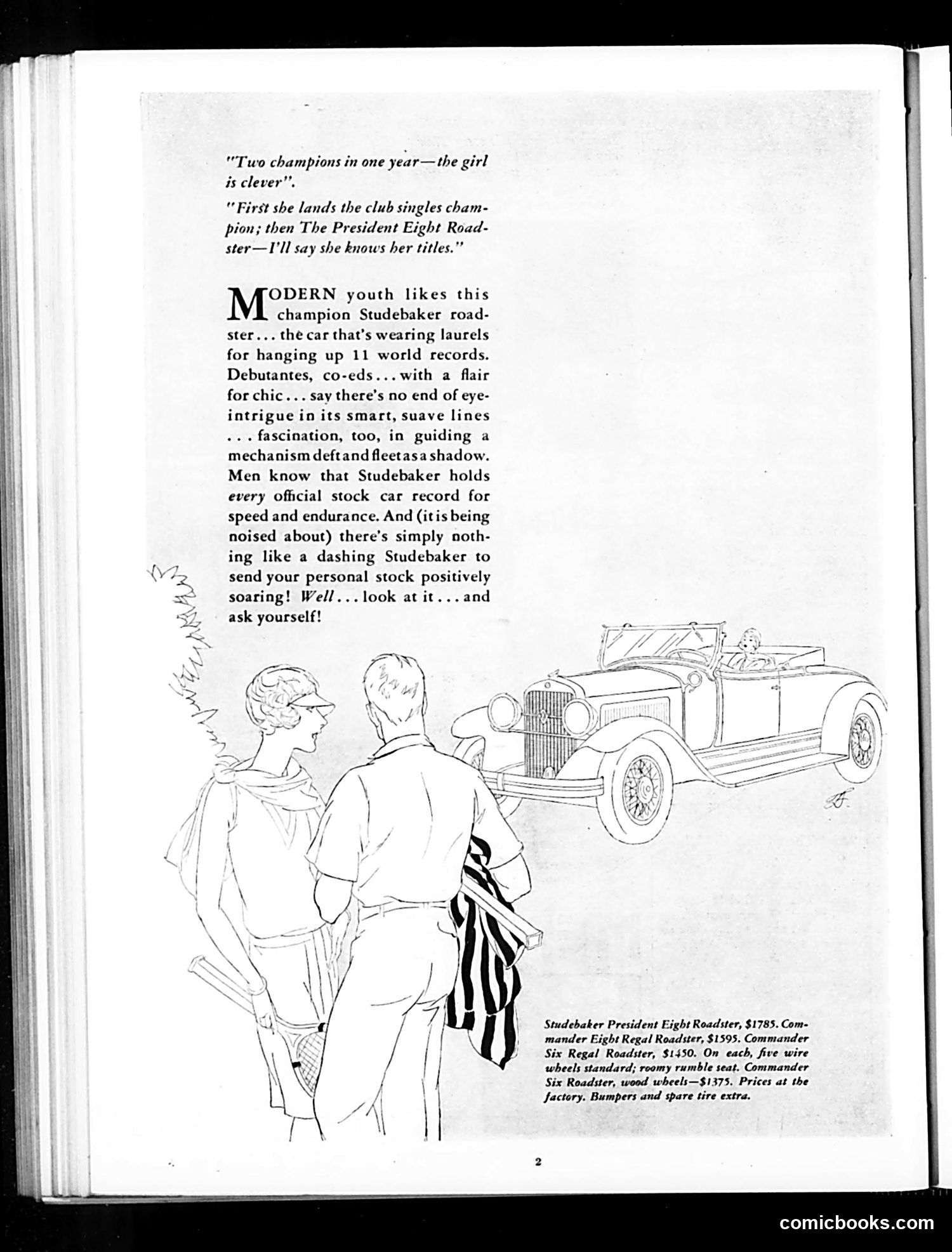
This page is primarily a **Studebaker automobile advertisement** disguised as social satire. The opening quotes praise a female champion driver who won club singles and holds a "President Eight Roadster" title, satirizing how modern youth—particularly young women—admire the car's sophistication and performance record. The illustration shows a well-dressed couple admiring a Studebaker roadster, emphasizing the vehicle's appeal to "modern youth" and debutantes. The ad highlights that Studebaker holds "every official stock car record" and positions ownership as a status symbol for aspiring drivers. The piece reflects 1920s-30s attitudes: fascination with female independence through automotive ownership, while framing car-buying as an aspirational lifestyle choice for the socially ambitious.
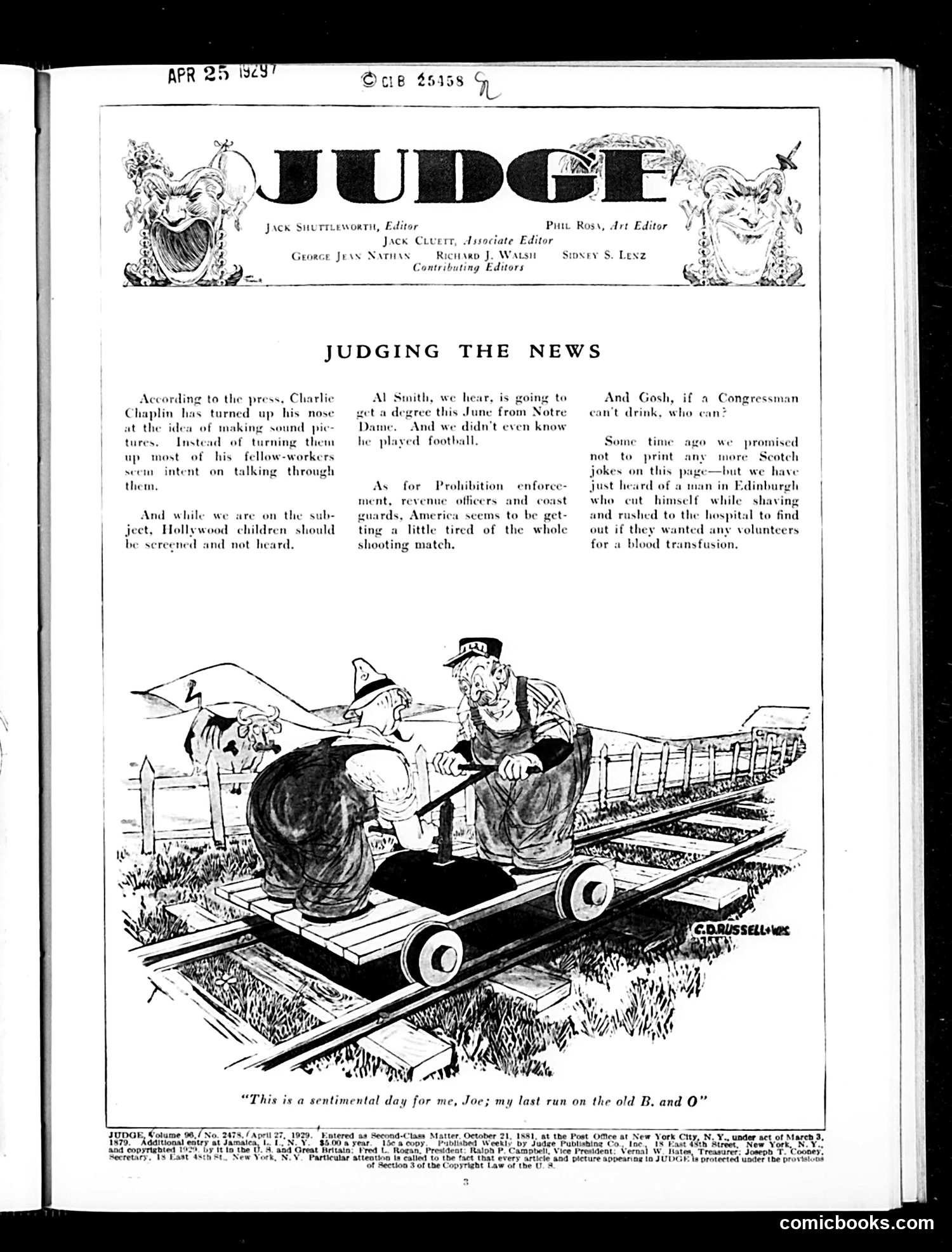
This page presents "Judging the News," a satirical column commenting on current events. The main cartoon depicts an elderly man riding a hand-car on railroad tracks, captioned "This is a sentimental day for me, Joe; my last run on the old B. and O." The image appears to reference railroad industry changes, possibly the decline of older rail lines or retirement of long-serving workers. The sentimental tone suggests nostalgia for an earlier era of American transportation. The text column discusses miscellaneous topics including Charlie Chaplin's sound-picture experiments, Notre Dame football, Prohibition enforcement efforts, and a Scotch-joke restraint. The commentary maintains Judge's typical irreverent, satirical approach to weekly news, poking fun at celebrities and policy matters alike.
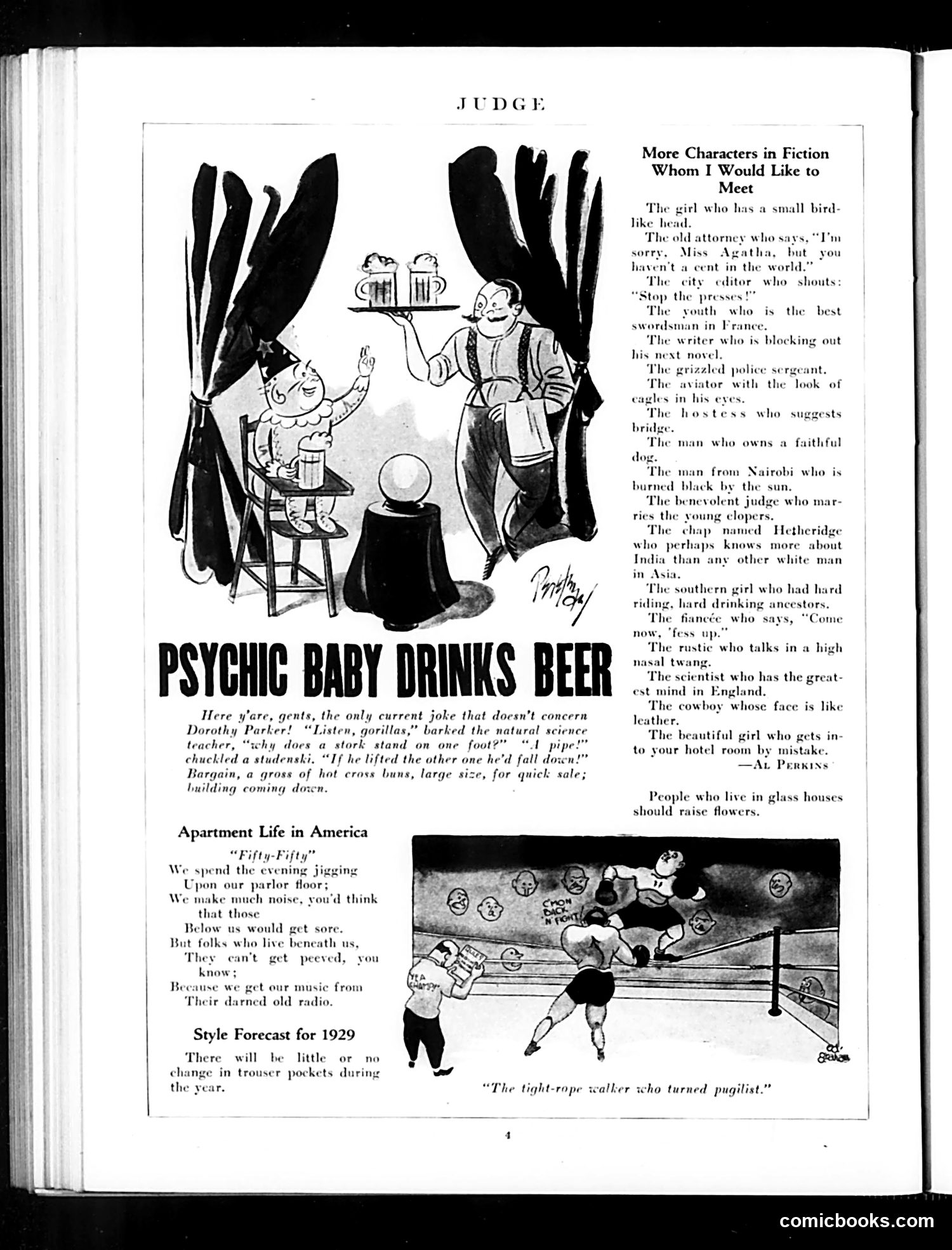
**Main Cartoon: "Psychic Baby Drinks Beer"** This satirical cartoon depicts two men in what appears to be a speakeasy or bar setting, with a crystal ball between them. The joke references Prohibition-era humor about illegal alcohol consumption. The caption suggests the "psychic baby" is a fortune-telling gimmick or novelty act at an establishment serving beer illegally. The setup mocks both the pseudoscientific mysticism popular in the 1920s and the pervasive defiance of Prohibition laws through underground bars. **Secondary Content:** The page includes lightweight social commentary ("Apartment Life in America," "Style Forecast for 1929") and a humorous sports cartoon about a "tight-rope walker who turned pugilist." These represent typical Judge magazine filler—light satirical observations on contemporary American life rather than hard political commentary. The overall tone reflects 1920s urban humor and Prohibition-era culture.
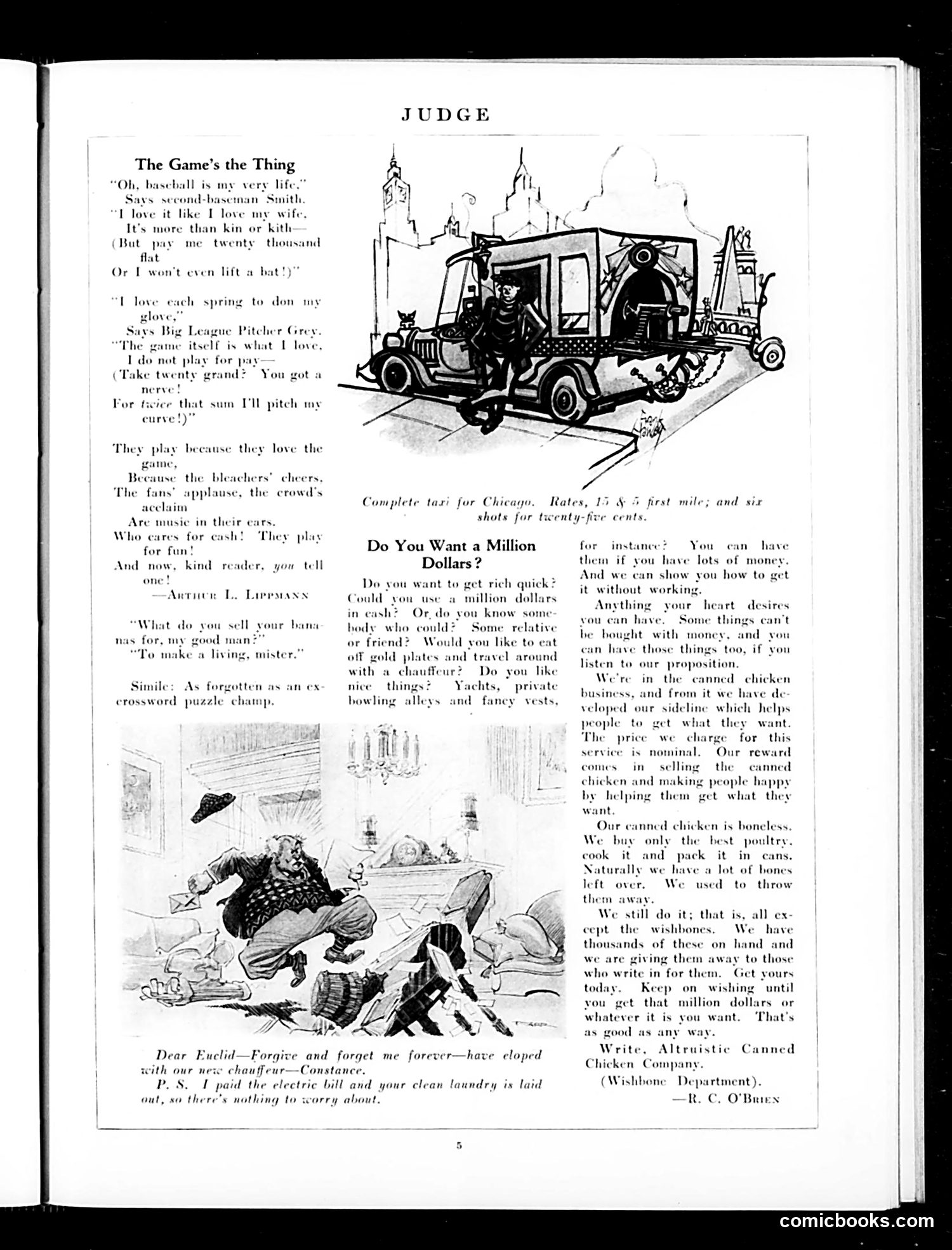
This page contains several distinct sections: **"The Game's the Thing"** (top): A poem celebrating baseball, featuring quotes from fans emphasizing they love the game itself rather than gambling or money. The illustration shows a fantastical taxi transporting Chicago baseball fans. **"Do You Want a Million Dollars?"** (right): An advertisement for "Artistique Canned Chicken Company" with their "Wishbone Department." The pitch cleverly uses the concept of wishbones to promise customers they can wish for anything—implying the canned chicken is so good it grants desires. It's tongue-in-cheek marketing humor. **Bottom cartoon**: Depicts domestic chaos—a woman in disarray amid scattered belongings. The caption references a note about eloping with a chauffeur, suggesting marital comedy. The page mixes sports commentary, whimsical advertising, and domestic humor typical of Judge's satirical approach.
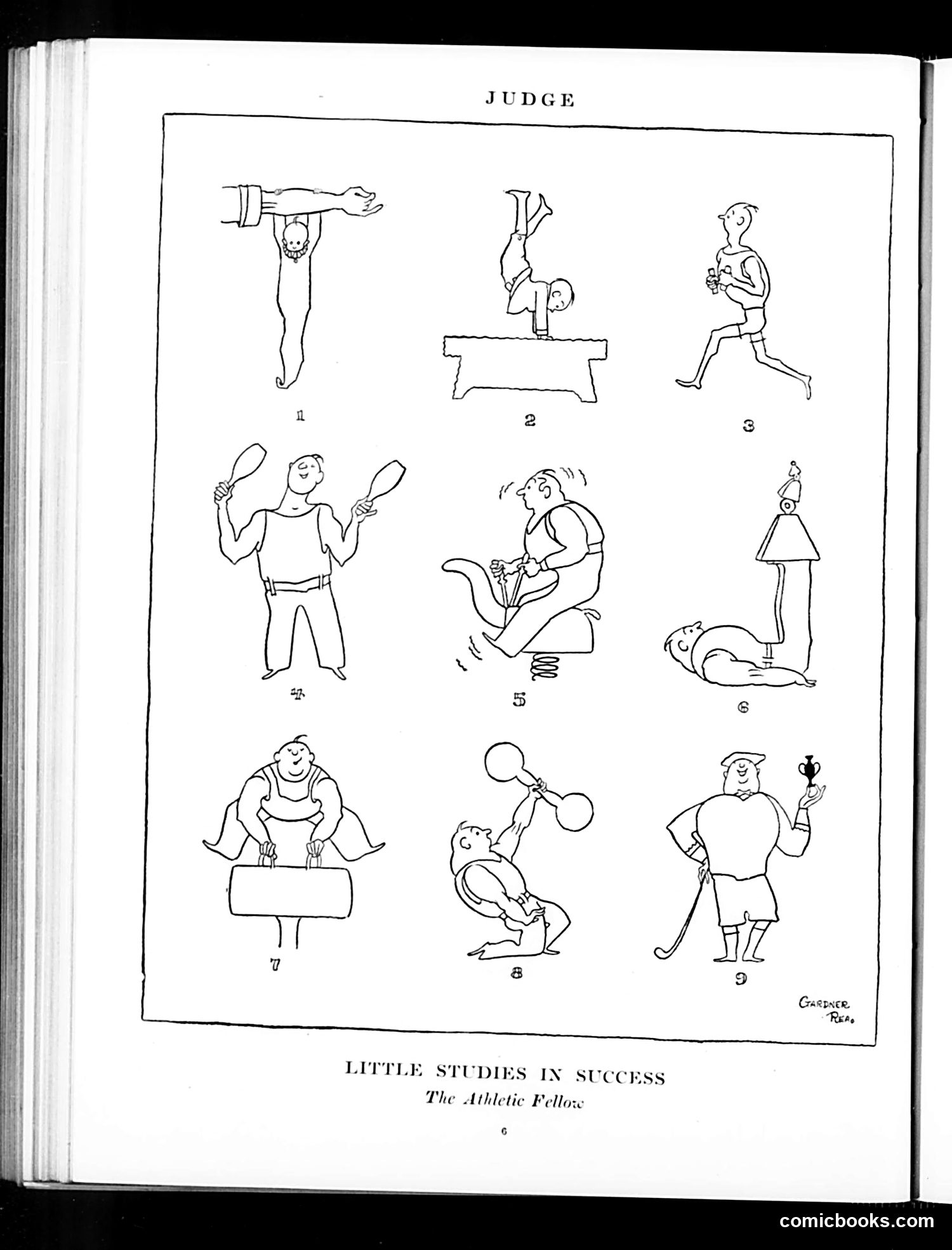
This page presents nine cartoon vignettes satirizing different athletic pursuits and body types. The title suggests these represent "successful" athletes, but the humor derives from exaggeration and physical comedy: 1. Acrobat on bar 2. Gymnast on vault 3. Runner 4. Juggler with clubs 5. Fisherman struggling with catch 6. Archer with small figure 7. Strongman lifting weights 8. Person with dumbbells 9. Military/authority figure with crown The satire appears to mock various athletic enthusiasts—from the genuinely athletic to the comically unfit. The fisherman (#5) and others suggest physical struggle treated as "athletic success." The humor relies on slapstick physical comedy rather than specific contemporary references. This represents late-19th/early-20th century American humor about physical culture and exercise fads.
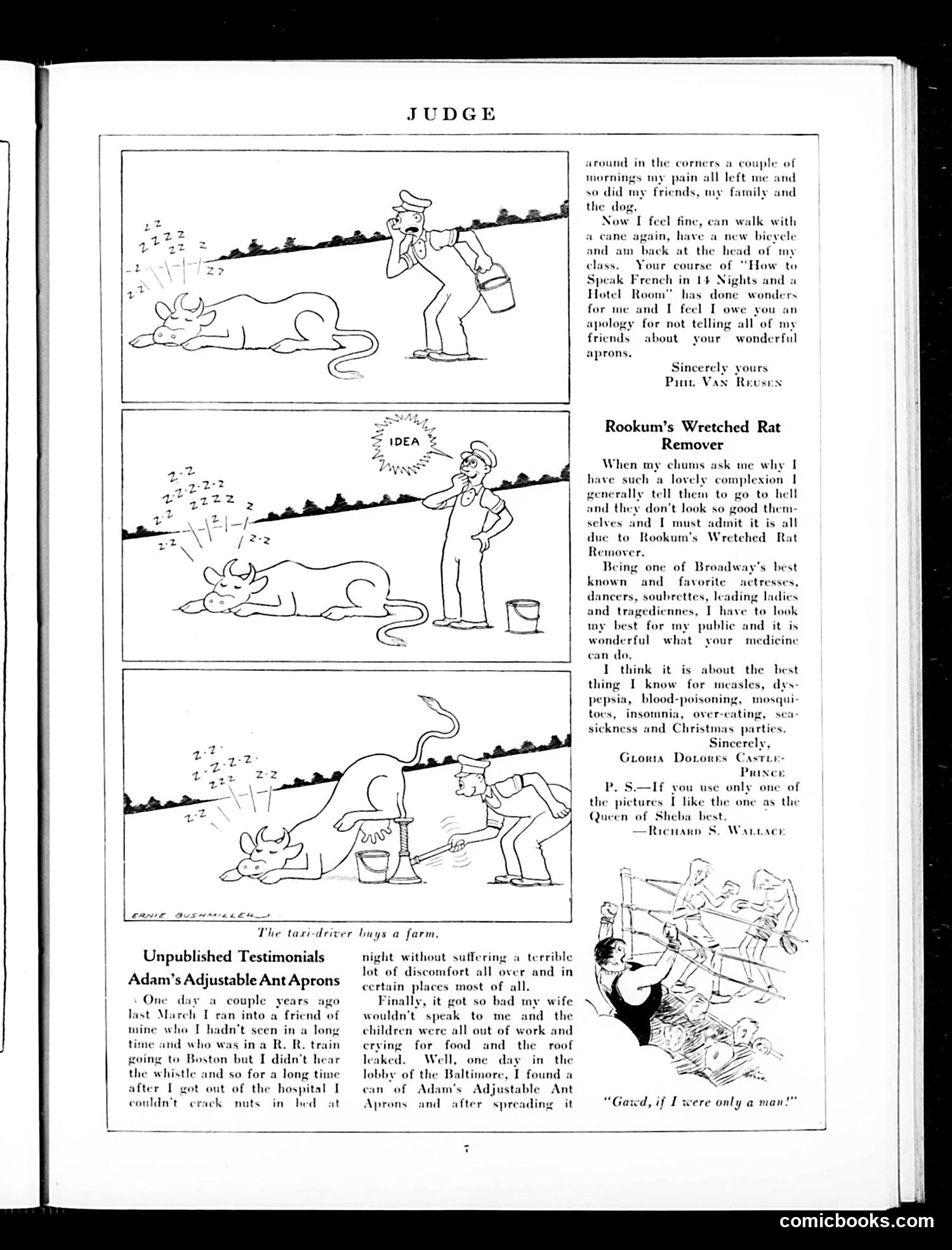
This page satirizes **fake testimonials and patent medicine advertising**—a common target of satirical magazines in the early 20th century. The three cartoon panels depict a taxi driver who, after buying a farm, must deal with a noisy rooster that keeps him awake. The humor escalates through increasingly absurd "solutions," culminating in the driver appearing to use a vacuum or pump device. Below, fake endorsements parody the era's dubious medical products: "Adam's Adjustable Ant Aprons" (nonsensical) and "Rookum's Wretched Rat Remover" supposedly cure everything from measles to Christmas parties—obviously ridiculous. The testimonials use the overwrought language and rambling structure typical of real patent medicine ads, mocking their absurd claims and vague causality (spreading something "around corners" cures unrelated ailments). The Broadway actress's endorsement particularly satirizes celebrity endorsements of dubious products. Judge is mocking both gullible consumers and the snake-oil industry exploiting them.
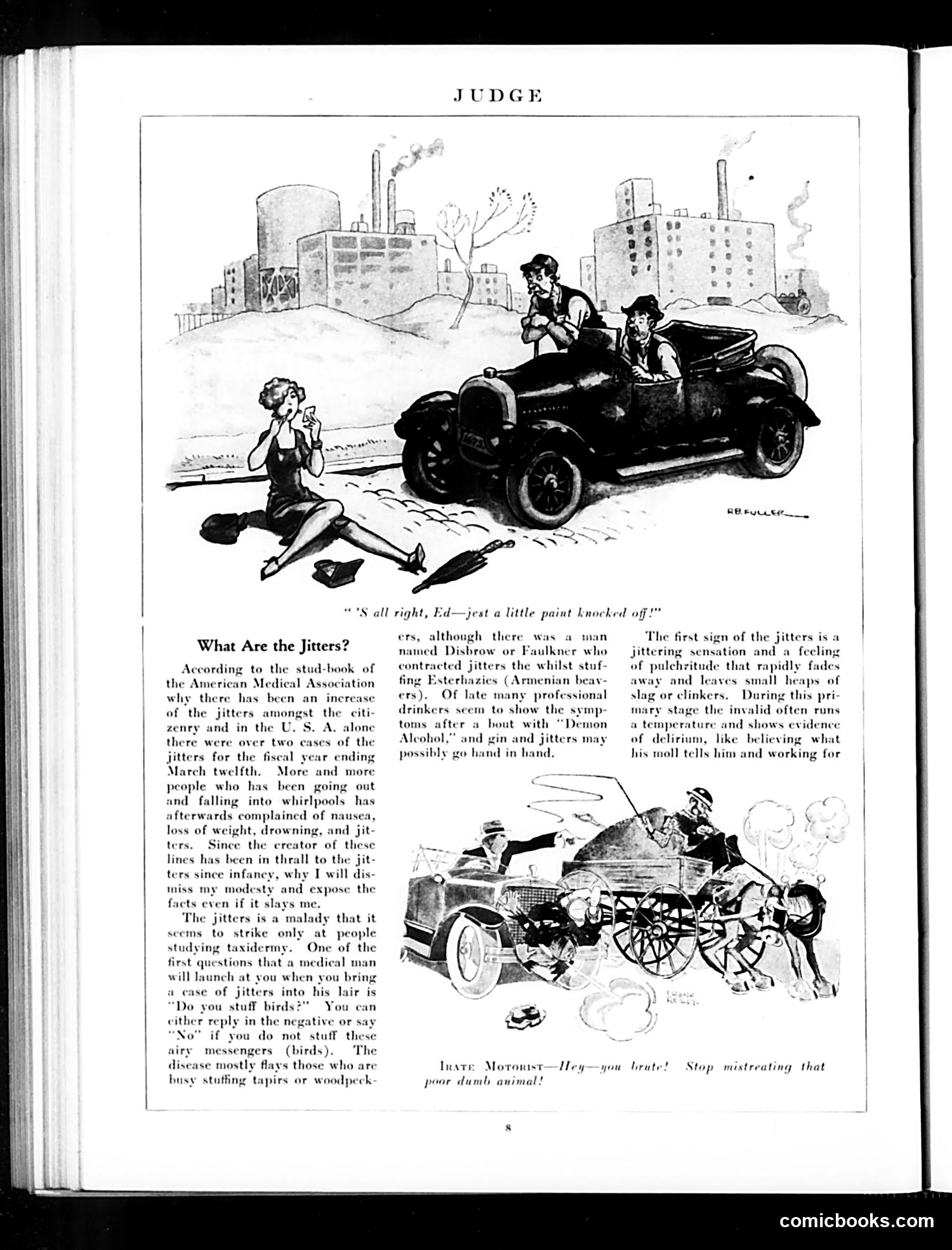
This page satirizes "the jitters," a nervous condition supposedly afflicting early 20th-century Americans. The text mock-seriously attributes the malady to taxidermy (stuffing birds), professional drinking, and gin consumption. The top cartoon shows a woman knocked down by a car driven by two men, casually dismissing the accident ("just a little paint knocked off"), suggesting reckless behavior and indifference to danger. The lower cartoon depicts a motorist mistreating a donkey, captioned "Irate Motorist—Hey—you brute! Stop mistreating that poor dumb animal!"—likely criticizing animal cruelty. The satire appears to mock both the medical establishment's diagnosis of nervous ailments and contemporary social problems: reckless driving, alcoholism, and moral indifference. The "jitters" serves as a humorous umbrella diagnosis for various modern anxieties and vices plaguing urban society.
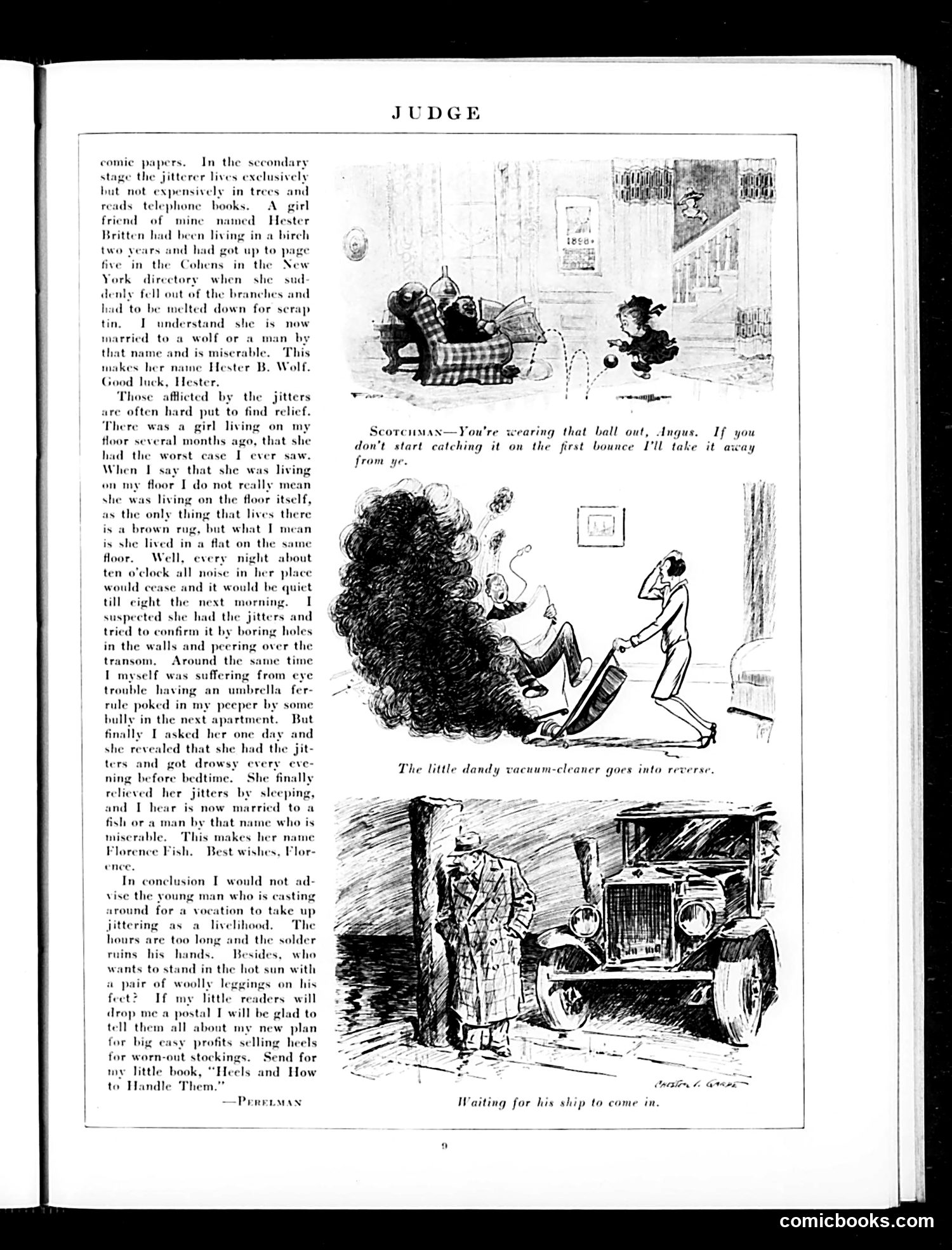
This page contains humor pieces about "the jitters"—a slang term for nervous anxiety or restlessness that was apparently common in this era. The author describes afflicted individuals (Hester Britton, Florence Fish) living in unusual places (trees, apartment floors) due to their condition, with darkly comic consequences (melted down for scrap tin, forced into miserable marriages). The three illustrations satirize different manifestations: a Scottish man playing catch with a ball, a vacuum cleaner going "into reverse" (likely depicting chaos), and a man waiting by a truck for "his ship to come in"—a phrase meaning hoping for good fortune that never arrives. The humor relies on absurdist exaggeration and the period's casual cruelty toward mental/nervous conditions. The final ad-like section offers the author's dubious self-help scheme on "heels and how to handle them"—characteristic of Judge's satirical tone mocking fraudulent self-improvement guides popular at the time.
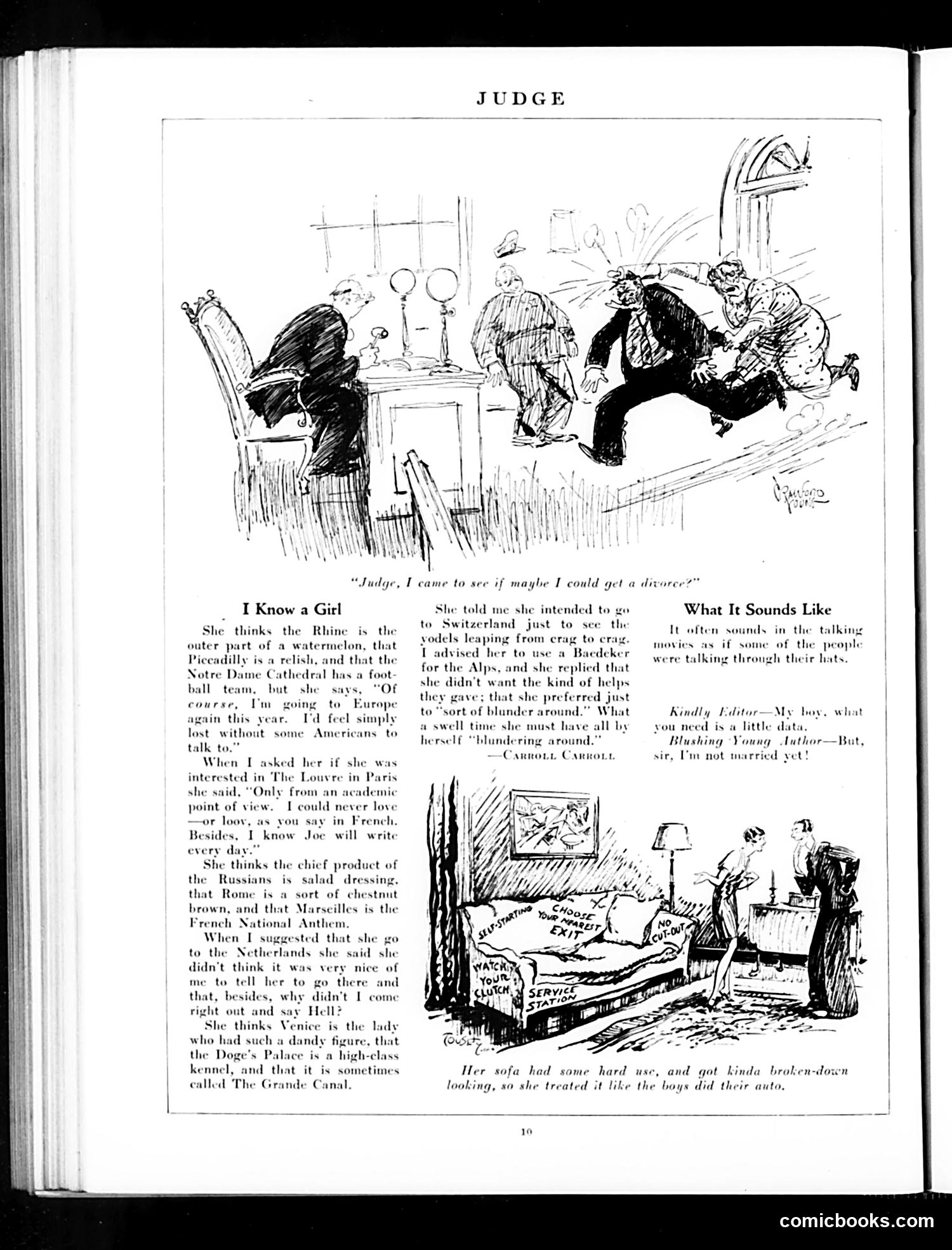
This page from *Judge* satirizes American cultural ignorance and pretension, particularly among women planning European travel. **The Main Cartoon** (top) depicts a judge's chambers where a man seeks divorce, claiming his wife is "blundering around" Europe—likely squandering money on frivolous tourism. **"I Know a Girl"** mocks a woman's absurd misconceptions about European geography and culture: she thinks the Rhine is part of a watermelon, Notre Dame has a football team, Russian cuisine is salad dressing, and Venice is a person. The satire targets both her ignorance and her shallow travel motivations (wanting to see "models leaping from crags" rather than appreciating actual landmarks). **"What It Sounds Like"** is a brief joke about people "talking through their hats"—speaking confidently about subjects they don't understand. The humor reflects early 20th-century anxieties about American tourists abroad and women's increasing independence in travel planning, portraying their lack of cultural education as laughable rather than admirable.
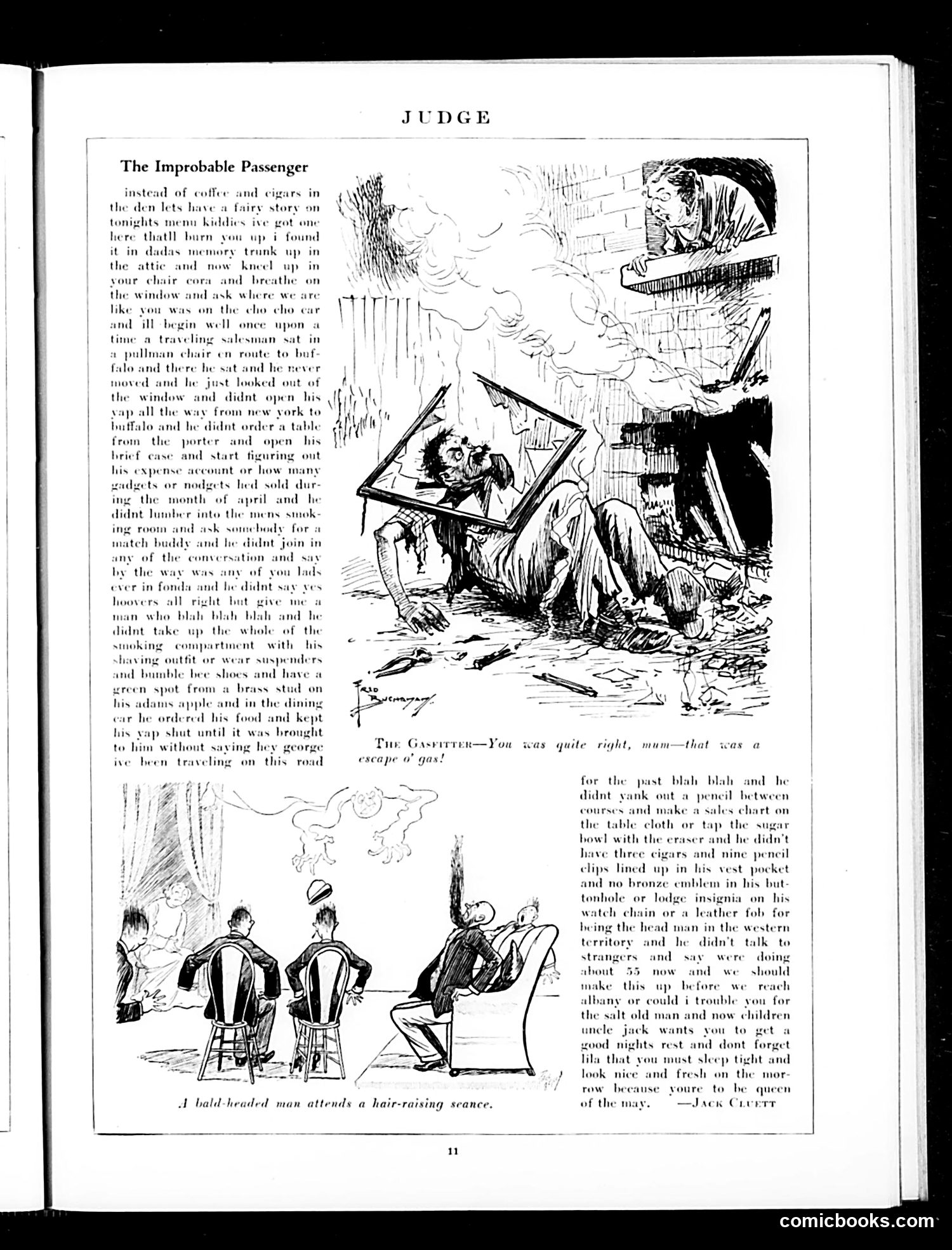
This page contains two distinct pieces of humor: **"The Improbable Passenger"** (main story): A father tells children a bedtime "fairy story" about a traveling salesman—a stock character in American humor. The joke is that this salesman is *completely* atypical: he sits quietly, doesn't talk, doesn't smoke cigars, doesn't brag about sales or lodge memberships, and generally violates every stereotype of the loud, obnoxious traveling salesman archetype common to the era. The humor relies on readers' familiarity with this clichéd character type, making his utter ordinariness absurdly fantastic by comparison. **"A Bald-Headed Man Attends a Hair-Raising Seance"** (bottom cartoon): Shows a séance scene with the obvious pun: a bald man attending a "hair-raising" (frightening) séance. The humor is visual wordplay—exploiting the double meaning of "hair-raising." Both pieces target middle-class American social types and conventions recognizable to Judge's contemporary readers.
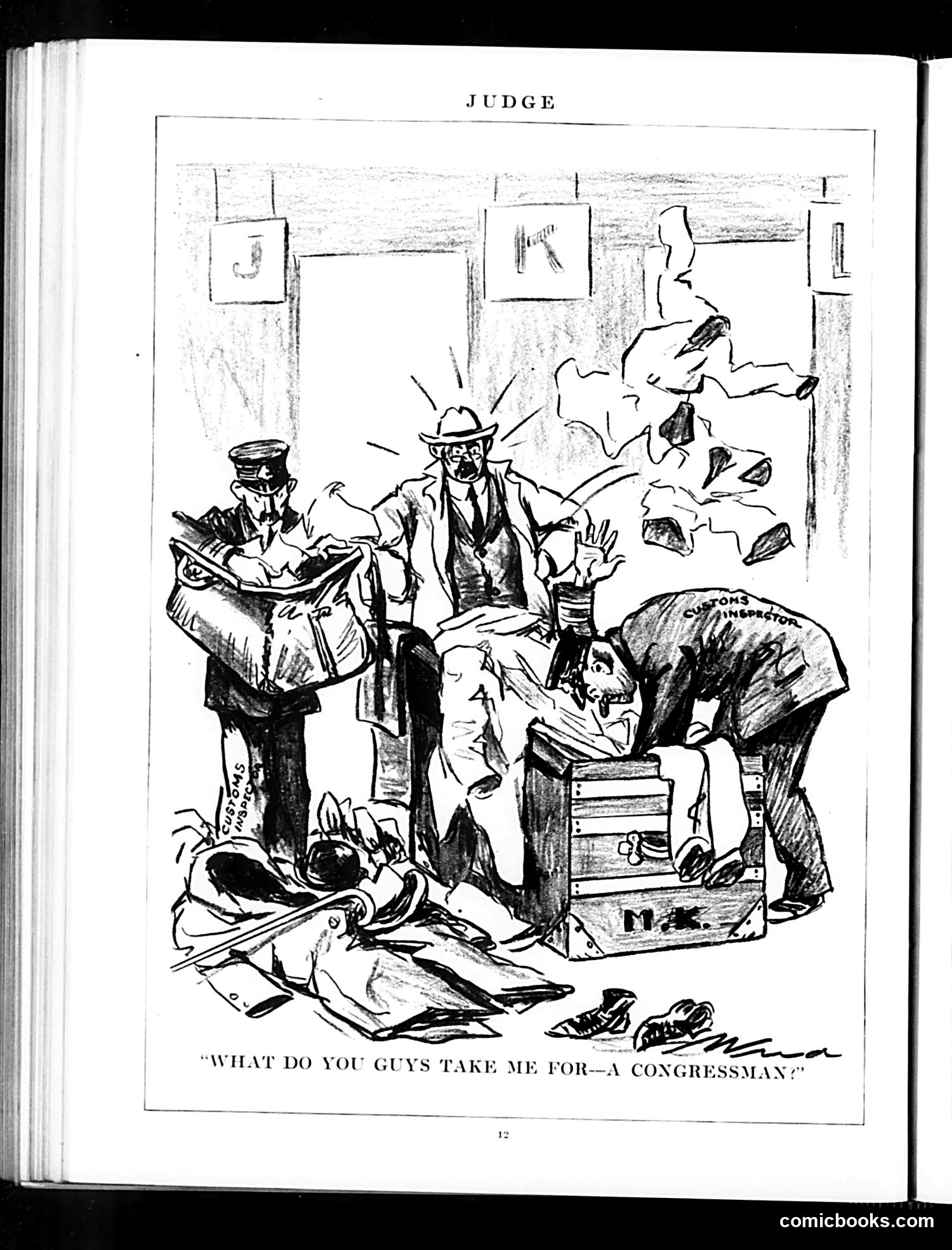
This cartoon satirizes the appearance and dignity of a Congressman. Three men in suits and hats are examining a disheveled figure surrounded by scattered belongings, torn papers, and what appears to be customs inspections materials. The central figure asks indignantly: "What do you guys take me for—a Congressman?" The satire suggests that Congressmen of this era were perceived as disreputable, poorly-dressed, or morally questionable characters—so disorganized or corrupt-looking that being mistaken for one would be insulting. The scattered baggage and inspection scene may reference concerns about smuggling, corruption, or dishonesty among elected officials. The cartoon reflects public cynicism about Congressional integrity and appearance during the Gilded Age or Progressive Era when such satirical magazines frequently mocked politicians.
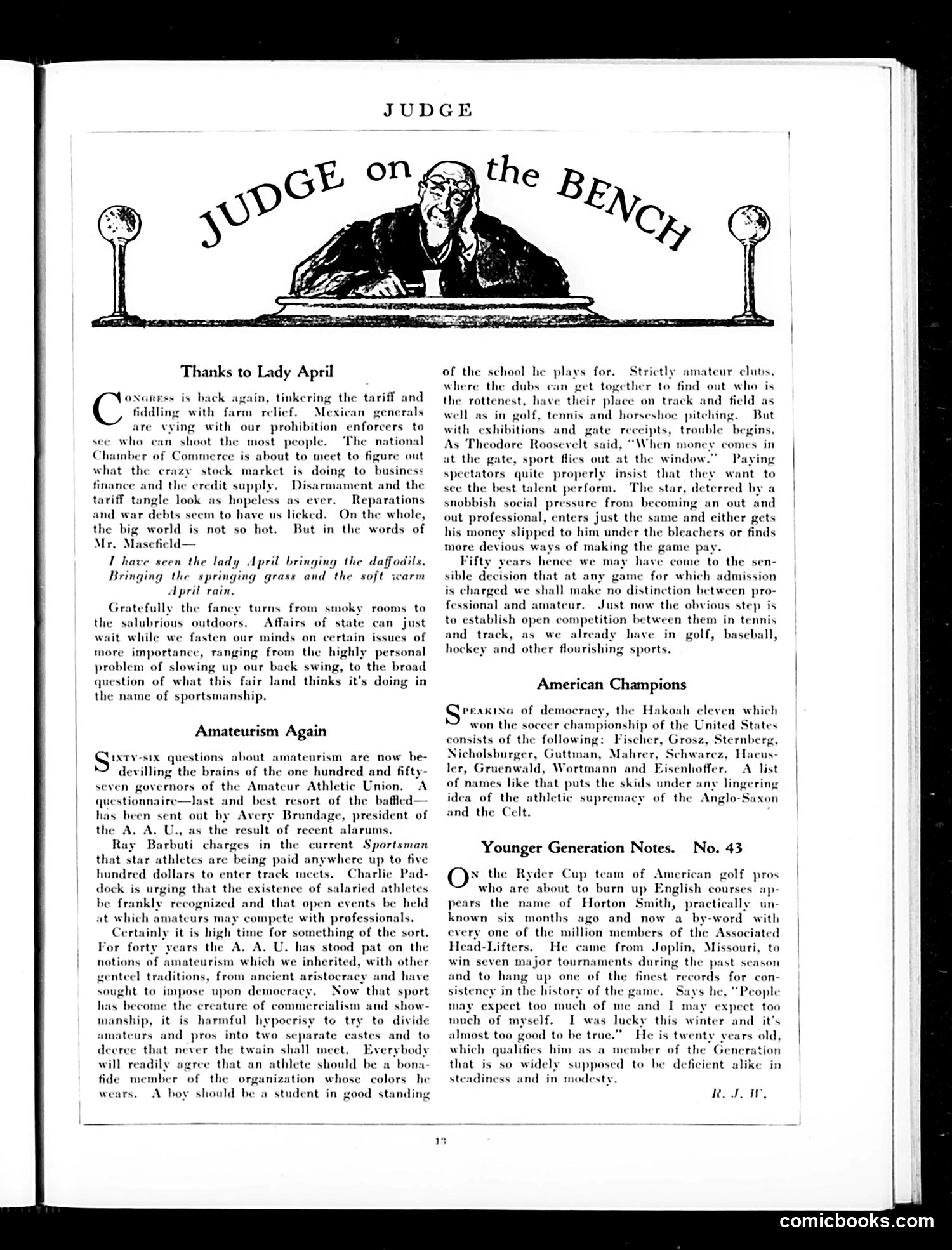
This page from Judge magazine (appears to be 1920s-era) contains three separate commentary pieces on American sports and politics: **"Thanks to Lady April"** opens with satirical jabs at current crises—tariff disputes, Mexican violence, prohibition enforcement failures, stock market chaos—before pivoting to spring sports as welcome relief. **"Amateurism Again"** addresses a genuine controversy: the Amateur Athletic Union's hypocrisy in enforcing amateur-only rules while star athletes like Ray Barbuti and Charlie Paddock openly receive payment. The author argues that with gate receipts and spectator demands, pretending sports remain amateur is absurd. Theodore Roosevelt is quoted approvingly: "When money comes in at the gate, sport flies out at the window." **"American Champions"** notes the Hakoah eleven (a Jewish soccer team from Palestine) won the U.S. championship, listing players with predominantly Jewish surnames. The satirical point—unstated but clear—challenges claims of "Anglo-Saxon athletic supremacy." The cartoon's scowling judge oversees these critiques of American hypocrisy and pretense.
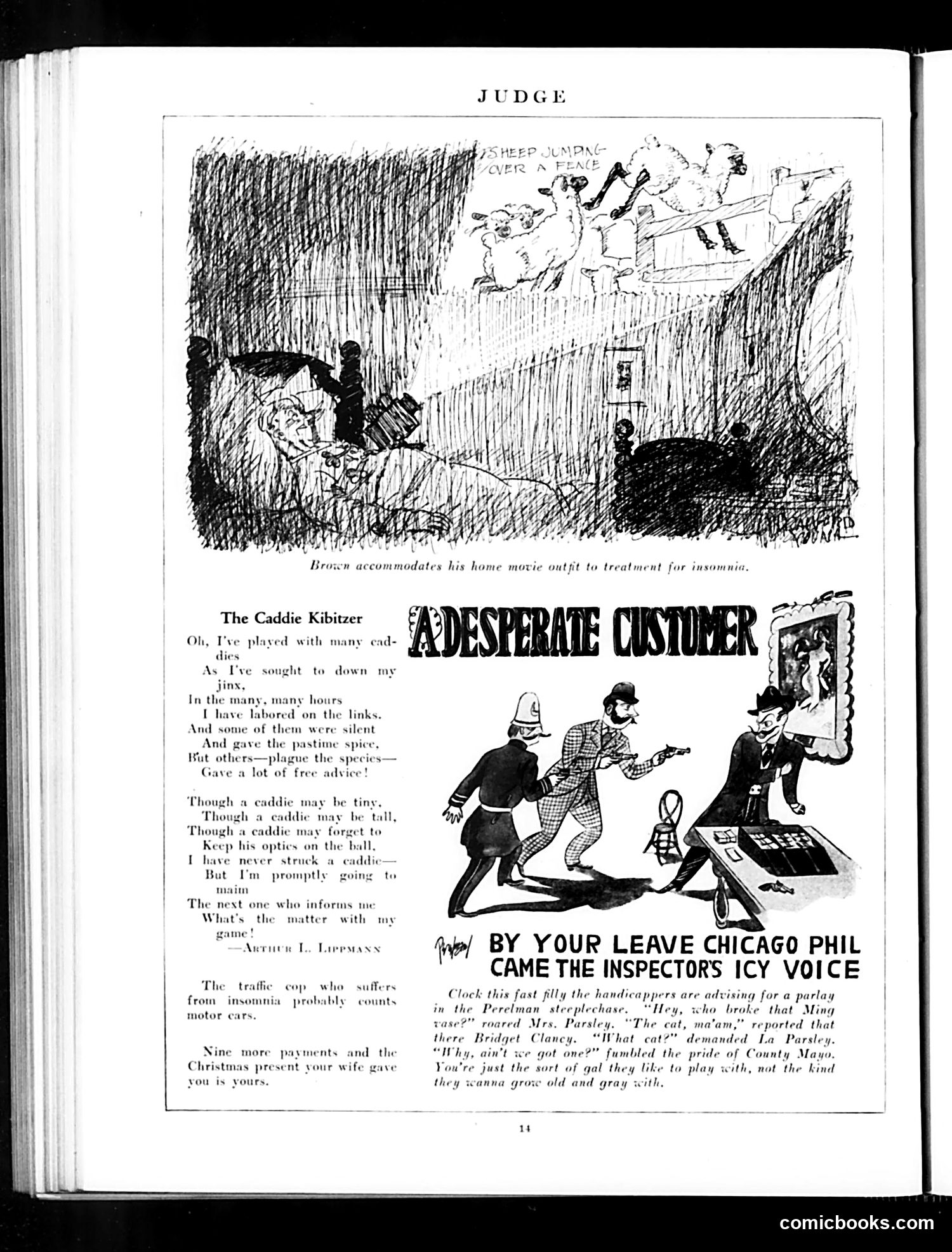
This page contains two unrelated pieces of humor: **"The Caddie Kibitzer"** (poem by Ariene L. Liverance): A golfer's complaint about caddies who offer unsolicited advice during play. The satire mocks both the presumption of junior caddies and the golfer's frustration with their commentary on his game. It's a lighthearted social observation about class dynamics and annoyance on the golf course. **"A Desperate Customer"** (illustrated story): Shows a hapless gambler ("Chicago Phil") caught by police inspectors while apparently engaged in illegal betting. The accompanying narrative involves Mrs. Parsley's missing cat and references to horse racing ("Perelman steeplechase," "handicappers"). The humor stems from the character's criminal activities and the confusion about the missing pet, depicting petty crime and police enforcement of gambling laws—likely referencing Prohibition-era Chicago crime. Both pieces reflect early 20th-century American leisure activities and urban social problems.
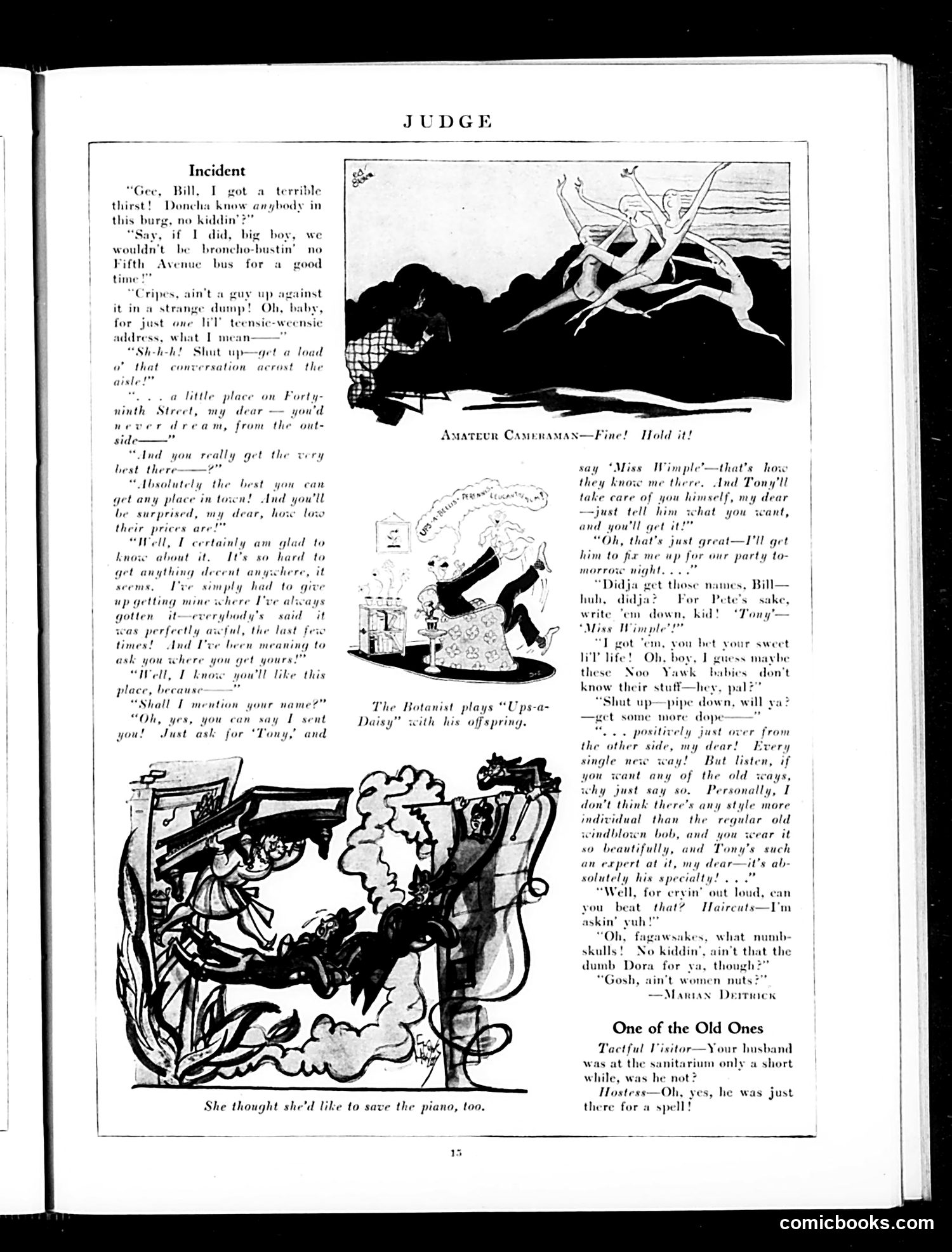
This Judge page contains two satirical pieces mocking early 1920s New York social pretension and gender stereotypes. **The Main Cartoon:** Two working-class men ("Bill" and another laborer) overhear society women discussing an exclusive speakeasy ("Tony's place" on 49th Street). The satire targets wealthy women who act sophisticated while frequenting illegal establishments during Prohibition—they use coded language ("ask for 'Tony'") and name-drop to seem fashionable. The laborers mockingly repeat the women's affected speech patterns, highlighting the absurdity of their pretense. **"One of the Old Ones":** A brief joke where a visitor tactfully asks if someone's husband had a long sanitarium stay, and the hostess replies he was "just there for a spell"—a pun playing on "spell" (a period of time) versus being under a magical spell, implying her husband is somewhat dim-witted. The overall humor relies on class mockery and mocking women's vanity and gullibility regarding fashionable venues.
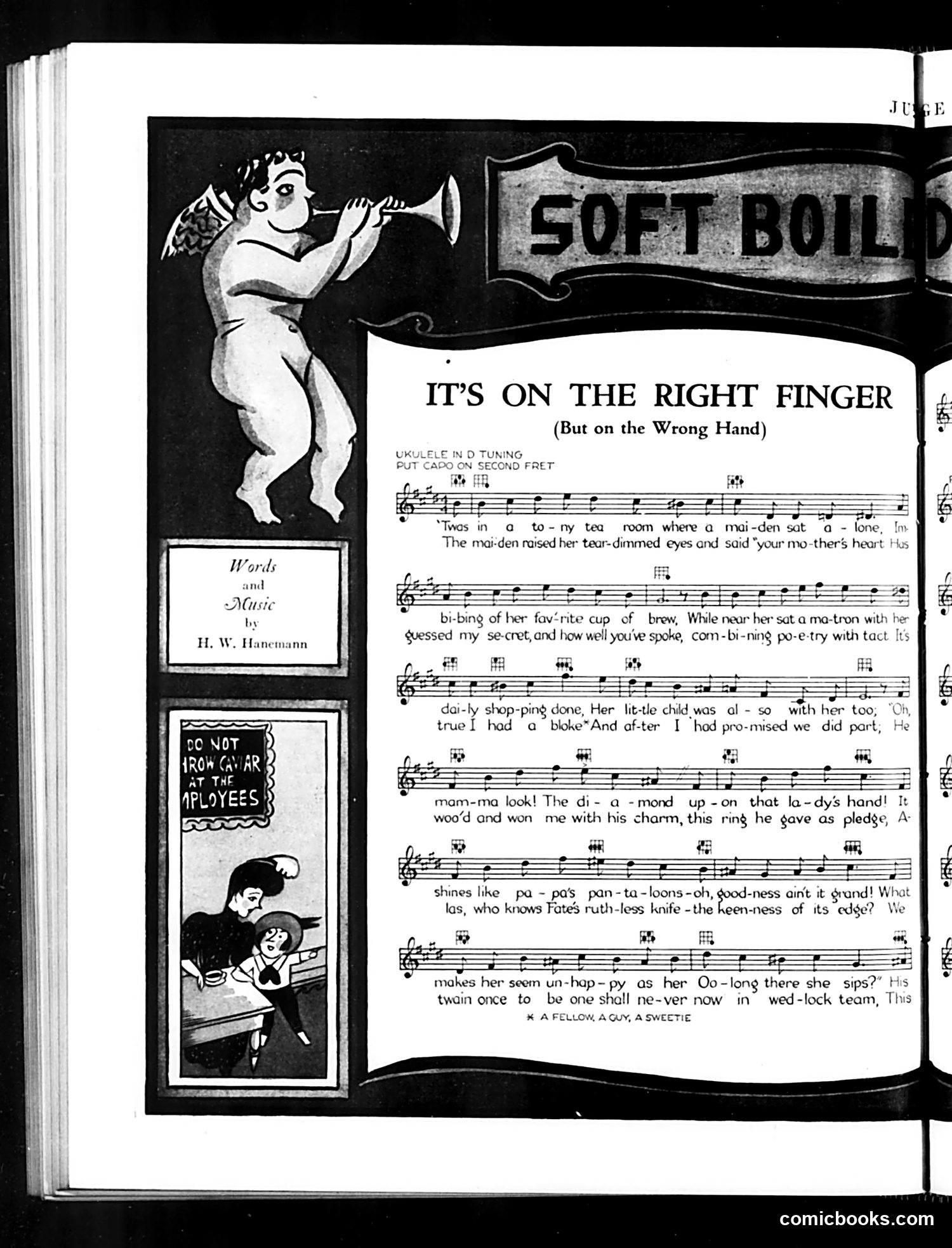
This song sheet depicts a sentimental narrative about a woman wearing an engagement ring—but the title's ironic twist suggests complications. The lyrics describe a maiden in a tea room who displays a diamond ring given by her beloved as a pledge of love. The satire appears to target romantic deception or compromised circumstances: the subtitle "(But on the Wrong Hand)" and the phrase "a fellow, a guy, a sweetie" hint that the ring's legitimacy is questionable. The woman may be wearing an engagement ring from someone unsuitable, or the relationship involves social impropriety (the mention of "a bloke" and the overall coy tone suggest illicit romance rather than proper courtship). The "Soft Boil" masthead and accompanying advertisements frame this as Judge magazine's commentary on romantic entanglements and moral ambiguity in courtship during this era—poking fun at women's romantic fantasies versus social reality.
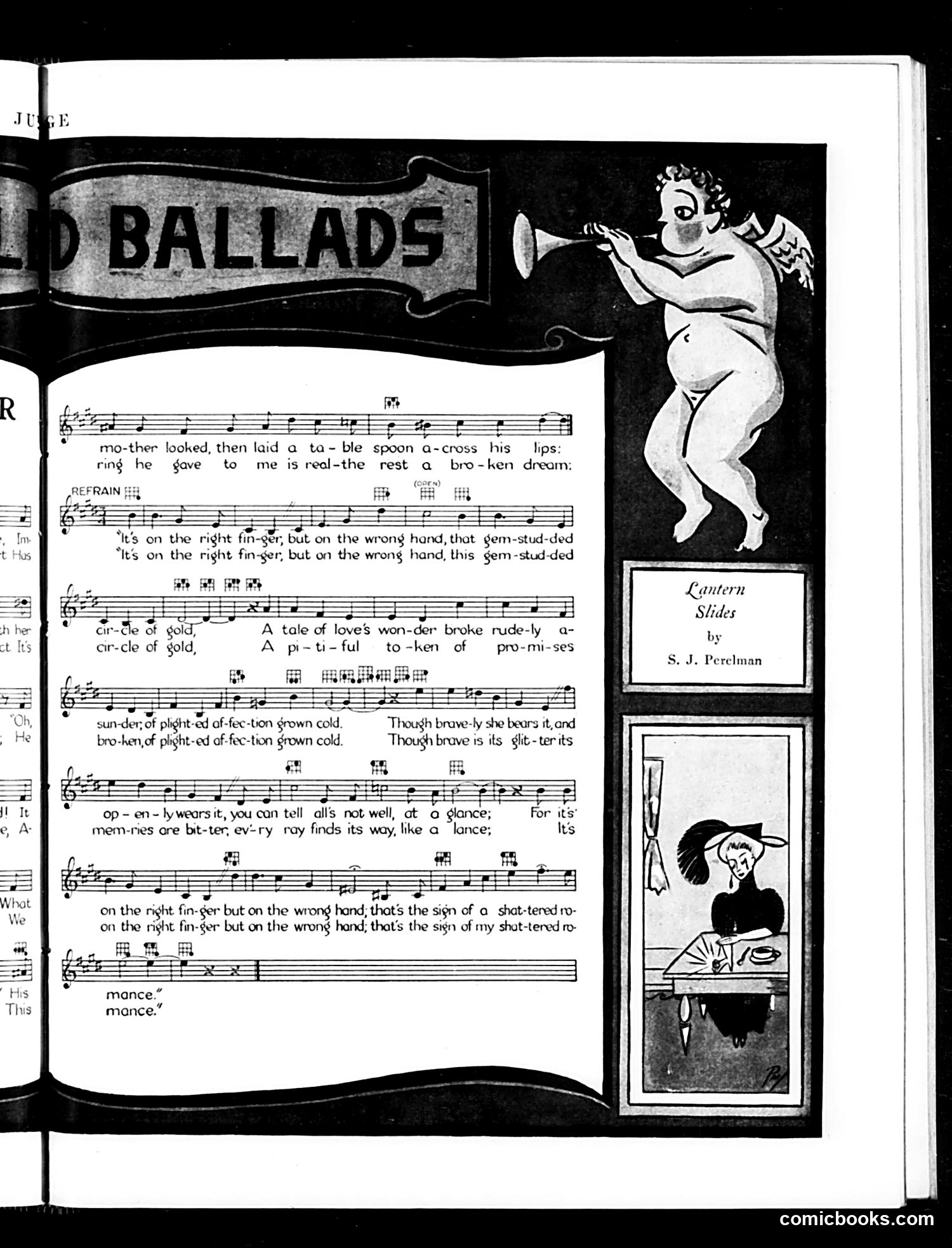
This page contains sheet music and lyrics for a sentimental ballad titled "Ballads," depicting a romantic tragedy. The song narrates a story of a broken engagement symbolized by an engagement ring worn on the "wrong hand" — suggesting the woman can no longer wear it on her ring finger, indicating the relationship has ended. The lyrics emphasize loss and disillusionment: "the rest a broken dream," "affection grown cold," and "shattered romance." The recurring refrain about the ring on the right finger but wrong hand serves as the central metaphor for failed promises and thwarted love. On the right, decorative "Lantern Slides" advertisements by S. J. Perelman feature a cherub and a woman, typical period advertisement imagery. This represents typical Judge magazine content: sentimental popular songs mixed with satirical advertising, appealing to readers' emotional sensibilities while subtly mocking Victorian romantic conventions through overwrought melodrama.
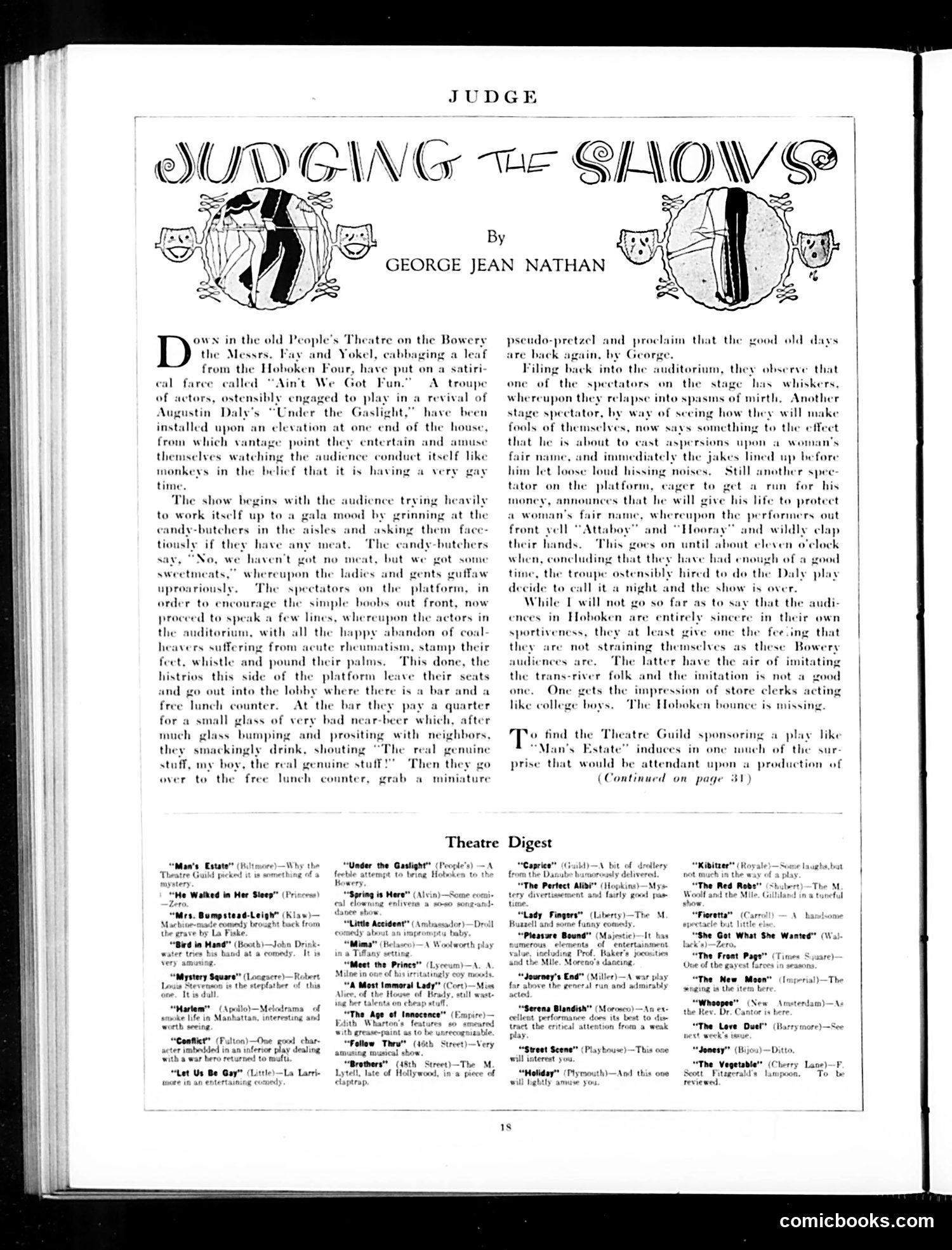
This is a theater review column, not a political cartoon. Nathan critiques a satirical farce called "Ain't We Fun" performed at the People's Theatre on the Bowery by the Hoboken Four. **The satire's target:** The audience itself. Nathan describes spectators who behave like "monkeys," encouraged by actors to stamp, whistle, and shout "Attaboy!" in manufactured enthusiasm. They eat cheap near-beer and engage in crude melodrama—when an actor mentions threatening a woman's reputation, spectators hiss; another promises protection, prompting cheers. **The joke:** The show exploits working-class audiences (implied by references to "store clerks" and "college boys") who mistake this manufactured rowdiness for genuine entertainment. Nathan observes that while Hoboken audiences are "entirely sincere," they lack the sophistication to recognize they're being manipulated. The piece is social satire targeting both lowbrow theater and the unsophisticated audiences it serves.
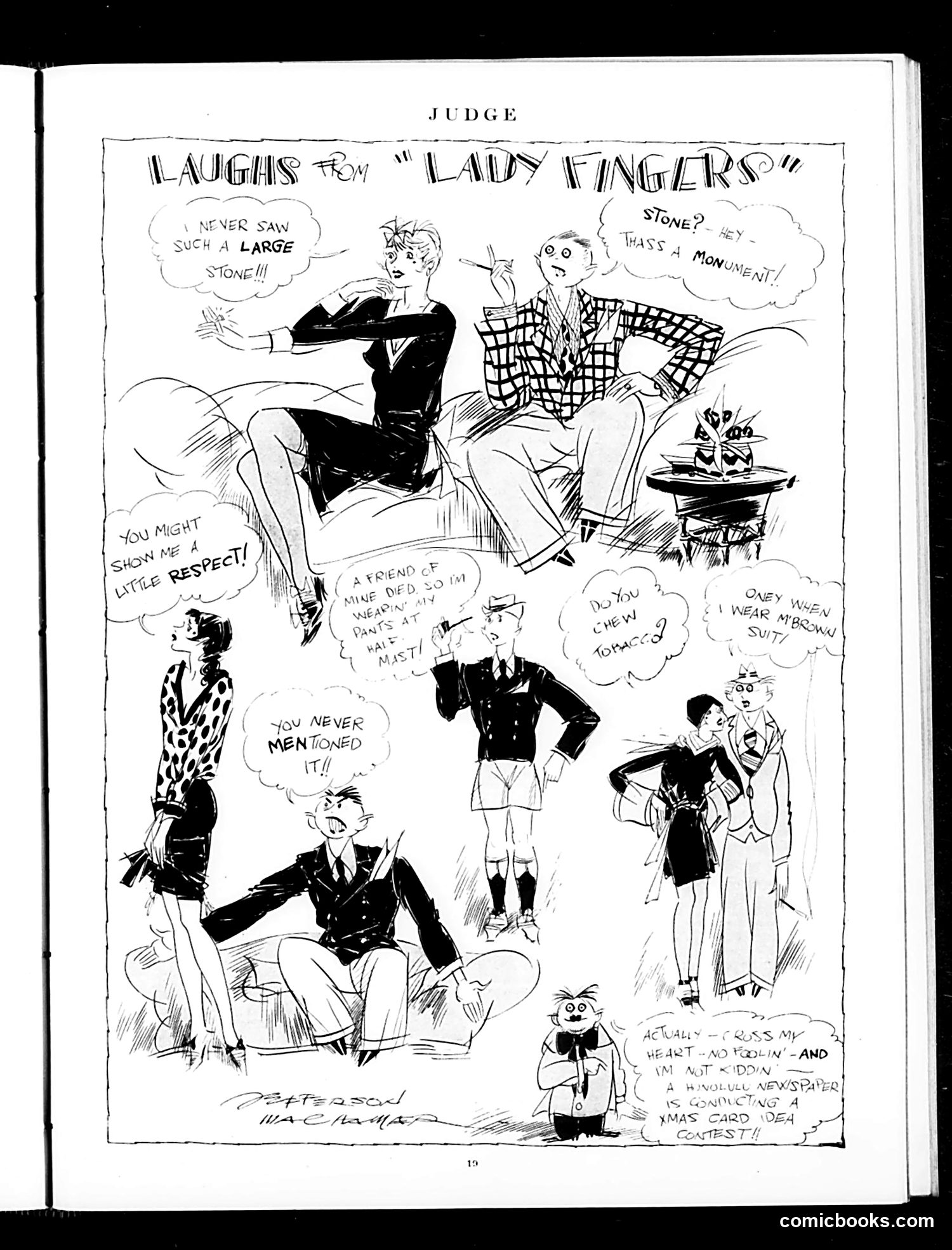
This is a satirical cartoon about "Lady Fingers" (likely referring to a social scandal or gossip involving prominent women). The comic shows various characters reacting with shock and indignation to revelations about the incident. The humor centers on people denying knowledge ("You never mentioned it!"), expressing outrage at perceived slights ("You might show me a little respect!"), and making excuses. One character mentions a "Christmas card contest," suggesting the scandal involves social pretense or hypocrisy among the upper classes. The cartoon mocks how society figures scramble to distance themselves from scandal while simultaneously demanding respect and attention. Without access to the specific 1920s-era Judge magazine context, the exact event referenced remains unclear, but the satire targets social climbing, gossip culture, and the performative indignation of wealthy circles caught in embarrassing situations.
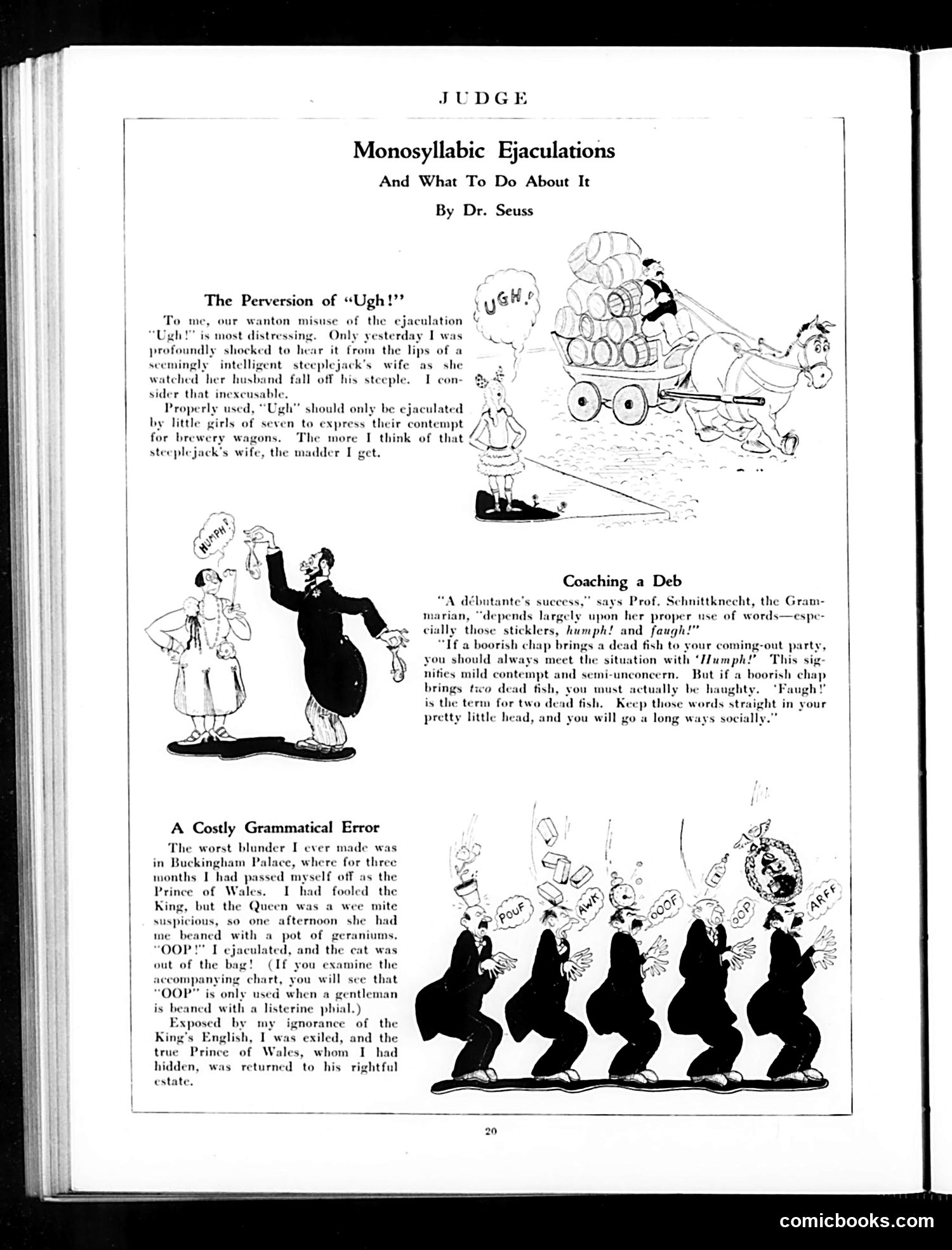
This is a humorous piece by Dr. Seuss (Theodor Geisel) satirizing excessive concern with proper etiquette and linguistic rules in early 20th-century high society. **The satire:** Three sections mock the absurd formality of upper-class speech codes: 1. **"Ugh!"** - Mocks the idea that certain exclamations are only "proper" for specific social situations (here, seven-year-old girls expressing contempt for brewery wagons). 2. **"Coaching a Deb"** - Parodies an overly-pedantic grammar professor teaching debutantes ridiculous distinctions between monosyllabic ejaculations. The joke: memorizing which grunt to use when someone brings dead fish to your coming-out party. 3. **"A Costly Grammatical Error"** - The punchline: a man successfully impersonated the Prince of Wales at Buckingham Palace until he uttered "OOP!" when hit with a flowerpot—revealing his lower-class status, since "OOP" is supposedly only proper when struck by "a lifetime phial" (suggesting a medicine bottle). The humor lies in exaggerating Victorian social anxiety about speaking "correctly" to absurd extremes.
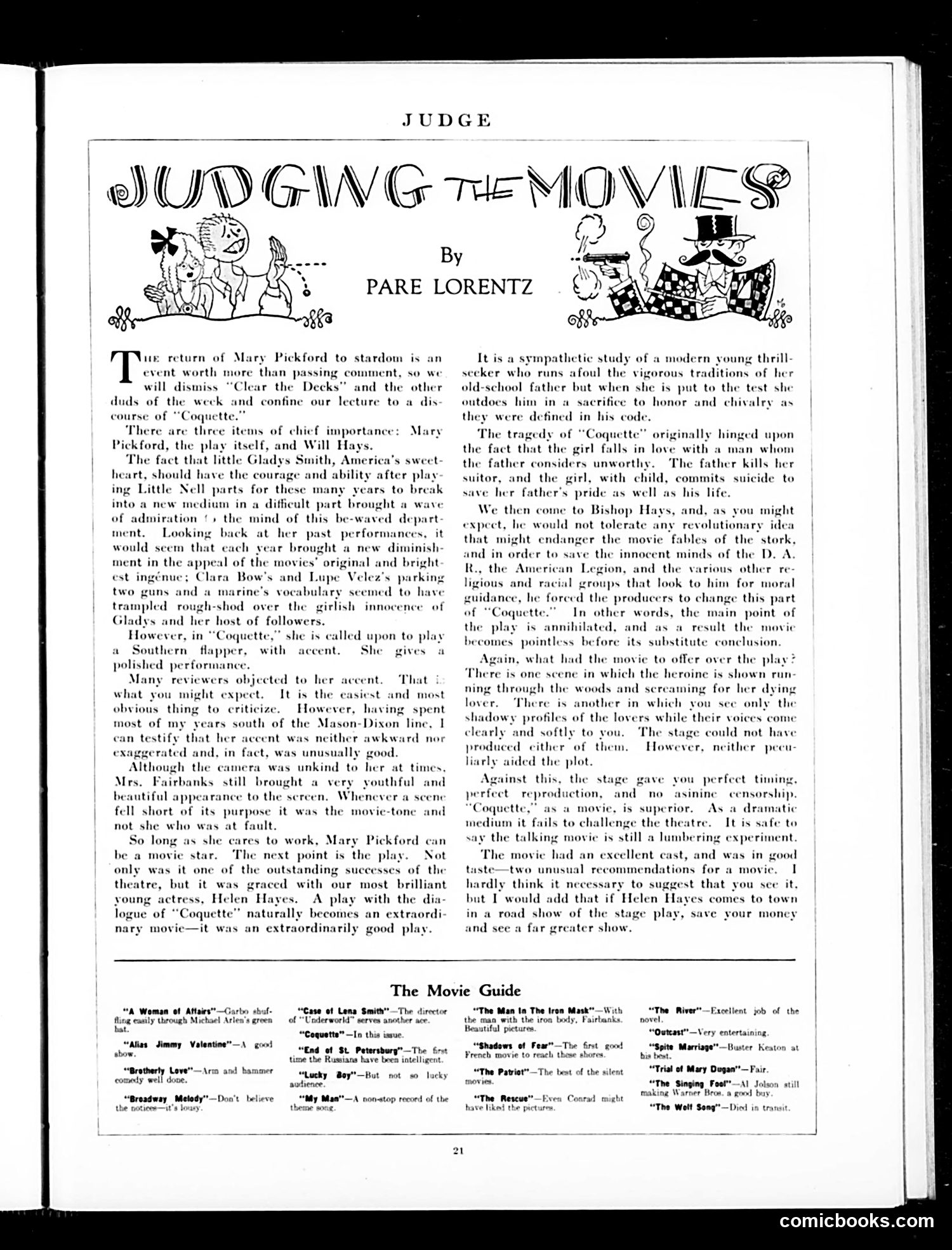
This is a film review column by Pare Lorentz examining Mary Pickford's return to cinema in the stage adaptation "Coquette." The piece praises Pickford's courage and performance while critiquing Hollywood censorship. **Key figures/references:** - **Mary Pickford**: Silent film star returning to acting after years in lesser roles - **Will Hays**: Head of Hollywood's Motion Picture Producers and Distributors of America (the censorship board) - **Helen Hayes**: Stage actress whose theatrical performance Lorentz compares favorably **The satire's point:** Lorentz argues that Hays's censorship forced producers to eliminate the play's central tragedy—a father killing his daughter's suitor, leading to her suicide—rendering the film dramatically pointless. The original stage play's moral weight disappears when sanitized for film audiences. Lorentz suggests cinema still cannot match theater's artistic power, especially under censorship constraints. The review ironically praises Pickford while lamenting how studio interference undermined the material's substance.
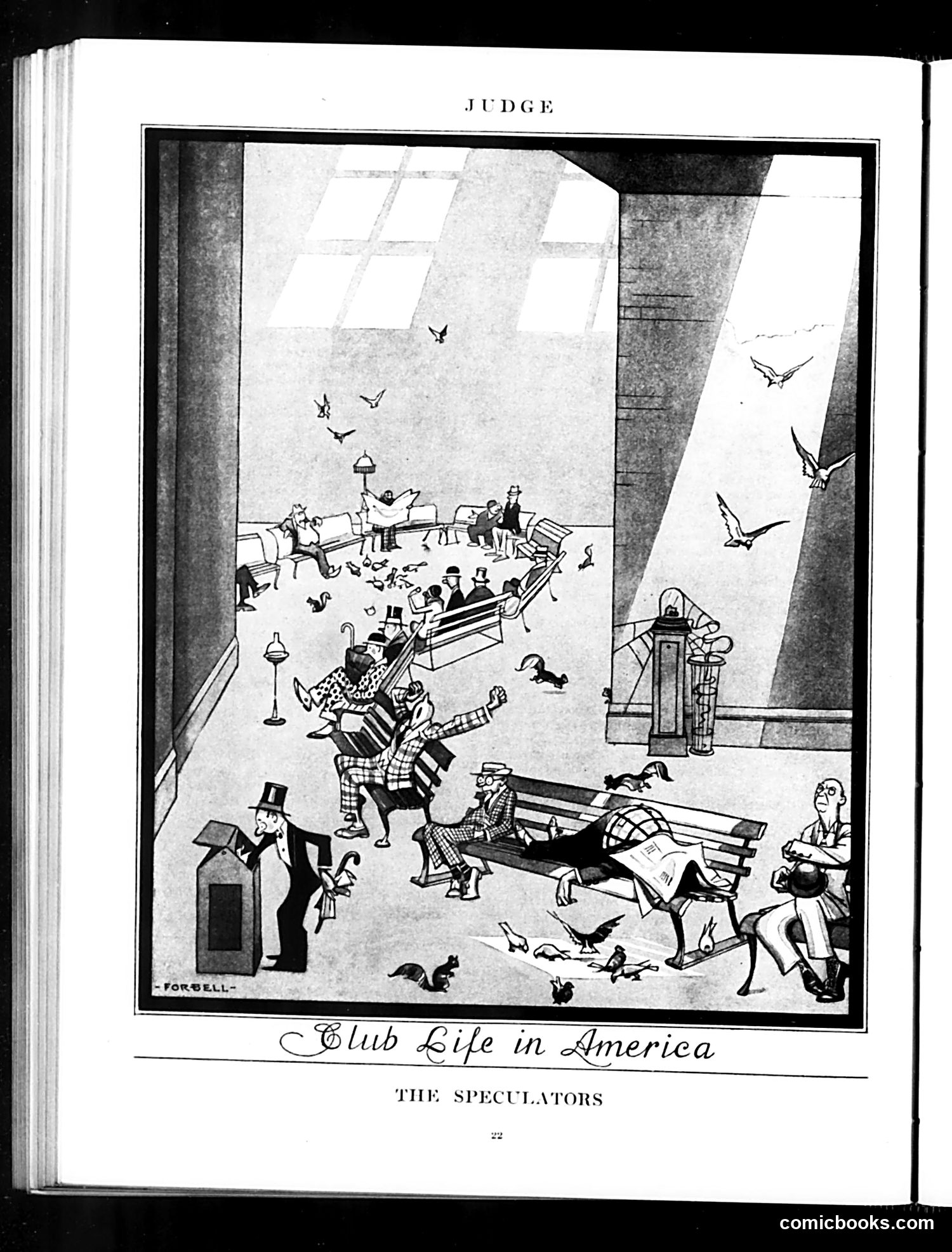
This satirical cartoon depicts an indoor club or gathering space where various well-dressed figures socialize. The title "The Speculators" suggests these are financial investors or risk-takers engaged in speculation—likely commentary on American business culture or stock market activity. The scene shows leisure activity: people lounging on benches, conversing, and relaxing while birds fly overhead through architectural openings. The contrast between idle leisure and the serious business connotation of "speculators" creates the satire—possibly mocking wealthy club members who engage in risky financial ventures while maintaining an appearance of genteel relaxation. The cartoon critiques the disconnect between leisured upper-class club life and aggressive financial speculation typical of the era. The artist's signature reads "Forbell."
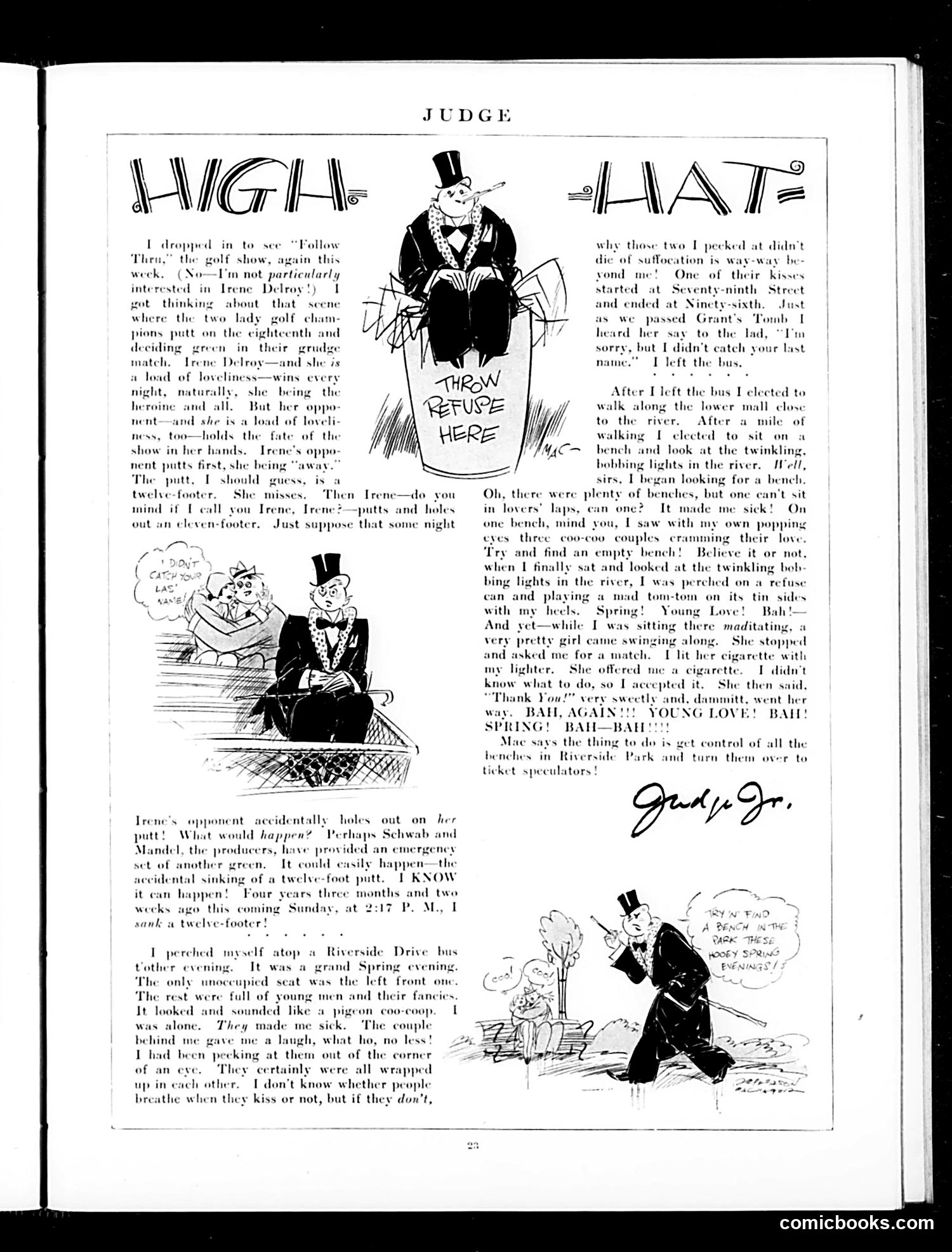
This satirical column mocks the sentimentality of springtime romance in 1920s New York. The narrator, a curmudgeonly observer, describes encounters with young couples engaged in excessive public displays of affection—on buses, in parks, and along the riverside. The humor derives from his exasperated misanthropy: he's disturbed by a couple kissing so long their lips travel from 79th to 96th Street, and by the proliferation of "coo-coo couples" monopolizing all available park benches, forcing him to sit on a refuse can. The cartoons illustrate his complaints with caricatured figures in top hats. The column concludes with a sardonic "solution": Mae's proposal to give Riverside Park benches to ticket speculators—essentially removing public seating to prevent romantic gatherings. The satire targets both youthful exuberance and the narrator's own bilious worldview, poking fun at both young love and curmudgeonly disapproval of it.
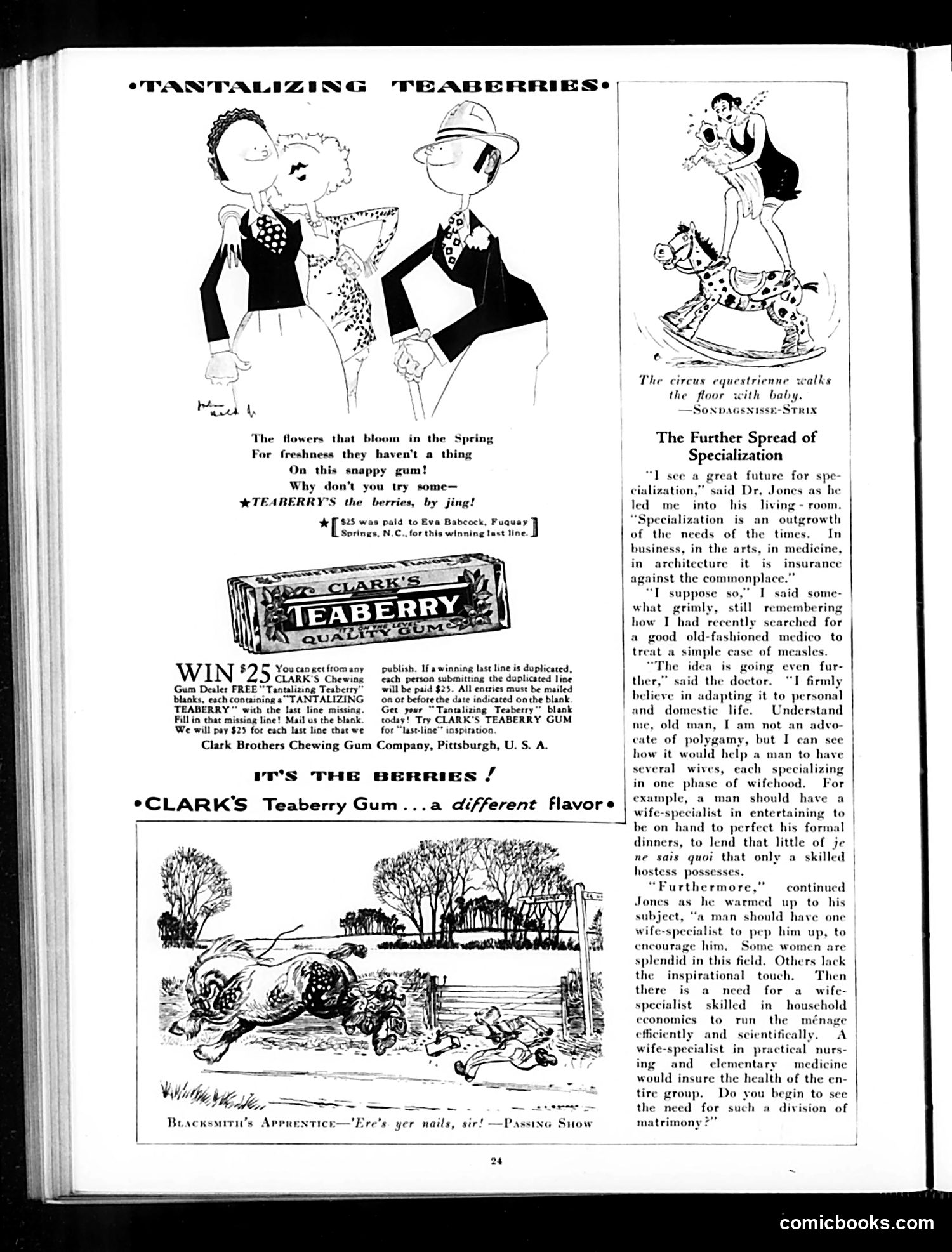
This page blends advertising with satirical commentary on early 20th-century social trends. **The Ads:** Clark's Teaberry Gum dominates with contests promising $25 for completing advertising jingles—typical period marketing strategy. **The Main Satire:** "The Further Spread of Specialization" mocks the era's obsession with professional specialization. Dr. Jones argues that just as businesses and medicine benefit from specialization, marriage should too—proposing men should have multiple wives, each "specialized" for different marital duties: entertaining, emotional support, household management, and nursing. The joke satirizes how contemporary ideology stretched specialization absurdly beyond practical professional contexts into personal life, revealing the era's mechanical thinking about human relationships. The proposal is obviously ridiculous, yet presented earnestly through a fictional doctor character. **Minor cartoon:** "Blacksmith's Apprentice" shows slapstick humor unrelated to the page's main themes. The satire critiques progressive-era overconfidence in rational systematization of all human activity.
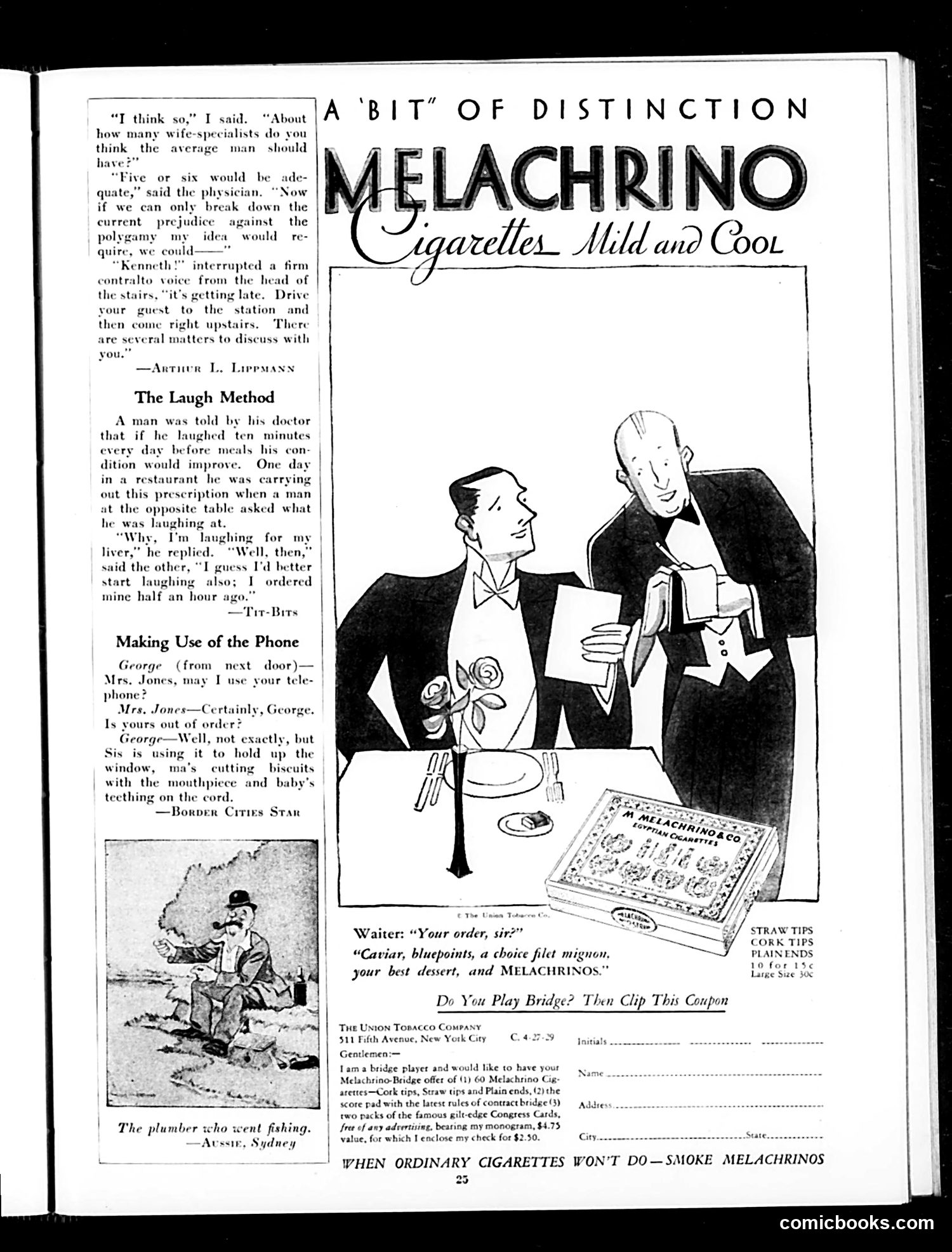
This page is primarily a **cigarette advertisement** for Melachrino cigarettes, presented as a satirical magazine page from Judge. The main content consists of three brief humorous anecdotes (unrelated to smoking) that establish an upscale, sophisticated tone—discussing health remedies, telephone misuse, and dinner etiquette. The advertisement's clever strategy positions Melachrinos as the choice of refined, educated people. A waiter recommends them alongside luxurious foods (caviar, filet mignon), and a bridge offer targets card-playing socialites with premium gifts. The recurring tagline—"When ordinary cigarettes won't do—smoke Melachrinos"—reinforces exclusivity. The satire works by using Judge's comedic authority to lend credibility to the product. For modern readers, this reflects early 20th-century cigarette marketing that exploited aspirational class identity and health claims (the "laugh method" anecdote subtly associates cigarettes with wellness) before advertising restrictions existed.
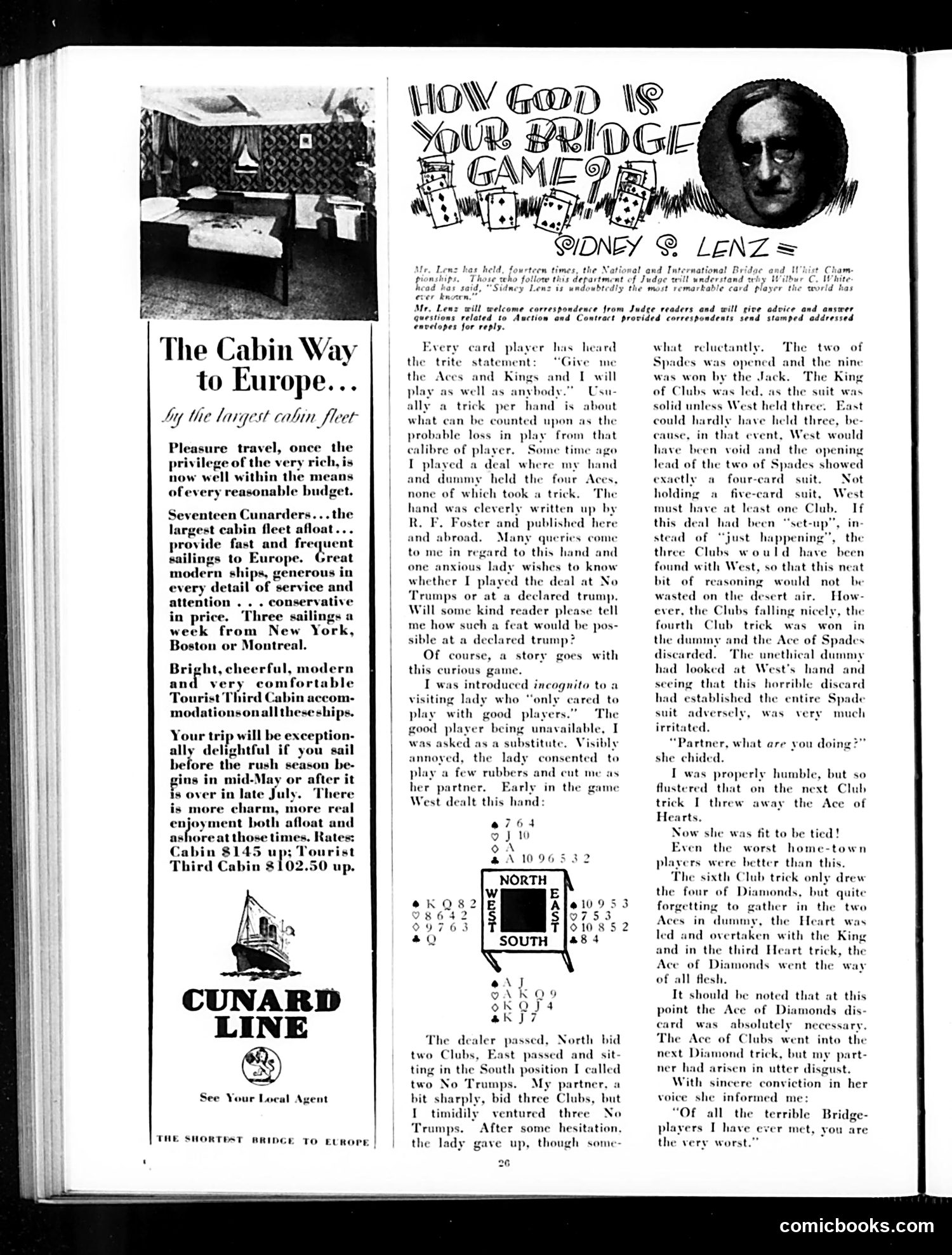
This page contains two distinct elements: **Left side:** A Cunard Line advertisement for transatlantic ocean travel, promoting their "Tourist Third Cabin" accommodations as affordable leisure travel for middle-class Americans. **Right side:** A bridge column by Sidney S. Lenz, a famous bridge expert. Lenz recounts a humorous hand of contract bridge where he was playing with a snobbish woman who insisted on playing only with "good players." The satire is gentle: Lenz, playing incognito, demonstrates superior skill by executing a brilliant contract despite the lady's initial disdain. The joke culminates when, after winning the hand through skillful play, Lenz deliberately makes a ridiculous mistake (throwing away the Ace of Hearts) on a later trick—apparently to humble his condescending partner who had been watching his play and complaining throughout. The humor lies in the tension between the lady's class-consciousness about bridge partners and her exposure to someone far more skilled than she expected.
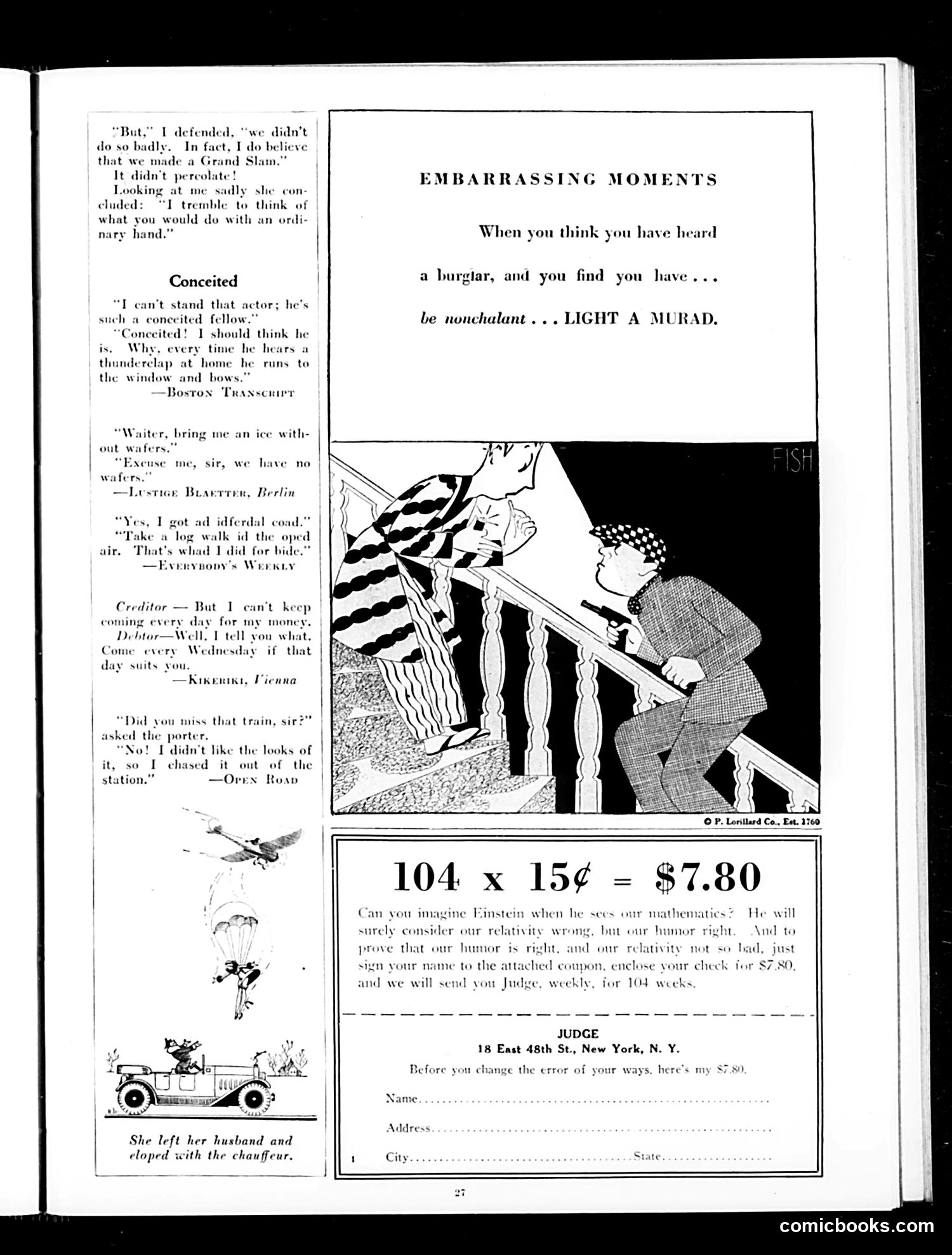
This page combines humorous anecdotes with advertising. The left column features brief jokes about social awkwardness—a wife criticizing her husband's bridge playing, an actor's vanity, waiter confusion, and a debtor negotiating payment schedules. These were typical filler jokes common in early 20th-century humor magazines. The main content is a **Murad cigarette advertisement** disguised as humor. The "Embarrassing Moments" section uses the scenario of mistakenly thinking there's a burglar to pitch cigarettes as a solution—smoking one will make you appear calm and composed. This reflects the era's marketing of cigarettes as sophistication aids. Below is a subscription offer for Judge itself, humorously referencing Einstein's theories of relativity as a hook: "Can you imagine Einstein when he sees our mathematics?"—a topical reference likely dating to the 1920s when Einstein's work fascinated American audiences. The offer was $7.80 for 104 weekly issues.
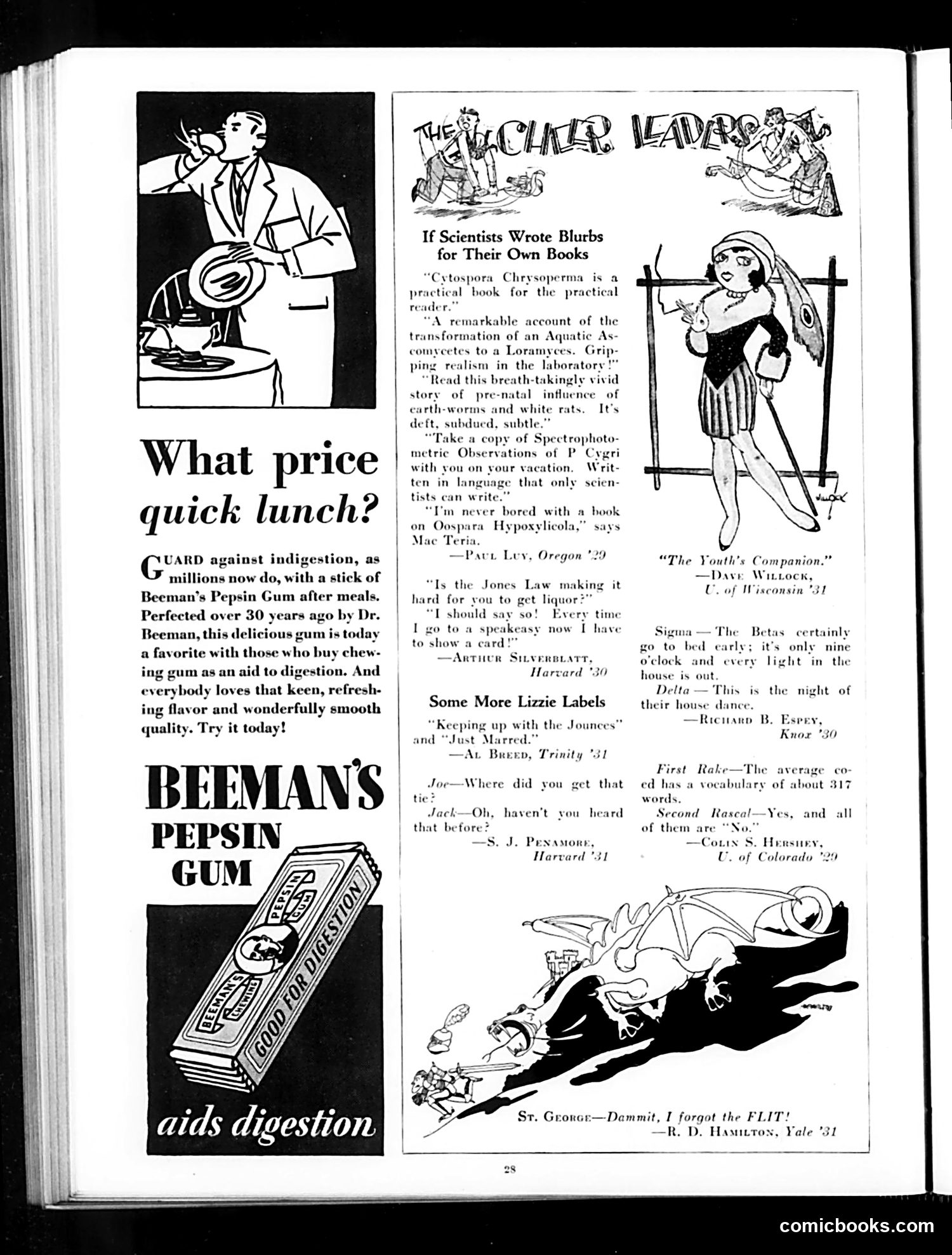
This Judge magazine page contains two distinct sections: **Left side:** A Beeman's Pepsin Gum advertisement claiming the product aids digestion after meals. The ad uses a doctor endorsement appeal, common in early 20th-century advertising. **Right side:** "The Lighter Vein" humor section mocking overwrought academic book blurbs. Scientists are satirized for writing absurdly pompous jacket copy using jargon ("Cytospora Chrysoperma," "Spectrophotometric Observations") to describe dry technical subjects. The satire suggests scholars inflate the importance of obscure research through pretentious marketing language. Below that are collegiate jokes and witticisms submitted by college students from various universities, including a running gag about "Lizzie Labels" (sorority stereotypes) and a final cartoon showing someone forgetting "FLIT" (an insecticide), suggesting comic consequences. The overall tone mocks academic pretension and collegiate humor conventions typical of 1930s Judge magazine.
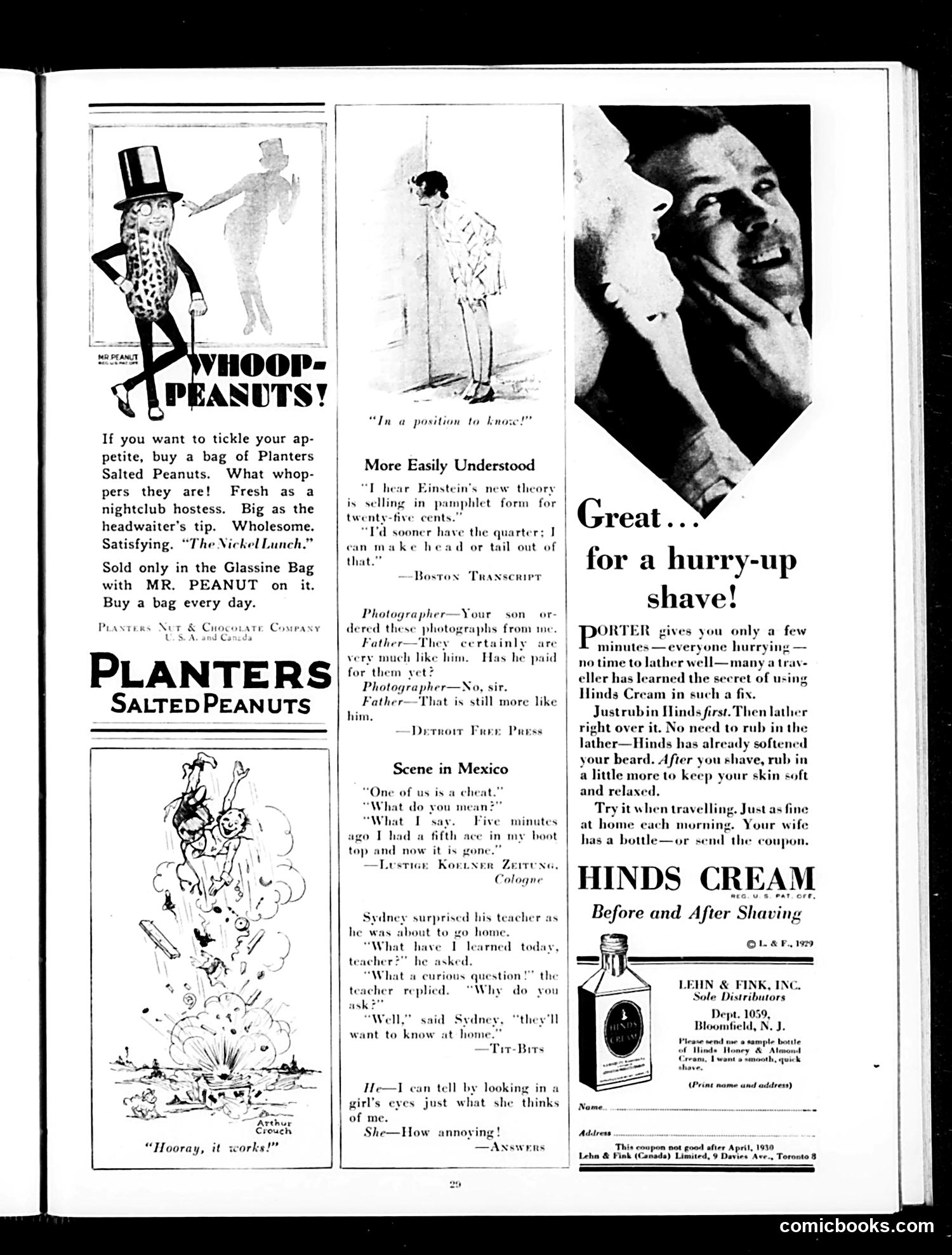
This page mixes satirical humor with period advertising (circa 1929-1930, based on the coupon date). **The Cartoons:** The left panel satirizes Planters Salted Peanuts, using Mr. Peanut (the mascot) and comparing the product's freshness to a "nightclub hostess"—a dig at the artificiality of 1920s nightlife culture. The center section contains brief jokes, including one mocking Einstein's relativity theory being sold cheaply, and a "Scene in Mexico" depicting a card cheat—likely reflecting American stereotypes about Mexico during Prohibition era tensions. The right panel shows a photograph advertisement for Hinds Cream shaving product, featuring a man's face. **Social Context:** These jokes reflect 1920s preoccupations: Einstein's celebrity status among the general public, Prohibition-era anxieties, and the busy modern lifestyle requiring quick grooming solutions. The humor assumes shared middle-class values and familiar stereotypes typical of Judge's satirical approach. The page is primarily **advertising content** disguised as editorial humor.
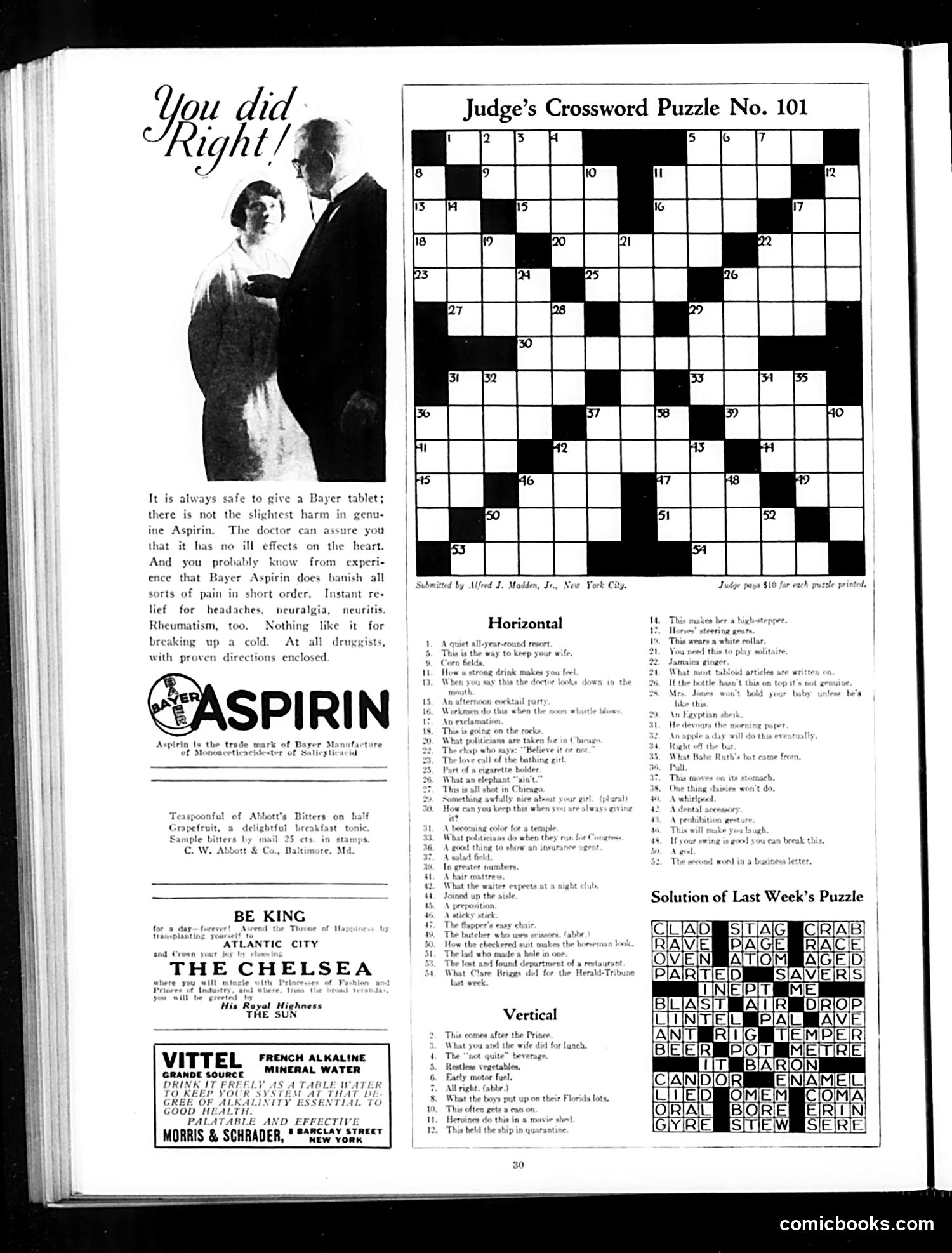
This page is primarily **advertising**, not satirical content. The main illustration shows a couple with the caption "You did Right!" — likely promoting Bayer Aspirin, which dominates the left side of the page. The Aspirin ad emphasizes safety and effectiveness for various ailments (headaches, neuralgia, rheumatism, colds), reflecting early 20th-century pharmaceutical marketing that made health claims now considered dubious or illegal. The phrase "You did Right!" suggests the couple made a wise health decision by using Aspirin. Below are additional period advertisements: one for "Be King" (unclear product), another for Atlantic City's Chelsea hotel, and Vittel mineral water promoting "alkalinity" as essential to health—a pseudo-scientific wellness claim common to the era. The page also contains a crossword puzzle ("Judge's Crossword Puzzle No. 101"), which was popular entertainment in magazines of this period. There is no obvious political satire visible on this particular page.
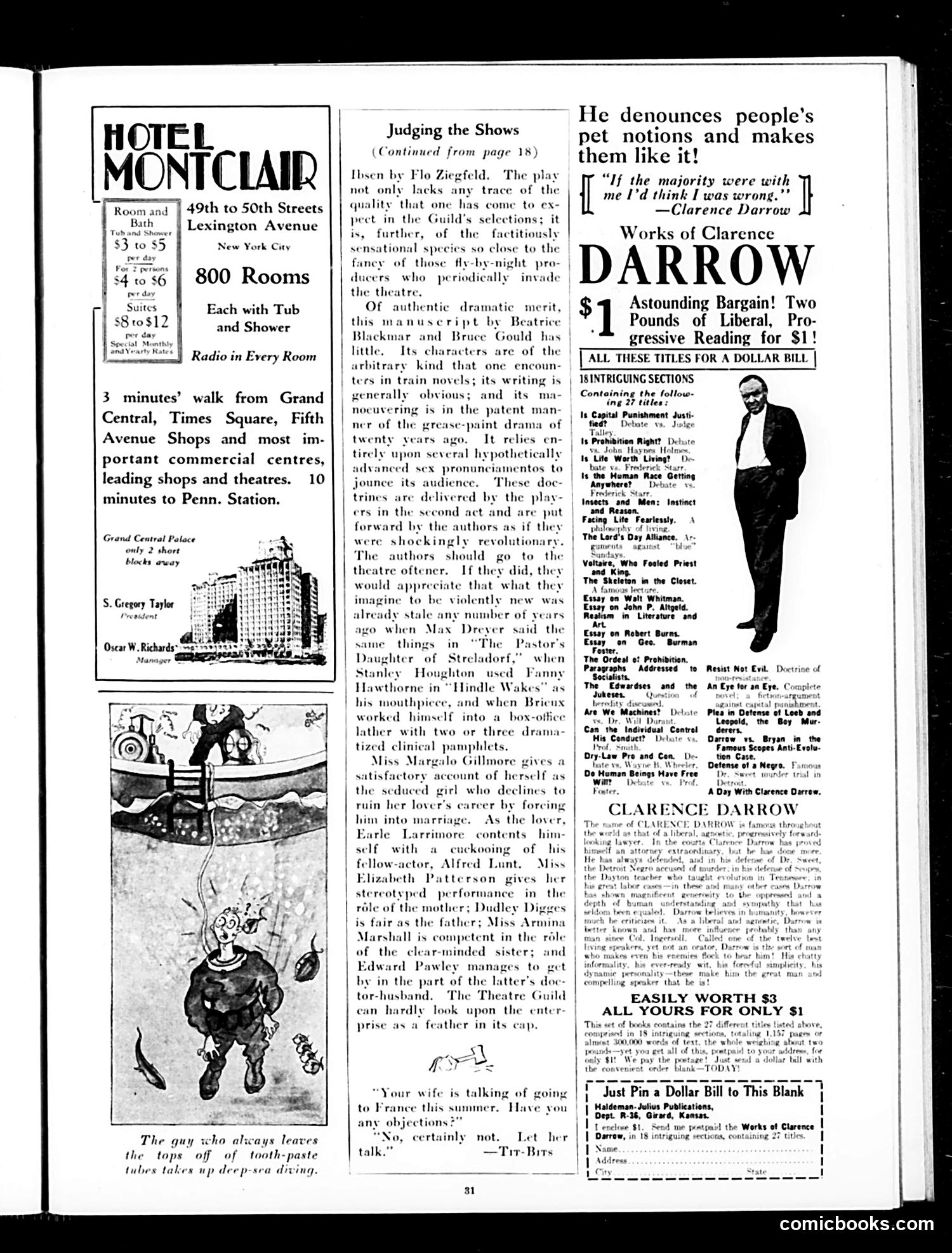
This page primarily contains **advertisements and book promotion**, not political satire, though it references **Clarence Darrow**, the famous defense attorney and skeptic. The **cartoon at bottom left** depicts a man leaving toothpaste tube caps off, captioned that he "takes up deep-sea diving"—a typical early-20th-century joke format implying he's reckless or careless. **Upper right section** promotes Darrow's collected works—27 essays and debates on topics like prohibition, evolution (Scopes trial reference), and social issues—marketed as "$3 worth for $1." The quoted epigraph ("If the majority were with me I'd think I was wrong") reflects Darrow's iconoclastic reputation: he famously challenged conventional thinking on religion, evolution, and law. The **hotel advertisement** and theater review filling the remainder are standard magazine content. The review discusses a new Ibsen play, criticizing it as derivative. This page reflects 1920s-30s American culture: Darrow's celebrity as a contrarian intellectual, ongoing debates about evolution, and Judge magazine's mix of light humor with serious social commentary.
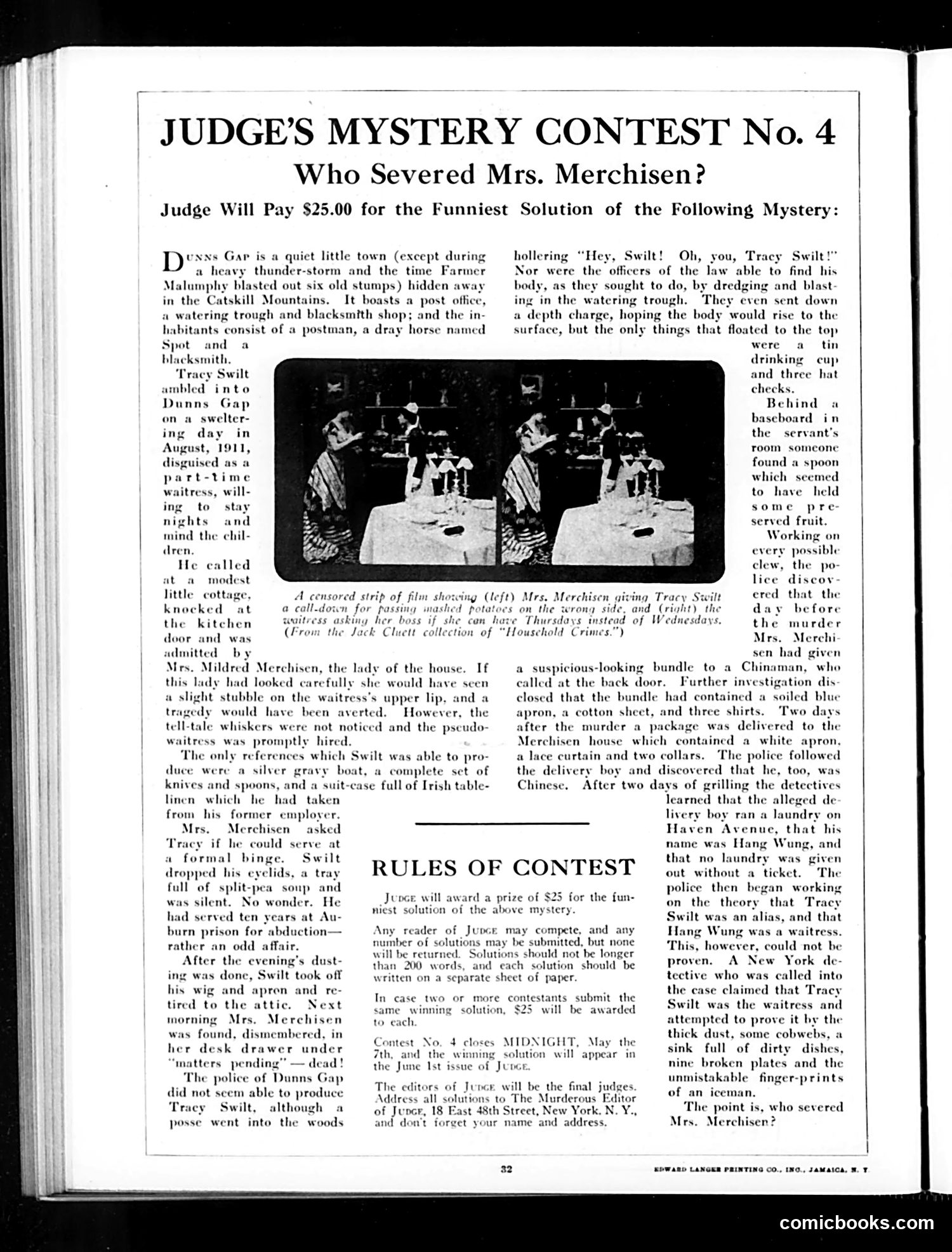
This page presents a interactive mystery puzzle rather than a traditional cartoon. Judge magazine ran "Mystery Contests" where readers submitted humorous solutions to posed crimes, with the $25 prize going to the funniest answer. The setup: Tracy Swilt, a man disguised as a part-time waitress, is hired by Mrs. Merchisen in the tiny town of Dunns Gap. After serving dinner, Mrs. Merchisen is found severed in her desk drawer—dead. The clues include a tin cup, hat checks, a spoon with preserved fruit, and packages containing laundry items delivered by a Chinese man named Hang Wung. Modern readers should know this reflects early-1900s detective fiction conventions (Sherlock Holmes-style puzzle stories) combined with vaudeville humor—the joke presumably being the absurdity of the situation and readers' creative, comedic explanations rather than logical deduction.
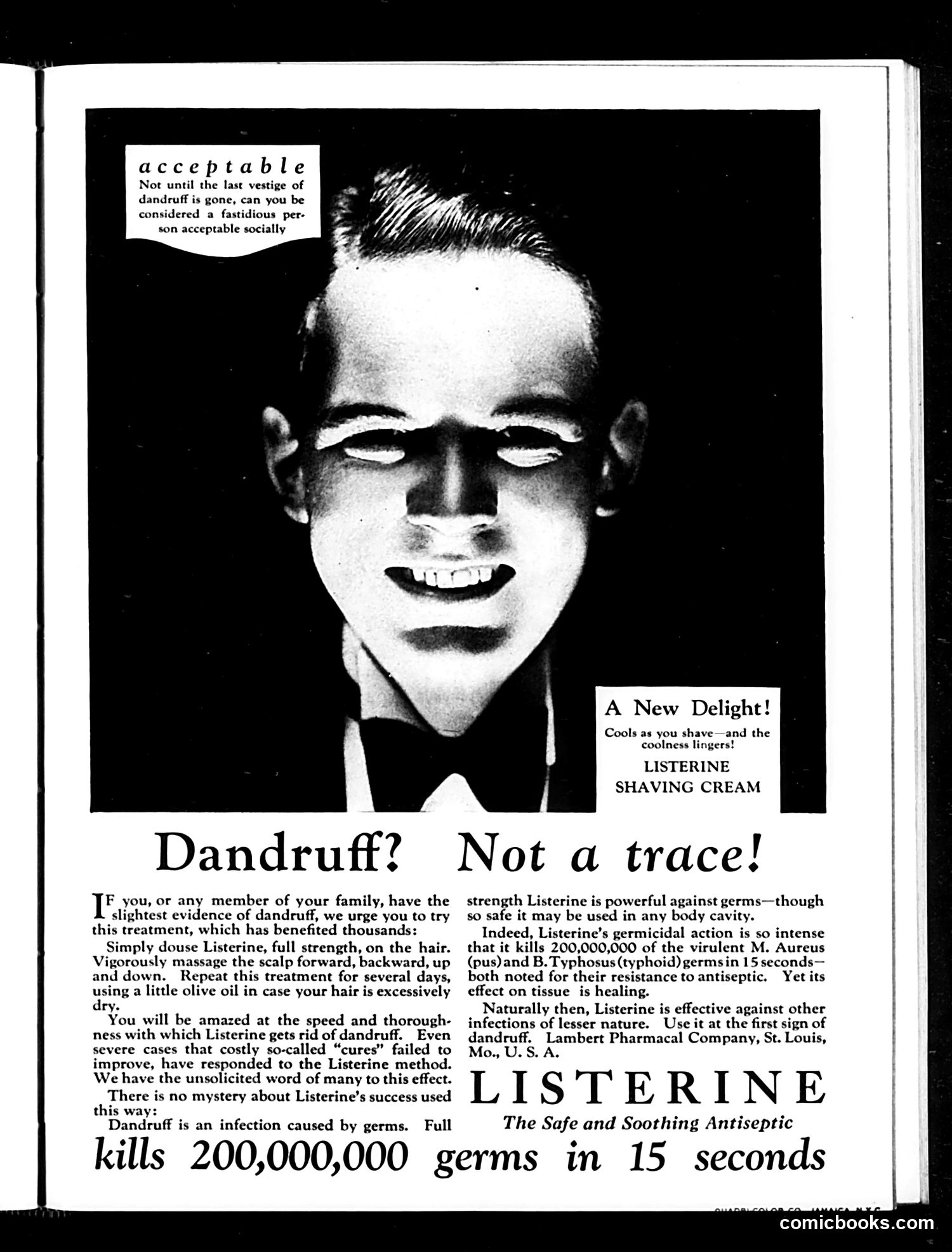
This page is primarily a **Listerine advertisement**, not satire or political commentary. It promotes Listerine as a dandruff treatment and shaving cream. The central message reflects **1920s-30s social anxiety**: dandruff is portrayed as socially unacceptable—a mark of being "fastidious" or respectable. The well-dressed man with glasses represents the ideal modern gentleman, implying that using Listerine is necessary for social acceptability. The advertisement uses pseudo-scientific language (claiming to kill "200,000,000 germs in 15 seconds") typical of vintage pharmaceutical marketing. It recommends applying full-strength Listerine directly to the scalp—a practice that would be considered unsafe today. Rather than satire, this reflects the **era's actual marketing strategy**: exploiting social insecurity about hygiene and appearance to sell products, positioning everyday conditions as embarrassing problems requiring commercial solutions.
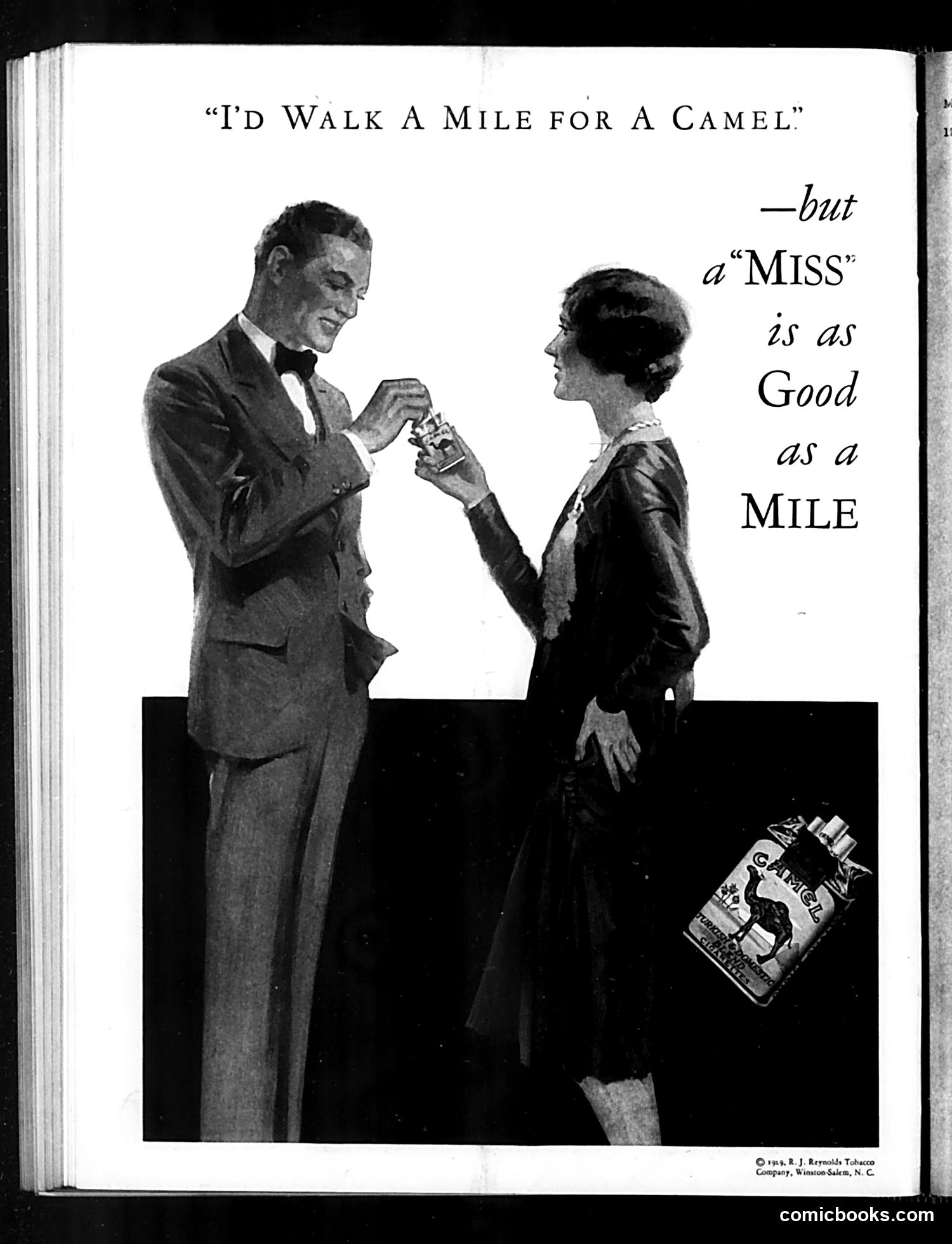
This is a cigarette advertisement for Camel brand cigarettes, playing on their famous slogan "I'd Walk a Mile for a Camel." The ad shows a well-dressed man offering cigarettes to a woman in elegant attire, suggesting romantic appeal. The joke contrasts the original slogan with a new claim: while someone might walk a mile for a Camel cigarette, a "miss" (a young woman) is equally valuable—or as the ad suggests, equally "good as a mile." This is a flirtation-based play on words, implying that winning a woman's affection rivals the appeal of the product itself. The advertisement reflects early 20th-century gender dynamics and cigarette marketing that emphasized sophistication and social desirability. The Camel brand package is visible in the lower right corner.