
A complete issue · 40 pages · 1929
Judge — June 22, 1929
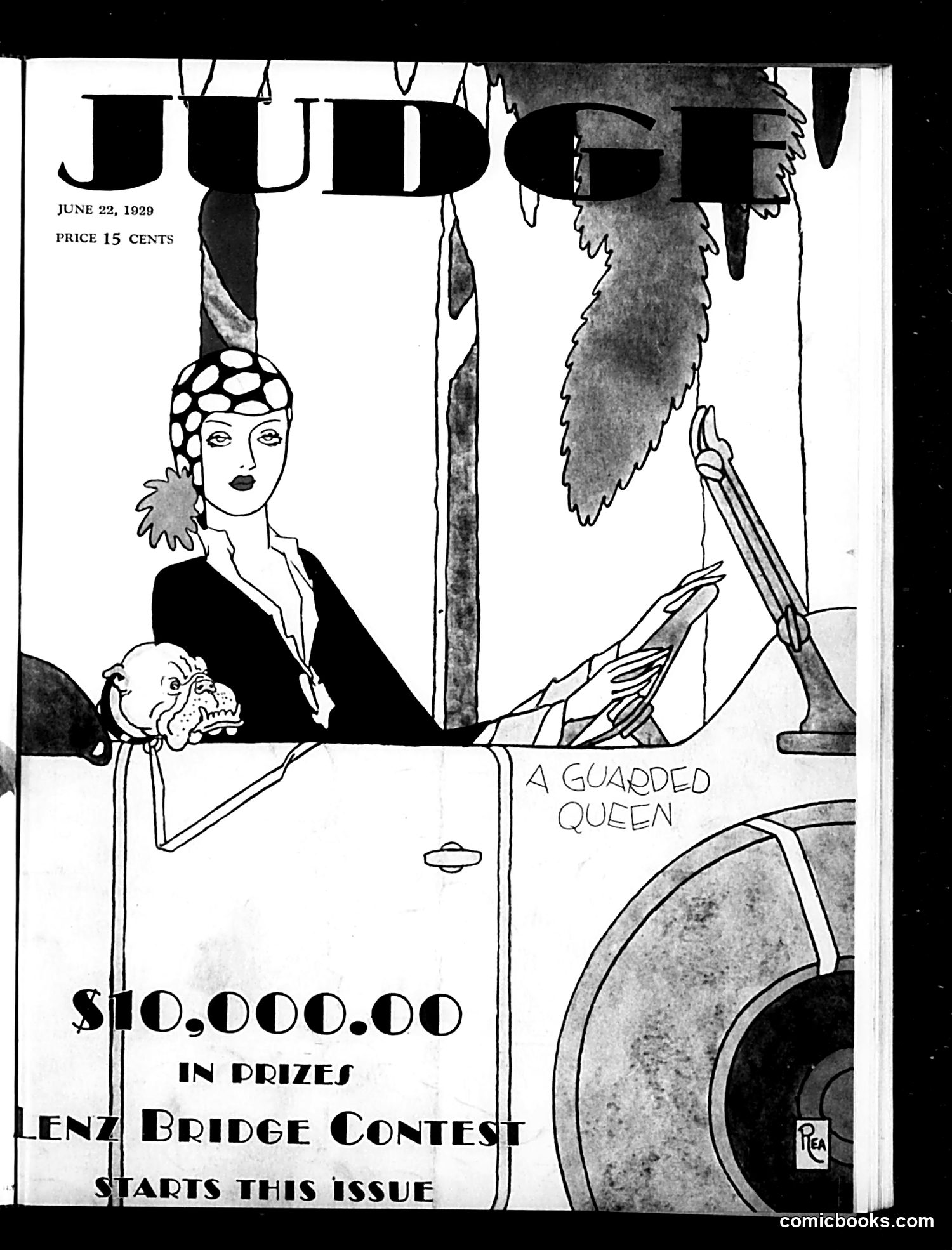
This Judge cover features **"A Guarded Queen,"** an Art Deco-style illustration of an elegant woman in 1920s fashion wearing a distinctive beaded headpiece. She's depicted in an automobile, holding what appears to be a small bulldog or similar dog as a protective companion. The caption's reference to a "guarded queen" likely satirizes wealthy women of the era and their need for security or protection—possibly commentary on kidnapping fears that were prevalent in the late 1920s (the Lindbergh kidnapping occurred in 1932, but such anxieties were emerging). The page also advertises a **"Lenz Bride Contest"** offering **$10,000 in prizes**, reflecting Judge's commercial content mixed with satirical commentary on contemporary social trends and consumer culture.
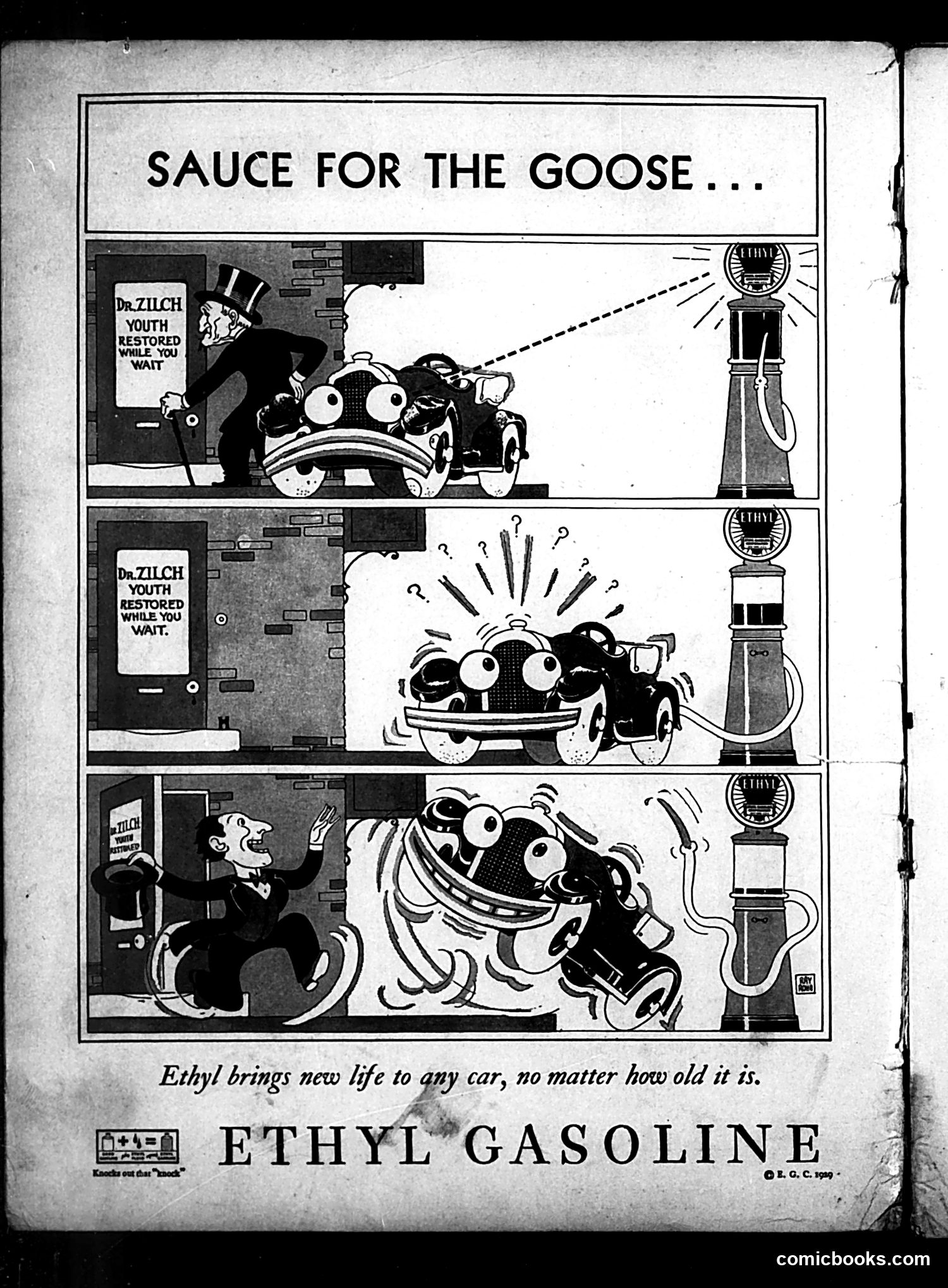
This is a **vintage advertisement**, not political satire. The page promotes **Ethyl Gasoline** through a comic strip titled "Sauce for the Goose." The three-panel narrative shows: 1. A man at a Dr. Zilch youth-restoration clinic watches a car get filled with fuel 2. The car becomes energized with question marks (confusion/bewilderment) 3. The man exits the clinic, apparently rejuvenated, as the car continues its animated behavior The tagline states: "Ethyl brings new life to any car, no matter how old it is." **The joke**: Just as Dr. Zilch restores human youth, Ethyl gasoline "restores" tired, old automobiles to vigorous performance. The anthropomorphized car's exaggerated reactions suggest dramatic revitalization. This uses playful, surreal humor typical of 1920s-30s advertising to pitch fuel additives as performance enhancers for aging vehicles.
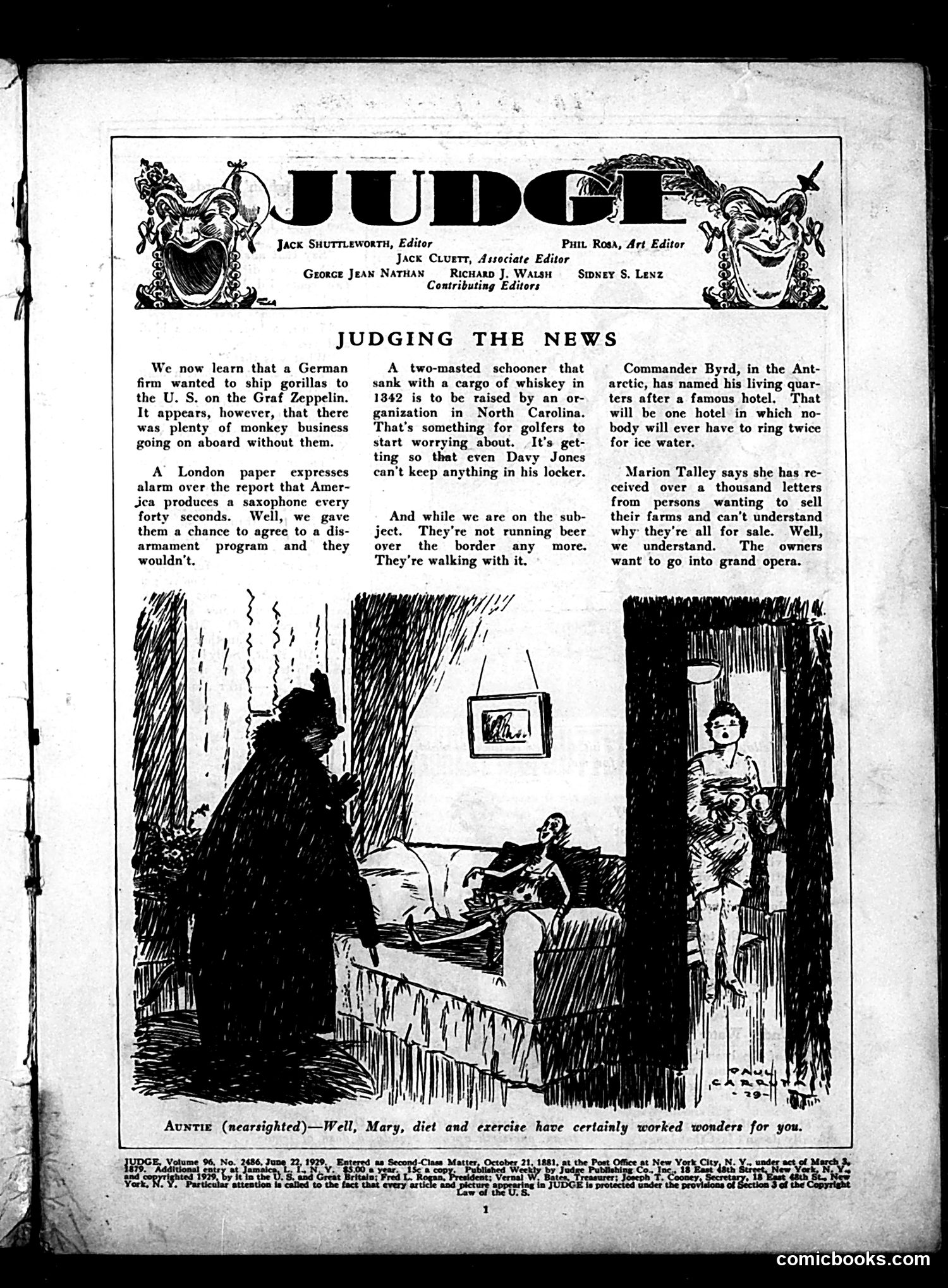
This cartoon satirizes prohibition-era hypocrisy. The caption "Austin (nearsighted)—Well, Mary, diet and exercise have certainly worked wonders for you" appears to mock someone's obliviousness to obvious reality. The visual likely depicts a domestic scene where a husband ("Austin") fails to notice his wife's dramatic physical transformation—possibly weight gain or other changes—attributing it instead to diet and exercise. The satire targets willful blindness or self-deception. The accompanying text discusses unrelated topics: German submarine activity, a schooner carrying whiskey (flagrantly illegal during Prohibition), and farm sales. The overall page presents satirical "news commentary" typical of Judge's approach to contemporary American social and political absurdities of the 1920s era.
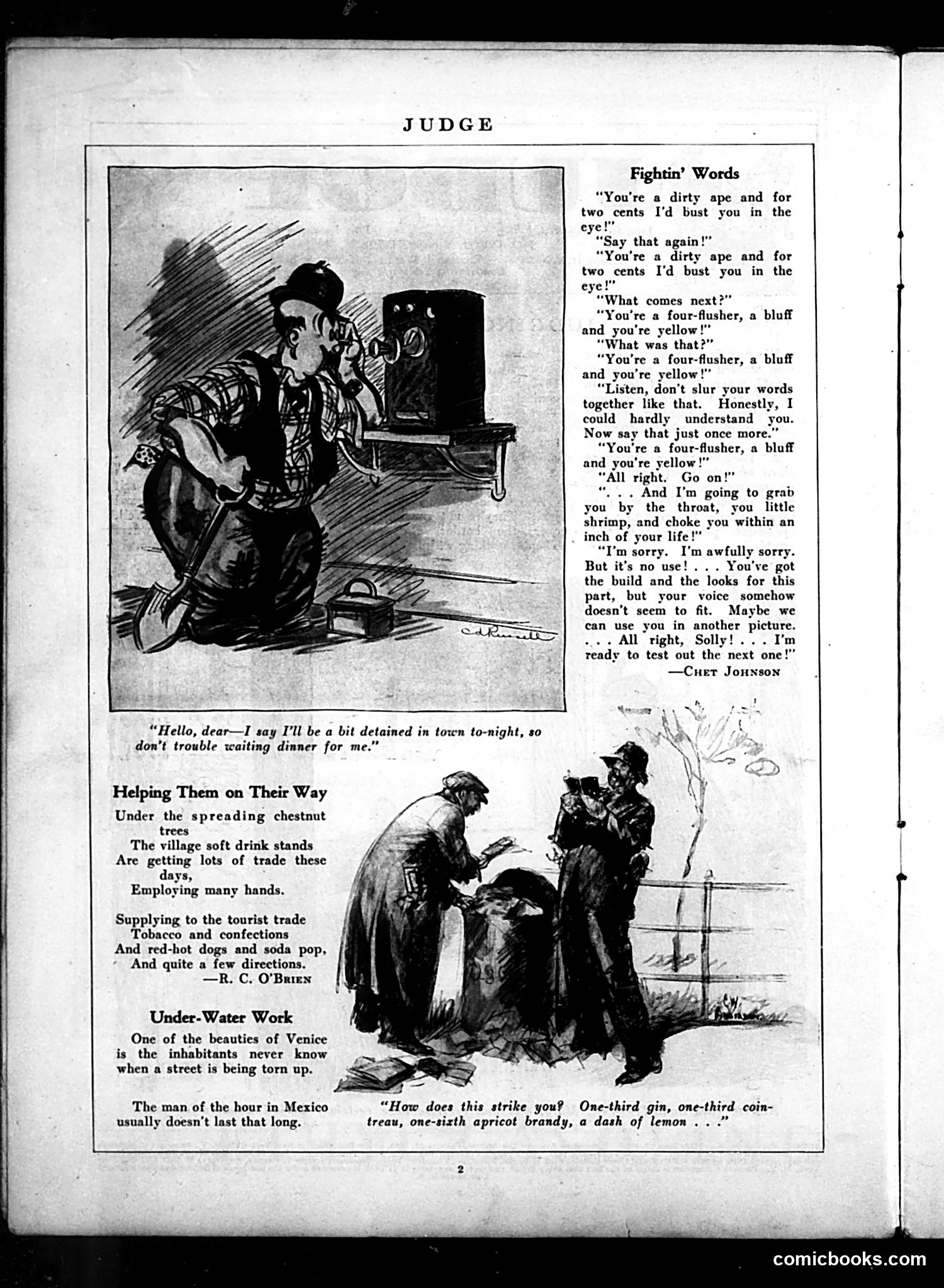
This page contains three separate humorous pieces rather than unified political cartoons. **"Fightin' Words"** (top right) presents a comedic dialogue between two people engaged in increasingly absurd insults, attributed to Chet Johnson. It's generic humor about argument escalation rather than political satire. **"Helping Them on Their Way"** (bottom left) shows a street vendor beneath chestnut trees supplying tourists with tobacco, confections, hot dogs, and soda—a gentle observation about commercial enterprise in tourist areas. Credited to R.C. O'Brien. **"Under-Water Work"** and **"The Man of the Hour in Mexico"** are brief, untethered quips with no clear satirical targets. The bottom illustration depicts men discussing a cocktail recipe, unrelated to the text above it. This appears to be a miscellaneous humor and observations page rather than focused political commentary.
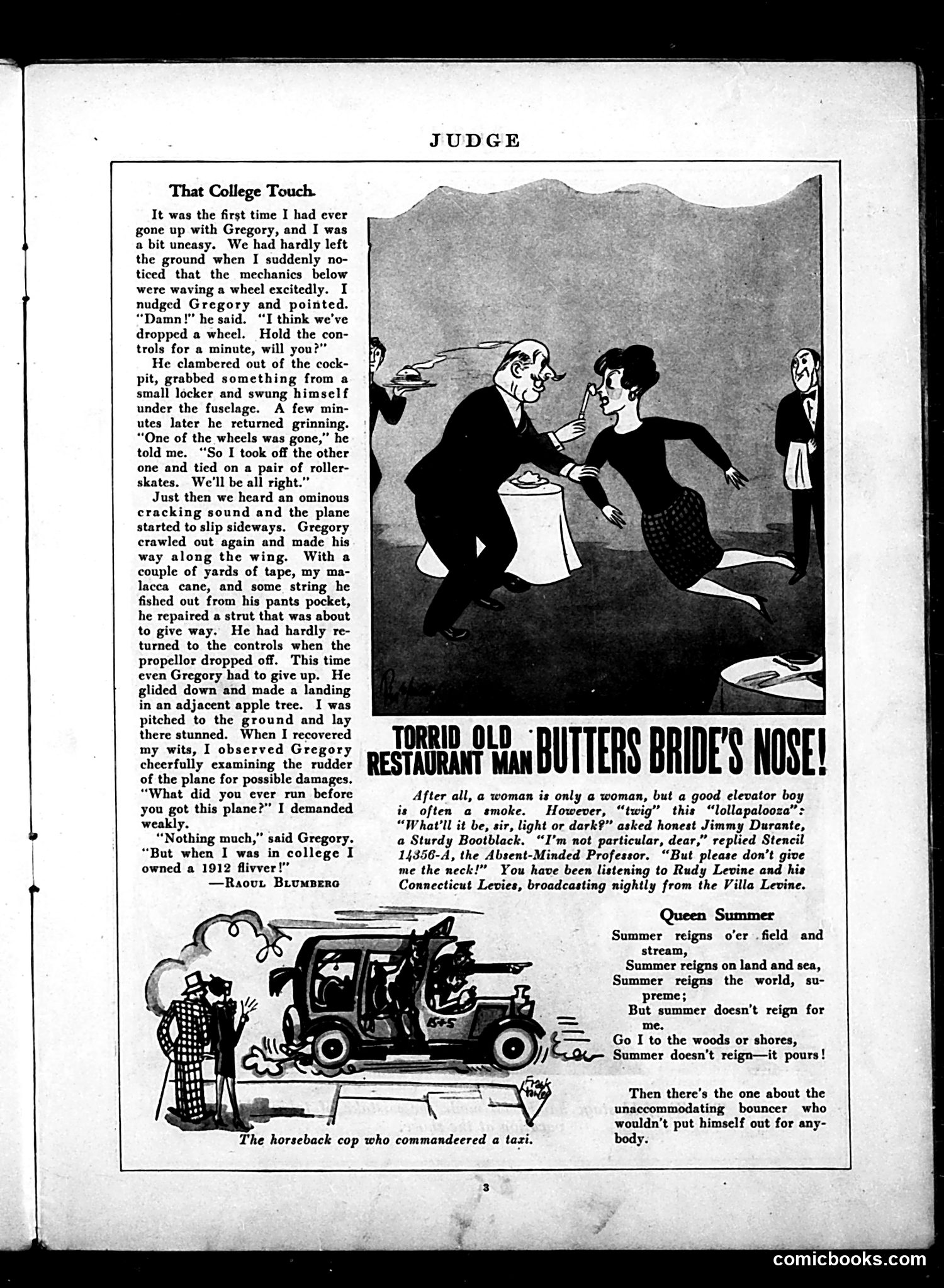
This page contains two distinct pieces: **"That College Touch"** (top): A humorous anecdote by Raoul Blumberg about flying with someone named Gregory. When mechanical failures occur during flight, Gregory improvises repairs using tape, string, and roller skates, ultimately crash-landing in an apple tree. The joke satirizes college-educated people as impractical problem-solvers who apply half-baked academic solutions to real-world emergencies—hence "that college touch." The narrator's deadpan observations of Gregory's failures drive the humor. **"Torrid Old Restaurant Man Butters Bride's Nose!"** (middle): A cartoon caption-joke playing on scandal sheet headlines. The detailed caption appears to reference radio personalities and creates mock-romantic tension. **"Queen Summer"** (bottom right): Verse about summer, apparently unrelated to other content. A small cartoon shows a taxi driver described as a "horseback cop."
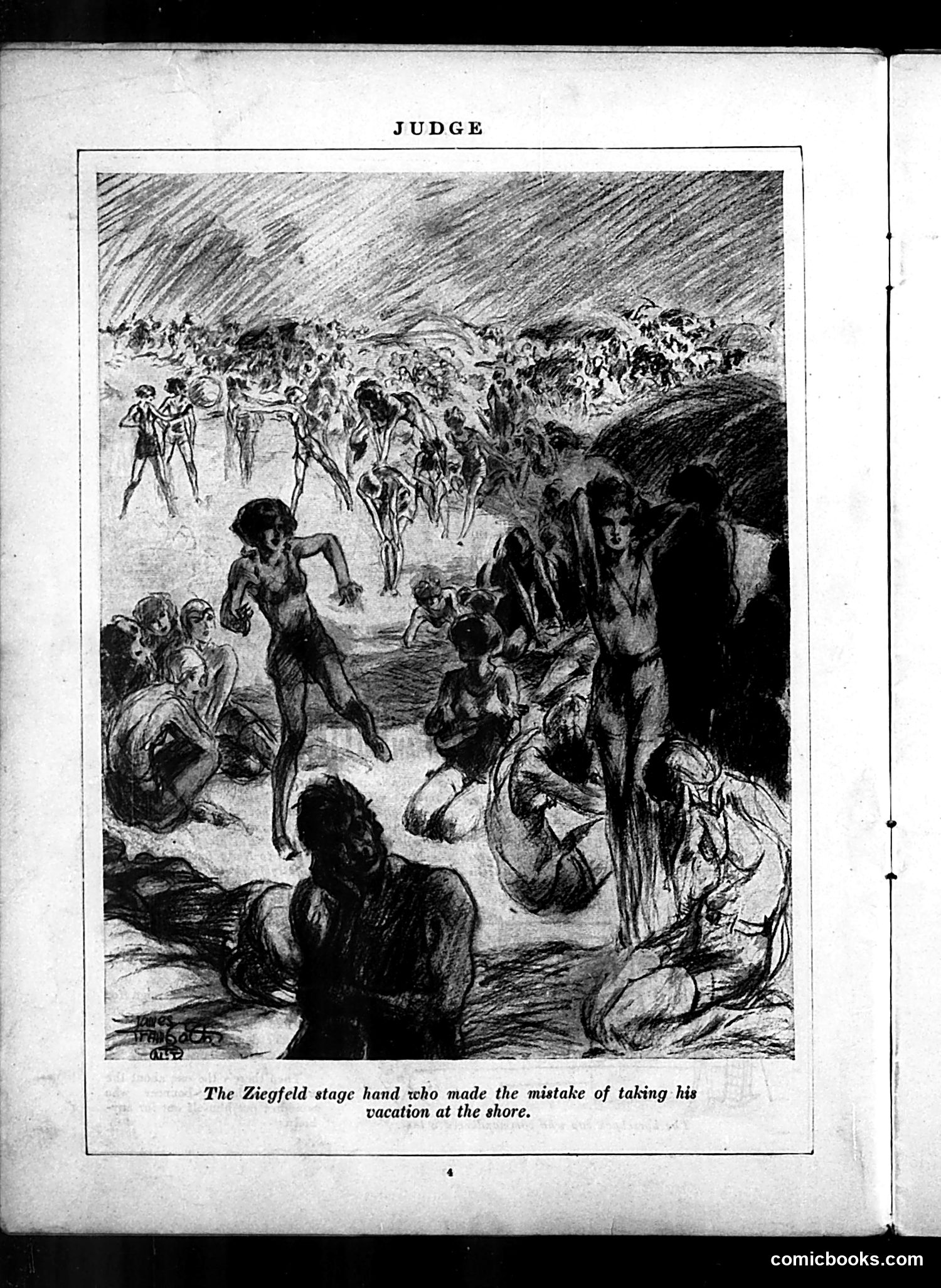
**Title:** "Judge" **Caption:** "The Ziegfeld stage hand who made the mistake of taking his vacation at the shore." **Content:** This is a satirical cartoon depicting a theatrical scene at a beach. The image shows numerous nude or semi-nude figures on a beach, with what appears to be a stage hand observing the scene. **Context:** The joke references the Ziegfeld Follies, the famous Broadway revue known for its elaborate productions and scantily-clad chorus girls. The satire suggests that a Ziegfeld stage hand, accustomed to theatrical productions featuring undressed performers, went to the beach for vacation and found the experience surprisingly similar to his work—surrounded by semi-nude beachgoers. The humor lies in the implied comparison between theatrical nudity and everyday beach culture.
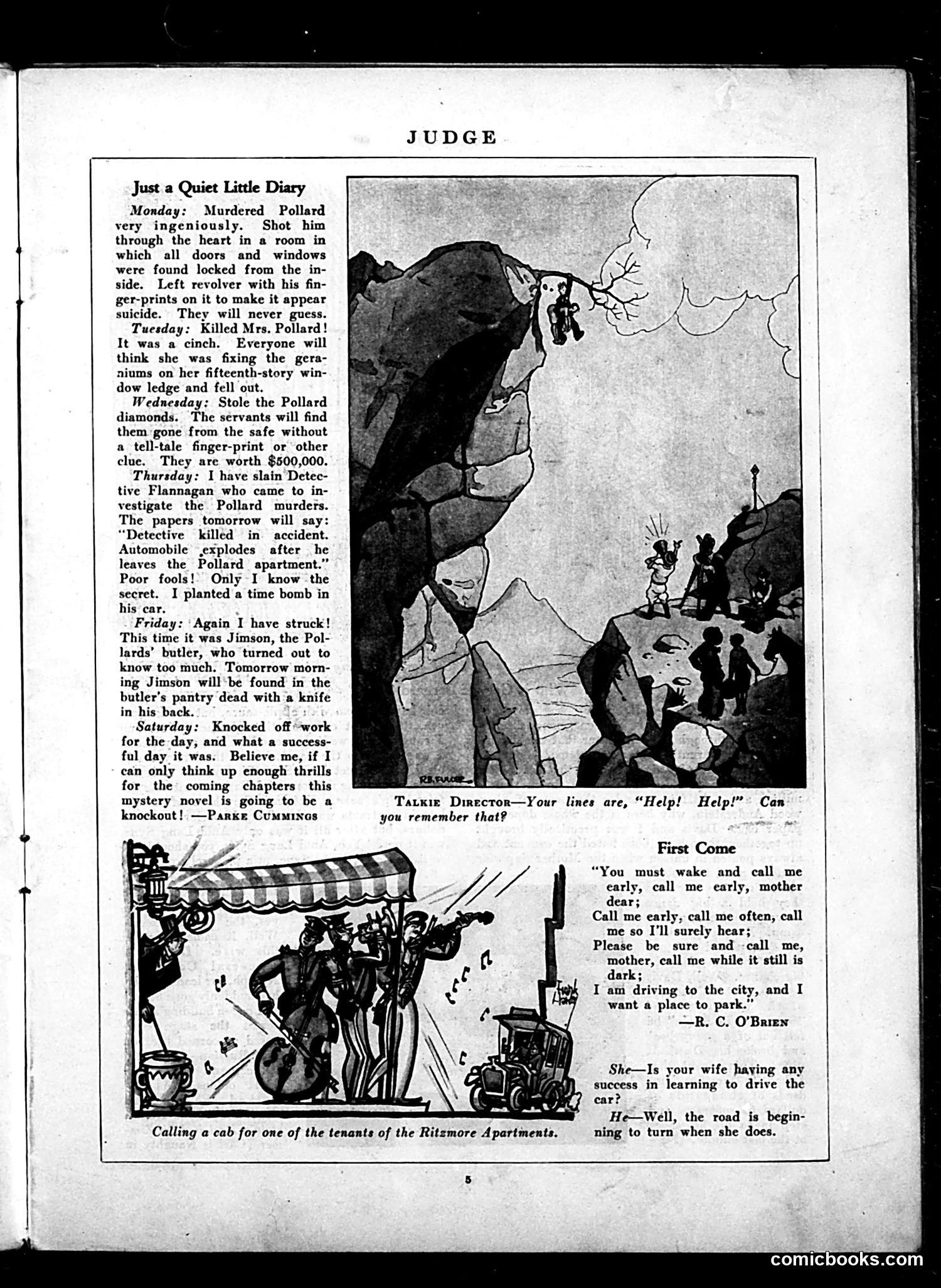
This page contains two distinct pieces: **"Just a Quiet Little Diary"** (left) is a humorous fictional account by Parker Cummings describing a week of elaborate murders—poisoning, stabbing, theft, and bombing—presented as casual diary entries. The satire mocks sensationalist crime fiction and mystery novels popular at the time, exaggerating the implausibility of one person committing multiple perfect crimes undetected. **The main cartoon** (center/right) depicts a figure on a cliff or high building with people gathered below, captioned "Talkie Director—Your lines are, 'Help! Help!' Can you remember that?" This satirizes early "talking pictures" (sound films), mocking how directors struggled to adapt silent-film techniques to dialogue, and perhaps critiquing actors' limited skills during cinema's transition to sound. **"First Come"** (bottom right) is a brief humorous dialogue about driving lessons.
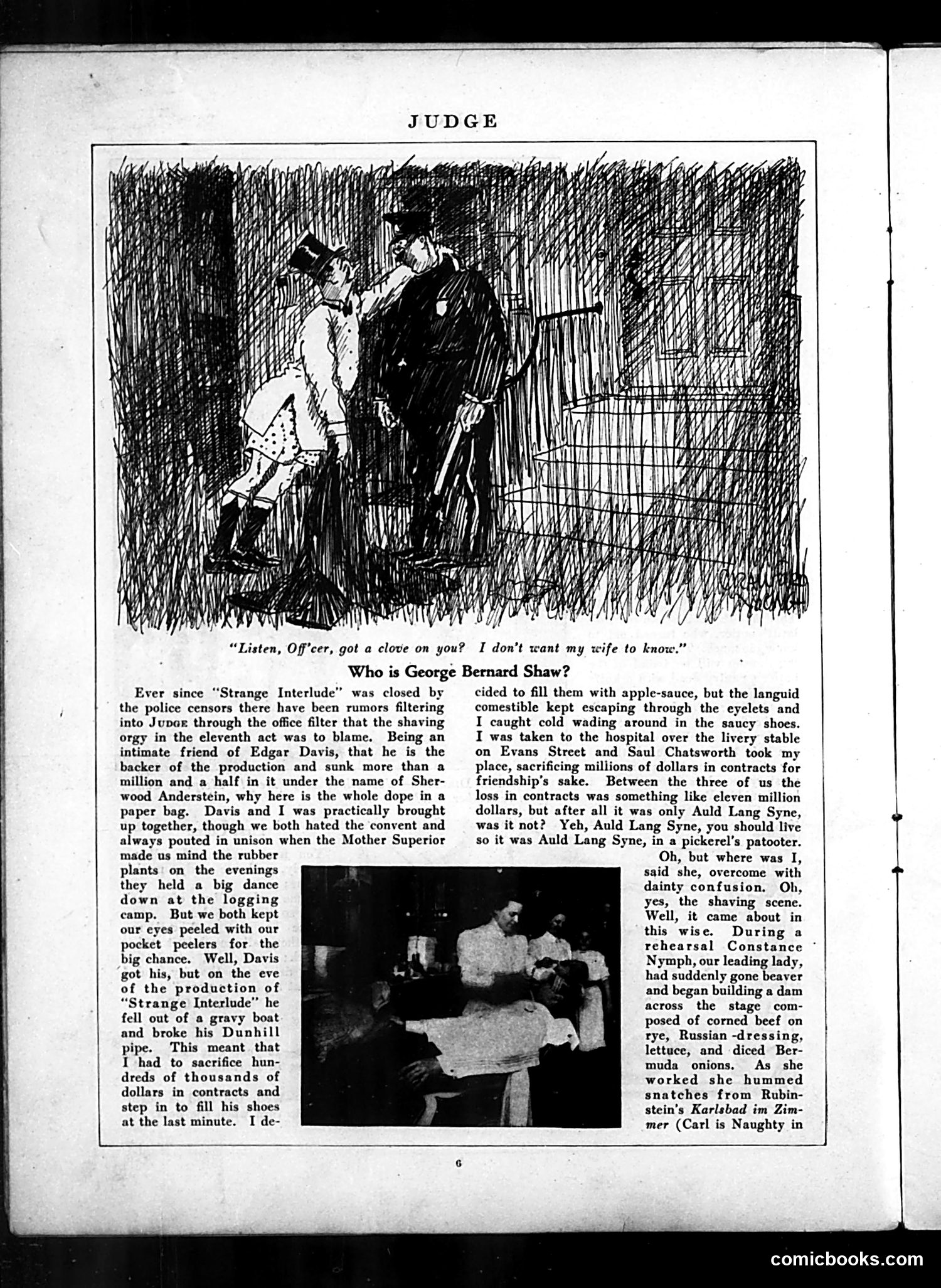
This page features a satirical article about George Bernard Shaw in the context of theatrical production. The top cartoon shows a police officer confronting someone, with the caption addressing marital discretion—likely referencing Shaw's controversial play "Strange Interlude." The article discusses Shaw's influence on theater censorship and production difficulties. It humorously attributes problems during a theatrical production (including a scene involving shaving and food preparation on stage) to Shaw's provocative dramatic style. The text suggests Shaw's avant-garde approach to theater created practical headaches for producers, forcing them to sacrifice significant money and effort to stage his unconventional works. The satire mocks both Shaw's artistic pretensions and the disruption his plays caused to traditional theatrical conventions.
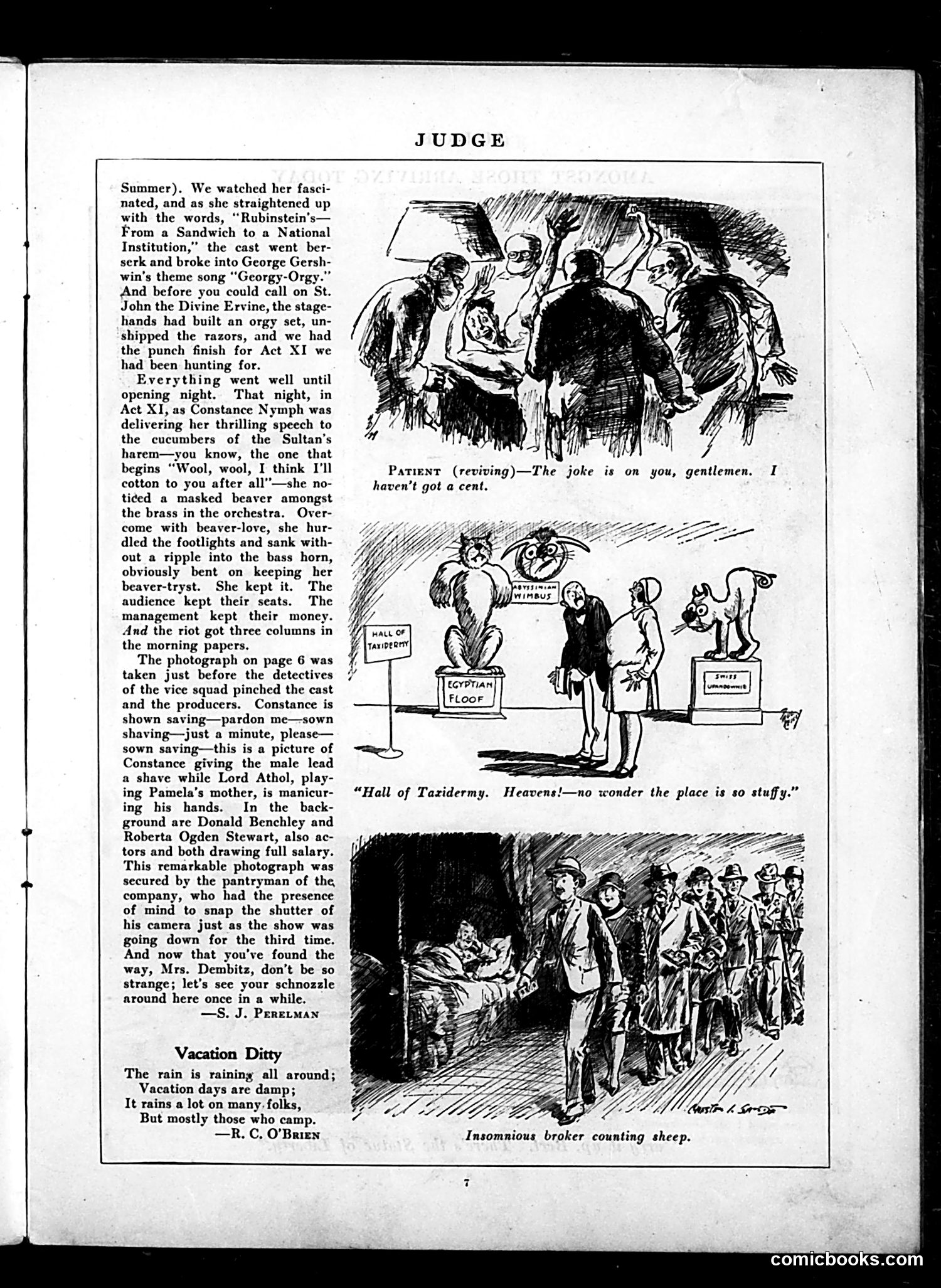
This page from *Judge* contains theatrical satire and humorous illustrations. The main text by S.J. Perelman describes a Broadway production gone awry: during opening night of a show featuring an "orgy set," an actress playing "Constance Nymph" becomes so enamored with a "masked beaver" in the orchestra that she literally jumps into a bass horn, causing a riot and police raid. The three cartoon illustrations satirize different subjects: 1. **Top cartoon**: Actors complaining that a joke "is on you, gentlemen. I haven't got a cent"—mocking theatrical poverty. 2. **Middle cartoon**: "Hall of Taxidermy"—satirizing a taxidermist's stuffy museum display. 3. **Bottom cartoon**: "Insomnious broker counting sheep"—Depression-era humor about financial anxiety. The "Vacation Ditty" poem provides light commentary on rainy vacation weather. The page is primarily theatrical entertainment satire aimed at contemporary readers familiar with Broadway and urban life.
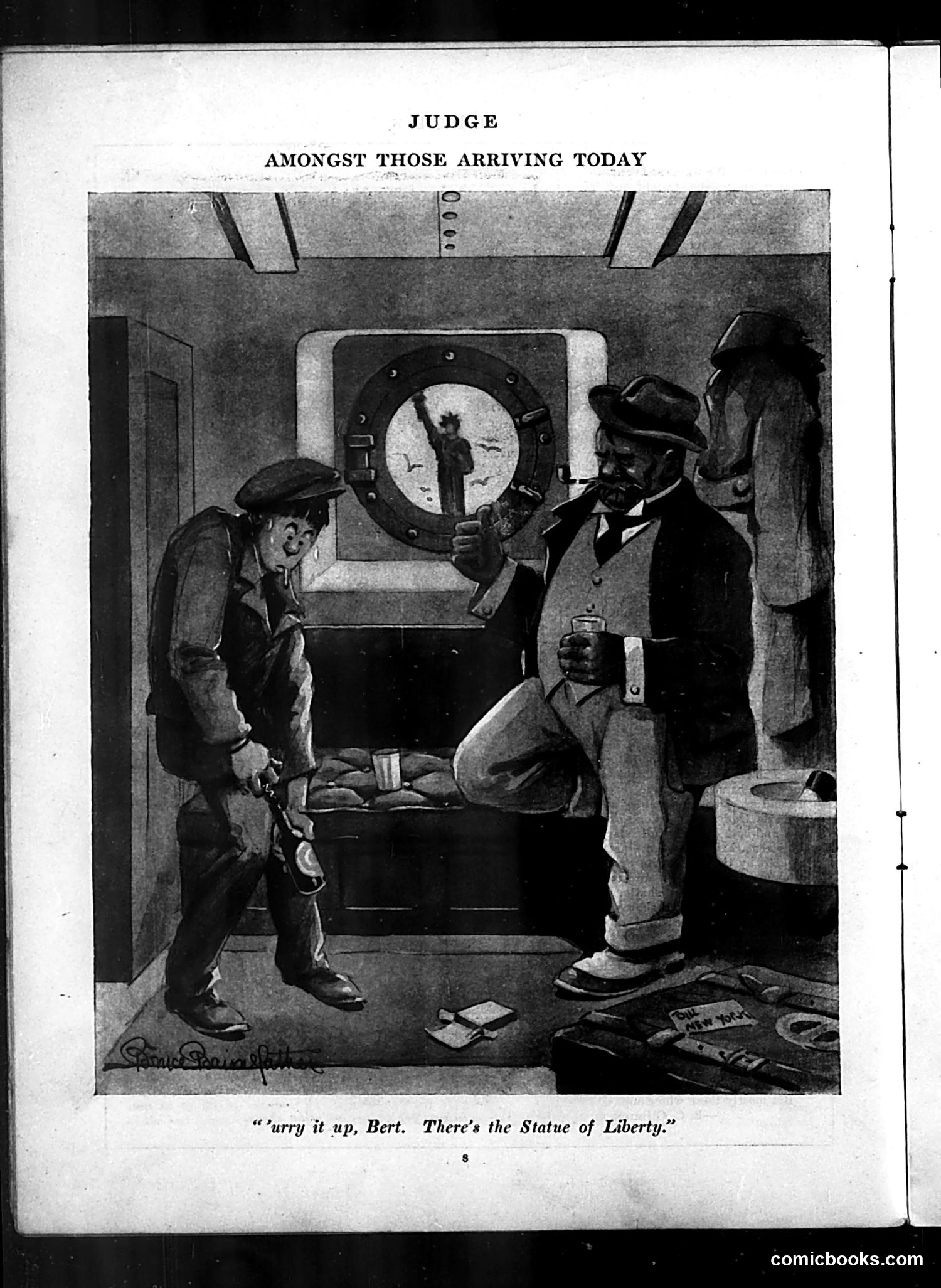
This cartoon satirizes immigration to America, likely from the early 20th century. The scene depicts men in a ship's cabin or hold, with one urging another ("Bert") to hurry because they can see the Statue of Liberty through a porthole—indicating their ship is arriving in New York Harbor. The satire targets immigrants as smugglers or contraband, suggested by the secretive cabin setting and hurried tone. The caption implies they're illegally entering or hiding goods. The caricatured features and working-class dress suggest working immigrants, possibly Eastern European. The joke plays on American anxiety about uncontrolled immigration and the assumption that newcomers are criminals or smugglers rather than legitimate arrivals. The Liberty reference adds ironic commentary—the symbol of American freedom overlooking what the cartoonist depicts as illicit entry.
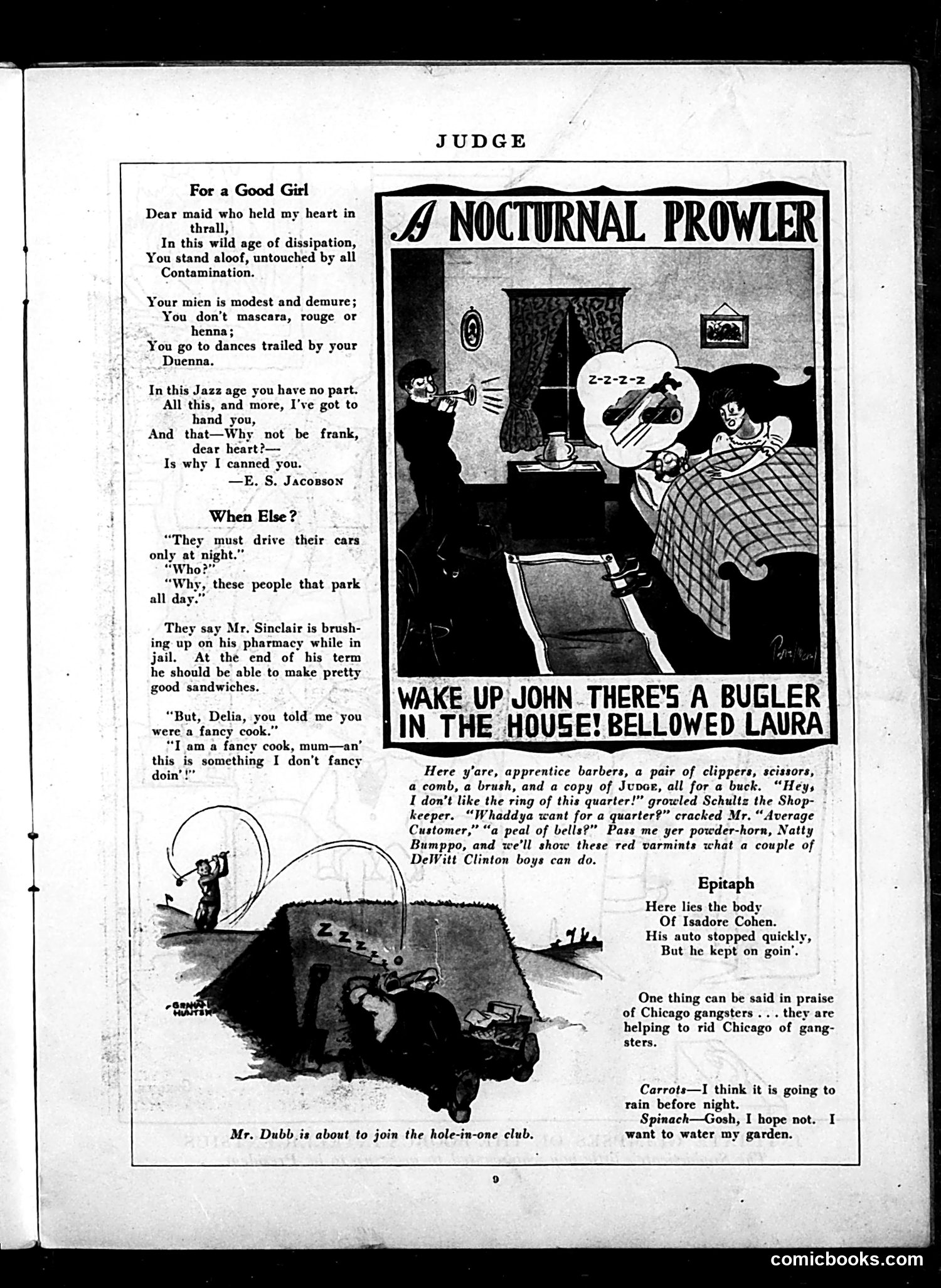
This page from Judge contains several satirical pieces reflecting 1920s social concerns: **"For a Good Girl"** mocks the era's "good woman" ideal—modest, makeup-free, chaperoned. The joke's twist: the poet rejects her precisely *because* she's so virtuous and boring, lacking the modern independence he secretly desires. It satirizes both old-fashioned morality and male hypocrisy. **"A Nocturnal Prowler"** cartoon jokes about late-night automobile activity—likely illicit behavior enabled by cars, a new technology enabling moral lapses. **Brief items** reference: prohibition-era concerns (Mr. Sinclair in jail, possibly for bootlegging); Chicago gangsters (topical violence); and modern dating conventions. **"Mr. Dabb joining the hole-in-one club"** is a golf joke with dark undertones—Dabb "joining" through death, implied by the illustration below showing a recumbent figure. The page reflects Jazz Age anxieties: changing sexual morality, automobile culture, organized crime, and tension between traditional and modern values.
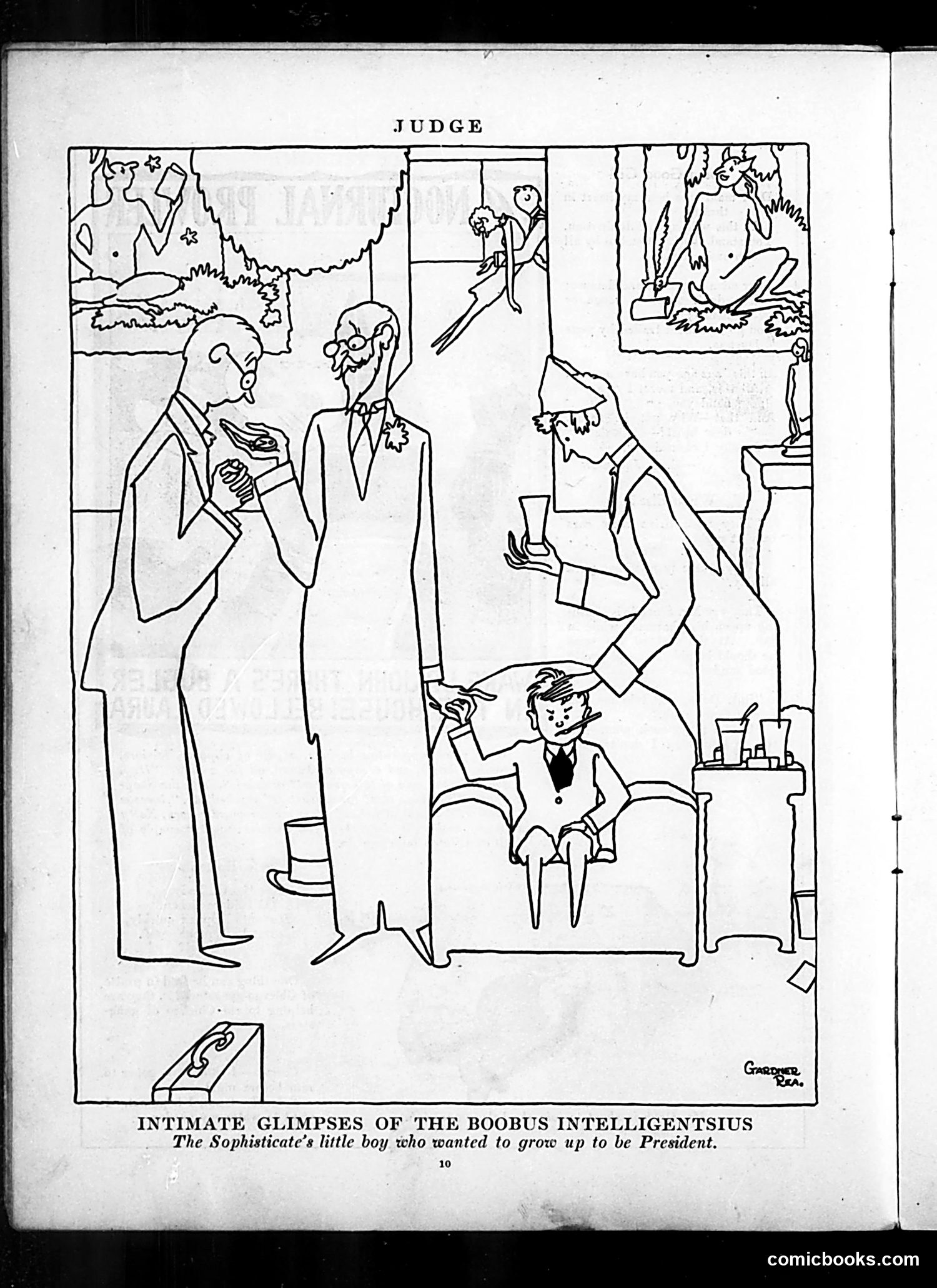
This satirical cartoon mocks intellectual pretension among the sophisticated classes. The title references H.L. Mencken's term "booboisie" (combining "booby" and "bourgeoisie"), used to describe the American masses. The scene depicts an upscale social gathering where a young boy—seated prominently—declares ambitions to become President. The adults around him appear to be wealthy intellectuals or socialites, engaged in conversations and surrounded by artwork and refined furnishings. The joke targets the contradiction between sophisticates' supposed intellectual superiority and their casual dismissal of democratic ambitions. By having their child aspire to the presidency, the cartoon ironically suggests that even educated elites' children absorb conventional American values despite their parents' air of superiority and cynicism toward mainstream politics.
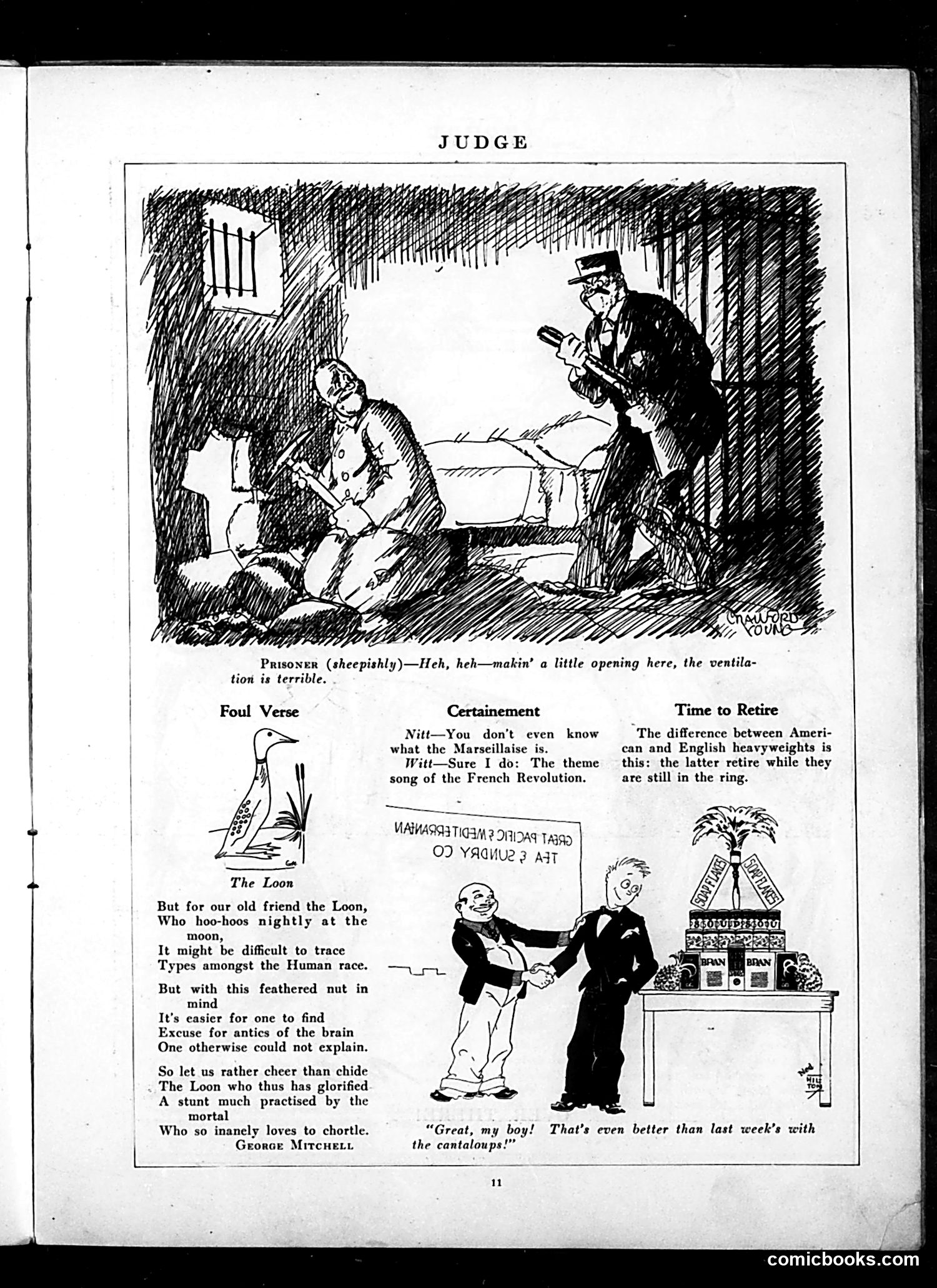
The main cartoon depicts a prisoner attempting an escape by enlarging a ventilation opening in his cell. The guard's caption is a typical prisoner's excuse—claiming poor ventilation rather than admitting escape attempts. This is straightforward satirical humor about prison life. Below are three unrelated humor pieces: **"Foul Verse"** mocks someone's ignorance of French culture, specifically the "Marseillaise" (France's national anthem), conflating it with the French Revolution's theme. **"Certainement"** appears to be a brief joke about French culture or language use. **"Time to Retire"** compares American and English heavyweight boxers, suggesting English fighters retire while still capable, whereas American fighters stay too long and decline in the ring—sports commentary disguised as satire. The poem about the Loon provides philosophical humor: using a bird's eccentric behavior as an excuse to forgive human foolishness.
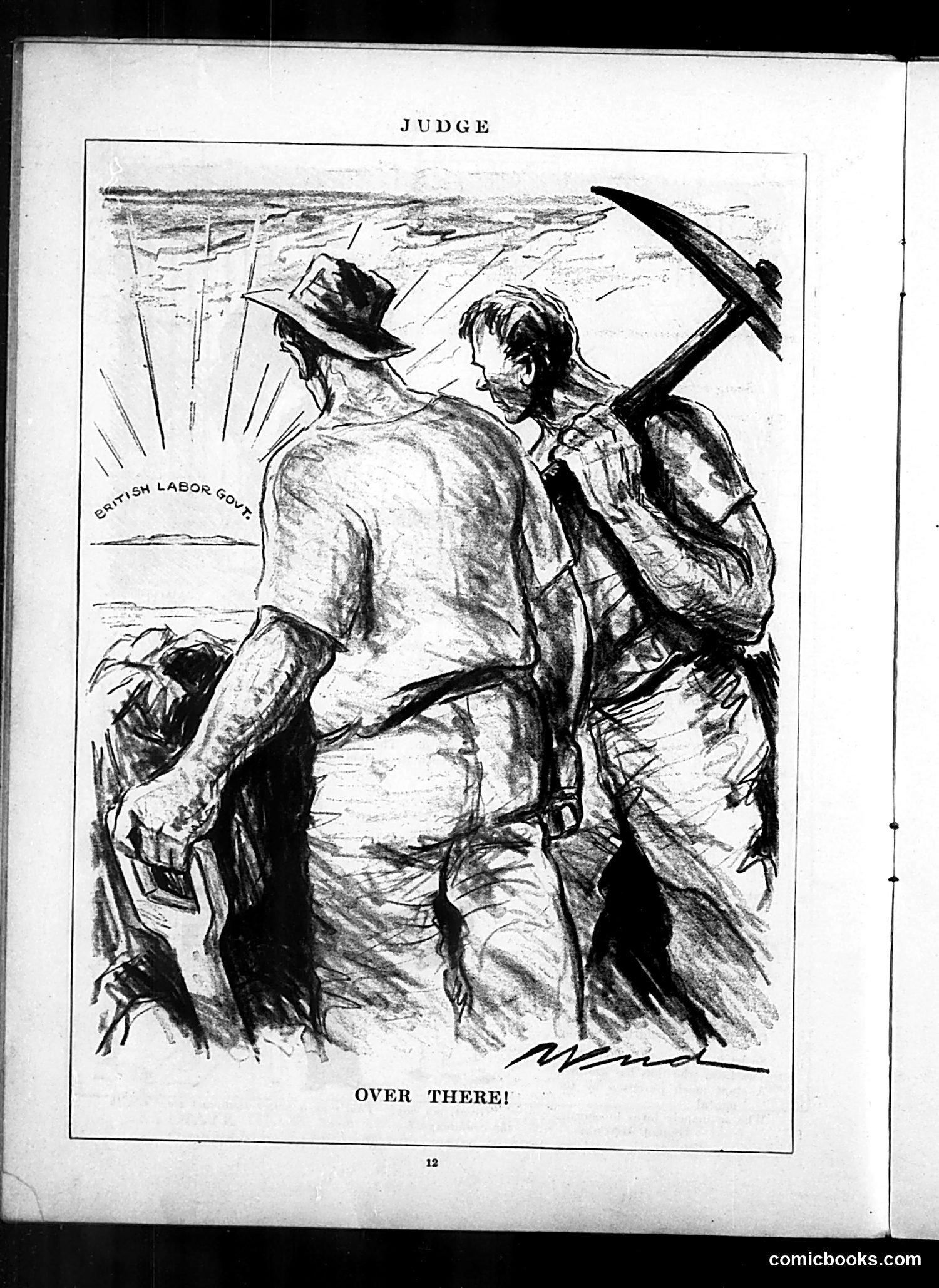
This wartime propaganda cartoon depicts a commanding officer (labeled "British Labor Gold" on the sun/insignia) directing a worker or soldier toward combat. The phrase "Over There!" references the popular WWI song encouraging American soldiers to fight in Europe. The cartoon appears to promote British-American labor cooperation for the war effort, showing British leadership directing British workers to military service. The pickaxe suggests labor being mobilized from civilian industry into warfare. The "British Labor Gold" label indicates the cartoon frames British workers as a valuable national resource being deployed for military purposes. This is likely from Judge's WWI-era coverage, promoting Allied war mobilization and American support for British military efforts.
This page contains three satirical pieces: **"Being a Good Snob Is Not So Easy"** mocks Professor Bobby Rogers of MIT, who advised graduates to adopt aristocratic manners and superiority. The satire's point: Rogers is *correct* in his cynical advice, but this creates a problem. If colleges produce hundreds of thousands of "ruling class" graduates annually, who remains to be ruled? The reference is W.S. Gilbert's famous principle that universal somebody-ness means nobody-ness. The joke attacks both the pretentiousness of upper-class aspiration and the absurdity of mass higher education producing elites. **"The Boon of Research"** praises industrial research's job-creation while noting businessmen still misunderstand it—treating researchers as hired hands to prove predetermined conclusions rather than pursuing genuine inquiry. The satire celebrates pure research's unpredictability and practical benefits. **"That Split Infinitive"** defends using split infinitives (to "boldly go"), invoking President Hoover's example and Webster-Daniel Noah's linguistic flexibility, arguing language naturally evolves. All three pieces reflect 1920s-30s concerns: class anxiety, industrial modernization, and linguistic prescription.
This article satirizes the 1920s craze of endurance competitions at Madison Square Garden, particularly dance marathons. Nathan mocks both the events themselves and the audiences who attend them. The piece describes a dance marathon where exhausted couples from working-class areas (Jersey and Pennsylvania "railroad junctions and ashheaps") collapse for prize money barely covering medical bills. Nathan ridicules the spectacle by comparing attendees to "followers of Christ"—sarcastically suggesting their voyeuristic enjoyment of human suffering has pseudo-religious fervor. The article highlights absurd competitors: the Meyers couple (Papa small, Mama weighing 200 pounds, "draped...like a ton of lead"), and "Shipwreck" Kelly, a flagpole-sitting champion. Nathan uses grotesque physical descriptions and contempt to expose these events as degrading entertainments exploiting poor, desperate people for profit and amusement. The satire targets both the degradation of participants and the gullible, morally bankrupt spectators.
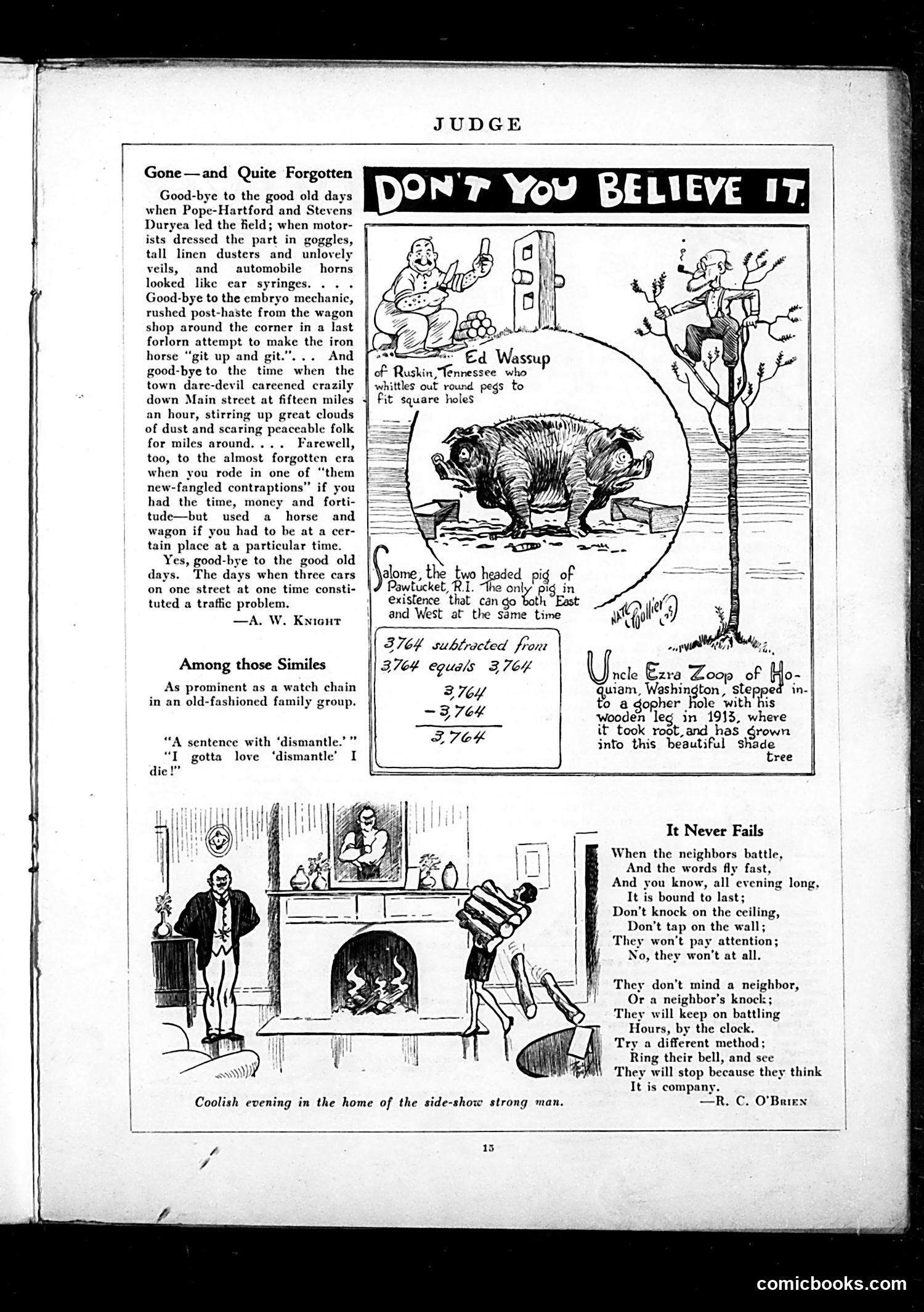
This page from Judge contains nostalgic humor about early automobiles and assorted "tall tales" typical of the magazine's satirical style. **Main Content:** The left column mourns the disappearance of early motoring culture—Pope-Hartford and Stevens-Duryea automobiles, goggles, linen dusters, and the era when three cars on one street constituted a traffic problem. The satire suggests how rapidly automobiles became commonplace, rendering once-exotic motorist culture quaint. **"Don't You Believe It" section:** This features absurdist "freaks" and impossible claims: Ed Wassup whittling round pegs for square holes, a two-headed pig, and Uncle Ezra Loop's wooden leg that grew into a tree. These are Judge's characteristic tall-tale humor—exaggerated rural American legends presented as fact. **"It Never Fails" poem:** Practical advice on neighbor disputes: ringing the doorbell works better than knocking or tapping because neighbors will stop fighting, assuming company is arriving. It's gentle satire on human vanity and social performance. The page reflects Judge's blend of automotive nostalgia, absurdist humor, and domestic social comedy.
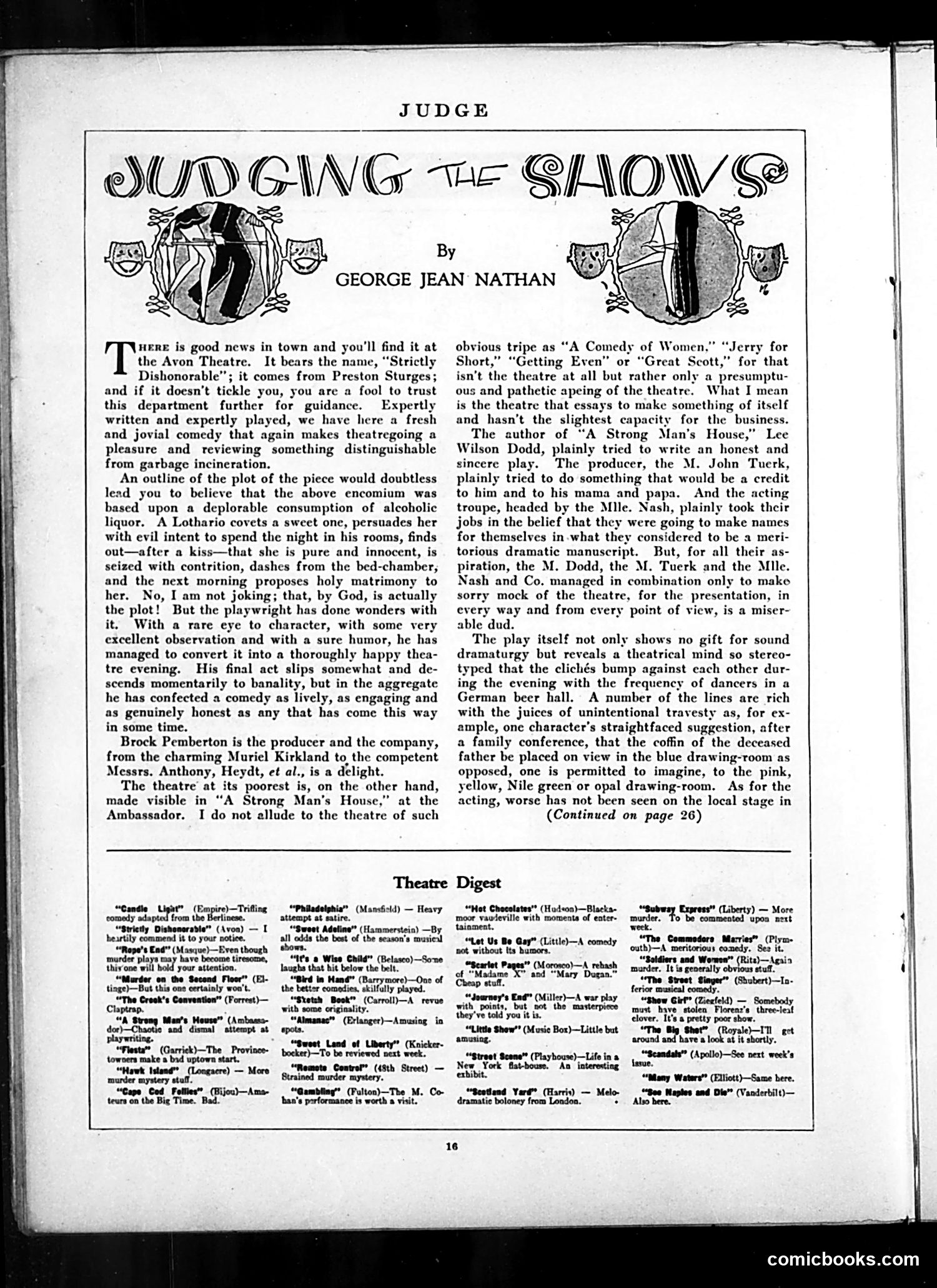
This page contains a theater column by George Jean Nathan reviewing Broadway productions. The column praises Preston Sturges' play "Strictly Dishonorable" at the Avon Theatre as a fresh, well-written comedy with excellent performances—despite its conventional plot about seduction and redemption through marriage. By contrast, Nathan harshly critiques "A Strong Man's House" at the Ambassador Theatre. Though author Lee Wilson Dodd, producer M. John Tuerk, and actress Mlle. Nash clearly attempted sincere, quality work, Nathan finds the play utterly failed—riddled with theatrical clichés and unintentionally ridiculous dialogue (he mocks a scene debating which colored drawing-room to display a coffin in). The review exemplifies early 20th-century theater criticism's acerbic wit, treating sincere mediocrity as more contemptible than obvious trash. The page concludes with a "Theatre Digest" listing brief reviews of other productions.
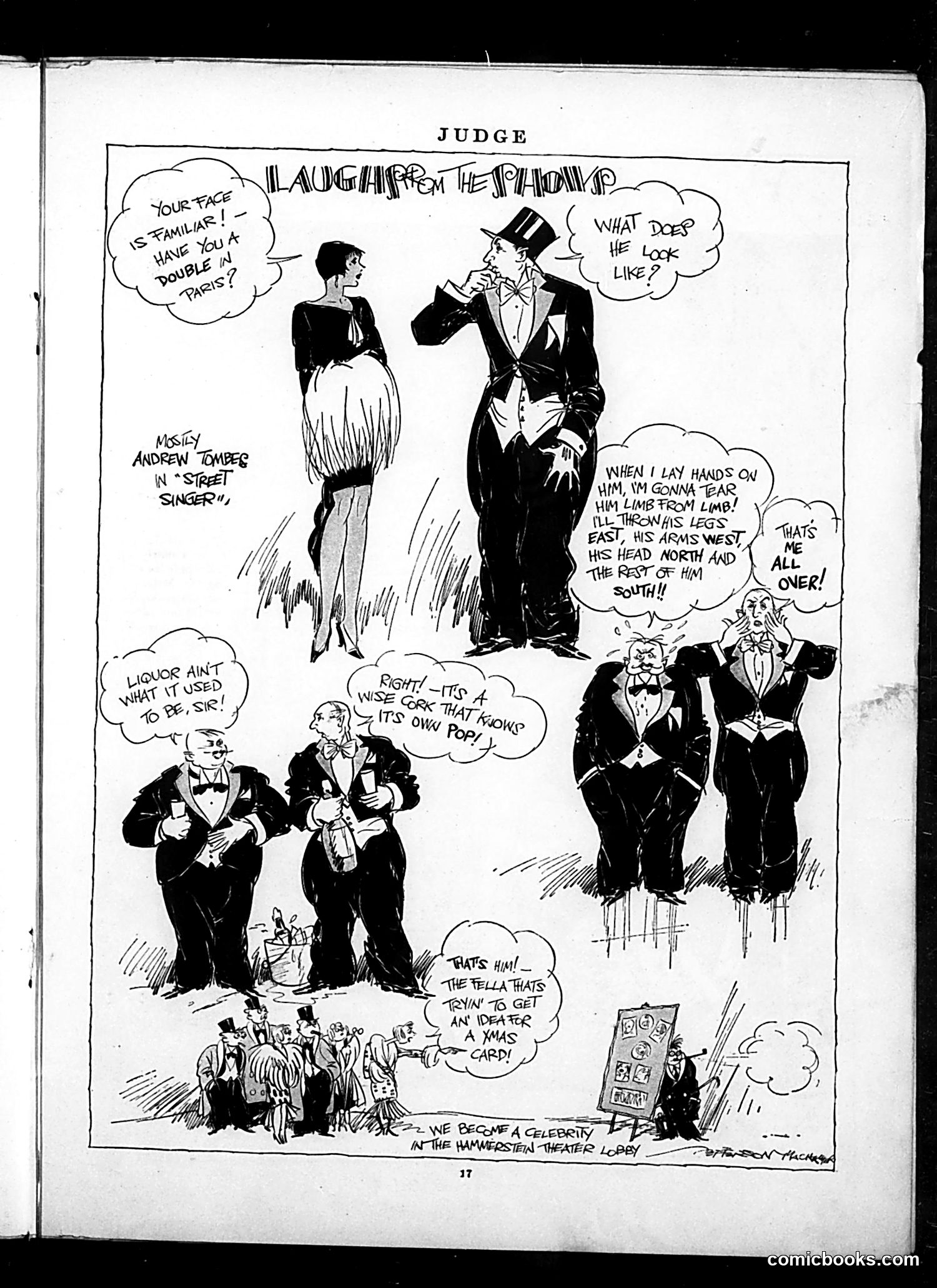
This satirical cartoon mocks **Andrew Tombes** in the theatrical production "Street Singer." The humor centers on a stage performer's physical comedy routine. The main joke depicts a vaudeville-style bit where a character describes violently dismantling someone's body ("tear him limb from limb...throw his legs east, his arms west"). The surrounding figures—well-dressed gentlemen in top hats—represent theater patrons and critics laughing at this slapstick performance. The caption at bottom indicates the performers "became a celebrity in the Hammerstein Theater lobby," suggesting the act generated significant buzz among theater-goers. The cartoonist satirizes both the crude physical humor of contemporary stage entertainment and the public's enthusiasm for such lowbrow comedy, contrasting the refined appearance of the suited audience members with the violent content they're applauding. This reflects early 20th-century tensions between vaudeville's popularity and cultural gatekeepers' attitudes toward theatrical taste.
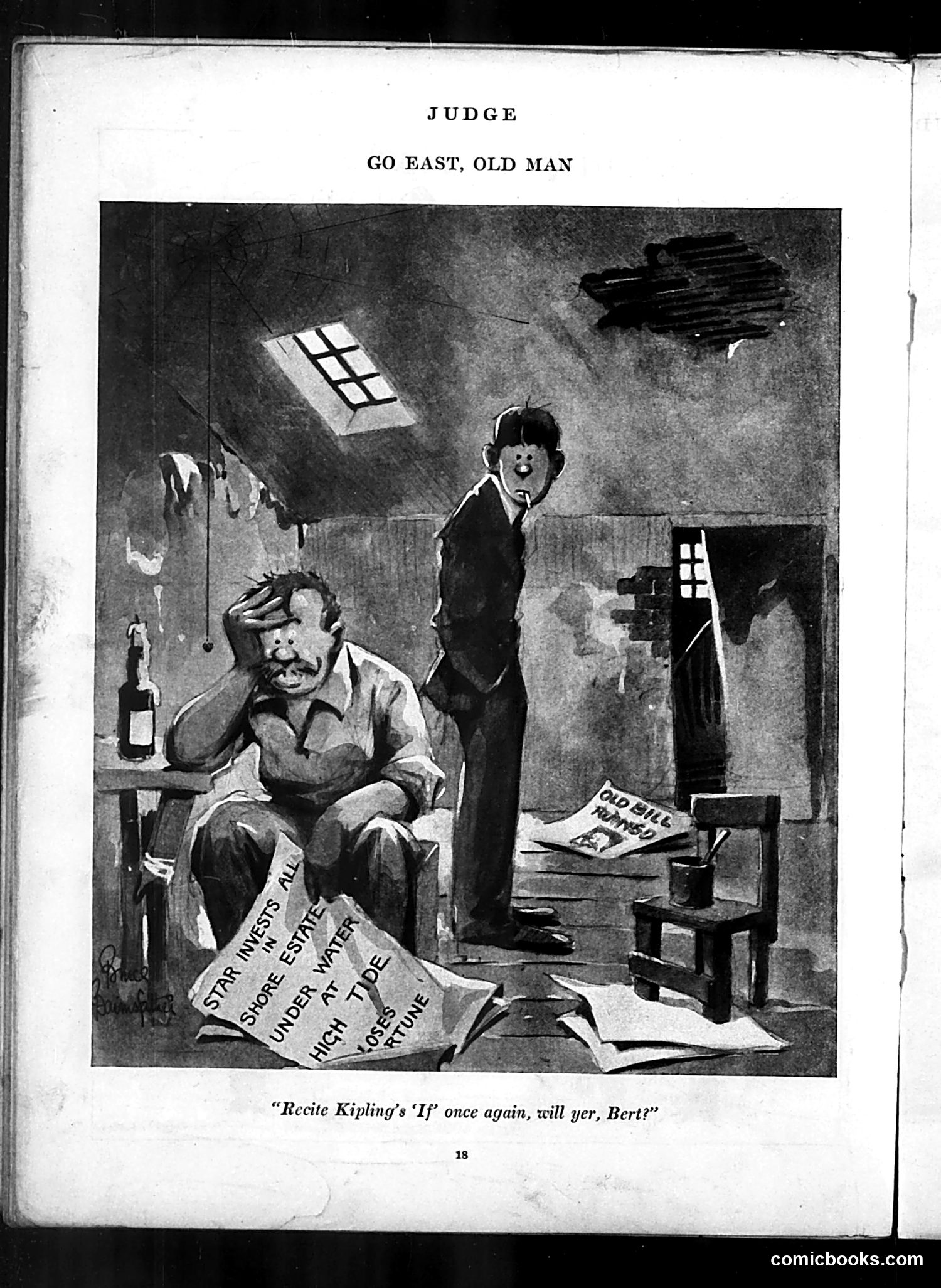
This political cartoon satirizes literary criticism and recitation culture. The title references Horace Greeley's famous "Go West, young man" motto, inverting it for ironic effect. The scene depicts a man in a prison cell being asked to recite Rudyard Kipling's "If" poem again—visible on scattered papers labeled "STAR INVESTS ALL," "SHORE ESTATE," and other financial/life struggles. The judge figure commands the prisoner recite the poem once more. The satire mocks how Kipling's famous motivational poem was used to lecture people about perseverance through hardship, particularly those facing poverty or ruin. The cartoon suggests this repeated recitation of inspirational verse to desperate people was hollow comfort—essentially telling struggling individuals to simply endure their circumstances with stoicism rather than addressing material conditions. The prison setting emphasizes the cruel irony of offering poetry instead of practical aid.
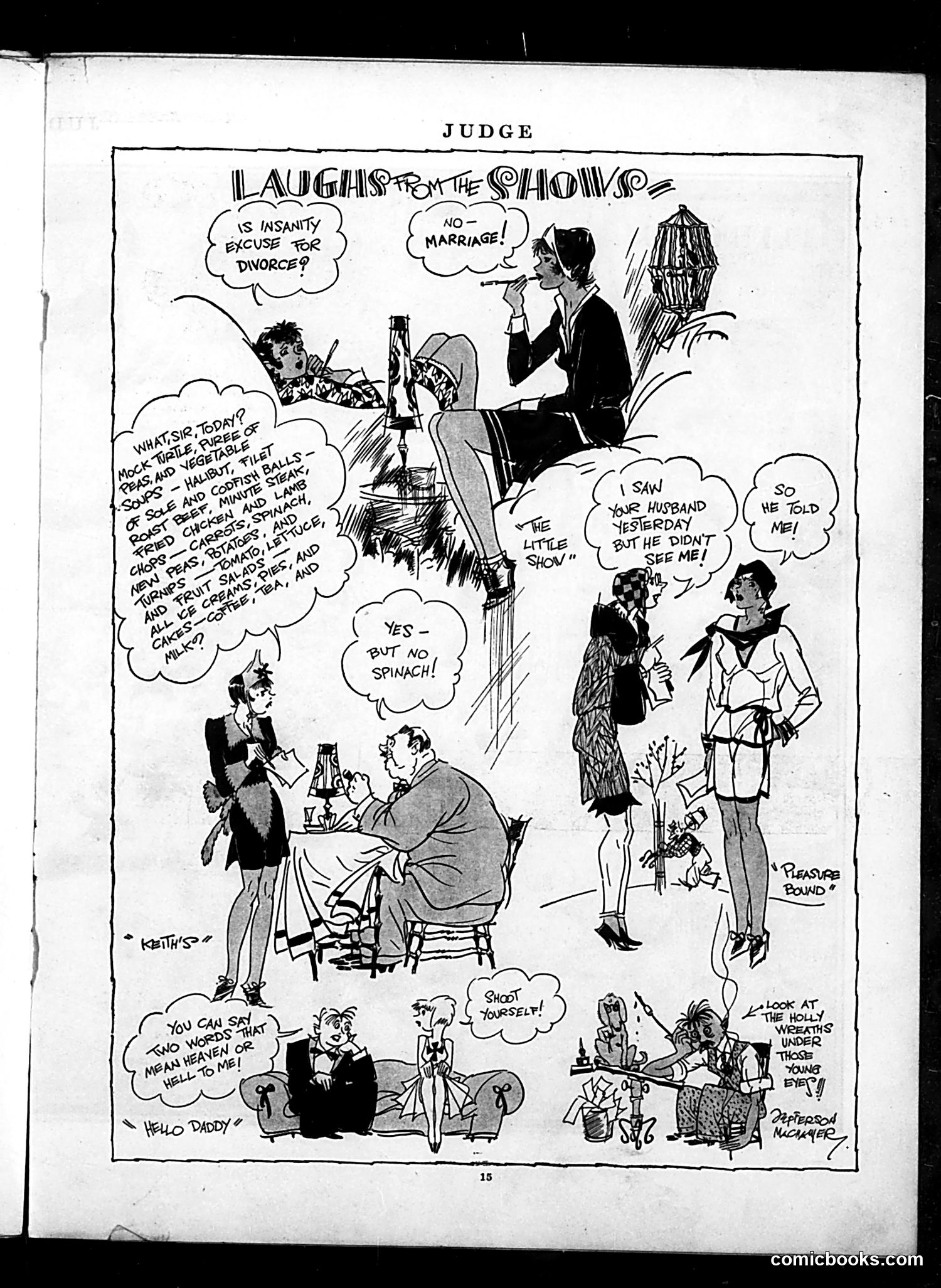
This is a multi-panel comic satirizing contemporary theater productions and social behavior. The central question—"Is insanity excuse for divorce?"—frames humorous scenarios from various stage shows of the era. The panels depict audiences and performers, with dialogue referencing popular productions. One panel mentions a wife seeing her husband in a "little show" but him not seeing her, suggesting infidelity or indifference. Another features a domestic dispute where a woman refuses to cook spinach—likely referencing Popeye's cultural prominence around this era. The cartoon mocks both theatrical plots (often melodramatic domestic conflicts) and contemporary marriage dynamics, suggesting that theater audiences found humor in recognizing exaggerated versions of their own relationship troubles on stage. The overall tone suggests satirical commentary on 1920s-30s entertainment and marital expectations.
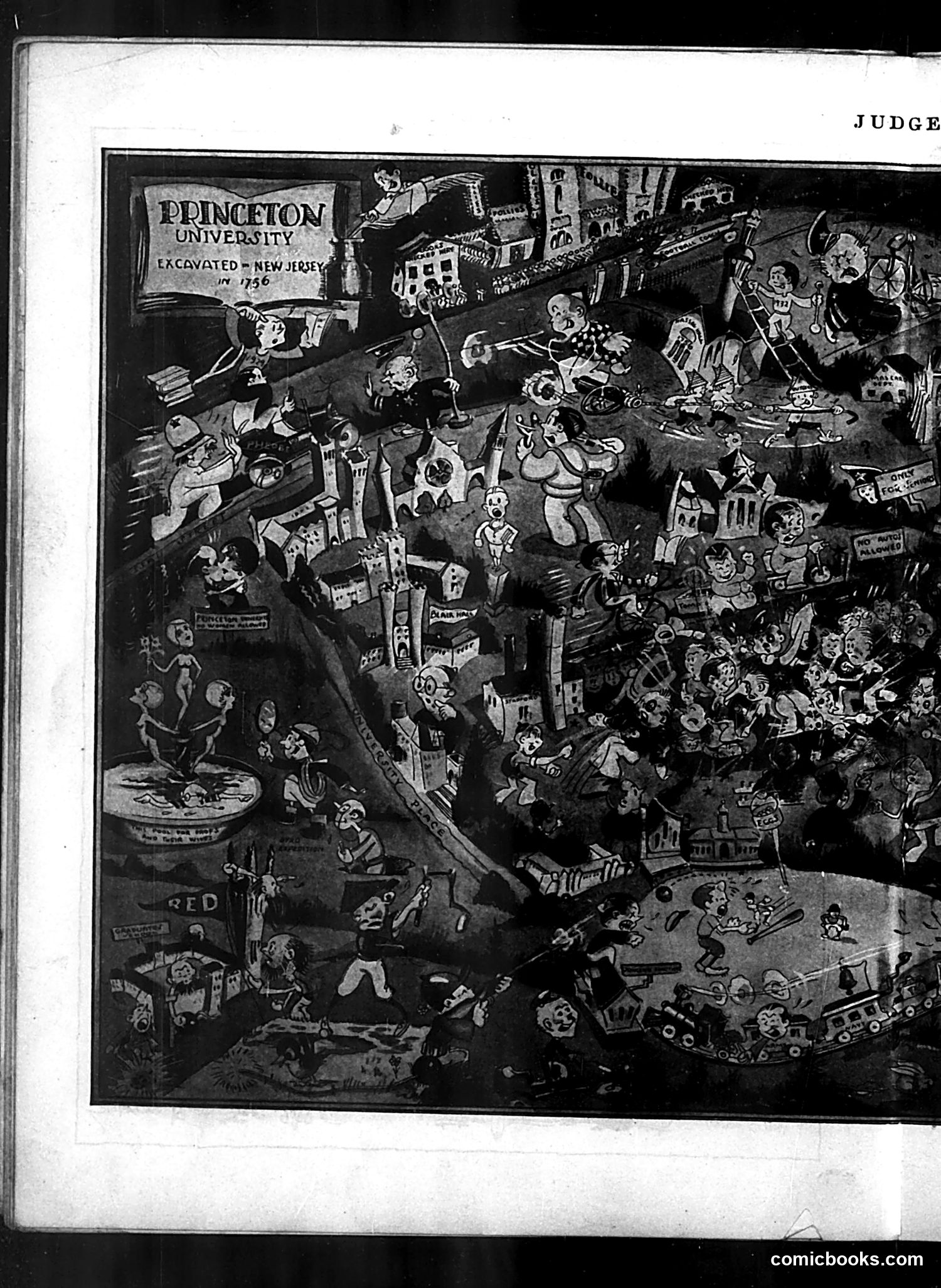
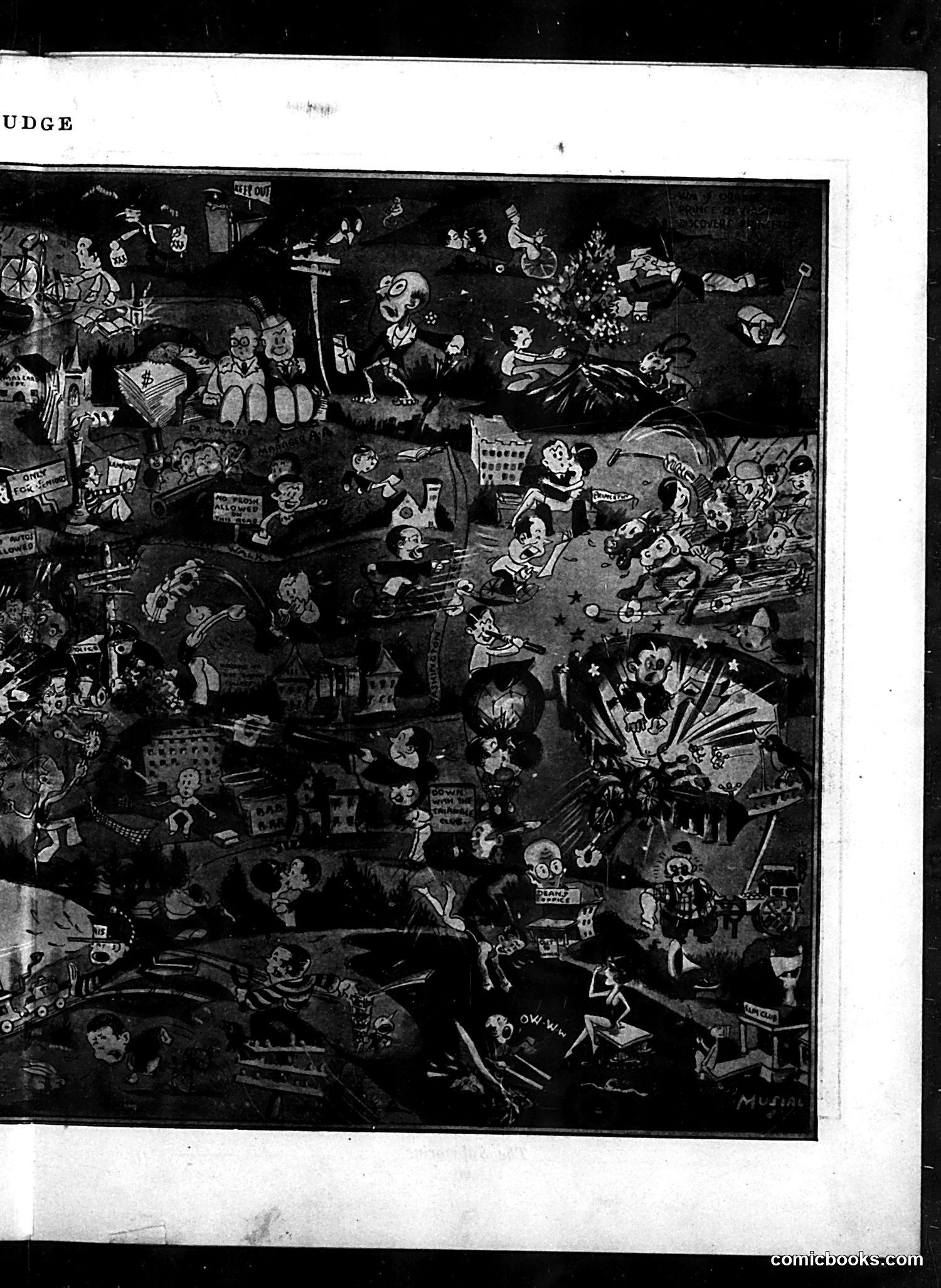
This appears to be a densely packed satirical illustration from *Judge* magazine depicting a chaotic Christmas or holiday shopping scene. The image is crowded with numerous figures, toys, merchandise, and holiday paraphernalia rendered in a busy, cartoonish style typical of early-to-mid 20th century American satire. The satire likely mocks the commercialization and frenzied nature of holiday shopping—a perennial target of social commentary. Figures appear scrambling amid toys, packages, and goods, suggesting critique of consumer excess and the hectic nature of holiday retail. Specific caricatures are difficult to identify due to image quality and the illustration's density, though various character types are visible throughout the composition. Without clearer detail or accompanying text, precise identification of targeted figures or specific political references remains unclear.
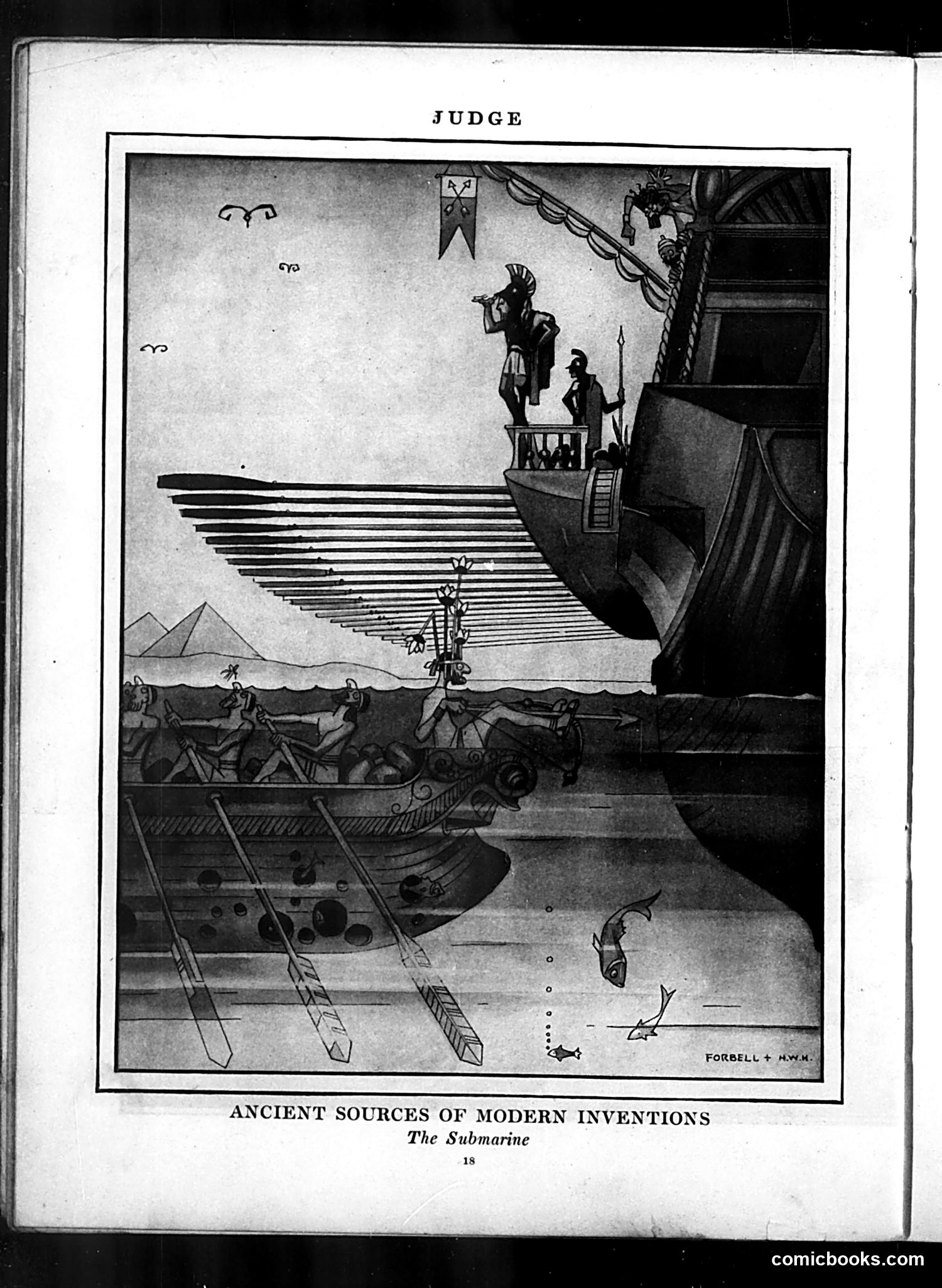
This Judge cartoon presents a humorous "ancient sources of modern inventions" concept, specifically about the submarine. The illustration depicts what appears to be ancient Egyptian or Mediterranean vessels, with figures operating primitive underwater vessels or diving apparatus. The satire suggests that the "modern" submarine invention has ancient precedents—showing soldiers or warriors in small boats with what look like early diving equipment or submersible vessels in water near larger ships. The winged symbols and architectural style indicate an ancient setting, likely Egyptian. The joke is that submarines, presented as cutting-edge modern technology, actually had conceptual origins in antiquity. This reflects early 20th-century humor about how "new" inventions often had surprisingly old historical roots or inspiration.
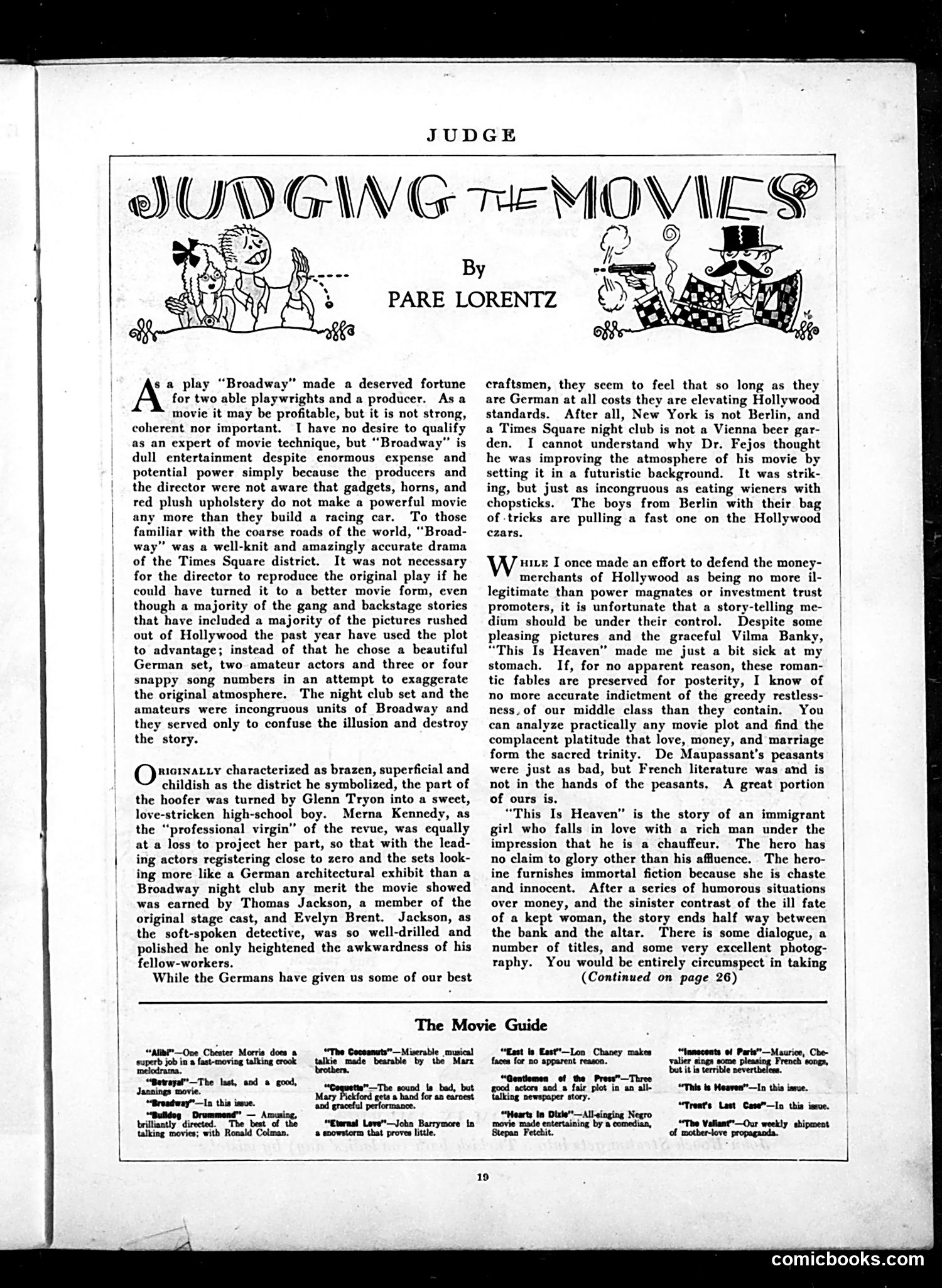
This page features a critical essay on 1920s cinema by Pare Lorentz. He reviews recent Hollywood films—notably "Broadway" (adapted from a stage play) and "This Is Heaven"—arguing that expensive production values and exotic sets don't compensate for weak storytelling. Lorentz criticizes German directors and set designers working in Hollywood, suggesting they prioritize visual spectacle over narrative coherence. He uses a sharp metaphor: "eating wieners with chopsticks"—culturally incongruous choices that undermine authenticity. He particularly targets "money-merchants" controlling Hollywood's narrative output, lamenting that romantic formulas ("love, money, and marriage") dominate because studios profit from mass-appeal sentimentality. The subtext reflects 1920s anxieties about European influence in American entertainment and concerns that commercial interests corrupt artistic integrity.
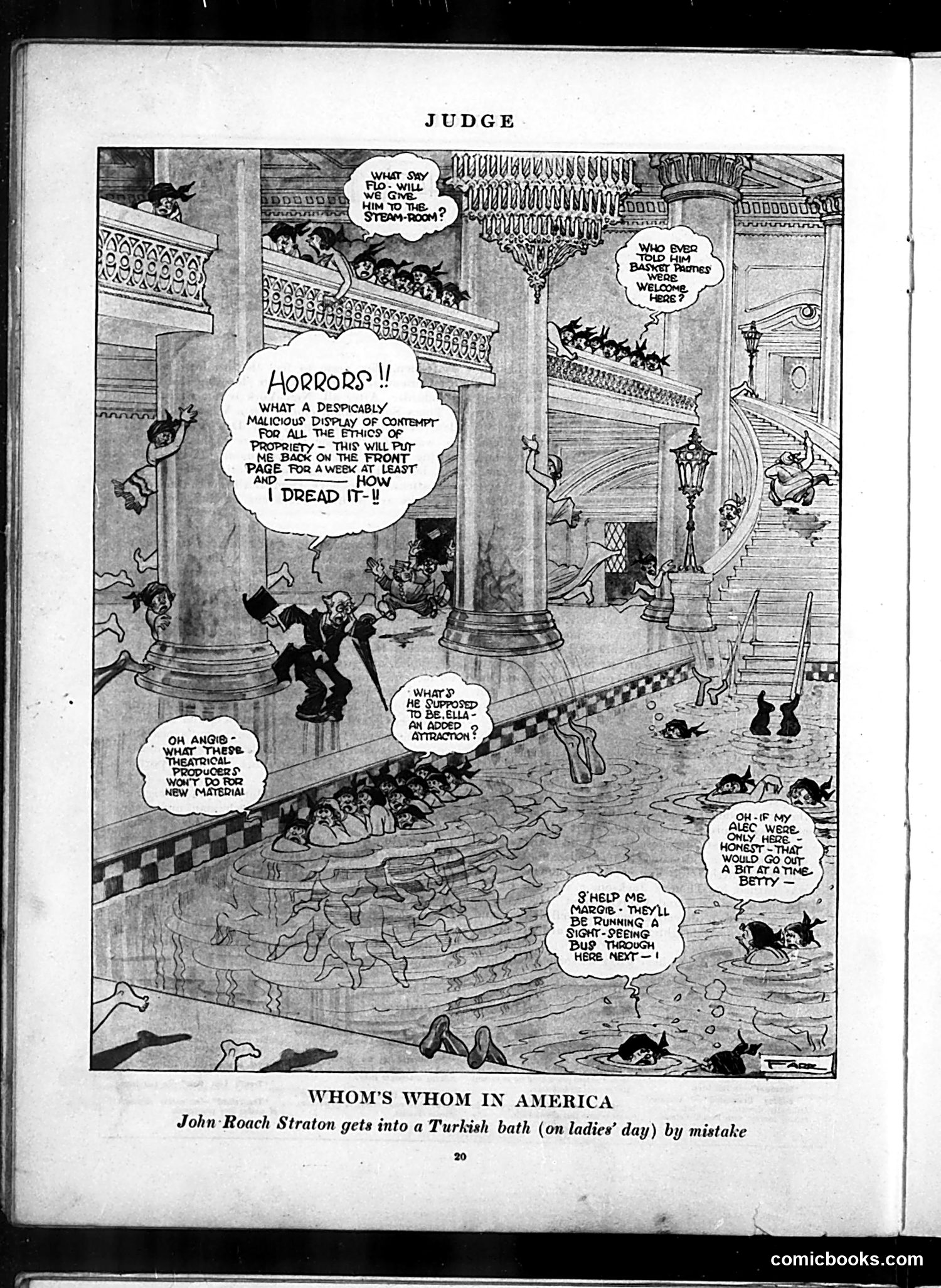
This is a humorous comic strip about **John Roach Straton**, a prominent fundamentalist Protestant minister of the 1920s, accidentally entering a Turkish bath during ladies' hours. The satire works on multiple levels: 1. **The Setup**: Straton was known for fiery moral condemnation of modern entertainments and social practices he deemed sinful. 2. **The Joke**: His accidental intrusion into the women's bath—a scenario he would publicly denounce as improper—creates ironic comedy. His outraged monologue about "despicably malicious display of contempt for all the ethics of propriety" is undermined by his own compromising position. 3. **The Point**: The cartoon mocks religious hypocrisy and moral crusaders who condemn others' behavior while finding themselves in awkward situations. The chaos of rats and animals fleeing the bath adds absurdist humor. The satire targets Straton's public moralizing by showing him literally trapped in exactly the kind of morally ambiguous scenario his sermons railed against.
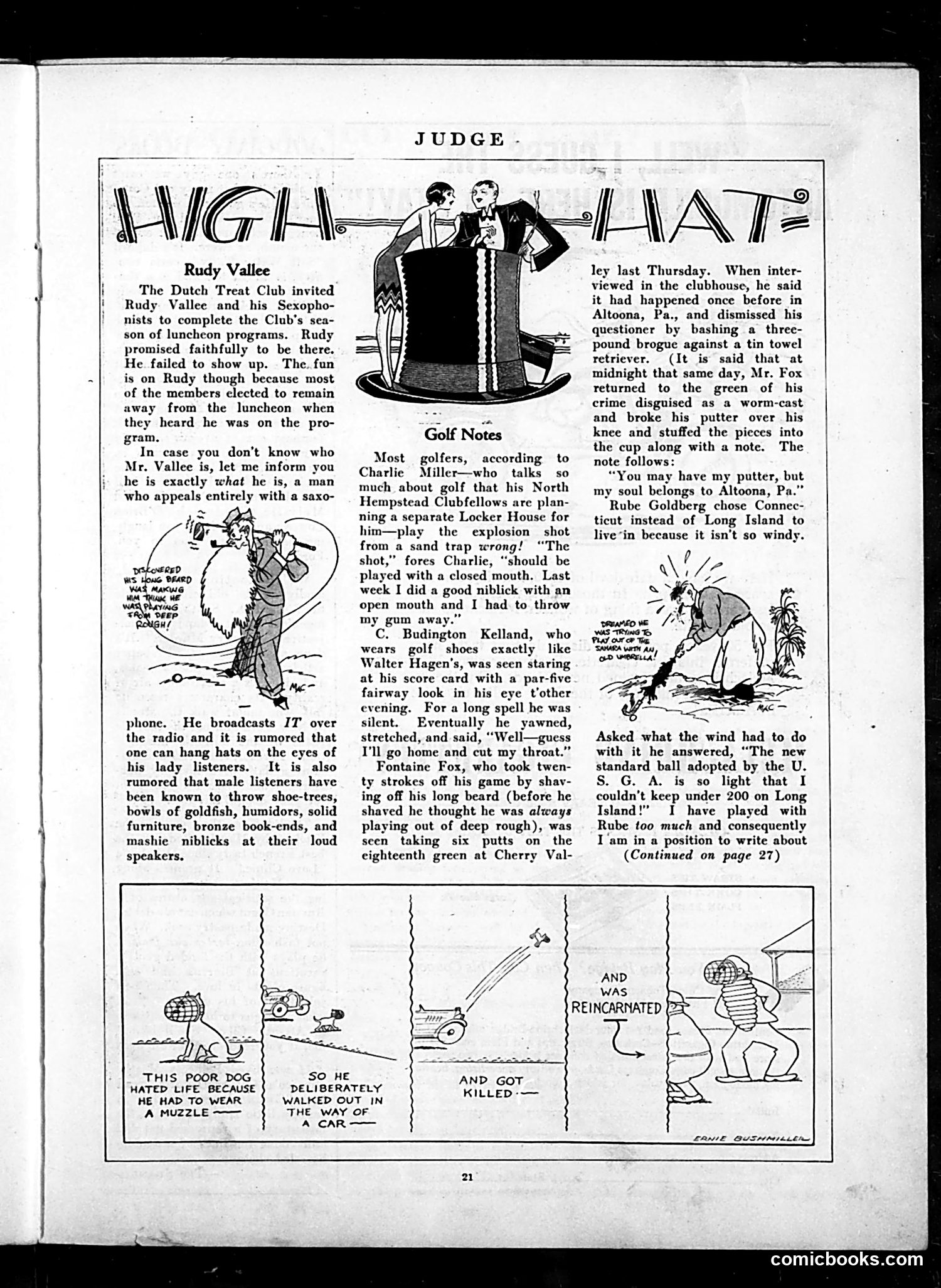
This page from Judge magazine contains satirical commentary on 1920s celebrity culture and golf humor. **Rudy Vallee section**: Mocks the popular crooner Rudy Vallee, whose appeal relied entirely on his saxophone playing and radio broadcasts. The joke is that club members avoided a luncheon rather than hear him perform, and that his female listeners are so infatuated they inspire men to throw objects at radios in frustration. This captures contemporary anxiety about radio's power and celebrity worship. **Golf Notes**: A humorous column about local golfers (including cartoonist Rube Goldberg), poking fun at their obsessive behavior, poor play, and eccentric habits. References to specific golfers like Walter Hagen (a famous pro) add period authenticity. **Bottom comic strip**: A darkly comedic four-panel sequence showing a dog that hates wearing a muzzle, walks into traffic, dies—and is reincarnated only to be hit by a car again. This appears to be gallows humor about fate and futility. Overall, the page reflects Judge's satirical approach to contemporary American leisure culture.
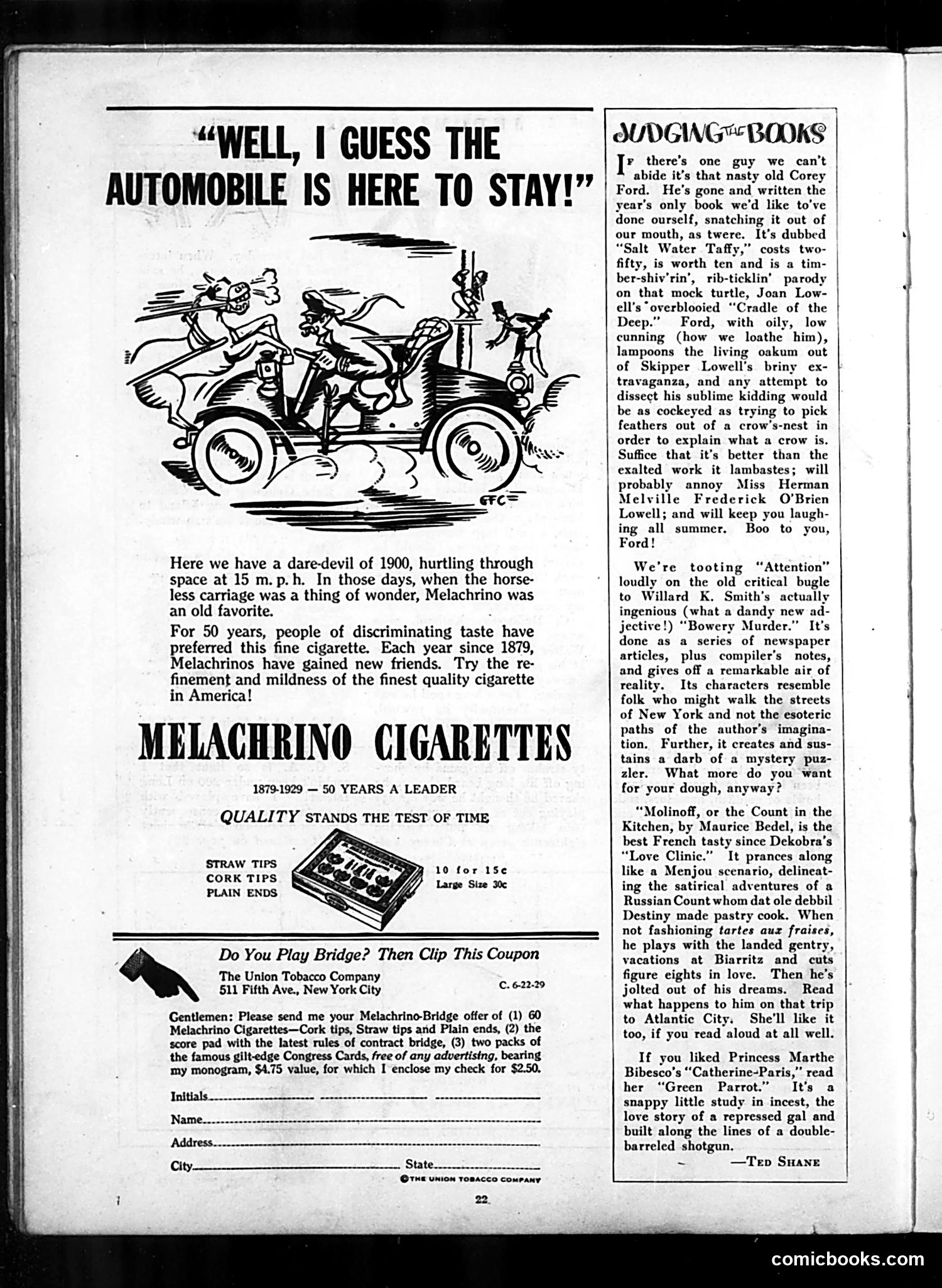
This 1929 page combines advertising with book reviews. The main cartoon satirizes early automobile skepticism: a frantic 1900 driver careens at 15 mph while text jokes "the automobile is here to stay"—mocking the era's wonder at horseless carriages. The illustration, dated 1929, looks back fifty years to highlight how far automotive technology has progressed. The Melachrino cigarette ad leverages this nostalgia, claiming 50 years of quality since 1879. The book review section (right) critiques recent publications with insider snark. Notably, it attacks Corey Ford's parody of Joan Lowell's "Cradle of the Deep" (a famous 1929 memoir), simultaneously praising Ford's satire while resenting his success. Reviews of Willard K. Smith's "Bowery Murder" and Maurice Bedel's "Molinoff" follow similar witty, gossipy tones typical of Judge's satirical voice.
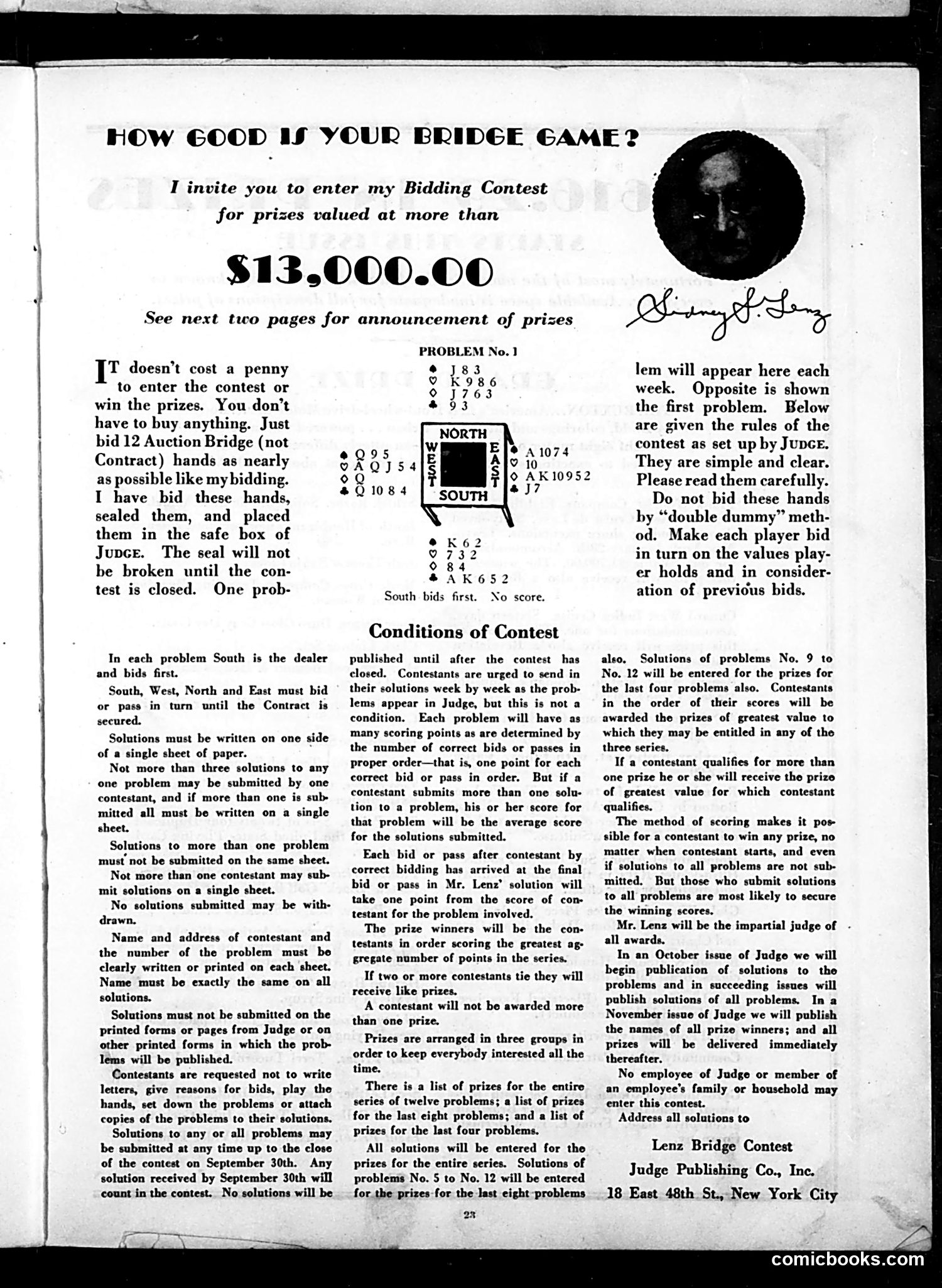
This is primarily an **advertisement and contest announcement**, not a political cartoon. Judge Publishing Co., Inc. announces a bridge-bidding competition with $13,000 in prizes, hosted by **"Mr. Lenz"** (visible in the circular portrait). The contest is for **Auction Bridge**—a card game popular in the early 20th century before Contract Bridge became standard. Contestants submit written solutions to bidding problems published weekly in Judge magazine. The contest runs through September 30th. The satirical element is implicit: Judge leverages the era's bridge-playing craze (a widespread upper-middle-class obsession) to boost circulation by offering substantial prizes for readers' participation. This was a common magazine marketing strategy of the period. No political content is present; this reflects Judge's shift toward lifestyle and entertainment advertising rather than solely political satire.
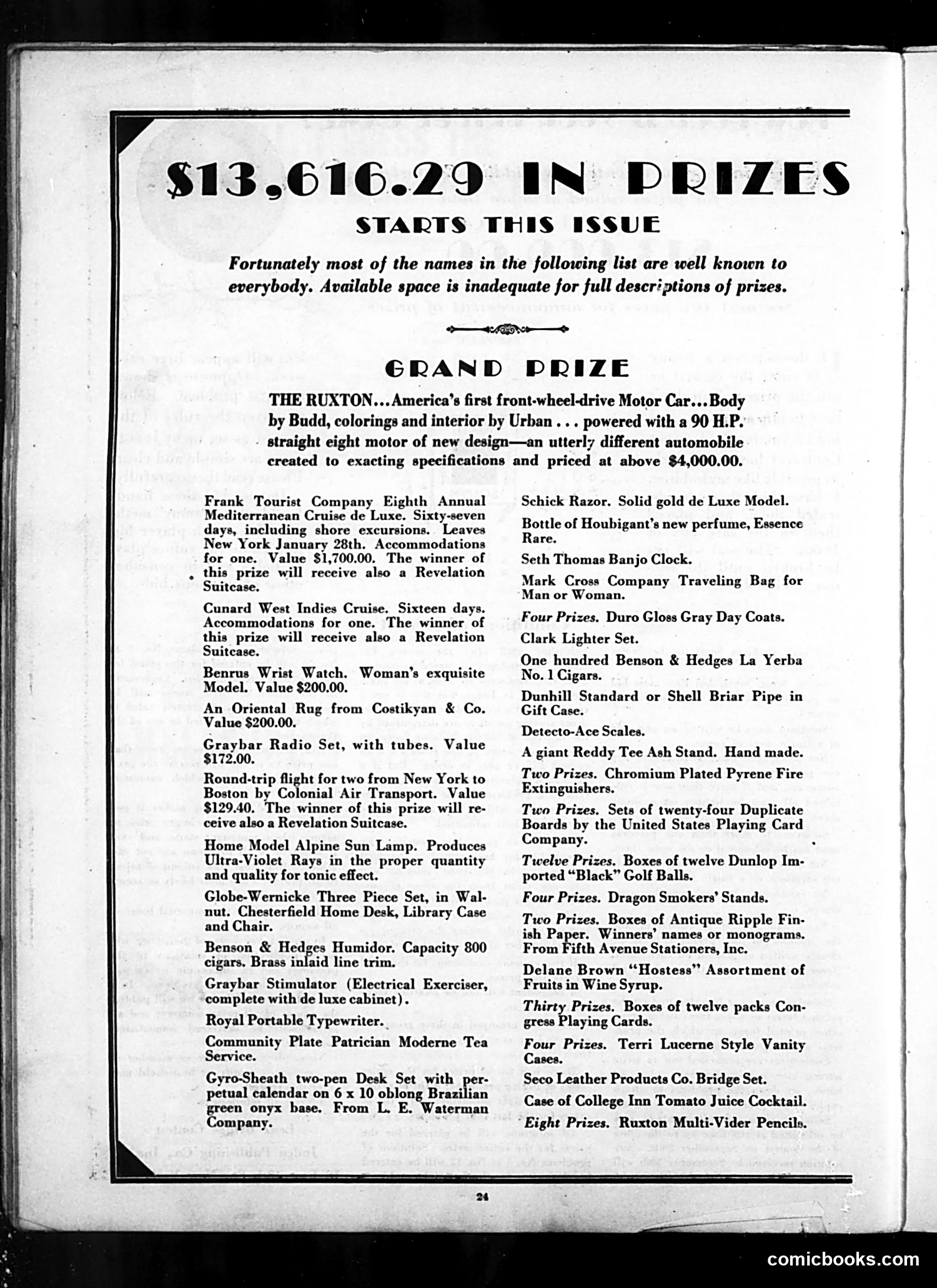
This is not a cartoon but rather a **prize announcement page** from *Judge* magazine. The publication is promoting a major contest offering $13,616.29 in total prizes, with a grand prize of a **Ruxton automobile**—marketed as "America's first front-wheel-drive Motor Car," priced above $4,000 (substantial money in the 1930s). The page lists luxury goods typical of the era's aspirational advertising: Mediterranean cruises, wrist watches, Oriental rugs, radio sets, golf balls, and various branded items (Schick razors, Houbigant perfume, Dunhill pipes). This reflects *Judge's* target audience: affluent, urban readers who could afford such prizes and the lifestyle they represented. The contest itself was a common magazine marketing tactic to boost circulation and advertising revenue during the Depression era, when such lavish giveaways had particular appeal.
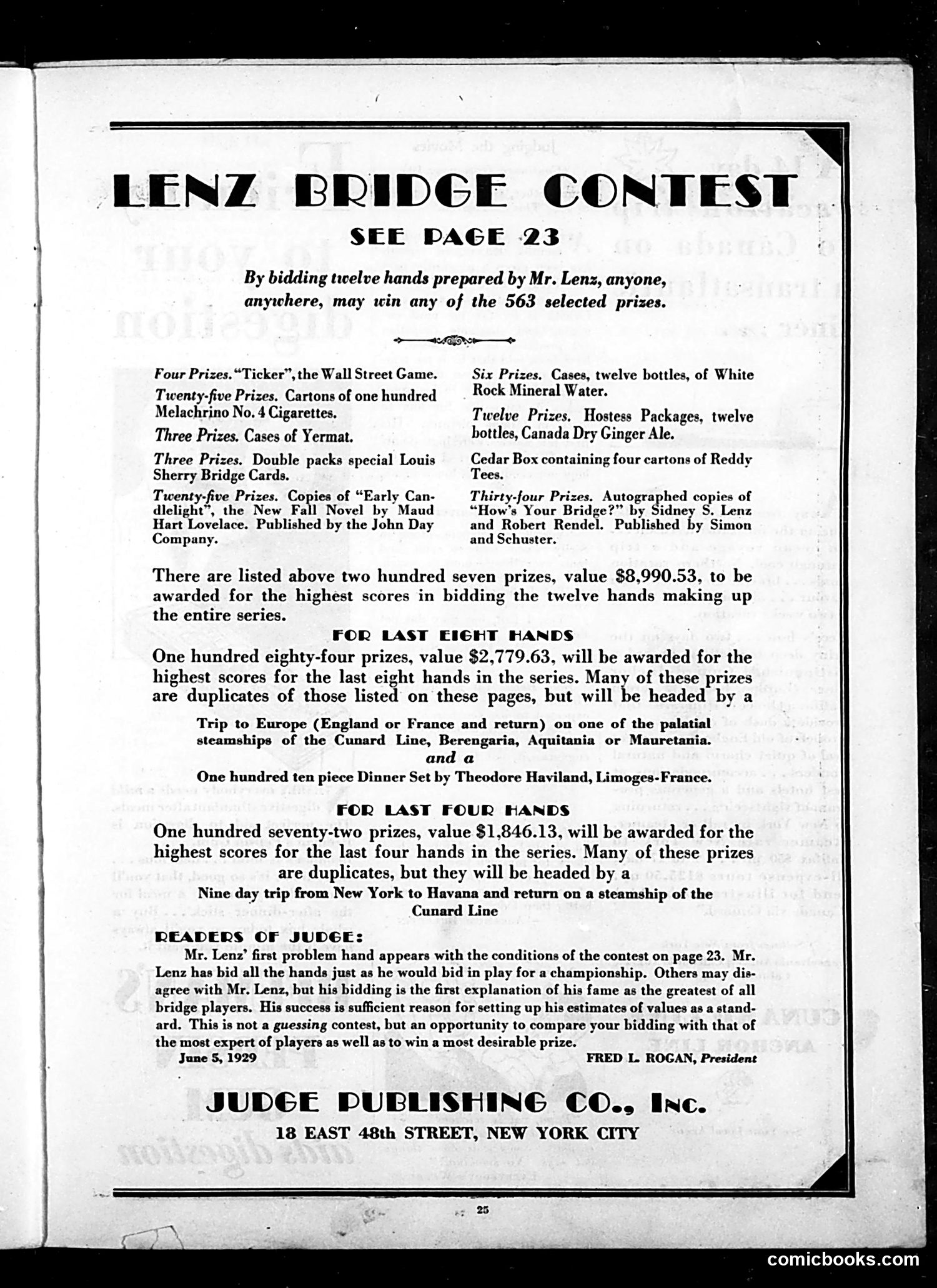
This page is primarily an advertisement for a bridge-bidding contest sponsored by Judge magazine (June 1929). It's not a cartoon but rather a promotional announcement for a competition based on twelve hands prepared by **Sidney Lenz**, described as "the greatest of all bridge players." The contest invites readers to bid these prepared hands and compete for 563 prizes totaling nearly $9,000, with premium rewards (European trips, Havana cruises, fine dinnerware) for highest scores on specific hand sequences. The appeal leverages Lenz's reputation: his bidding decisions serve as the contest standard, allowing participants to "compare your bidding with that of the most expert of players." This reflects 1920s American enthusiasm for bridge as a competitive intellectual pursuit among educated audiences—a pastime prestigious enough to warrant major magazine promotion and substantial prizes.
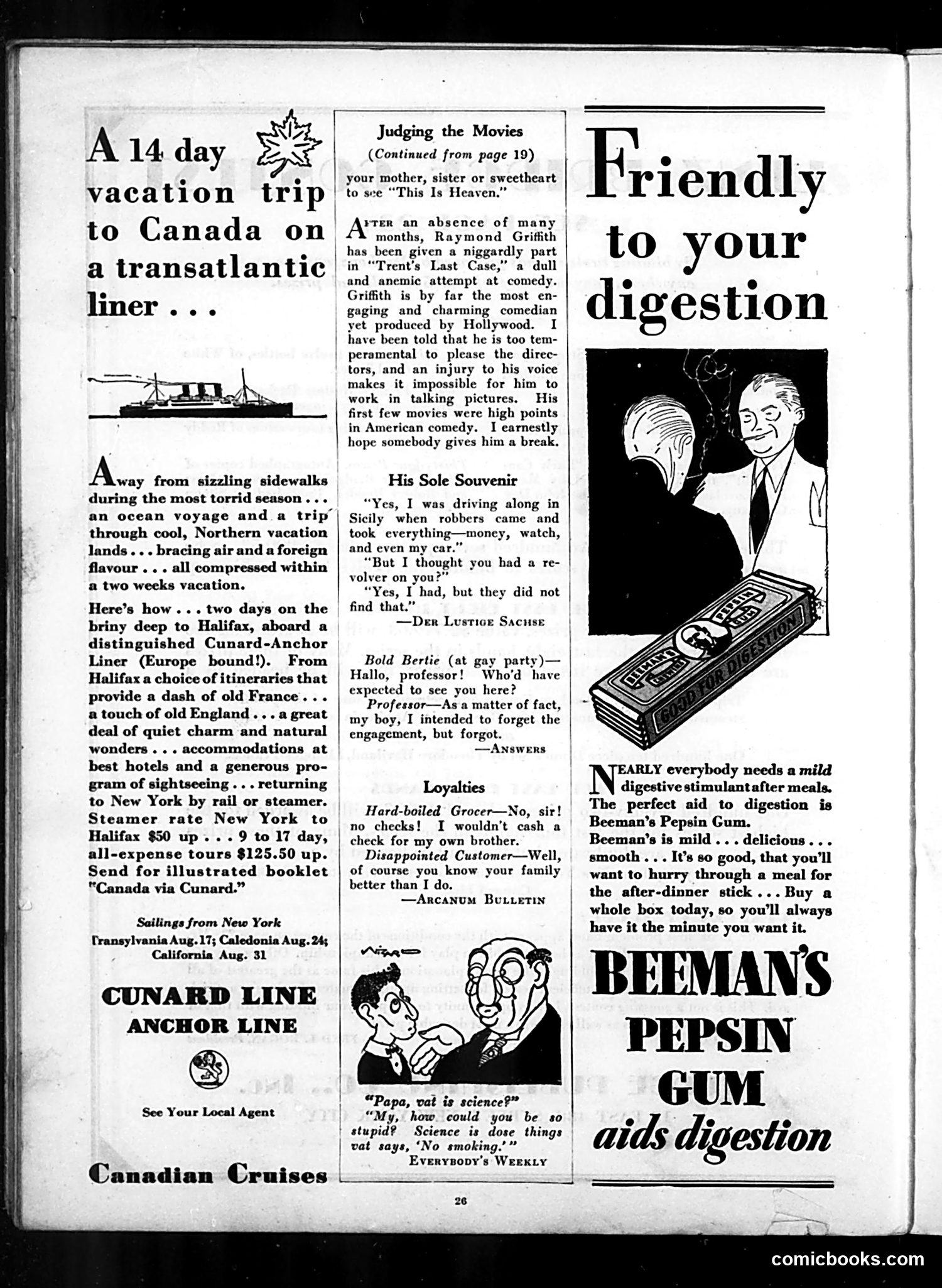
This page mixes travel advertising with humor content typical of 1920s satirical magazines. **Main Content:** The left side advertises Cunard Line cruises to Canada—a luxury vacation escape from hot American summers. Marketed to affluent readers, it emphasizes ocean travel's prestige and leisurely sightseeing. **Humor Sections:** "Judging the Movies" critiques actor Raymond Griffith, lamenting his small roles and suggesting voice injury prevents him from working in "talking pictures" (early sound films). The piece expresses hope he'll get better opportunities. Below are brief jokes about robberies in Sicily, a professor at a party, a grocer's integrity, and a father's definition of science (making a pun on "No Smoking" signs). These are generic, era-appropriate humor—no specific political satire. **Advertising:** The right side promotes Beeman's Pepsin Gum as a digestive aid, using a cartoon of two men discussing the product's benefits. This was standard patent medicine marketing of the period. The page is primarily **commercial content with light entertainment**—no significant political commentary or historical reference.
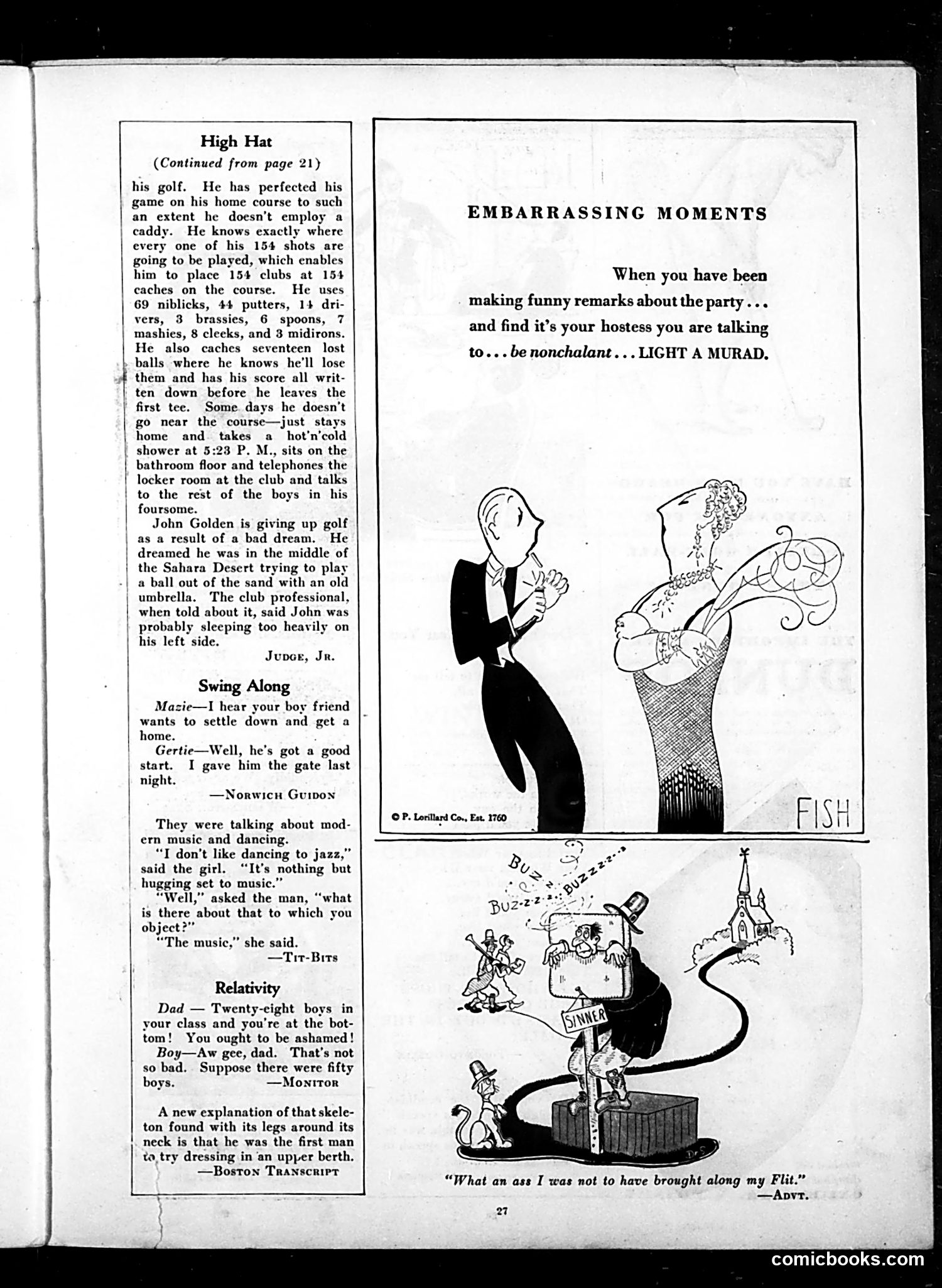
This page contains humor pieces typical of early 20th-century satirical magazines. The "Embarrassing Moments" cartoon shows a man awkwardly realizing the well-dressed woman he's been insulting is his hostess—the joke being that smoking a Murad cigarette will help him appear composed during this social gaffe. This is an advertisement disguised as humor. The text pieces are brief comedic anecdotes: "High Hat" mocks an obsessive golfer who places 154 clubs around his home course; "Swing Along" contains flirtation jokes; "Relativity" presents child-versus-parent humor about school grades; and the skeleton joke makes dark humor about train berth dressing. The "Fish" cartoon below shows a man at some kind of noisy gathering (possibly a speakeasy, given the Prohibition-era "Sinner" sign), regretting not bringing a Murad cigarette. The humor relies on casual social embarrassment and product placement as comedic relief—advertising integrated into editorial content.
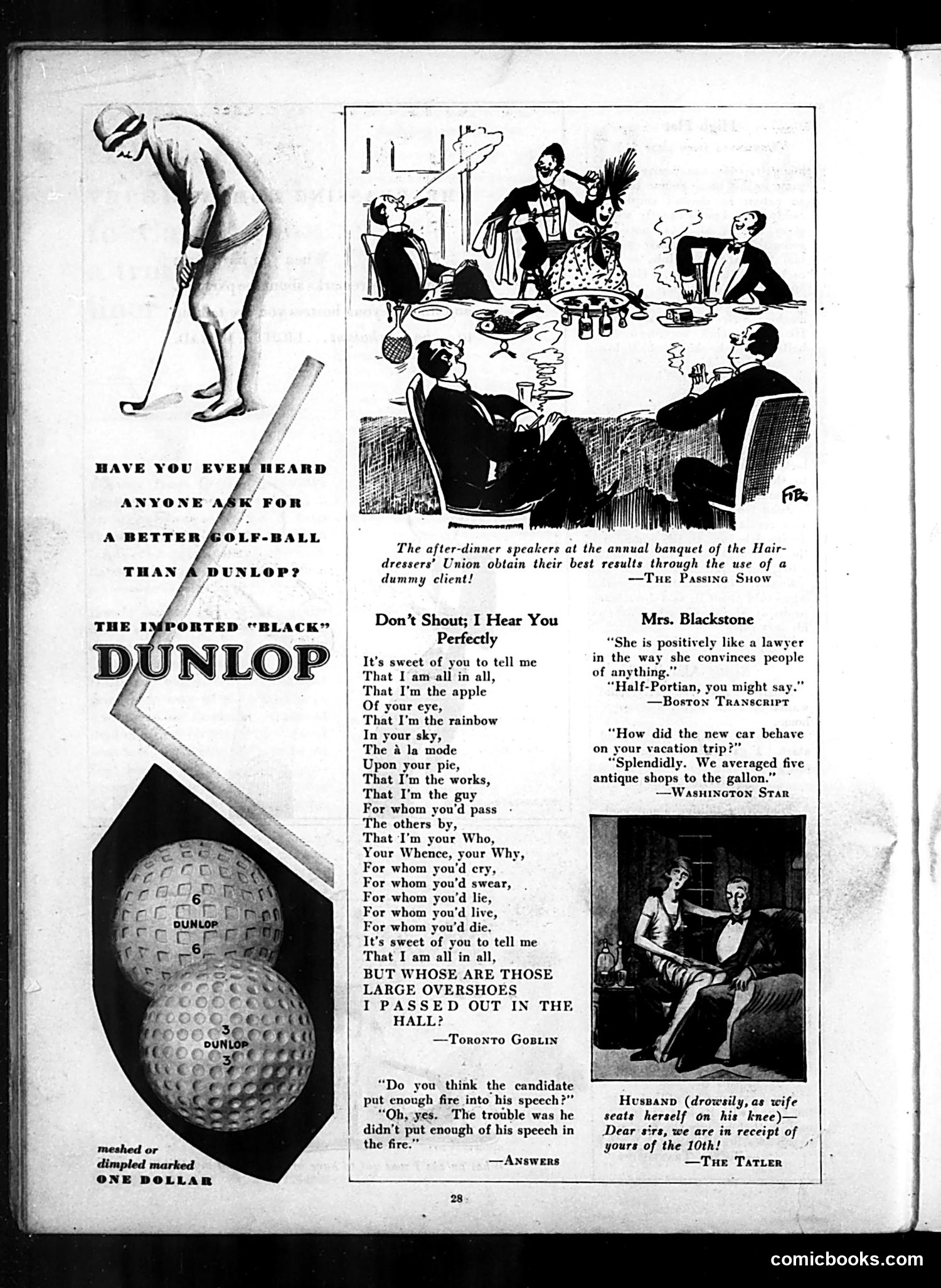
This page contains multiple satirical jokes typical of early 20th-century American humor magazines. **Top cartoon:** Mocks the Hairdressers' Union's after-dinner speakers by suggesting they use a dummy mannequin client as a prop—implying the speakers are so boring or ineffective they need visual aids. **Left side:** Advertisement for Dunlop golf balls, not satirical content. **Poetry (Toronto Goblin):** A romantic poem listing romantic sentiments ("you are my all in all") is undercut by a punchline revealing infidelity—the speaker questions whose large overshoes were left in the hallway, suggesting an affair. **Bottom right photograph:** Shows a couple; the caption jokes that a drowsy husband, when his wife sits on his lap, mechanically responds with a business letter opening ("we are in receipt of yours of the 10th"), suggesting marital disconnection or his exhaustion. **Other brief jokes:** Target politicians' ineffective speeches and automotive reliability. The page's humor relies on domestic situations, infidelity, and marital tension as comedy—typical of period satire.
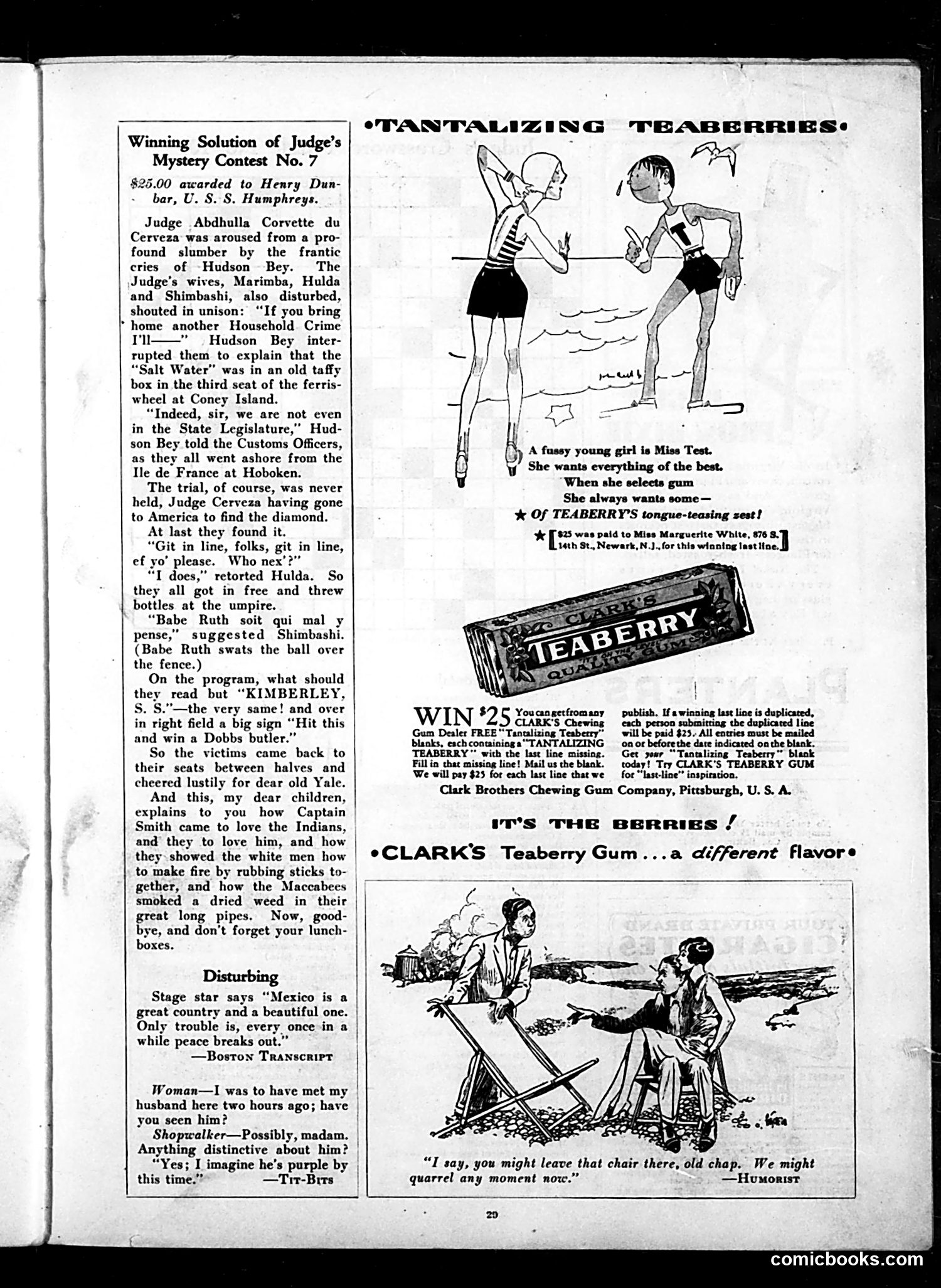
This page combines a humorous short story with advertising for Clark's Teaberry Gum. **The Main Story:** "Winning Solution of Judge's Mystery Contest No. 7" is an absurdist tale satirizing nothing in particular—it's simply nonsensical comedy. Characters with ridiculous names (Judge Abdulla Corvetta du Cerveza, Hudson Bey) search for "Salt Water" hidden at Coney Island, eventually finding it, then inexplicably ending up at a baseball game where they cheer for Yale. The narrative intentionally makes no sense, jumping between unrelated events (Captain Smith and Native Americans, the Maccabees smoking pipes) as a parody of contrived storytelling. **The Advertising:** Multiple Clark's Teaberry Gum advertisements use period slang ("It's the berries!") and feature cartoon illustrations of young people. The brand ran a contest where readers completed missing punchlines for payment. **The Humor:** Appeals to 1920s readers through absurdism, wordplay ("Babe Ruth soit qui mal y pense"), and casual references to contemporary figures like Babe Ruth. The advertisements use flapper-era imagery and youthful appeal.
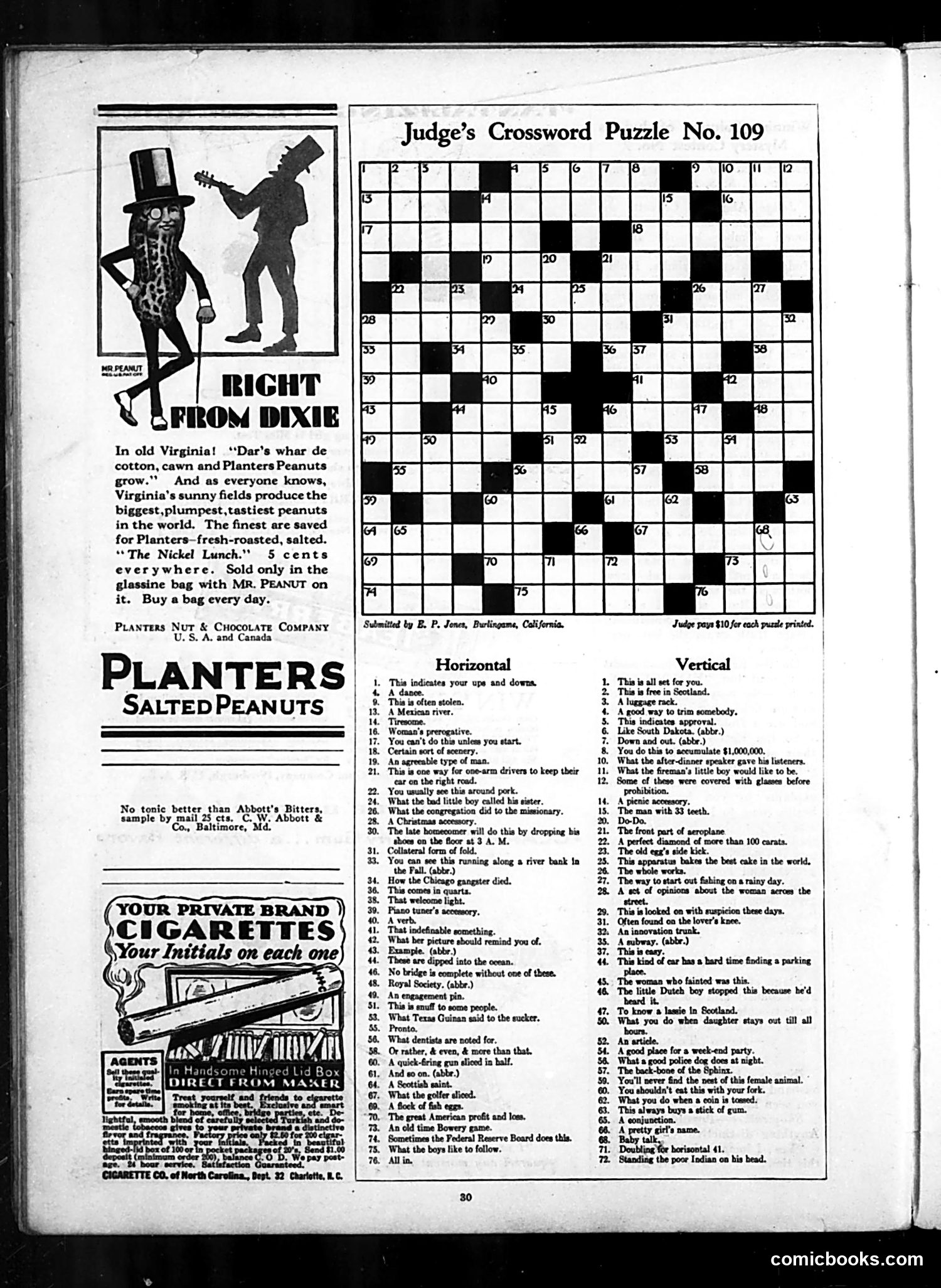
This page is primarily **advertising and a crossword puzzle**, not political satire. The cartoon at top left shows two figures in blackface—a common, deeply offensive advertising trope of the era—promoting **Planters Salted Peanuts**. The text uses dialect ("Dar's whar de") to invoke a romanticized, racist stereotype of the American South to sell peanuts supposedly grown in Virginia. This reflects the casual racism embedded in early 20th-century commercial advertising. The remainder of the page contains: - Additional ads (Abbott's Bitters, cigarettes) - **Judge's Crossword Puzzle No. 109**, a standard puzzle feature with horizontal and vertical clues There is no political commentary or social satire evident. The page demonstrates how racist imagery was normalized in period advertising and popular magazines, now recognized as offensive historical artifacts.
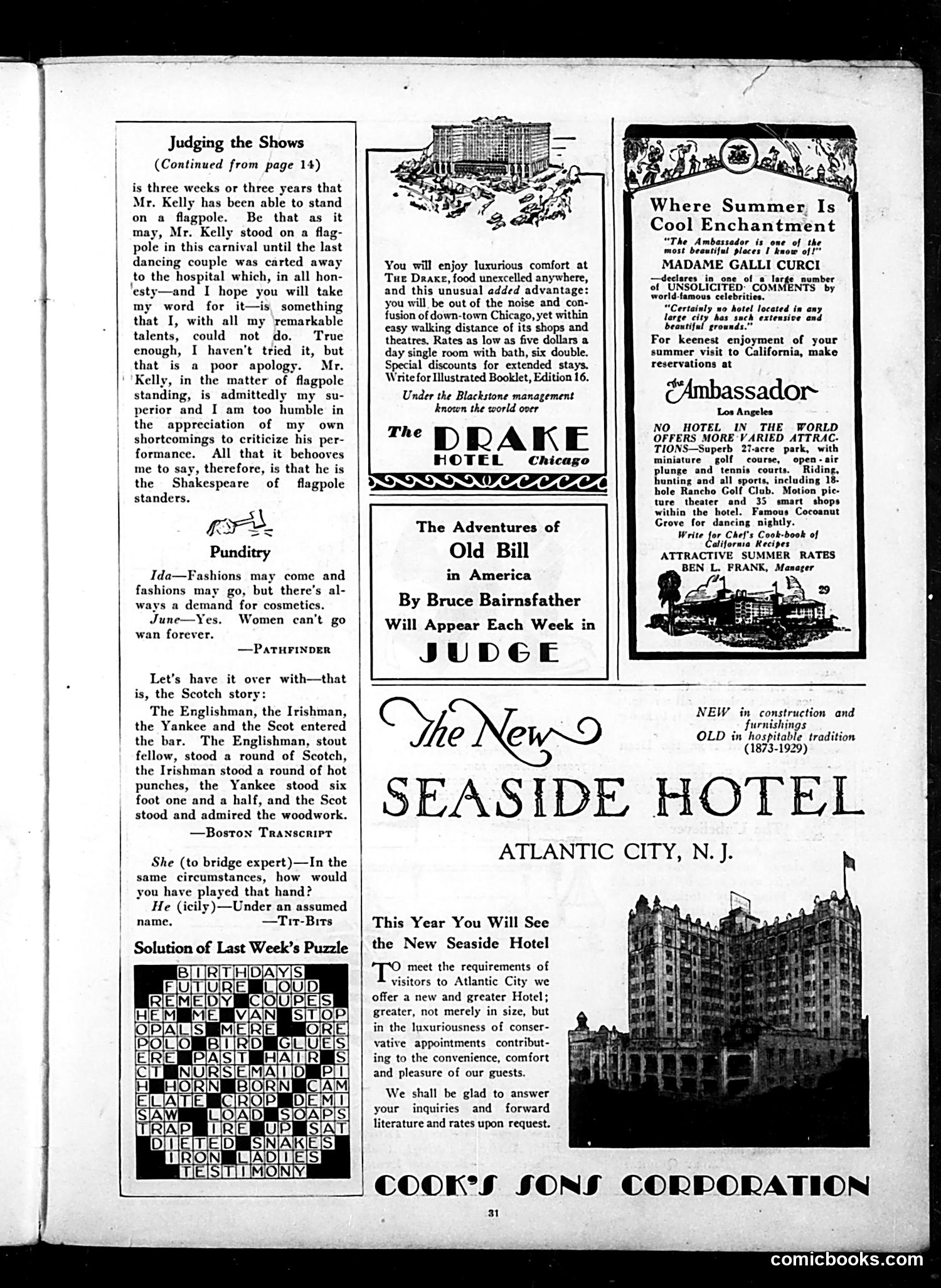
This page is primarily **advertising** for hotels and entertainment, with light satirical content. The main satirical elements are brief: 1. **"Judging the Shows"** — A theater critic humorously praising a flagpole sitter named Kelly, comparing him to "the Shakespeare of flagpole standers." This mocks both the stunt's absurdity and critics who over-praise mediocre performances. Flagpole sitting was an actual 1920s fad. 2. **"Punditry" section** — Quick jokes about fashion and cosmetics, and a racist "Scotch story" playing on ethnic stereotypes (the Scot character is stingy, admiring woodwork rather than buying drinks). 3. **"Solution of Last Week's Puzzle"** — A standard crossword answer grid. The remainder is hotel advertising: The Drake (Chicago), Ambassador (Los Angeles), and Seaside Hotel (Atlantic City)—typical luxury travel promotion. References to Madame Galli Curci (famous opera singer) lend prestige. The content reflects 1920s American middle-class entertainment and tourism culture, with casual ethnic humor now considered offensive.
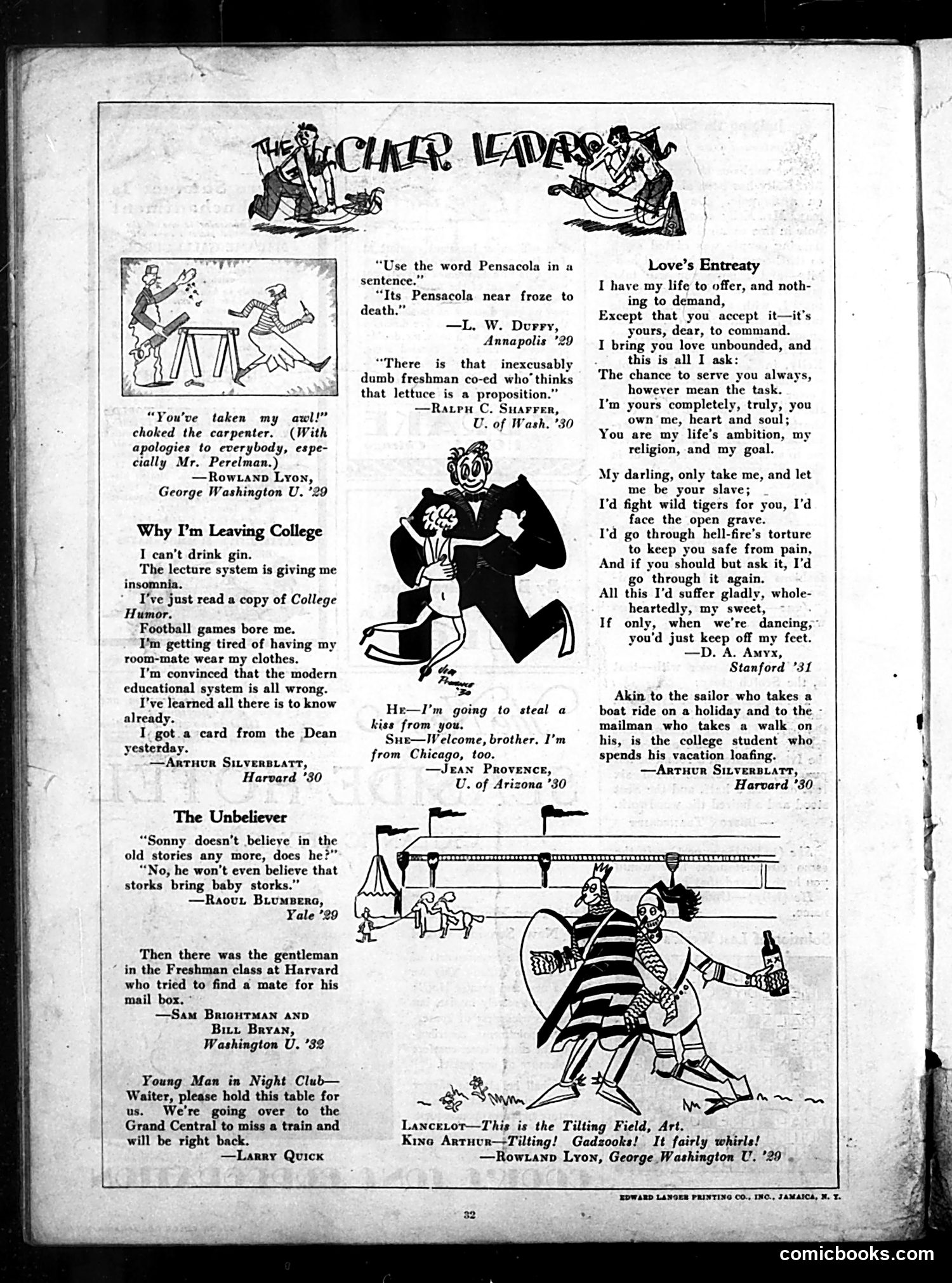
This is a humor page from Judge magazine featuring student-submitted jokes and quips, primarily from college contributors (Harvard, Yale, Stanford, etc.). The content reflects 1920s-30s college life through satire. **Key themes:** The jokes mock college experiences: tedious lectures, prohibition-era drinking ("I can't drink gin"), football games, and administrative discipline ("got a card from the Dean"). One recurring joke targets female students' intellectual capabilities ("dumb freshman co-ed who thinks lettuce is a proposition"). The cartoons employ slapstick and wordplay—one depicts a carpenter losing his tool ("awl"), another shows a mailman confused about dating his mailbox, and a final illustration satirizes romantic overstatement by having an overly devoted suitor ultimately just ask his date not to step on his feet while dancing. **Social context:** These reflect 1920s student attitudes toward education as burdensome, authority as ridiculous, and romantic devotion as performative excess worthy of mockery. The collected humor represents typical college magazine fare celebrating adolescent irreverence.
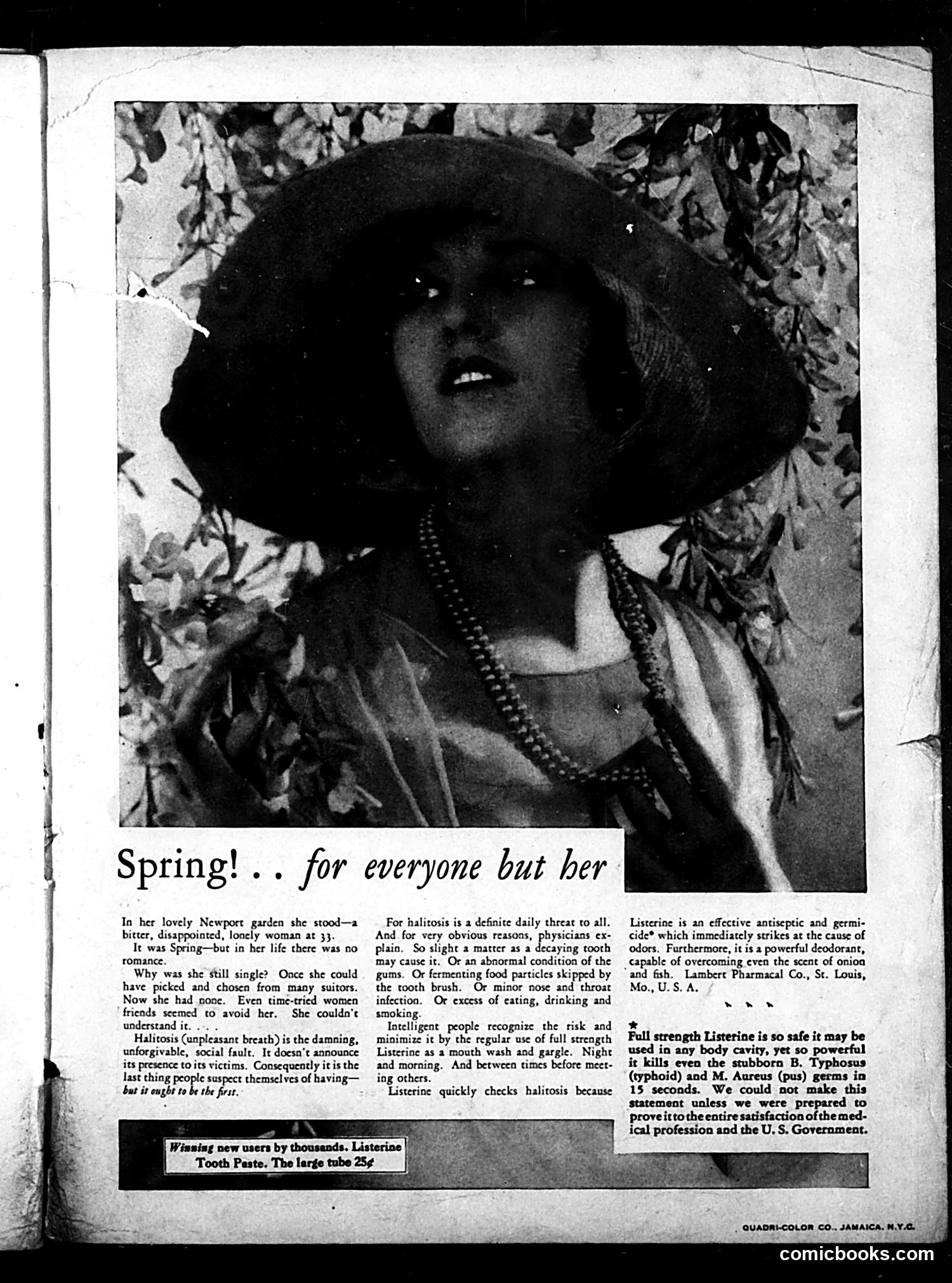
This is a **Listerine mouthwash advertisement** disguised as editorial content in *Judge* magazine. The layout uses a common advertising technique of the era: a sympathetic human-interest story leading to a product solution. **The "Story":** A 33-year-old unmarried woman in Newport (implying upper-class) is socially isolated and romantically unsuccessful. The implication is subtle but clear: she has **halitosis** (bad breath), which is presented as a definite social death sentence preventing romantic prospects and friendships. **The Point:** This is fear-based marketing. The ad suggests that bad breath is an invisible social killer—victims don't know they have it, but everyone avoids them because of it. The solution: use Listerine mouthwash twice daily and before social meetings. **Historical Context:** This reflects 1920s-30s advertising that weaponized social anxiety, particularly targeting women's desirability and marriageability. Halitosis wasn't a newly discovered condition; Listerine's marketing essentially *invented* it as a widespread concern to drive sales.
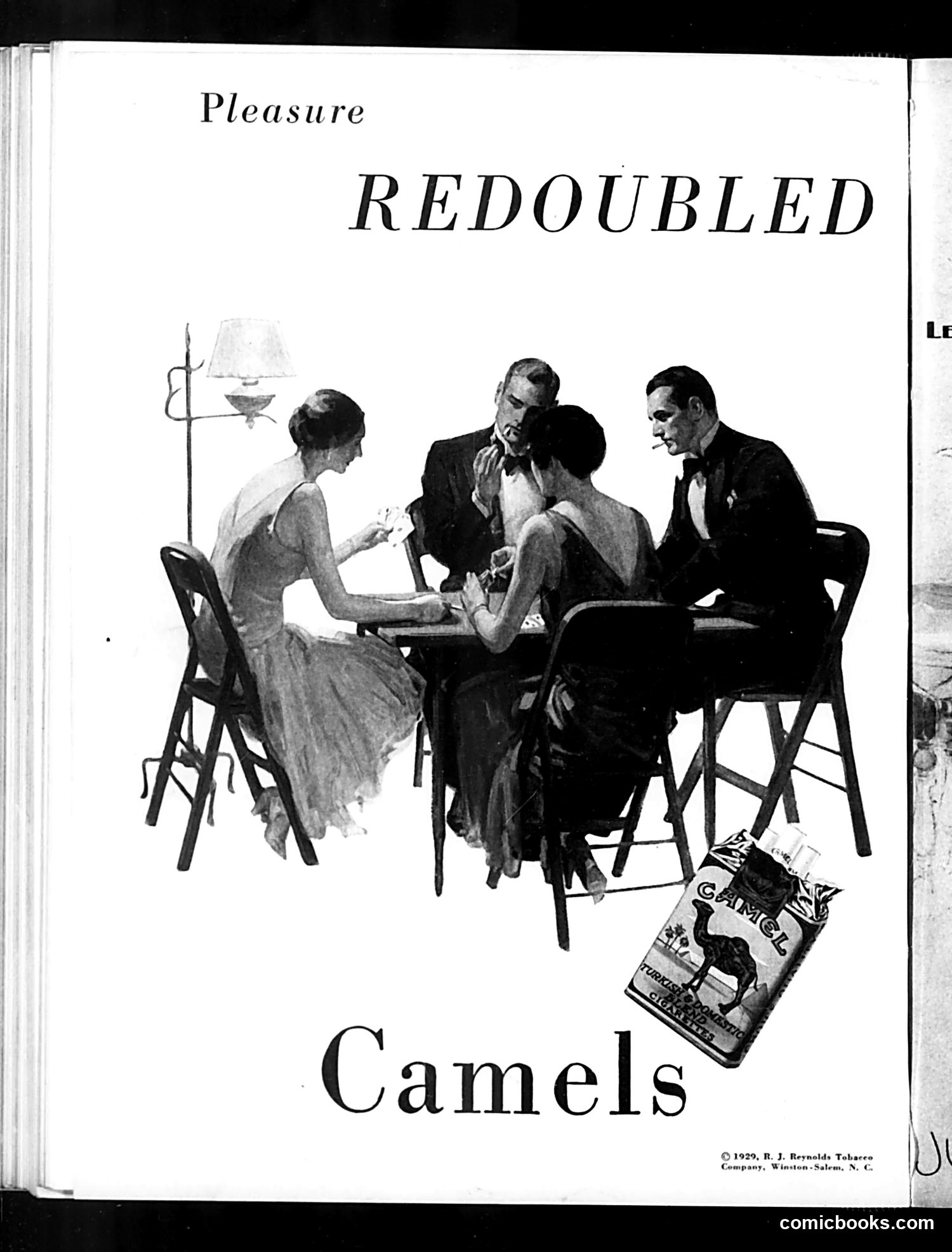
This is a 1929 Camel cigarette advertisement rather than political satire. The ad depicts four well-dressed people in an elegant social setting, appearing to enjoy themselves around a table with a lamp. The headline "Pleasure Redoubled" suggests that smoking Camels enhances social enjoyment and leisure. The image reflects 1920s advertising conventions: cigarettes were marketed as sophisticated lifestyle products associated with glamour, sociability, and modern living. The elegant clothing and intimate gathering convey aspirational middle-to-upper-class social status. By modern standards, this advertisement is notable primarily for its casual promotion of tobacco without any health warnings—entirely legal and common in 1929, decades before warning labels became required.