
A complete issue · 44 pages · 1929
Life — March 15, 1929
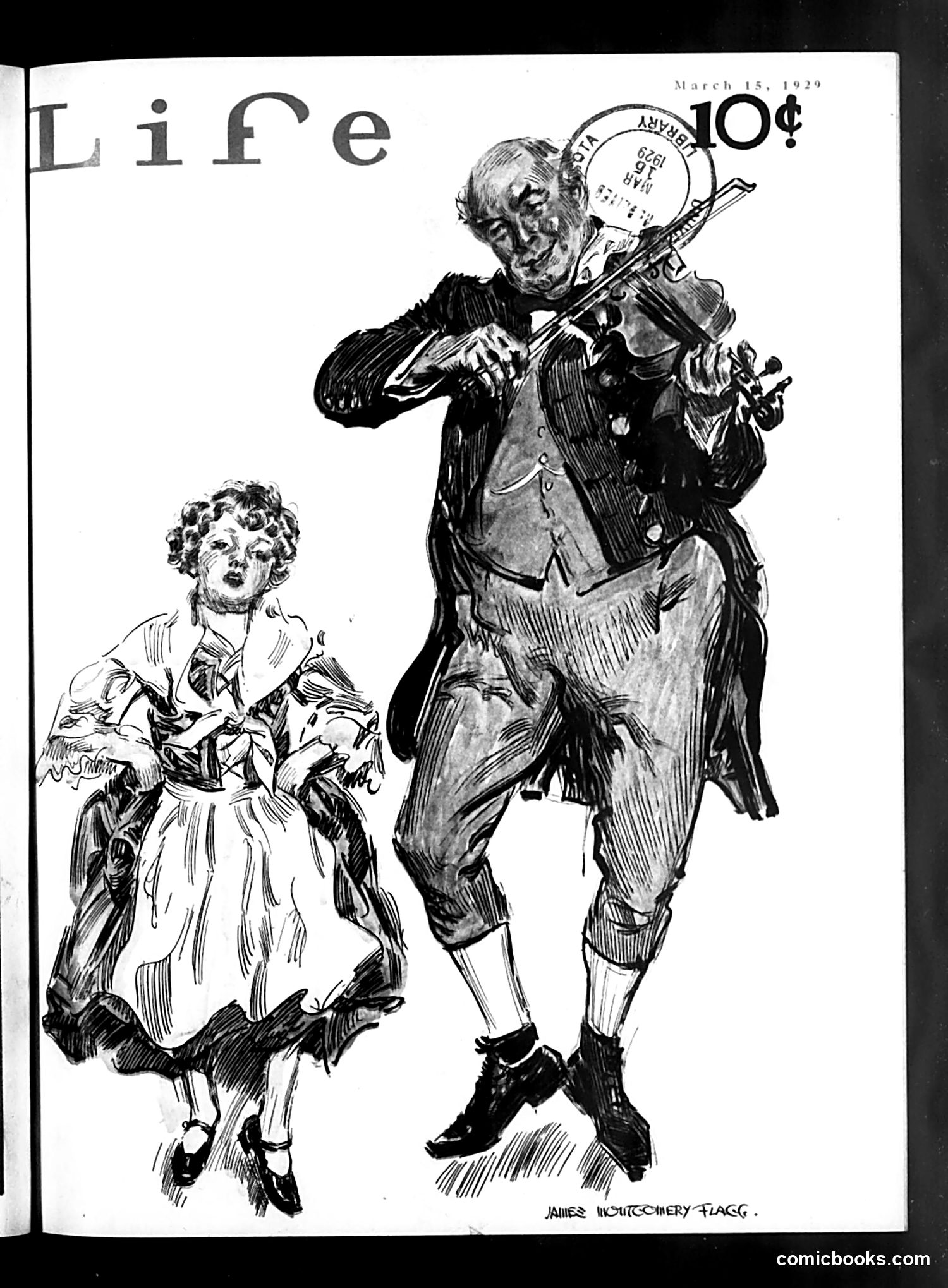
This satirical illustration by James Montgomery Flagg depicts an elderly man playing a violin while a young girl watches. The man appears to be a caricatured figure—possibly representing an older generation or authority figure—performing music while the child looks on with apparent concern or bewilderment. The cartoon likely satirizes generational disconnect or the clash between old and new cultural values prevalent in 1929. The violin suggests "old-fashioned" entertainment or values, while the child's reaction implies skepticism toward dated traditions. Given the era's rapid modernization and the emerging youth culture of the Jazz Age, this probably mocks how older generations' tastes seemed increasingly irrelevant to younger Americans.
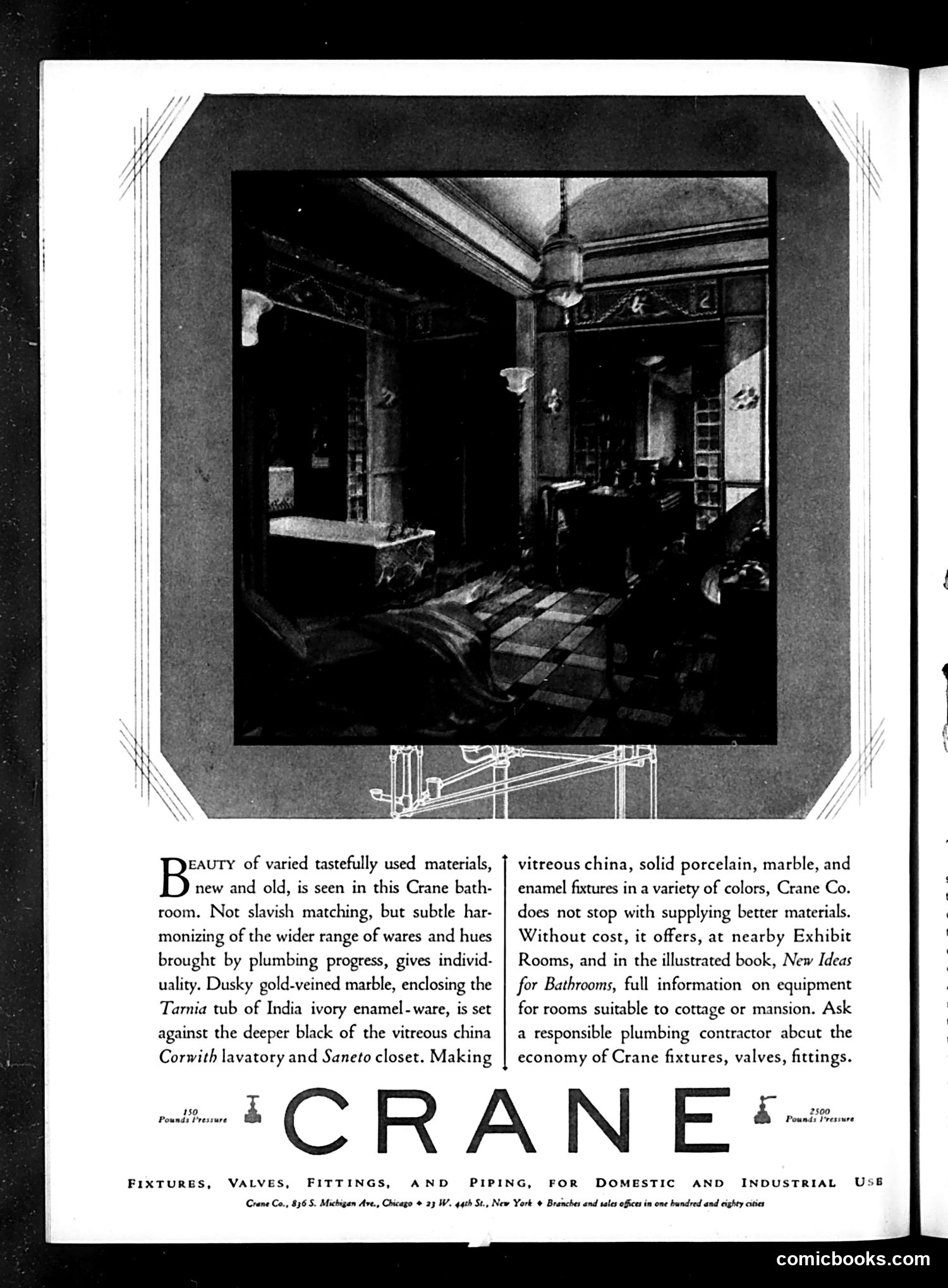
This page is primarily an advertisement for Crane plumbing fixtures, not satirical content. The black-and-white photograph shows a luxuriously appointed bathroom featuring various Crane products—vitreous china, porcelain, marble, and enamel fixtures. The ad text emphasizes how different materials work together harmoniously without appearing "slavish" in their matching, highlighting the "individuality" created by Crane's range of colors and styles. The advertisement promotes both the aesthetic appeal and practical quality of their plumbing products, directing readers to nearby exhibit rooms and a book titled "New Ideas for Bathrooms" for further information. This represents typical early-to-mid-twentieth-century advertising copy emphasizing modern domestic luxury and consumer choice.
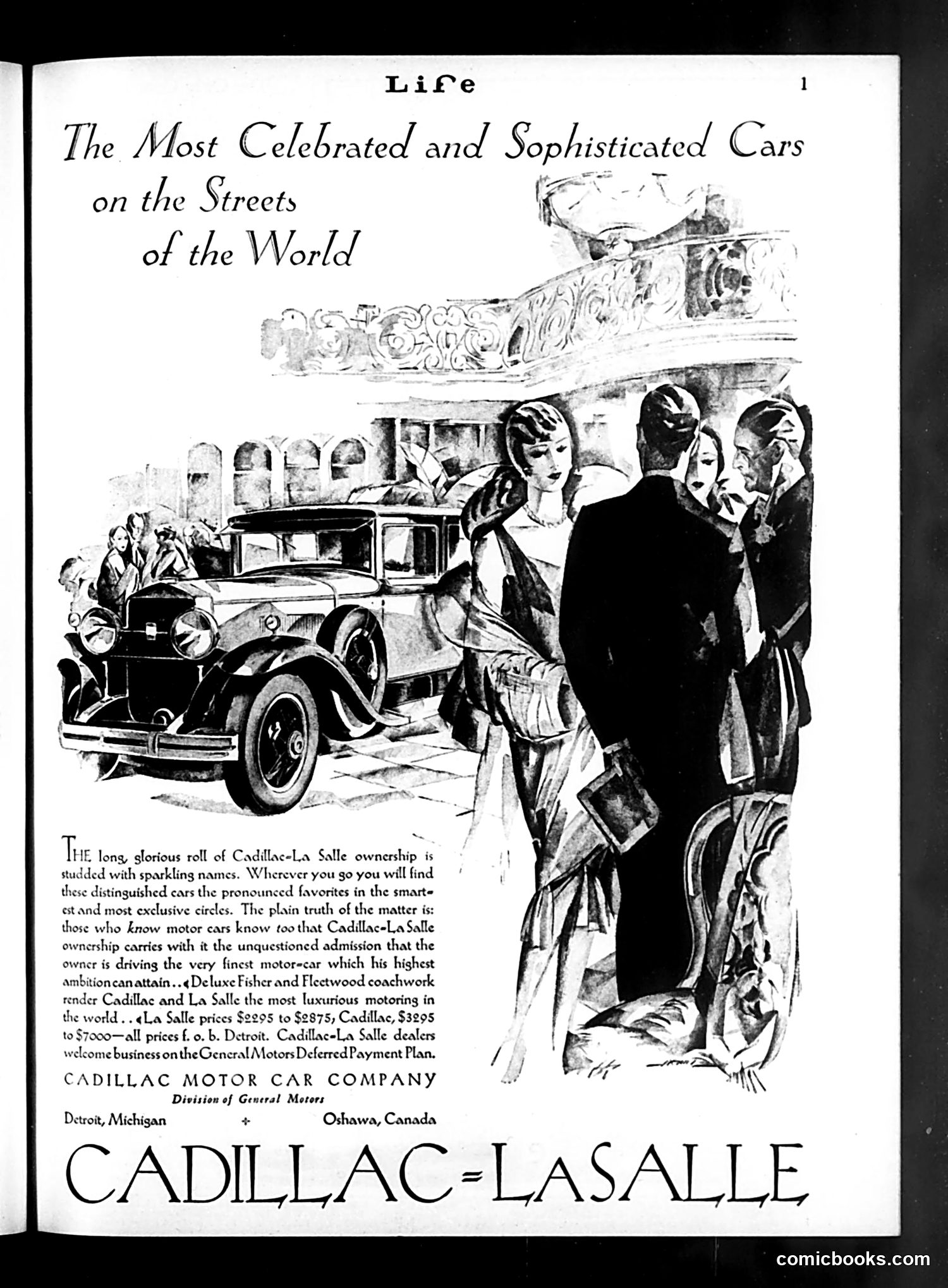
This is primarily a **luxury automobile advertisement**, not satire. The page advertises Cadillac-La Salle vehicles through Life magazine. The illustration depicts well-dressed, sophisticated urbanites admiring a Cadillac-La Salle automobile—establishing the car as a status symbol. The text claims that Cadillac-La Salle ownership demonstrates refined taste and "the highest ambition" one can achieve in motorcar ownership. The ad emphasizes exclusivity: ownership signals membership in "smart" society circles. Pricing ($2295 to $7000) and references to luxury body styles (Fleetwood, Fisher) underscore the premium positioning. This reflects 1920s consumer culture, where automobiles represented aspiration and social standing. The advertisement assumes readers understand that displaying the "right" car publicly communicates wealth and sophistication to observers.
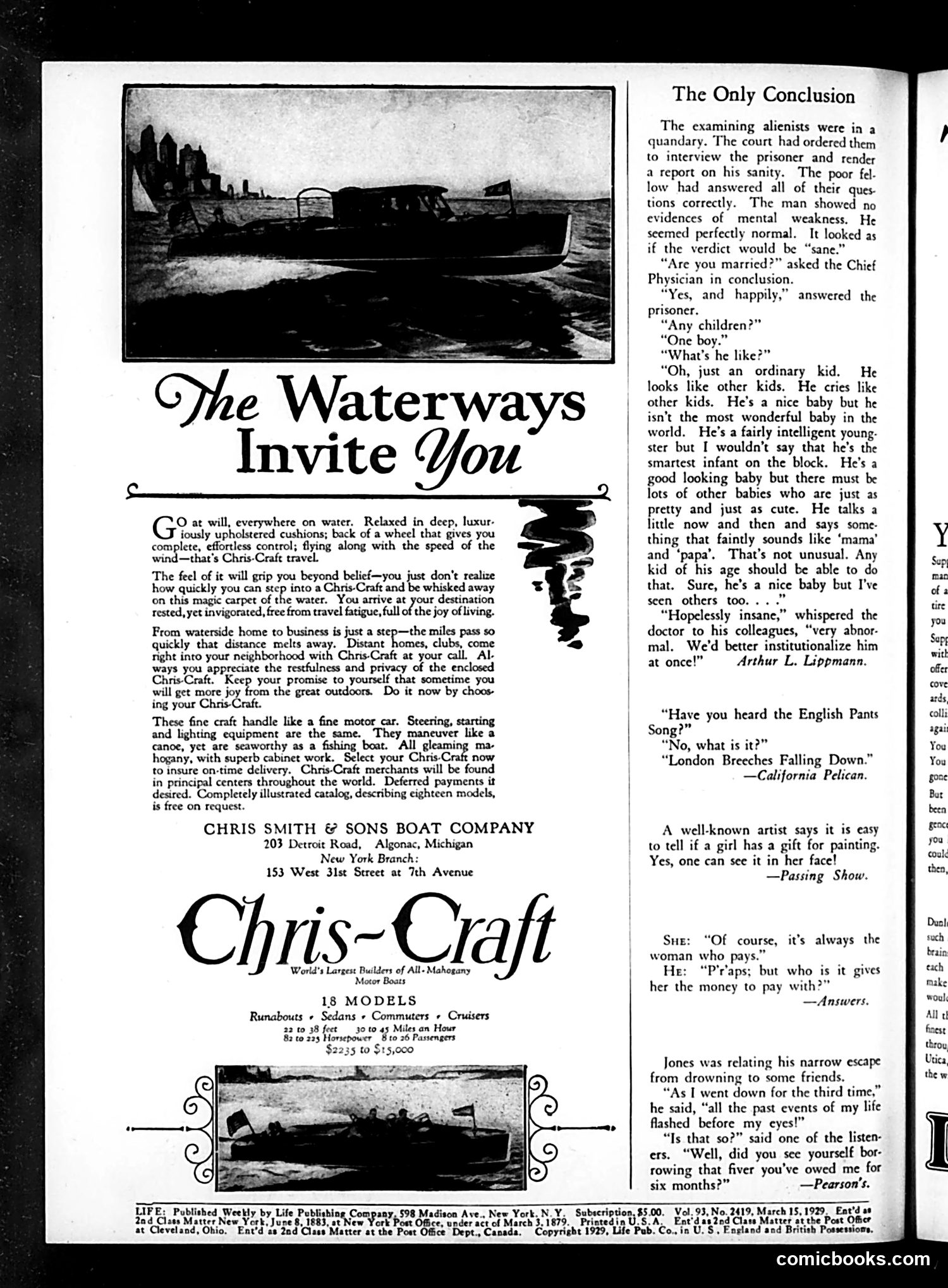
This page is primarily **advertising**, not political satire. It contains two Chris-Craft boat advertisements featuring images of motor vessels on water. The right column contains humorous anecdotes and jokes typical of Life magazine's "fillers" - including a piece titled "The Only Conclusion" about a court-ordered sanity examination of a prisoner, followed by brief comic exchanges on unrelated topics (marriage, children, painting talent, who pays in relationships, and a drowning anecdote). **No political cartoons or caricatures appear here.** The content reflects early 20th-century humor styles: absurdist logic, gender-role jokes, and everyday social observations. The boat advertisements emphasize leisure and technological advancement typical of 1920s marketing to middle-class readers.
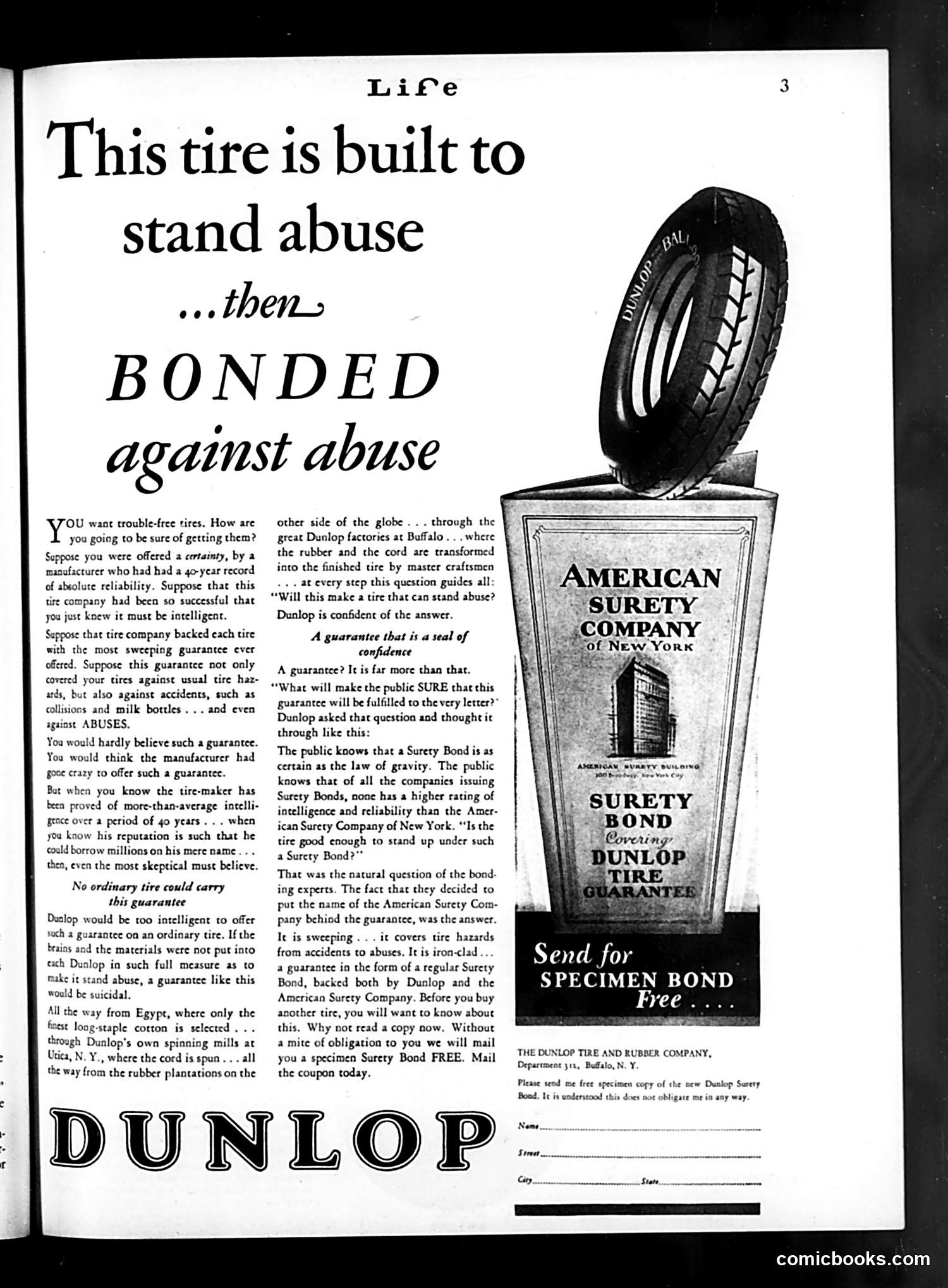
This is primarily a **commercial advertisement**, not a political cartoon. It promotes Dunlop tires by emphasizing their durability and reliability through the American Surety Company's guarantee. The ad uses a marketing strategy common to early 20th-century advertising: it appeals to consumer anxiety by posing hypothetical concerns ("How are you going to be sure of getting trouble-free tires?") then positions the product as the solution through a "Surety Bond" guarantee—a legal backing that adds credibility. The text references Dunlop's manufacturing reputation and Egyptian cotton sourcing. The visual shows a tire displayed prominently alongside an American Surety Building image, combining product and institutional authority to convince readers of trustworthiness. This is straightforward brand-building through guarantee assurance, not satire.
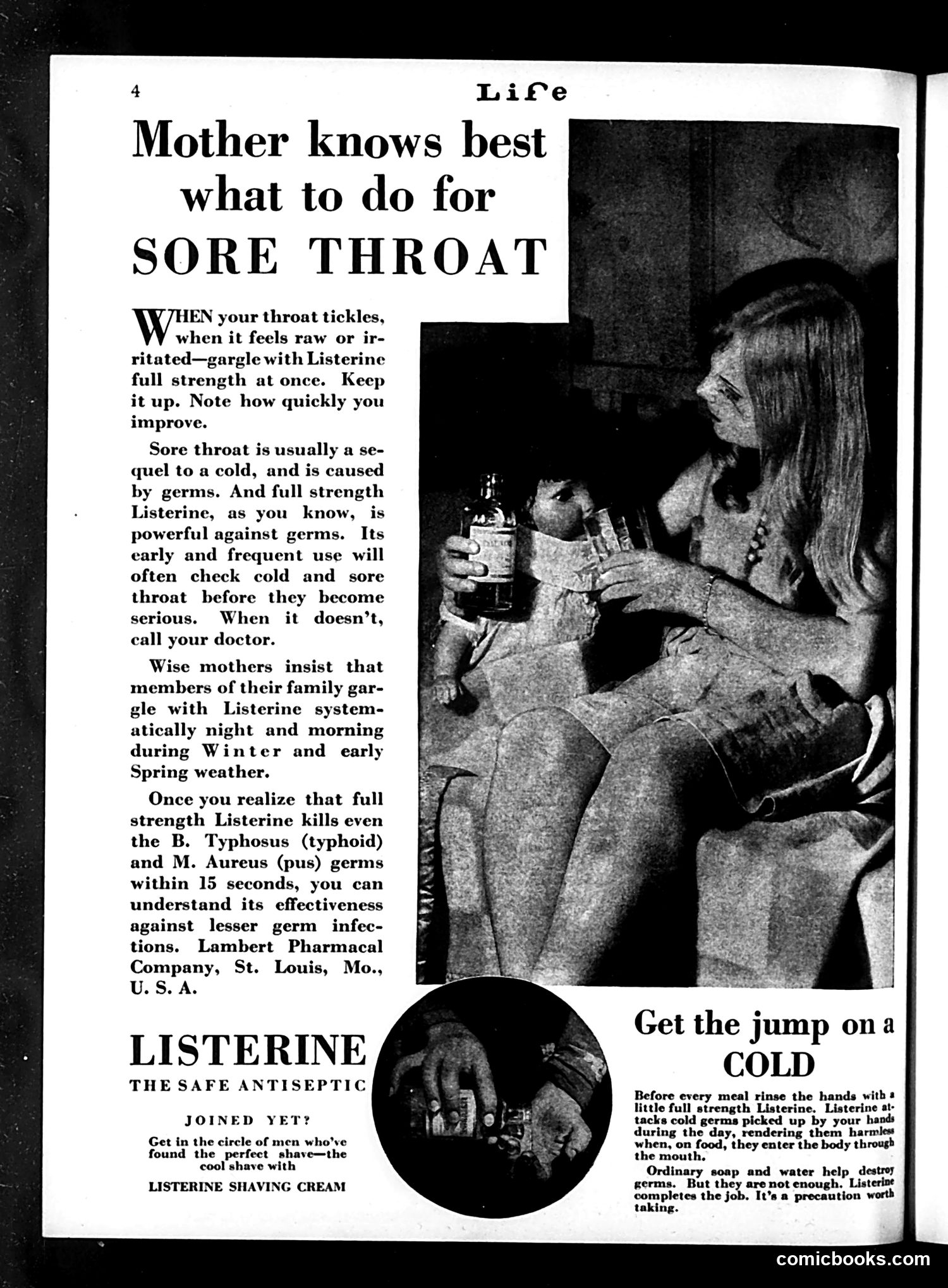
This is not a political cartoon or satire—it's a **Listerine advertisement** from Life magazine's "Life" section. The page promotes Listerine antiseptic mouthwash through two claims: 1. **Sore Throat Treatment**: The ad claims Listerine kills dangerous germs (including typhoid and other bacteria) within 15 seconds, positioning it as a preventative remedy mothers should use on family members during cold/flu season. 2. **Cold Prevention**: A secondary pitch recommends rinsing hands with Listerine before meals to prevent catching colds from germs picked up during the day. The photograph shows a mother administering Listerine to a child. This is straightforward product marketing exploiting medical anxieties—no satirical content is present. Such exaggerated health claims were common in early-to-mid 20th century advertising before modern FDA regulations.
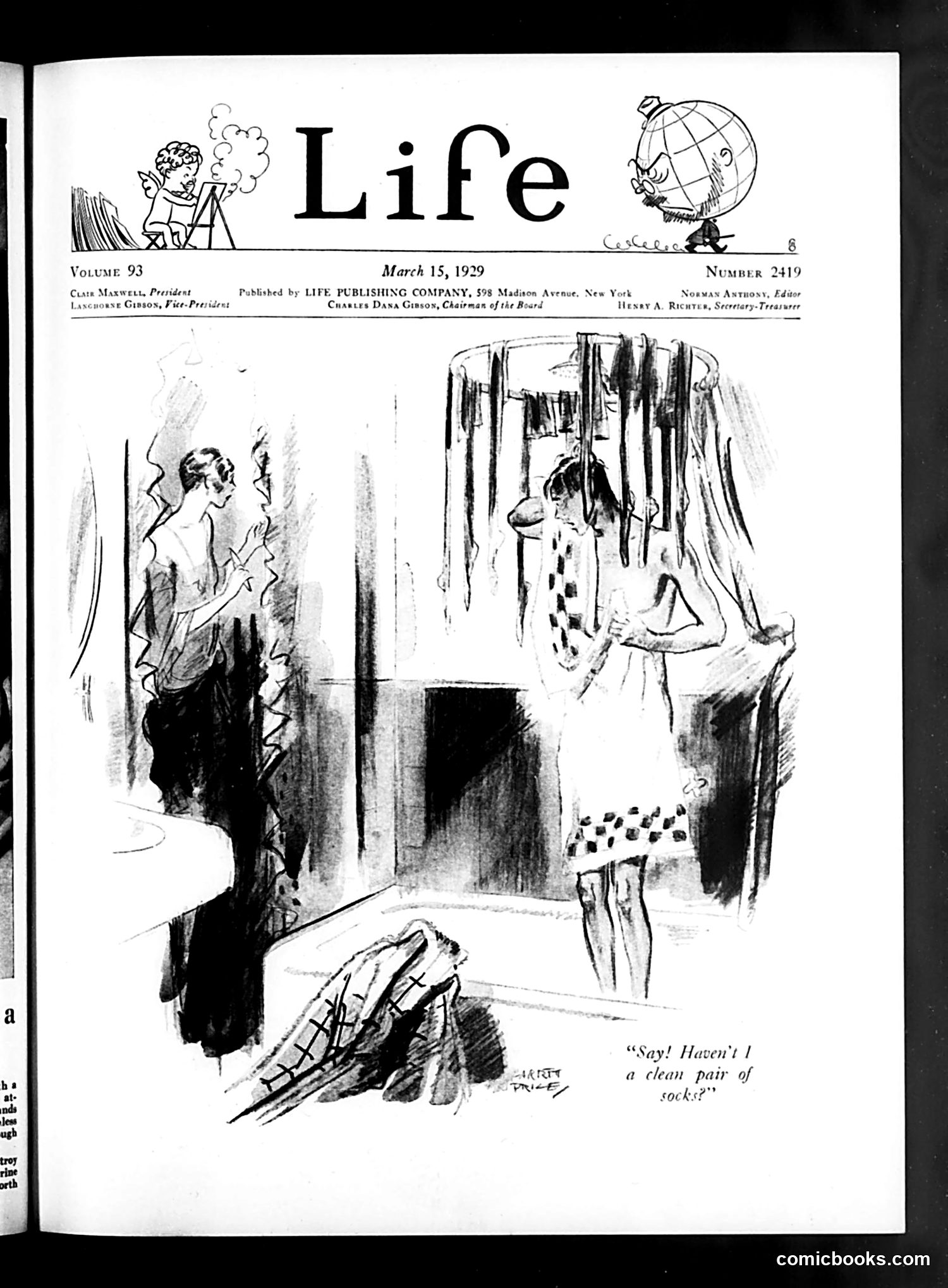
This is a single-panel cartoon depicting a domestic scene. A woman stands in a doorway or closet area, gesturing with apparent exasperation while addressing a man visible on the right side of the frame. The cartoon's caption reads: "Say! Haven't I a clean pair of socks?" The joke appears to be a domestic humor piece about household chores and marital expectations—specifically, the common complaint that husbands expect wives to maintain their wardrobes, including keeping clean socks available. The cartoon satirizes traditional gender roles of the era, where wives were responsible for laundry and domestic tasks while husbands took such services for granted. This represents typical 1920s domestic comedy found in Life magazine's satirical humor sections.
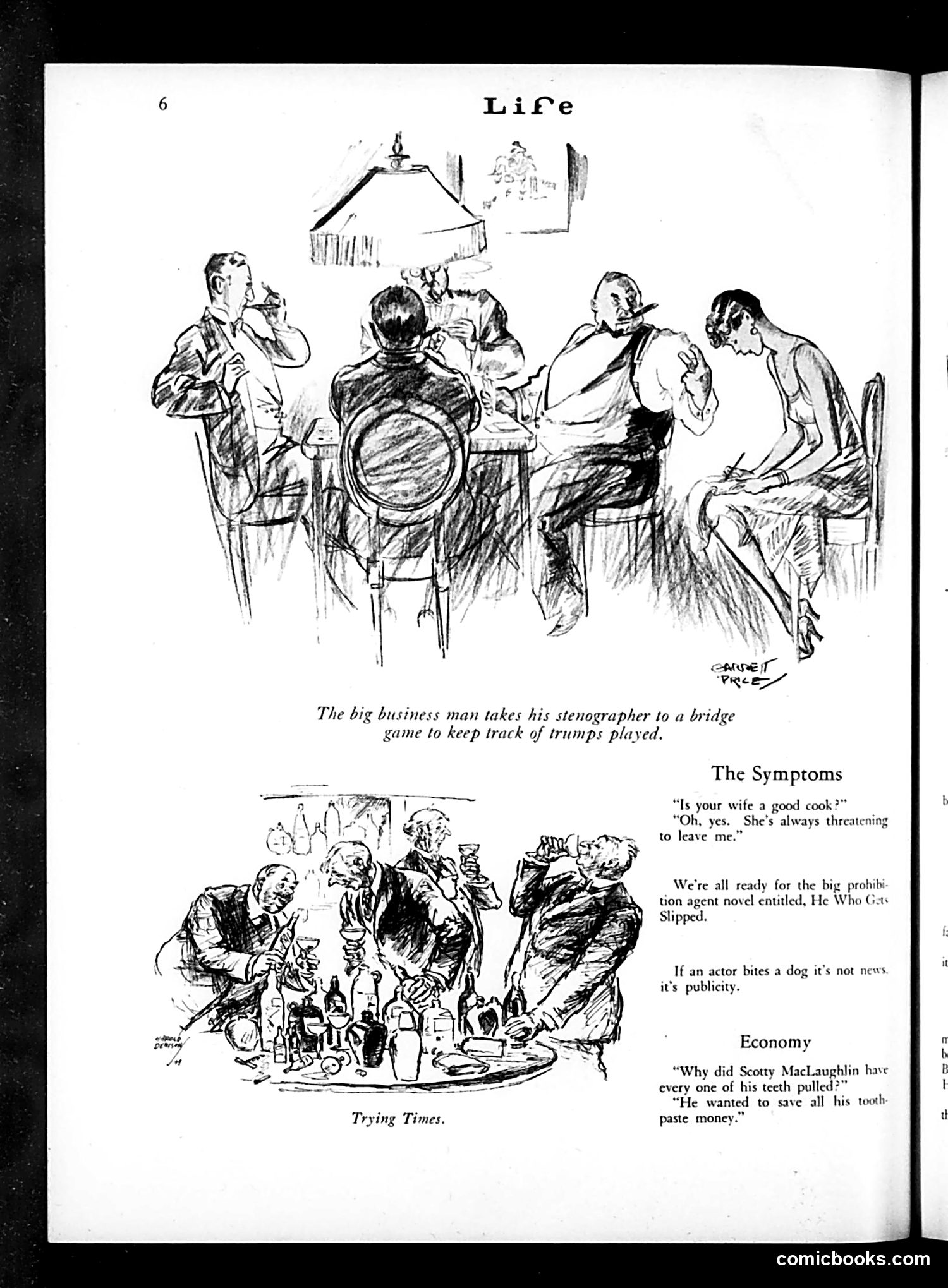
This page from *Life* magazine contains three satirical cartoons mocking contemporary social behaviors: 1. **"The Big Business Man Takes His Stenographer to a Bridge Game"** — satirizes wealthy businessmen's pretentiousness, suggesting they flaunt their employees/status symbols at leisure activities. 2. **"Trying Times"** — depicts men drinking and socializing during Prohibition (evident from the bottles and glasses), mocking the era's hypocrisy and "trying times" of illegal alcohol consumption. 3. **Text sections** titled "The Symptoms," "Economy," and similar headings contain brief jokes about marital discord, entertainment industry gossip, and penny-pinching behavior. The cartoons reflect early 20th-century *Life* magazine's style: satirizing upper-class pretension, Prohibition-era drinking culture, and domestic/social absurdities through sharp observational humor and quick comedic quips.
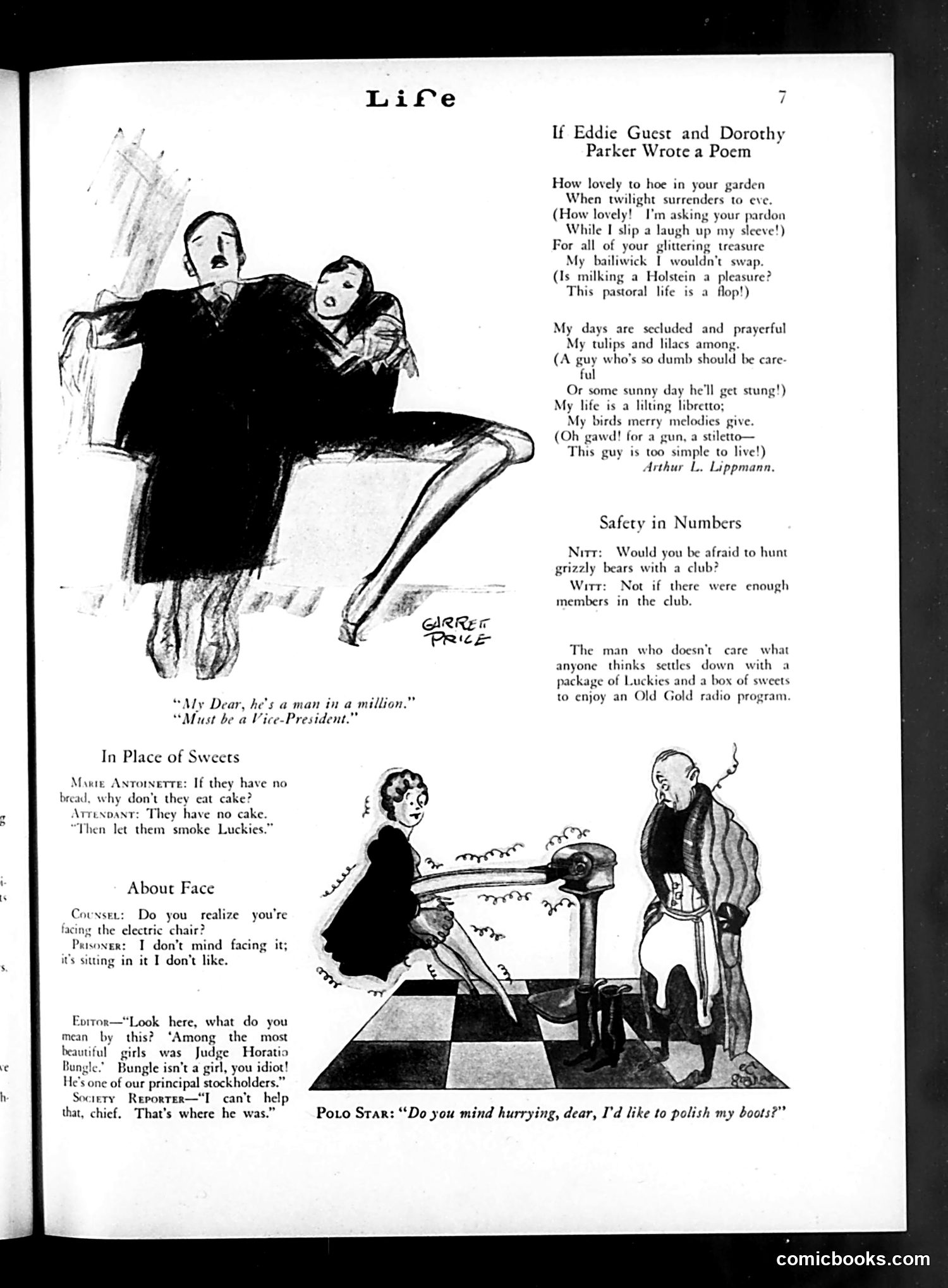
This page contains several satirical humor pieces typical of Life magazine's social commentary: **Top illustration**: Shows a couple relaxing, captioned "My Dear, he's a man in a million" / "Must be a Vice-President." This satirizes corporate culture, implying that only unremarkable men achieve executive status. **"In Place of Sweets"**: A dark joke about Depression-era scarcity, where Marie Antoinette's famous "let them eat cake" quote is inverted—suggesting the poor smoke cheaper cigarettes instead. **"About Face"**: Mocks legal/political absurdity: a prisoner facing execution dismisses the severity, while an editor's complaint about stock-holder terminology reveals institutional priorities over justice. **"Safety in Numbers"**: A brief joke about group confidence enabling risky behavior. The overall tone reflects 1920s-30s skepticism toward authority, wealth inequality, and institutional pretension.
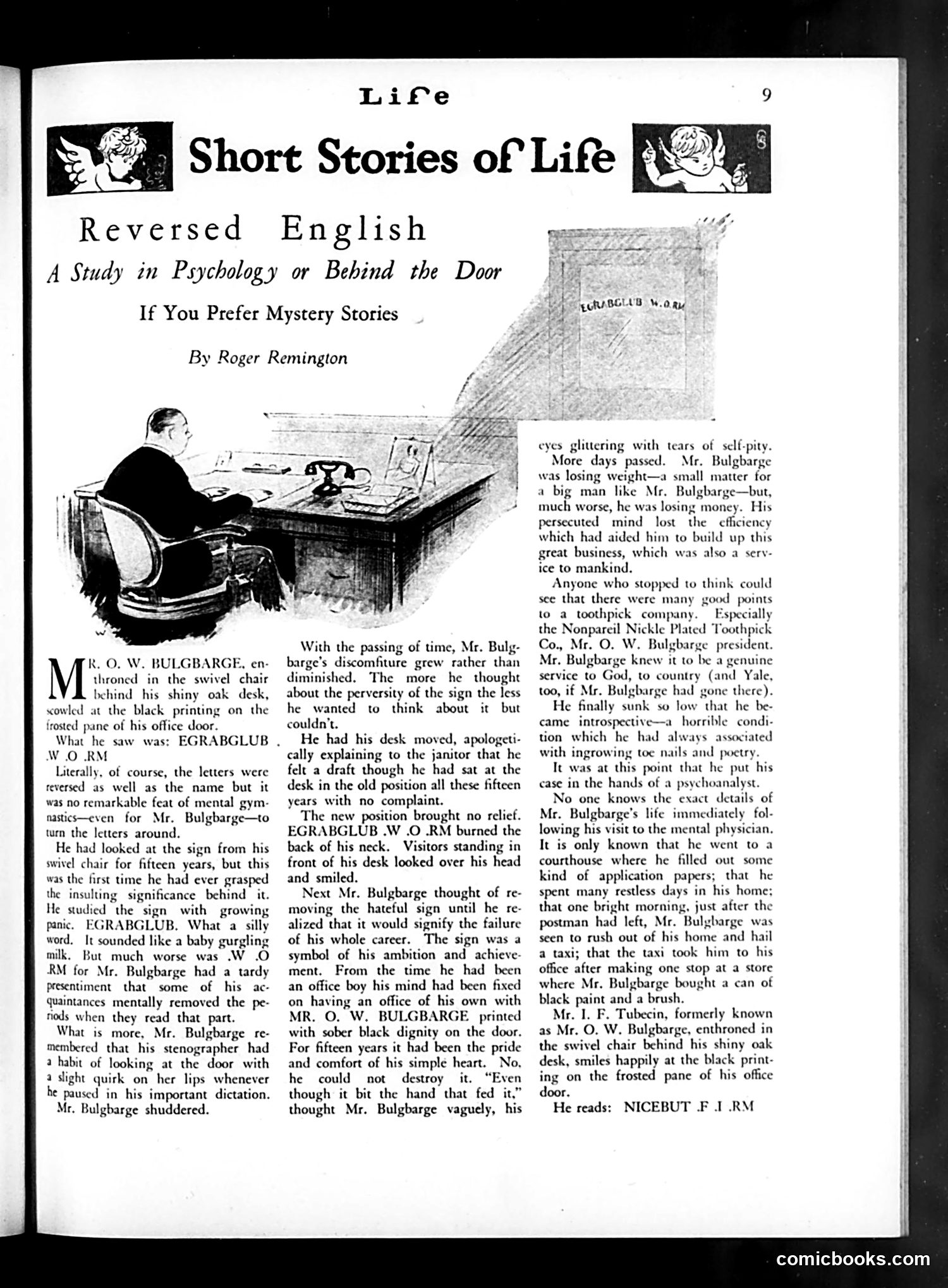
This page presents a short story about Mr. O.W. Bulbarge, an office manager obsessed with a sign on his door reading "EGRARGLUB W.O RM"—his name spelled backwards. The illustration shows him at his desk, troubled by this reversed nameplate. The satire mocks corporate vanity and misplaced priorities. Despite running a successful toothpick company, Bulbarge becomes consumed with the embarrassment of the backwards sign, losing focus on actual business concerns. He grows depressed, loses weight, and eventually seeks psychiatric help over this trivial matter. The story's title, "Reversed English," plays on the phrase meaning indirect or deceptive communication, suggesting Bulbarge's own distorted perspective has reversed his priorities and sanity.
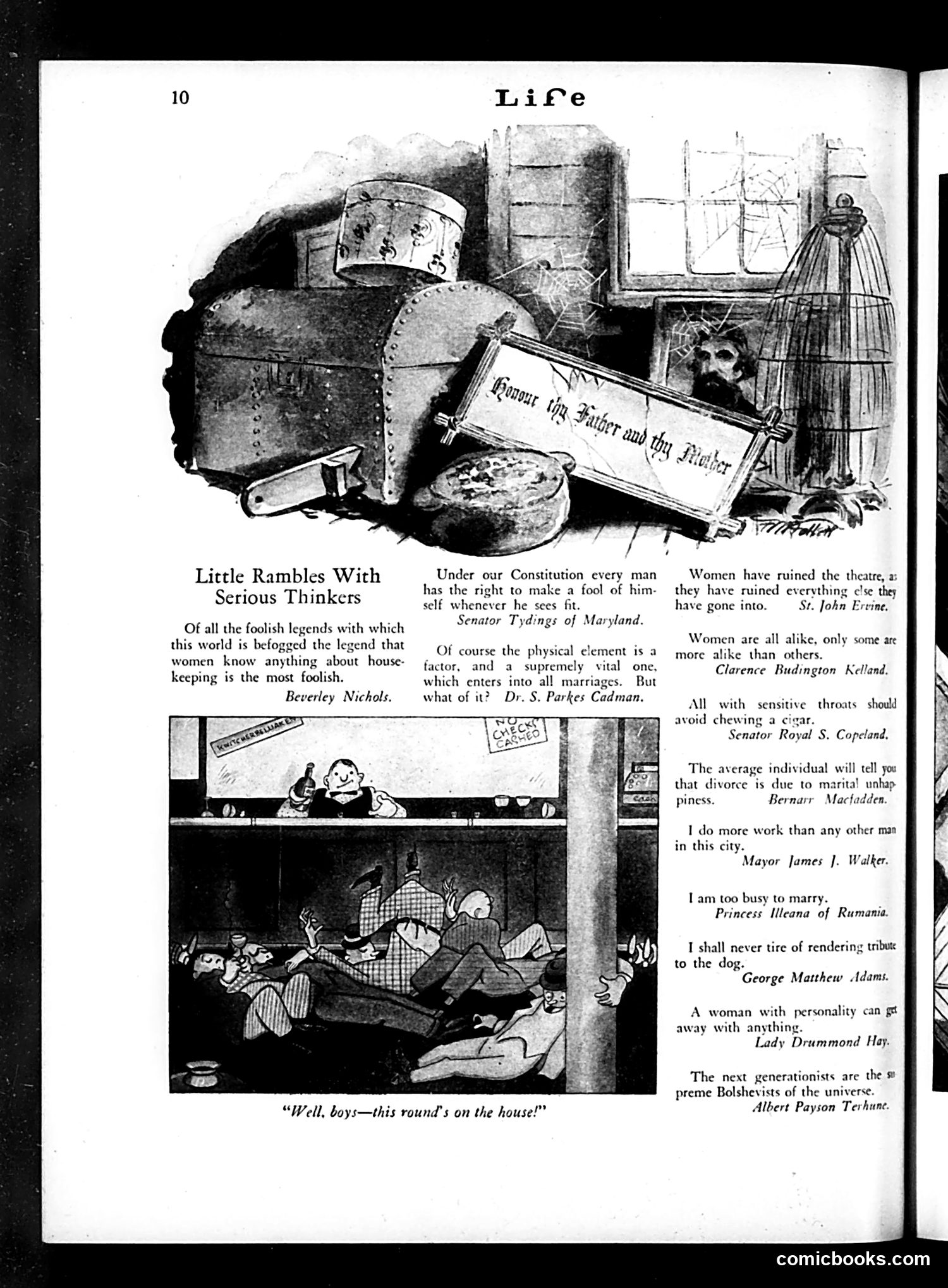
This page satirizes prominent figures' contradictory statements on marriage, women, and morality. The column pairs quotes from named politicians, celebrities, and public figures (Senator Tydings, St. John Ervine, Mayor James J. Walker, Princess Ileana of Rumania, George Matthew Adams) with absurd or hypocritical positions—one claiming women ruin everything, another saying women are all alike, a third too busy to marry. The cartoon above shows a man in a theater surrounded by debris labeled "Honor the Father and the Brother," mocking sentimental morality tales. The satire's point: prominent men make grandiose public statements about virtue, women's roles, and duty while their actual behavior contradicts these principles. The juxtaposition exposes hypocrisy in public discourse about gender and morality during the Jazz Age.
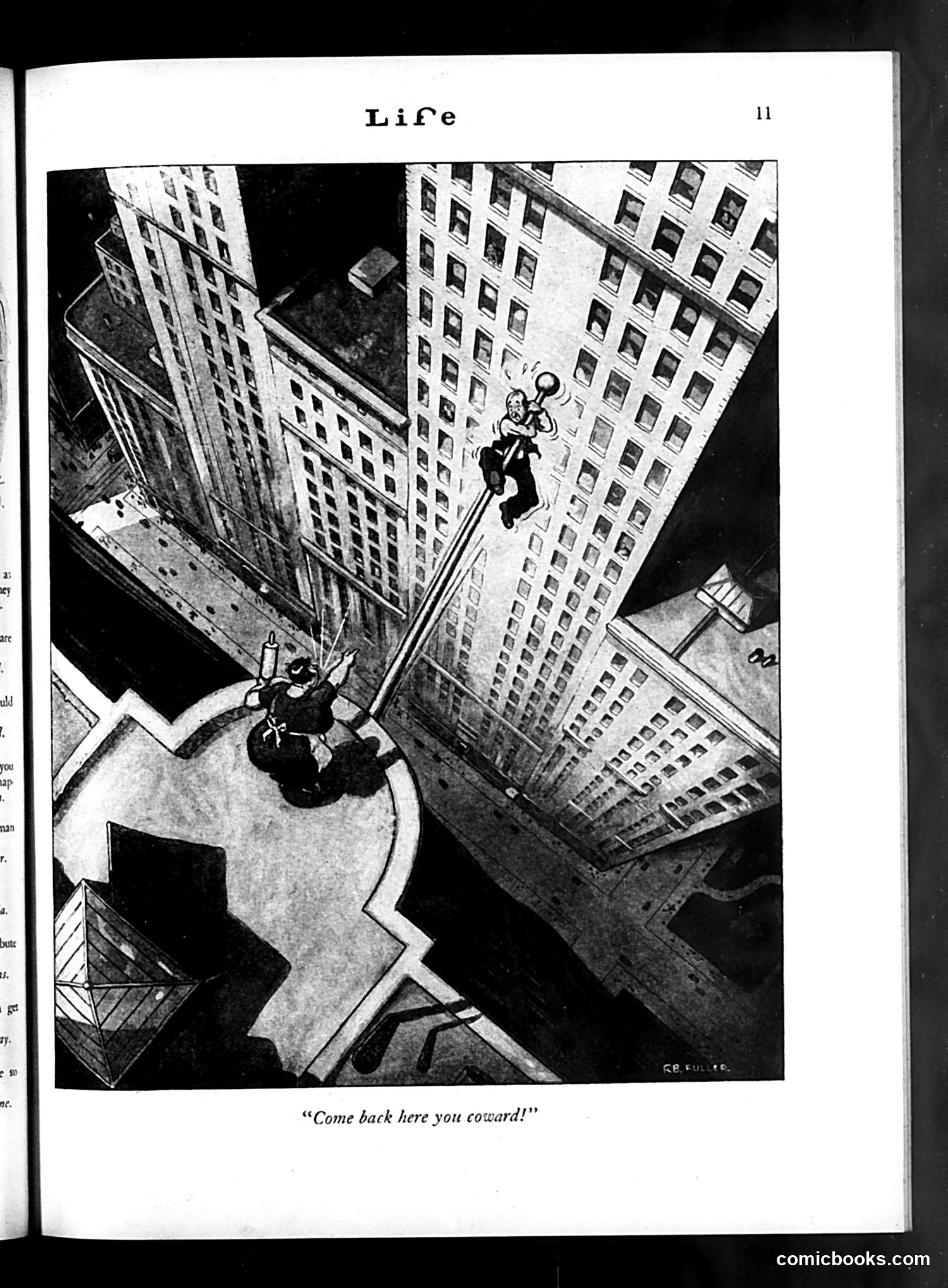
This cartoon depicts a dramatic scene of someone dangling from a rope between tall buildings in what appears to be an urban canyon. The figure at the bottom—seemingly safe on a rooftop or ledge—shouts "Come back here you coward!" to the person suspended above. The satire appears to address cowardice or fear in a high-stakes situation. The irony is that the person on solid ground calls the suspended figure a coward, when the latter is literally taking the more dangerous position. This likely satirizes political or social figures who make bold accusations while remaining safely protected themselves, or perhaps critiques those who verbally challenge others while avoiding personal risk. The artist's signature appears to be "C.B. Fuller" or similar.
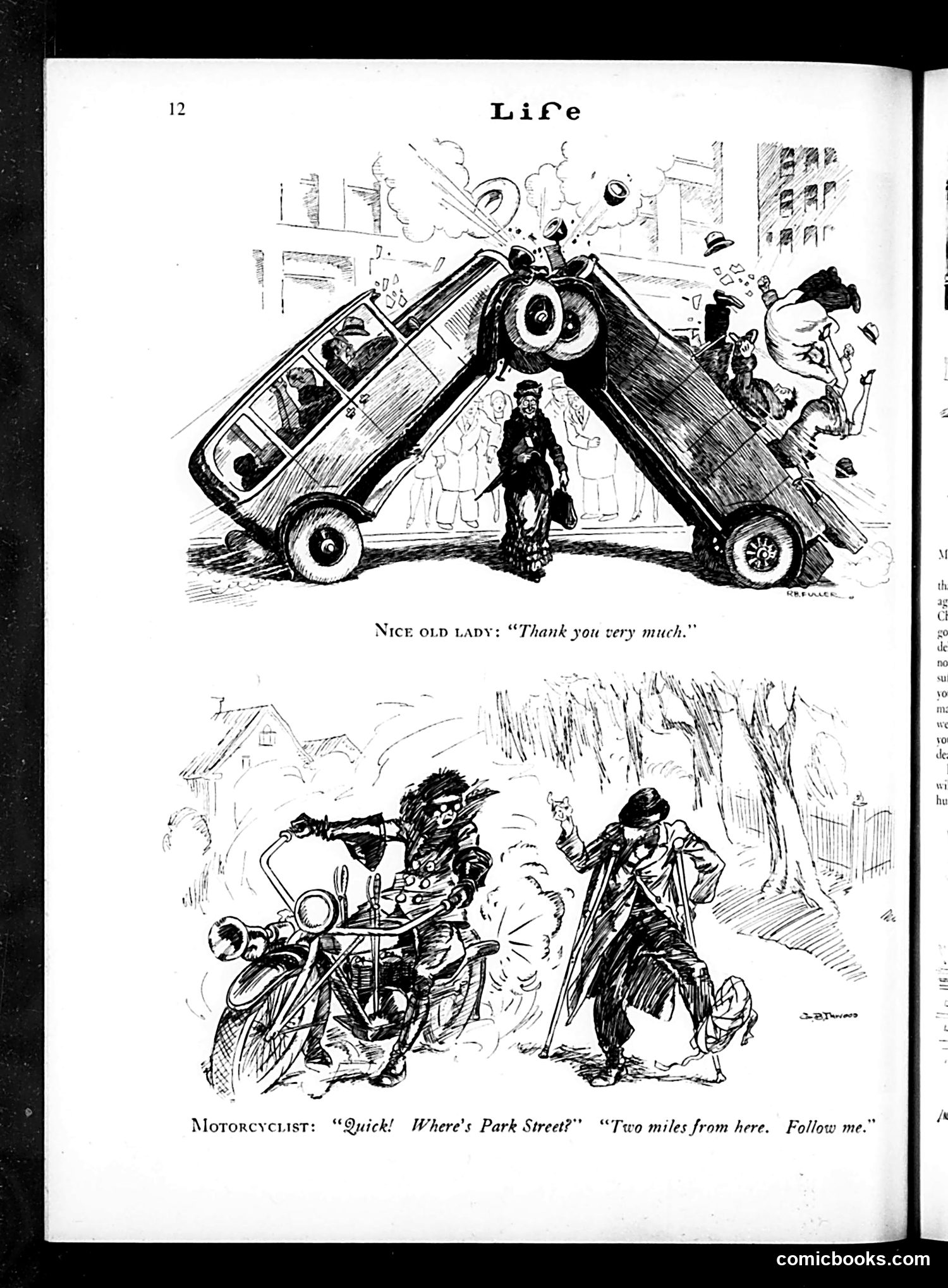
This page contains two satirical cartoons about urban transportation and safety. **Top cartoon:** A motorist helps an elderly woman while two cars collide violently behind them, their impact so forceful they're flipping into the air. The joke mocks the contrast between courteous individual behavior ("Thank you very much") and the chaos of dangerous street traffic. It satirizes how politeness among drivers doesn't prevent accidents. **Bottom cartoon:** A motorcyclist aggressively directs an elderly woman toward Park Street, two miles away, rather than helping her. The satire here appears to mock reckless motorcyclists—portrayed as impatient and unhelpful contrasted with the courteous motorist above. Both cartoons critique early 20th-century urban traffic behavior and safety, using elderly women as vulnerable figures to highlight driver attitudes.
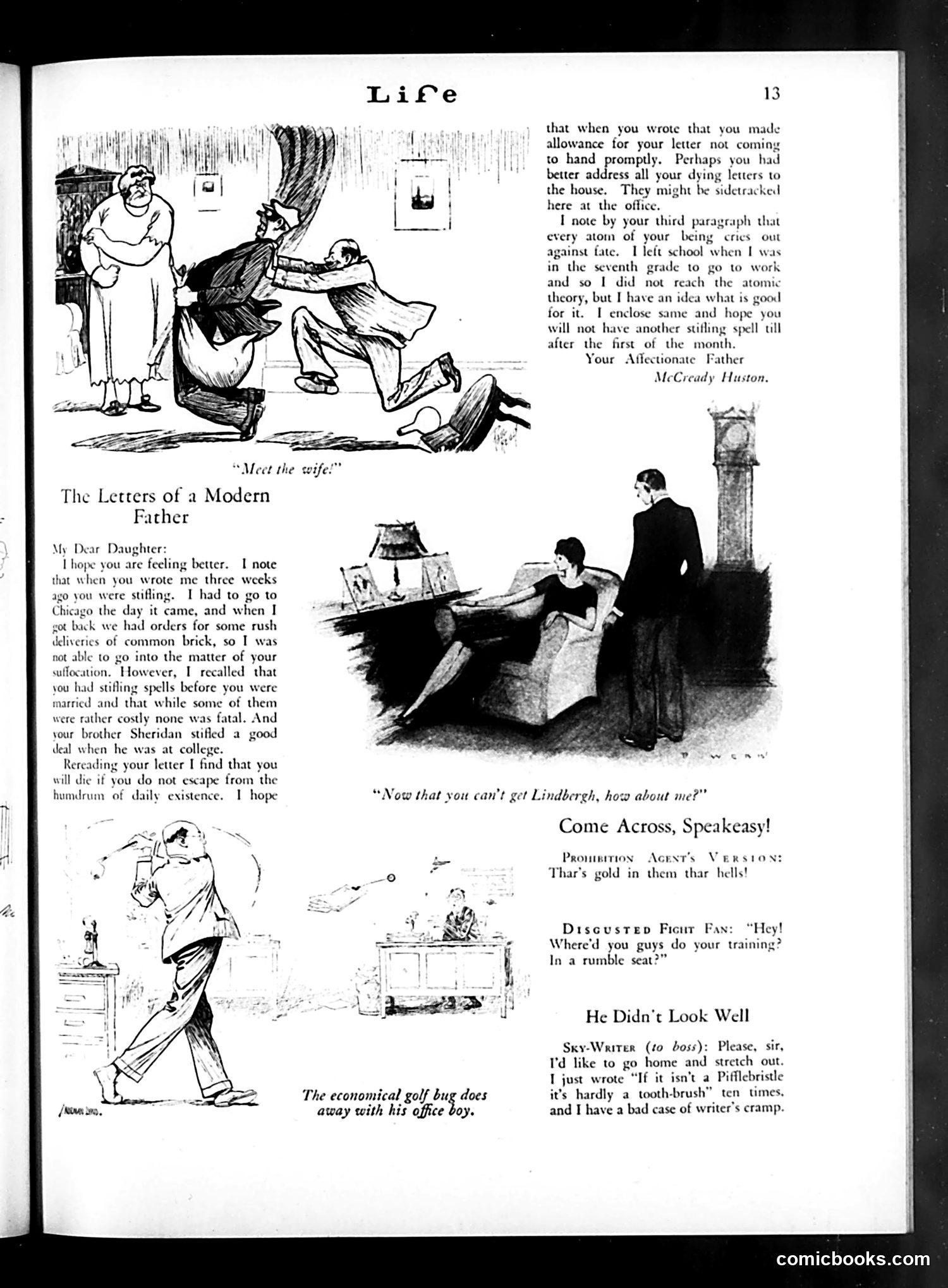
This page contains satirical humor pieces typical of early 20th-century Life magazine: **"The Letters of a Modern Father"** depicts a father responding to his daughter's complaint about marital dissatisfaction. He dismissively recalls her earlier "stifling spells" before marriage and her brother's college success, implying her unhappiness is trivial. **"Meet the wife!"** shows a man introducing his wife—a visual gag about marriage. **"Come Across, Speakeasy!"** references Prohibition-era illegal bars, with humor about bootleggers. **"The economical golf bug"** satirizes a man sneaking away to golf during office hours. **"He Didn't Look Well"** presents a sky-writer (aerial advertiser) asking his boss to go home, claiming writer's cramp. The page's overall theme: workplace escape, marital discord, and prohibition-era social customs treated as everyday comedy.
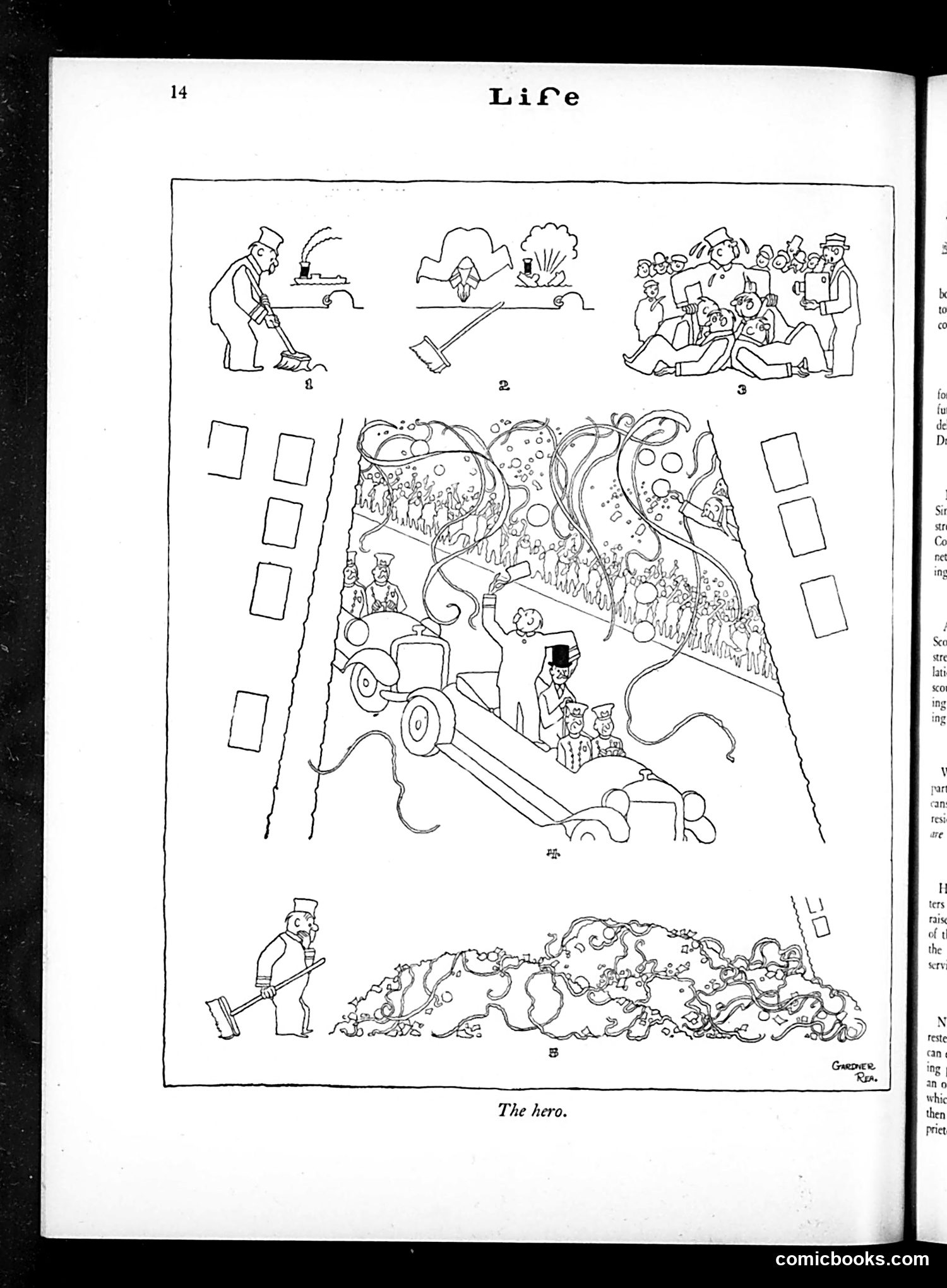
This multi-panel satirical cartoon titled "The Hero" depicts the lifecycle of a public figure's popularity. Panel 1 shows a man being celebrated by crowds; Panel 2 depicts him being attacked or torn down; Panel 3 shows him addressing supporters. The large central illustration portrays a chaotic landscape of mixed fortunes—crowds, vehicles, and turbulent activity—suggesting the unpredictable journey of public life. The bottom panel shows a solitary figure with a shovel facing a pile of debris, likely representing the aftermath of scandal or failure. The cartoon satirizes how quickly public heroes rise and fall in American culture, and how the adulation shown to prominent figures can rapidly reverse into criticism or abandonment. The "hero" becomes victimized by the same public that once celebrated him—a commentary on American celebrity and political fickleness.
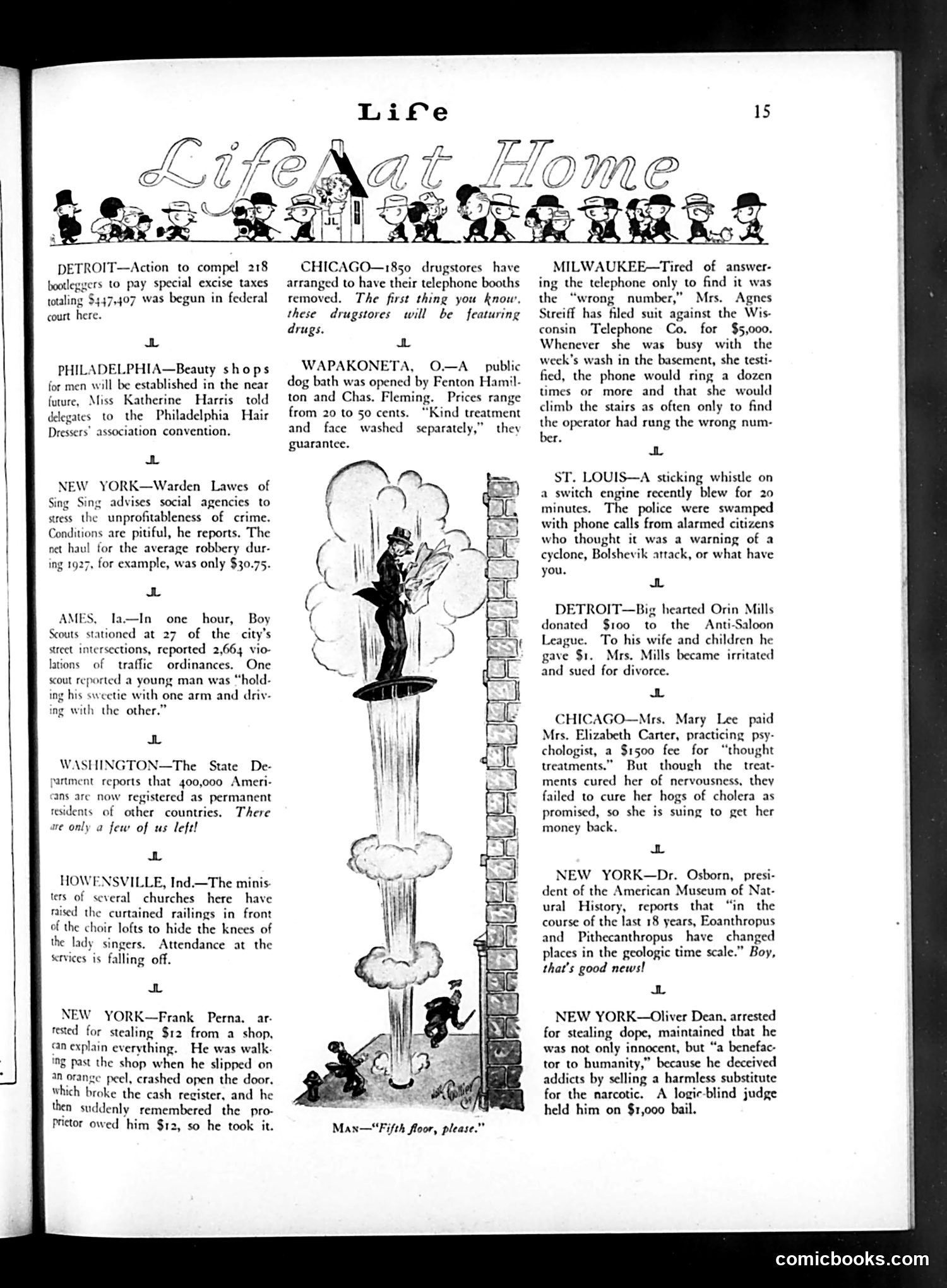
This page contains a cartoon titled "Man—'Fifth floor, please,'" showing a man in an elevator ascending through clouds. The visual gag appears to reference the then-novel experience of skyscrapers and elevators as modern technology. The surrounding text consists of brief humorous anecdotes from various American cities, typical of *Life* magazine's satirical "Life at Home" column. These snippets mock contemporary social issues: telephone company complaints, a man suing over unwanted phone calls, frivolous lawsuits, arrest absurdities, and a con artist's theft. The collective effect satirizes modern urban life's complications—legal systems, new technologies, and human folly—presented as amusing human-interest vignettes from across America.
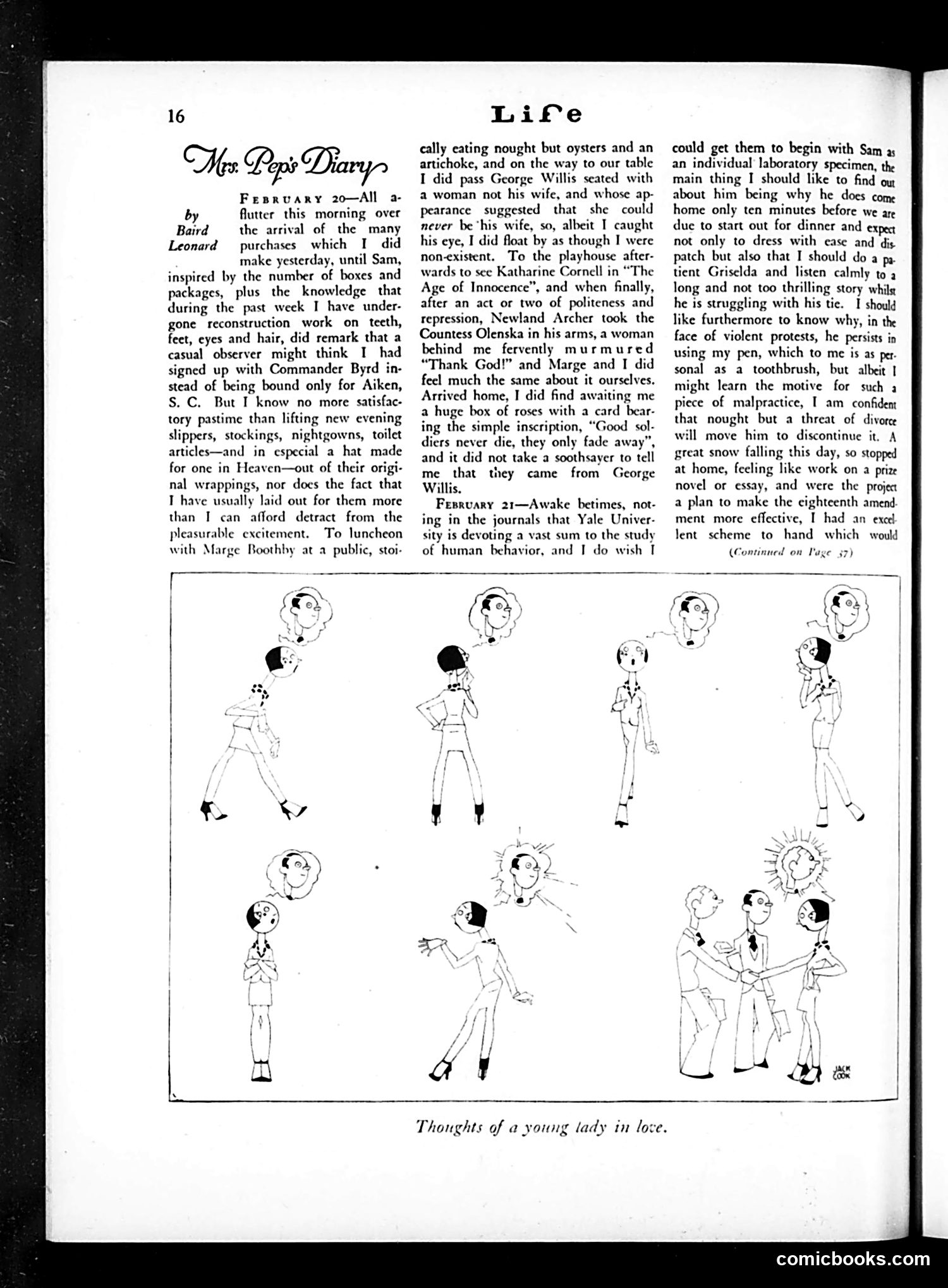
This is a humorous illustration by Baird Leonard accompanying Mrs. Pep's Diary column in Life magazine. The cartoon depicts seven sequential sketches showing a young woman's fantasies and emotional states while in love—a common satirical subject for the era. The drawings show her daydreaming, posing dramatically, appearing distressed or euphoric, and socializing. The caption "Thoughts of a young lady in love" suggests the piece gently mocks the romantic preoccupations and emotional volatility stereotypically attributed to unmarried women of the period. The diary entries discuss theater-going, social obligations, and romantic encounters, reflecting upper-middle-class leisure activities. The overall tone is light satirical commentary on courtship customs and female psychology circa the early 20th century.
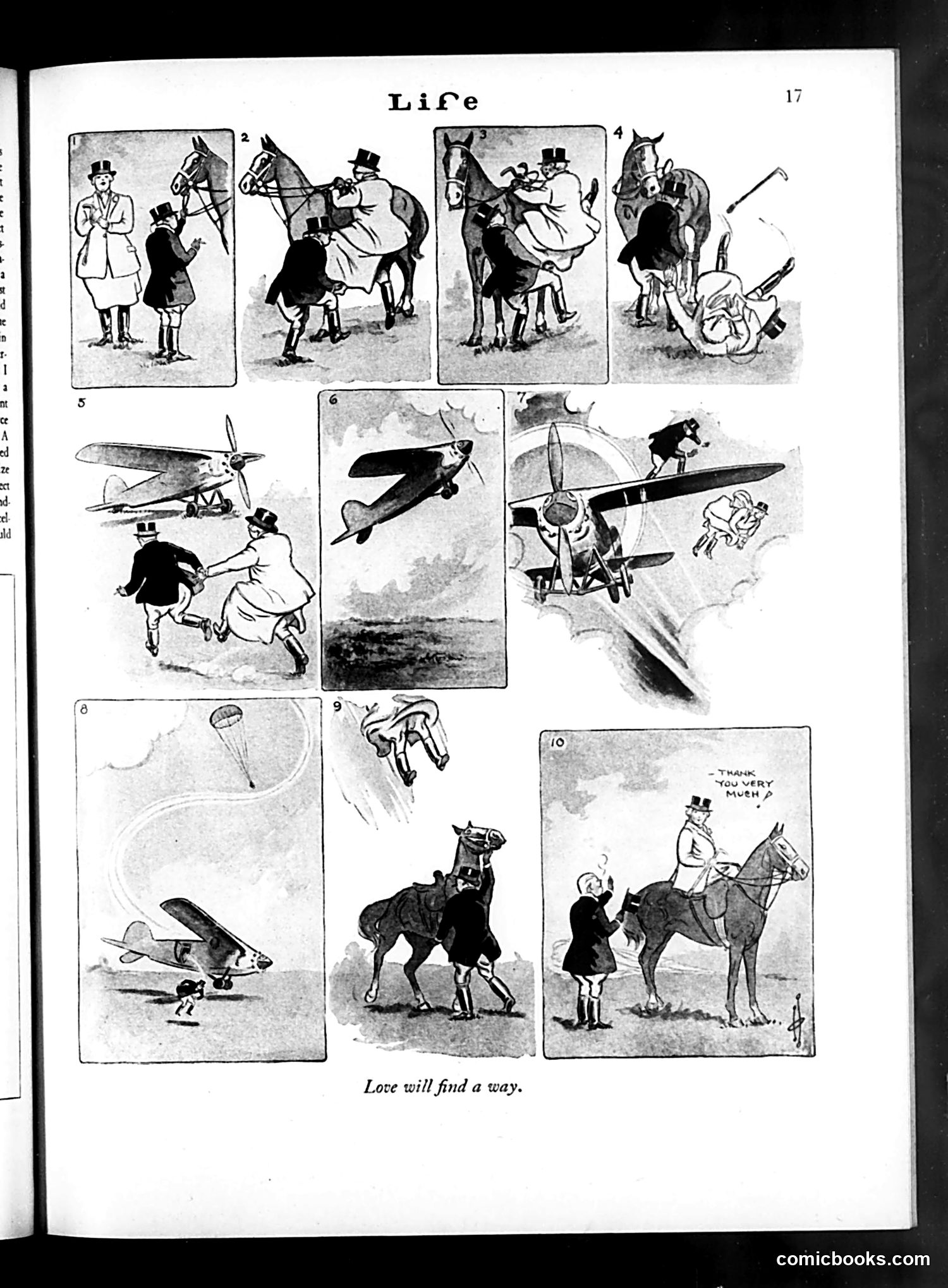
This ten-panel comic strip presents a humorous narrative about determination in romance. A man in formal attire (top hat and suit) pursues a woman through increasingly absurd scenarios: horseback riding, airplane piloting, and parachuting. Each panel shows the woman rejecting or escaping his advances—she falls from horses, abandons airplanes, and refuses his mounted proposal. The final panel depicts the man, now on horseback, thanking the woman "very much" as she stands beside him. The caption "Love will find a way" suggests romantic persistence ultimately succeeds, though the woman's consistent resistance throughout creates ironic humor. The satire gently mocks both determined suitors and the era's romanticized notions of courtship.
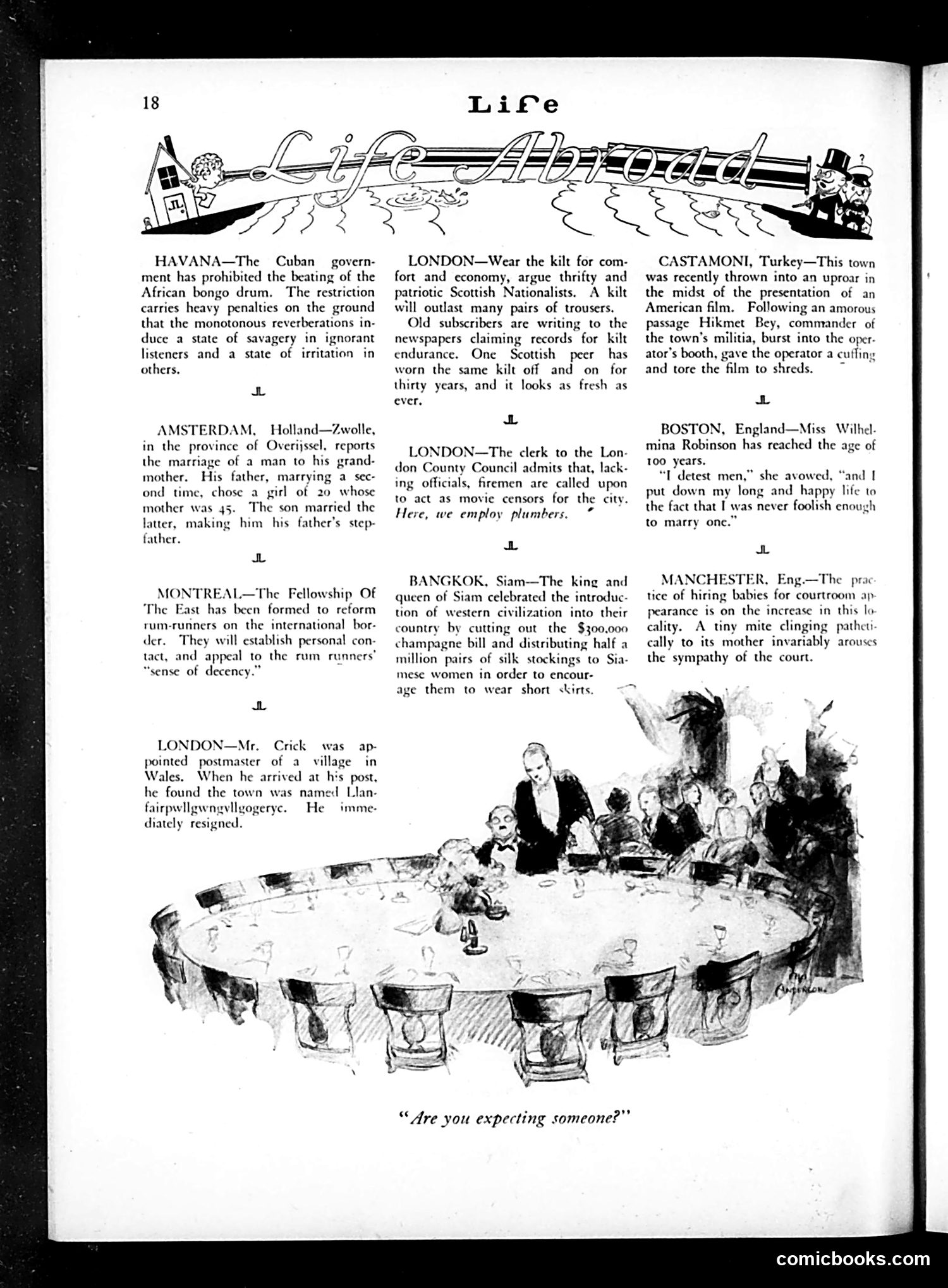
This page from *Life* presents humorous brief news items from around the world, exemplifying the magazine's satirical approach to international oddities. The main cartoon depicts a formal dinner where one guest asks another, "Are you expecting someone?"—the joke being that many chairs sit empty, suggesting social awkwardness or rejection. The text items mock various cultural and social absurdities: Cuba banning drums out of paternalistic fear; a bizarre family marriage in Holland; Montreal's naive faith that criminals have "decency"; a Welsh postmaster resigning over an impossibly long town name; Scottish nationalism promoting kilts as economical; London using firemen as movie censors; Siam's king cutting champagne spending while distributing stockings to encourage women's clothing; a Turkish militia commander censoring cinema; a 100-year-old woman crediting her happiness to avoiding marriage; and courts hiring babies to manipulate judicial sympathy. The satire targets bureaucratic overreach, cultural pretension, and human irrationality across nations.
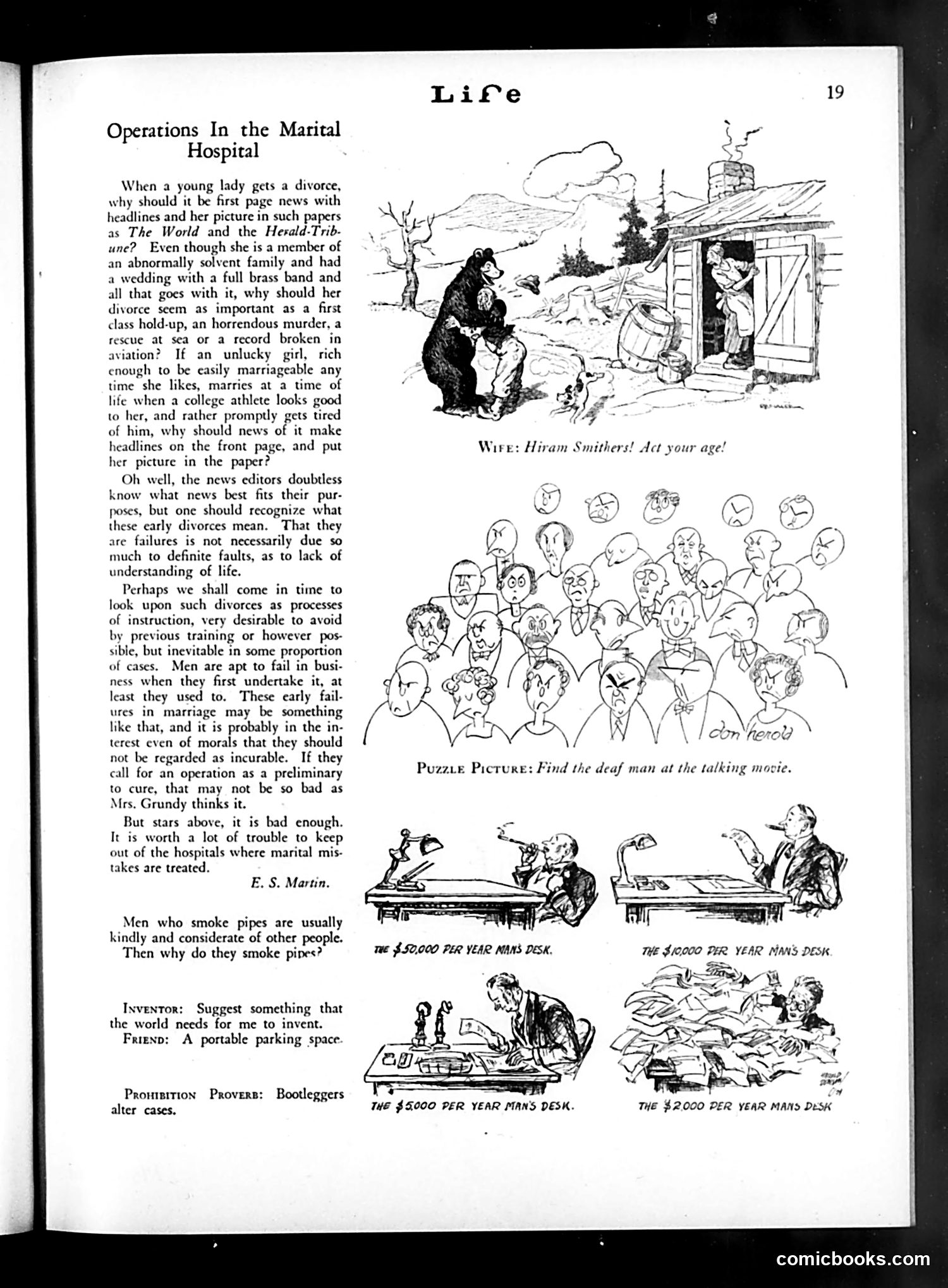
This page critiques 1920s newspaper sensationalism and marital discord. The main article, "Operations in the Marital Hospital," argues that wealthy young divorcees shouldn't dominate front-page news alongside major crimes and achievements. Author E.S. Martin suggests early divorces are learning experiences, not moral catastrophes, though still regrettable. The lower section contains humorous quips: a joke about pipe-smokers' contradictory kindness, an inventor needing ideas, and a Prohibition jab at bootleggers. The "man's desk" cartoon series satirizes workplace inequality—showing men earning $5,000-$2,000 annually dealing with increasingly chaotic workloads, culminating in a cluttered $2,000 desk, implying lower pay correlates with worse conditions or incompetence. The puzzle challenges readers to "find the deaf man at the talking movie," referencing early sound film technology's novelty (talkies were recent).
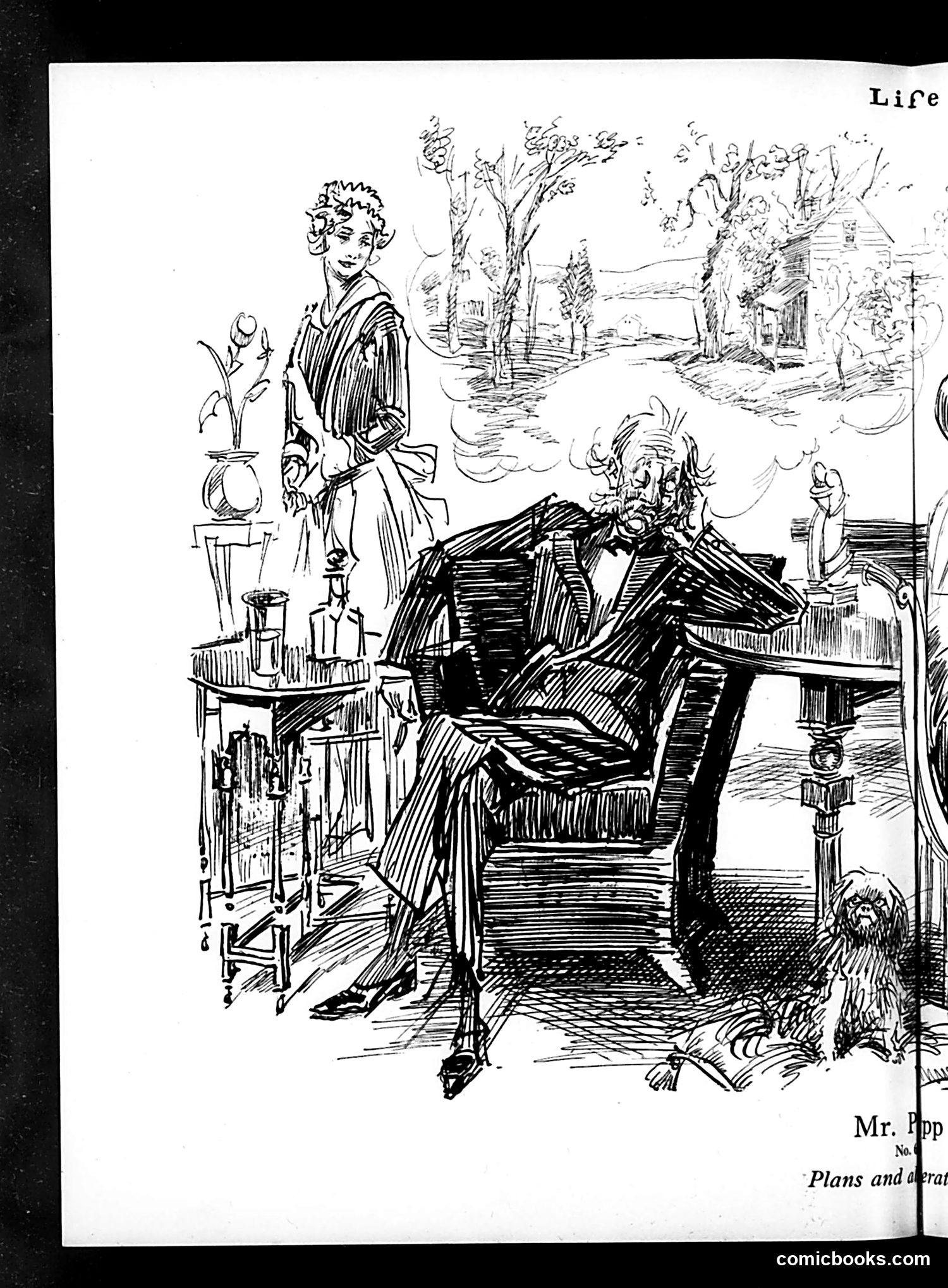
This page appears to be from *Life* magazine and shows an illustration labeled "Mr. Popp" (visible at bottom right). The image depicts a well-dressed man seated indoors, being attended to by a woman in the background. A small dog sits at his feet. Through windows, a rural landscape is visible. The OCR text is largely illegible, making it difficult to determine the specific satirical content or historical reference. Without readable caption or article text, I cannot reliably identify who "Mr. Popp" was, what social or political situation is being lampooned, or what the joke intended. The scene suggests domestic leisure or comfort, possibly satirizing wealth or leisure-class behavior, but this remains unclear without supporting text.
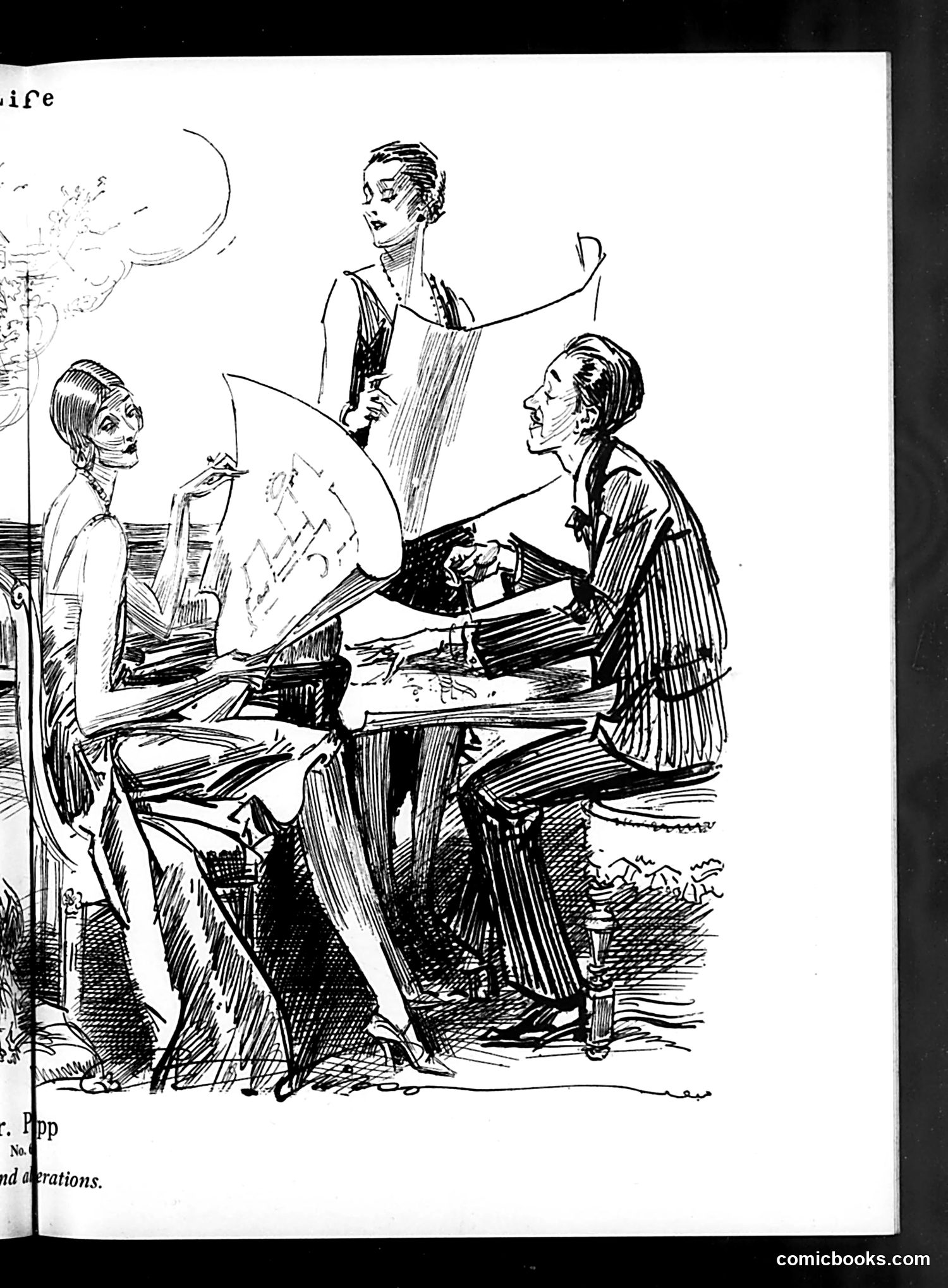
This appears to be a satirical illustration from *Life* magazine showing three figures in what seems to be an office or business setting. A woman sits at a desk on the left, a man stands in the center gesturing dramatically, and another man sits on the right also gesturing. The standing figure's theatrical pose and raised arms suggest he's delivering an impassioned speech or oration—hence the caption reference to "orations." The satire likely mocks overwrought public speaking, corporate pomposity, or theatrical business behavior. The formal attire and office setting indicate this targets professional or political figures of the era. However, without visible identifying features or clearer text, I cannot definitively identify which specific individuals or events are being satirized.
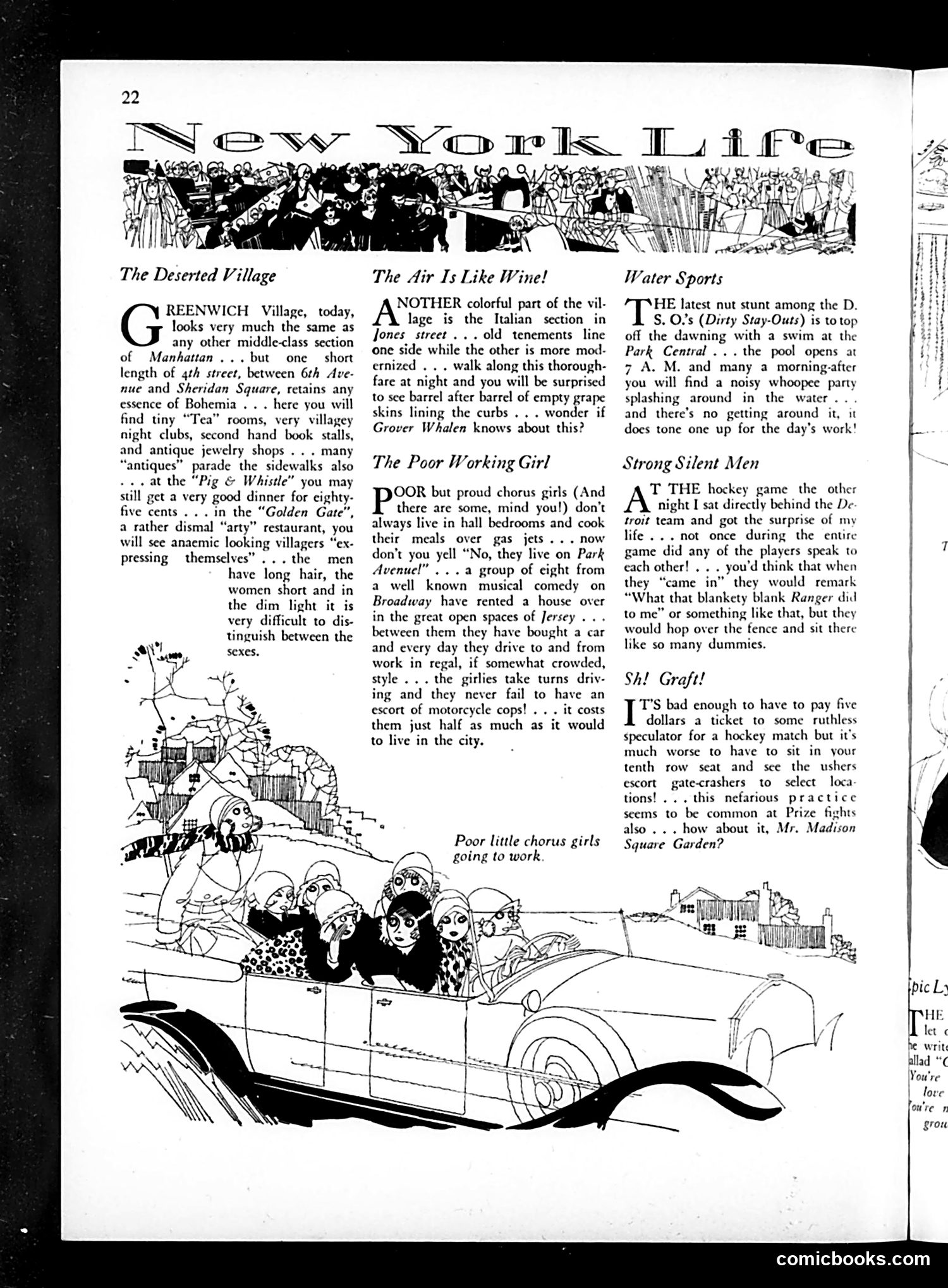
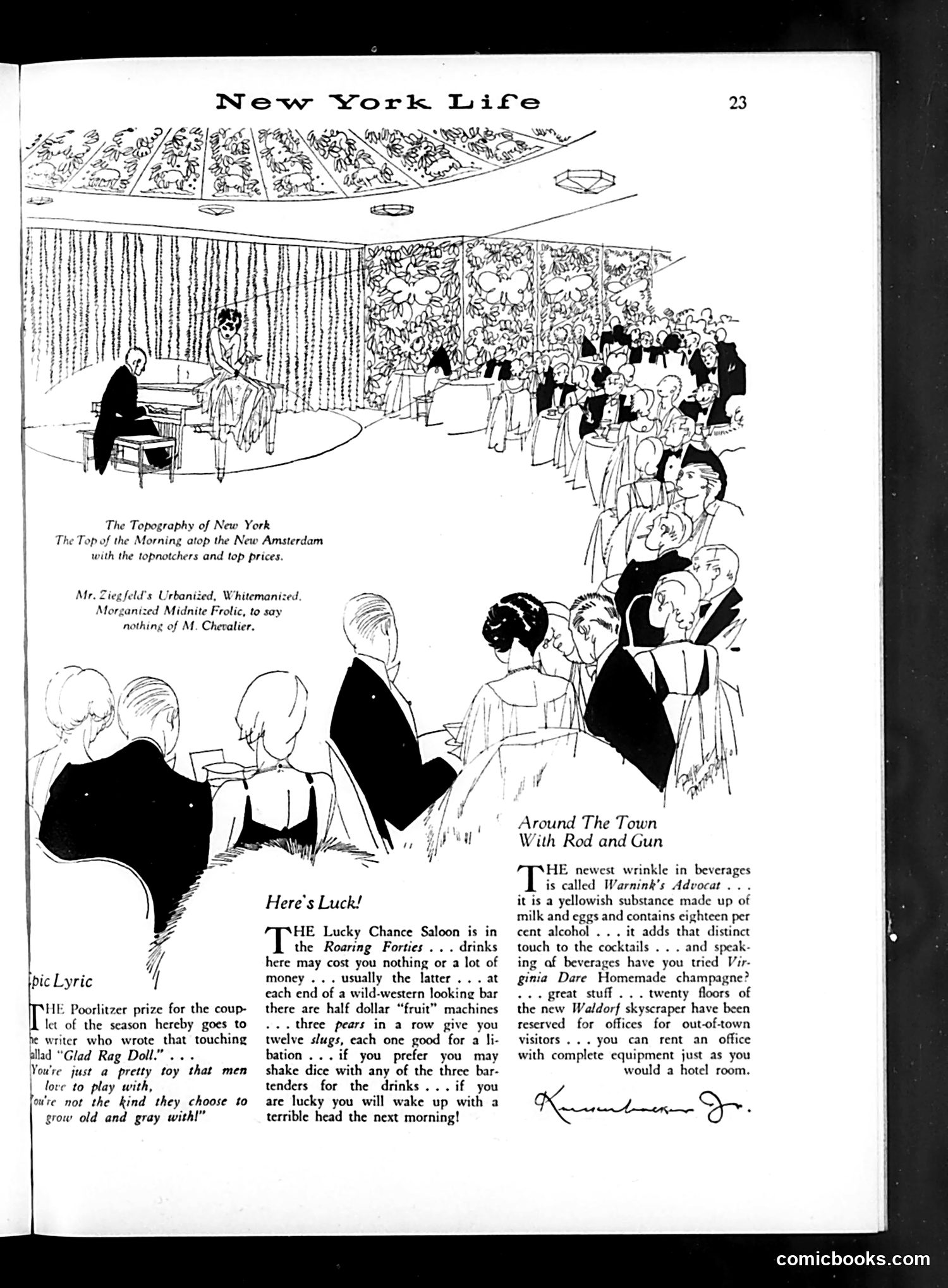
This page satirizes 1920s New York high society and nightlife during Prohibition. The main illustration depicts an upscale gathering at the "New Amsterdam" venue, mocking the wealthy elite ("topnotchers") who frequented fashionable establishments while paying inflated prices. The text references the "Lucky Chance Saloon" in the Roaring Forties—a speakeasy where drinks cost nothing or exorbitant amounts, featuring slot machines and dice games. This mocks Prohibition-era illegal drinking culture. The beverage section advertises liquor brands like Warnink's Advocat and "Virginia Dare Homemade champagne," satirizing how wealthy New Yorkers openly consumed alcohol despite the legal ban. The opening "Glad Rag Doll" lyric mockingly quotes popular song lyrics about disposable romantic relationships. Overall, the page lambastes New York's wealthy class for their conspicuous consumption, moral hypocrisy regarding Prohibition, and shallow social values during the Jazz Age.
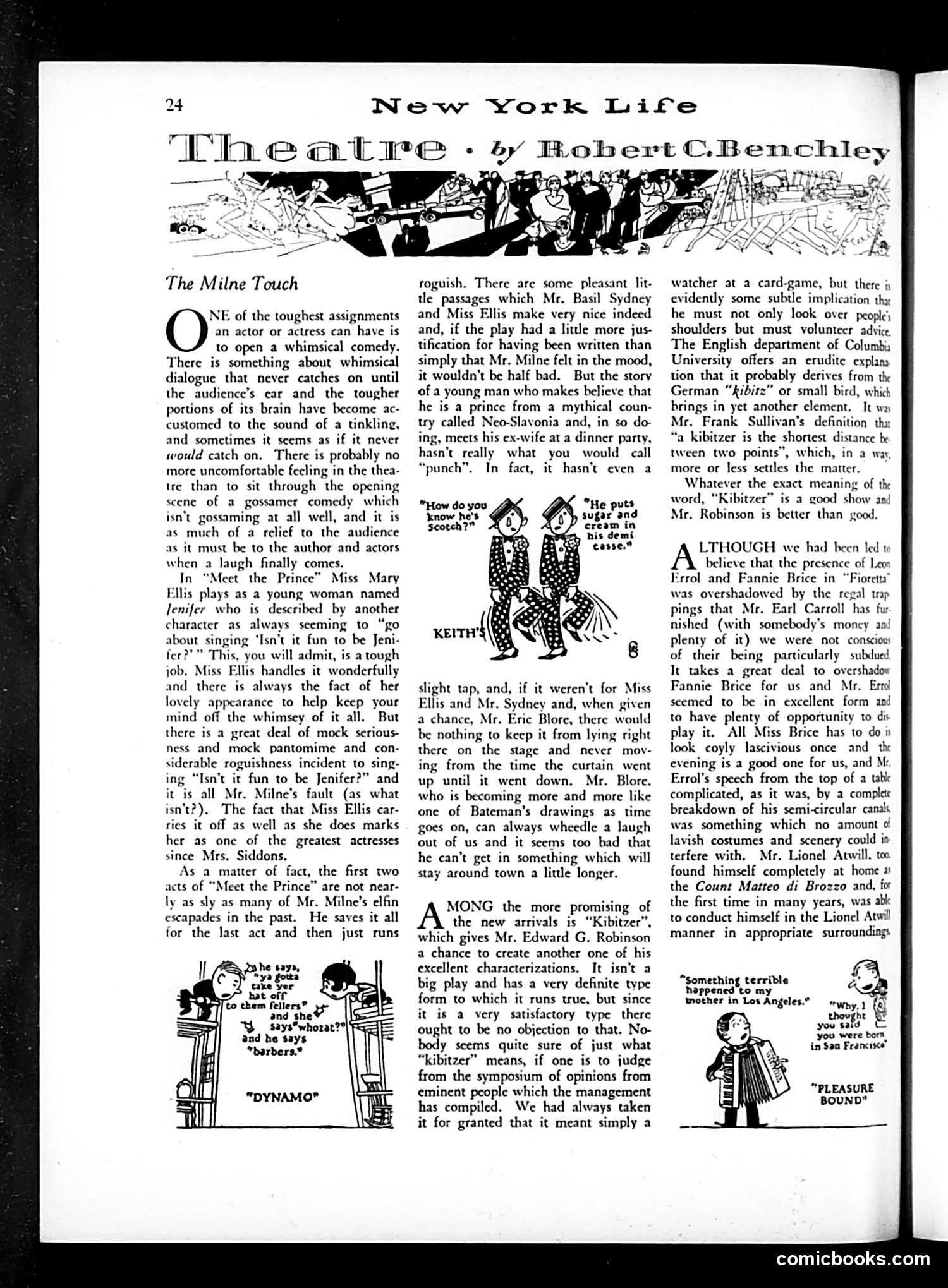
This is Robert C. Benchley's theater column reviewing three Broadway productions: "Meet the Prince" (starring Mary Ellis and Basil Sydney, written by A.A. Milne) and "Kibitzer" (starring Edward G. Robinson). **The cartoons** are small humorous illustrations unrelated to the reviews—one labeled "Dynamo" shows a barbershop scene, another titled "Pleasure Bound" depicts a musician with an accordion. **The satire targets whimsical comedies**: Benchley argues that plays with delicate, fanciful dialogue risk falling flat unless audiences adjust to their tone. He praises Ellis's performance despite the play's thin premise (a man pretending to be a mythical prince), crediting her talent and appearance for making it work. He criticizes the play's lack of genuine "punch." **On "Kibitzer"**: Benchley explains the Yiddish term (one who gives unsolicited advice while watching card games) with humorous sidebar quotes from "eminent people"—including Columbia University's German etymology and columnist Frank Sullivan's definition—showing how the word's meaning varies by source. The overall tone is sophisticated, witty criticism for an educated audience familiar with Broadway and theater conventions.
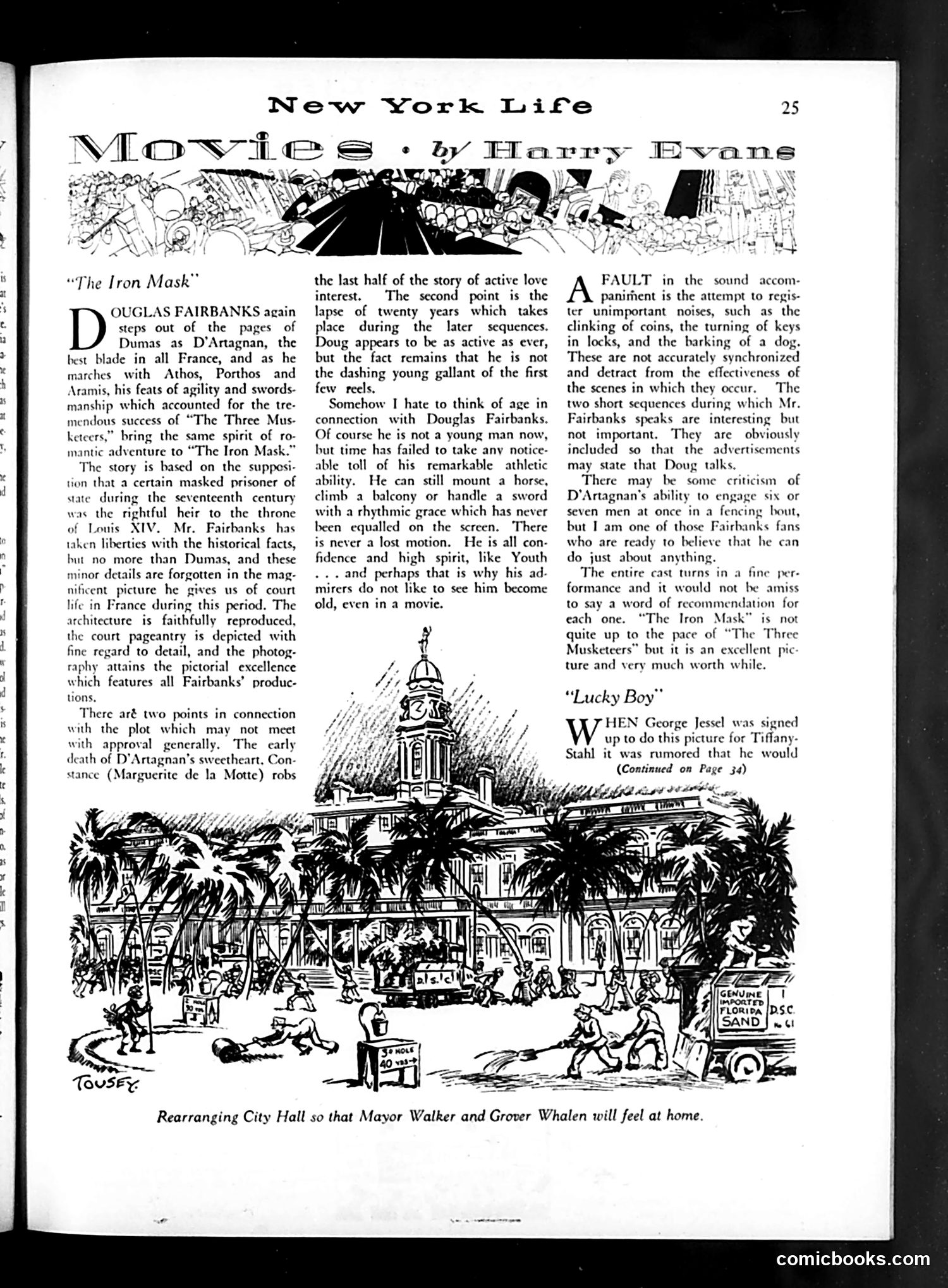
This is a film criticism column by Harry Evans reviewing two movies. **"The Iron Mask"** features Douglas Fairbanks in a swashbuckling adaptation of Dumas's story about a masked prisoner who may be the rightful French heir. Evans praises Fairbanks's athletic performance and the film's production design but notes two plot weaknesses: the death of the love interest and a time-jump that makes the aging Fairbanks seem less the dashing hero. He criticizes poor sound synchronization (coins jingling, dog barks don't match action), a common technical problem in early sound films. Evans finds it overall excellent despite these flaws. **"Lucky Boy"** is briefly introduced as starring George Jessel in a Tiffany-Stahl production, with the review continuing on another page. The cartoon illustration shows a Florida beach scene being rearranged as a movie set, likely satirizing Hollywood's artificial recreation of locations for filming.
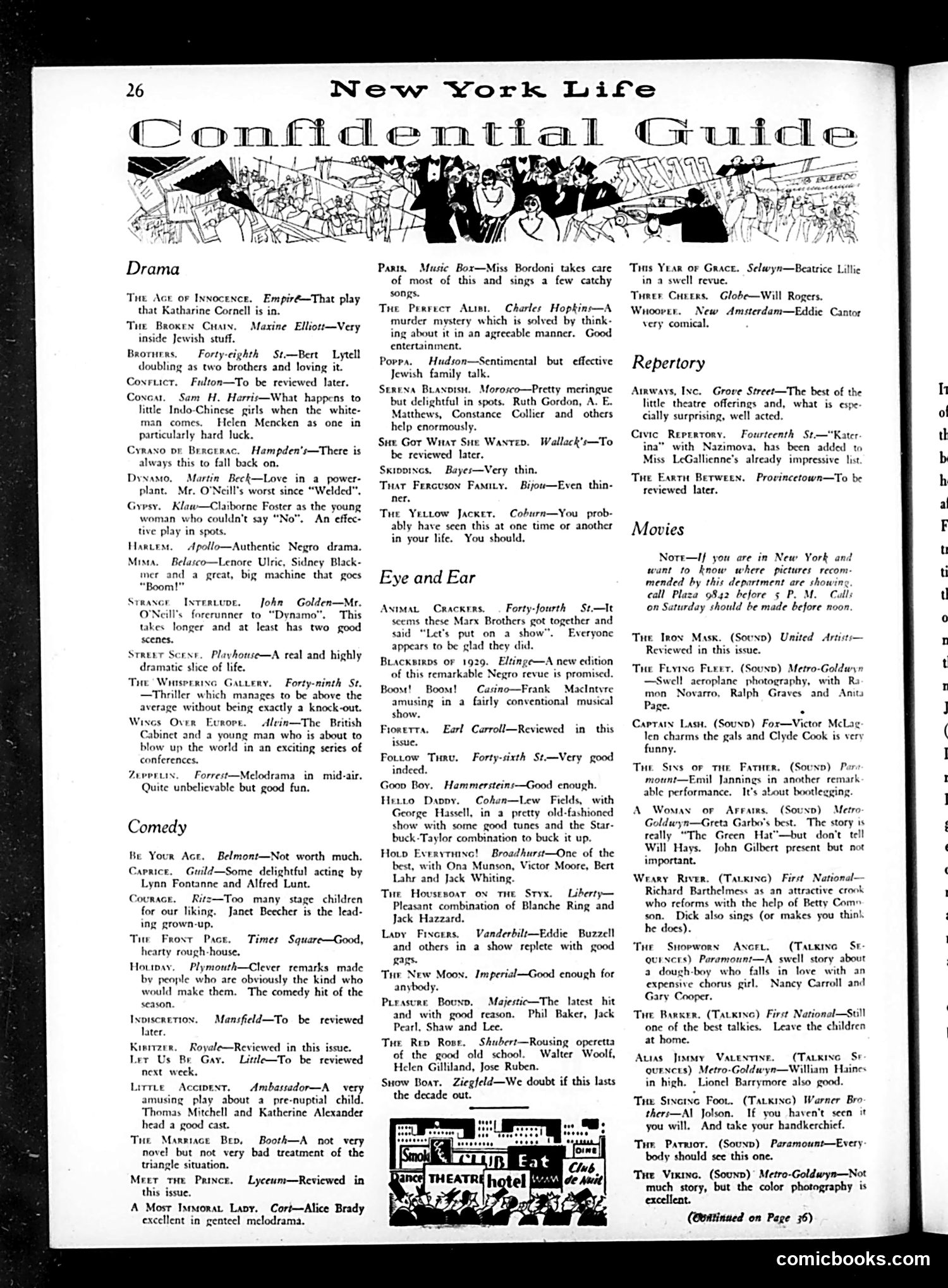
This page is a **theater review guide** for Broadway shows, not a political cartoon. It's organized by genre (Drama, Comedy, Musical Entertainment) and lists current productions with brief critical assessments. The reviews are punchy, often one-liners: some praise ("hearty rough-house"), some are dismissive ("Not worth much"), others note specific performers like Katharine Cornell, the Marx Brothers, and Lynn Fontanne. Notable is the review of "Blackbirds of 1929"—described as "a remarkable Negro revue"—reflecting the era's segregated entertainment industry and contemporary language for Black performers and productions. The small advertisement at bottom promotes theaters and dining venues, typical of Life magazine's monetization strategy. This snapshot documents 1920s Broadway's commercial landscape and critical tastes, with no satirical or political commentary present—just practical theater guidance for New York audiences.
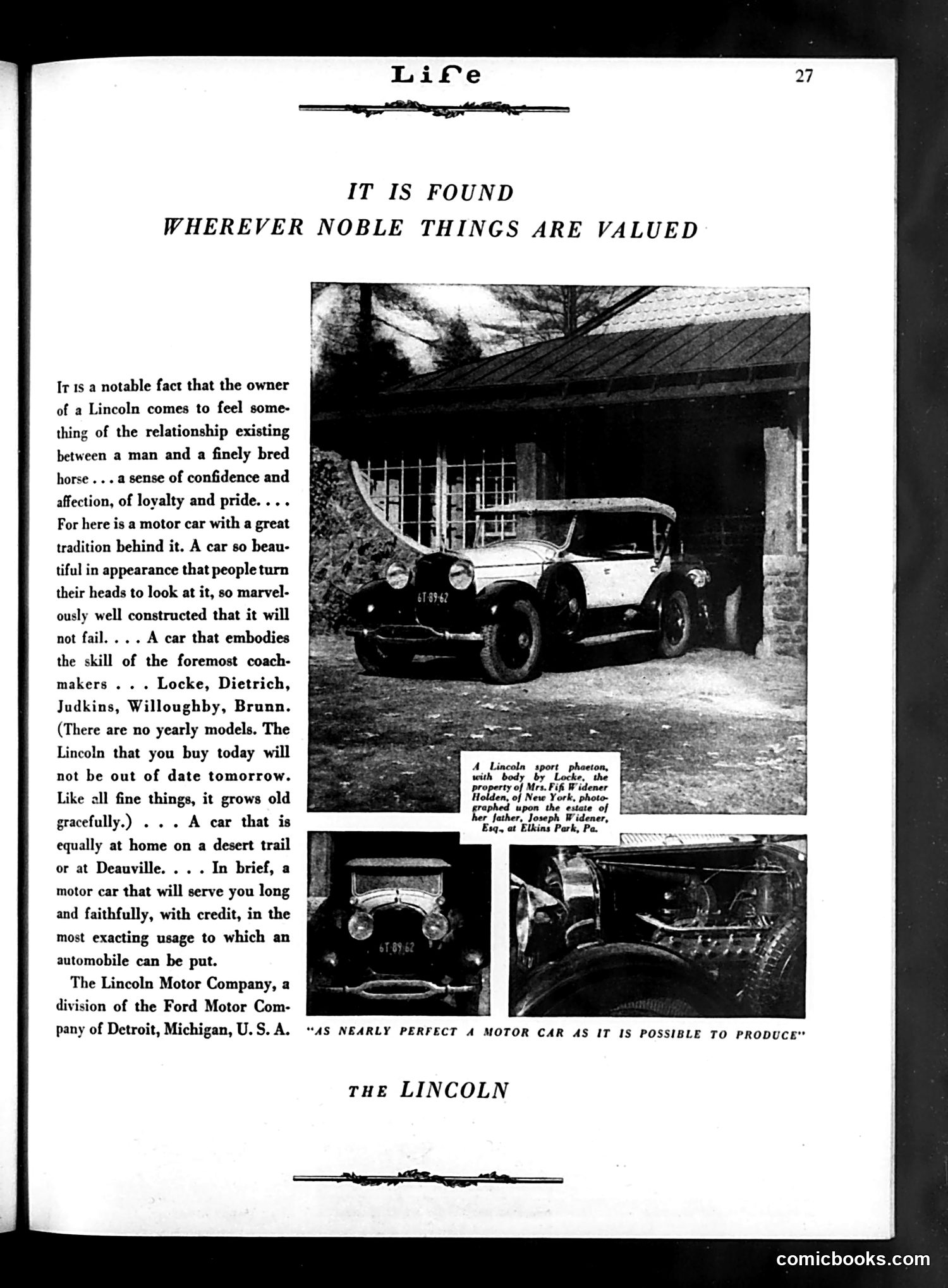
This is **not a political cartoon or satire**, but rather a **luxury car advertisement** from Life magazine's early advertising era. The page promotes the Lincoln automobile through aspirational messaging: the car embodies timeless quality, craftsmanship by prestigious coachmakers (Locke, Dietrich, Judkins, etc.), and never becomes outdated—it "grows old gracefully." The copy compares owning a Lincoln to the bond between a man and a thoroughbred horse, emphasizing emotional attachment and prestige rather than mechanical features. The accompanying photographs show a Lincoln sport phaeton owned by Mrs. Fifi Widener Holden, photographed at her father Joseph Widener's Pennsylvania estate—establishing the car's association with East Coast wealth and inherited social standing. The tagline "It Is Found Wherever Noble Things Are Valued" positions Lincoln as a status symbol for the affluent. This represents early automotive advertising's focus on class aspiration rather than performance specifications.
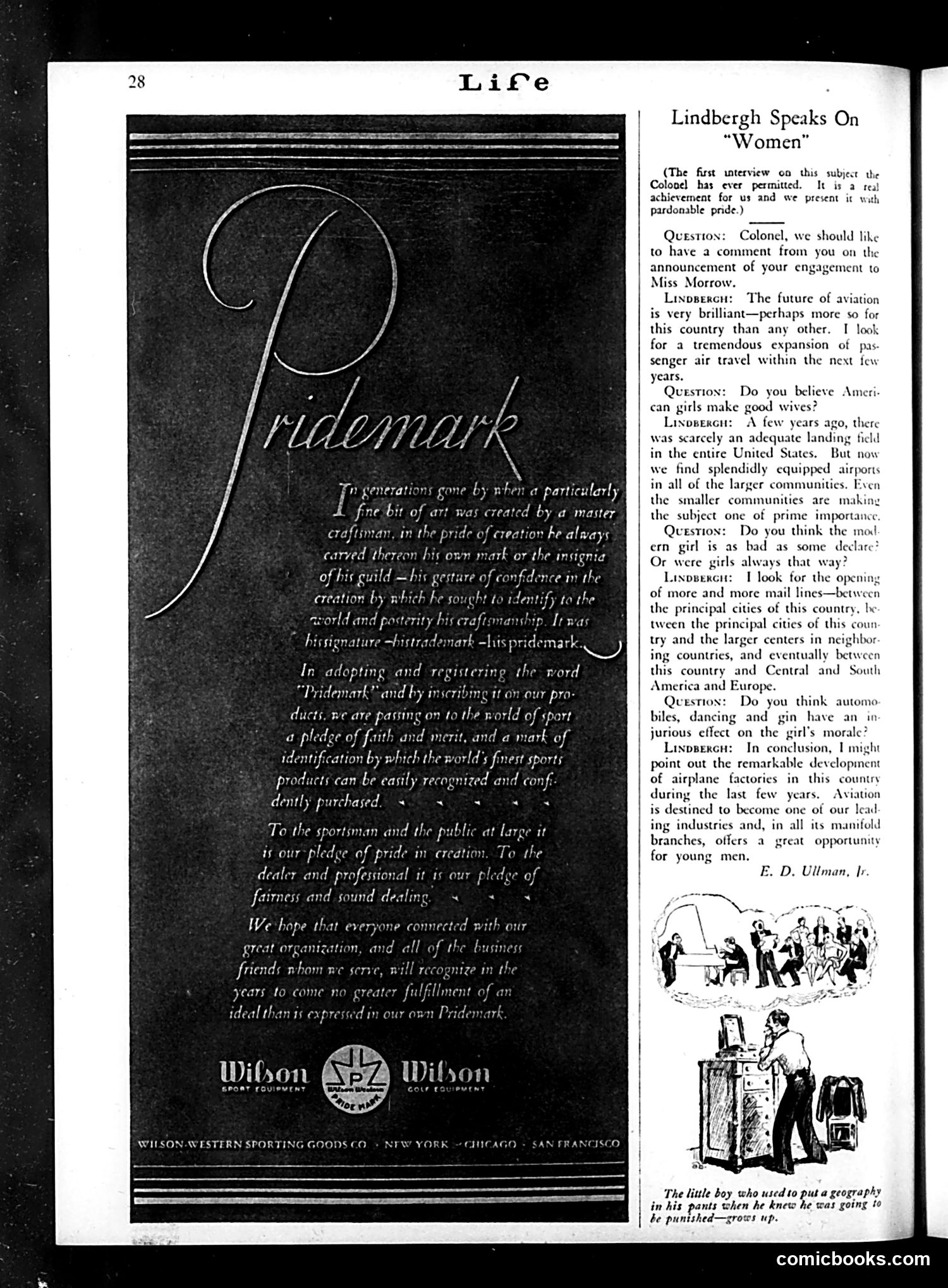
This page satirizes Charles Lindbergh's engagement to Miss Morrow by presenting a fake interview where he repeatedly avoids answering questions about women, marriage, and modern girls' morality—instead launching into non-sequiturs about aviation expansion and airport development. The humor lies in Lindbergh's evasiveness: asked "Do you believe American girls make good wives?" he responds with facts about landing fields. Asked if modern girls are immoral, he discusses mail routes. The satire mocks both Lindbergh's celebrity status (the magazine notes this is his "first interview" on the subject) and the disconnect between public curiosity about his personal life versus his single-minded focus on aviation. The Wilson Sporting Goods advertisement on the left is unrelated to the satire.
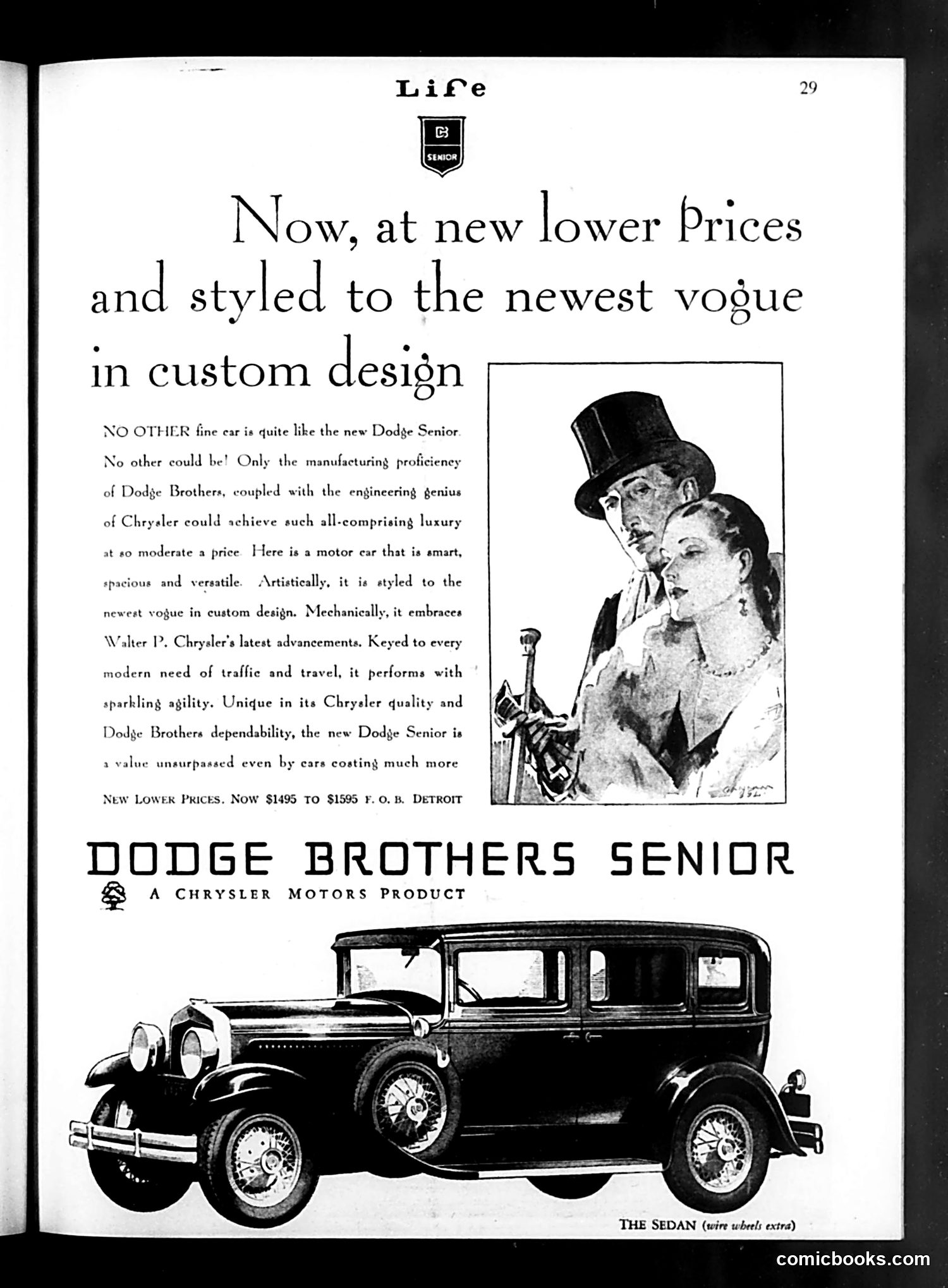
This is primarily a **car advertisement**, not a political cartoon. It appears from Life magazine's advertising section (page 29). The page promotes the Dodge Brothers Senior sedan, newly priced lower ($1,495-$1,595) and marketed as stylish and modern. The illustration shows an elegantly dressed couple in 1920s attire—the man in a top hat, the woman in fashionable dress—presented as aspirational consumers of this "luxury" vehicle positioned as affordable. The rhetorical strategy conflates Dodge Brothers' manufacturing with Chrysler's engineering prestige to justify the car's quality-to-price ratio. The "newest vogue in custom design" language appeals to fashion-conscious buyers during the era when automobiles were becoming status symbols for the middle class. There is no satirical content here—this is straightforward commercial messaging using period-appropriate imagery and class aspirations to sell vehicles.
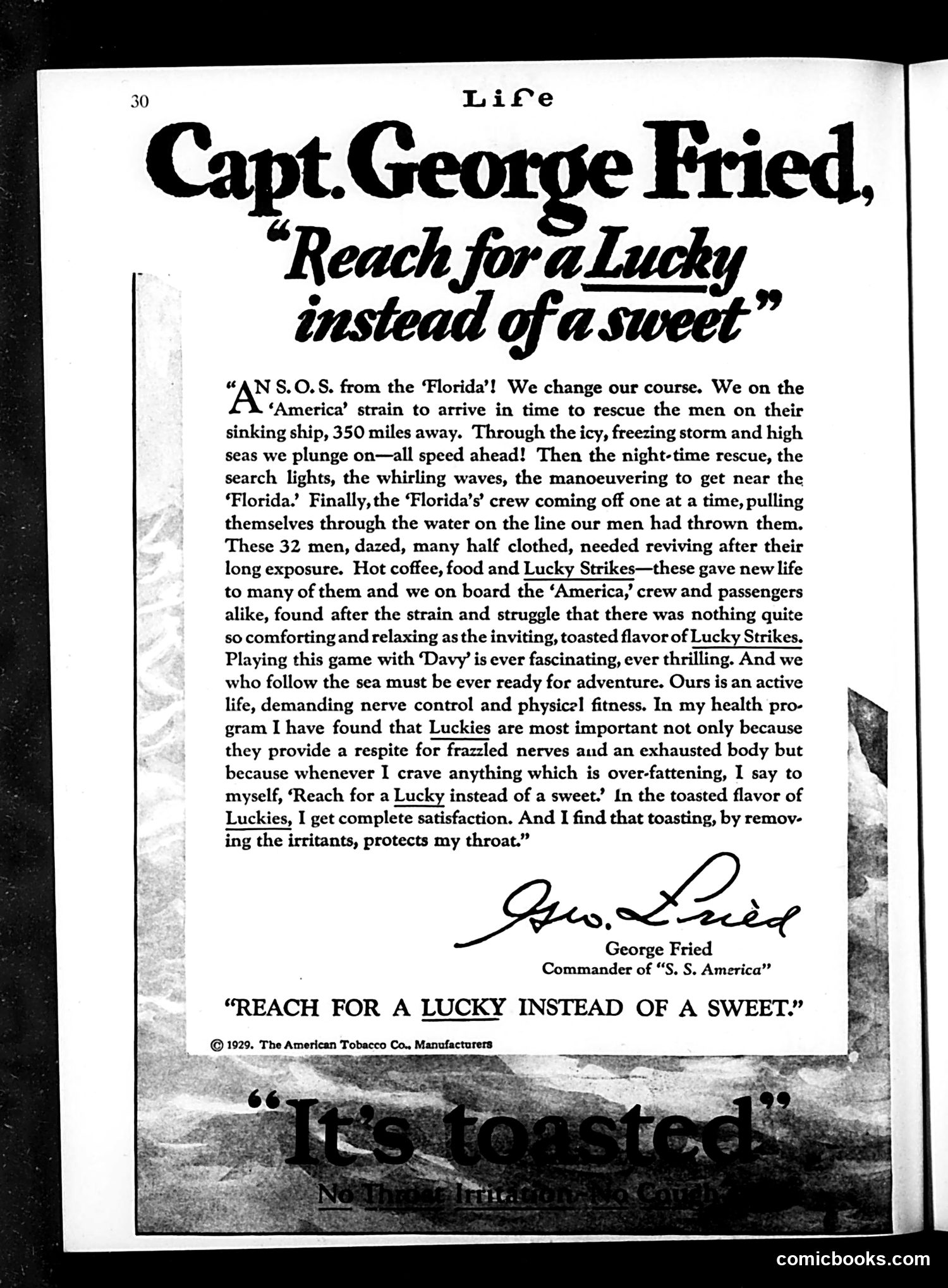
This is a **cigarette advertisement**, not satire or political commentary. It's a 1929 Lucky Strike ad featuring Captain George Fried, commander of the S.S. America, endorsing the product based on a real maritime rescue. The ad references an actual 1929 incident where the America rescued 32 men from the sinking ship Florida during a storm. Fried's testimonial claims Lucky Strikes helped revive the rescued sailors and that he personally uses them as a substitute for sweets to maintain health and nerve control during demanding seafaring work. The slogan "Reach for a Lucky instead of a sweet" was Lucky Strike's actual marketing campaign. Modern readers should note: this represents pre-regulation tobacco advertising that made explicit health claims, framing cigarettes as beneficial for fitness and appetite control—now recognized as completely false and harmful. The ad exploits a genuine heroic rescue to sell cigarettes.
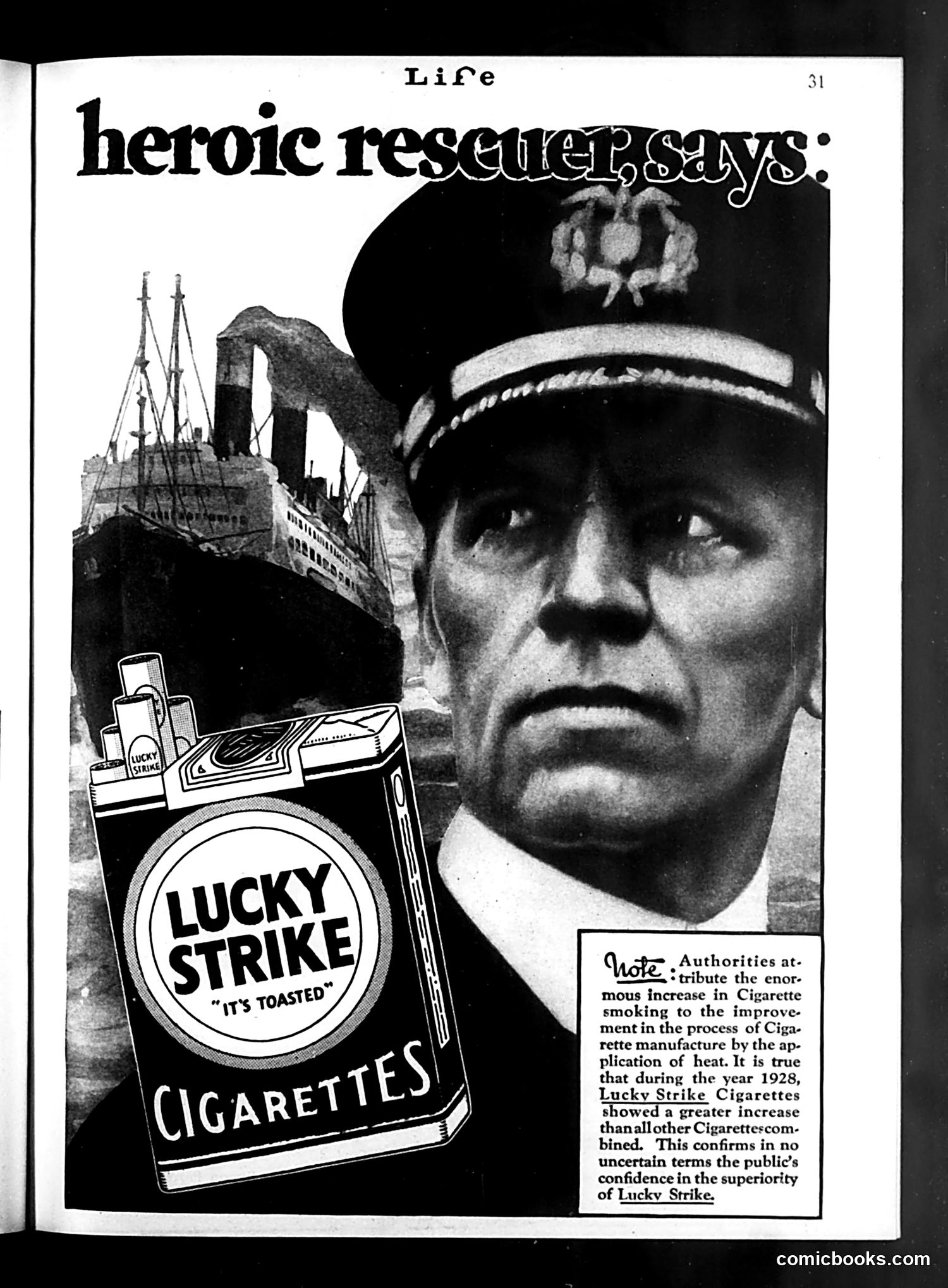
This is a **Lucky Strike cigarette advertisement**, not satire. The page presents a man in what appears to be a naval or maritime captain's uniform alongside a Lucky Strike cigarette package. The accompanying note claims that authorities attribute increased cigarette smoking to improved manufacturing processes, and specifically credits Lucky Strike with outselling all competitors combined in 1928. The "heroic rescuer" headline suggests the advertisement is positioning Lucky Strike cigarettes as a desirable, quality product associated with authority and reliability. This represents early-20th-century advertising before health warnings were required—cigarettes were marketed as beneficial and sophisticated products. The maritime imagery likely evoked themes of adventure and masculine appeal.
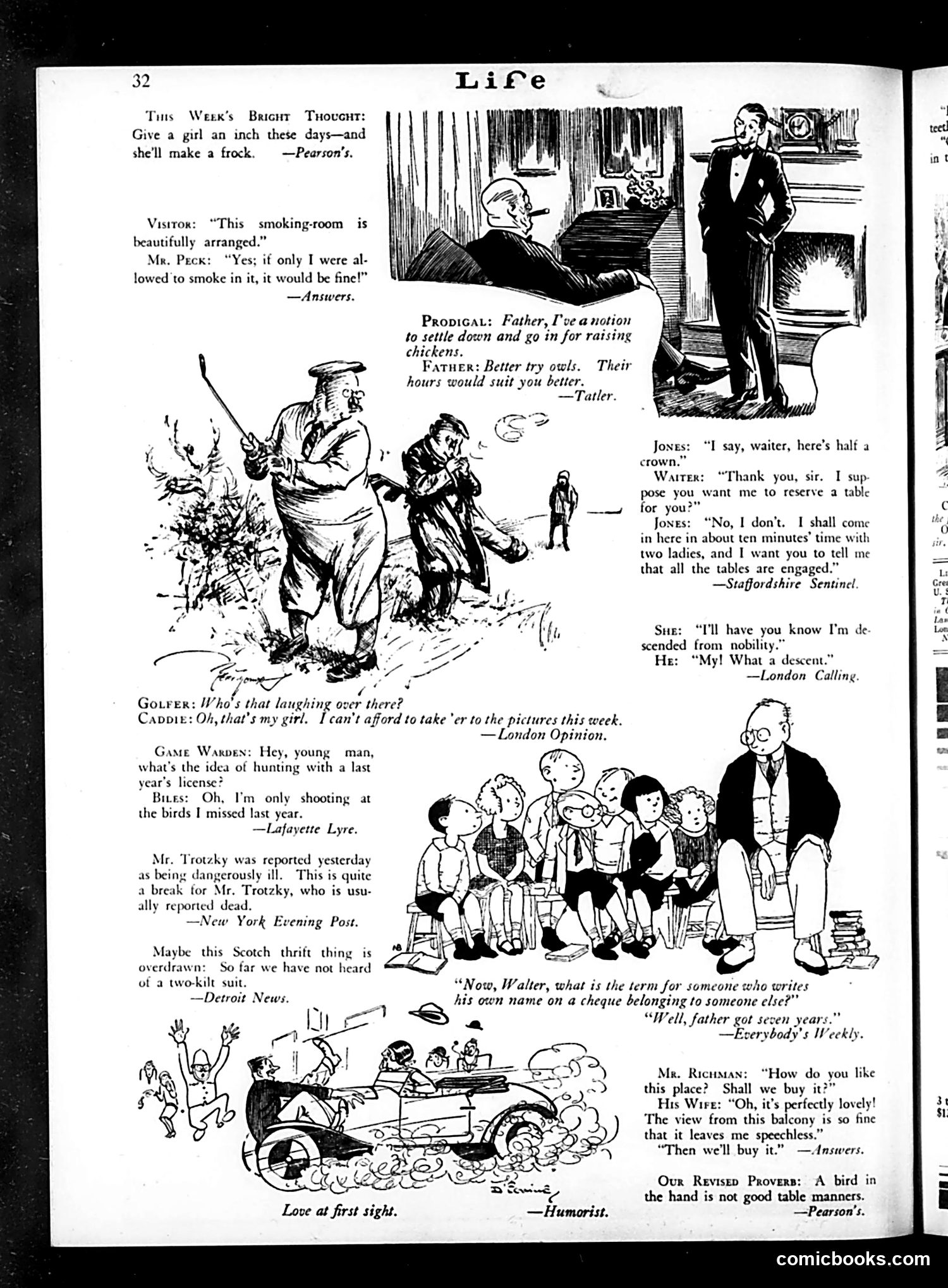
This page collects brief satirical jokes and cartoons from early 20th-century Life magazine, targeting social conventions and gender roles of the era. **Key themes:** - **Women's fashion**: A quip about girls' extravagance—give them minimal freedom and they'll spend lavishly on clothes. - **Gender dynamics**: A woman boasting of noble descent is deflated by a man's wordplay; another wife is so captivated by a view she's rendered speechless, prompting her husband to buy the property. - **Class and manners**: Jokes about smoking restrictions in "smoking-rooms," reserve tables at restaurants, and social pretense. - **The Trotsky reference**: A dark topical joke—Leon Trotsky was frequently reported dead in Western press despite being alive; the humor comes from this being "good news" for him (a break from constant death rumors). The cartoons depict everyday scenarios: hunting, family life, restaurant service. The satire is gentle, targeting human foibles rather than serious politics—typical of Life's lighthearted approach to social observation.
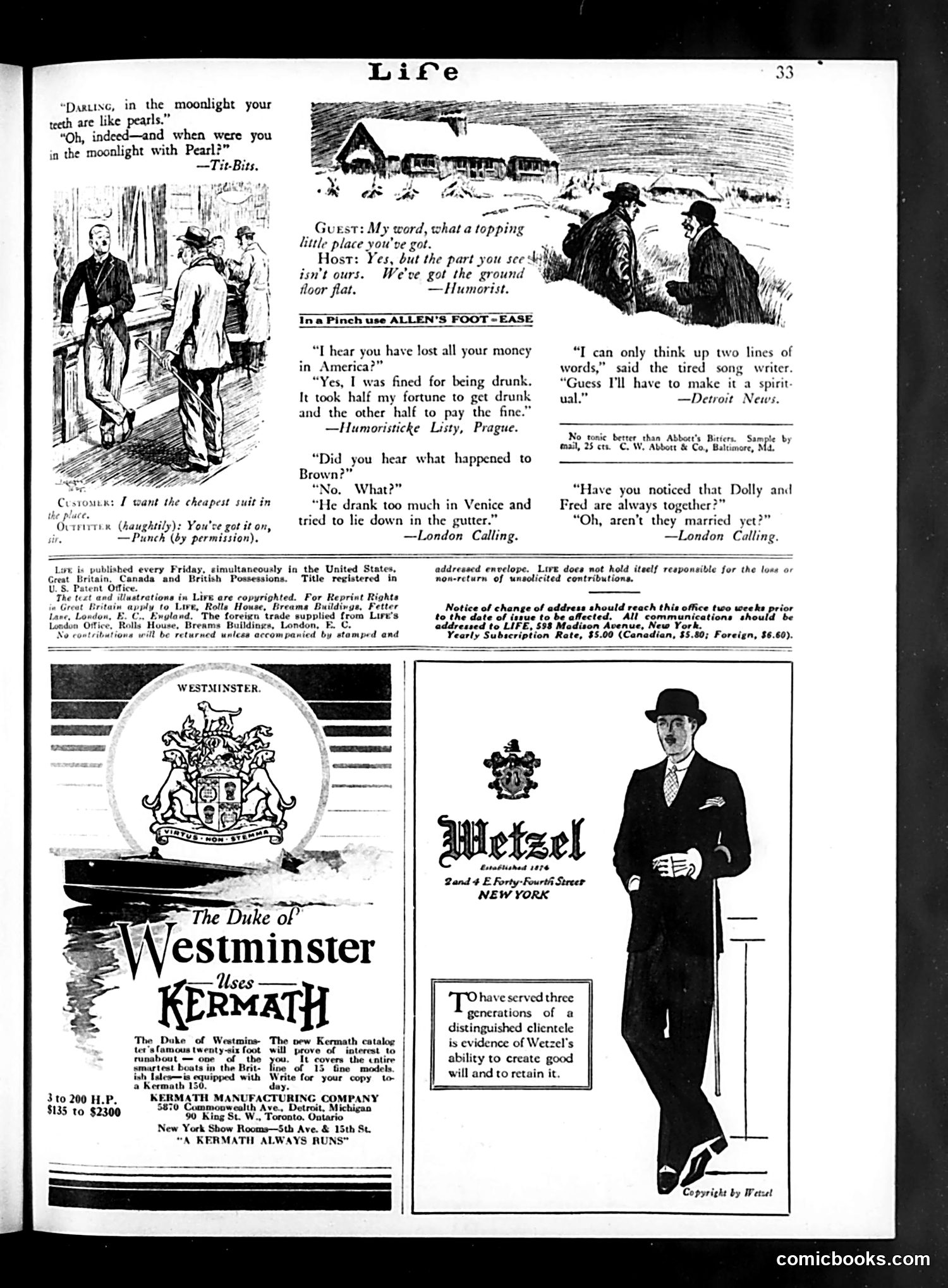
This page collects brief satirical jokes from Life's humor section, paired with period advertisements. The cartoons mock everyday social situations: - A man caught in a romantic lie about moonlight with a woman named "Pearl" - Social pretense: a host admitting his flat's only the ground floor - Financial ruin from American excess: a man fined for drunkenness, losing his entire fortune to fines and drinking costs - A struggling songwriter unable to complete lyrics - Romantic ambiguity: observers questioning whether an always-together couple is actually married The humor targets turn-of-the-century concerns: infidelity, class anxiety, American economic excess, and changing courtship norms. Advertisements for Kermath boats and Wetzel clothing occupy the lower half—luxury goods suggesting Life's wealthy readership. The page reflects early 20th-century satirical magazine conventions: brief, observational humor and upscale advertising targeting affluent readers.
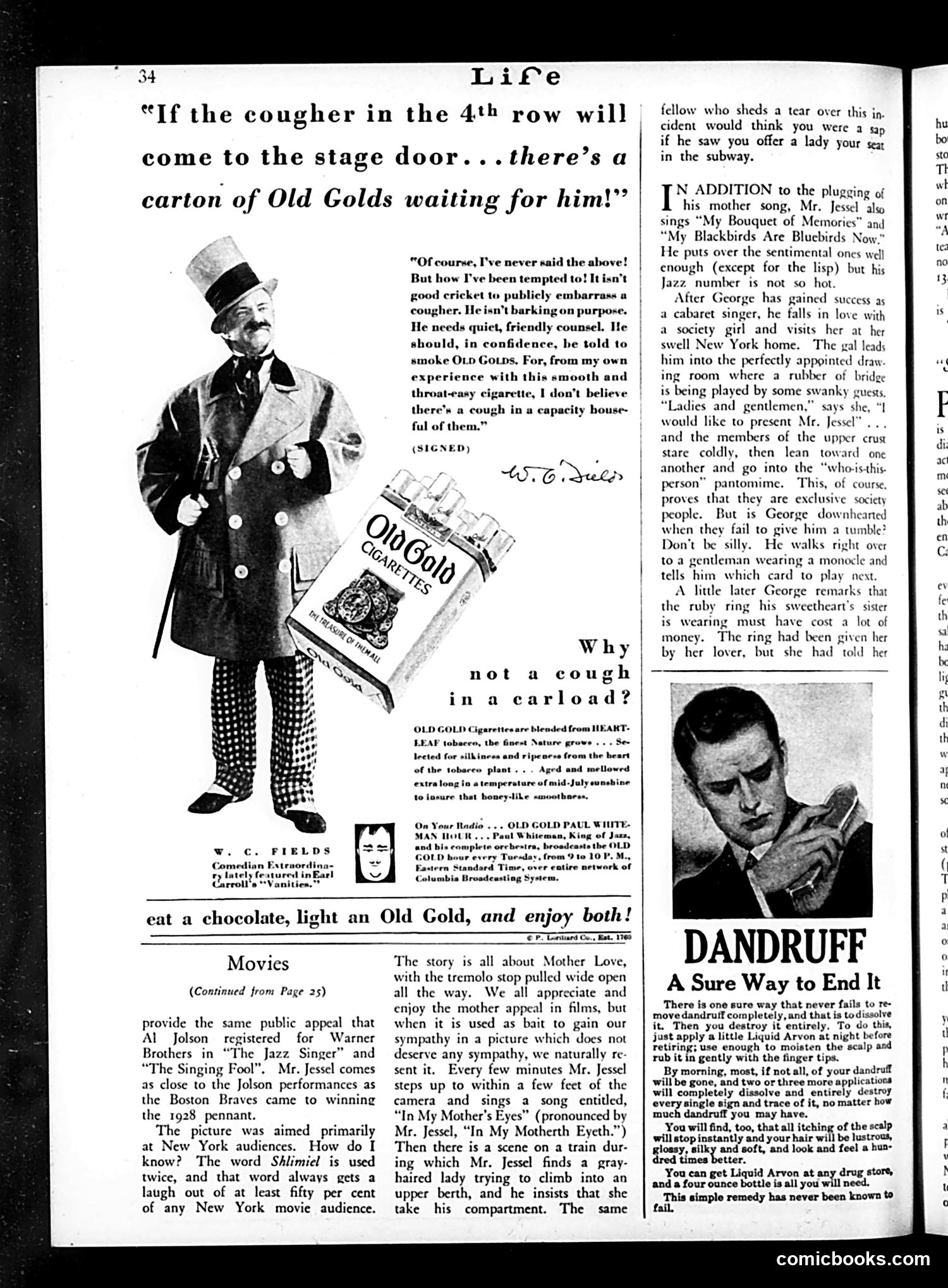
This Life magazine page contains a **W.C. Fields advertisement** for Old Gold cigarettes featuring the famous comedian. The joke plays on theater etiquette: Fields humorously offers to bribe a coughing audience member with cigarettes to stop disrupting the show, then claims he'd "never said" such a thing—though of course he just did in the ad itself. The ad's premise satirizes both **inconsiderate theater behavior** (coughing during performances) and **cigarette marketing tactics** of the 1920s-30s, which often made dubious health claims. The irony is thick: Fields suggests cigarettes prevent coughs while simultaneously using audience disruption as his sales hook. The page also reviews actor George Jessel's film, mocking his overwrought sentimentality and use of Yiddish ("Shlimiel") for cheap laughs with New York audiences.
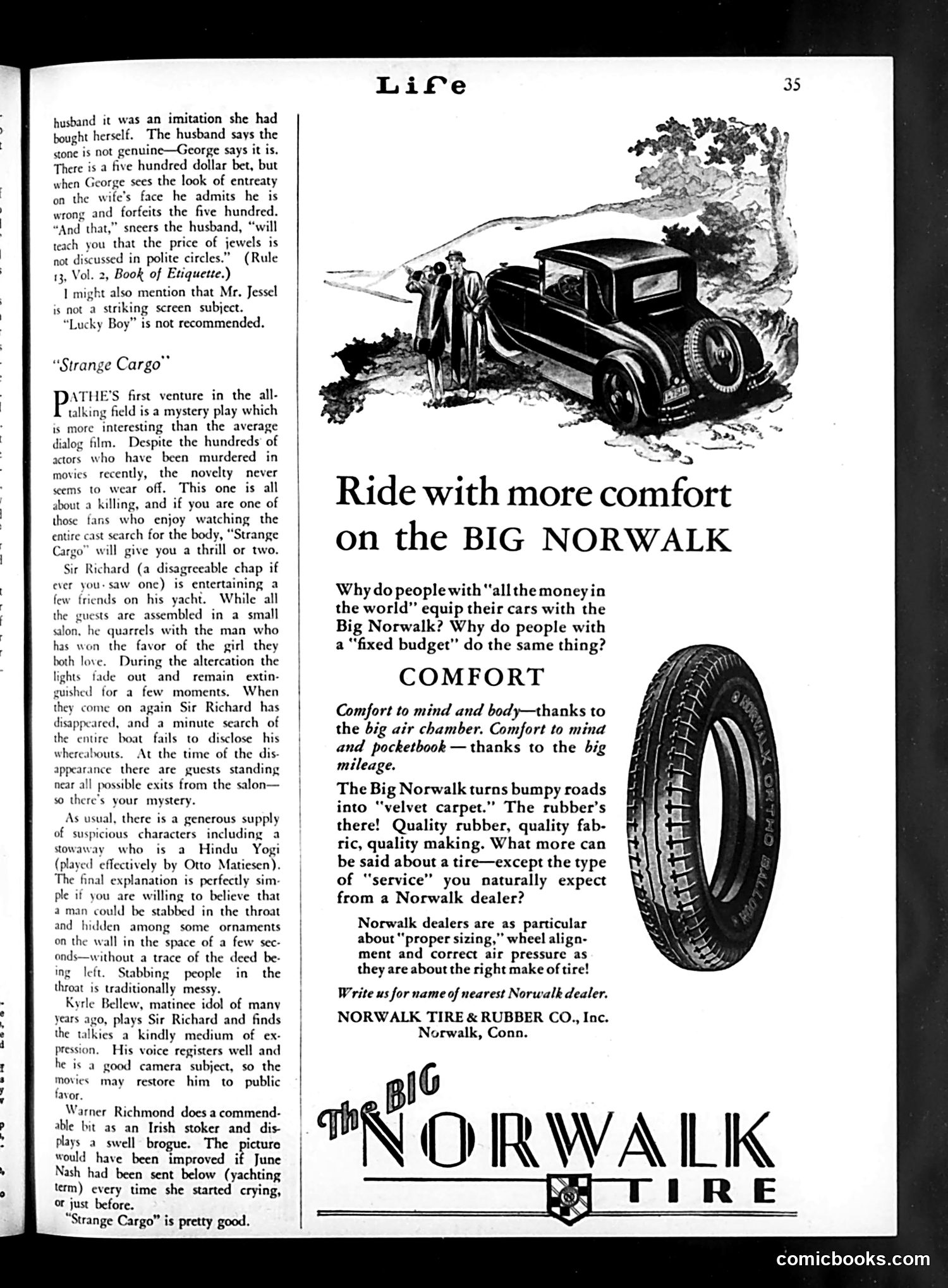
This page contains **two distinct sections**: a film review and an advertisement, with no political cartoon present. **Film Review ("Strange Cargo"):** The text critiques a mystery play featuring actor Kyrle Bellew as "Sir Richard," an disagreeable character entertaining guests on a yacht. During an altercation over a woman, the lights go out and Sir Richard disappears—the mystery being how he vanished despite guests guarding all exits. The reviewer notes the implausible plot (a throat-stabbing with no mess) but praises the film's novelty and Bellew's performance in this "talking" (sound) picture. Actress June Nash is mildly mocked for excessive crying. **Advertisement:** The remainder is a Norwalk Tire & Rubber Co. advertisement emphasizing comfort and value—using the rhetorical device of asking why both wealthy and budget-conscious drivers choose Big Norwalk tires, attributing the appeal to quality construction and dealer service. The page reflects 1920s-30s entertainment industry content with standard period advertising.
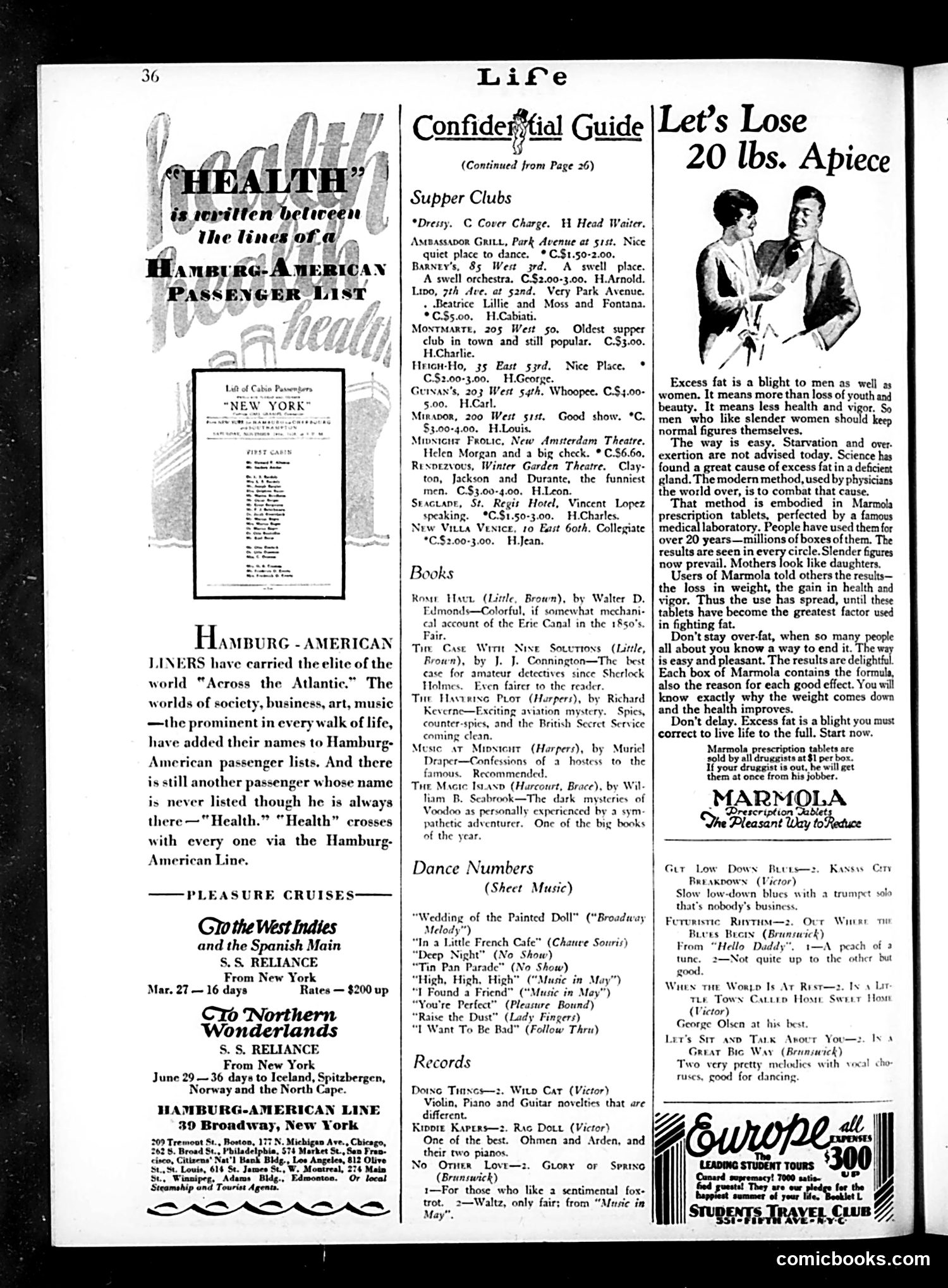
This page is primarily **advertising and entertainment listings** rather than political satire. The main content includes: **Left side:** Hamburg-American Line cruise ship advertisements, emphasizing "Health" as an invisible passenger crossing the Atlantic—a marketing appeal to wealthy travelers seeking health benefits from ocean voyages. **Center:** A "Confidential Guide" listing upscale Manhattan supper clubs (many featuring jazz-era entertainers like Beatrice Lillie and Jimmy Durante), plus book and music reviews typical of 1920s-30s Life magazine culture coverage. **Right side:** A weight-loss advertisement for "Marmola" tablets, featuring a couple and promoting the popular 1920s-30s ideal of slenderness. The copy explicitly states overweight men should stay trim to attract thin women—reflecting era-specific beauty standards and gender attitudes that would strike modern readers as dated and problematic. This reflects Life's dual role as satirical commentary *and* lifestyle magazine for affluent readers.
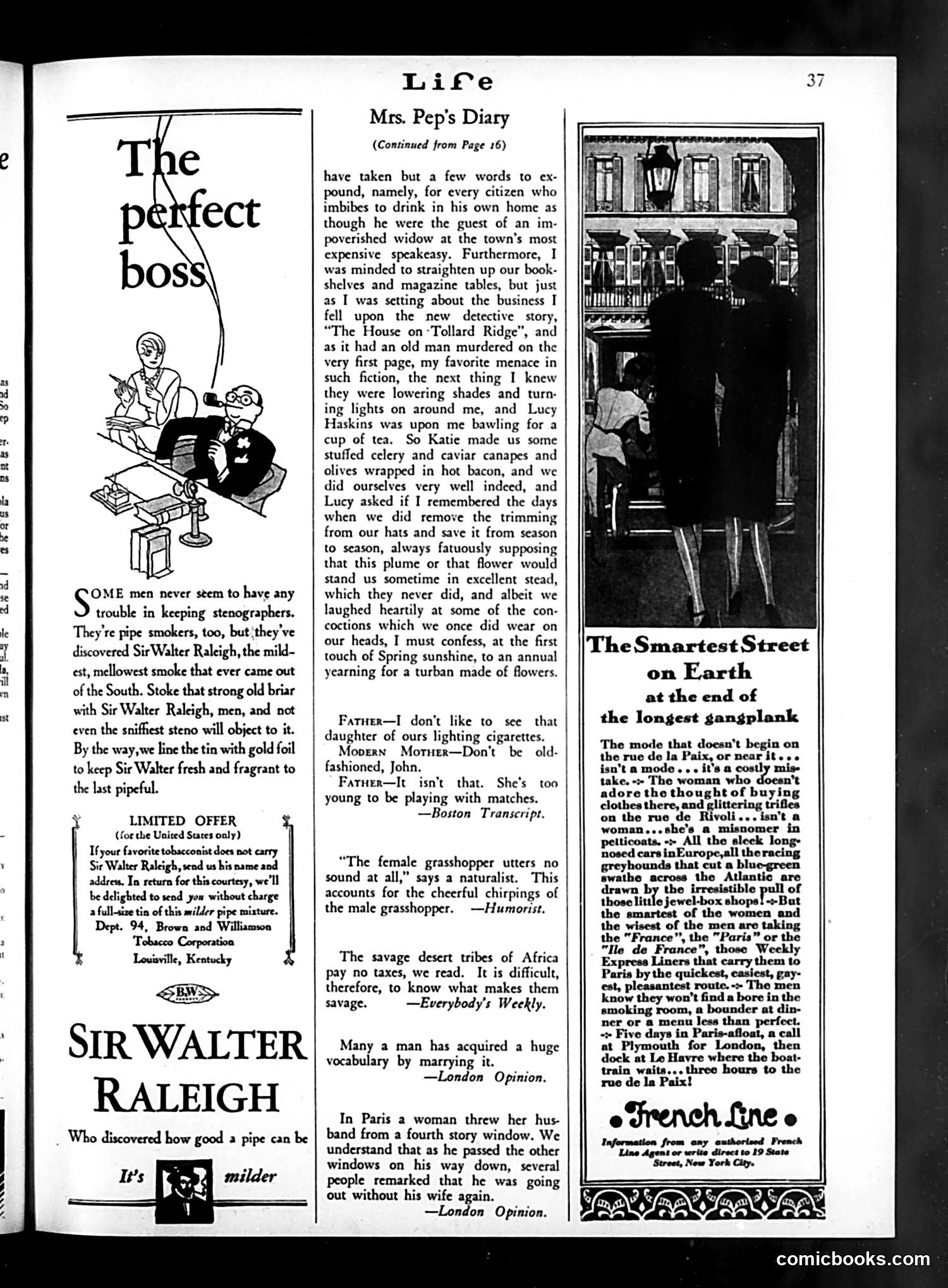
**Main Content:** This page mixes advertising, humor columns, and social commentary typical of *Life* magazine's satirical format. **The Cartoon ("The Perfect Boss"):** A simple line drawing depicts a boss and stenographer—a visual joke about workplace dynamics. The accompanying Sir Walter Raleigh pipe tobacco ad suggests the "perfect boss" is one who smokes mild pipes that don't offend his female stenographer. This reflects 1920s workplace attitudes: male bosses, female clerical workers, and the social acceptability of male smoking. **"Mrs. Pep's Diary":** A gossipy social column about upper-middle-class leisure—reading detective fiction, entertaining friends with caviar canapés, discussing outdated fashion trends. The humor is gentle domestic satire. **Joke Section:** Brief humorous quotes from various publications mock gender relations, marriage, and social pretension—including a dark joke about a Parisian woman throwing her husband from a window. **"Smartest Street on Earth":** An advertisement for Paris fashion, emphasizing the rue de la Paix and rue de Rivoli as ultimate luxury destinations for wealthy Americans. The page reflects 1920s American upper-class culture and attitudes toward work, gender, and European sophistication.
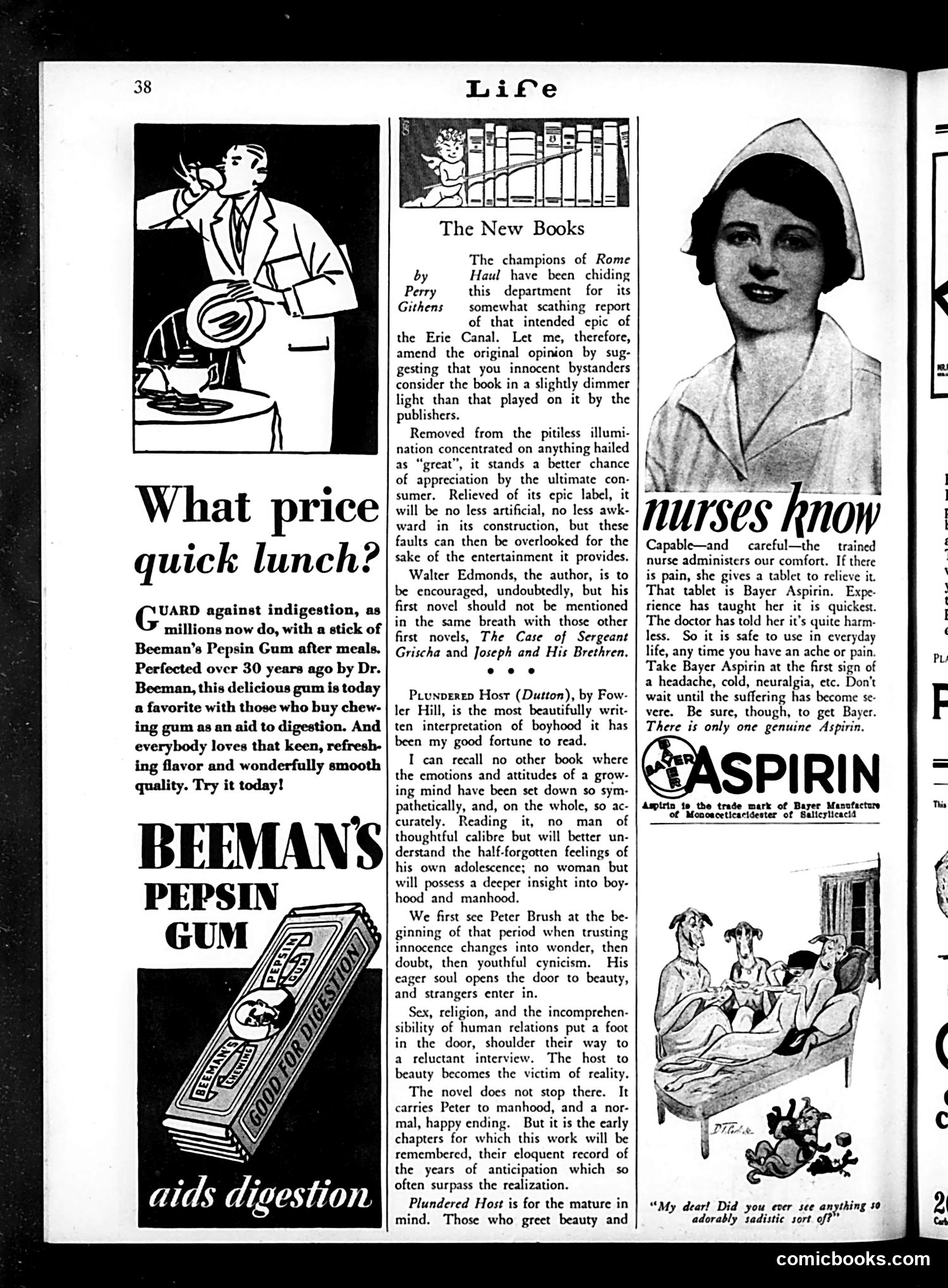
This page combines advertising with book reviews. The left side features a **Beeman's Pepsin Gum advertisement** satirizing the modern obsession with quick meals and digestive aids—showing a man hastily eating while chewing gum "aids digestion." The joke targets efficiency-minded Americans who prioritize speed over proper eating. The center contains a **book review section** critiquing recent novels, including Walter Edmonds' *Rome Haul* (about the Erie Canal), *Plundered Host* by Fowler Hill, and references to classic works. The reviewer advocates for judging books on entertainment value rather than inflated "great" labels. The right side advertises **Bayer Aspirin**, featuring a nurse administering the tablet. The copy emphasizes its safety and effectiveness for everyday pain relief. At the bottom, a cartoon depicts a sophisticated couple observing something, with the woman calling it "adorably sadistic"—likely satirizing pretentious modernist aesthetics and how cultured society rationalized questionable behaviors as artistic.
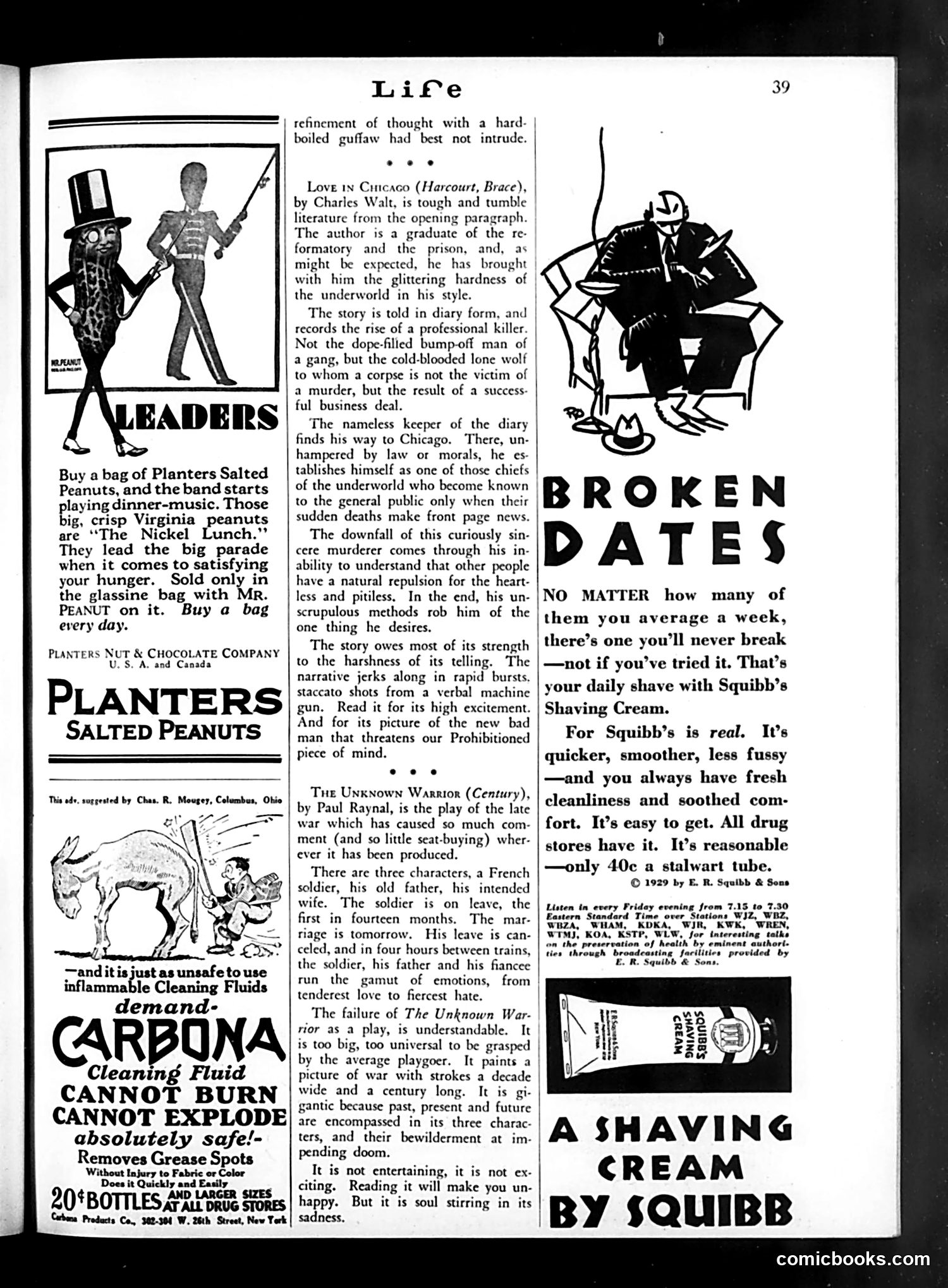
This page is primarily **advertising with book reviews**. The cartoons are minor—a stylized illustration for Planters Peanuts (top left) showing a figure in a top hat and another holding a rifle, captioned "LEADERS," and a simple drawing of a man in a chair for Squibb's Shaving Cream. The main content reviews three books: *Love in Chicago* (a crime novel about a professional killer in Prohibition-era Chicago), *The Unknown Warrior* (a World War I play), and mentions Squibb's Shaving Cream. The "Broken Dates" advertisement plays on the idea that while romantic dates may fall through, one reliable "date" is daily shaving with their product—a humorous pun on consistency and dependability. The page reflects 1929 consumer culture: Prohibition-era crime literature was popular, WWI remained culturally significant, and personal grooming products marketed themselves through lifestyle appeals. The advertisements dominate, which was typical of Life's business model as a magazine.
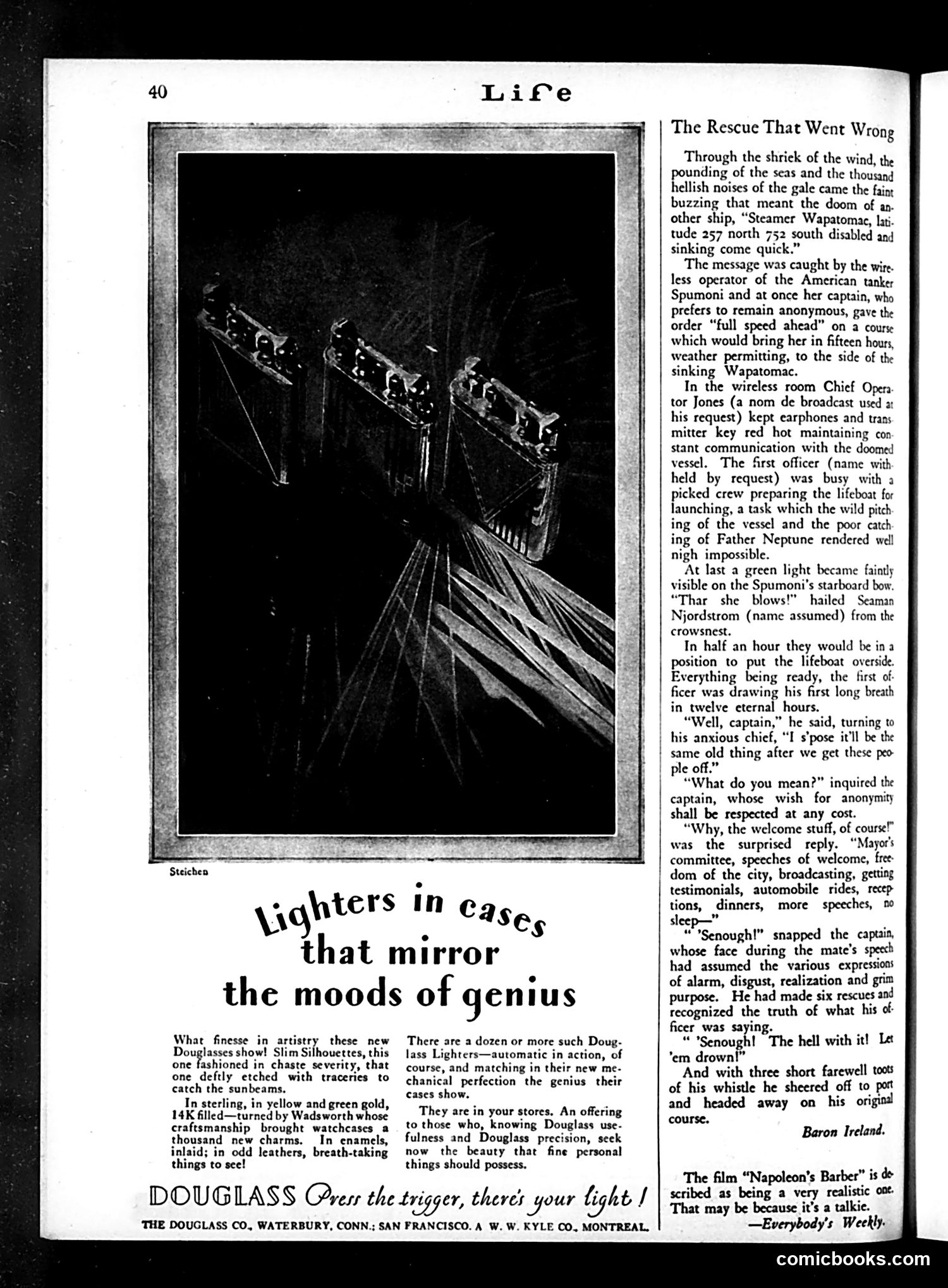
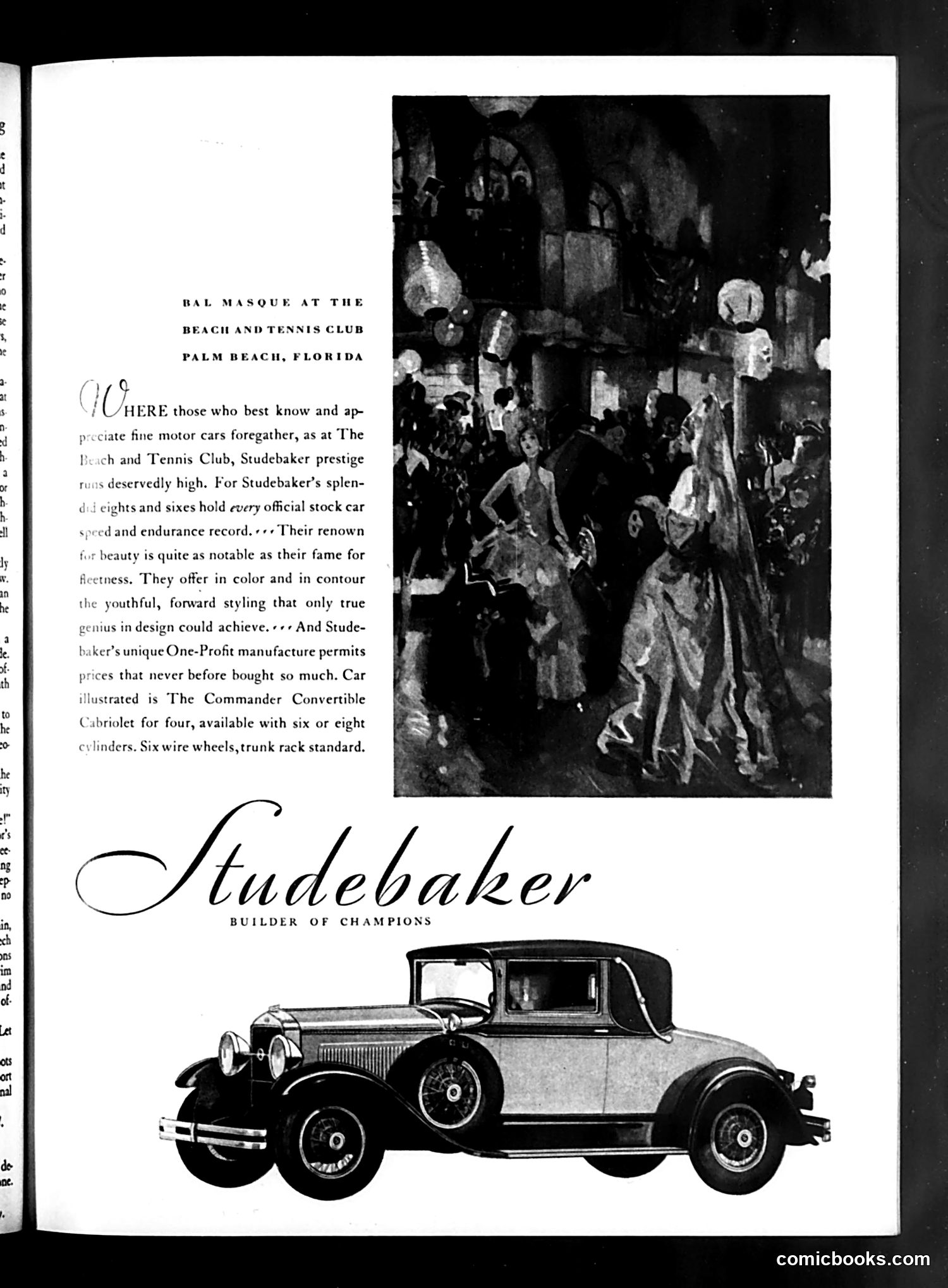
This is primarily a **Studebaker automobile advertisement**, not political satire. The page uses a photograph of a formal masquerade ball at an exclusive Palm Beach country club as aspirational lifestyle imagery to sell cars. The advertisement argues that Studebaker vehicles are favored by wealthy, discerning people who appreciate fine automobiles. It emphasizes the brand's racing credentials ("every official stock car speed and endurance record"), aesthetic design ("youthful, forward styling"), and value proposition ("prices that never before bought so much"). The "Commander Convertible Cabriolet" shown at bottom is presented as the vehicle of choice for this elite social set. The masquerade ball—a formal, exclusive gathering—serves as shorthand for affluence and sophistication, implying that Studebaker owners belong to this class. There is no political cartoon or satire here; this is straightforward luxury marketing from the pre-Depression or early Depression era, using social prestige and speed records to justify premium pricing.
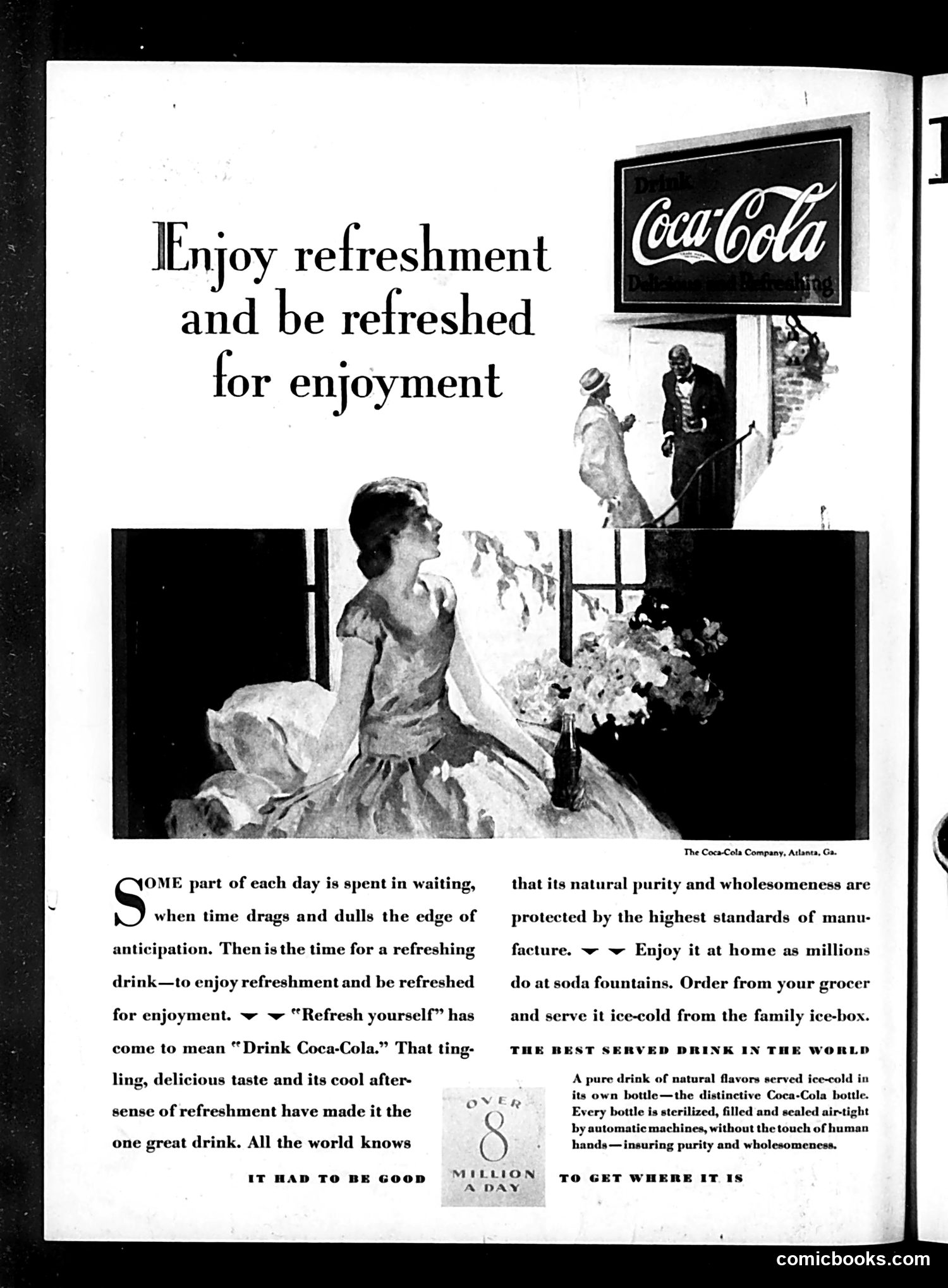
This is a **Coca-Cola advertisement**, not a political cartoon or satire. The page depicts an elegantly dressed woman in an interior setting, gazing toward a Coca-Cola sign visible through a window where two figures stand outside. The ad's messaging emphasizes: - **Refreshment as leisure**: Coca-Cola is positioned as relief from tedium and waiting - **Purity and hygiene**: Heavy emphasis on sterilization, automated bottling "without the touch of human hands," and manufacturing standards—reflecting early 20th-century anxieties about food safety - **Ubiquity**: The claim of "8 million a day" consumption and availability everywhere (home, soda fountains, grocers) - **Class appeal**: The refined domestic scene targets middle/upper-class consumers The slogan "Refresh yourself" is presented as having become synonymous with "Drink Coca-Cola"—an early example of brand colonization of language. This represents Depression-era or interwar advertising emphasizing scientific cleanliness and aspirational lifestyle rather than satirical content.