
A complete issue · 36 pages · 1929
Life — July 19, 1929
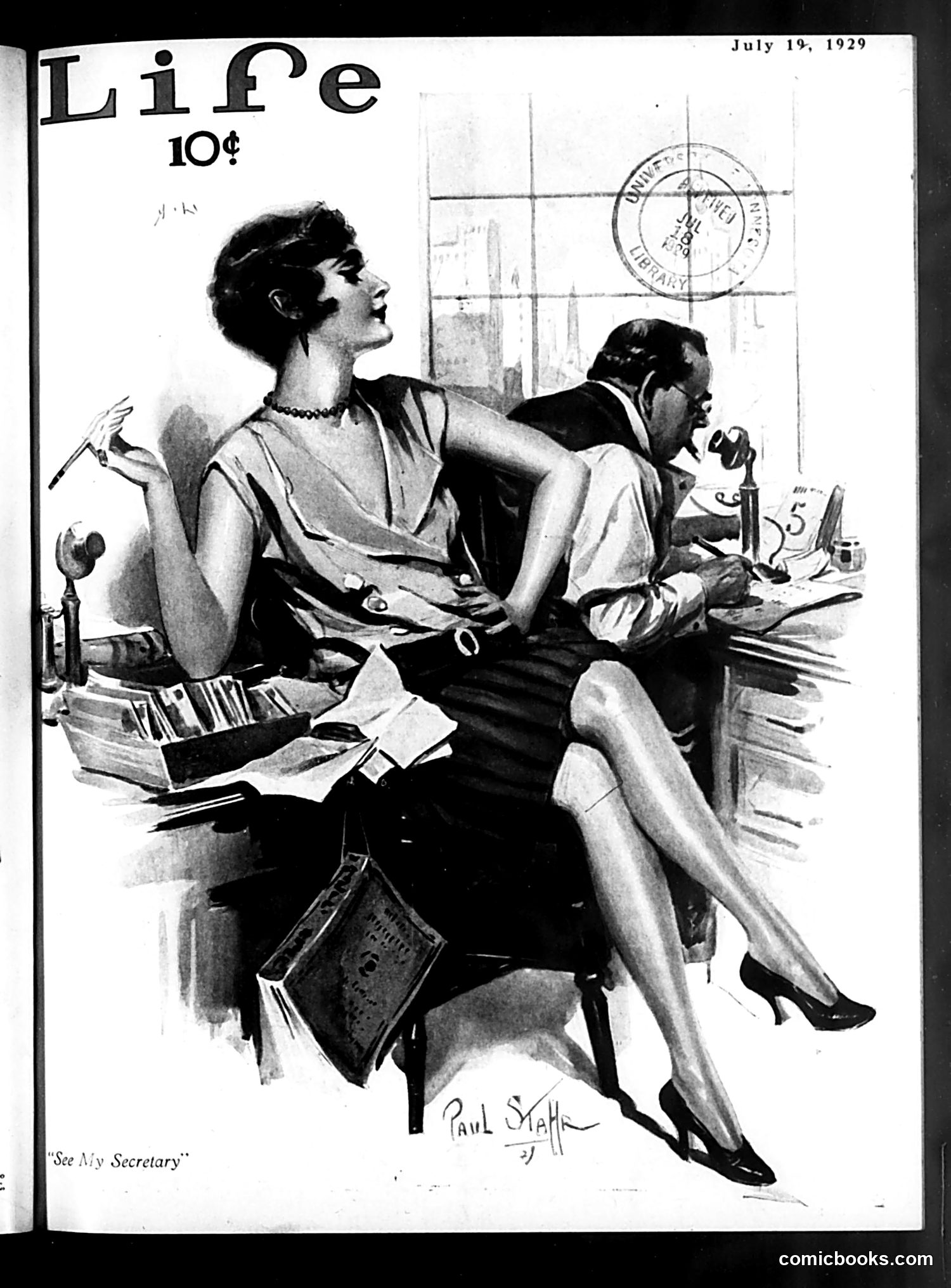
This cover illustration by Paul Steffan depicts a flirtatious office scene typical of 1920s humor. A man at a desk admires his attractive female secretary, who poses prominently while he works behind her. The cartoon plays on contemporary workplace dynamics and the era's light treatment of office romance and gender relations. The image reflects 1920s attitudes toward secretarial work—a growing female profession—often portrayed in popular media with sexual undertones rather than professional respect. The title "See My Secretary" suggests the woman is displayed as an accessory or status symbol rather than valued for her work. This satirizes both workplace culture and the objectification of women during the Jazz Age, presented here as humor for Life's readers.
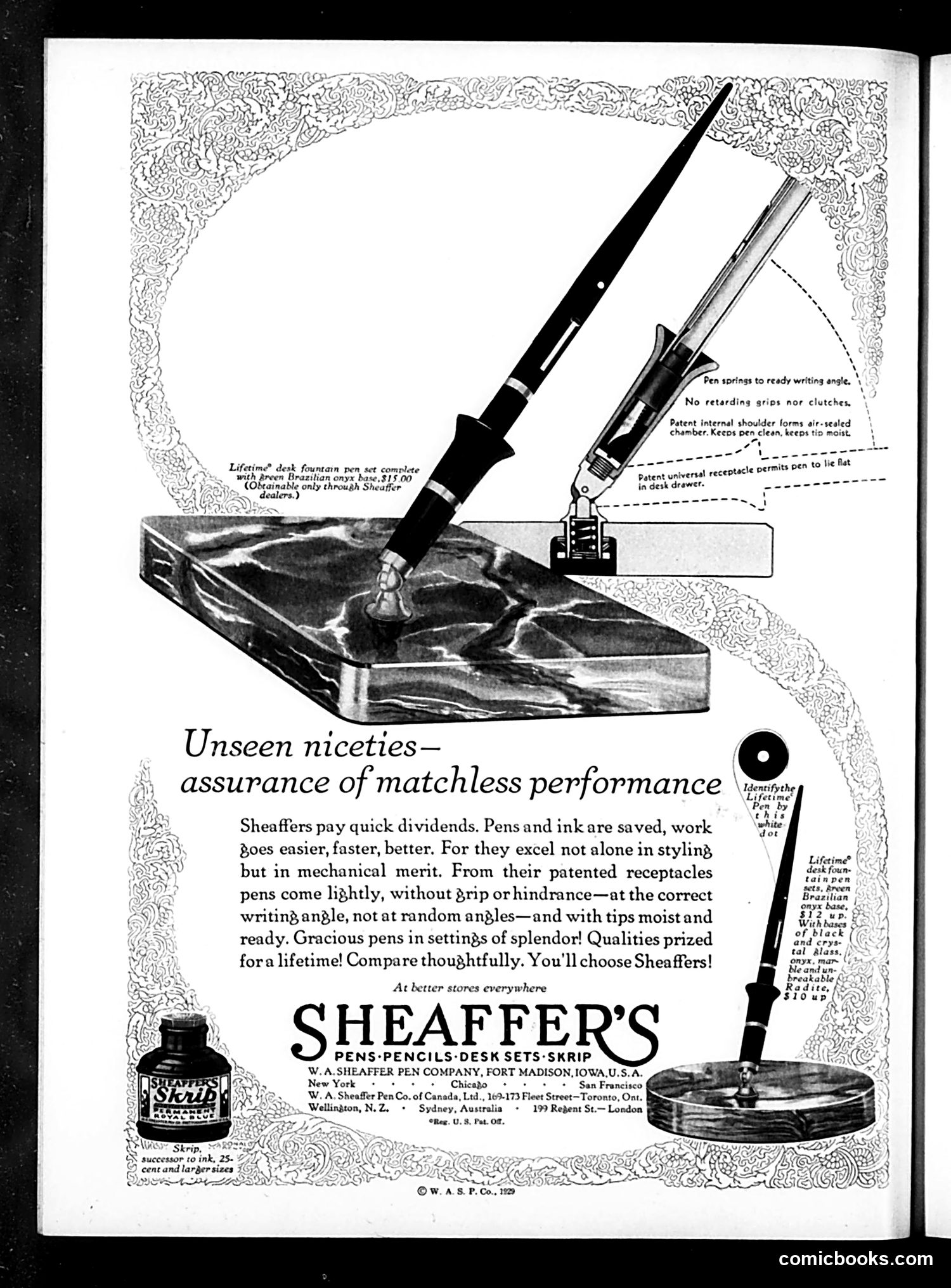
This is **primarily an advertisement**, not political satire. It promotes Sheaffer fountain pens and desk sets, marketed as premium writing instruments. The ad emphasizes "unseen niceties"—internal mechanical features like patented receptacles and shoulder-formed chambers that ensure reliable performance. The copy appeals to consumers seeking quality and efficiency: "Pens and ink are saved, work goes easier, faster, better." The visual demonstrates the pen's precise engineering through technical diagrams and a stylized desk-set display. The ornamental border and period typography suggest this ran in the 1920s-1930s. There is **no political cartoon or satire** on this page. It's straightforward product marketing targeting professionals and desk workers who valued dependable writing instruments—a significant consumer concern before ballpoint pens became standard.
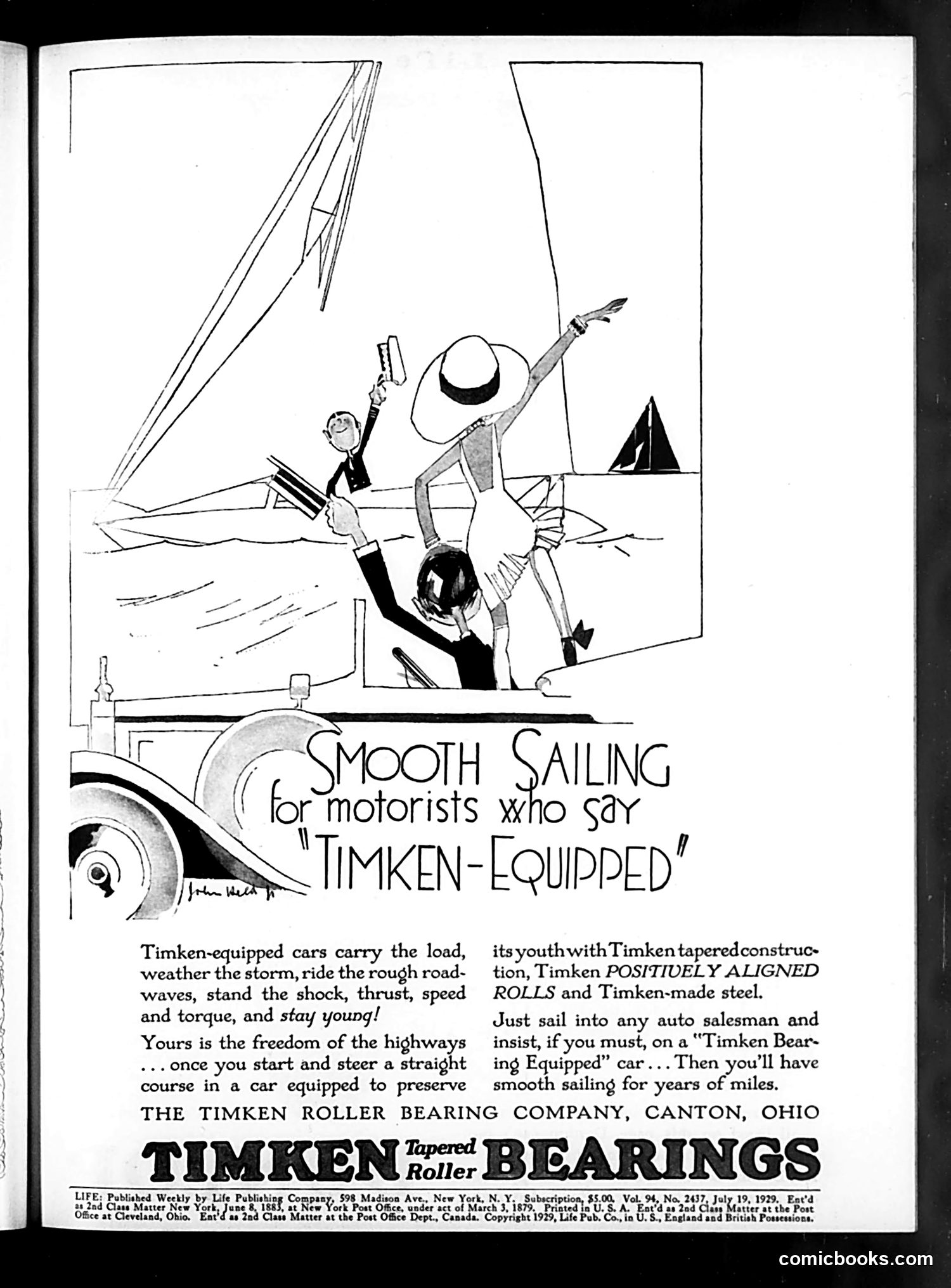
This is primarily a **Timken Roller Bearing Company advertisement** from July 19, 1929 (Life magazine), not political satire. The cartoon illustrates a humorous concept: motorists with Timken bearings can drive so smoothly they might as well be sailing. The illustration shows a car transformed into a sailboat with passengers enjoying leisurely sailing while traveling on roads. The ad's message is that Timken bearings provide such smooth, effortless driving that it feels like recreational sailing rather than motoring. The copy emphasizes durability—bearings that "weather the storm, ride the rough road waves, stand the shock, thrust, speed and torque, and **stay young**." This is commercial advertising employing whimsical imagery to sell automotive components to 1920s motorists, not political commentary.
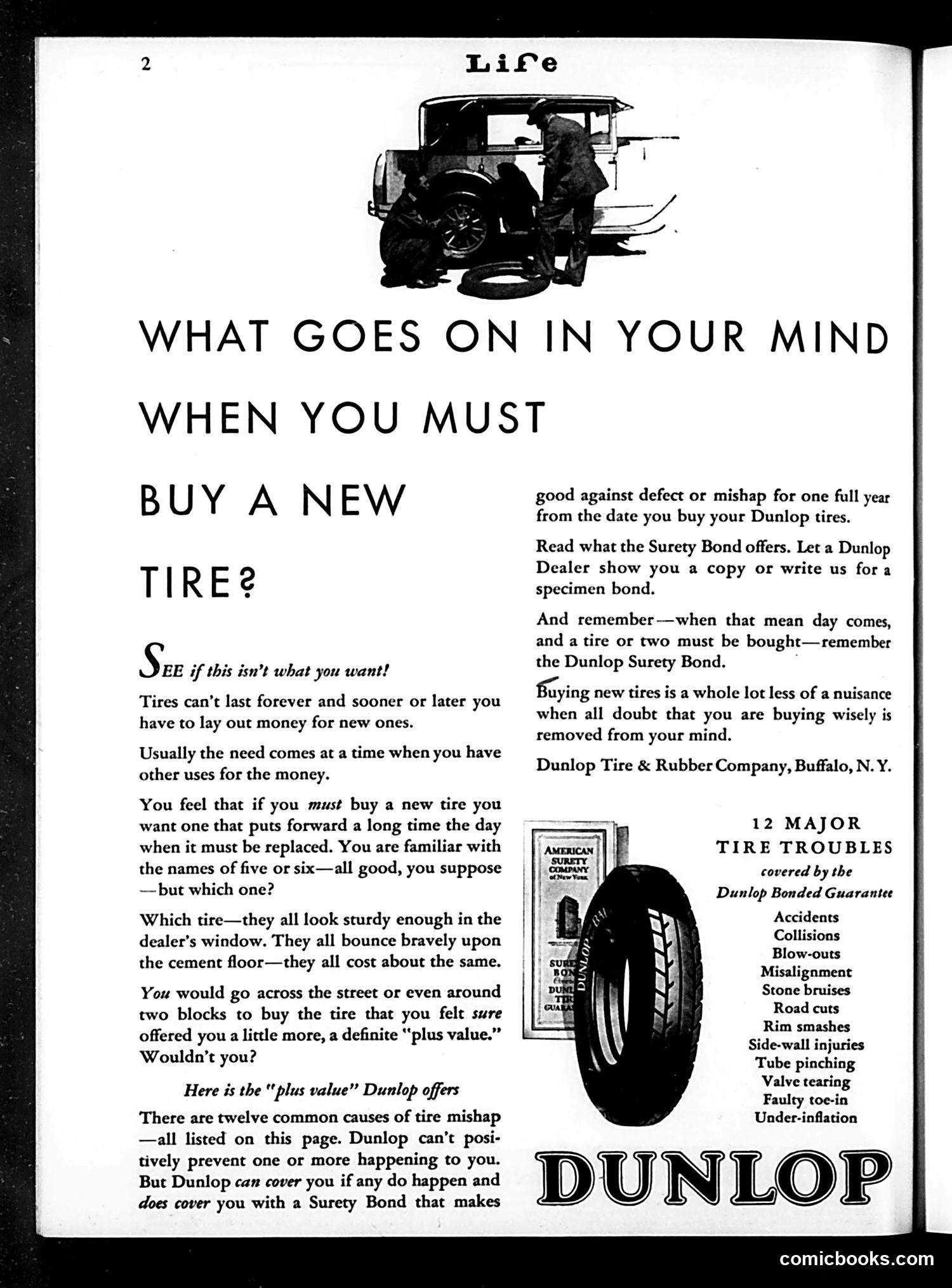
This page is primarily **advertising, not satire or political commentary**. It's a Dunlop tire advertisement from an early 20th-century Life magazine. The ad addresses consumer anxiety about purchasing tires—a relatively new consumer good at the time. The headline poses a relatable question: what concerns you when buying tires? The copy then reassures buyers that Dunlop offers a "Surety Bond" guaranteeing coverage against twelve common tire problems (blowouts, rim damage, misalignment, etc.). The cartoon at top shows a car with a flat tire, illustrating the tire troubles customers fear. The advertisement uses this anxiety to promote Dunlop's warranty as superior "plus value"—offering peace of mind competitors don't provide. This reflects early automotive culture when tire reliability was genuinely uncertain and worrisome.
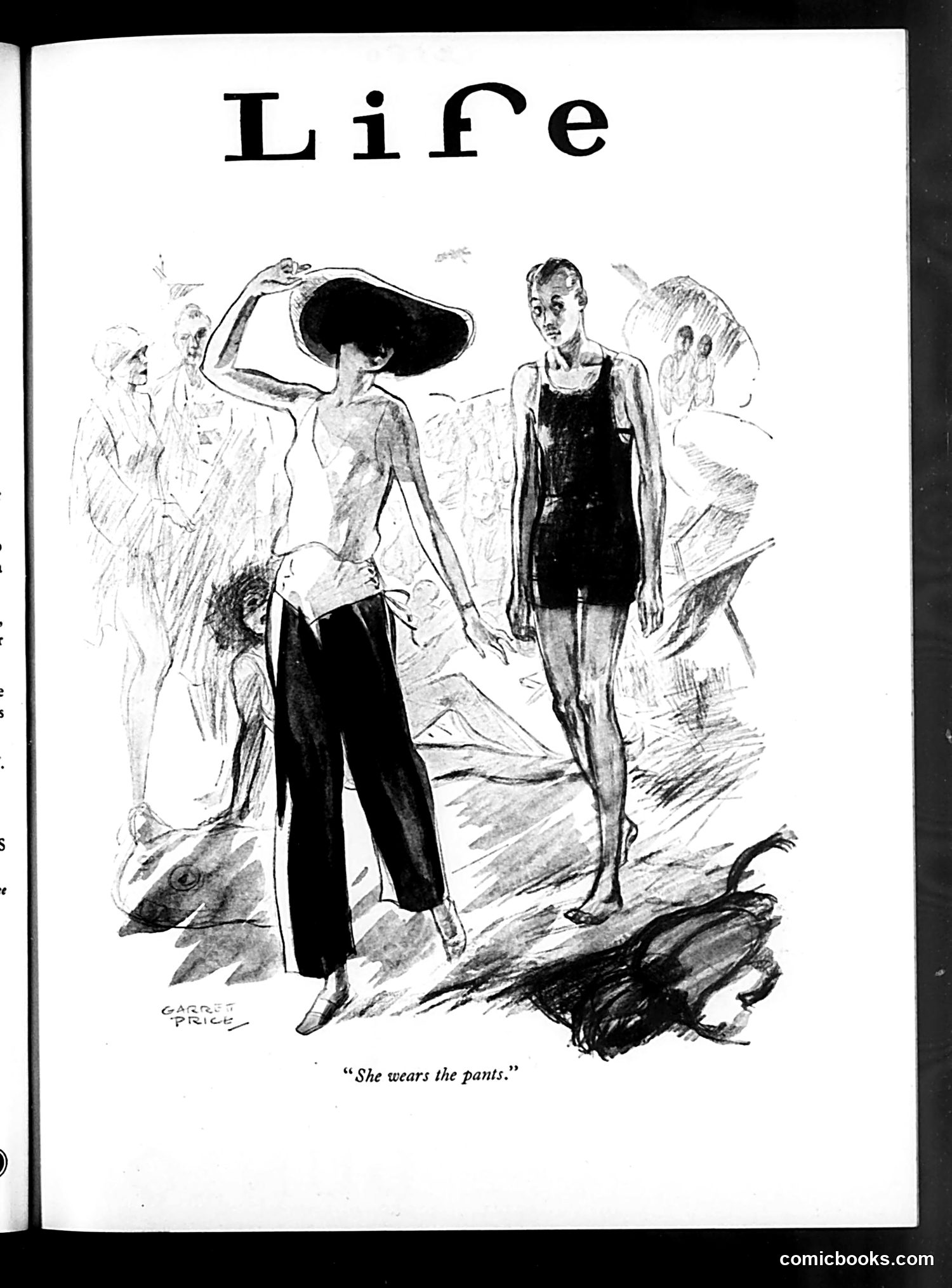
This cartoon satirizes women wearing pants—a controversial fashion choice in early-to-mid 20th century America. The illustration shows a woman in the center wearing pants and a large hat, while shocked onlookers (drawn as sketchy background figures) react with apparent disapproval or scandal. The caption, "She wears the pants," uses a period idiom suggesting a woman who dominates her household or defies traditional gender roles. The satire targets social anxieties about changing women's fashion and independence. Wearing pants was considered masculine and improper for women, making this cartoon commentary on conservative resistance to evolving gender norms and women's increasing freedom in dress and social roles.
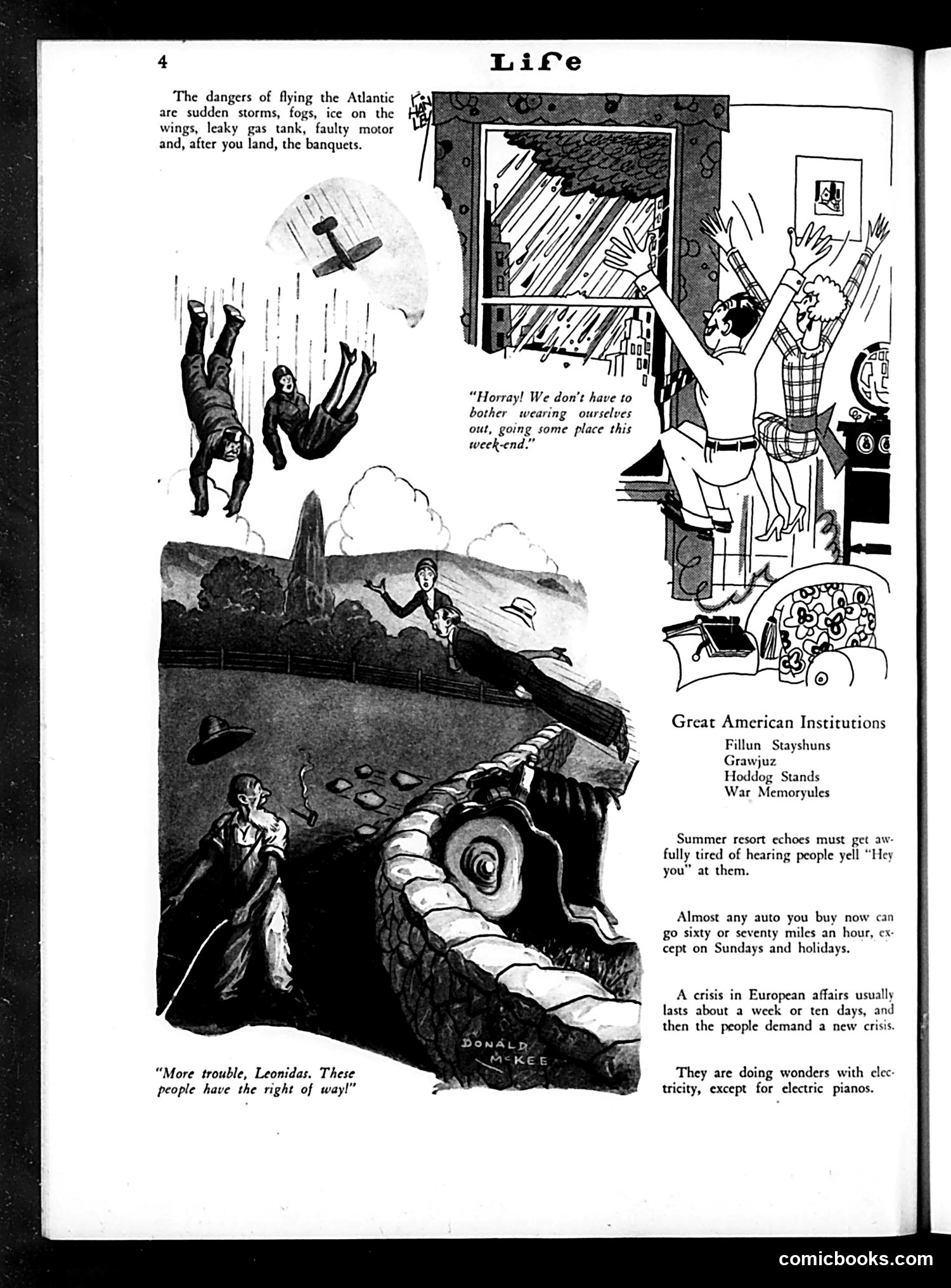
This page contains two distinct cartoons mocking different aspects of 1920s American life. **Top cartoon**: Shows people celebrating avoiding formal attire for a weekend trip, satirizing the rigid dress codes of the era. **Bottom cartoon** (signed Donald McKee): Depicts a traffic accident or collision near a rural area. The caption "More trouble, Leonidas. These people have the right of way!" suggests satire about automobile safety and right-of-way rules—likely mocking either reckless driving or unclear traffic regulations during the early automobile era. The right column lists "Great American Institutions" humorously (Fillun Stayshuns, Grawjuz, etc.), continuing the satirical tone by poking fun at American culture and contemporary concerns like summer resorts, automotive speeds, and European crises.
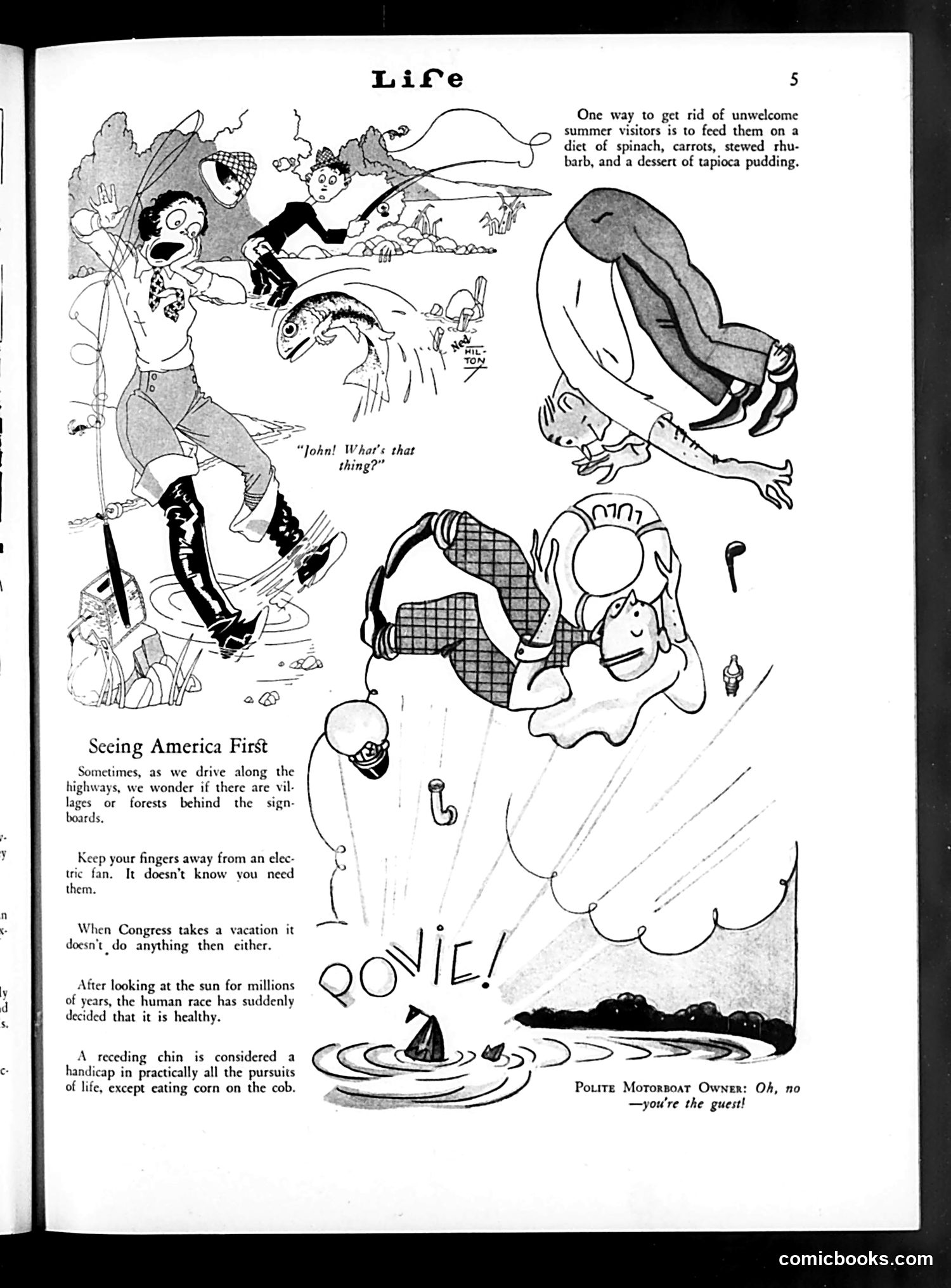
This page contains several brief satirical jokes and comic vignettes typical of Life magazine's humor format: **"Seeing America First"** mocks tourist behavior, suggesting roadside attractions and billboards dominate American travel experiences rather than genuine natural wonders. **"Unwelcome Summer Visitors"** (top right) suggests feeding unwanted guests an unappetizing diet of healthy vegetables and tapioca pudding to discourage them from returning. The remaining jokes target Congress's ineffectiveness, the fashion of sun-bathing as a supposed health trend, and the social stigma of a receding chin. The bottom cartoon shows a motorboat scene with the caption "Oh, no—you're the guest!" suggesting unexpected entertaining obligations. These represent typical early-to-mid 20th-century American humor: light social observation rather than serious political satire.
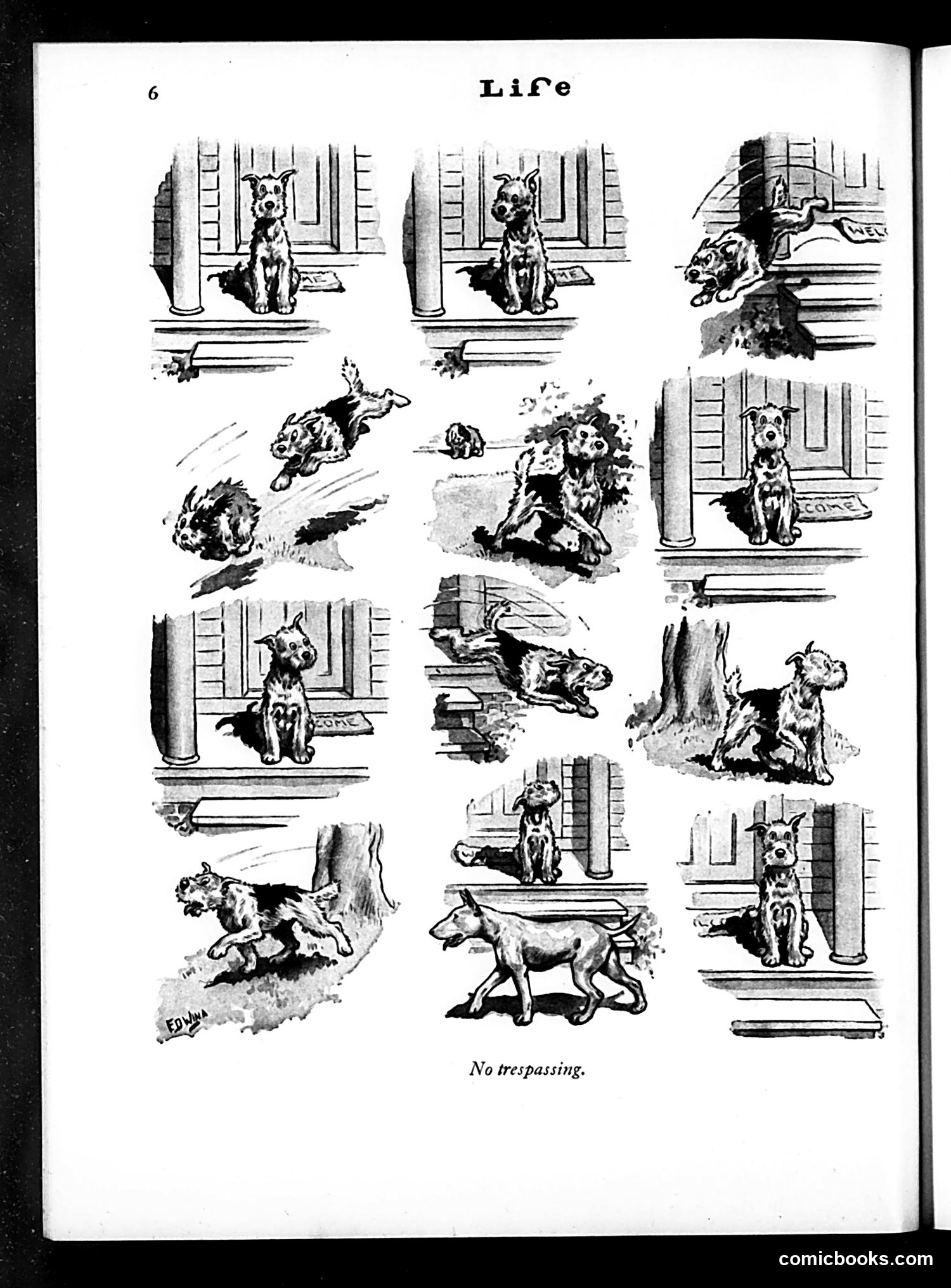
This page features a series of humorous illustrations about dogs and property boundaries, titled "No Trespassing." The cartoons depict various scenarios of dogs encountering barriers or restrictions at residential entrances—sitting obediently at doorways, being caught mid-trespass, or reacting to "No Trespassing" signs. The satire appears to mock both canine behavior and human property enforcement. The joke likely plays on dogs' indifference to human social conventions: no matter how prominently displayed the warnings, dogs continue their natural inclinations to roam, investigate, and transgress boundaries. This anthropomorphic humor was typical of Life's early satirical approach, using animal misbehavior to gently critique human concerns about property rights and social order.
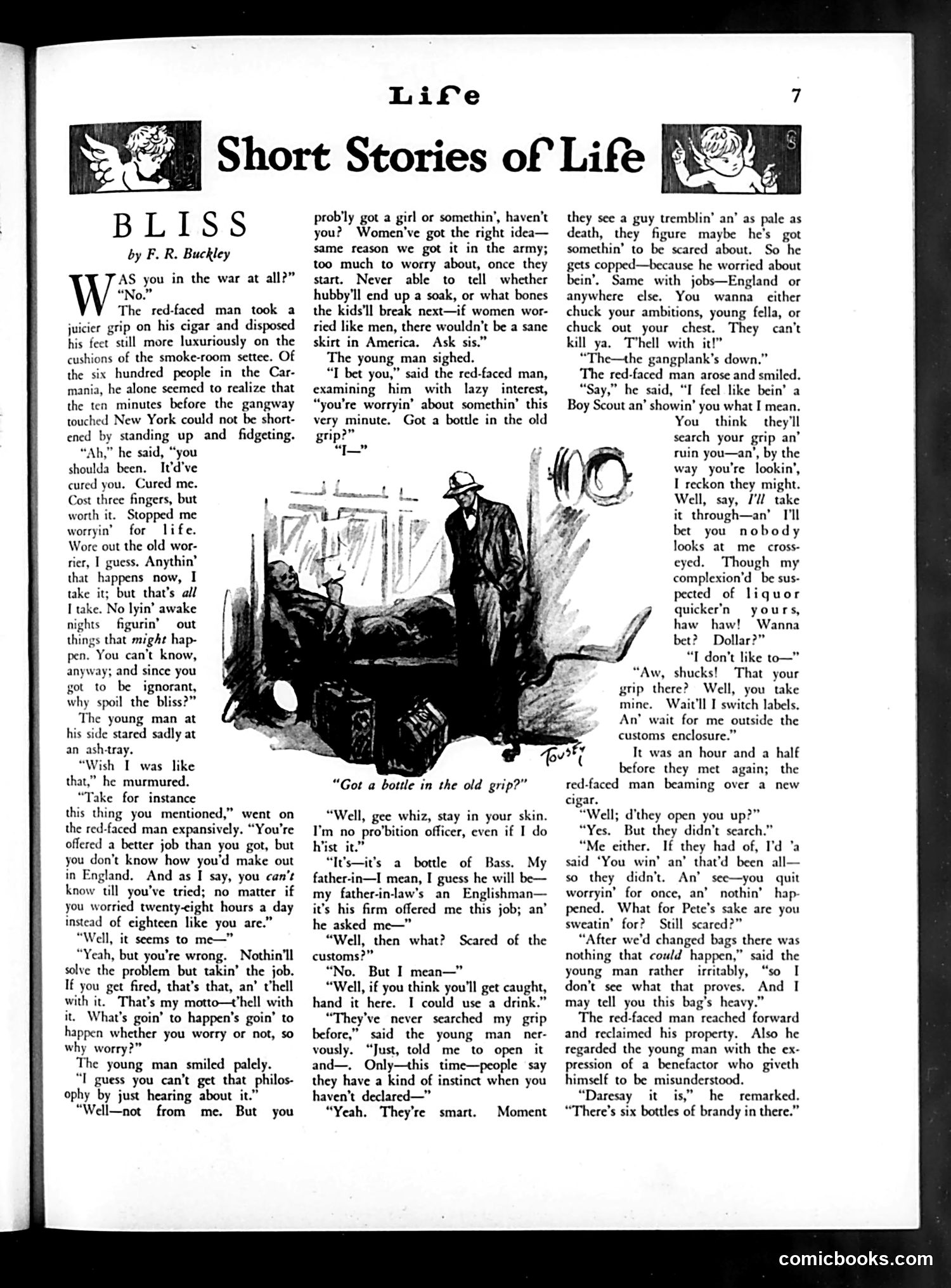
This story depicts a post-WWI encounter between a war veteran and a young soldier. The red-faced man, apparently a seasoned soldier, counsels the anxious younger man about wartime worries—romantic concerns, job prospects, and military discipline. The satire targets the romanticized notion of military service. The veteran's cynical philosophy—"take it" and stop worrying—contrasts with the young soldier's anxieties. The story mocks both the recruit's naive fears and the hardened soldier's attempt to project toughness and indifference. The "bliss" referenced in the title appears ironic: true peace comes from accepting life's uncertainties rather than fearing them. The tale critiques how war strips idealism and replaces it with resigned fatalism among servicemen.
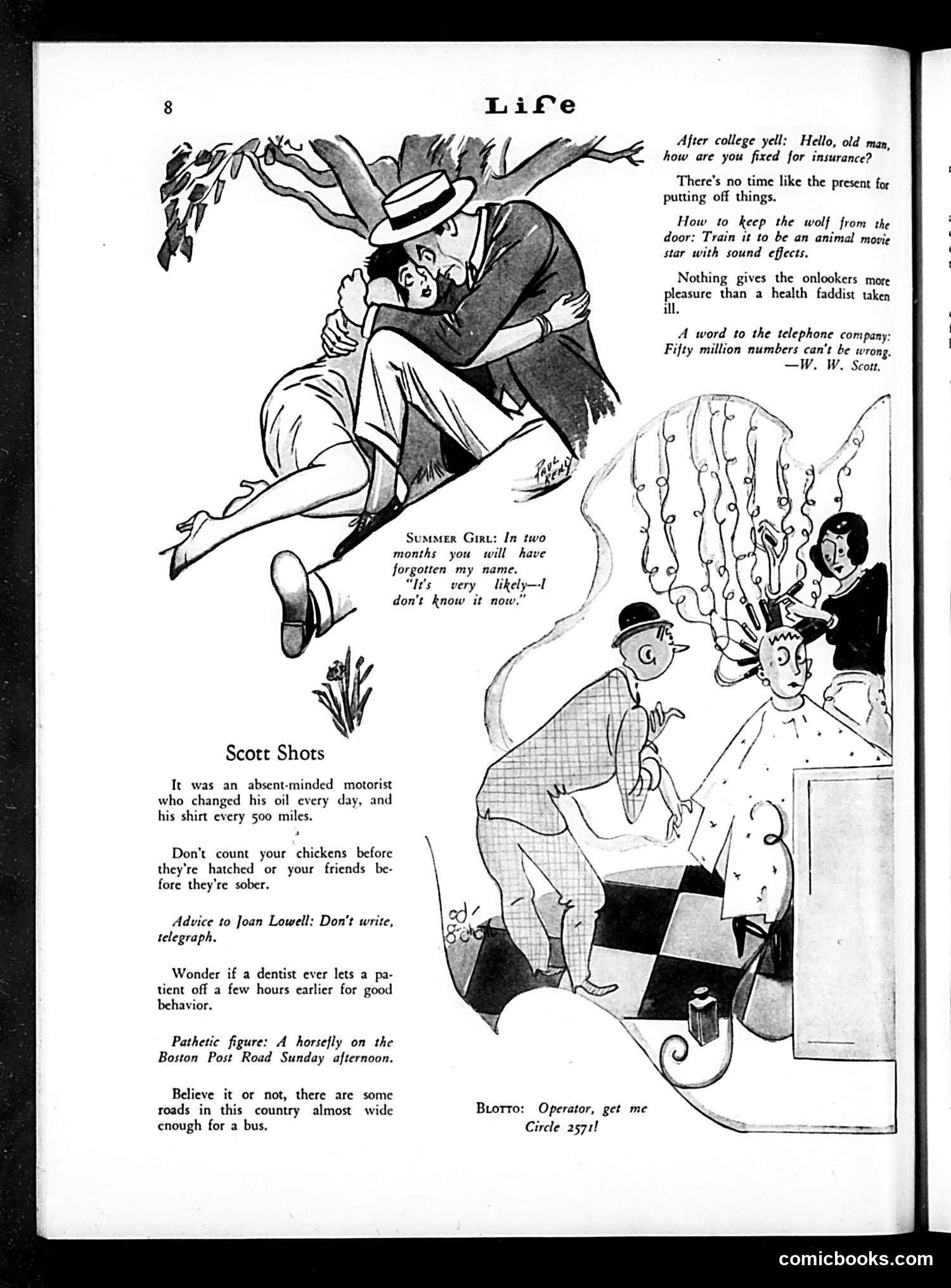
This page contains several unrelated humorous pieces typical of Life's satirical format: **Top cartoon**: A man in a top hat embraces a woman on a branch, captioned "After college yell." The joke appears to play on romantic encounters among alumni. **"Scott Shots"**: A brief humorous anecdote about an absent-minded motorist who changes his shirt daily but only every 500 miles—inverting normal hygiene priorities for comedic effect. **"Summer Girl"**: A woman predicts her romantic partner will forget her name within two months, suggesting casual summer romance. **Bottom cartoon**: Shows a man at what appears to be a salon or barber chair with octopus-like tentacles, with someone requesting "Circle 257!" (likely a phone exchange)—a joke about telephone operators of that era. The page is primarily humor and satire without apparent political content.
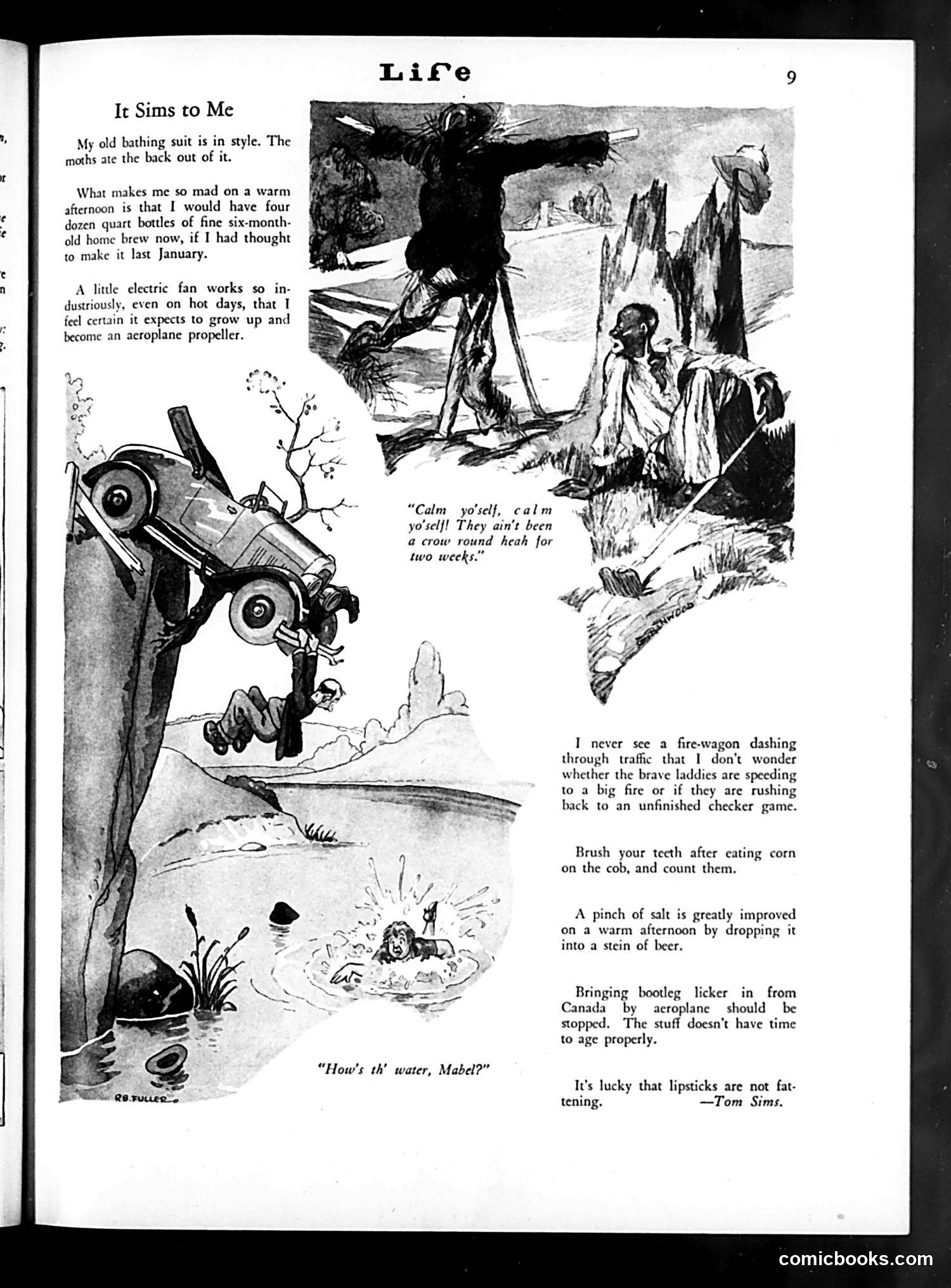
This page is a humor column featuring whimsical observations about everyday life. The sketches and text are satirical vignettes rather than political commentary. The illustrations depict absurd scenarios: a small electric fan expected to become an airplane propeller, a person in water asking "How's th' water, Mabel?", and a group reacting to crows. The text contains deadpan jokes about bathing suits, home-brewed beer lasting until January, fire wagons, dental hygiene, and bootleg liquor smuggling from Canada by airplane. The satire targets contemporary concerns of the Prohibition era (bootlegging references), mundane domestic life, and emerging technology. The humor is gentle observational comedy rather than sharp political critique—characteristic of Life magazine's lighter satirical approach during this period.
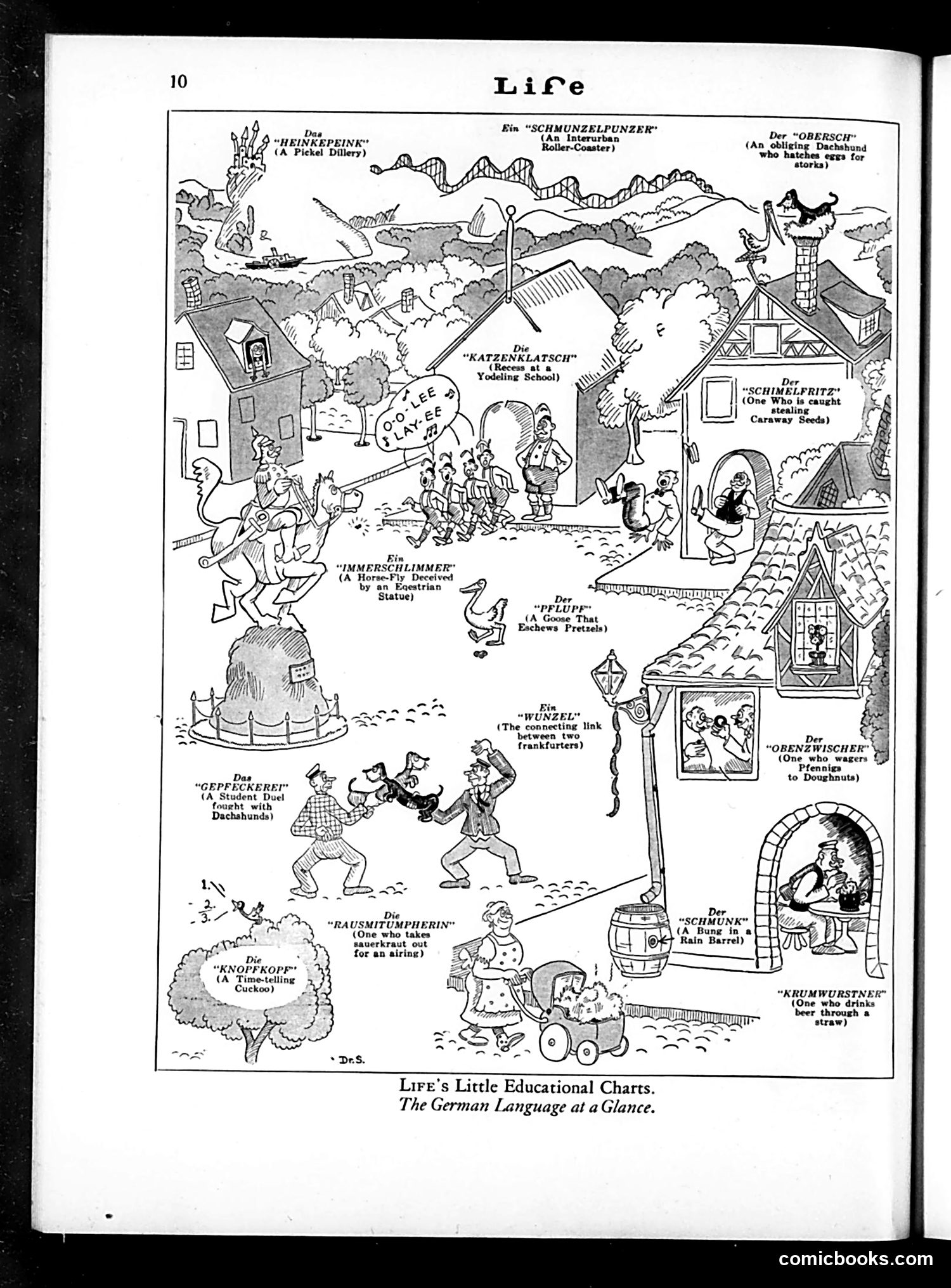
This educational satire teaches English speakers German vocabulary through a village scene depicting German compound words and their literal English translations. Each labeled building or figure illustrates an absurdly literal translation—for example, "Katzenklatsch" (literally "cat-slap," meaning gossip), "Schnitzelbank" (a cutting bench), and "Krumwurstner" (one who drinks beer through a straw). The joke targets the German language's famous tendency toward long, complex compound words that sound ridiculous when translated word-for-word into English. Rather than mocking Germans directly, it highlights the linguistic peculiarity that English speakers found comical and difficult to parse. This appears designed as lighthearted educational humor rather than malicious satire.
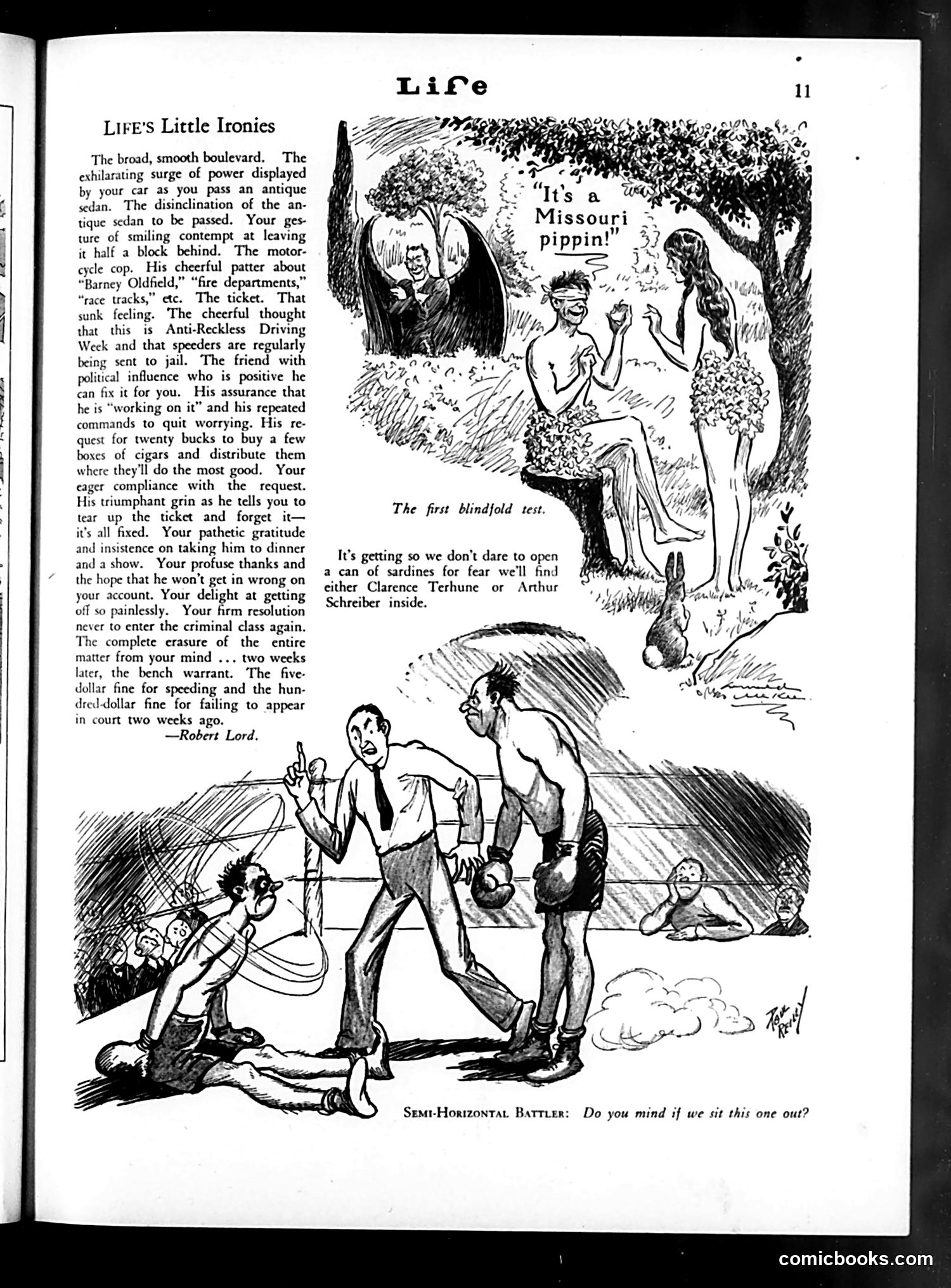
This page contains two cartoons satirizing early 20th-century American society: **"Life's Little Ironies"** (text piece by Robert Lord): Mocks the hollow courtesy of traffic enforcement—a motorist ticketed for speeding receives polite explanations and assurances he's "working on it," yet faces real consequences (fines, jail threat). The irony critiques performative politeness masking actual punishment. **Top cartoon** ("It's a Missouri pippin!"): Shows a blindfold test where people identify vegetables. The joke appears to be about foolish gullibility or misidentification. **Bottom cartoon** ("Semi-Horizontal Battle"): Depicts boxers fighting, with one asking if others "mind if we sit this one out?"—mocking either lazy fighters or the absurdity of boxing itself. Both cartoons target human hypocrisy and foolishness through exaggeration.
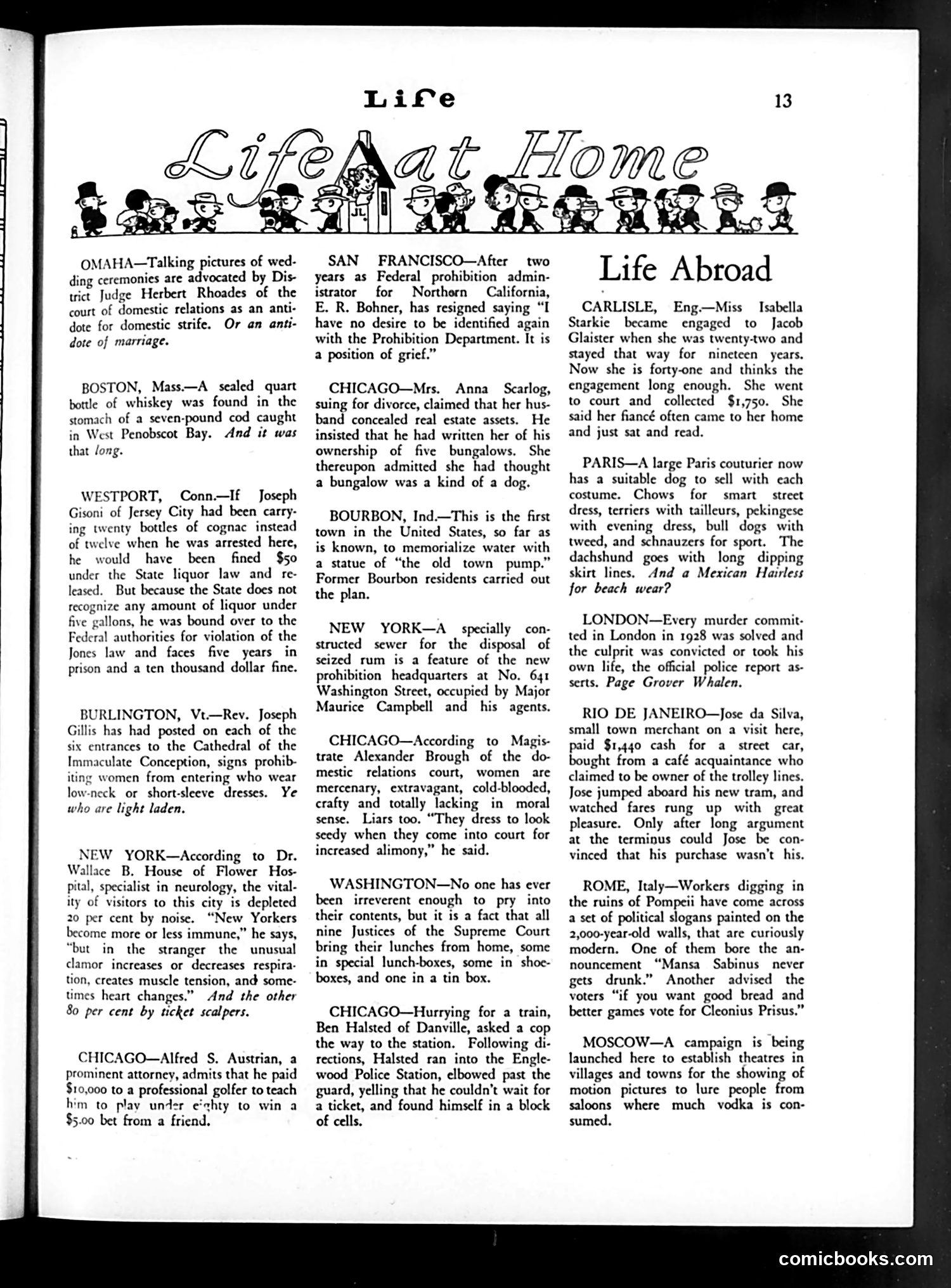
This page from *Life* magazine's "Life at Home" and "Life Abroad" sections contains brief satirical news items rather than traditional political cartoons. The decorative header shows a row of cartoon figures in period dress. The items mock contemporary social issues: Prohibition enforcement (liquor smuggling), divorce proceedings revealing hidden assets, fashion absurdities, and judicial inefficiency. For instance, the Chicago item ridicules how women dress extravagantly for court appearances, while the Washington item satirizes Supreme Court justices bringing lunch from home in various makeshift containers—highlighting the mundane reality behind institutional dignity. The "Life Abroad" section extends the satire internationally, mocking European customs and behaviors. The overall tone is lighthearted social commentary on 1920s-era manners, legal systems, and cultural practices.
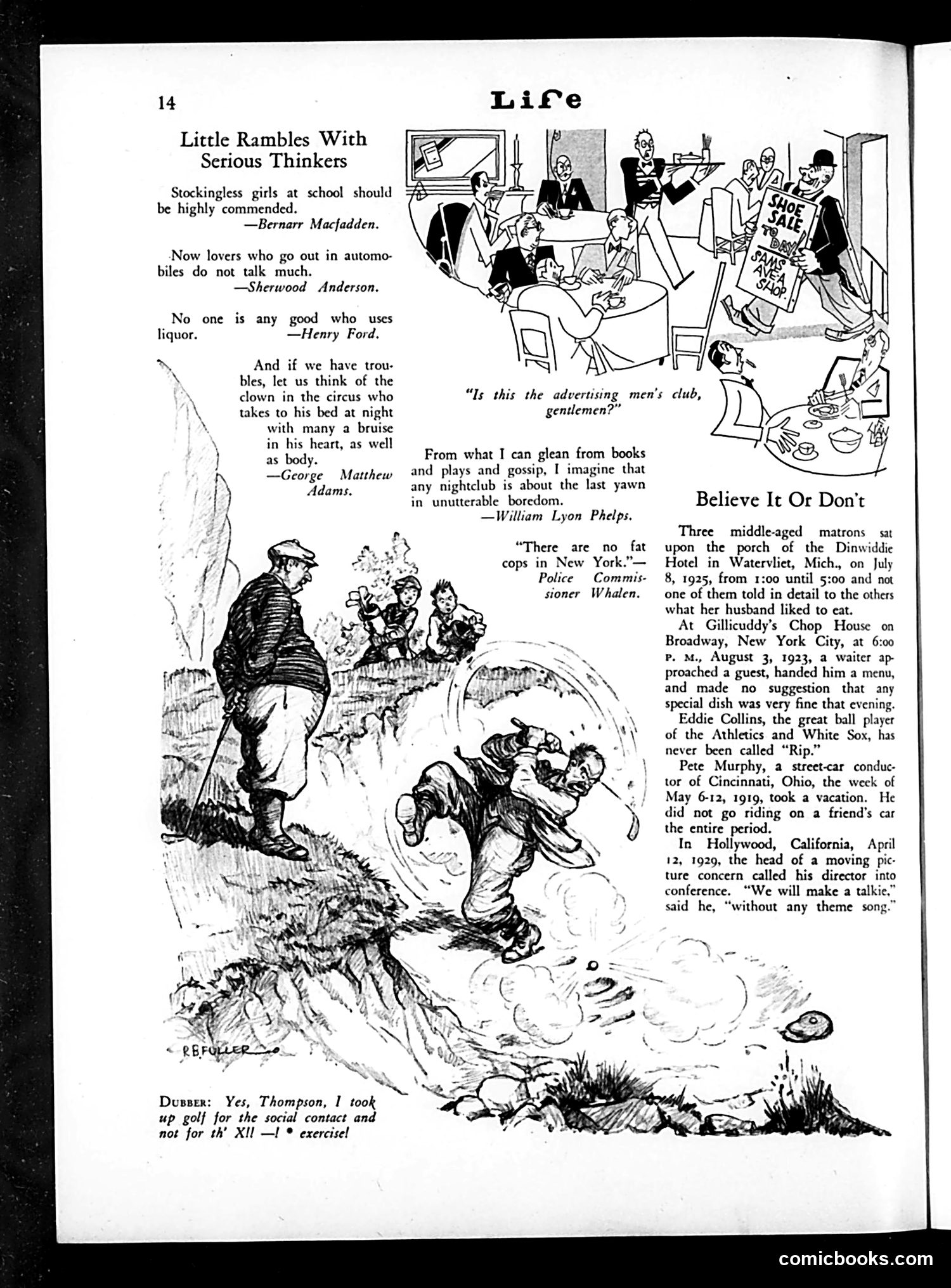
This Life magazine page (page 14) contains a humorous section titled "Little Rambles With Serious Thinkers" featuring satirical quotes from famous figures like Henry Ford and Sherwood Anderson on topics like stockings, automobiles, and liquor. The main cartoon (signed "Rebuffier") depicts a golfer's mishap—a wild shot that sends the ball flying dangerously near spectators. The caption parodies the sport's pretensions: a golfer claims he took up golf "for the social contact and not for th' XII—i's exercise!" The "Believe It Or Don't" section contains anecdotes about celebrities and oddities, including Eddie Collins (baseball player), Pete Murphy (streetcar conductor), and a Hollywood director's conference about making "talkies" (early sound films). The satire mocks both the pretensions of leisure activities and the absurdities of early 1920s culture.
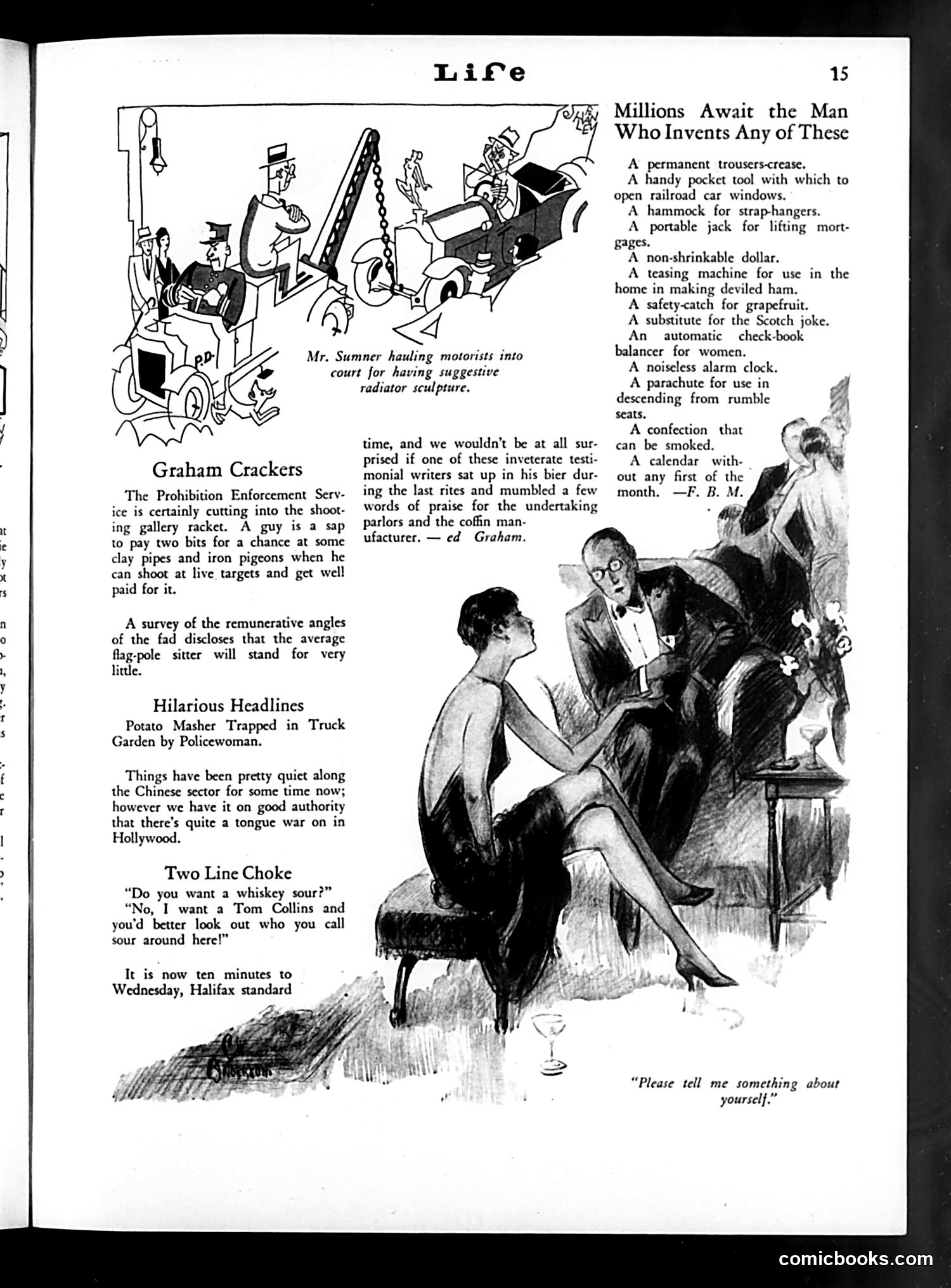
This page contains three satirical pieces: **"Graham Crackers"** mocks Prohibition enforcement by depicting agents shooting at clay pipes and iron pigeons—a darkly humorous commentary on trigger-happy law enforcement during the dry era. **"Hilarious Headlines"** is a brief joke about a potato masher incident, reflecting the magazine's practice of collecting absurd real newspaper headlines for comedy. **"Two Line Choke"** presents a domestic comedy sketch where a woman asks her male companion for a drink, then corrects herself, warning him to watch "who you call your around here!"—satirizing changing gender dynamics and women's assertiveness in the 1920s-30s era. The illustration shows a flirtatious social scene typical of Life's humor targeting middle-class relationships and modern social anxieties.
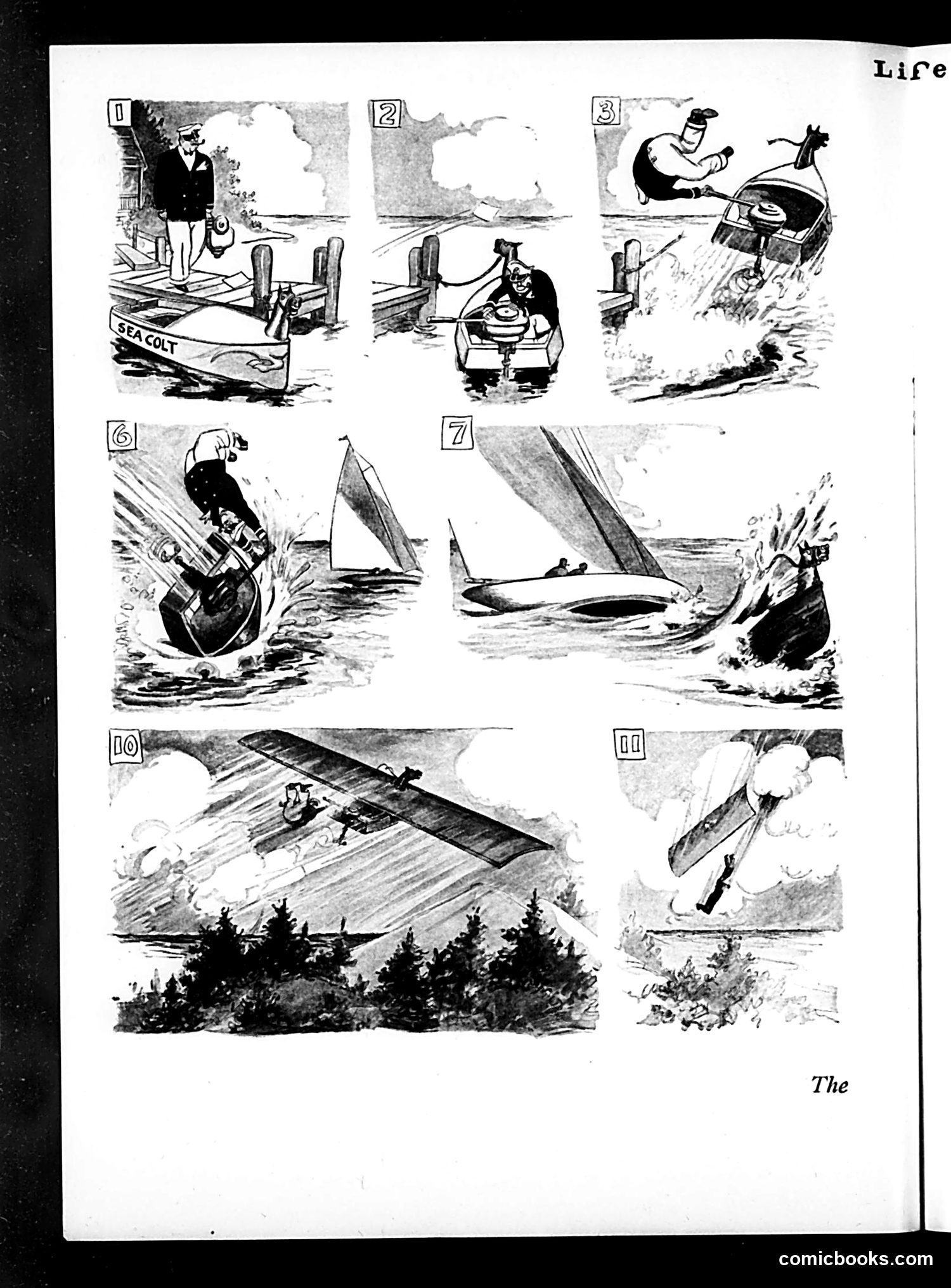
This page from *Life* magazine presents a numbered comic sequence (panels 0-11) depicting a nautical mishap or adventure story. The narrative appears to show: - Panel 0: A man in formal attire stands beside a boat labeled "SEA COLT" - Panels 1-3: Action sequences involving boats and water - Panels 6-7: Sailboats in distress or dramatic situations - Panel 10: An aircraft or flying vessel - Panel 11: What appears to be a conclusion to the sequence The exact satirical point is unclear without accompanying text or caption. The sequence may be satirizing either maritime incompetence, technological mishaps, or social pretension. The formal dress in the opening panel suggests the humor might involve an unprepared gentleman encountering nautical challenges. The progression from boats to aircraft in later panels is notable but its significance remains ambiguous without additional context or labels.
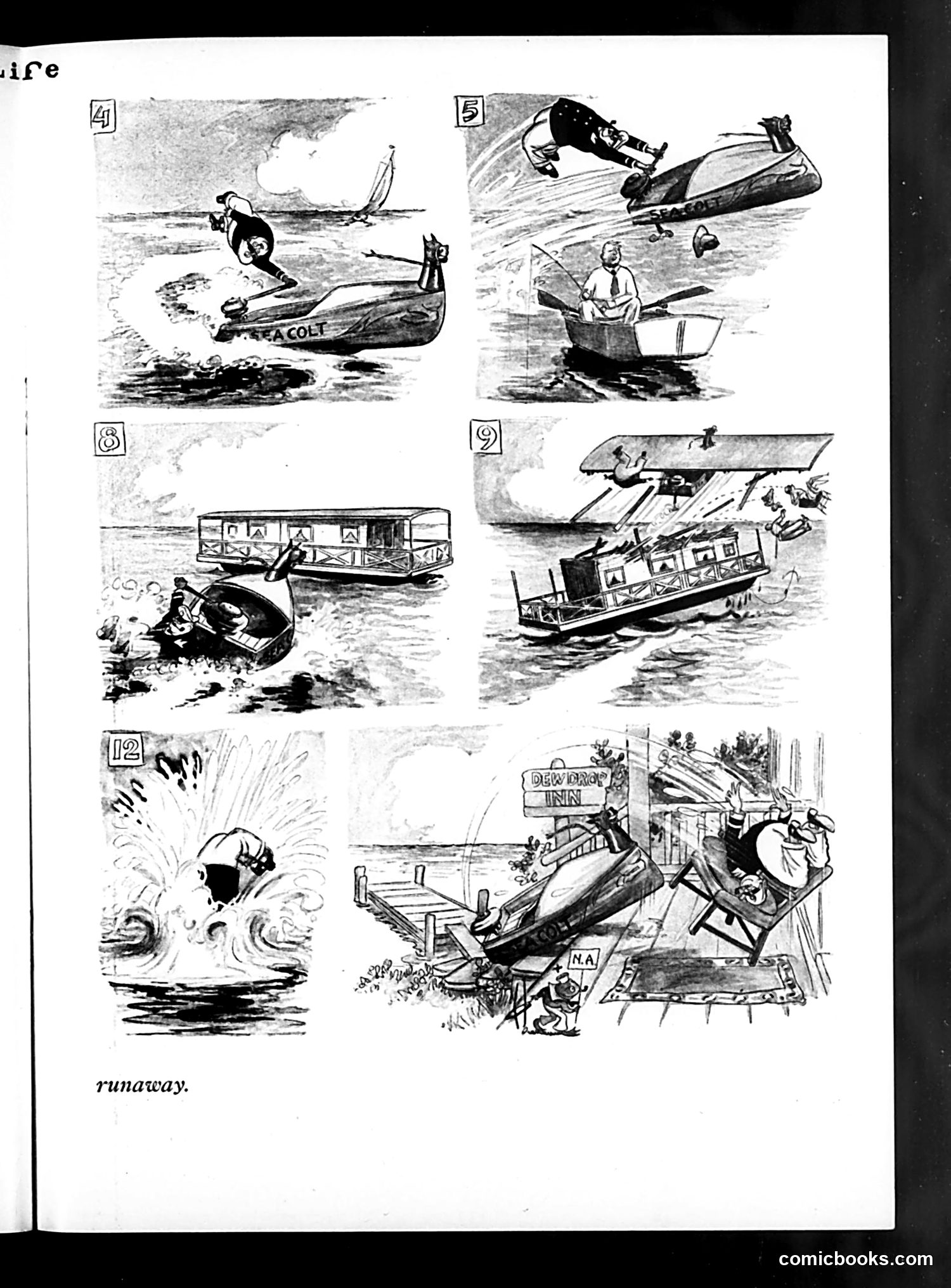
This appears to be a sequential comic strip illustrating a humorous "runaway" scenario. The numbered panels (4-12) show: - **Panel 4**: A person stealing a small boat labeled "A COLT" - **Panel 5**: The person in a motorized boat with another figure - **Panel 6-9**: A chase sequence involving larger boats/vessels, suggesting pursuit - **Panel 12**: The person being launched or ejected from a dock near an inn The satirical point seems to be a darkly humorous take on attempting to escape—each attempt to flee fails progressively, ending in physical mishap at what appears to be a riverside inn. The "runaway" theme likely mocks futile escape attempts, a relatable subject for Life magazine's early 20th-century audiences. The exact historical or political reference remains unclear without additional context.
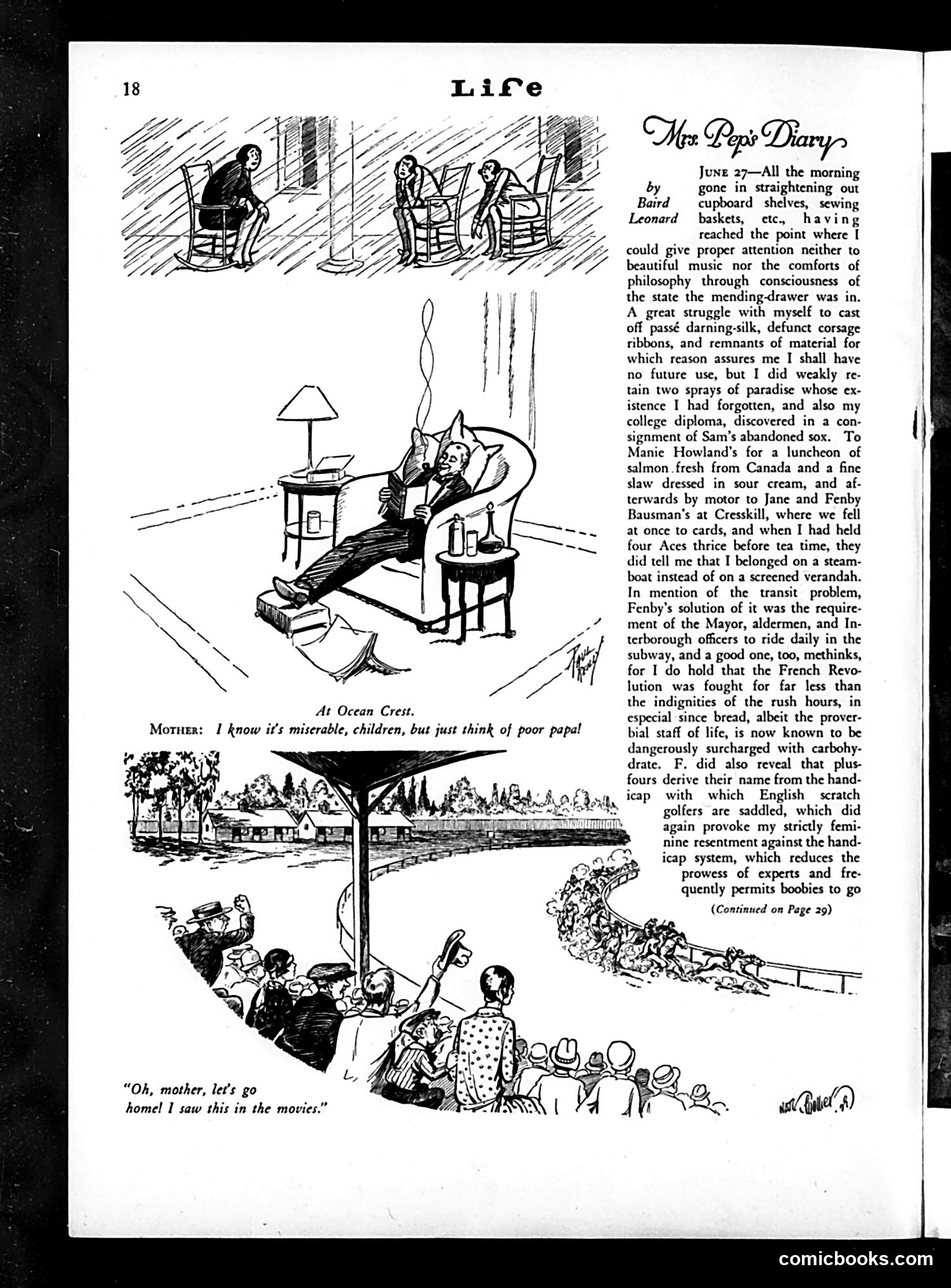
This is a humorous diary entry satirizing upper-middle-class domestic life. The main cartoon shows a woman relaxing while her husband works, captioned "At Ocean Crest" with Mother saying "I know it's miserable, children, but just think of poor papa!"—mocking the disparity between leisured wives and hardworking husbands. The lower cartoon depicts people at what appears to be an amusement park or public venue, with a child saying "Oh, mother, let's go home! I saw this in the movies"—satirizing how ordinary outings now seem mundane compared to cinema entertainment. The diary text discusses mundane domestic tasks (sewing, organizing shelves) and social observations, with sardonic commentary on contemporary issues like transit problems and social hierarchies, typical of Life magazine's satirical commentary on modern life.
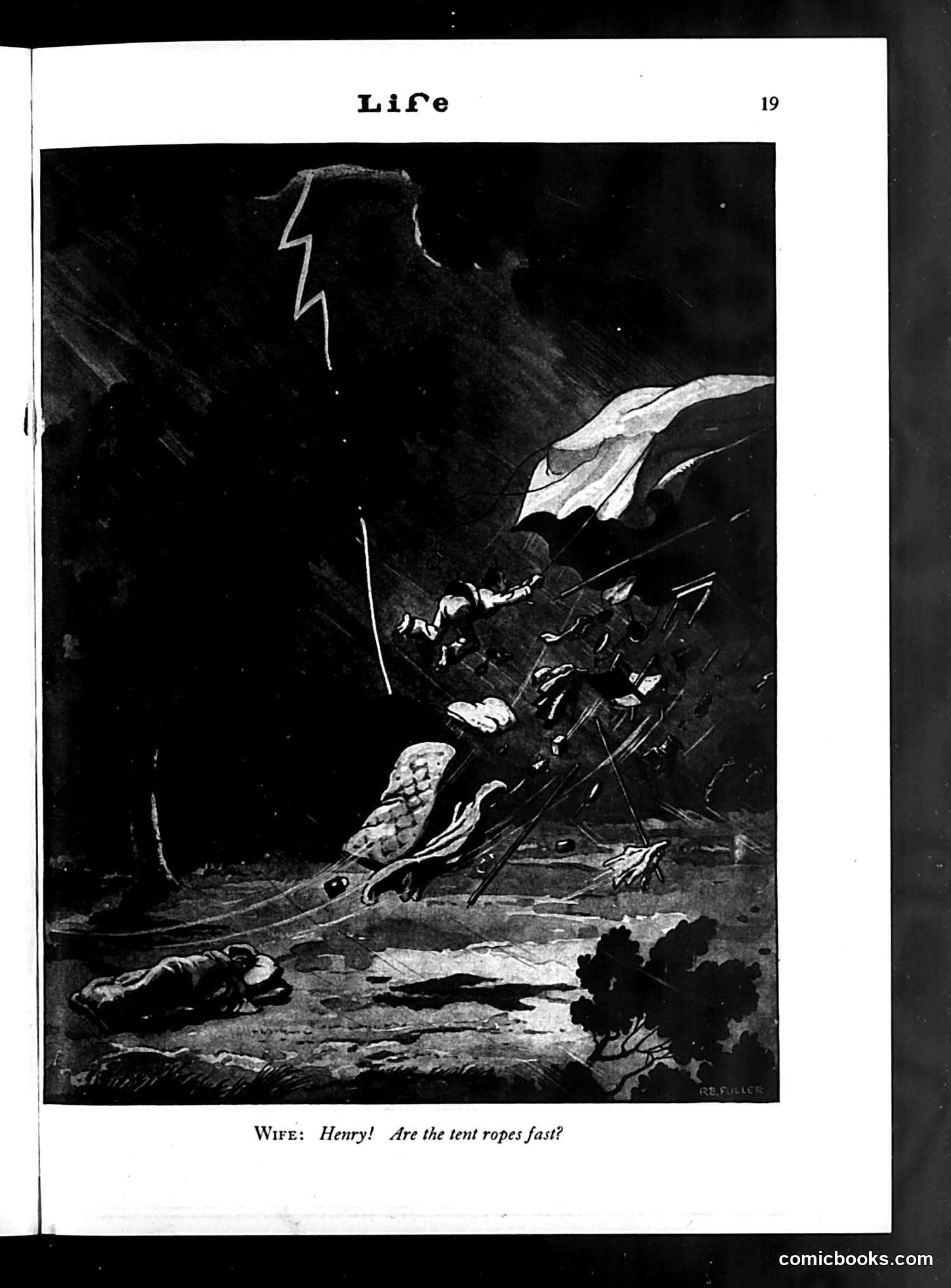
This is a single-panel cartoon from *Life* magazine depicting a camping or outdoor disaster scene. A man (presumably "Henry") appears to be in danger from a violent storm—lightning strikes above while a tent is being blown away. His wife calls out asking if the tent ropes are secure, suggesting an anxious moment during extreme weather. The humor is situational comedy: Henry is clearly in the midst of a crisis (possibly injured or struggling), yet his wife's concern focuses on the practical detail of the tent ropes rather than his immediate safety. It's a commentary on misplaced priorities or the gap between awareness of actual danger and domestic concerns. The cartoon plays on the contrast between domestic worry and genuine peril.
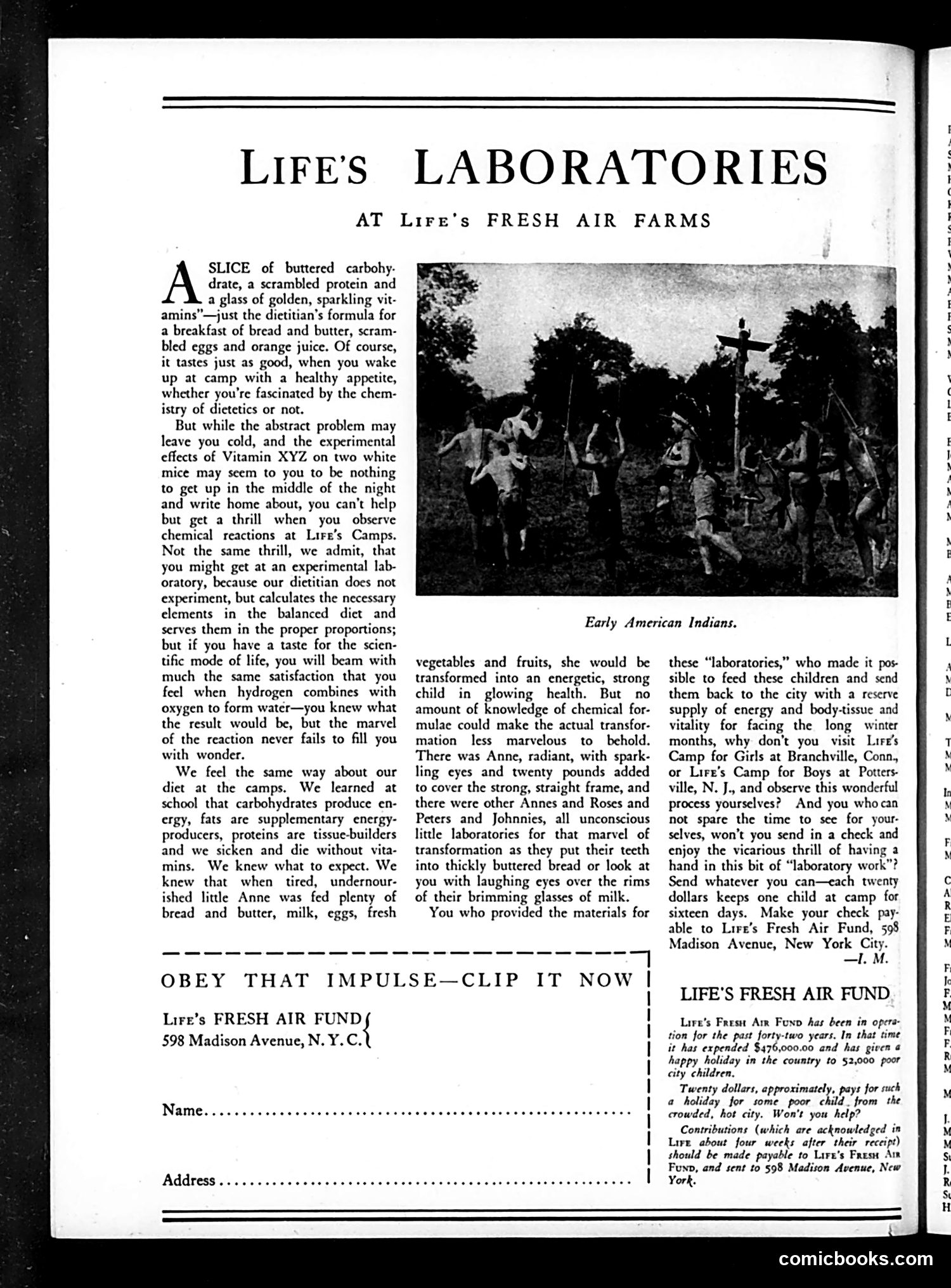
This is a charitable fundraising appeal, not a political cartoon. The page promotes Life magazine's Fresh Air Fund, which sends poor urban children to summer camps for health and nutrition. The "laboratories" metaphor compares malnourished city children to scientific experiments: when fed proper nutrition (carbohydrates, proteins, vitamins), they undergo miraculous physical transformation—gaining weight, energy, and vitality. The photograph labeled "Early American Indians" appears to show children at camp. The appeal uses scientific language to dignify the charitable work and appeal to educated donors. It solicits $20 donations (enough to send one child to camp for 16 days) from Life readers. The fund claims 42 years of operation and service to 52,000 poor children. This reflects early 20th-century Progressive Era attitudes: social reform through nutrition science, romanticization of nature/countryside as curative, and paternalistic charity toward urban poor.
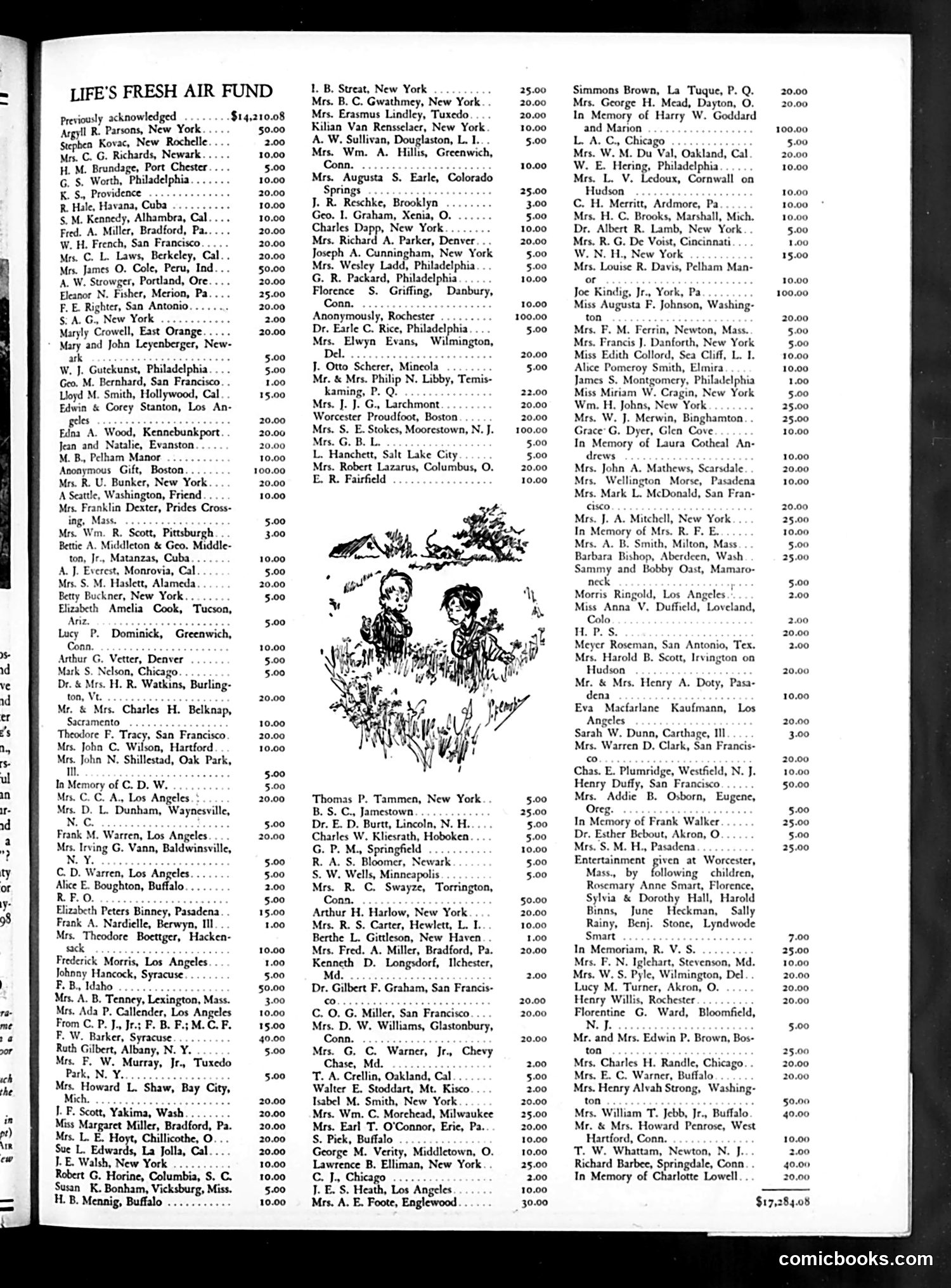
This page documents donations to **Life magazine's Fresh Air Fund**, a charitable initiative providing outdoor recreation for underprivileged urban children—a common Progressive Era cause. The small illustration shows two children in nature, symbolizing the fund's purpose: giving poor city kids access to fresh air and countryside experiences. The bulk of the page lists hundreds of donors with their hometowns and contribution amounts (typically $5-$50). The contributors span the country from major cities (New York, Chicago, Philadelphia) to small towns, suggesting broad middle-class support. The opening line notes "$14,210.08 previously acknowledged," indicating ongoing fundraising across multiple publication issues. This format—publishing donor lists—served dual purposes: accountability and social pressure encouraging additional contributions from readers seeing peers' generosity publicly recognized. The page reflects turn-of-century American philanthropy priorities and Life magazine's role as both satirical publication and civic institution.
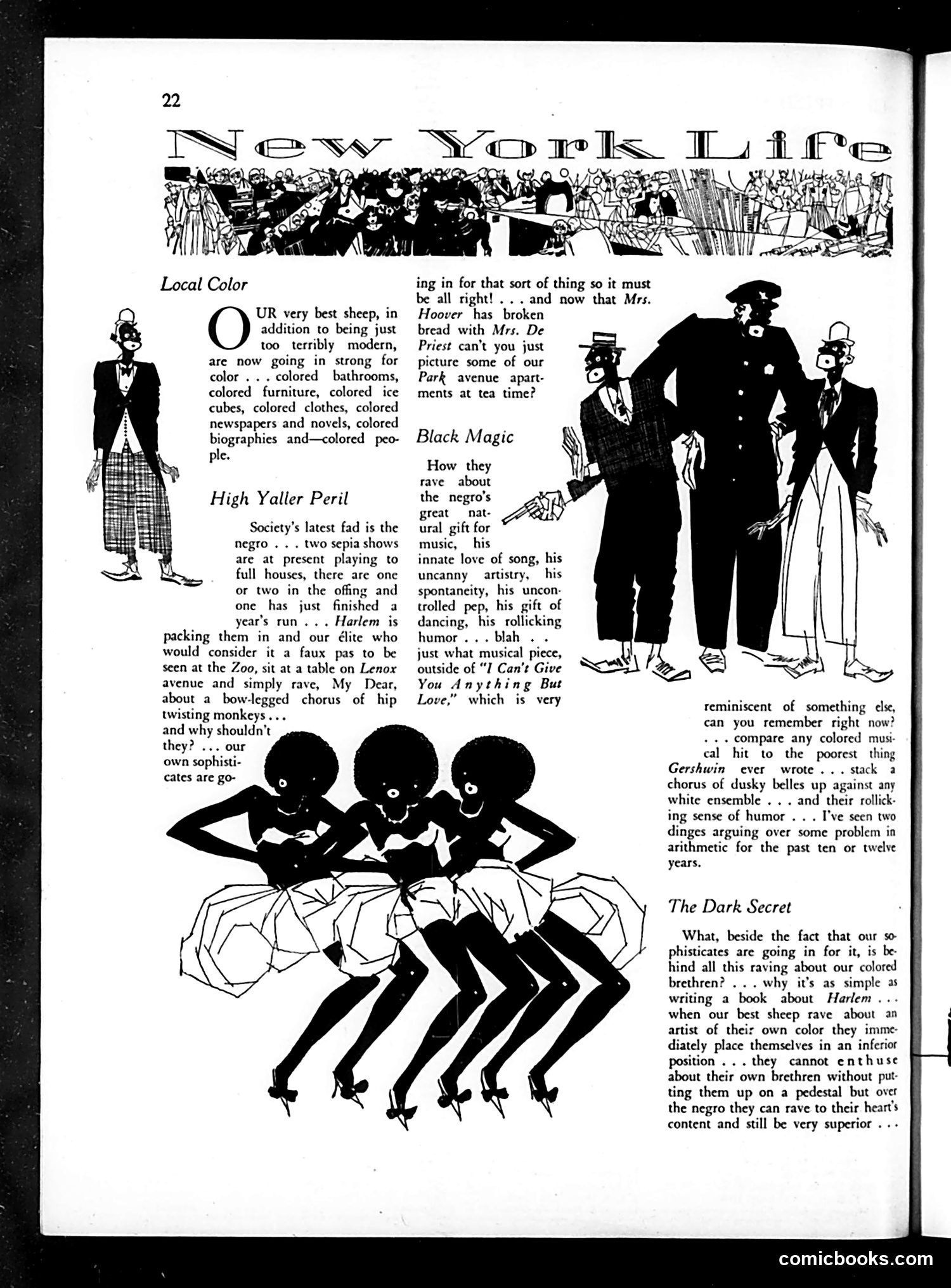
This is a satirical piece mocking white high-society's fashionable embrace of Black culture in the late 1920s-early 1930s. The article critiques wealthy Manhattan elites ("our best sheep," "sophisticates") who treat African American art and Harlem nightclubs as trendy novelties rather than genuine appreciation. Key targets: **"High Yaller Peril"** mocks society women attending Harlem shows and references Mrs. Hoover (wife of President Herbert Hoover) dining with Mrs. De Priest, wife of the first Black congressman—treating this as shocking scandal-chic. **"Black Magic"** ridicules white audiences who gush about Black musicians' "natural gifts" while being unable to name actual songs, comparing Negro performers unfavorably to white composer Gershwin. **"The Dark Secret"** reveals the satire's core: whites can praise Black artists only by placing them "on a pedestal" while maintaining superiority—they cannot genuinely respect Black culture without contradicting their own racial hierarchy. The accompanying caricatural illustrations emphasize racial stereotypes common to the era's racist visual language.
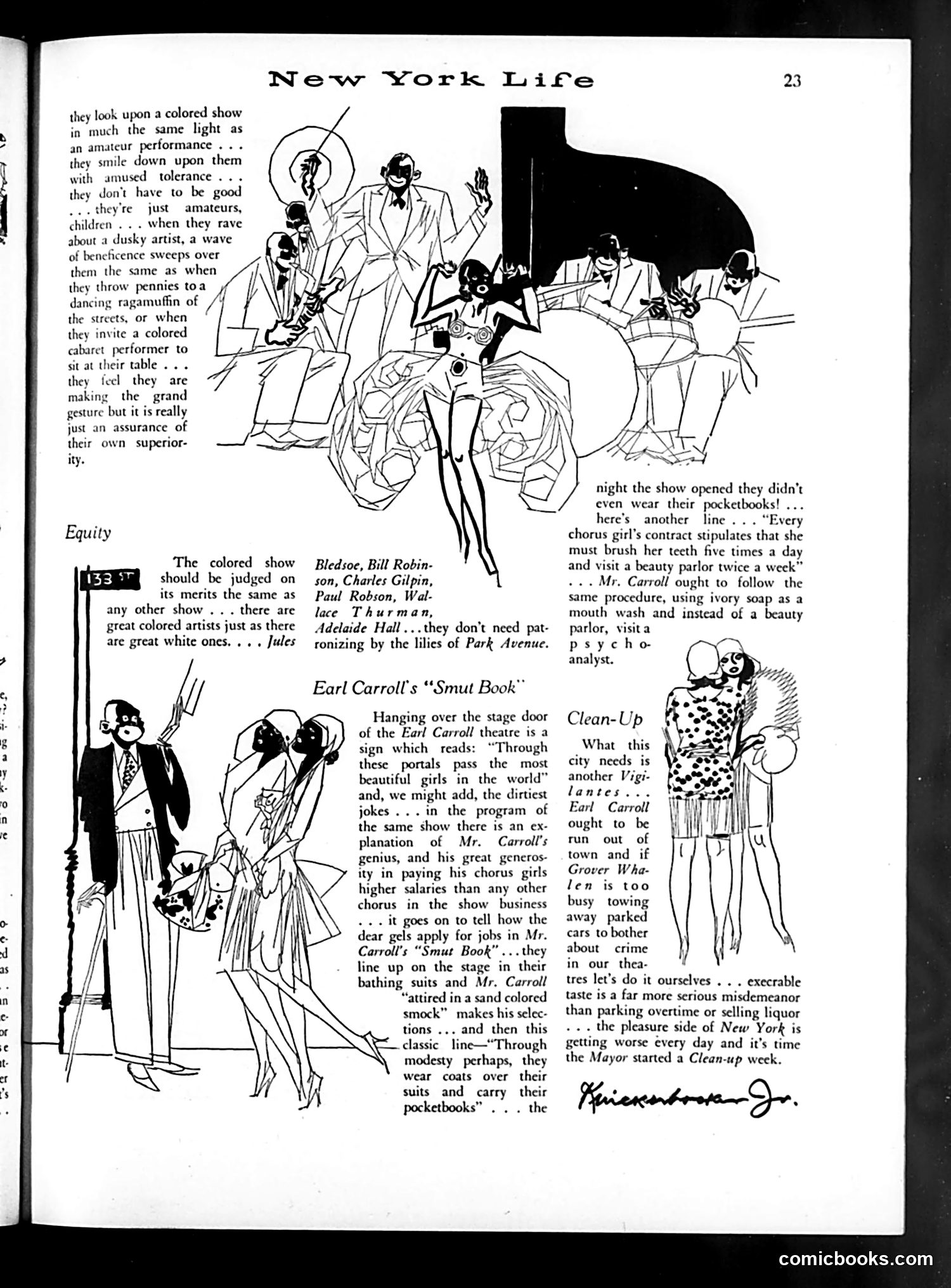
This page contains three satirical commentaries on 1920s New York entertainment and society: **"Equity"** critiques white patrons' condescending attitudes toward Black performers. The text mocks the wealthy (particularly "Park Avenue" elites) who view Black entertainers as amusing curiosities worthy of charitable patronage rather than legitimate artists. It names accomplished Black performers—Bill Robinson, Charles Gilpin, Paul Robeson, Wallace Thurman, Adelaide Hall—arguing they deserve equal critical judgment without condescension. **"Earl Carroll's 'Smut Book'"** attacks theatrical producer Earl Carroll's hypocrisy. The satire exposes how Carroll advertises moral virtue (chorus girls brushing teeth, visiting beauty parlors) while presenting explicitly crude shows. The joke about girls not wearing pocketbooks on opening night suggests indecent exposure. **"Clean-Up"** demands city action against theatrical obscenity, calling for Mayor intervention and vigilante-style enforcement if necessary—arguing moral standards matter more than parking violations. Overall, the page advocates for both racial equity in arts appreciation and stricter standards for theatrical decency.
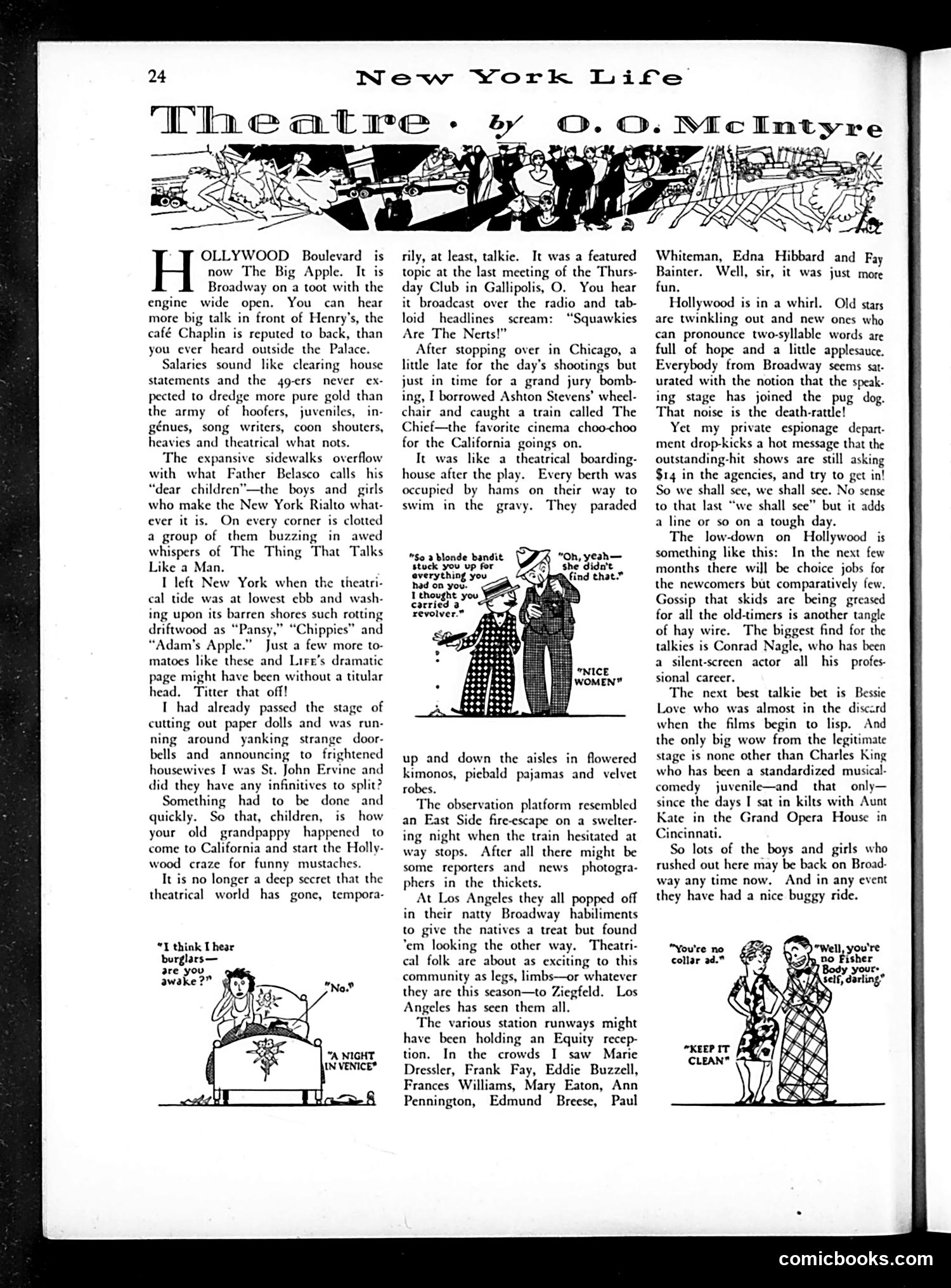
This is a satirical theater column by O.O. McIntyre about Hollywood's transition to "talking pictures" (sound films). The piece mocks the theatrical establishment's panicked migration from Broadway to California. **The central joke**: Theater people are fleeing New York in droves, treating Hollywood like a gold rush. McIntyre satirizes their pretentiousness—they parade around train cars in fancy robes, hoping reporters will notice them, but Los Angeles audiences find them utterly boring ("as exciting as legs"). **The cartoons** illustrate theatrical absurdities: one shows a woman robbing a man who casually mentions he carries three revolvers; another depicts someone hearing "burglars" during a performance of "A Night in Venice." **Historical context**: This reflects the early 1920s panic among stage actors facing the new "talkie" technology. The column names actual performers (Marie Dressler, Frank Fay) arriving in Hollywood. **The satire's point**: Theater people vastly overestimate their importance to the general public, yet the talking picture industry will ultimately succeed—making their dramatic hand-wringing ironic.
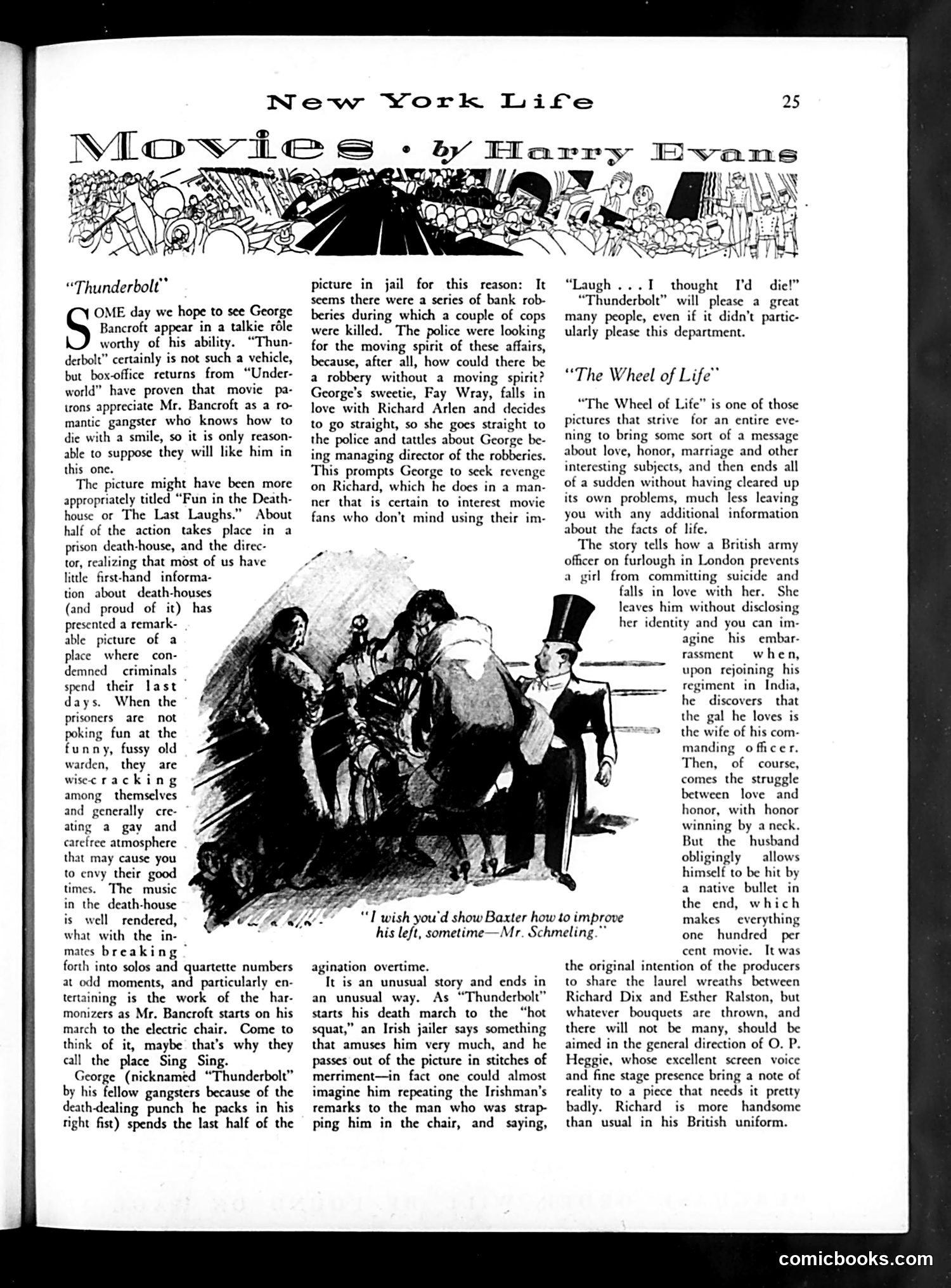
This page reviews two 1929 films. The **cartoon** (captioned "I wish you'd show Baxter how to improve his left, sometime—Mr. Schmeling") references boxer Max Schmeling, a famous contemporary fighter. It's a joke about improving boxing technique, inserted into a death-house scene from "Thunderbolt." The reviews themselves are satirical critiques. "Thunderbolt" stars George Bancroft as a gangster executed for bank robberies; the reviewer mocks how the film treats a death-house as comic entertainment, with prisoners singing and joking before execution. The title joke—calling it "Sing Sing" (the famous prison)—plays on the inmates' musical performances. "The Wheel of Life" is criticized for tackling serious themes (love, honor, marriage) without resolution. A British officer falls for a woman in London, later discovers she's his commanding officer's wife in India, and honor prevails—but the film leaves larger questions unanswered. Both reviews use humor to expose the films' shallow treatments of serious subjects: capital punishment trivialized, and moral dilemmas left unresolved.
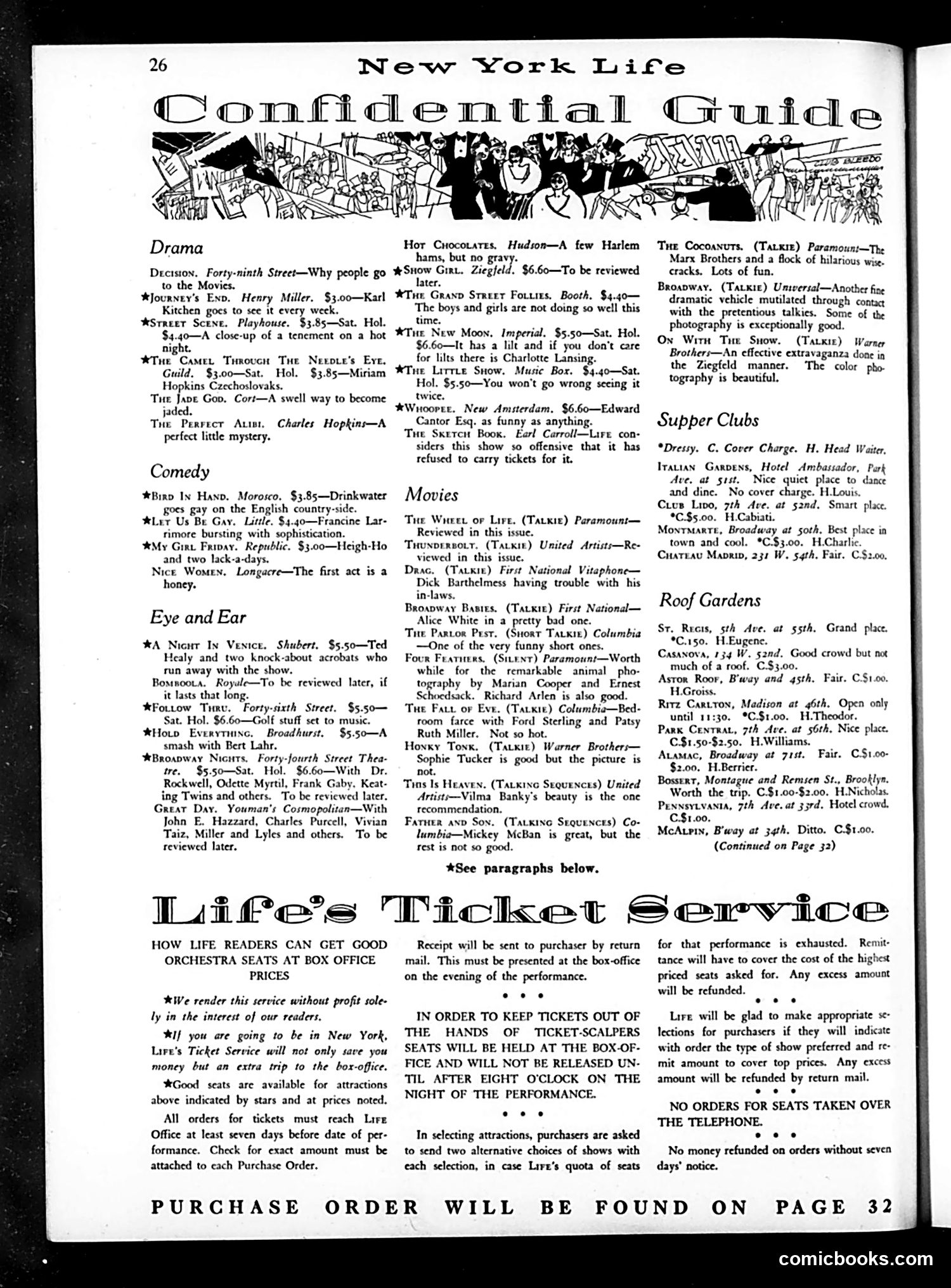
This page from *Life* magazine is **not a cartoon** but rather an entertainment listings guide for New York theaters and nightclubs. It reviews Broadway plays, movies (many newly converted to "talkies"—sound films), and supper clubs. The satirical commentary is in the brief, witty **review blurbs** rather than visual cartoons. For example, one reviewer sarcastically notes a show "won't go wrong seeing it twice," while another says of a film that "Dick Barthelmess having trouble with his in-laws" is the plot—the brevity itself mocking the film's banality. The Marx Brothers' *Cocoanuts* gets praise ("hilarious"). References to "Talkie" versus silent films reflect the rapid technological shift of the era—a major cultural moment when sound revolutionized cinema. The section also advertises a ticket service allowing readers to purchase theater seats, underlining this guide's practical purpose alongside entertainment criticism.
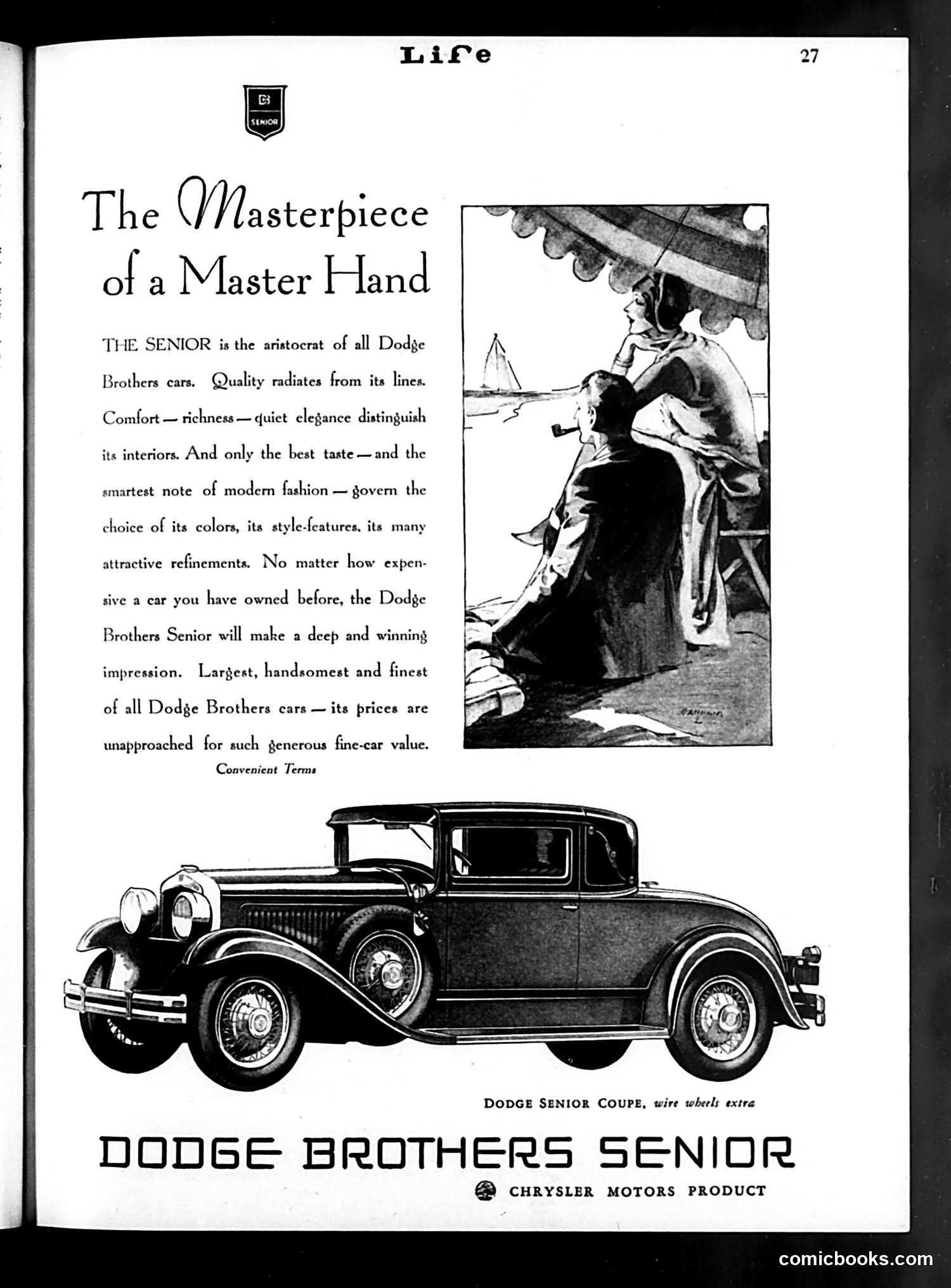
This is **not a cartoon or satire**—it's a straightforward automobile advertisement from Life magazine's advertising section (page 27). The page promotes the Dodge Brothers Senior, a luxury car marketed as "the aristocrat of all Dodge Brothers cars." The advertising copy emphasizes quality, elegance, and refinement, claiming it rivals more expensive vehicles while offering competitive pricing with "convenient terms." The illustration shows an elegantly dressed couple admiring a scenic waterfront view, positioned above a detailed drawing of the Dodge Senior Coupe. This aspirational imagery—linking the car to leisure, sophistication, and refined taste—was standard advertising strategy of the era (appearing to be from the late 1920s). The text's flowery language ("masterpiece of a master hand," "aristocrat") reflects period advertising conventions designed to appeal to middle-to-upper-class buyers seeking status and luxury.
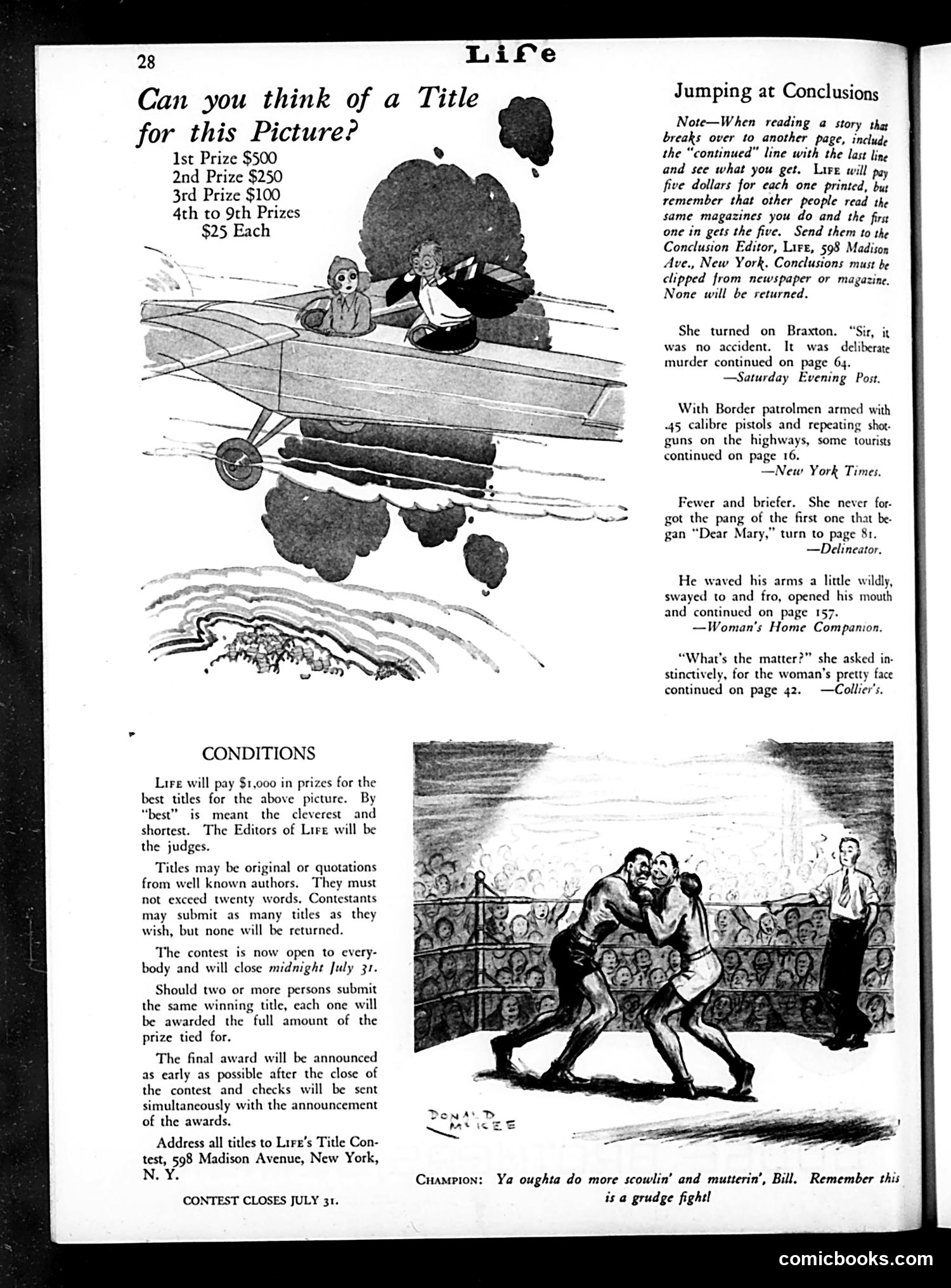
This page features two distinct elements: **Left side:** A title-writing contest where *Life* magazine challenges readers to caption a surreal illustration of a woman in an airplane cabin encountering oversized clouds and landscape features. The prize structure ($500 first place down to $25) incentivizes clever, brief titles. **Right side:** A satirical feature called "Jumping at Conclusions" that mocks how magazine serialization works. It shows excerpts from popular periodicals (Saturday Evening Post, New York Times, Delineator, Woman's Home Companion, Collier's) where story fragments abruptly end mid-narrative with "continued on page X"—creating absurd, misleading cliff-hangers. The humor lies in how readers' imaginations fill gaps, often misinterpreting mundane continuations as dramatic plot developments. **Bottom illustration:** A boxing match scene captioned "Ya oughta do more scowlin' and mutterin', Bill. Remember this is a grudge fight!"—likely satirizing theatrical sports entertainment performance. The page overall gently mocks early-twentieth-century magazine publishing conventions and reader credulity.
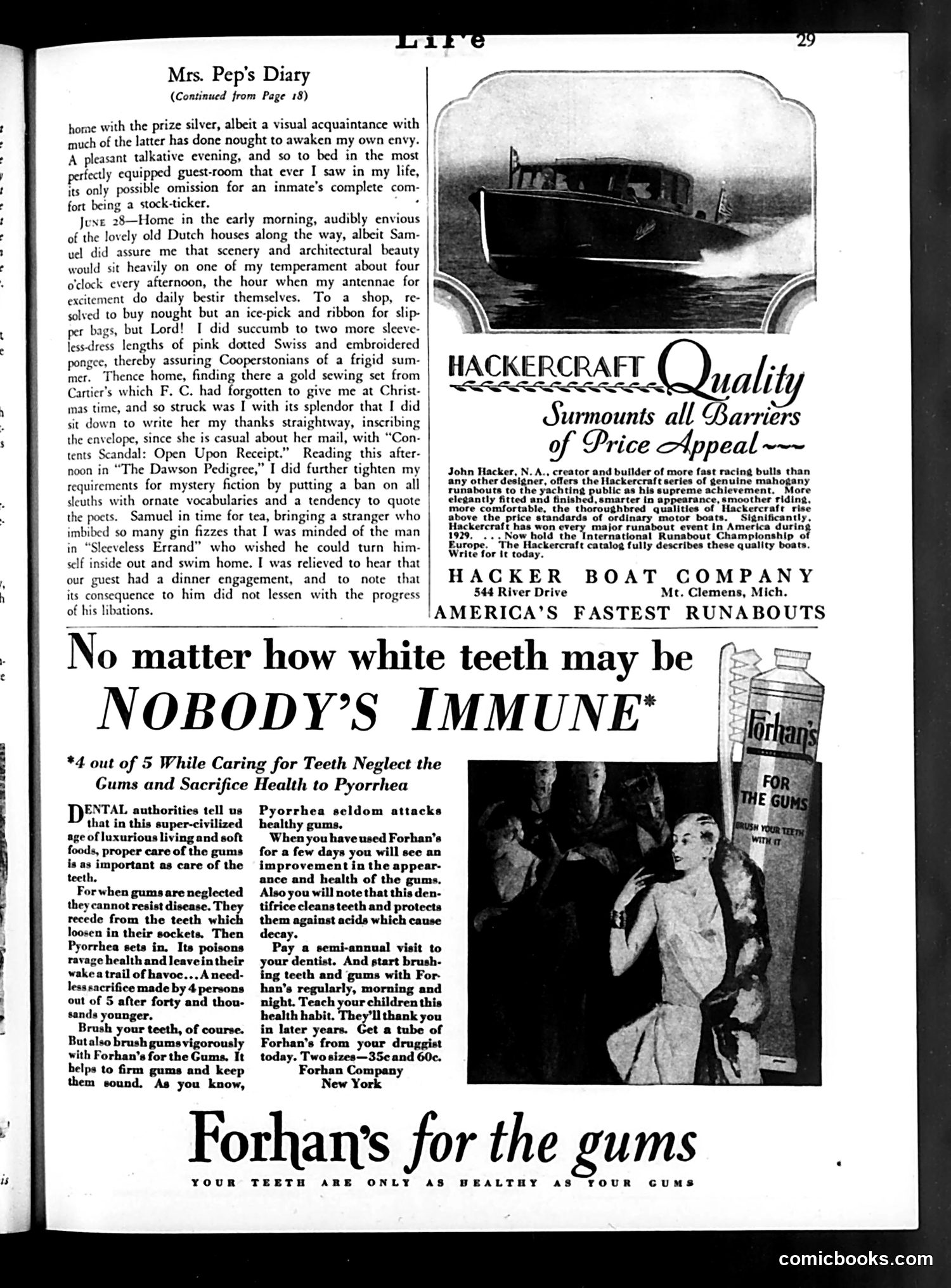
This page is primarily **advertisements** interspersed with the conclusion of "Mrs. Pep's Diary," a satirical column about a wealthy woman's social observations. The diary excerpt mocks upper-class pretensions: Mrs. Pep obsesses over shopping, name-drops luxury brands (Cartier), and judges a drunk dinner guest while pretending to sophisticated literary tastes. The **advertisements** reveal 1920s-30s anxieties: - **Hackercraft boats**: Appeal to wealth and speed ("America's Fastest Runabouts") - **Forhan's toothpaste**: Uses fear-mongering about pyorrhea (gum disease), claiming 4 in 5 people neglect gums, to sell oral hygiene—a common advertising tactic of the era that dramatized health concerns to boost sales. Together, the diary and ads satirize consumer culture and status-seeking among the affluent, while the ads themselves exemplify the era's manipulative marketing strategies targeting health anxieties.
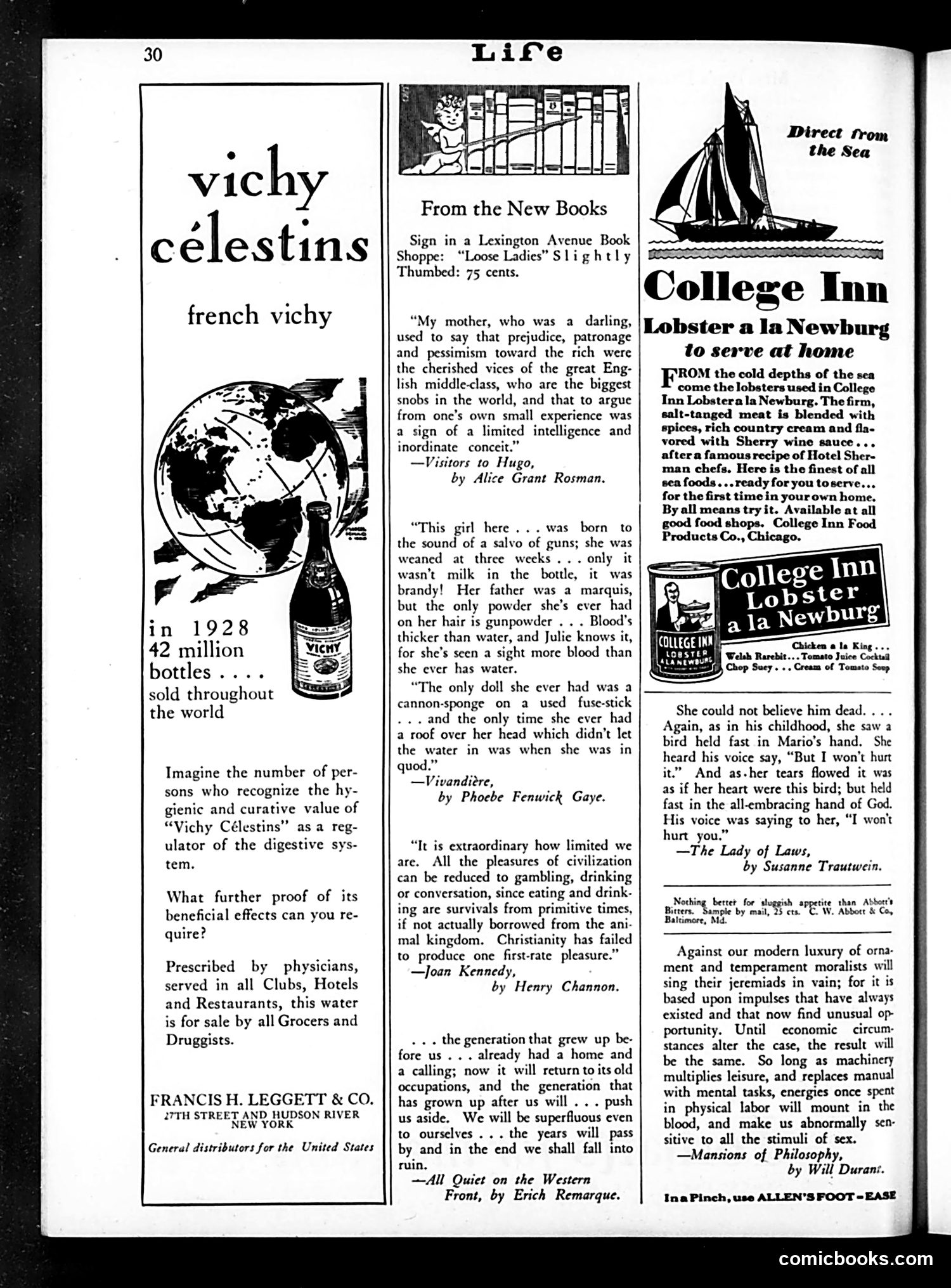
This page is primarily **advertising and book promotion**, not political satire. The left side features a French mineral water advertisement ("Vichy Célestins"), emphasizing its digestive health benefits and 1928 sales figures—typical wellness marketing of the era. The center section, "From the New Books," excerpts passages from contemporary literature, including works by Alice Grant Rosman, Phoebe Fenwick Gaye, Henry Channon, and Erich Remarque's *All Quiet on the Western Front*. The quotes reveal 1920s literary preoccupations: class criticism, war trauma, existential pessimism, and moral decline. The right side advertises "College Inn Lobster à la Newburg," promoting canned seafood as convenient home dining. The literary excerpts themselves contain mild social commentary—critiques of class snobbery and civilization's shallow pleasures—but these are presented as book content, not original satire from *Life* magazine.
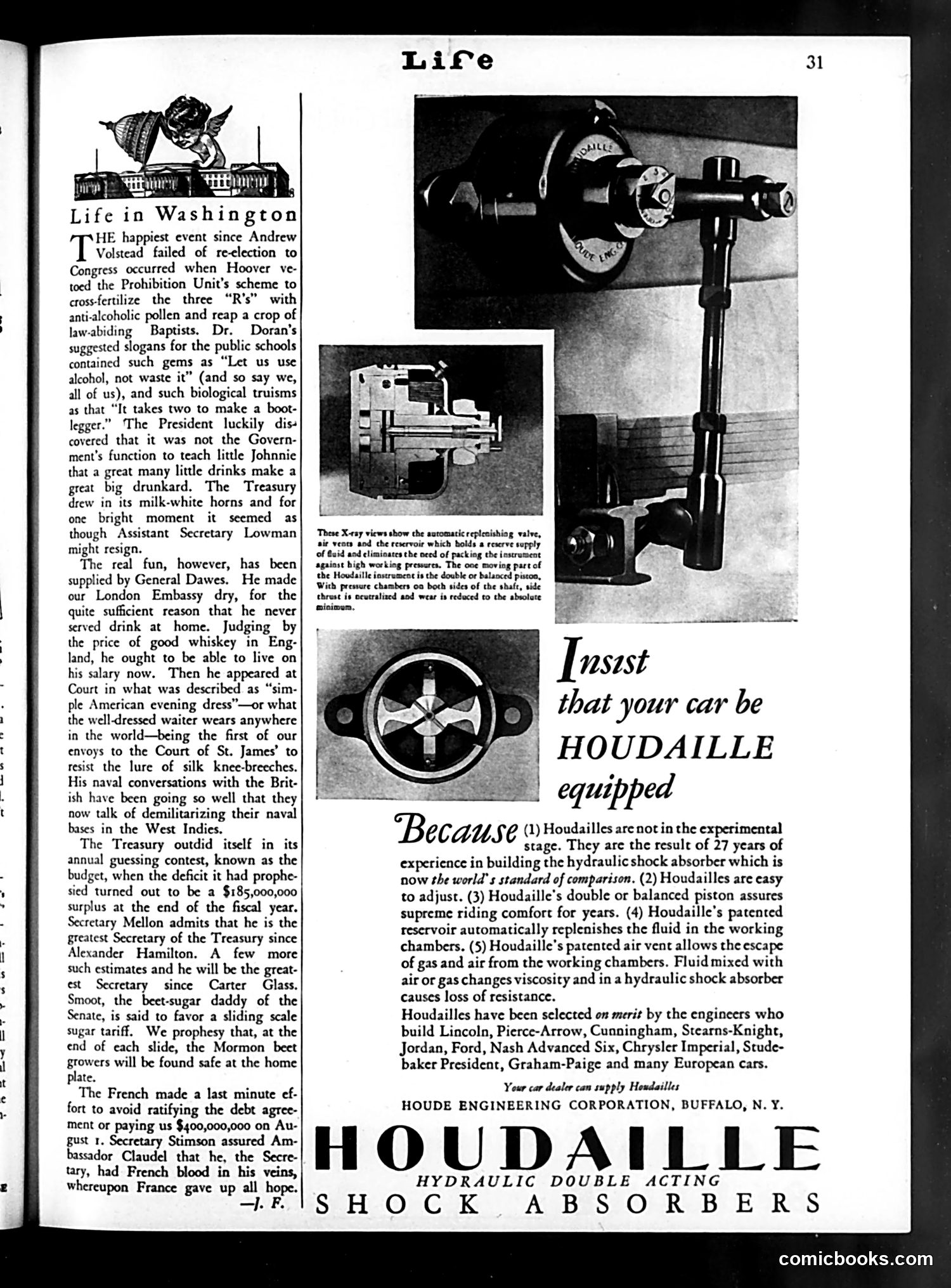
This satirical column mocks Washington's recent political events during the Prohibition era. Key figures referenced: - **Andrew Volstead** (failed re-election): Prohibition's chief architect - **Hoover** (President): Vetoed an anti-alcohol education scheme, earning praise for restraint - **General Dawes** (London Ambassador): Ridiculed for making the embassy "dry" based on his personal abstinence; also mocked for wearing simple American dress instead of formal diplomatic attire at the British Court - **Secretary Mellon**: Satirized for claiming to be the "greatest Secretary of the Treasury since Alexander Hamilton" - **Smoot**: Called the "beet-sugar daddy," criticized for sugar tariff favoritism toward Mormon growers The humor targets governmental overreach, pompous officials, and Prohibition enforcement inconsistencies. The page also contains a separate Houdaille shock-absorber advertisement—typical of magazine layout from this era (1920s).
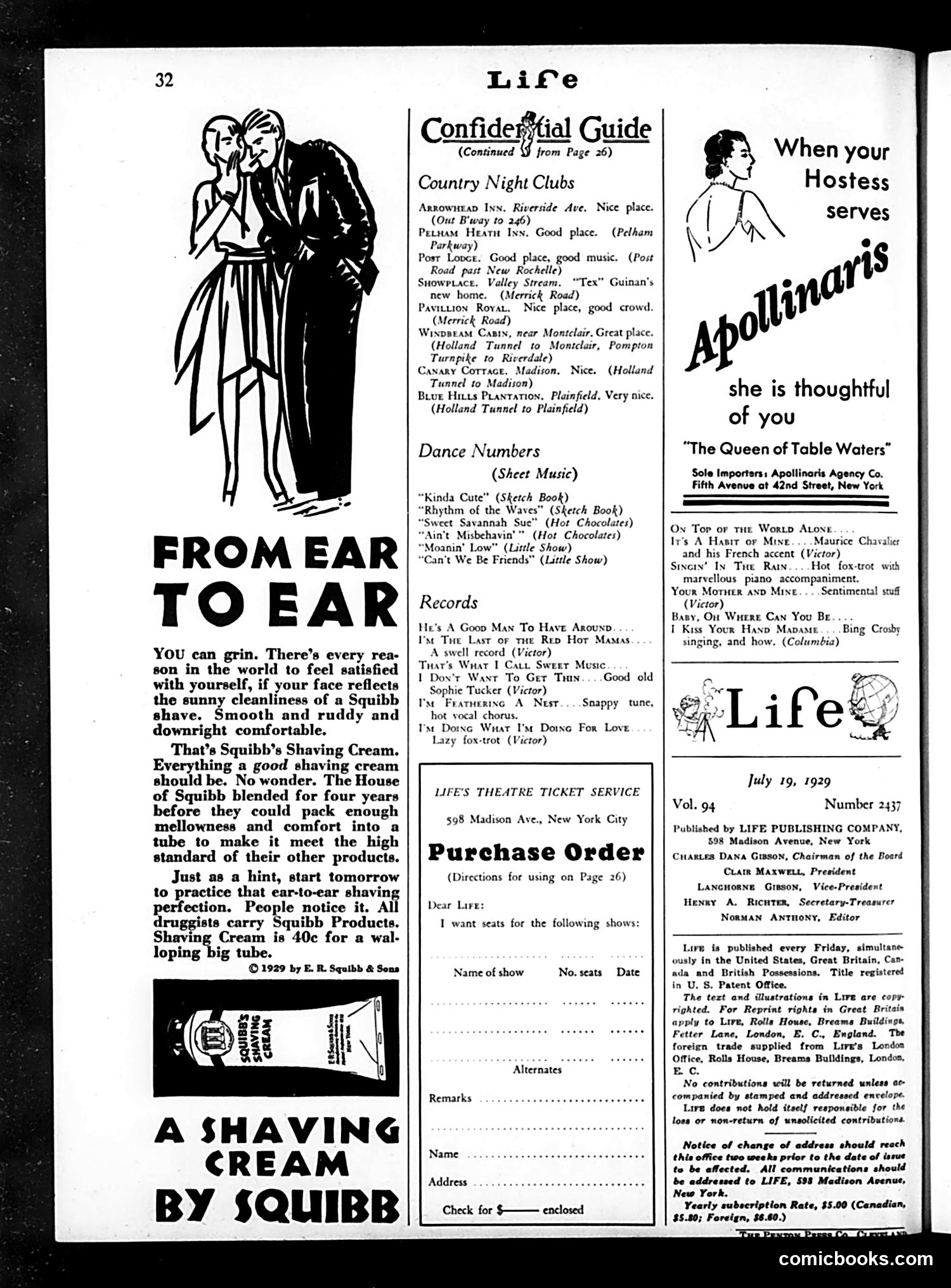
This page is primarily **advertising and service content** rather than satire or editorial cartoons. The main advertisement is **Squibb Shaving Cream**, featuring a couple in formal evening wear with the tagline "From Ear to Ear"—a pun on achieving a wide, satisfied smile through a perfect shave. The ad emphasizes comfort and quality, claiming Squibb spent four years perfecting the formula. The remainder of the page contains practical guides: listings of upscale country night clubs near New York (including one operated by famous speakeasy owner "Tex" Guinan, reflecting Prohibition-era culture), sheet music recommendations, phonograph records to purchase, and a theater ticket order form. An **Apollinaris mineral water advertisement** appears on the right, marketing it as "The Queen of Table Waters." This reflects Life's 1929 audience: affluent urbanites seeking entertainment and luxury goods during the prosperous Jazz Age, before the October stock market crash.
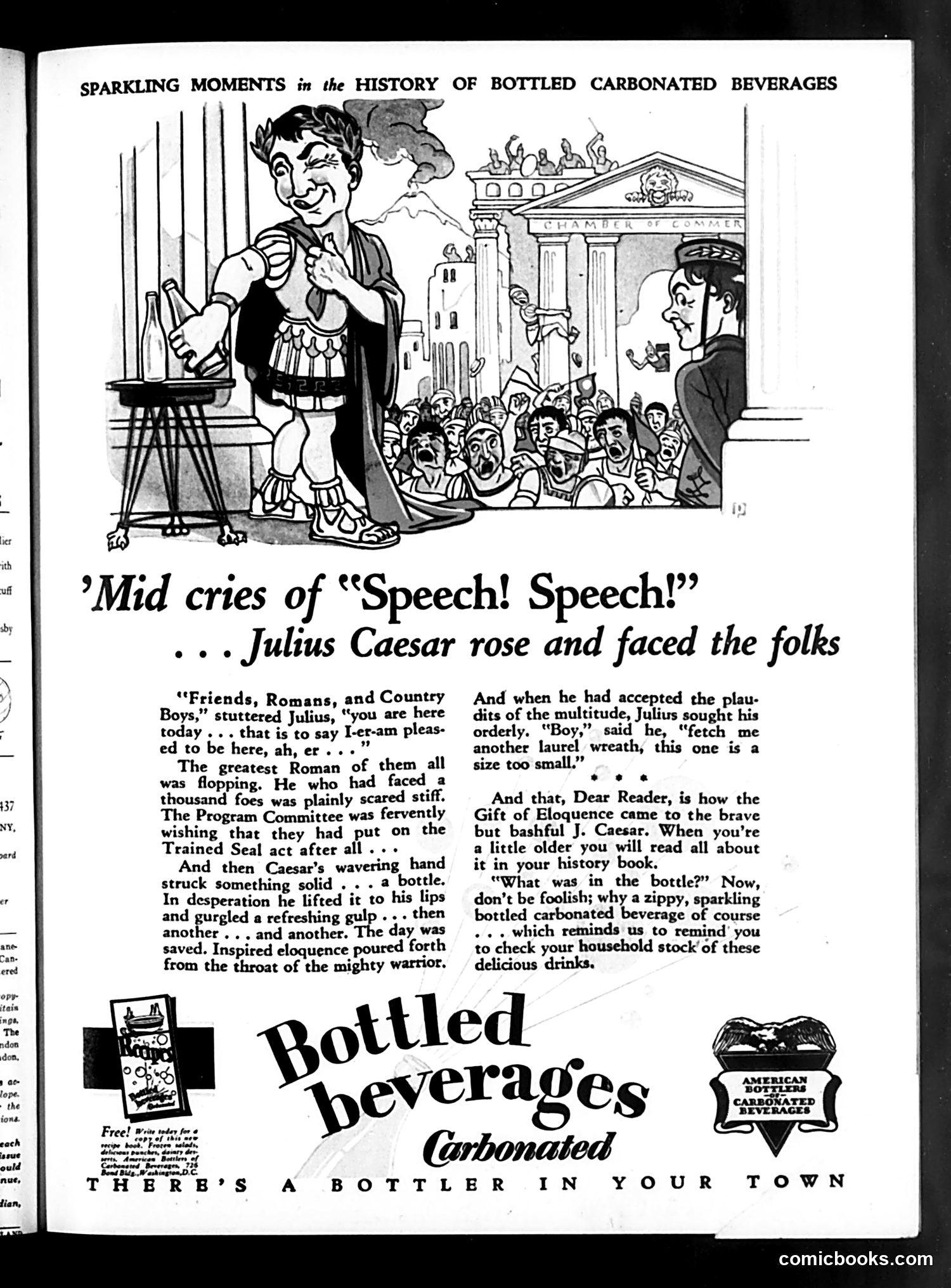
This is a **humorous advertisement** for bottled carbonated beverages disguised as historical satire. The cartoon depicts Julius Caesar nervously stammering before a Roman crowd, appearing to suffer stage fright. In desperation, he drinks from a bottle, which supposedly grants him eloquence and confidence to deliver a triumphant speech. The joke is absurdist and deliberately silly: the ad uses Caesar—a historical figure associated with military power and oratory—to humorously suggest that carbonated beverages provide confidence and eloquence. The text playfully reframes Caesar's famous public speaking abilities as actually deriving from a fizzy drink. This is primarily **commercial propaganda** rather than political satire. It targets consumers (particularly families, addressing "Dear Reader") by suggesting bottled sodas offer social benefits. The "sparkling moments in history" framing is tongue-in-cheek advertising copy meant to entertain while promoting the product. No specific political figures or events are mocked—the humor relies on anachronistic absurdity.
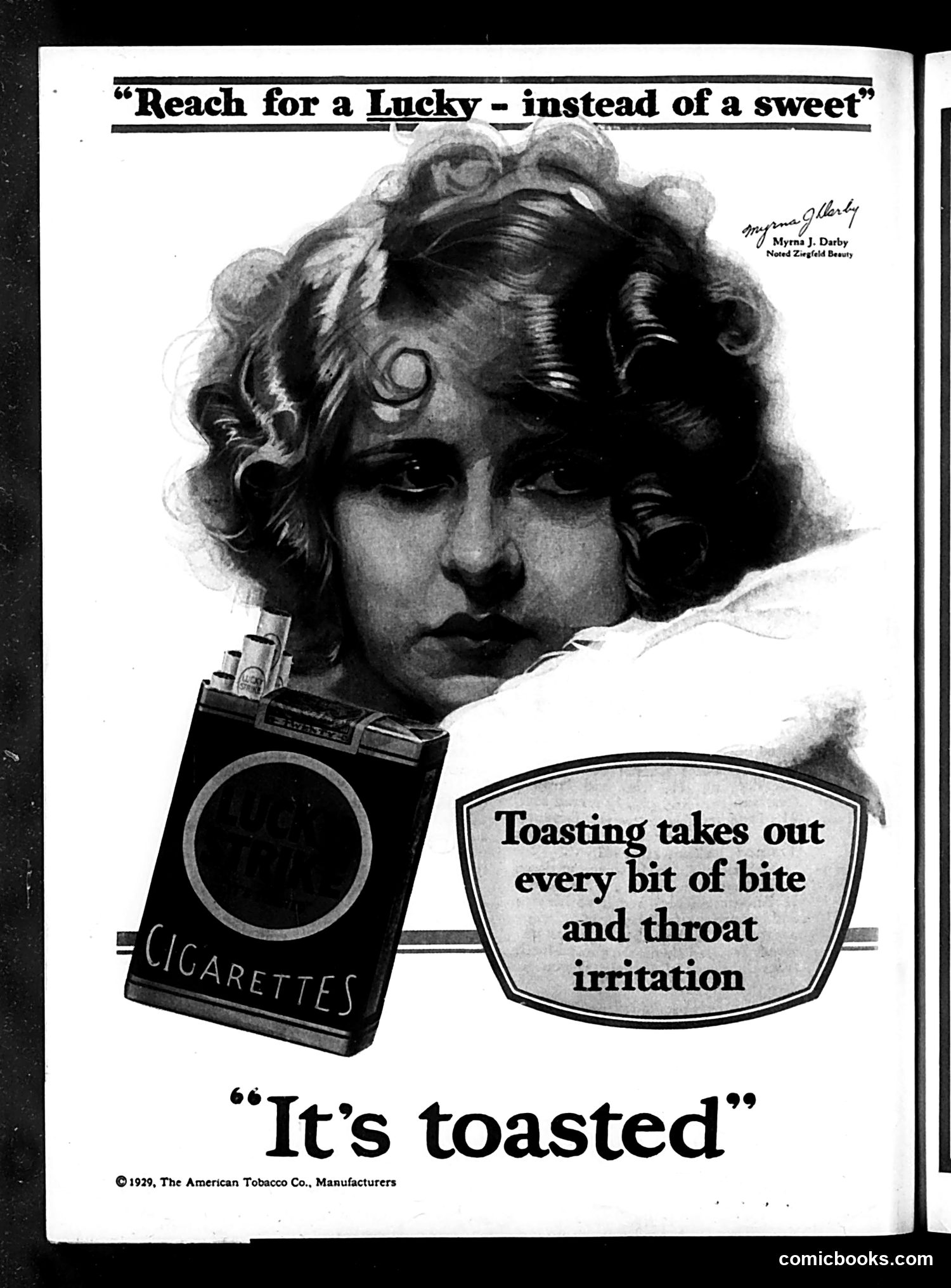
This is a 1929 advertisement for Lucky Strike cigarettes, not satire or political commentary. It features a glamorous woman's portrait (credited to "Myrna J. Darby, Noted Ziegfeld Beauty") endorsing cigarettes as a substitute for candy or sweets. The ad's pitch claims that the cigarette brand's "toasting" process removes throat irritation—a dubious health claim typical of early tobacco advertising. The tagline "Reach for a Lucky—instead of a sweet" marketed smoking as a weight-control alternative for women, a strategy that helped expand the female cigarette market during this era. This represents pre-regulation tobacco marketing, before health warnings were required.