
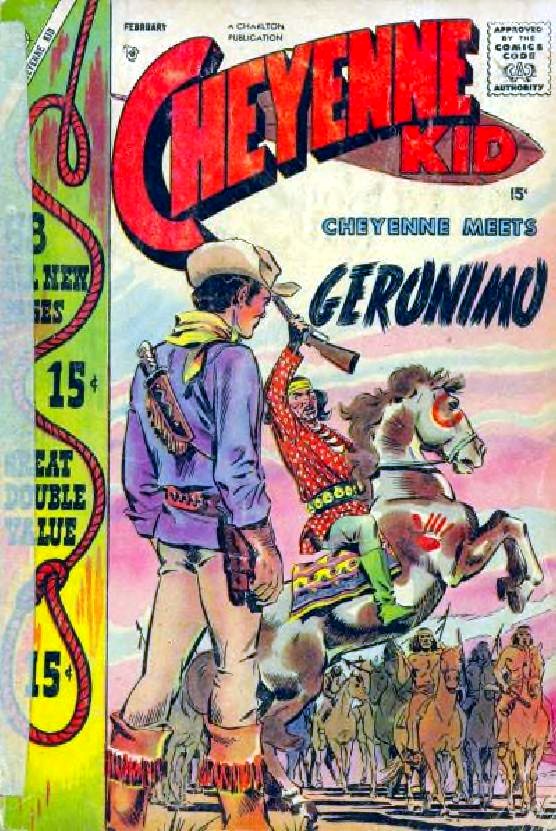
Cheyenne Kid #11
☆ Be the first to review + Add to your collection — Join freeIn "Cheyenne Meets Geronimo," the Cheyenne Kid encounters the legendary Apache leader Geronimo and becomes embroiled in tribal conflict after men attack him and Geronimo, shooting at them as they flee. The issue also features a secondary story titled "Bronc-Stomper," in which a skilled horseman named Mustang works with wild horses and must confront a dangerous hardcase named Otto Kurtz who is coming to the ranch.
The Cheyenne Kid tracks a band of renegade braves defying peace treaties, only to discover they're led by Running Wolf, a war chief who refuses to acknowledge the signed agreements. To stop the uprising before the Army crushes them, the Cheyenne Kid challenges Running Wolf to single combat—but the real test lies in outsmarting a seasoned warrior who's never tasted defeat.
Johnny Deuce, a gunslinger nursing a wounded pride after backing down from John Ringo, sets his sights on Bill Taylor—a peaceful newcomer from Ohio who's never fired a weapon in his life. When Deuce corners Taylor and demands a gunfight, the dude must decide whether to learn to shoot or find another way to stand his ground against a ruthless bully.
The Cheyenne Kid rides into an unforgiving desert, parched and desperate for water—unaware that his old enemy Silent Otter, who escaped imprisonment during a lightning strike and now leads Sioux war parties, has removed a crucial warning sign from a treacherous waterhole. As the Kid closes in on what he believes is salvation, Otter's vendetta moves toward its deadly conclusion in this gripping first chapter of "The Waterhole of Doom."
Dane Warren has sworn off violence after a Union Colonel's warning, so he's running a general store in town—but he's secretly watching as a ruthless guerrilla named Fuller abuses the townspeople and terrorizes local farmers. When Fuller's brutality reaches a breaking point, Dane makes a calculated move that sets off a chain of events bigger than either man bargained for, forcing him to finally confront the forces he's been carefully avoiding.
The Cheyenne Kid pursues a cunning foe named Silent Otter across sun-baked desert and cold nights, only to discover that his quarry has laid an elaborate trap: a poisoned waterhole meant to be his undoing. When the Kid arrives, parched and desperate, he must rely on quick thinking and keen observation to turn the tables on a crafty enemy who believed he had engineered the perfect doom.
In "Geronimo the War Chief of the Apaches," Cheyenne Jones rides out under Colonel Tarbes’ orders to negotiate peace with the famed Apache leader, leading a reluctant squad of soldiers who doubt the value of talks. As Jones and Geronimo speak of truce, tension flares when Sergeant Kass nearly breaks the fragile moment with a reckless shot. When Mexican raiders attack Geronimo and his warriors, the soldiers and Apaches unite in defense, forging a temporary alliance—and a fragile promise that Geronimo will spare American supply lines.
In "Geronimo's Challenge," the Cheyenne Kid answers a call to uphold the fragile peace he once helped forge with Geronimo, riding into the heart of the Apache tribe to stand against growing unrest. When two ruthless traders assault a lone Apache, the Cheyenne Kid and Geronimo pursue them to a military outpost, where they confront both the traders and the lieutenant commanding the soldiers. The story unfolds with tense justice and quiet resolve, as the Cheyenne Kid makes his stance clear—peace is not a gift, but a duty.
Dick Eagles is a fearless trapper working the frontier before settlers and railroads pushed west, and when he's cornered by a Native American chief who's tired of him hunting the tribe's game, he relies on quick wit and nerve to talk his way free. This tale celebrates the breed of early frontiersmen who earned respect through sheer toughness and cunning—men who came before the rush and changed the land forever.
When Tate Sloane and his gunmen plan to raid a Native American village for its gold while the braves are away hunting buffalo, Cheyenne Kid discovers the theft and races to warn the tribe—but finding the camp undermanned, he devises a bold deception to make a handful of warriors look like an entire war party. Armed with war paint, borrowed weapons, and his old skills from living with the Cheyennes, the Kid transforms himself into multiple defenders to turn the tables on Sloane's greedy gang.
Judge Roy Bean, the unorthodox Justice of the Peace in Vinegaroon, Texas, handles a case involving three gamblers who've cheated a stagecoach driver out of his money and horses. Bean's brand of frontier justice is swift and decisive, combining restitution with penalties that send a clear message about the cost of dishonesty in his territory.
A horse trainer called Mustang refuses to part with a prized colt when the ruthless Otto Kurtz demands it, sparking a brutal confrontation that forces the peaceful bronc-stomper to dust off his guns for a showdown. With Kurtz determined to prove his speed and Mustang unwilling to back down, the two face off on the street—but the man who claims he doesn't need firearms to handle trouble proves he can match any gunslinger when pushed to it.
General George Custer's 1876 defeat at Little Bighorn is examined in this historical piece, which reveals that his headquarters had access to four 90-pound Gatling guns—weapons capable of firing 1,000 rounds per minute—before the battle. These guns were versatile enough to be deployed either from horseback or from the ground with a tripod, making them formidable tools that could have dramatically altered the outcome of the infamous engagement.
The Cheyenne Kid finds himself caught between Apache warriors and white opportunists when he discovers that Barlow and his gang are planning to stage a fake raid on a local ranch—disguised as Geronimo's braves—to frame the Apache leader and sell him guns at inflated prices. Teaming up with Geronimo himself, the Cheyenne Kid works to expose the scheme before the false raid can tear the fragile peace in Arizona territory apart. It's a showdown where quick wits and faster guns prove that honor beats deception every time.
ComicBooks.com Value
Find on ebay
Read it digitally
Sell my copy
Have this issue — or a whole collection? Get a fair offer from us, skip the marketplace fees and the hassle.
We Buy Collections ▸Cast · 3 characters
Full credits
Reprints
Reprinted in Cheyenne Kid #10 (1958), Cheyenne Kid #47 (1964), Blazing Western #2 (2000), Golden-Age Treasury #1 (2003), Al Williamson Forbidden Worlds #[nn] (2009)
Reviews
Reader reviews
No reader reviews yet.