
Four Color #7
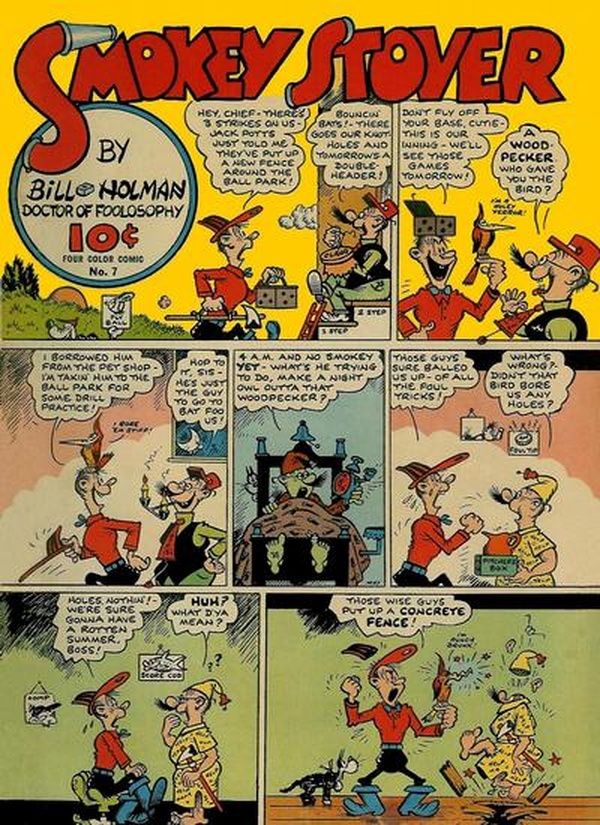
☆ Be the first to review + Add to your collection — Join freeFour Color #7 (1942) marks the first time Bill Holman's beloved screwball newspaper strip Smokey Stover appeared in comic book form, bringing the full cast — firefighter Smokey, his boss Chief Cash U. Nutt, wife Cookie, and the bandaged-tail cat Spooky — to a new, standalone format. As the opening entry in Dell's second Four Color series, it sits at the very front of one of the longest-running anthology series in American comics history, a line that would eventually span more than 1,300 issues. The issue also stands out as a formal curiosity: its cover reprints a complete seven-panel Sunday strip sequence, a genuine rarity in an era when comic book covers almost universally depicted a single illustration. Smokey Stover itself had a cultural reach that stretched well beyond the funny pages — Holman's invented slang term 'foo fighter' was later borrowed by a U.S. radar operator to describe unidentified aerial phenomena over World War II combat zones, making this comic an indirect ancestor of one of the war's most persistent mysteries.
ComicBooks.com Value
Show all 13 grades ▾
Find on ebay
Read it digitally
Sell my copy
Have this issue — or a whole collection? Get a fair offer from us, skip the marketplace fees and the hassle.
We Buy Collections ▸History
Smokey Stover launched as a Sunday strip for the Chicago Tribune Syndicate on March 10, 1935, written and drawn entirely by Indiana-born cartoonist Bill Holman (1903–1987), who had honed his craft as an office boy in the Tribune art department and later as a magazine freelancer. Holman simultaneously launched the companion topper strip Spooky — featuring a perpetually bandaged black cat — just one month after Smokey debuted, on April 7, 1935, signing that strip under the pseudonym 'Scat H.' When Dell began its second Four Color series in 1942, it turned to the Chicago Tribune–N.Y. News Syndicate's archive of Holman strips (copyrighted 1937–1940, as noted in the indicia) to fill the pages; the content in #7 consists entirely of reprinted Sunday sequences, reformatted for the comic book page, with cover art credited to Holman himself.
Trivia · 8 facts
- First comic book appearance of Smokey Stover and his core cast, comprising the issue's entire 68-page contents in the form of reprinted Sunday newspaper strips.
- Published in 1942 by Dell as issue #7 of the second Four Color series; the indicia title reads 'SMOKEY STOVER, No. 7,' with no code number.
- Cover art is by Bill Holman and reproduces a complete seven-panel Sunday strip sequence — an unusual design choice that was a rarity among comic book covers of the era.
- Characters appearing throughout the issue include Smokey Stover (the 'foolish foo-fighter'), Chief Cash U. Nutt, Cookie (Smokey's wife), and Spooky the cat (in cameo).
- Strip content is drawn from syndicated material copyrighted 1937, 1938, 1939 by the Chicago Tribune–N.Y. News Syndicate, Inc., and 1940 by News Syndicate Co., Inc.
- Smokey Stover was created and drawn solely by Bill Holman (March 22, 1903 – February 27, 1987), who ran the strip until his retirement in 1973 — the longest run of any strip in the screwball comics genre.
- Five additional Smokey Stover issues followed in the Four Color series: #35 (1944), #64 (February 1945), #229 (May 1949), #730 (October 1956), and #827 (August 1957).
- Smokey Stover received its only animated adaptation in 1971 as a recurring segment on Filmation's 'Archie's TV Funnies,' later repeated in 1978 under the title 'Fabulous Funnies.'
Cast · 4 characters
Full credits
Key issues in Four Color
 ★
★ ★
★ ★
★ ★
★ ★
★ ★
★ ★
★Reviews
Reader reviews
No reader reviews yet.