
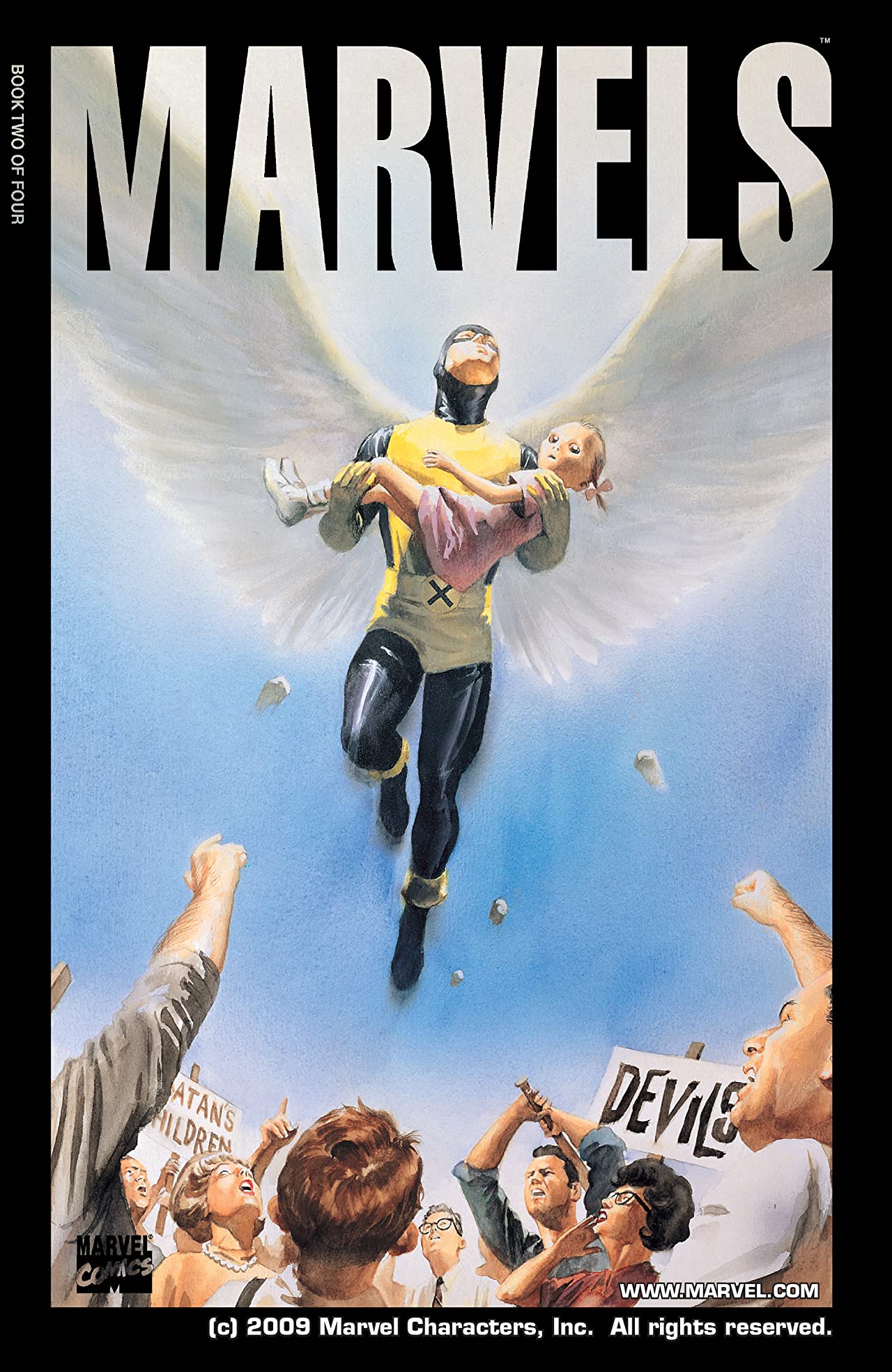
Marvels #2
☆ Be the first to review + Add to your collection — Join freeMarvels #2 — subtitled 'Monsters Among Us' — is the issue where Kurt Busiek and Alex Ross plant the series' most enduring thematic stake: the direct parallel between mid-1960s mutant hysteria and real-world civil-rights-era bigotry, filtered entirely through the conscience of one conflicted everyman. Phil Sheldon's arc here — joining an anti-mutant mob in the street, throwing a brick at Iceman, then discovering a frightened mutant child sheltered in his own home by his daughters — is one of the most compact and effective moral-education sequences in superhero comics history. The issue reframes two of Marvel's foundational Silver Age events (the formation of the Avengers and the Reed Richards–Sue Storm wedding) not as triumphs but as cultural spectacles observed by ordinary New Yorkers whose simultaneous celebrity worship of the Fantastic Four and visceral fear of the X-Men map the contradictions of the era with striking precision. Coming at the height of the 1990s speculator market, the series — and this issue in particular — pointed toward a more grounded, literary style of superhero storytelling that would influence work across the rest of the decade and beyond.
ComicBooks.com Value
Show all 11 grades ▾
More listings for this title
Read it digitally
Sell my copy
Have this issue — or a whole collection? Get a fair offer from us, skip the marketplace fees and the hassle.
We Buy Collections ▸History
The series grew from a pitch that Alex Ross had been developing as a painted anthology, but it was Kurt Busiek who pushed for a single continuous narrative thread and suggested the photojournalist protagonist who would tie the historical vignettes together. Ross's painted samples of Marvel characters — including what would eventually become Marvels #0 — were routed from an Eclipse Comics editor to Marvel editor Marcus McLaurin, who invited a formal pitch; a previous writer attached to the project had already departed by then, which brought Busiek officially on board. The four-issue miniseries was edited by McLaurin under editor-in-chief Tom DeFalco, with Richard Starkings and John Gaushell handling lettering, and its first printings were distinguished by an acetate outer cover on which only the logo and credits were printed — an idea reportedly borrowed from Art Spiegelman's Raw — so that Ross's painted cover art could be seen unobstructed beneath it. Marvel's own editorial team reportedly advised Busiek and Ross to cut the World War II-era material from the first issue because they doubted readers would care about Golden Age history, advice the creators ignored; the series went on to win the Eisner Award for Best Finite Series and the Harvey Award for Best Continuing or Limited Series in 1994.
Trivia · 8 facts
- Written by Kurt Busiek with fully painted art, inks, and colors entirely by Alex Ross; lettered by Richard Starkings and John Gaushell; edited by Marcus McLaurin (Marvel, cover date February 1994).
- The story is set in the early-to-mid 1960s and covers Phil Sheldon's witness of the Avengers' formation, the original X-Men's public debut and the anti-mutant hysteria it triggers (including the first televised unveiling of Bolivar Trask's Sentinel MK I during a debate with Professor Xavier), and the celebrity wedding of Reed Richards and Sue Storm.
- Alex Ross painted the Beatles into the background of the Richards–Sue Storm wedding sequence, reasoning that if a famous superhero couple married in 1965, the era's biggest celebrities would naturally attend — an example of the series' policy of anchoring Marvel history to its real-world calendar context.
- Phil Sheldon's personal moral crisis is the emotional core of this issue: swept up in a street mob, he throws a brick at Iceman, then later protects a young mutant girl his daughters have been hiding from neighbors forming a vigilante hunt — dramatizing the gap between abstract prejudice and human reality.
- The first printing of every issue in the series featured a distinctive acetate (clear plastic) outer cover with only the logo printed on it, so the painted cover image could be seen unobstructed; the second printing omitted the acetate cover.
- The full character roster includes Phil Sheldon, all four original Avengers lineups (Captain America, Thor, Iron Man, Giant-Man/Hank Pym, Hawkeye, Scarlet Witch/Wanda Maximoff, Quicksilver/Pietro Maximoff), the original X-Men (Cyclops, Marvel Girl, Beast, Angel, Iceman, Professor X), the Fantastic Four, and a wide supporting cast from across 1960s Marvel including J. Jonah Jameson, Norman Osborn, Nick Fury, Daredevil, Doctor Strange, and members of the Masters of Evil (Black Knight, Melter, Radioactive Man).
- The series as a whole — with this issue forming its Silver Age heart — won the 1994 Eisner Award for Best Finite Series and the Harvey Award for Best Continuing or Limited Series, and is credited by comics historian Matthew K. Manning with having 're-invigorated painted comics as a genre.'
- The story in this issue has been reprinted in numerous collected editions, including the original 1994 trade paperback, a 10th Anniversary edition (2004), Marvels: The Remastered Edition (2018, with new annotations by Busiek and Ross), a 25th Anniversary edition (2019), and international editions in French, Dutch, German, Russian, Spanish, and other languages.
Cast · 40 characters
Full credits
Reprints
Reprinted in Marvels (Graphitti Designs Limited Hardcover Edition, Number 47) #[nn] (1994), Marvel Magazine #5 (1994), Marvels #[nn] (1994), Marvels #[nn] (1994), Marvels #[nn] (1994), Superaventuras Marvel #168 (1996), Marvels #1 (1997), Marvels #[nn] (2008), Marvels #[nn] (2009), Marvel : Les Grandes Sagas #3 [fascicule] (2011), Marvel : Les Grandes Sagas #4 [fascicule] (2011), Marvel. Официальная коллекция комиксов #7 (2014), Marvels: The Platinum Edition #[nn] (2014), Universo Marvel #7 (2014), Marvel Comics - La collection #16 (2014), Marvels #2 (2018), Marvels: The Remastered Edition #[nn] (2018), Marvels Monster-Sized #[nn] (2019), Marvels 25th Anniversary #[nn] (2020), Marvel: The First 80 Years #[nn] (2020), Marvel Must-Have #[32] (2021)
Key issues in Marvels
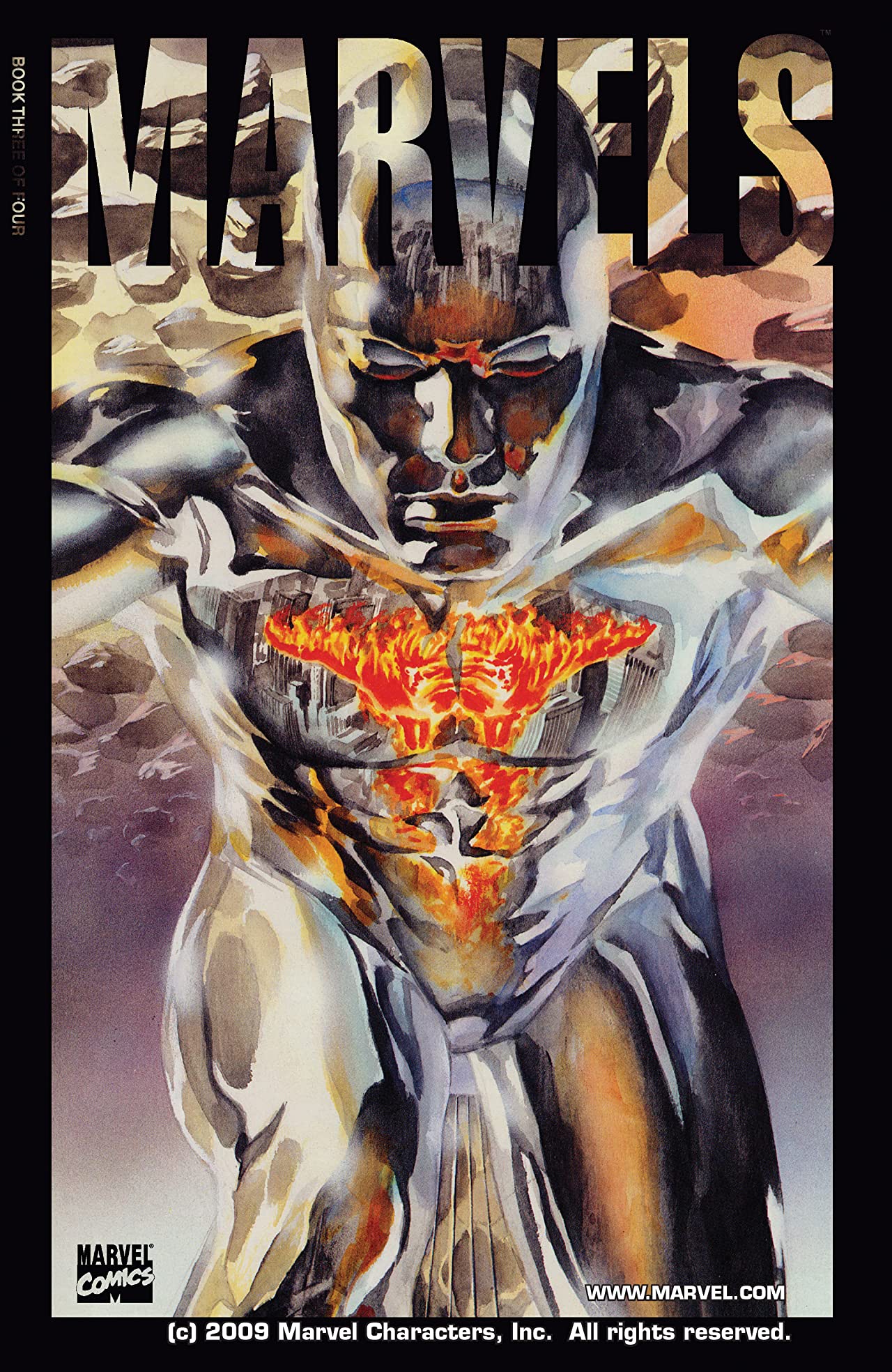
Variants (2)
Reviews
Reader reviews
No reader reviews yet.