
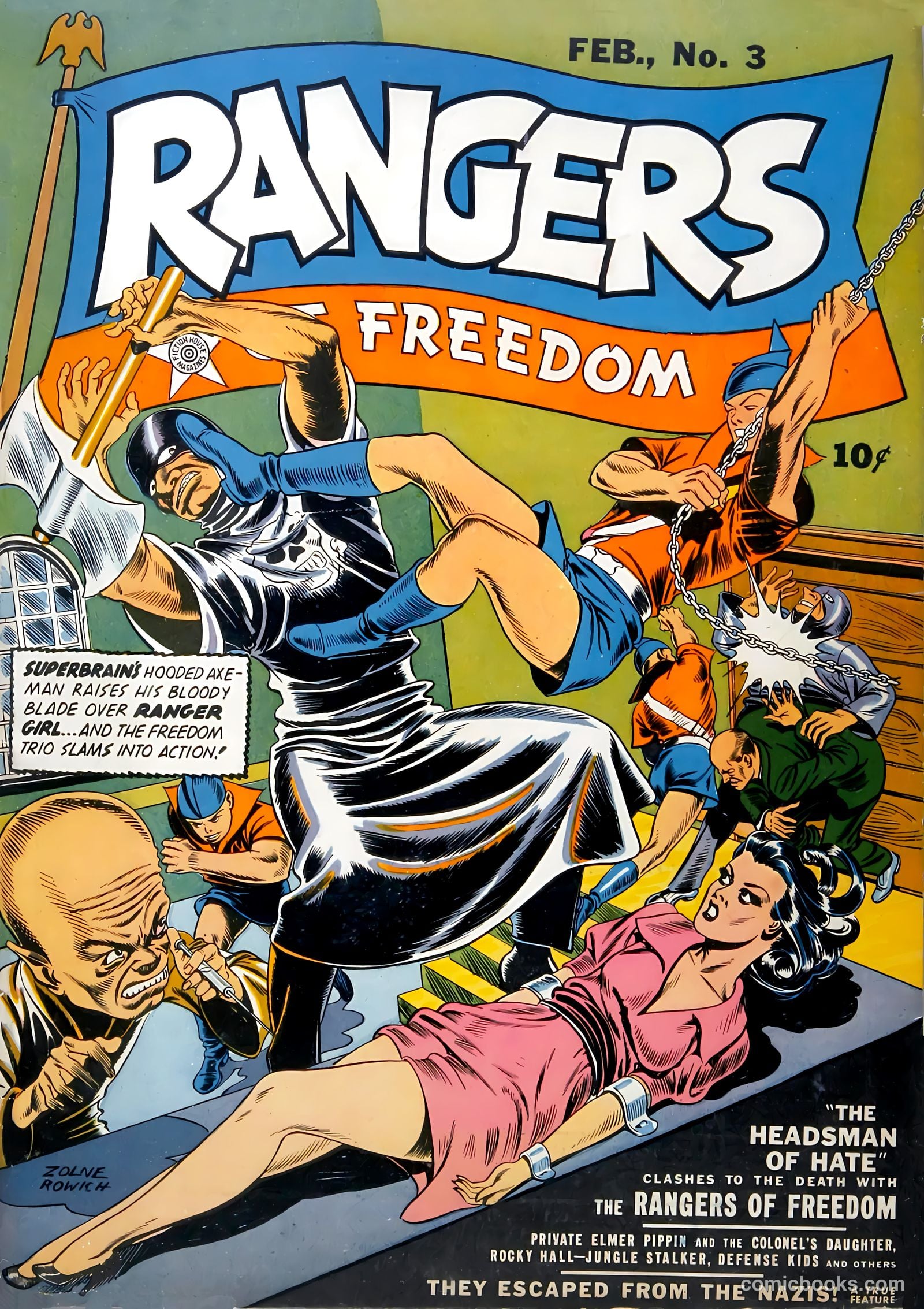
Rangers Comics #3
☆ Be the first to review + Add to your collection — Join freeRangers of Freedom Comics #3 (cover-dated February 1942, also catalogued as Rangers Comics #3) is the issue in which Lt. Gloria Travers — already introduced as a Miss America titleholder and military pilot in the series' earlier installments — formally adopts the Ranger Girl identity and joins the Rangers of Freedom as a full member, making it the first-as-Ranger-Girl appearance of one of Fiction House's few recurring female action heroes. This places the issue at an intriguing intersection of Golden Age superhero convention and wartime propaganda: a woman defined by a national beauty pageant is recast as a costumed combatant at a moment when American culture was actively debating women's roles in the war effort. The issue also introduces three new villain groups — the Black Axemen, Scarface, and the Bundists — deepening the series' super-patriotic mythology during the months immediately following Pearl Harbor. As one of the earliest issues of a title that ran 65 issues through 1952, it documents Fiction House's brief, energetic experiment blending superhero-team storytelling with war-era jingoism before the series later pivoted to more conventional western and adventure formats.
Rangers of Freedom features "The Headsman of Hate," in which a villain named Superbrains wielding a hooded axe-man raises his blade over Ranger Girl while the Freedom Trio takes action. Private Elmer Pippin and the Colonel's daughter Rocky Hall, along with Jungle Stalker and Defense Kids, must escape from Nazi forces after encountering Superbrains' plot. The story includes action involving parachutes, aircraft, and Nazi soldiers, culminating in the children's escape from Nazi custody and their encounter with military personnel who commend their bravery. A separate story follows children discovering Nazi plans at an airport and working with Captain Mason to thwart an attack, leading to a triumphant aerial encounter with a Navy bomber.
ComicBooks.com Value
Show all 17 grades ▾
Find on ebay
Read it digitally
Sell my copy
Have this issue — or a whole collection? Get a fair offer from us, skip the marketplace fees and the hassle.
We Buy Collections ▸History
The series launched in October 1941 under the editorial direction of DeWitt Shank, a figure with a background in pulp fiction editing who had joined Fiction House in fall 1940; unlike every other Fiction House title of the period, Rangers of Freedom had no direct pulp counterpart and was conceived specifically as a wartime superhero property. Issue #3 was edited jointly by Shank and art director Gene Fawcette, with interior stories and art credited to Joe Doolin, Jim Chambers, Walter Galli, Don Lynch, Al Walker, and Richard Case, and a cover by the series' regular cover artist Dan Zolnerowich. Shank enlisted in the U.S. Army on April 4, 1942 — just weeks after this issue shipped — meaning #3 appeared during the final months of his editorial stewardship; his departure is widely considered the reason the Rangers of Freedom superhero concept was abruptly retired, with the title transitioning to straight war stories from issue #5 onward.
Trivia · 8 facts
- Published February 1942 by Fiction House; cover title reads 'Rangers of Freedom Comics,' which is why the issue appears in databases under both 'Rangers of Freedom Comics #3' and 'Rangers Comics #3.'
- Contains the first appearance of Gloria Travers as Ranger Girl — her formal adoption of the costumed identity and full membership in the Rangers of Freedom team; she had appeared in earlier issues without the Ranger Girl name or role.
- Ranger Girl's civilian backstory ties her to the Miss America pageant (the character is described as a Miss America 1941 titleholder turned WAAC pilot), grounding a superhero origin in a real wartime cultural institution.
- Introduces three new villainous factions in a single issue: the Black Axemen, Scarface, and the Bundists (a domestic Nazi-sympathizer group), escalating the series' wartime threat landscape.
- Issue also features the last appearance of the Double-Slango Kids backup feature and introduces supporting character Phineas B. Tutts.
- Cover and interior art by Dan Zolnerowich (cover) and Joe Doolin, Jim Chambers, Walter Galli, Don Lynch, Al Walker, and Richard Case (interiors); edited by DeWitt Shank and Gene Fawcette.
- The 68-page, full-color issue was one of the final issues produced under editor DeWitt Shank before he enlisted in the U.S. Army in April 1942, effectively ending the original Rangers of Freedom superhero era.
- The Rangers of Freedom super-team concept — including Ranger Girl — was discontinued within two issues of this one; the title ran on for decades under different characters, eventually featuring Firehair, Tiger Man, and Sky Rangers.
Key issues in Rangers Comics
Reviews
Reader reviews
No reader reviews yet.