
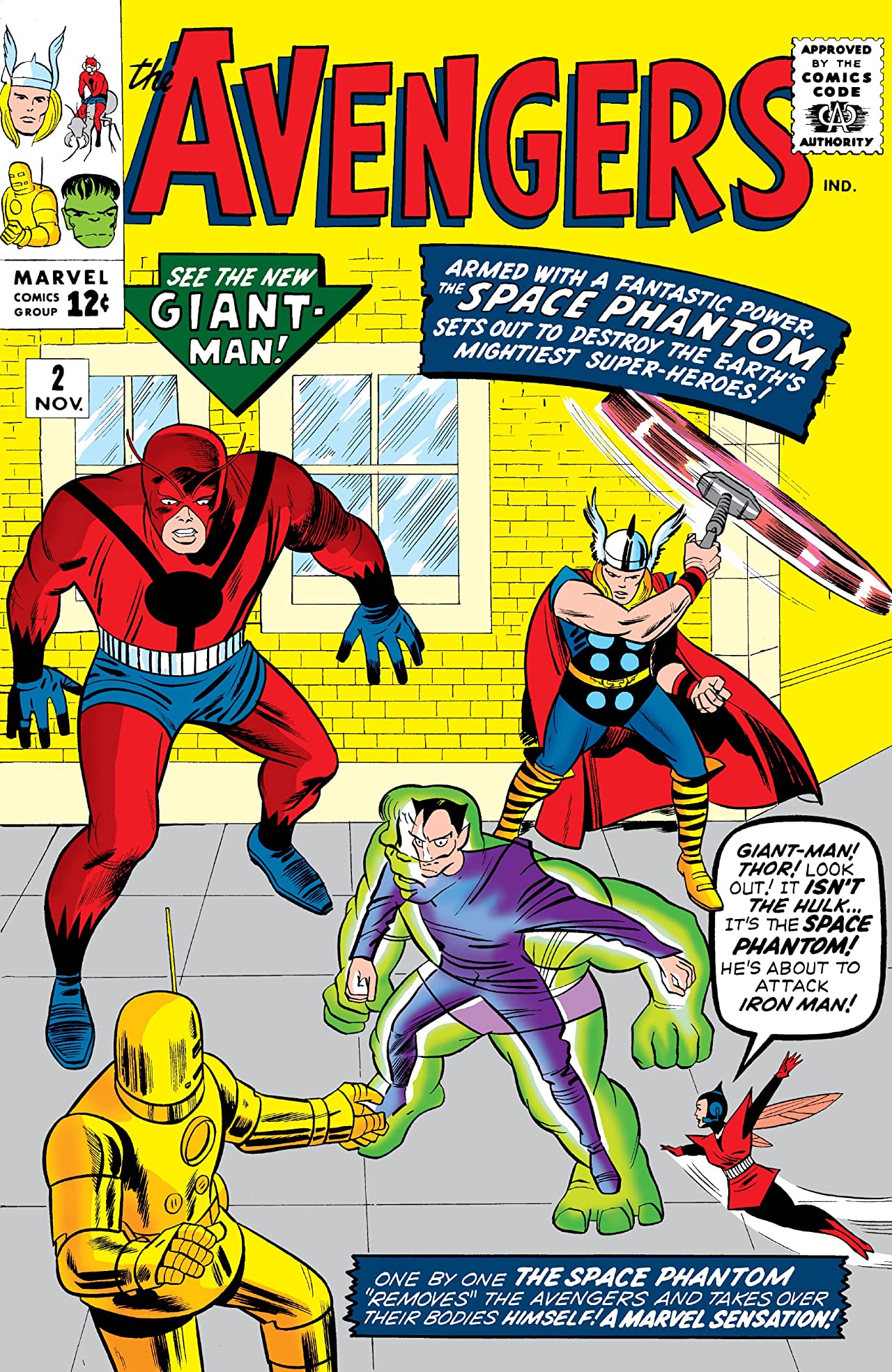
The Avengers #2
Only one issue into their existence, Earth's Mightiest Heroes nearly tore themselves apart — and that deliberate instability is what made the Avengers something genuinely new in superhero comics. By introducing the Space Phantom, a shape-shifting alien who banishes his targets to Limbo and impersonates them, Stan Lee and Jack Kirby established hero-versus-hero conflict as a foundational tension of the Marvel Universe, a storytelling engine the line would run on for decades. The Hulk's departure at the end of the issue — the first founding member to quit the team — proved that the Avengers' roster was not fixed sacred canon but a living, volatile thing, clearing the way for Captain America's induction just three issues later. Every subsequent Avengers lineup change, every resignation in disgust or dramatic expulsion, traces its creative DNA back to this single issue.
In "The Avengers! Battle... the Space Phantom," the team faces a cosmic threat that doesn't just attack with power, but with deception—aiming to unravel their unity before Earth even knows it's under siege. Written by Stan Lee and illustrated by Jack Kirby, with inks by Paul Reinman and colors by Stan Goldberg, this 1963 issue delivers a tense clash of wits and wills, all under Kirby’s dynamic cover by Sol Brodsky.
ComicBooks.com Value
Show all 22 grades ▾
More listings for this title
- JAF Comics · Bethlehem, PA3 on eBay ↗
- Diverted Comics · Bakersfield, CA2 on eBay ↗
- Rainbow Comics, Cards & Collectibles · 2 locations2 on eBay ↗
Read it digitally
Sell my copy
Have this issue — or a whole collection? Get a fair offer from us, skip the marketplace fees and the hassle.
We Buy Collections ▸History
The issue was written by Stan Lee, penciled by Jack Kirby, and inked by Paul Reinman on interiors, with Sol Brodsky inking Kirby's cover — the same core creative engine driving the entire early Marvel line simultaneously across multiple titles. It went on sale September 3, 1963, and carried a November 1963 cover date, part of the title's original bi-monthly schedule. Hank Pym's transition from Ant-Man to Giant-Man in this issue ran in parallel with the same transformation debuting in *Tales to Astonish* #49 (also November 1963), a deliberate cross-title coordination typical of Lee and Kirby's tightly interwoven early Marvel publishing strategy. Stan Lee later acknowledged uncertainty about why Ant-Man never resonated as strongly as his teammates, a commercial reality that likely accelerated Pym's identity upgrade here.
Trivia · 8 facts
- First appearance of the Space Phantom, a shape-shifting alien who impersonates his targets and banishes them to Limbo; created by Stan Lee and Jack Kirby (The Avengers vol. 1 #2, November 1963).
- The Hulk quits the Avengers at the end of this issue — the first founding member to leave the team — and would not officially rejoin as a regular member for nearly 50 years.
- Hank Pym debuts the Giant-Man identity within this story, demonstrating new size-changing capsules that allow him to grow rather than only shrink; this change was simultaneously introduced in Tales to Astonish #49 (November 1963).
- First appearance of Avengers Mansion (Tony Stark's headquarters at 890 Fifth Avenue, Manhattan) as the team's base of operations.
- The Space Phantom's power fails when he attempts to copy Thor, as his ability to banish someone to Limbo does not work on Asgardians — the plot mechanism that ends the villain's assault.
- A notable continuity error in the original script has Rick Jones refer to the Hulk's alter ego as 'Don Blake' (Thor's human identity) rather than Bruce Banner.
- The Space Phantom was later retconned in Avengers Forever #8 (1999, by Kurt Busiek, Roger Stern, and Carlos Pacheco) to be a servant of Immortus, hypnotized into believing his own cover story about an alien invasion.
- The issue has been reprinted extensively, including in Marvel Super Heroes #1 (October 1966), Essential Avengers Vol. 1 (1999), Marvel Masterworks: The Avengers Vol. 1, and the Penguin Classics Marvel Collection (2023).
Cast · 18 characters
Full credits
Reprints
↩ Reprints Sgt. Fury #4 (1963), The Amazing Spider-Man #7 (1963)
Reprinted in Spellbound #55 (1965), Marvel Super Heroes #1 (1966), Los Vengadores #1 (1969), The Avengers Annual #4 (1971), Il Mitico Thor #6 (1971), Eclipso #16 (1971), The Mighty World of Marvel #47 (1973), Die ruhmreichen Rächer #2 (1974), Giant-Size Avengers #3 (1975), Os Vingadores #1 (1975), De Vergelders #1 (1979), Die Rächer #1 (1979), Los Vengadores #2 (1981), Les Vengeurs Color #1 (1982), Vengeur #17 (1987), Marvel Masterworks #4 (1988), Marvel Milestone Edition: Avengers #1 (1993), Avengers Masterworks #1 (1993), Marvel Masterworks: The Avengers #[1] (1997), Biblioteca Marvel: Los Vengadores #1 (1999), Marvel Klassik #5 (1999), Essential Avengers #1 (1999), Marvel Masterworks: The Avengers #1 (2002), Marvel Masterworks: The Avengers - Barnes & Noble Edition #1 (2003) + 19 more
Key issues in The Avengers
 ★
★ ★
★ ★
★ ★
★ ★
★ ★
★ ★
★ ★
★Variants (1)
Reviews
Reader reviews
No reader reviews yet.