
Life, 1928-12-21 · page 21 of 36
Life — December 21, 1928 — page 21: what you’re looking at
What you’re looking at
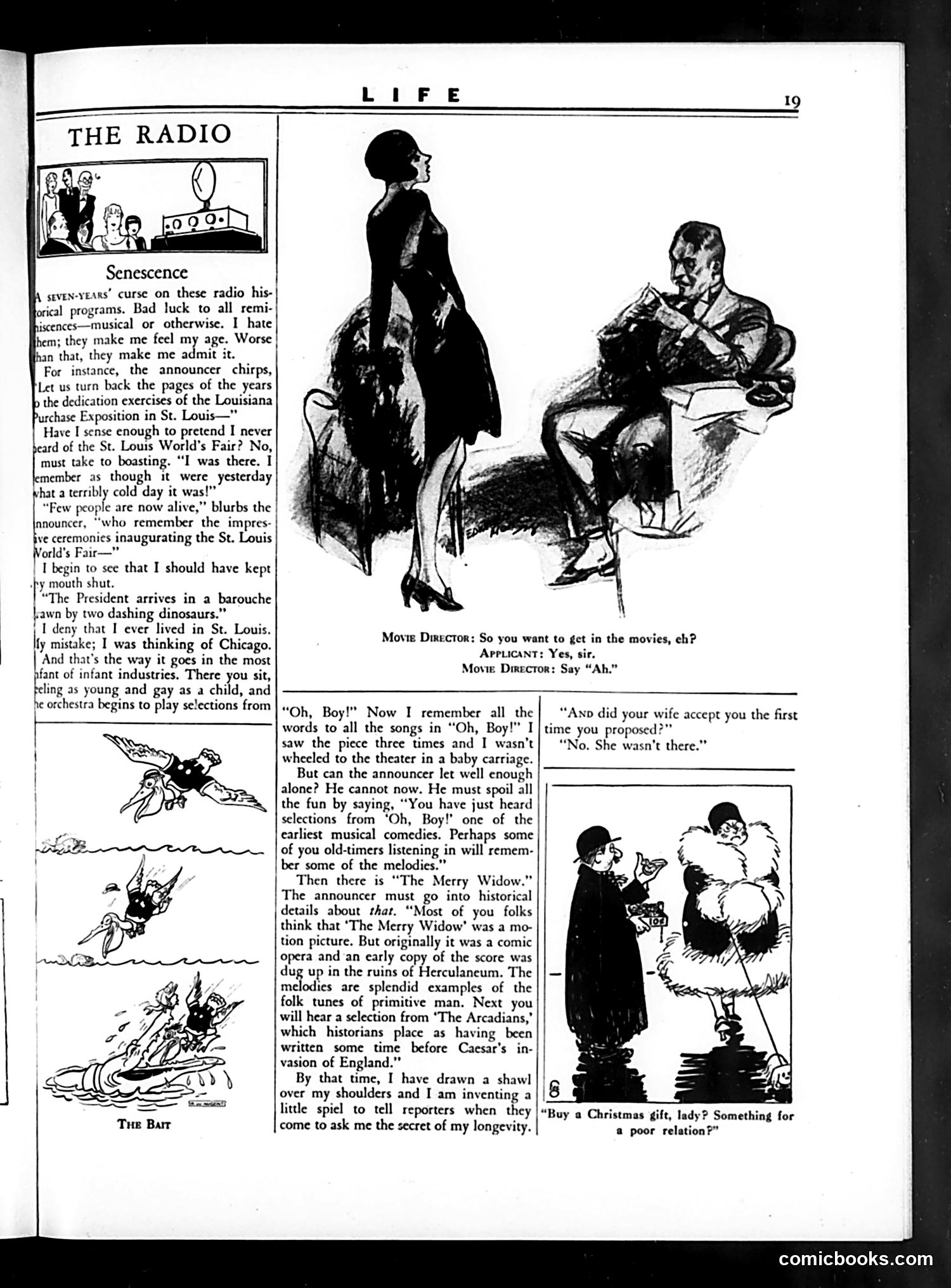
This satirical piece mocks radio's "historical programs" that broadcast old musical selections while adding tedious historical commentary. The author complains these nostalgia broadcasts make him feel old and embarrass him into admitting his age. The joke: Radio announcers frame decades-old entertainment (like the 1911 musical "Oh, Boy!") as ancient history, forcing older listeners to either pretend ignorance or confess they attended the original performances. The announcer's increasingly absurd claims—that "The Merry Widow" scores were "dug up in the ruins of Herculaneum"—amplify the satire on overwrought historical framing. The accompanying cartoons mock other industries: a movie director performing a ridiculous "talent test," and a Christmas gift-giver asking about buying for "poor relations." The "Bat" drawing is unclear but appears unrelated filler. The satire targets both radio programming excess and the universal discomfort of aging.
📄 Transcribed text from this page (OCR, searchable)
Machine-transcribed from the original scan — historical spelling and the odd misread are preserved.
Senescence seven-vears’ curse on these radio his- lorical programs. Bad luck to all remi- iscences—musical or otherwise. I hate hem; they make me feel my age. Worse | han that, they make me admit it. For instance, the announcer chirps, Let us turn back the pages of the years b the dedication exercises of the Louisiana Purchase Exposition in St. Louis—” Have I sense enough to pretend I never beard of the St. Louis World's Fair? No, must take to boasting. “I was there. I member as though it were yesterday yhat a terribly cold day it was!” “Few people are now alive,” blurbs the Innouncer, “who remember the impres- ve ceremonies inaugurating the St. Louis Yorld’s Fair—” | I begin to see that I should have kept 1 mouth shut. “The President arrives in a barouche \awn by two dashing dinosaurs.” ; I deny that I ever lived in St. Louis. ly mistake; I was thinking of Chicago. And that’s the way it goes in the most pfant of infant industries. There you sit, ling as young and gay as a child, and he orchestra begins to play selections from Tue Barr Movie Director: So you want to get in the movies, eh? Appuicant: Yes, sir. Movie Director: Say “Ah.” “Oh, Boy!” Now I remember all the words to all the songs in “Oh, Boy!” I saw the piece three times and I wasn’t wheeled to the theater in a baby carriage. But can the announcer let well enough alone? He cannot now. He must spoil all the fun by saying, “You have just heard selections from ‘Oh, Boy!’ one of the earliest musical comedies. Perhaps some of you old-timers listening in will remem- ber some of the melodies.” Then there is “The Merry Widow.” The announcer must go into historical details about that. “Most of you folks think that ‘The Merry Widow’ was a mo- tion picture. But originally it was a comic opera and an carly copy of the score was dug up in the ruins of Herculaneum. The melodies are splendid examples of the folk tunes of primitive man. Next you will hear a selection from ‘The Arcadians,’ which historians place as having been written some time before Caesar's in- vasion of England.” By that time, I have drawn a shaw! | | over my shoulders and I am inventing a || little spiel to tell reporters when they come to ask me the secret of my longevity. “Ano did your wife accept you the first time you proposed?” “No. She wasn't there.” “Buy a Christmas gift, lady? Something for a poor relation?” comicbooks.com