
Life, 1928-12-21 · page 24 of 36
Life — December 21, 1928 — page 24: what you’re looking at
What you’re looking at
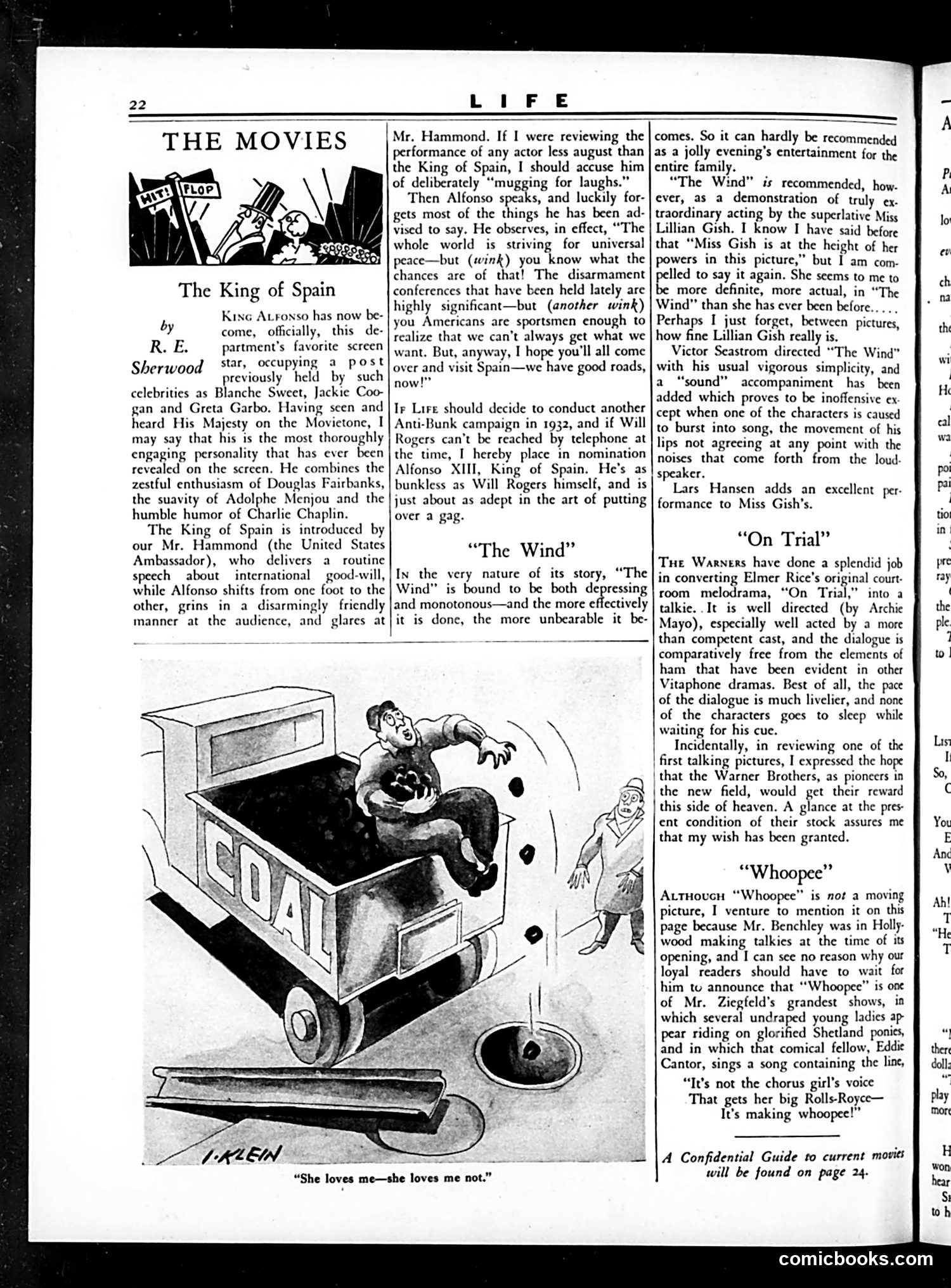
This page reviews three films. The main cartoon illustrates "The King of Spain," showing King Alfonso XIII of Spain literally inside a movie camera, with the caption "She loves me—she loves me not"—suggesting he's being manipulated by cinema like a prop. The review praises King Alfonso XIII's charisma in a Movietone newsreel appearance, comparing him favorably to Douglas Fairbanks and Charlie Chaplin. The satire targets his diplomatic speech about disarmament conferences and international peace, which the reviewer suggests Alfonso undermines with winks and knowing glances—implying such diplomatic rhetoric is hollow performance rather than genuine commitment. The page also reviews "The Wind" (praising Lillian Gish's acting), "On Trial" (a Warner Brothers talkie adaptation), and briefly mentions "Whoopee." This appears to be from the late 1920s, during the transition to talking pictures.
📄 Transcribed text from this page (OCR, searchable)
Machine-transcribed from the original scan — historical spelling and the odd misread are preserved.
Lie THE MOVIES The King of Spain Kine Aroxso has now be- come, officially, this de- partment’s favorite screen star, occupying a post previously held by such celebrities as Blanche Sweet, Jackie Coo- gan and Greta Garbo. Having seen and heard His Majesty on the Movietone, I may say that his is the most thoroughly engaging personality that has ever been revealed on the screen, He combines the zestful enthusiasm of Douglas Fairbanks, the suavity of Adolphe Menjou and the humble humor of Charlie Chaplin. The King of Spain is introduced by our Mr. Hammond (the United States Ambassador), who delivers a routine speech about international good-will, while Alfonso shifts from one foot to the other, grins in a disarmingly friendly manner at the audience, and glares at by R. E. Sherwood Mr. Hammond. If I were reviewing the performance of any actor less august than the King of Spain, I should accuse him of deliberately “mugging for laughs.” Then Alfonso speaks, and luckily for- gets most of the things he has been ad- vised to say. He observes, in effect, “The whole world is striving for universal peace—but (wink) you know what the chances are of that! The disarmament conferences that have been held lately are highly significant—but (another wink) you Americans are sportsmen enough to realize that we can’t always get what we want. But, anyway, I hope you'll all come over and visit Spain—we have good roads, now!” Ir Lire should decide to conduct another Anti-Bunk campaign in 1932, and if Will Rogers can’t be reached by telephone at the time, I hereby place in nomination Alfonso XIII, King of Spain, He's as bunkless as Will Rogers himself, and is just about as adept in the art of putting over a gag. “The Wind” In the very nature of its story, “The Wind” is bound to be both depressing and monotonous—and the more effectively it is done, the more unbearable it be- PALE Q 52} PB y ‘A “She loves me—she loves me not.” comes. So it can hardly be recommended as a jolly evening's entertainment for the entire family. “The Wind" is recommended, how- ever, as a demonstration of truly ex. traordinary acting by the superlative Miss Lillian Gish. I know I have said before that “Miss Gish is at the height of her powers in this picture,” but I am com- pelled to say it again. She seems to me to be more definite, more actual, in “The Wind” than she has ever been before... . Perhaps I just forget, between pictures, how fine Lillian Gish really is, Victor Seastrom directed “The Wind” with his usual vigorous simplicity, and a “sound” accompaniment has been added which proves to be inoffensive ex cept when one of the characters is caused to burst into song, the movement of his lips not agreeing at any point with the noises that come forth from the loud- speaker. Lars Hansen adds an excellent per- formance to Miss Gish’s. “On Trial” Tue Warners have done a splendid job in converting Elmer Rice's original court- room melodrama, “On Trial,” into a talkie. .It is well directed (by Archie Mayo), especially well acted by a more than competent cast, and the dialogue is comparatively free from the elements of ham that have been evident in other Vitaphone dramas. Best of all, the pace of the dialogue is much livelier, and none of the characters goes to sleep while waiting for his cue. | _ Incidentally, in reviewing one of the | first talking pictures, I expressed the hope | that the Warner Brothers, as pioneers in |the new field, would get their reward this side of heaven. A glance at the pres- ent condition of their stock assures me that my wish has been granted. “Wh ope” AttHoucH “Whoopee” is not a moving picture, I venture to mention it on this page because Mr. Benchley was in Holly- wood making talkies at the time of its opening, and I can see no reason why our loyal readers should have to wait for him to announce that “Whoopee” is one of Mr. Ziegfeld’s grandest shows, in which several undraped young ladies ap- pear riding on glorified Shetland ponies, and in which that comical fellow, Eddie Cantor, sings a song containing the line, “It’s not the chorus girl’s voice That gets her big Rolls-Royce— It’s making whoopee!” A Confidential Guide to current movits will be found on page 24. comicbooks.com