
Life, 1929-03-29 · page 22 of 36
Life — March 29, 1929 — page 22: what you’re looking at
What you’re looking at
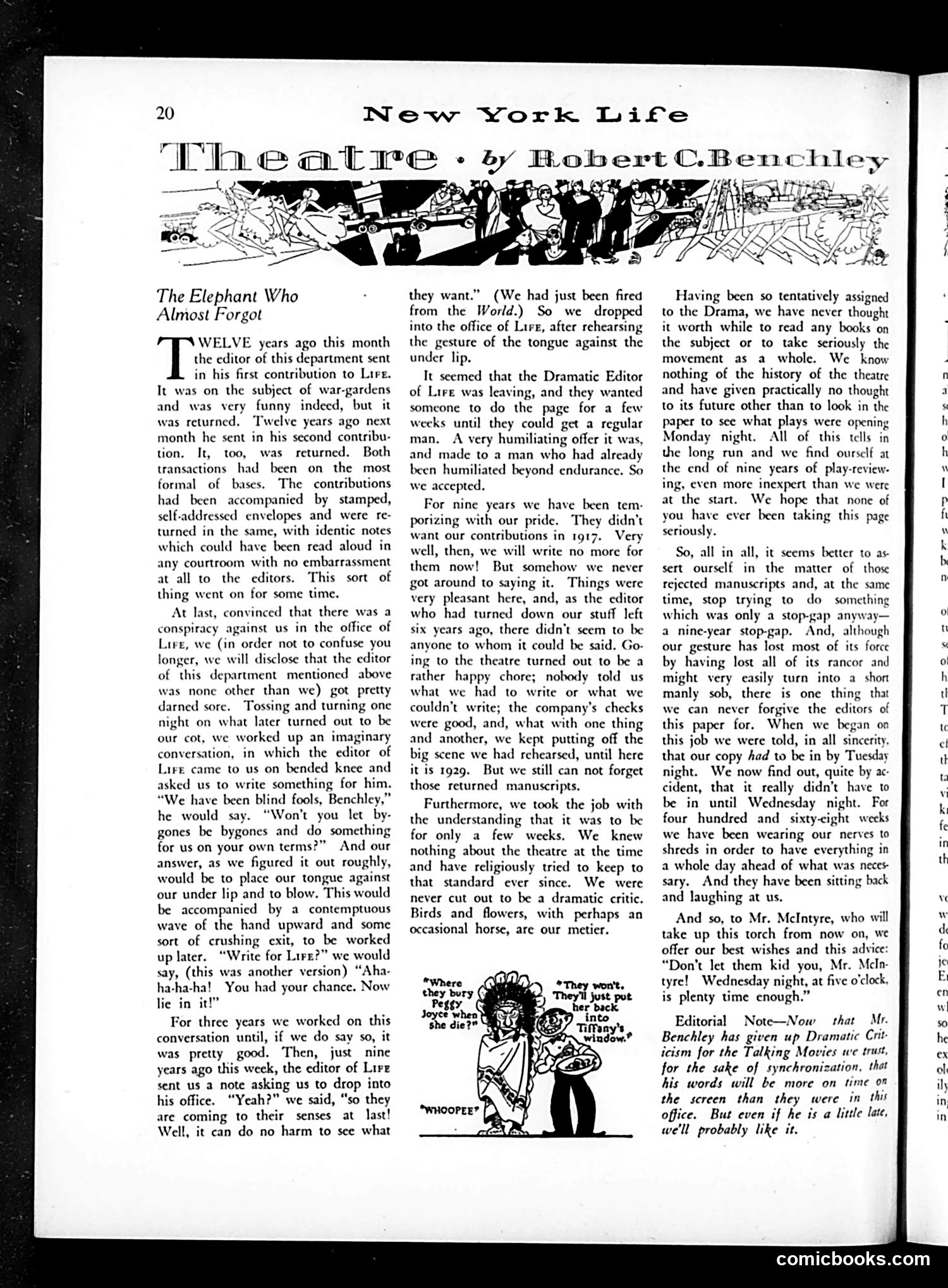
This is Robert C. Benchley's humorous essay about his own career at *Life* magazine. Benchley describes how he submitted theatrical criticism contributions for nine years after initial rejections, nursing a grudge. When finally invited to write for the Drama section in 1920, he accepted what was supposed to be a temporary assignment—intending to dramatically refuse once they "came to their senses." However, the job became pleasant and permanent. Nine years later (1929), Benchley realizes he never delivered his imagined revenge scene. He admits he took the role reluctantly, knows little about theater or dramatic criticism, and preferred writing about nature and animals. The cartoon below (labeled "WHOOPEE") appears to illustrate his fantasy confrontation with the editor. The satire gently mocks Benchley's own wounded pride and his failure to follow through on his dignified exit—a relatable human weakness about professional slights and delayed gratification.
📄 Transcribed text from this page (OCR, searchable)
Machine-transcribed from the original scan — historical spelling and the odd misread are preserved.
New York Life The Elephant Who Almost Forgot WELVE years ago this month ] the editor of this department sent in his first contribution to Lire. It was on the subject of war-gardens and was very funny indeed, but it was returned, Twelve years ago next month he sent in his second contribu- tion. It, too, was returned. Both transactions had been on the most formal of bases. The contributions had been accompanied by stamped, self-addressed envelopes and were re- turned in the same, with identic notes which could have been read aloud in any courtroom with no embarrassment at all to the editors. This sort of thing went on for some time, At last, convinced that there was a conspiracy against us in the office of Lire, we (in order not to confuse you longer, we will disclose that the editor of this department: mentioned above was none other than we) got pretty darned sore. Tossing and turning one night on what later turned out to be our cot, we worked up an imaginary conversation, in which the editor of Lire came to us on bended knee and asked us to write something for him. “We have been blind fools, Benchley,” he would say. “Won't you let by- gones be bygones and do something for us on your own terms?” And our answer, as we figured it out roughly, would be to place our tongue against our under lip and to blow. This would be accompanied by a contemptuous wave of the hand upward and some sort of crushing exit, to be worked up later. “Write for Lire?” we would say, (this was another version) “Aha- ha-ha-ha!_ You had your chance. Now lie in it!” For three years we worked on this conversation until, if we do say so, it was pretty good. Then, just nine years ago this week, the editor of Lire sent us a note asking us to drop into his office. “Yeah?” we said, “so they are coming to their senses at last! Well, it can do no harm to see what they want.” (We had just been fired from the World.) So we dropped into the office of Lire, after rehearsing the gesture of the tongue against the under lip. It seemed that the Dramatic Editor of Lire was leaving, and they wanted someone to do the page for a few weeks until they could get a regular man. A very humiliating offer it was, and made to a man who had already been humiliated beyond endurance. So we accepted. For nine years we have been tem- porizing with our pride. They didn’t want our contributions in 1917. Very well, then, we will write no more for them now! But somehow we never got around to saying it. Things were very pleasant here, and, as the editor who had turned down our stuff left six years ago, there didn’t seem to be anyone to whom it could be said. Go- ing to the theatre turned out to be a rather happy chore; nobody told us what we had to write or what we couldn't write; the company’s checks were good, and, what with one thing and another, we kept putting off the big scene we had rehearsed, until here it is 1929. But we still can not forget those returned manuscripts, Furthermore, we took the job with the understanding that it was to be for only a few weeks. We knew nothing about the theatre at the time and have religiously tried to keep to that standard ever since. We were never cut out to be a dramatic critic. Birds and flowers, with perhaps an occasional horse, are our metier. Having been so tentatively assigned to the Drama, we have never thought it worth while to read any books on the subject or to take seriously the movement as a whole. We know nothing of the history of the theatre and have given practically no thought to its future other than to look in the paper to see what plays were opening Monday night. All of this tells in the long run and we find ourself at the end of nine years of play-review- ing, even more inexpert than we were at the start. We hope that none of you have ever been taking this page seriously. So, all in all, it seems better to as- sert ourself in the matter of those rejected manuscripts and, at the same time, stop trying to do something which was only a stop-gap anyway— a nine-year stop-gap. And, although our gesture has lost most of its force by having lost all of its rancor and might very easily turn into a short manly sob, there is one thing that we can never forgive the editors of this paper for, When we began on this job we were told, in all sincerity, that our copy Aad to be in by Tuesday night. We now find out, quite by ac- cident, that it really didn’t have to be in until Wednesday night. For four hundred and _ sixty-eight weeks we have been wearing our nerves to shreds in order to have everything in a whole day ahead of what was neces- sary. And they have been sitting back and laughing at us. And so, to Mr. McIntyre, who will take up this torch from now on, we offer our best wishes and this advice: “Don't let them kid you, Mr. McIn- tyre! Wednesday night, at five o'clock, is plenty time enough.” Editorial Note—Now that Mr. Benchley has given up Dramatic Crit icism for the Talking Movies we trust, for the sake of synchronization, that his words will be more on time on the screen than they were in this office. But even if he is a little late, we'll probably like it. comicbooks.com