
A complete issue · 36 pages · 1929
Life — March 29, 1929
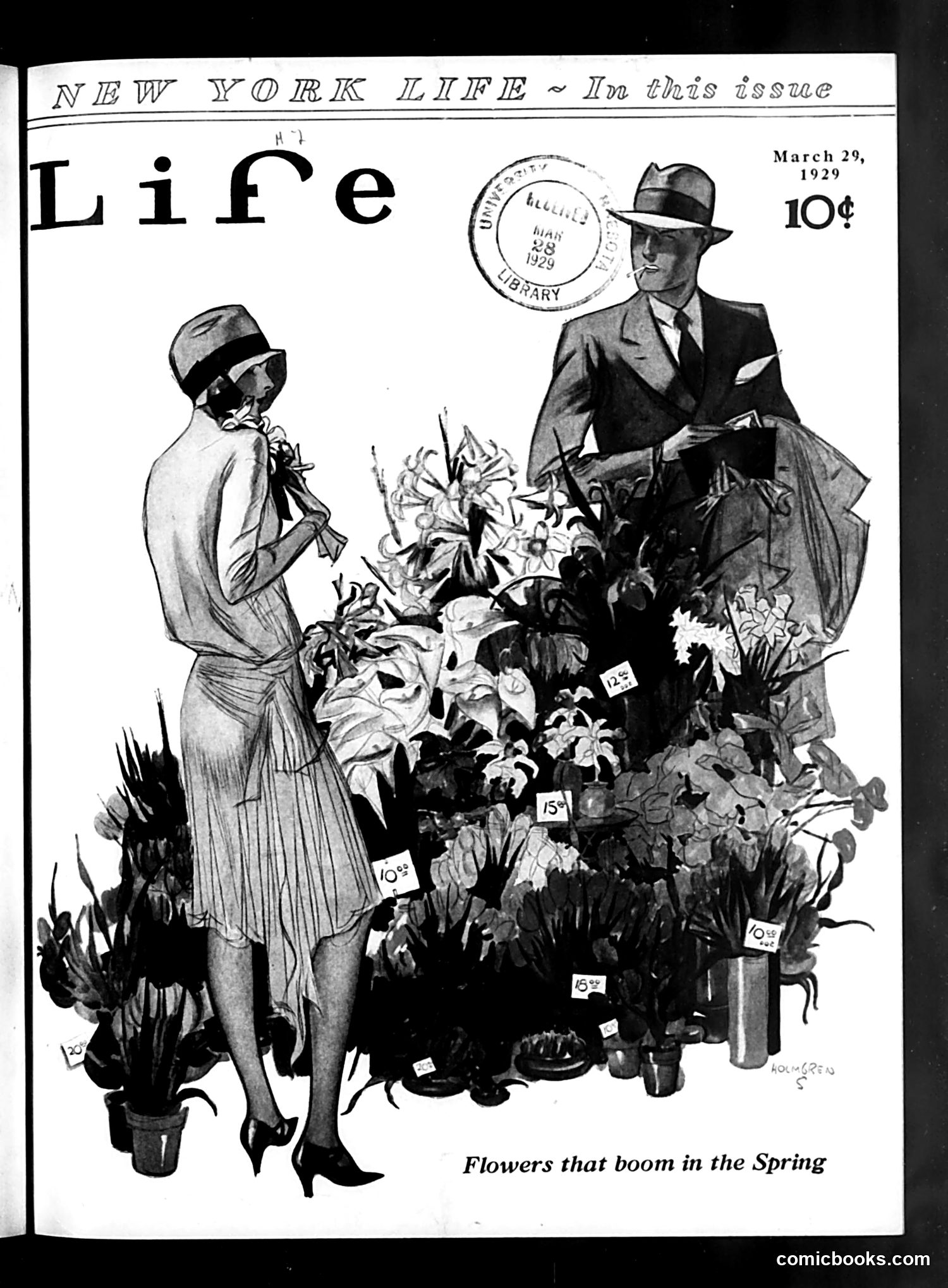
This Life magazine cover from March 29, 1929 depicts two fashionable figures examining spring flowers with price tags attached to the plants. The caption references a famous Gilbert and Sullivan operetta lyric, suggesting seasonal renewal. The satire appears to target **commercialization of spring** — the flowers, typically symbols of natural growth and beauty, are reduced to priced commodities. The well-dressed man and woman seem to be evaluating purchases, with visible price labels marking each plant. This likely reflects **1920s consumer culture** and the commercialization of traditionally natural experiences. The cartoon criticizes how modern capitalism transforms even seasonal nature into a marketplace. The "spring" referenced in the operetta lyric becomes merely another consumer good rather than genuine renewal.
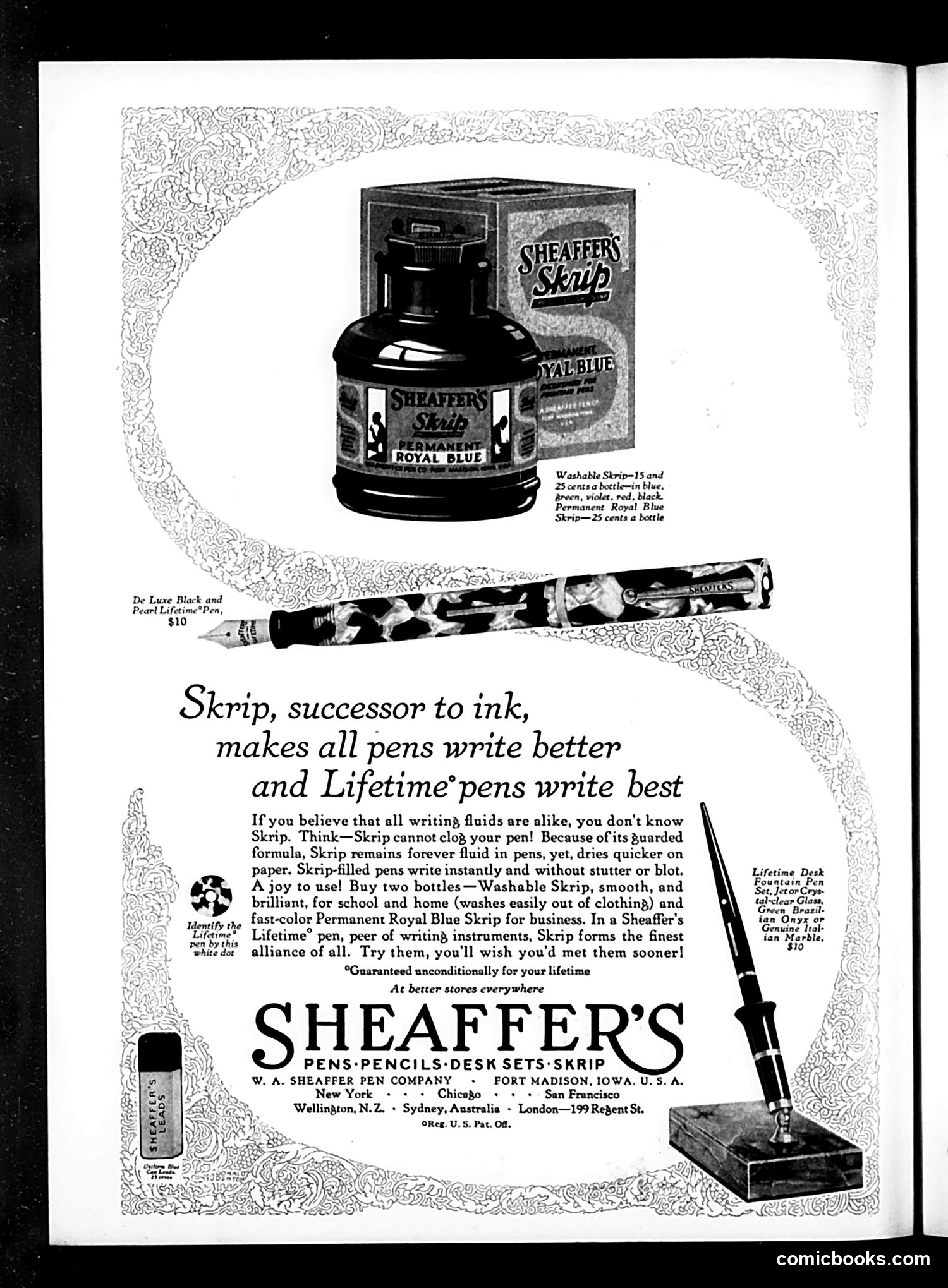
This is **not a political cartoon or satirical content** — it's a straightforward **advertisement for Sheaffer's writing instruments**, specifically their Skrip ink product and Lifetime pens. The page promotes Sheaffer's line of pens, pencils, desk sets, and Skrip brand ink, manufactured by the W.A. Sheaffer Pen Company in Fort Madison, Iowa. The ad claims Skrip ink won't clog pens and dries quickly, making it superior to competitors. It showcases various products including Royal Blue Skrip (25 cents per bottle), a decorative fountain pen ($10), and desk accessories. The ornamental border and vintage typography are typical 1920s-era advertising design. This appears to be a standard commercial advertisement rather than satirical editorial content.

This is primarily a **commercial advertisement**, not political satire. It promotes Timken tapered roller bearings for automobiles. The cartoon depicts a cheerful businessman in a car launching joyfully into the air, with dogs running alongside—visual metaphors for smooth performance and reliability. The headline "Cars That Stay Young" and "This Thing Called 'Spring'" use playful language to describe the technical benefits of Timken bearings in providing shock absorption, torque management, and speed. The ad targets car dealers and owners, emphasizing that "Timken-Equipped" vehicles maintain their performance over time. The satirical tone is gentle—mocking motorists' enthusiasm for this mechanical feature while positioning it as desirable and exclusive. Published in Life magazine (March 29, 1929), this reflects pre-Depression consumer optimism about automobiles.
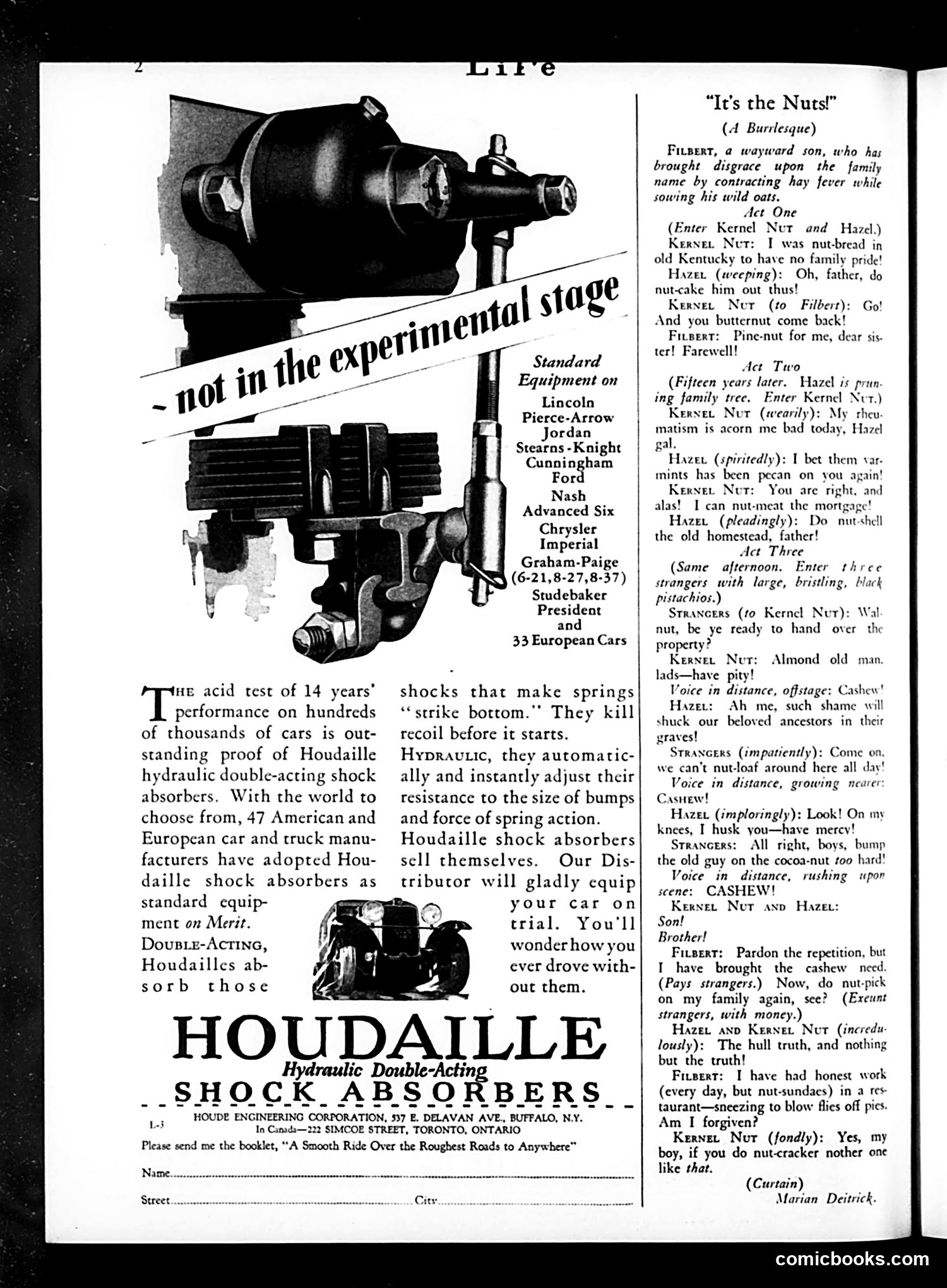
This page is primarily a **Houdaille shock absorber advertisement**, not a political cartoon. The ad occupies most of the space with technical details about hydraulic suspension systems used in 47 American and European car models. The right side contains "**It's the Nuts**" — a brief **burlesque sketch** (comedic play) by Marian Deitrick. The comedy centers on a character named Filbert from Kentucky and his relatives (Kernel Nut, Hazel), playing on nut-related puns and family shame. The "nuts" are literal surnames used for wordplay humor. The sketch has no political content—it's simply absurdist comedy exploiting family shame, regional stereotypes, and puns. The page blends serious automotive advertising with lightweight theatrical entertainment typical of Life magazine's mixed content format.
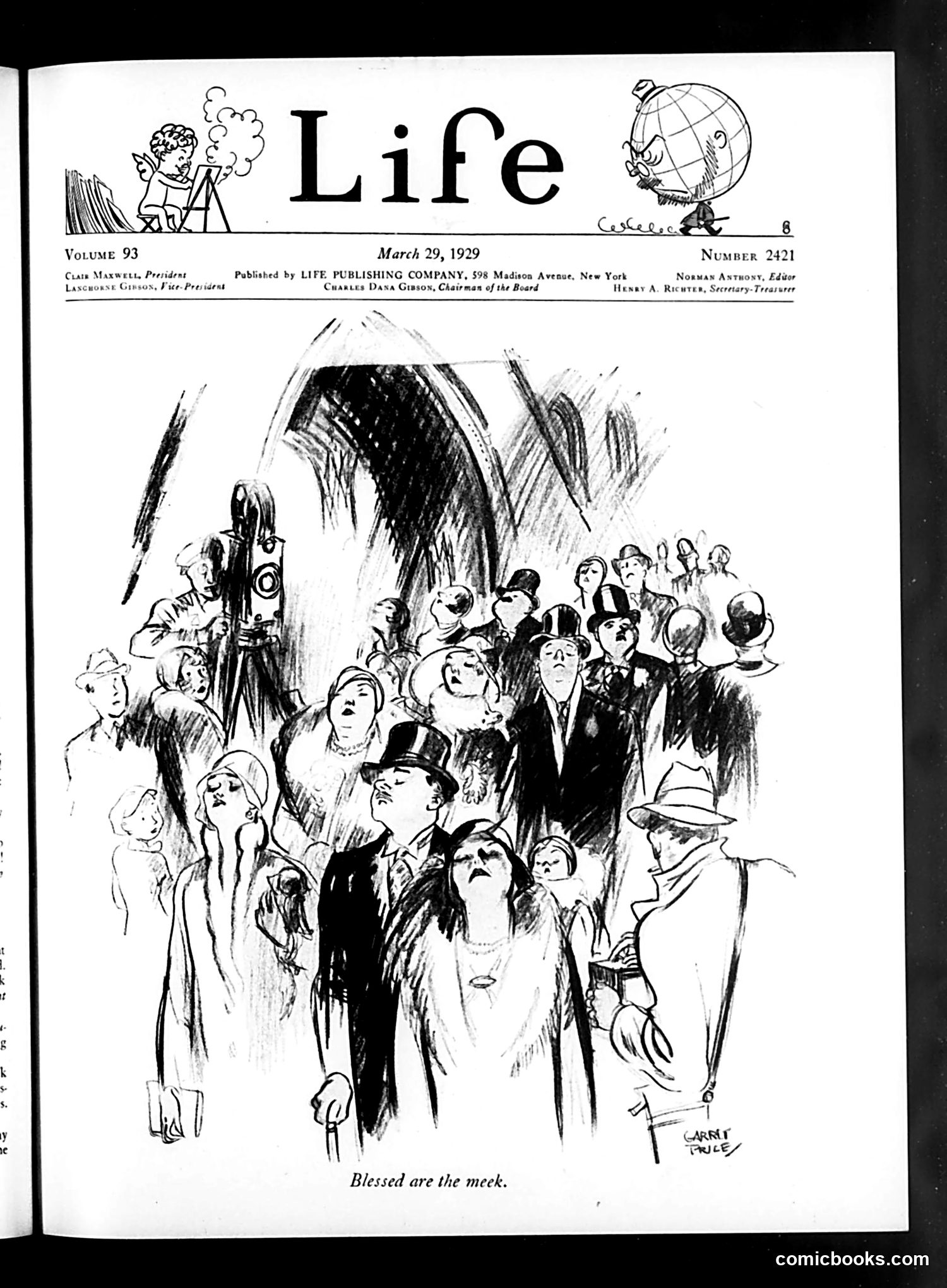
This cartoon depicts a crowd of people gazing upward with expressions of awe and reverence, accompanying the caption "Blessed are the meek." The imagery appears to be religious or spiritual satire, likely commenting on contemporary attitudes toward wealth, power, or authority figures. Given the 1929 date—just months before the stock market crash—the cartoon may satirize public reverence toward financial or industrial leaders of the Gilded Age. The "meek" reference suggests irony: those depicted are likely not actually meek but powerful individuals being treated with excessive deference by ordinary people below them. The artist, signed as "Cesare," uses the biblical phrase mockingly to critique social hierarchies and public worship of the wealthy or powerful during this pivotal moment in American history.
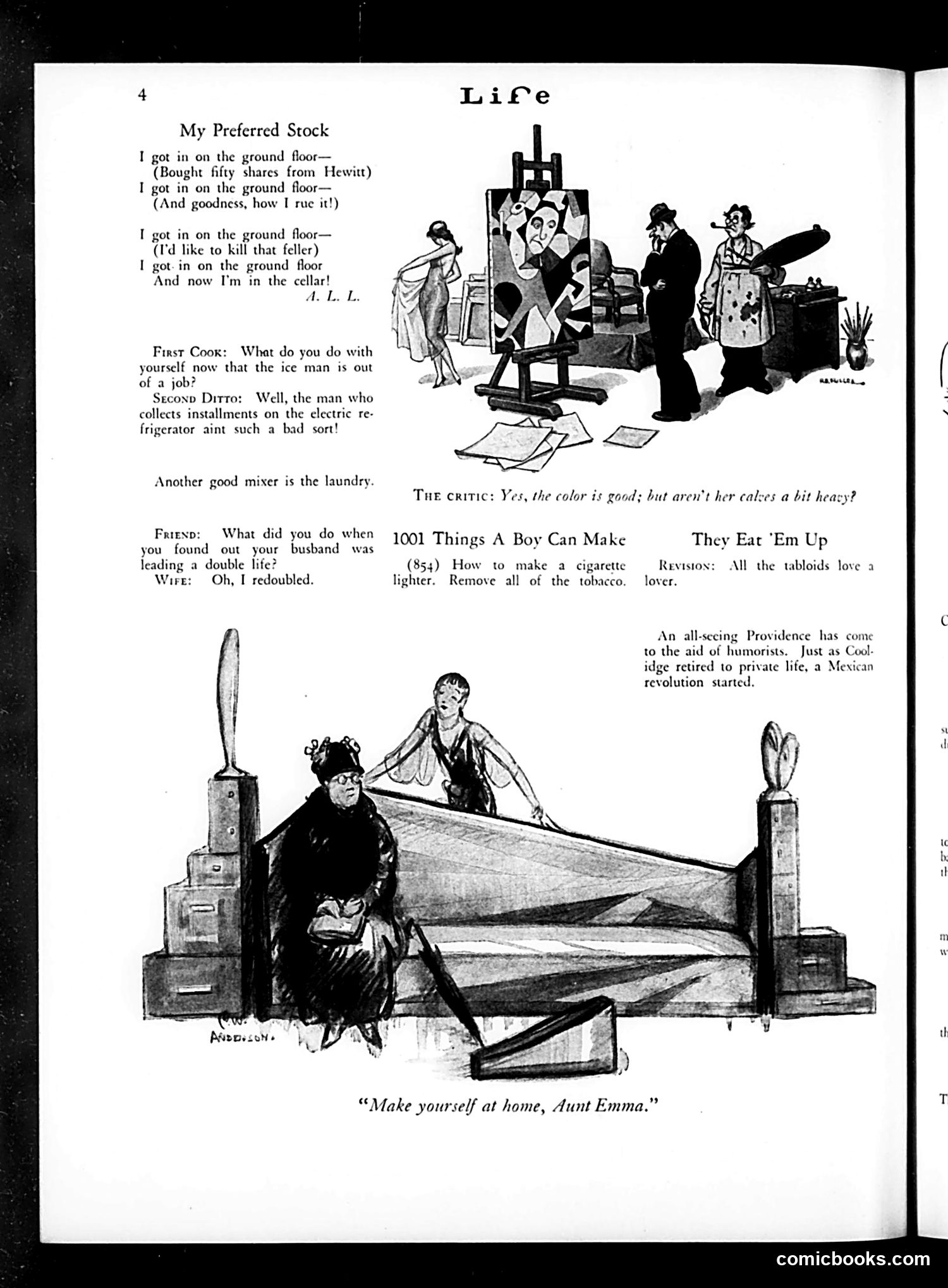
This page contains humor pieces satirizing early 20th-century domestic and social life. The top poem "My Preferred Stock" jokes about a person climbing corporate/social hierarchy by getting jobs on "ground floors," with the punchline that they're now "in the cellar"—suggesting downward mobility despite perceived advancement. The dialogue exchanges mock domestic situations: a cook discussing job prospects after the "ice man" loses work (refrigeration was replacing ice delivery), and a husband caught in infidelity. The illustrated joke "Make yourself at home, Aunt Emma" depicts a woman making an unwelcome houseguest comfortable by literally stretching her bed to accommodate her, a visual pun on the hospitable phrase. The final section references tabloid journalism and Mexican politics, though specifics are unclear without broader context.
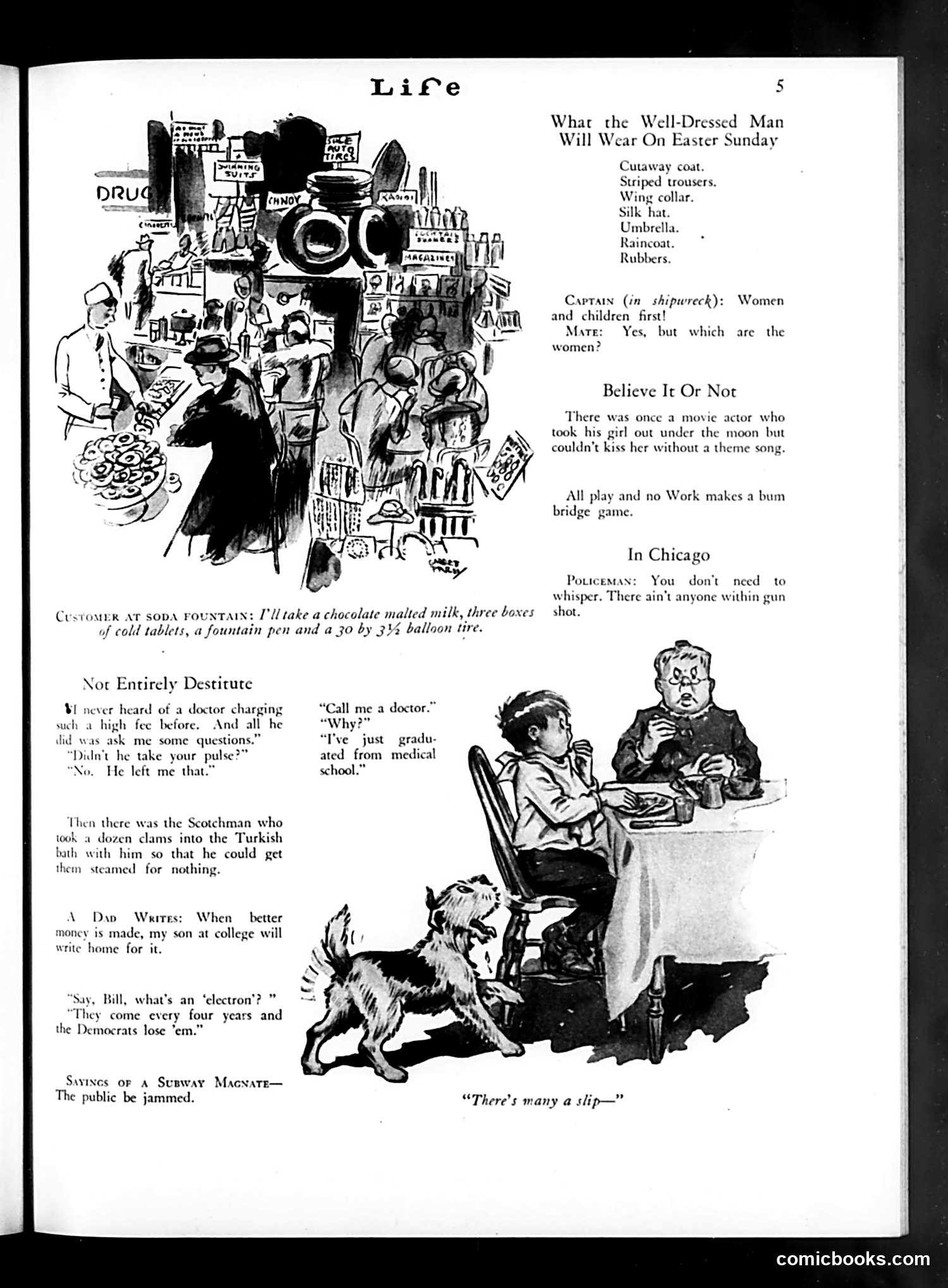
This page contains humorous anecdotes and satirical observations typical of Life magazine's format. Key content includes: **"What the Well-Dressed Man Will Wear On Easter Sunday"** — A straightforward fashion list for the holiday. **"Believe It Or Not"** — Humorous short stories, including one about a movie actor who required theme songs to kiss, and observations about work-life balance. **"In Chicago"** — A joke about police intimidation tactics. **"Not Entirely Destitute"** — Stories mocking various professionals: a doctor who charged nothing, a Scotsman economizing at a Turkish bath, and a "Dad Writer" expecting his college son to subsidize him. The bottom cartoon shows a young man introducing someone as "a doctor" recently graduated from medical school, with a dog present. The caption reads "There's many a slip," suggesting ironic skepticism about the graduate's qualifications.
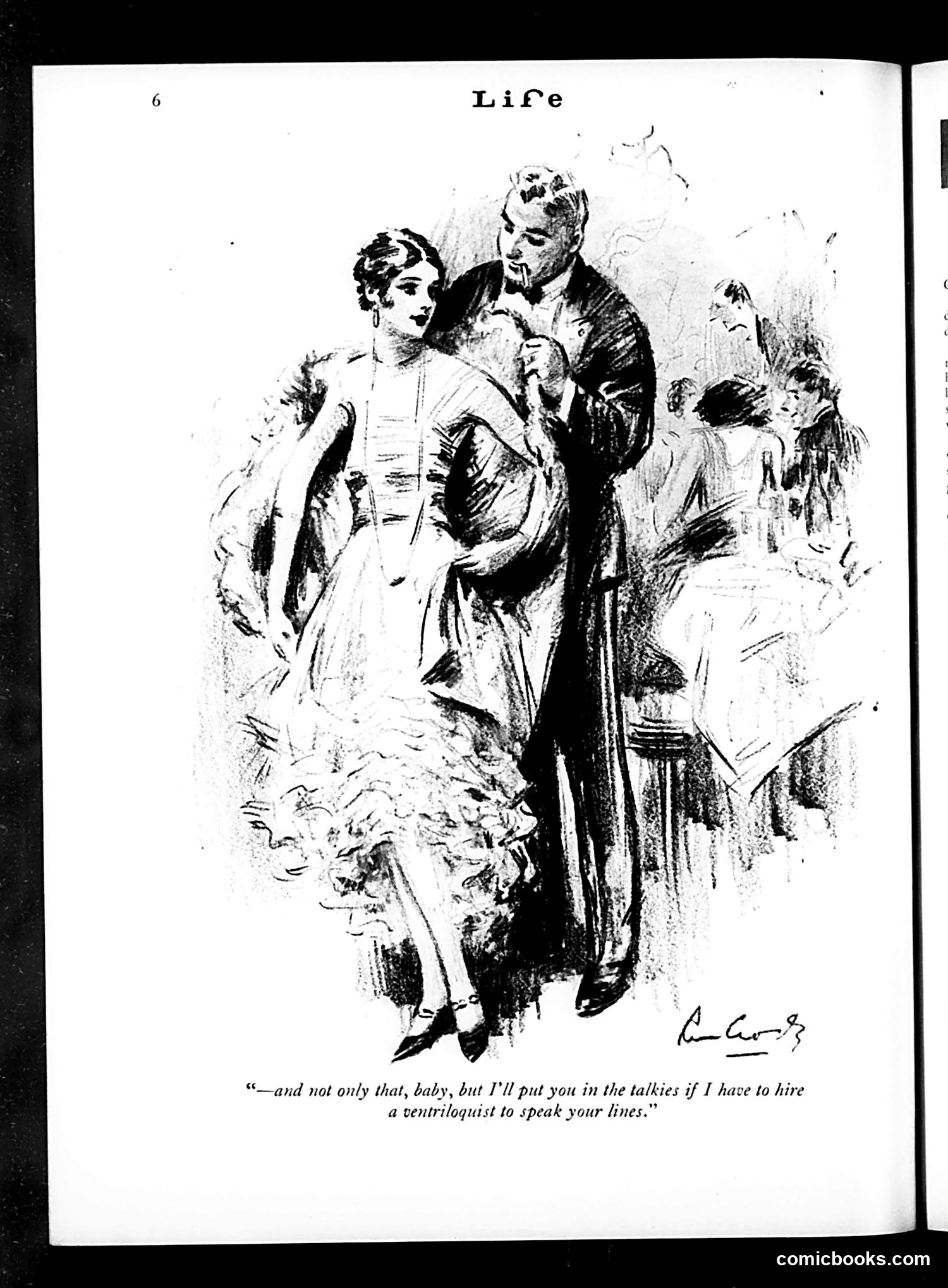
This is a single-panel cartoon from *Life* magazine depicting what appears to be a theatrical or film industry scene. A man in formal evening wear (tuxedo and bow tie) speaks to a woman in an elegant dress, with other figures visible in the background. The caption reads: "—and not only that, baby, but I'll put you in the talkies if I have to hire a ventriloquist to speak your lines." **The joke:** This satirizes the early "talkies" (sound films) era when silent film actors struggled to transition to talking pictures. The man is essentially offering the woman a film role while mocking her acting ability or voice—suggesting he'd need a ventriloquist to make her dialogue audible or acceptable. It's humor about Hollywood casting practices and the challenges posed by the new sound technology.
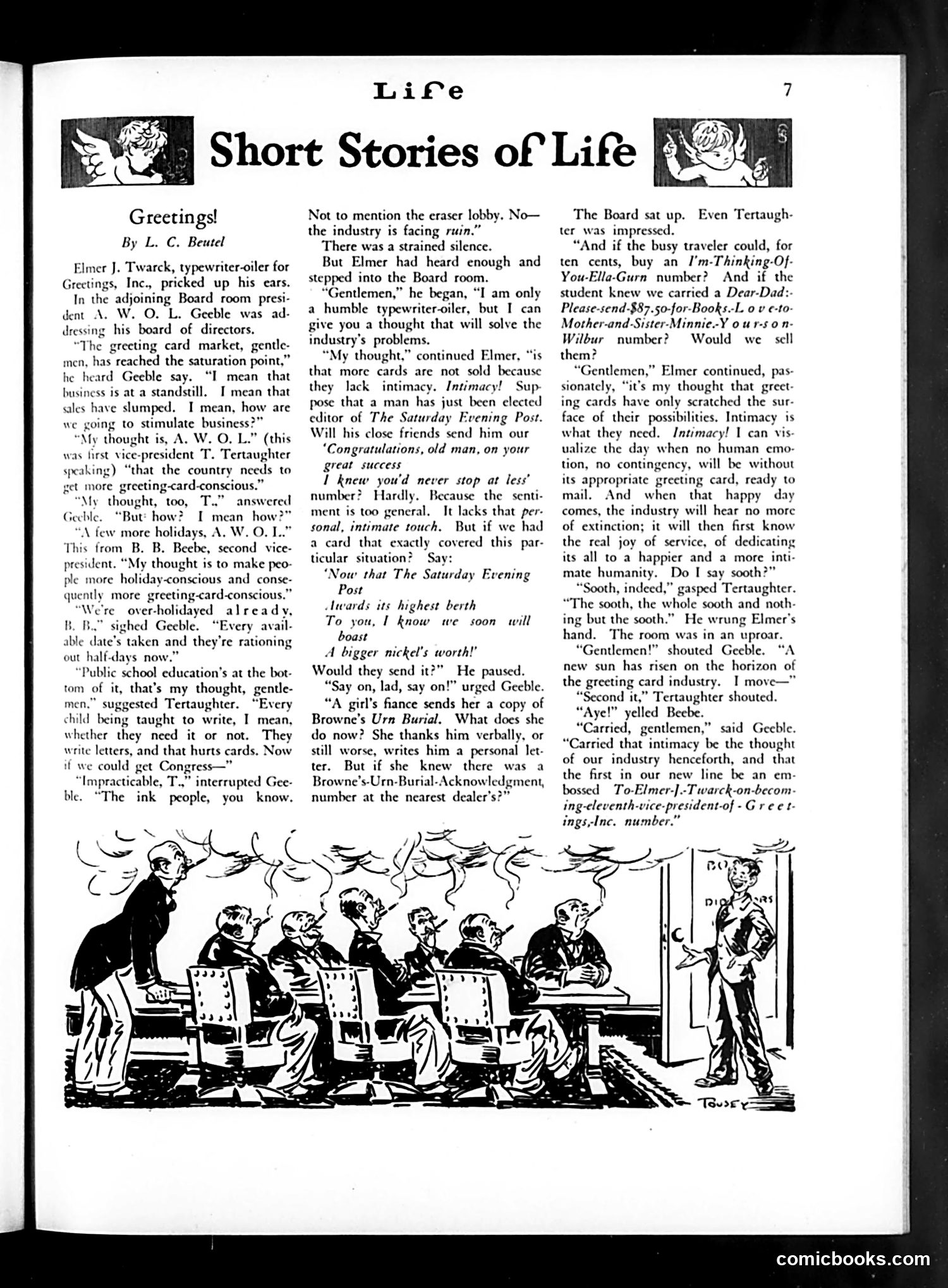
This story by L.C. Beutel satirizes the greeting card industry's business challenges. Elmer J. Twarck, a typewriter-oiler at Greetings, Inc., proposes that cards fail because they lack "intimate touch" and "personal feeling." He suggests cards need specific, targeted messages rather than generic sentiments. The cartoon illustrates businessmen at desks apparently struggling with the industry's stagnation. Twarck argues greeting cards should acknowledge life's specific moments—elections, engagements, job promotions—with personalized messages to feel meaningful. The satire mocks both corporate boardroom culture and the greeting card industry's attempt to commercialize human emotion, suggesting that mass-produced sentiment rings hollow without authentic particularity.
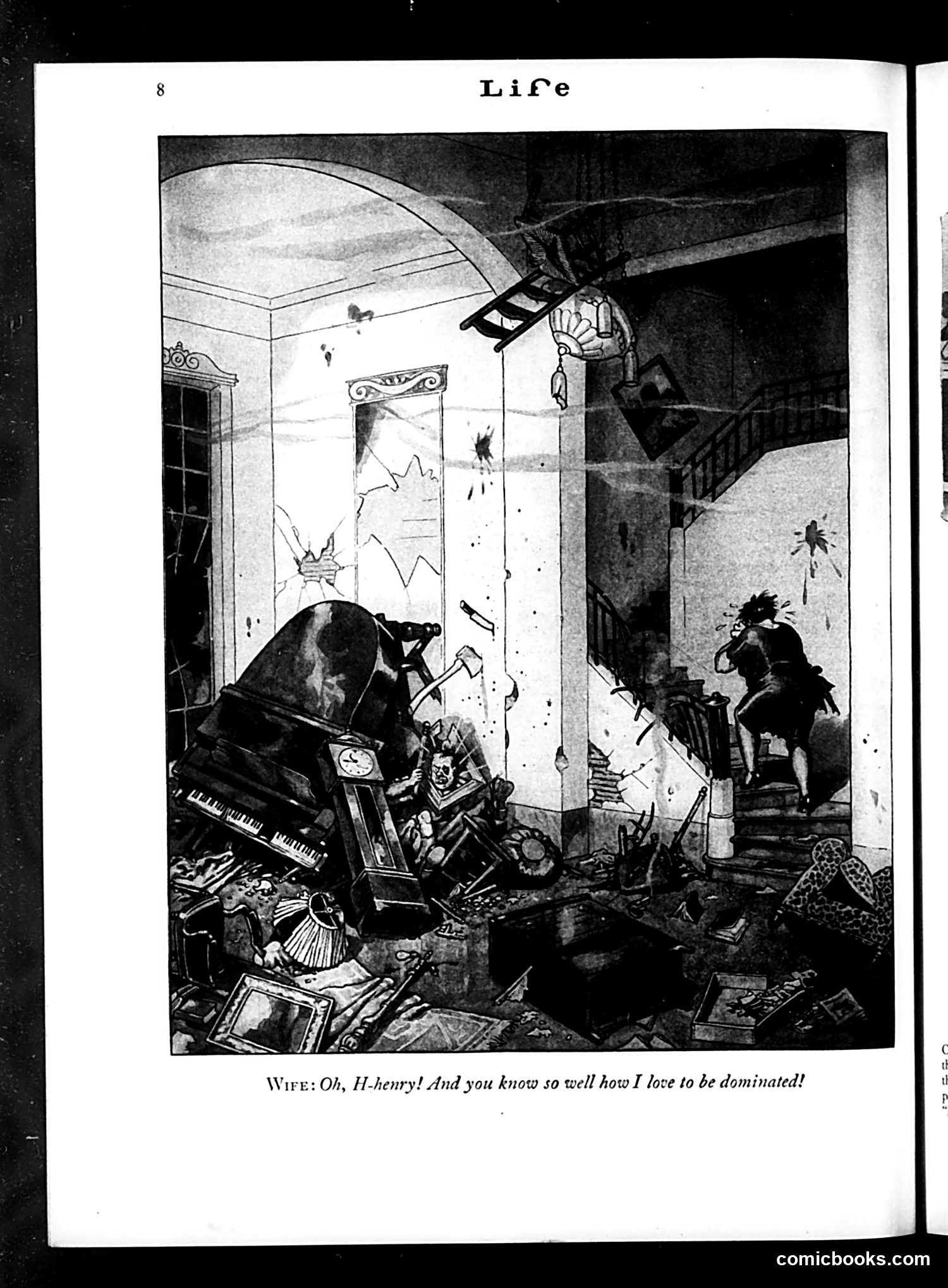
This page from Life magazine presents a domestic satire cartoon. The scene depicts a chaotic home interior where a husband (identified as "H-henry" in the wife's dialogue) sits surrounded by musical instruments, papers, and various objects in disarray. The wife stands nearby, addressing him with the caption: "Oh, H-henry! And you know so well how I love to be dominated!" The satire mocks the gender dynamics of early-to-mid 20th century marriage, specifically the contradiction between wives' stated desire for male authority and the reality of domestic chaos. The husband's complete failure to maintain household order—despite his wife's proclamation that she enjoys being dominated—suggests the satirist is commenting on the gap between traditional gender role expectations and actual household management. The visual clutter emphasizes male incompetence in domestic matters.
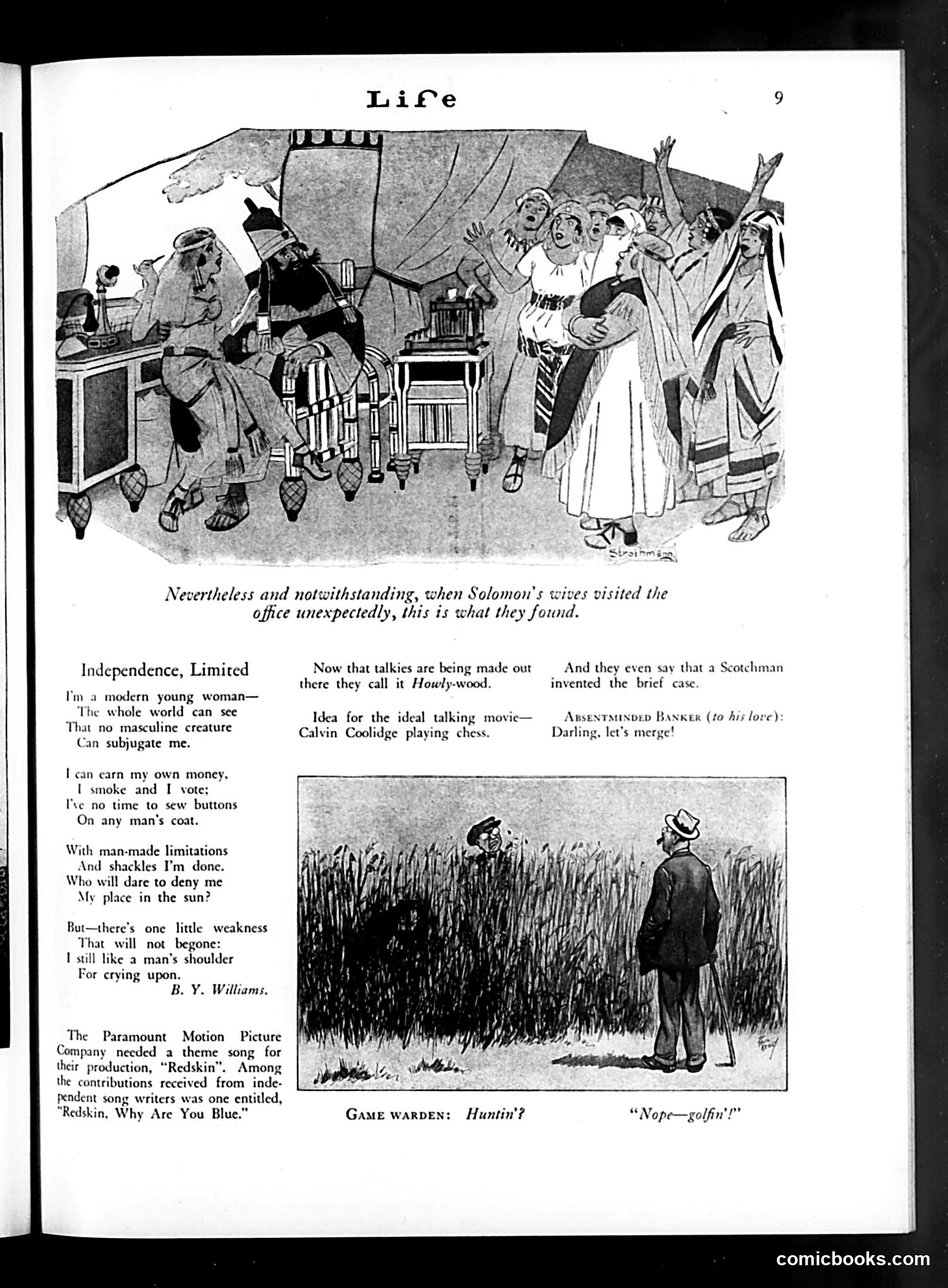
This page satirizes women's liberation and changing gender roles in what appears to be the 1920s era. The top cartoon shows Solomon's wives visiting his office unexpectedly, finding it in disarray—a visual joke about men's incompetence in domestic/professional spaces when women aren't managing them. Below, the poem "Independence, Limited" by B.Y. Williams mocks a "modern young woman" who claims independence, smokes, votes, and refuses domestic duties ("no time to sew buttons / On any man's coat"). The satirical twist: despite rejecting femininity, she still wants "a man's shoulder / For crying upon"—suggesting women can't truly escape traditional emotional dependence. The bottom cartoon shows two men in a wheat field; one asks "Huntin'?" The other replies "Nope—golfin'!" —apparently mocking upper-class leisure pursuits or masculine affectation.
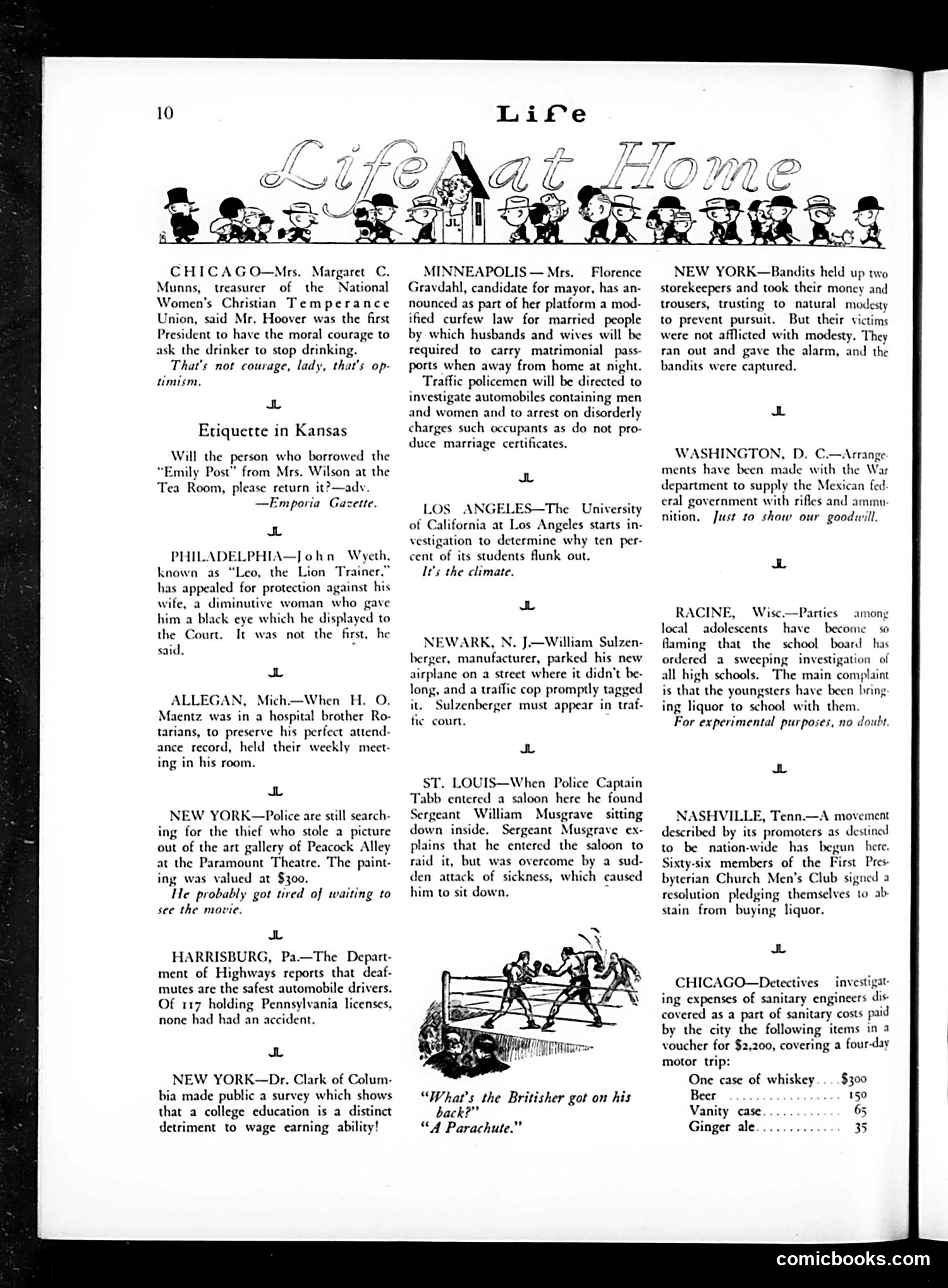
This is a satirical news digest page from *Life* magazine featuring humorous anecdotes about American social behavior and legal/moral controversies of the era. The cartoon shows two men fighting over what appears to be a parachute, captioned "What's the Britisher got on his back? A Parachute." This likely mocks British military preparedness or stereotypes about British soldiers. The text items satirize Prohibition-era concerns (liquor smuggling, saloon visits), automotive culture, women's suffrage activism, and municipal governance. Notable is the Minneapolis item about a "rural curfew law for married people" requiring spouses away from home at night—clearly absurd social engineering being mocked. The Chicago item at bottom itemizes sanitary engineers' motor trip expenses, sarcastically highlighting government waste ($3 for whiskey, beer, etc.).
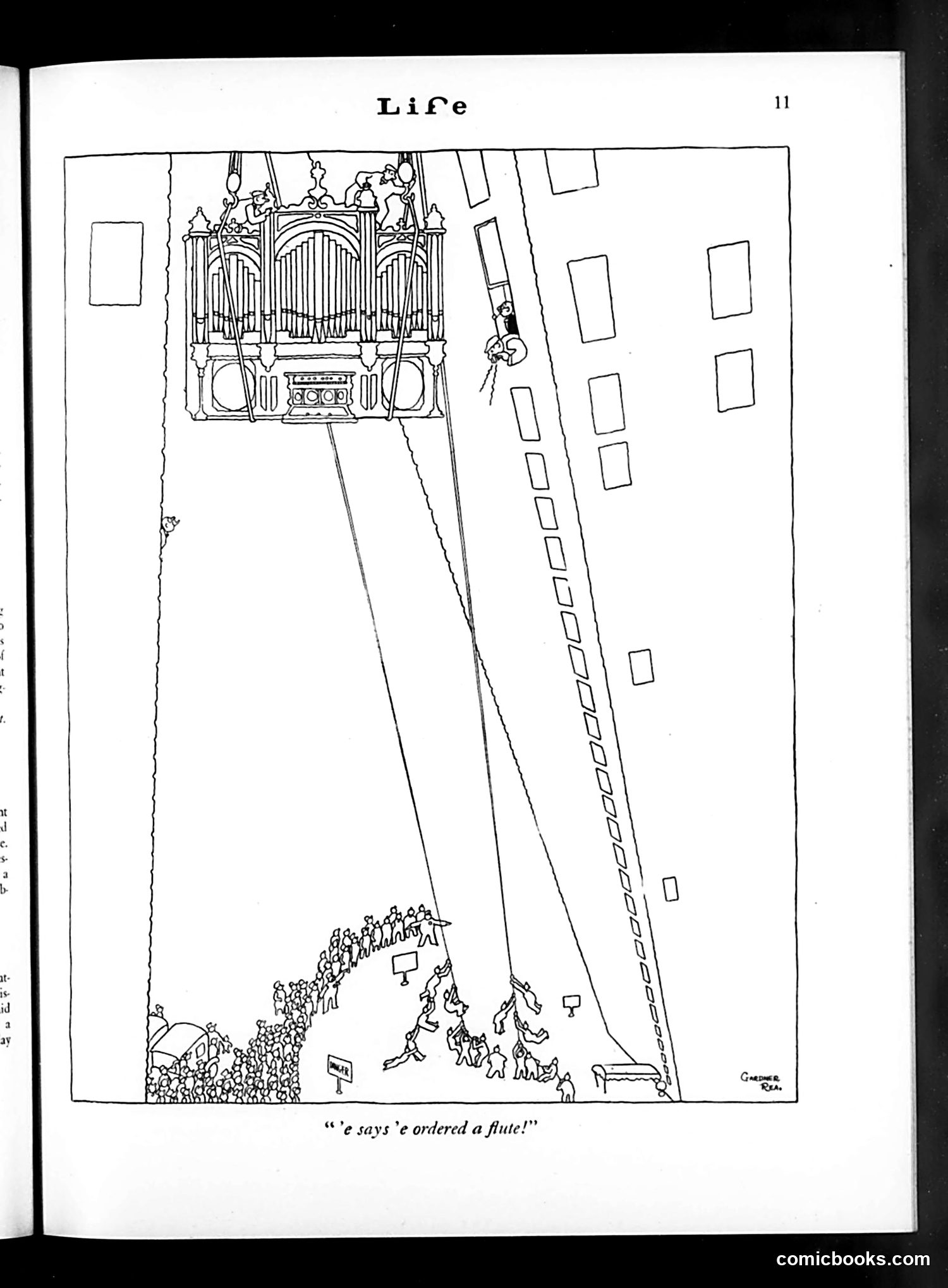
This is a single-panel cartoon from *Life* magazine (page 11) depicting a massive pipe organ in a cathedral-like setting with a crowd of people far below. A figure appears to be descending or being lowered on ropes near the organ. The caption reads: "'e says 'e ordered a flute!" The satire appears to mock a comical miscommunication: someone ordered a "flute" (the musical instrument), but instead received an enormous pipe organ. The visual joke emphasizes the absurd scale difference—the organ dominates the composition while the person requesting it is tiny and distant. This plays on the humor of literal misunderstanding in orders or communication, a common satirical theme in early 20th-century humor magazines.
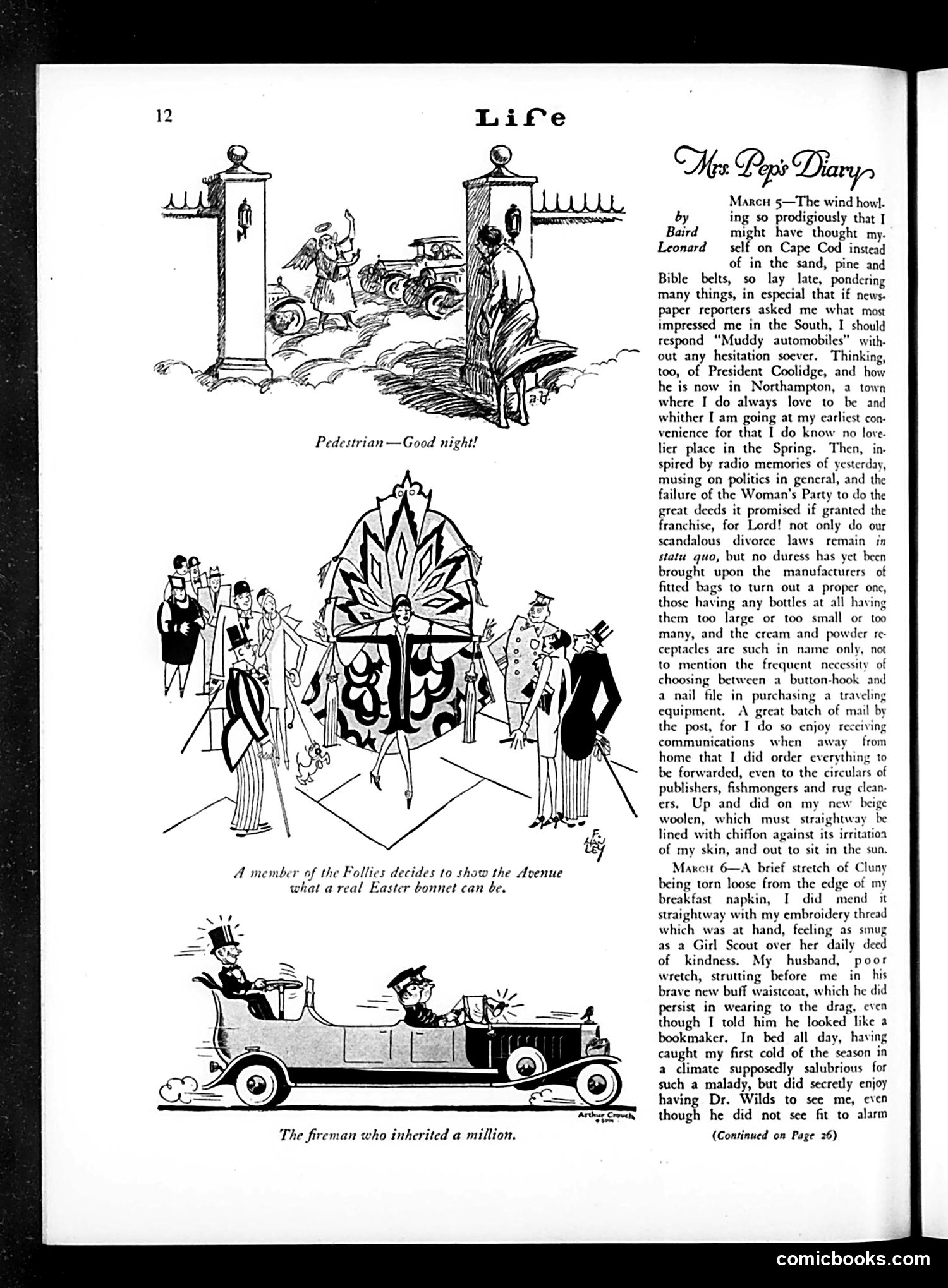
This page contains **Mrs. Peps Diary** — a satirical column about upper-class social life. The three cartoons illustrate entries from March 5-6. The top cartoon shows a traffic accident ("Pedestrian—Good night!"), satirizing dangerous automobile culture. The middle cartoon depicts fashionable women at an Easter parade, mocking extravagant millinery and women's fashion obsession. The caption notes a woman displaying an elaborate bonnet. The bottom cartoon shows "The fireman who inherited a million"—a working-class figure suddenly wealthy, suggesting satire about social mobility and how newfound riches change behavior. The diary text itself critiques political disappointments (women's suffrage/voting rights failure), consumer culture, and domestic frustrations with husbands and servants—typical satirical targets of 1920s-era Life magazine's commentary on American society.
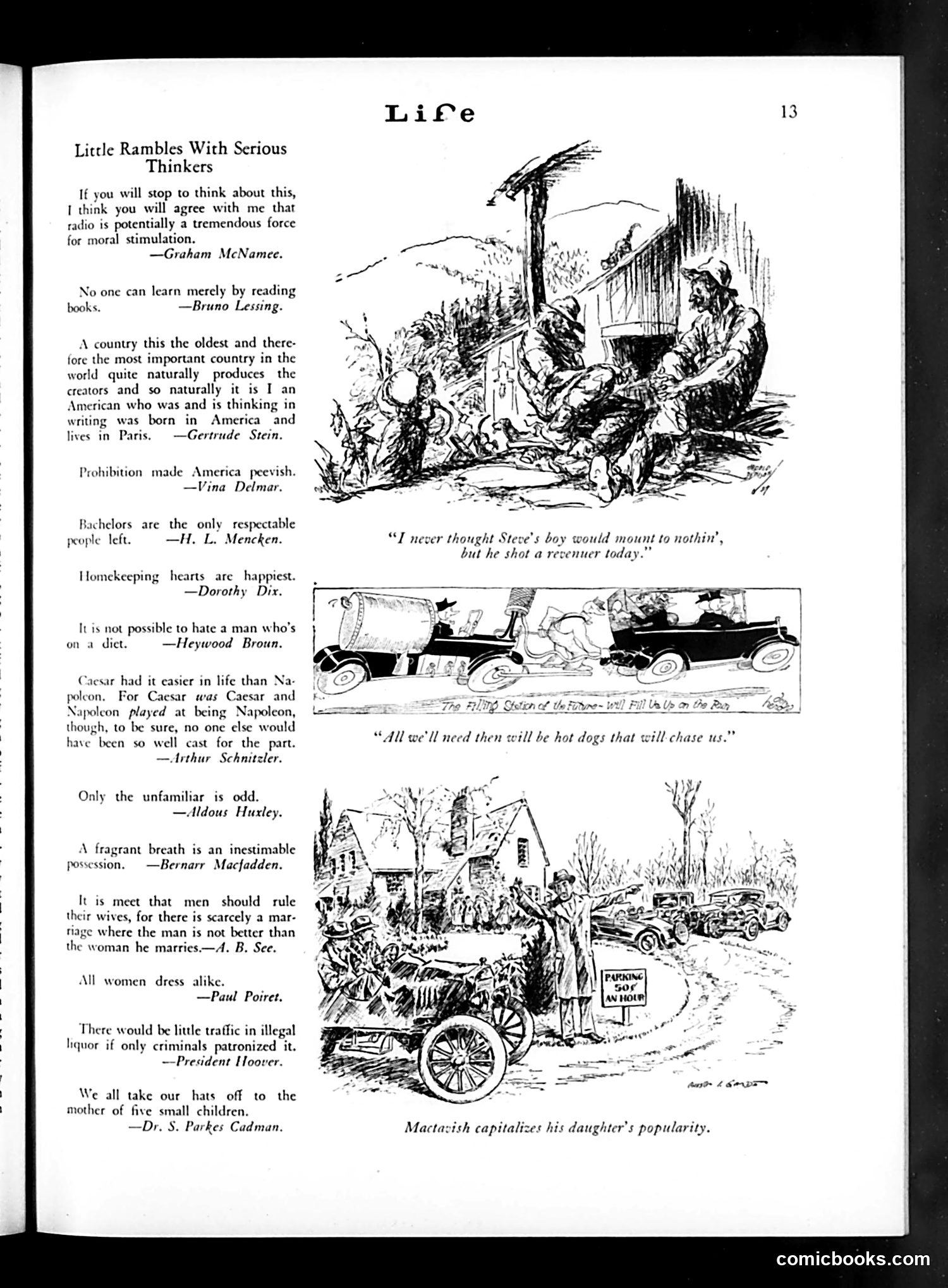
This page collects satirical quotes ("Little Rambles With Serious Thinkers") alongside three cartoon illustrations mocking 1920s American life. **Top cartoon**: A rural scene where a boy has mounted what appears to be a cow or large animal, captioned about "Steve's boy" becoming a "rescuer today"—likely satirizing exaggerated rural or frontier mythology. **Middle cartoon**: Shows a car accident with the caption about "hot dogs that will chase us," apparently mocking Prohibition-era anxieties and automotive culture's rapid expansion. **Bottom cartoon**: Depicts a father profiting from his daughter's popularity with suitors parked outside their home, labeled "Maztazish capitalizes his daughter's popularity"—social satire about parents exploiting their children's romantic appeal for financial gain. The page overall ridicules contemporary American values: consumerism, Prohibition, automotive obsession, and commercialized romance.
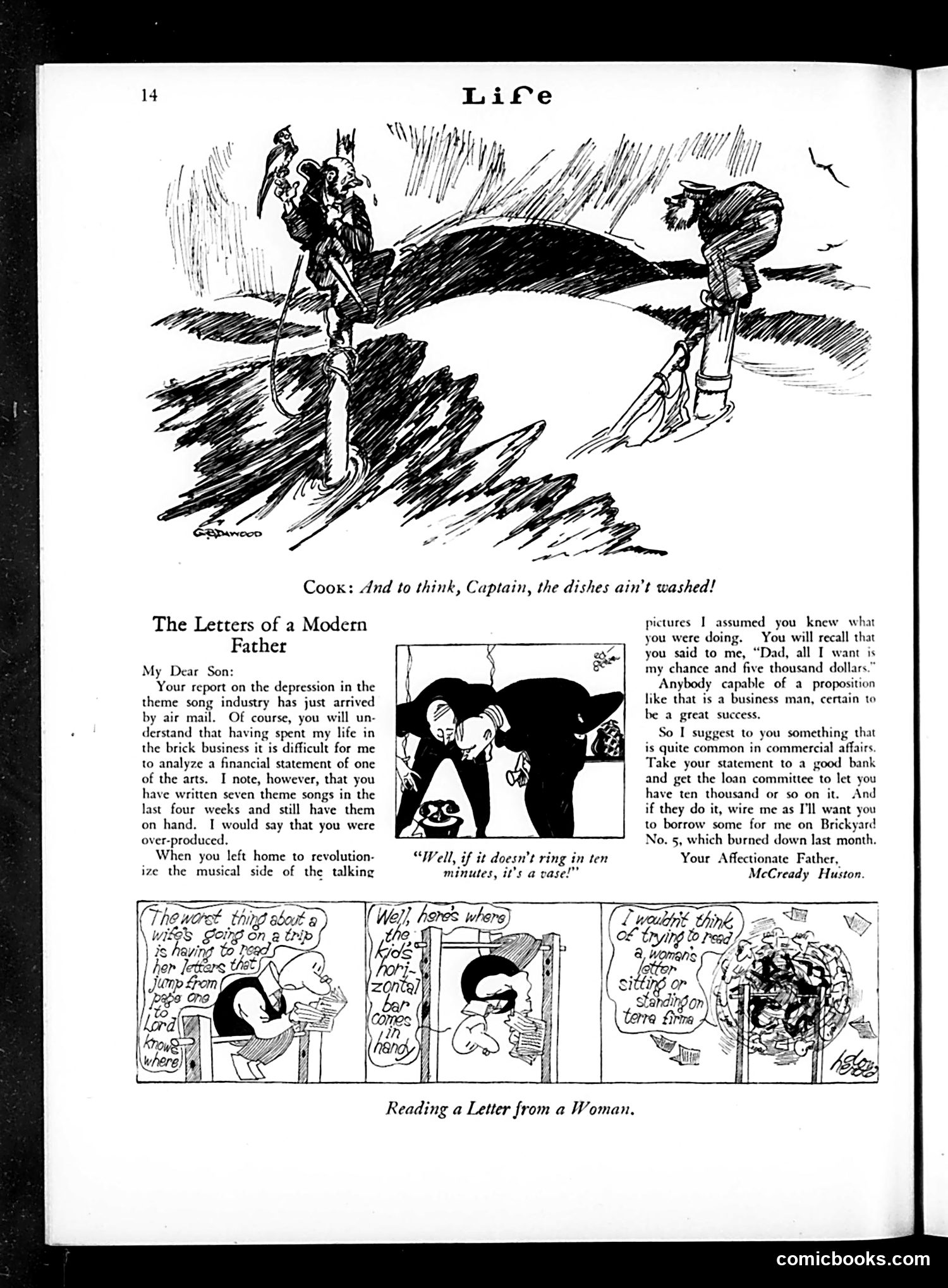
**Top cartoon:** Two figures on skis encounter a large bird. The caption reads "Cook: And to think, Captain, the dishes ain't washed!" This appears to be a humorous military scene, likely referencing naval or expedition life where mundane domestic chores persist even in extreme circumstances. **"The Letters of a Modern Father":** A father advises his son on business matters—specifically obtaining a bank loan to rebuild a property on Brickyard No. 5 that "burned down last month." The satire targets how fathers dispense financial advice, and perhaps the casualness with which business property is destroyed and rebuilt. **Bottom comic strip:** "Reading a Letter from a Woman" depicts a man struggling to decipher a woman's handwriting while reading correspondence. The joke plays on the stereotype of illegible female penmanship—a common early-20th-century comedic trope.
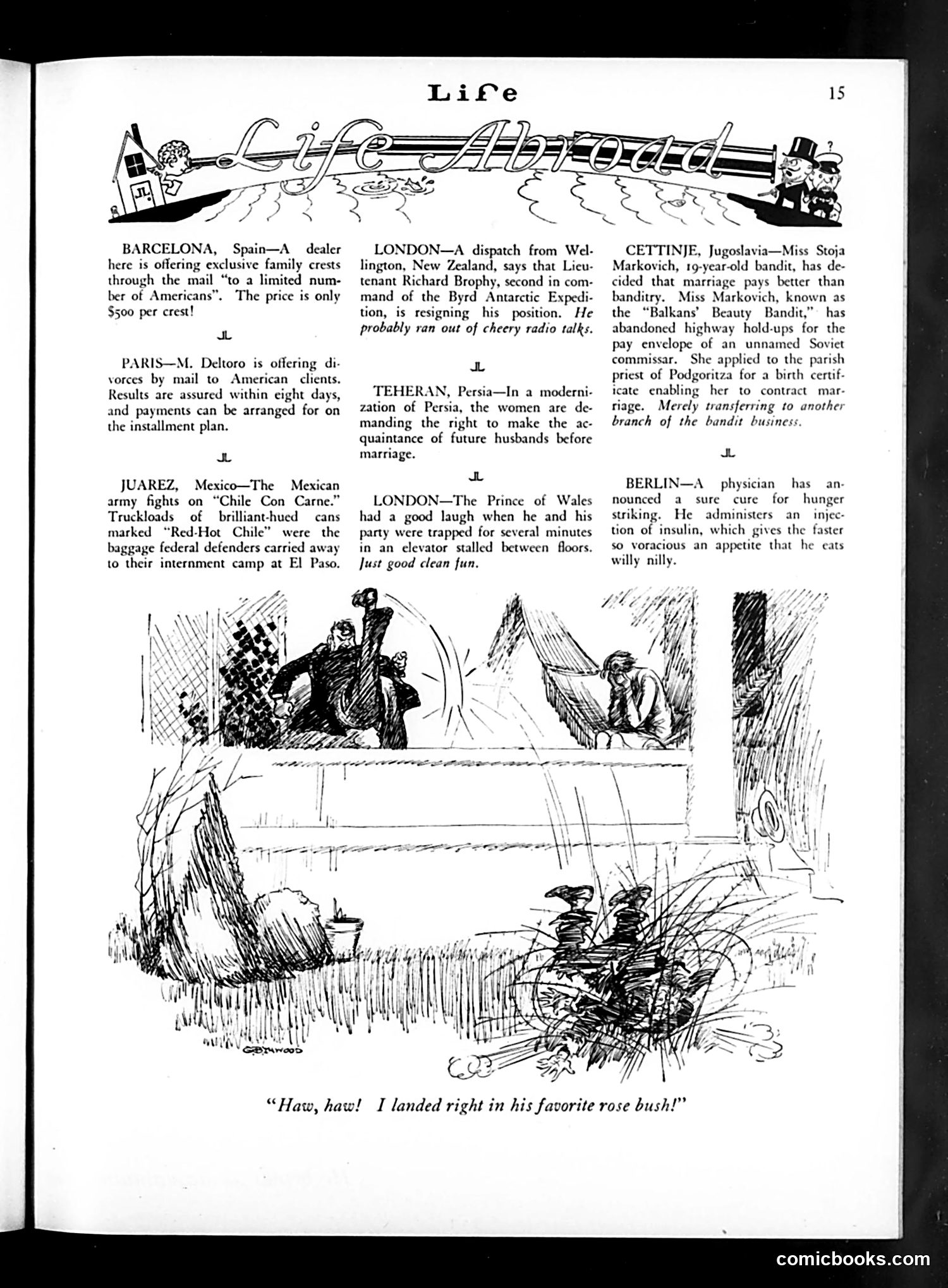
This page from *Life* magazine contains brief news-style humor items and one cartoon. The cartoon depicts someone who has crashed through a window into a garden, landing in a rose bush. The caption reads: "Haw, haw! I landed right in his favorite rose bush!" The joke appears to be slapstick humor about an accident—someone falling from an upper floor (visible in the background) and ending up in a garden below. The humor relies on physical comedy: the irony that despite the violent fall, the person lands in something soft (a rose bush), and the homeowner's amusement at the specific misfortune of it being *his* cherished roses that cushioned the impact. The surrounding news items are brief satirical snippets about international and domestic topics from the era, mixing the absurd with the mundane.
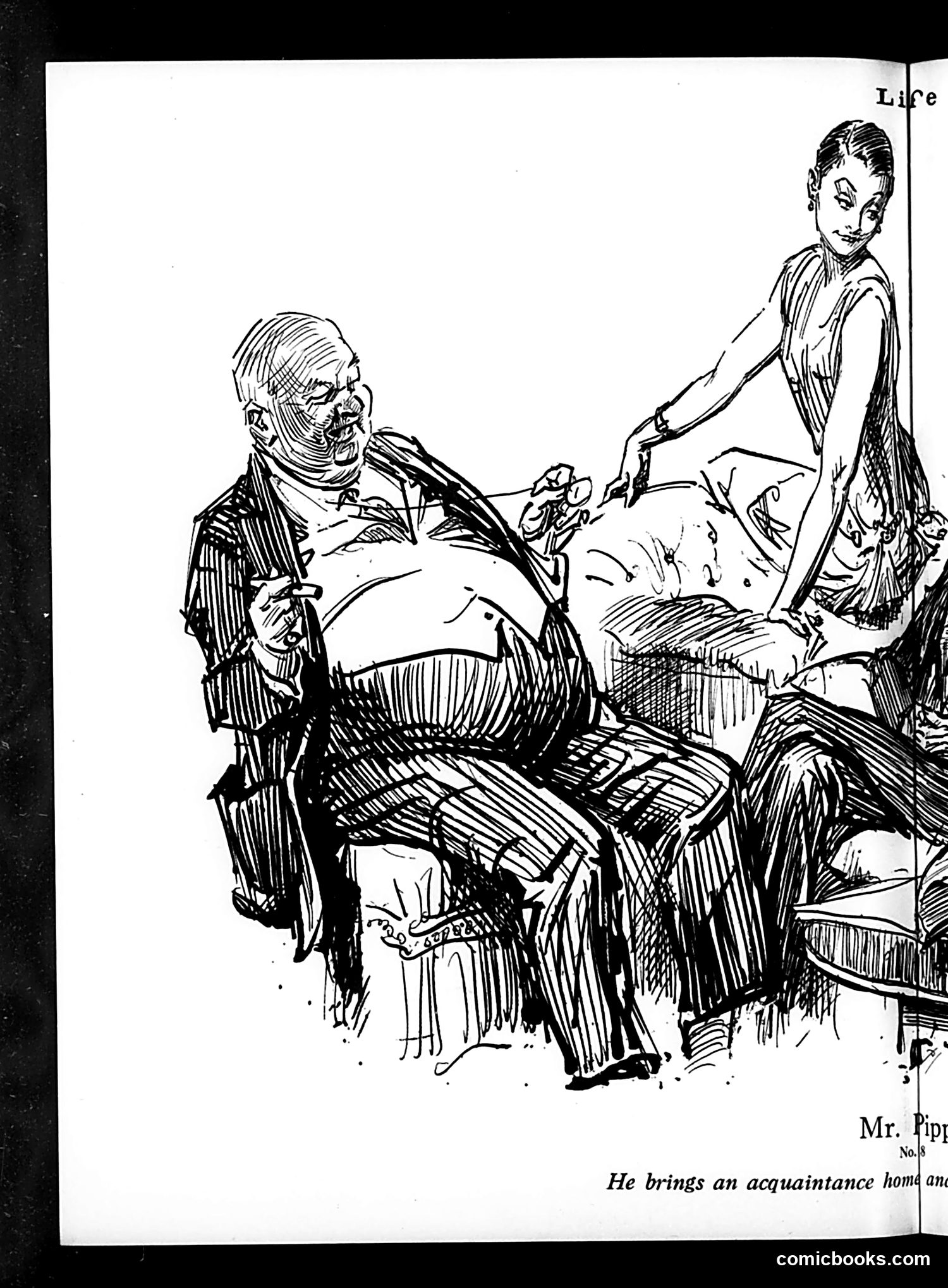
This appears to be a satirical illustration from *Life* magazine showing a scene titled "He brings an acquaintance home and—" (caption incomplete). The cartoon depicts a portly, older gentleman in a suit seated while a woman stands beside him, seemingly in a domestic setting. The text references "Mr. Pip" (visible at bottom right), though I cannot definitively identify which historical or public figure this caricatures without additional context. The illustration satirizes what appears to be a social situation involving unexpected guests or awkward domestic moments—a common *Life* magazine theme mocking middle-class social conventions and domestic life. The heavy cross-hatching and expressive linework are characteristic of early-to-mid 20th century satirical illustration, but the specific social commentary remains unclear without the complete caption.
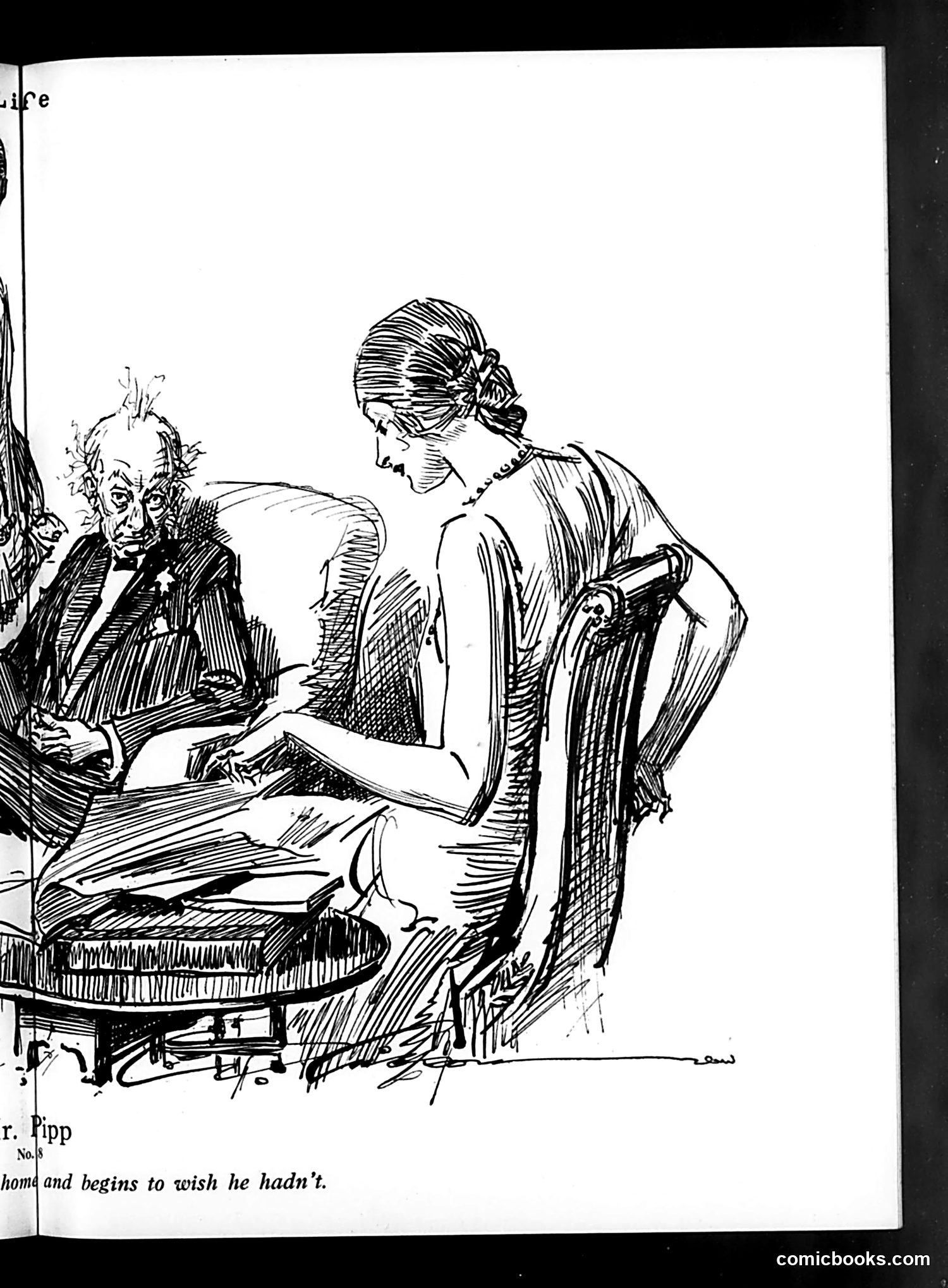
This illustration shows two figures in what appears to be an office or formal setting. An older, stern-looking man in a suit sits at a desk examining documents, while a well-dressed woman stands nearby. The caption's visible fragment reads "...home and begins to wish he hadn't." The sketch is credited to "r. Pipp" (No. 8), suggesting this is one installment in a serialized comic or satirical series from *Life* magazine. Without the complete caption, the exact satirical point is unclear, but the scenario appears to depict a domestic or romantic situation involving paperwork—possibly commenting on marriage, legal matters, or business dealings between the sexes. The woman's confident posture and the man's concerned expression suggest the humor involves the woman gaining advantage or the man regretting his involvement.
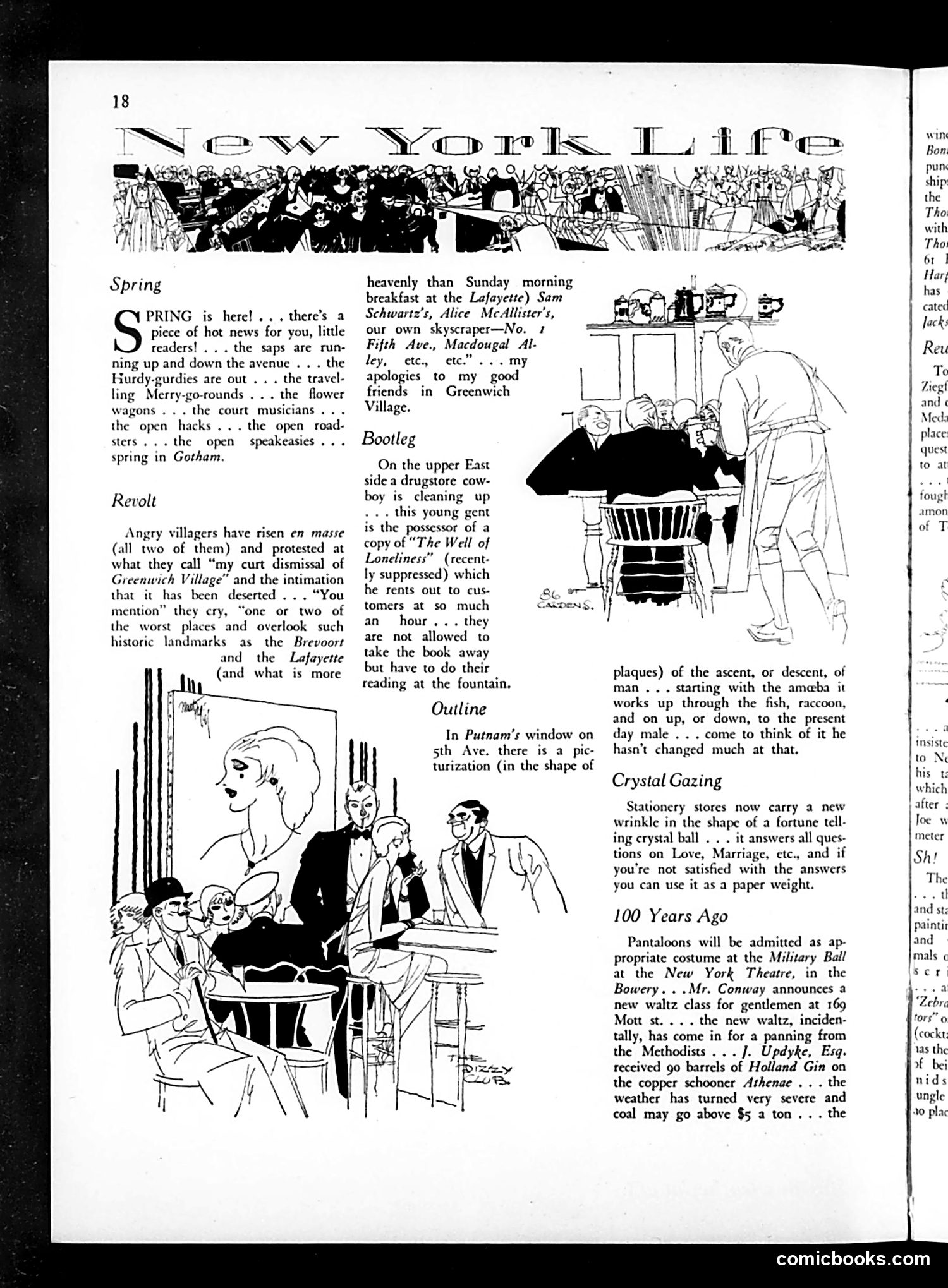
This page contains several satirical sections about New York City life, circa early 20th century: **"Spring"** mocks the season's arrival and tourist behavior in Gotham (New York). **"Revolt"** describes villagers protesting the neglect of historic landmarks like the Brevoort and Lafayette, suggesting urban decay and indifference to preservation. **"Bootleg"** satirizes a young man displaying a copy of "The Well of Loneliness" (a suppressed novel) at a drugstore fountain, joking about forbidden literature and social propriety. **"Outline"** features an illustration of what appears to be a socialite with admirers, likely satirizing high society pretension. **"Crystal Gazing"** mocks fortune-telling trends among the wealthy. **"100 Years Ago"** humorously contrasts past announcements with present-day concerns, including military balls, new dances, and gin smuggling during Prohibition.
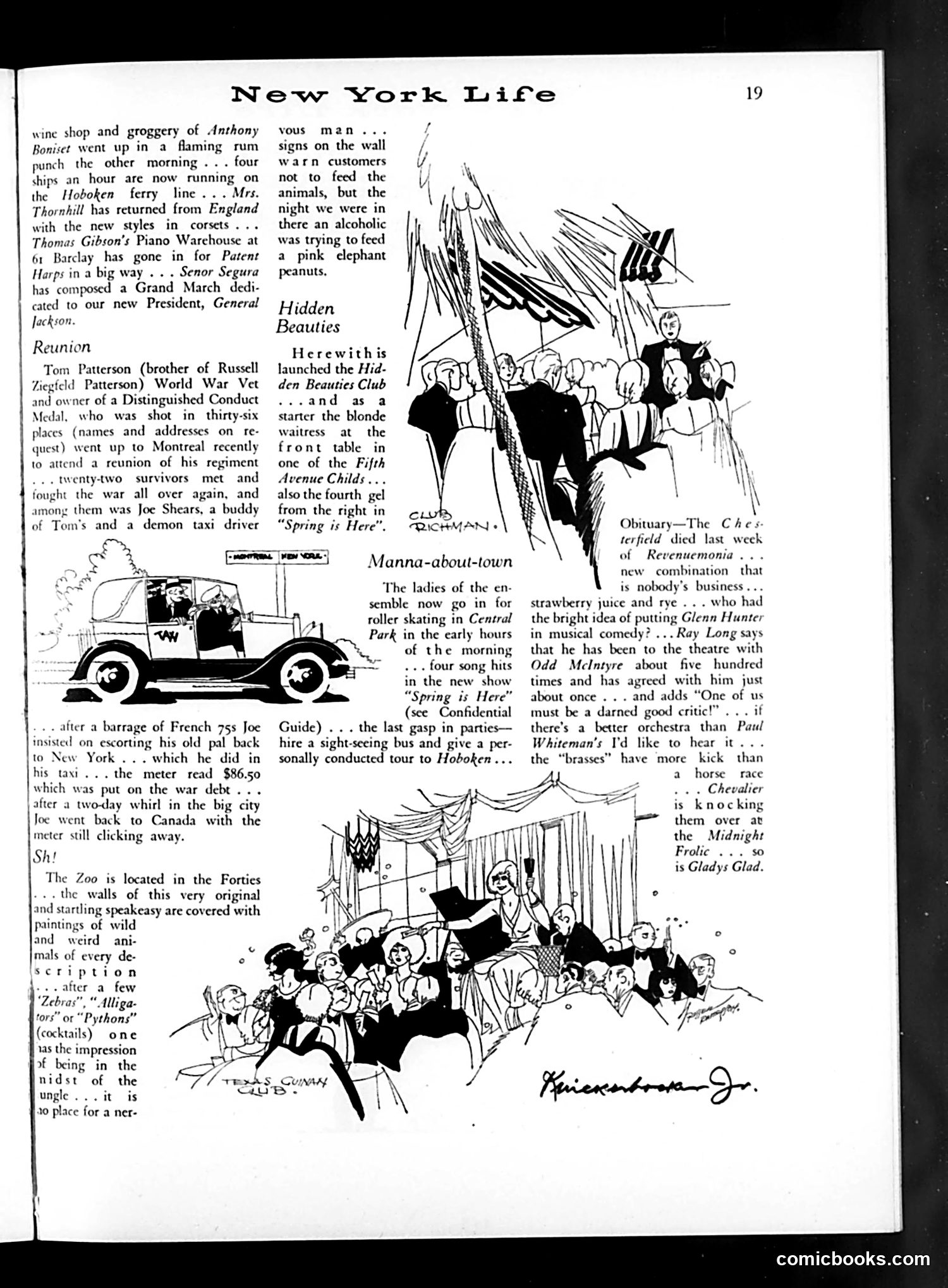
This is a satirical gossip and humor column from Life magazine documenting Manhattan social scenes and entertainment. The page includes several cartoon vignettes: **"Reunion"**: Describes a World War veteran attending a regimental gathering in Montreal, mentioning a buddy named Joe Shears who later charges a $86.50 taxi ride back to New York to "the war debt"—satirizing post-war financial chaos. **"Hidden Beauties Club"**: A humorous column launching a club featuring attractive women, including a blonde waitress and performers from the show "Spring is Here." **"Manna-about-Town"**: Social commentary on ladies roller-skating in Central Park and theater/entertainment gossip, mocking pretentious theatrical types and orchestras. **"Sh!"**: Describes "the Zoo," a Prohibition-era speakeasy decorated with wild animal paintings, where cocktails are humorously named after animals ("Alligators," "Pythons"). The cartoons and text reflect 1920s urban sophistication, theatrical culture, Prohibition-era speakeasies, and post-WWI social life in New York City.
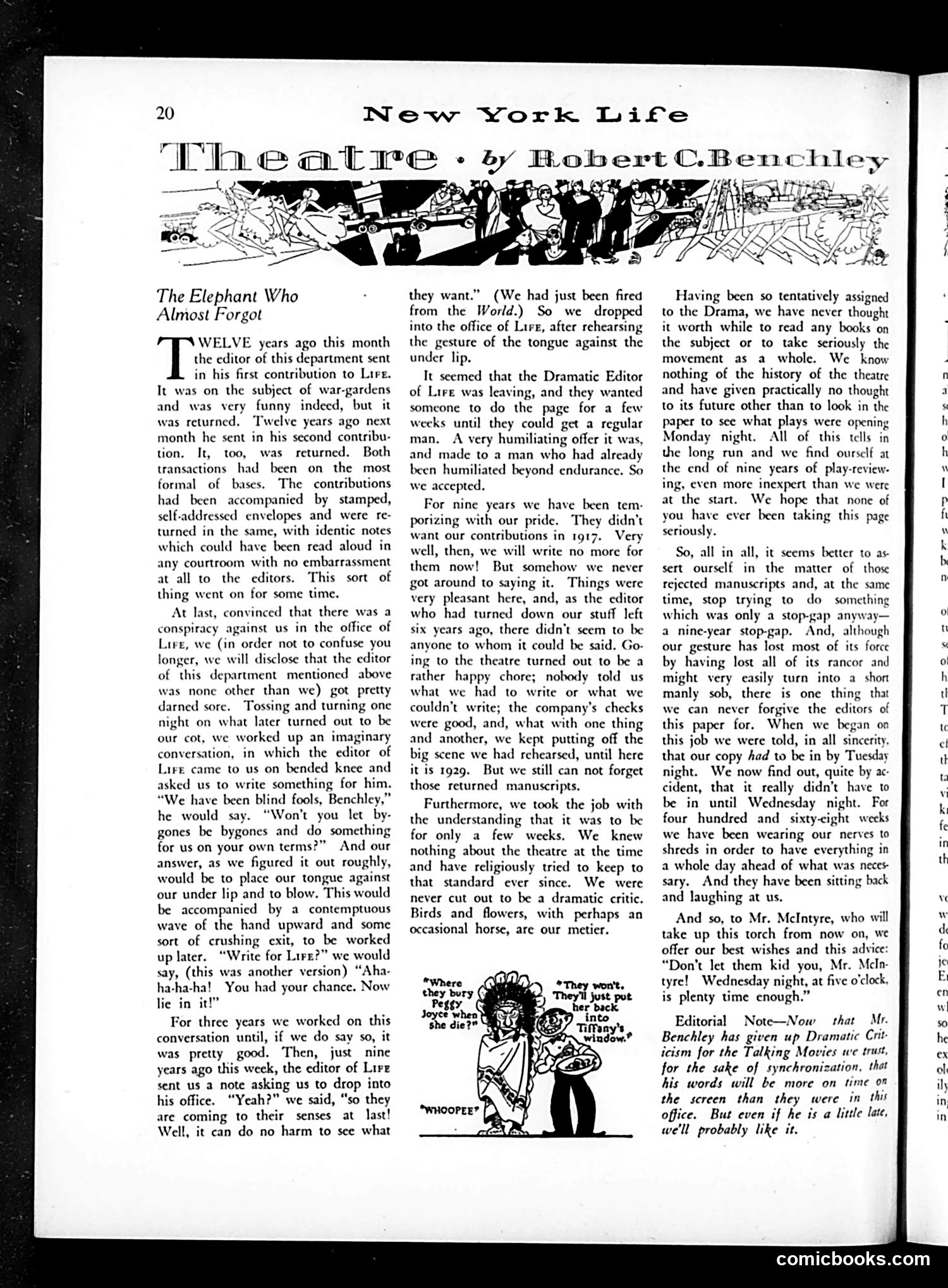
This is Robert C. Benchley's humorous essay about his own career at *Life* magazine. Benchley describes how he submitted theatrical criticism contributions for nine years after initial rejections, nursing a grudge. When finally invited to write for the Drama section in 1920, he accepted what was supposed to be a temporary assignment—intending to dramatically refuse once they "came to their senses." However, the job became pleasant and permanent. Nine years later (1929), Benchley realizes he never delivered his imagined revenge scene. He admits he took the role reluctantly, knows little about theater or dramatic criticism, and preferred writing about nature and animals. The cartoon below (labeled "WHOOPEE") appears to illustrate his fantasy confrontation with the editor. The satire gently mocks Benchley's own wounded pride and his failure to follow through on his dignified exit—a relatable human weakness about professional slights and delayed gratification.
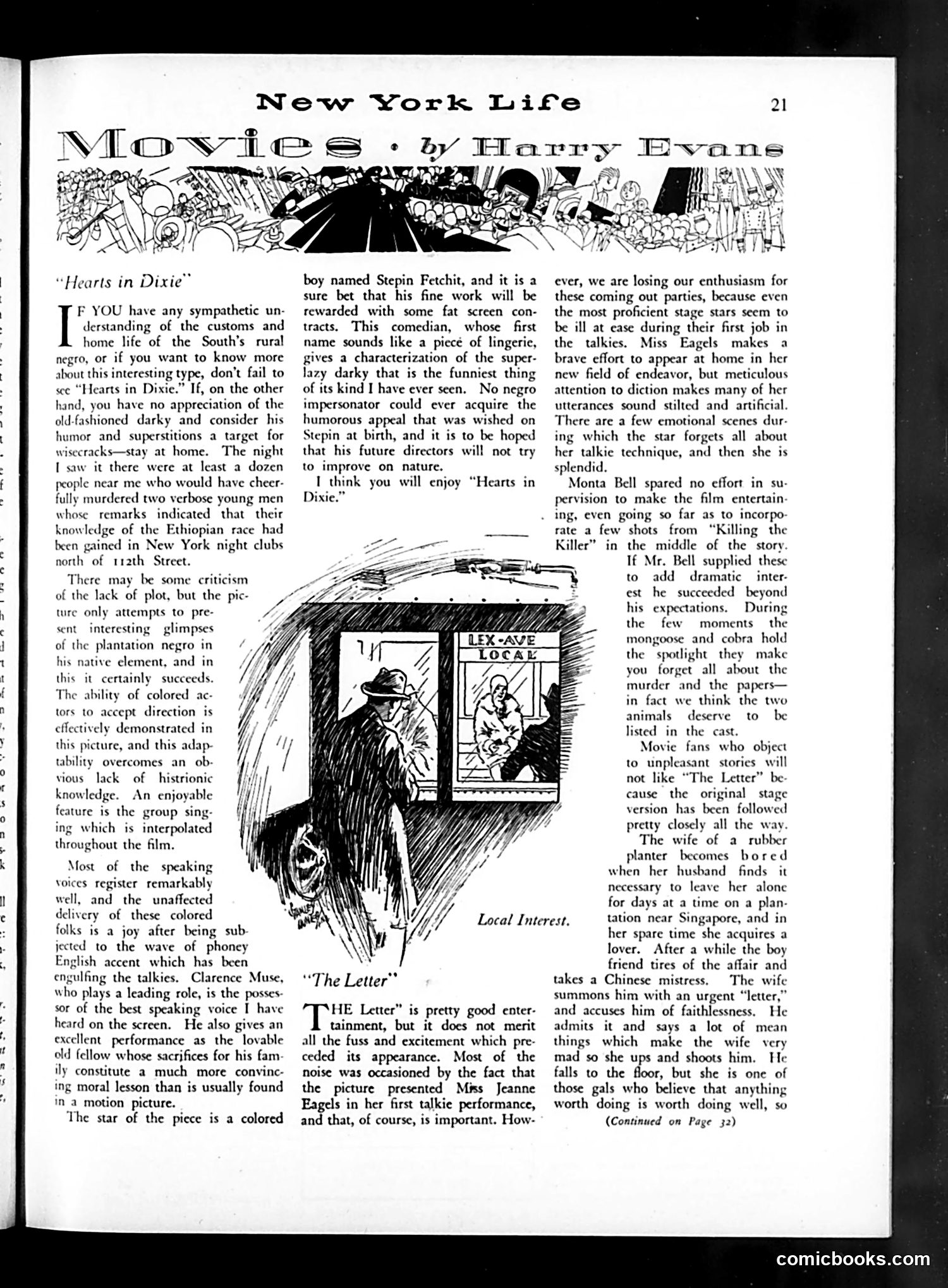
This page contains two film reviews by Harry Evans from what appears to be the late 1920s or early 1930s. **"Hearts in Dixie"** reviews an all-Black cast film. The critic praises the "natural" performances of Black actors, particularly Stepin Fetchit and Clarence Muse. However, the language reveals period racism: the reviewer uses the slur "darky" approvingly, celebrates stereotypical "lazy" characterizations as authentic, and expresses relief that Black actors speak without "phoney English accent." The piece treats Black rural Southern life as exotic entertainment for white audiences. **"The Letter"** reviews a talkie (early sound film) starring stage actress Jeanne Eagels. The critic finds her stage-to-screen transition awkward, noting her diction sounds "stilted and artificial" except during emotional scenes. Notably, he praises a mongoose-versus-cobra sequence as more engaging than the murder plot. Both reviews reflect 1920s-30s film criticism standards and racial attitudes of the era.
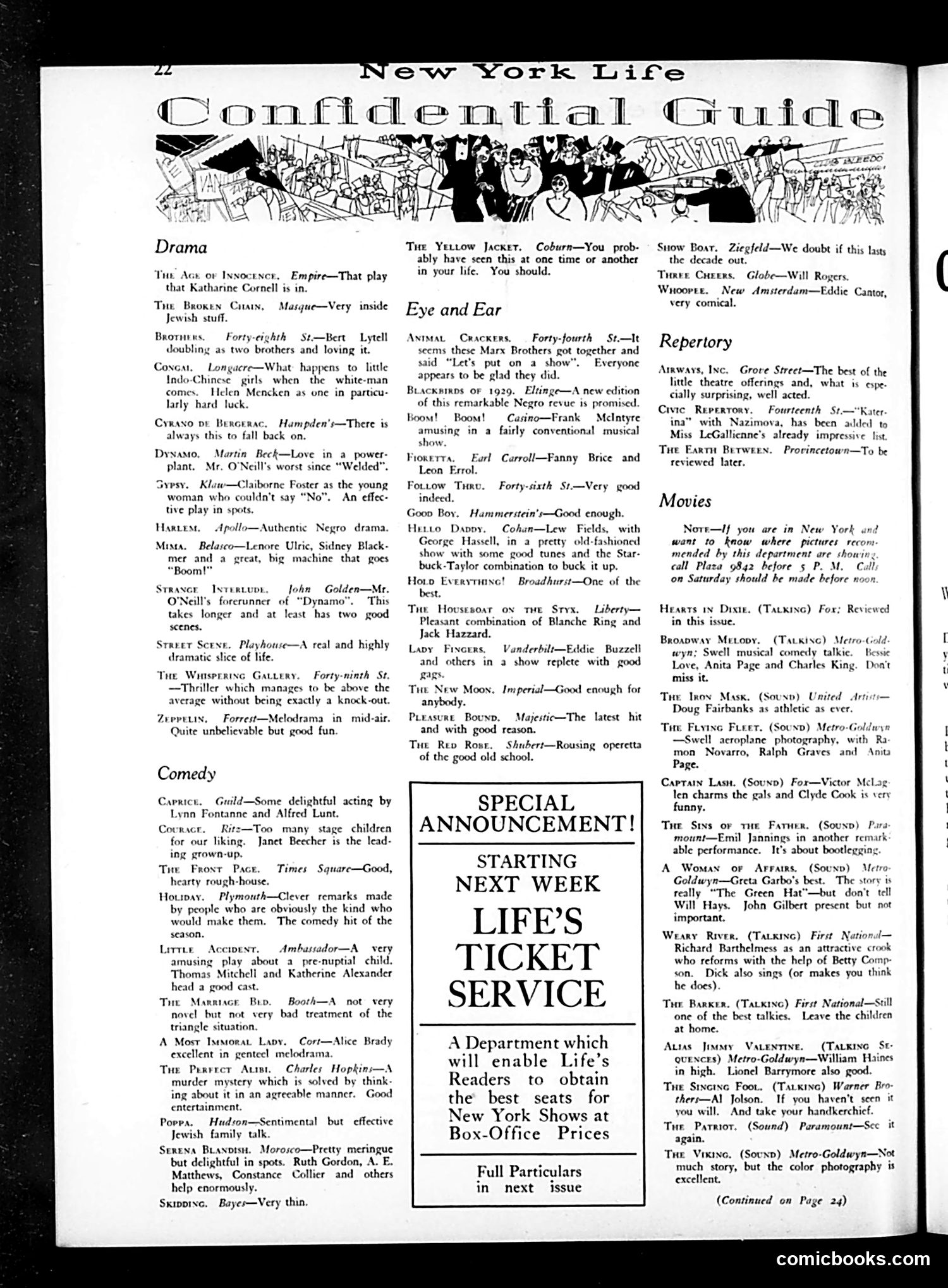
This page is primarily a theater review section, not a political cartoon. It's a "Confidential Guide" to New York Broadway shows circa 1929, covering drama, comedy, and musical entertainment. The page lists contemporary theatrical productions with brief reviews, mentioning performers like Katharine Cornell, Lynn Fontanne, and the Marx Brothers. Notable references include Eugene O'Neill plays ("Dynamo," "Strange Interlude") and "Blackbirds of 1929," described as a "remarkable Negro revue." The masthead features a stylized illustration of a Broadway/theater district scene with crowds and marquees, reflecting the vibrant entertainment culture of 1920s New York. The substantial box announcing "Life's Ticket Service" is an advertisement for a new departmental service enabling readers to obtain prime Broadway theater seats at box-office prices—essentially an early ticketing convenience service. This is entertainment journalism and marketing rather than satire or political commentary.
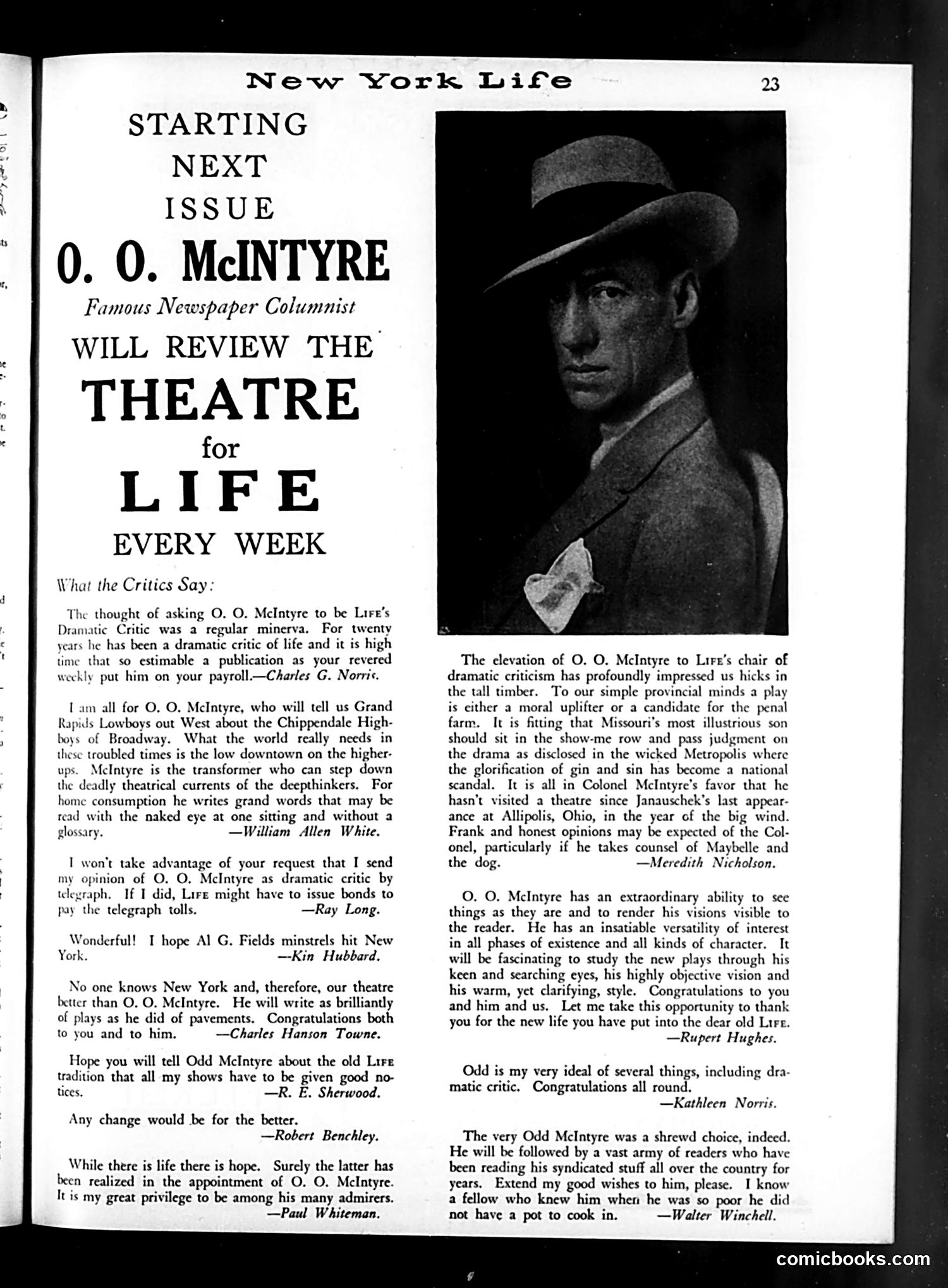
This is a promotional announcement, not a cartoon. Life magazine is announcing that O. O. McIntyre, a famous newspaper columnist, will become their theater critic starting in the next issue. The page features a formal portrait photograph of McIntyre alongside testimonials from prominent literary and entertainment figures (Charles G. Norris, William Allen White, Ray Long, Robert Benchley, Paul Whiteman, and others) praising the appointment. The satire is genteel rather than sharp: some quotes gently mock McIntyre's plain-spoken, accessible style ("read with the naked eye at one sitting and without a glossary") and his outsider perspective as someone from the Midwest rather than Broadway sophistication. A reference to his syndicated newspaper work being read "all over the country" and his long career suggest he brought mass-market credibility to theatrical criticism. This appears designed to attract readers and lend prestige to Life's drama coverage through celebrity endorsement.
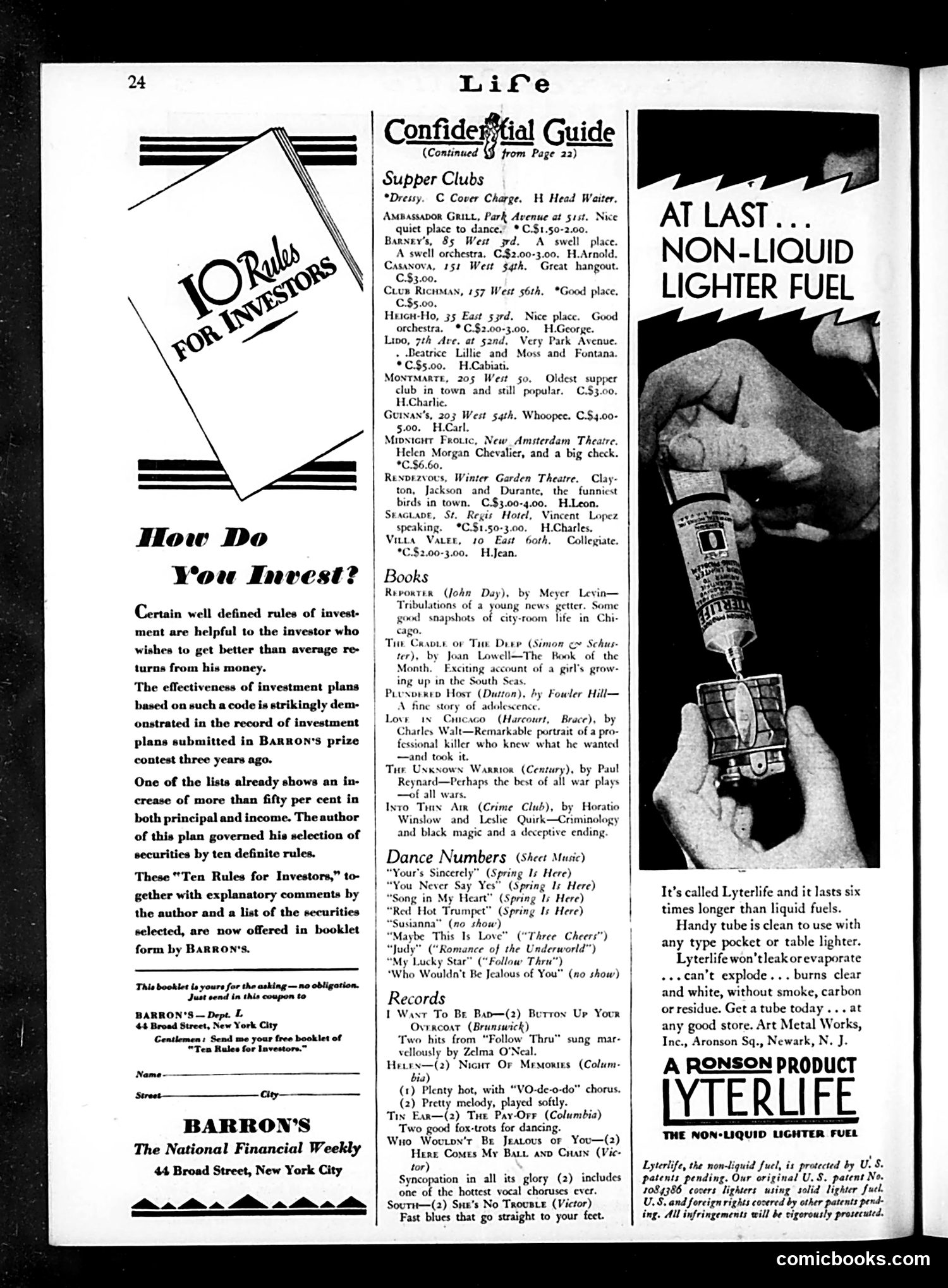
This page is primarily **advertising and entertainment listings**, not political satire. The left side features a Barron's financial services advertisement promoting investment rules through a booklet offer. The center column provides a "Confidential Guide" listing Manhattan supper clubs (with cover charges and notable performers like Helen Morgan and Jimmy Durante), plus book and music reviews typical of 1920s entertainment journalism. The right side advertises **Lyterlife**, a non-liquid lighter fuel product—emphasizing it burns cleanly without smoke or residue, lasting six times longer than liquid fuels. This is a straightforward commercial pitch for an early alternative fuel technology. There is **no political cartoon or satire** on this page. It represents typical Life magazine content from the Jazz Age era: consumer guides, nightlife recommendations, and product advertisements aimed at affluent urban readers.
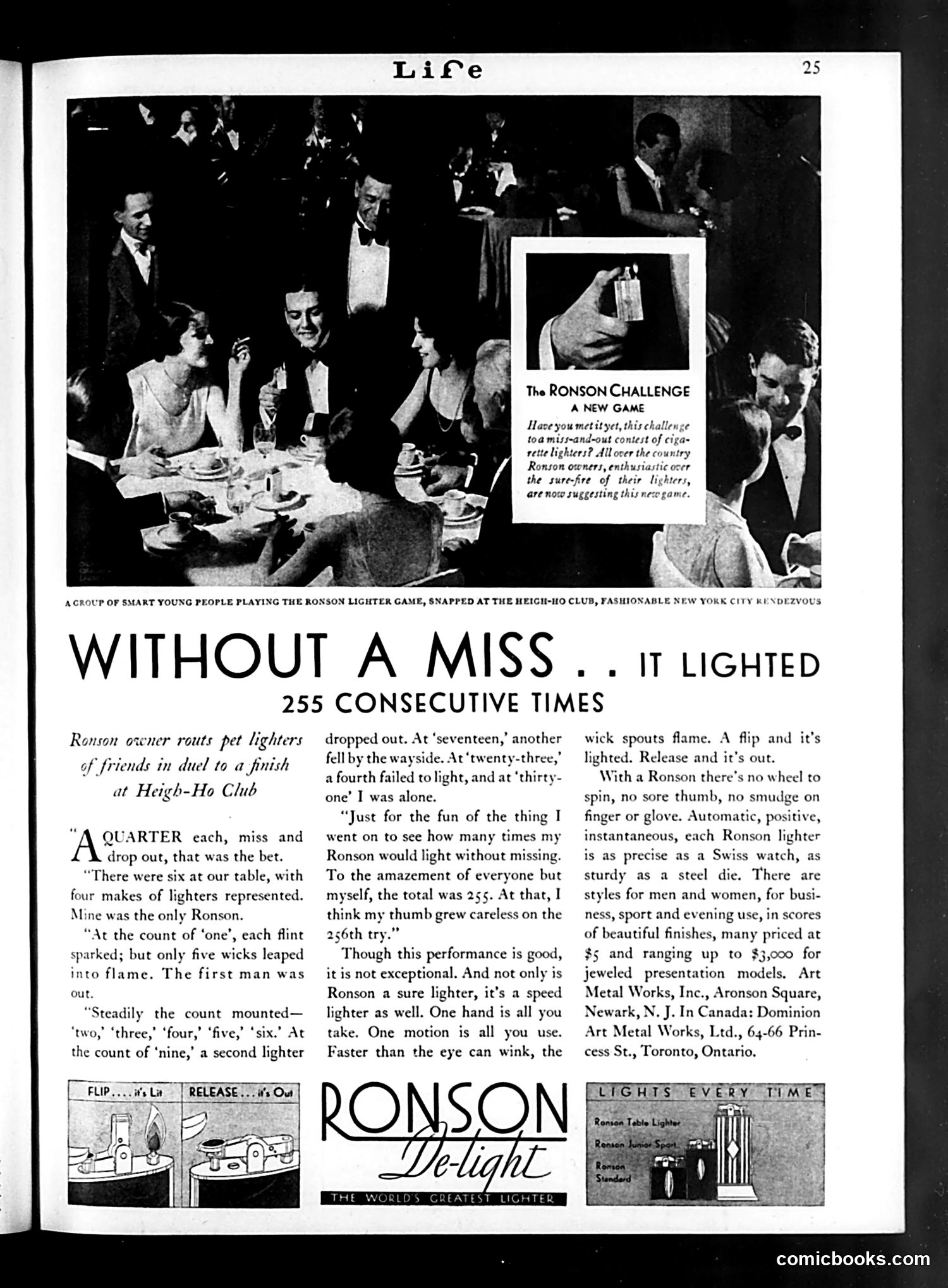
This is primarily an **advertisement for Ronson lighters**, disguised as editorial content about a social game. The "cartoon" element is minimal—mostly a photo-story format typical of 1920s-30s advertising. The premise: a Ronson owner challenges competitors at an upscale New York nightclub (the Heigh-Ho Club) to a "lighter duel." Each person's lighter must ignite on command; whoever's fails first is eliminated. The Ronson owner's lighter allegedly worked 255 consecutive times without failure, while rivals' lighters quit early. **The point:** This is product demonstration disguised as entertainment. By framing the lighter as a status symbol among "smart young people" at a fashionable club, the ad appeals to aspirational consumers. The competitive "challenge" format suggests superiority—your lighter versus theirs. There's no political satire here; it's pure marketing, exploiting the era's fascination with gadgetry and social one-upmanship. Modern readers might find the advertisement's blunt consumerism striking, dressed up in the language of leisure and sophistication.
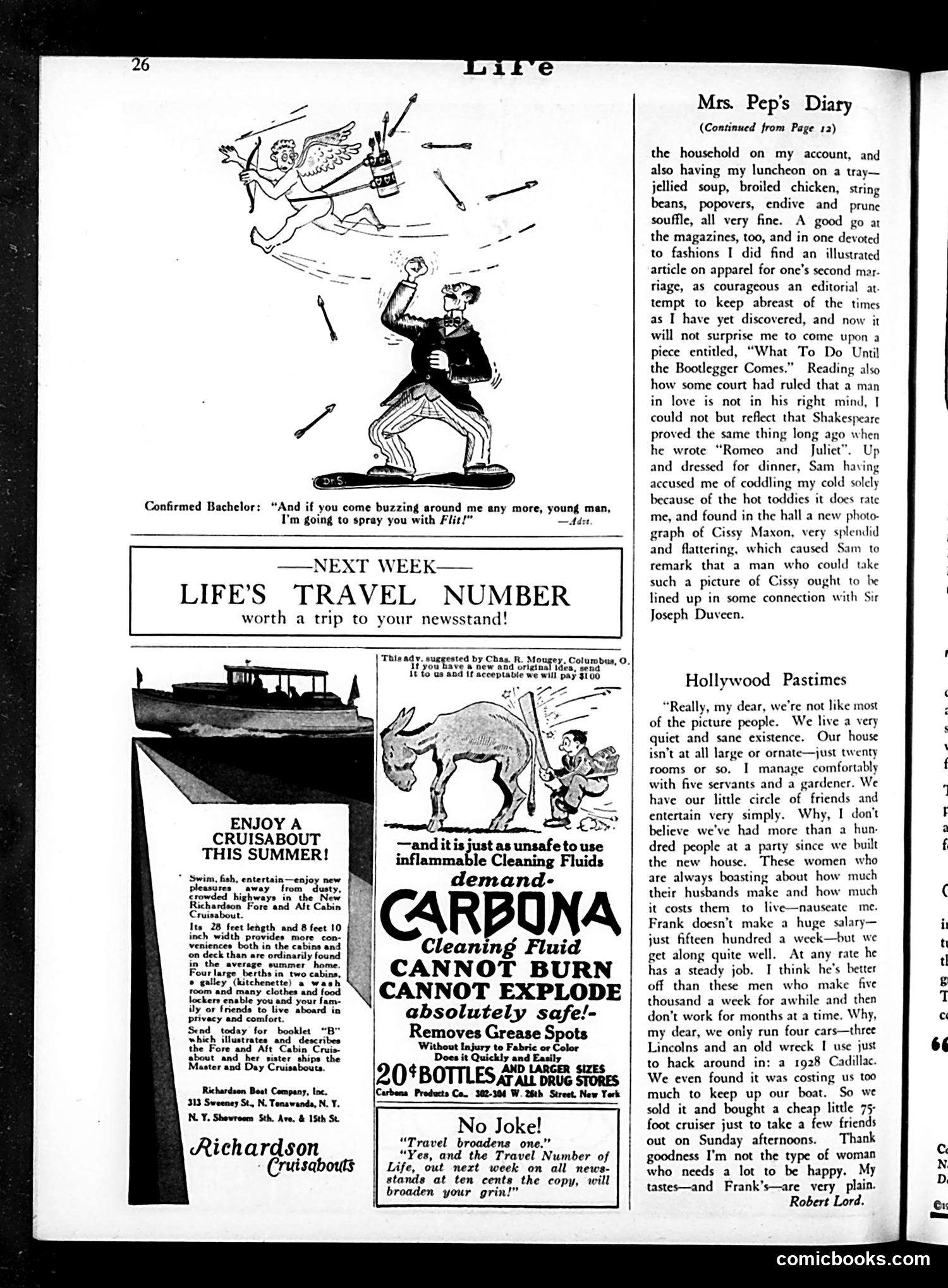
The top cartoon depicts a "Confirmed Bachelor" confronting a Cupid-like figure. The man threatens to spray the cherub with "Flit!" — a commercial insecticide advertised on this page. The joke satirizes the bachelor's aggressive resistance to romantic entanglement; he treats love itself as a pest to be exterminated. The reference to Flit, a real product shown in advertisements below, adds contemporary commercial humor. The page is primarily advertisements and diary/gossip columns. The cartoon's satire targets unmarried men who defensively reject romance, using the era's popular pest-control product as an absurdist metaphor for eliminating unwanted romantic "advances."
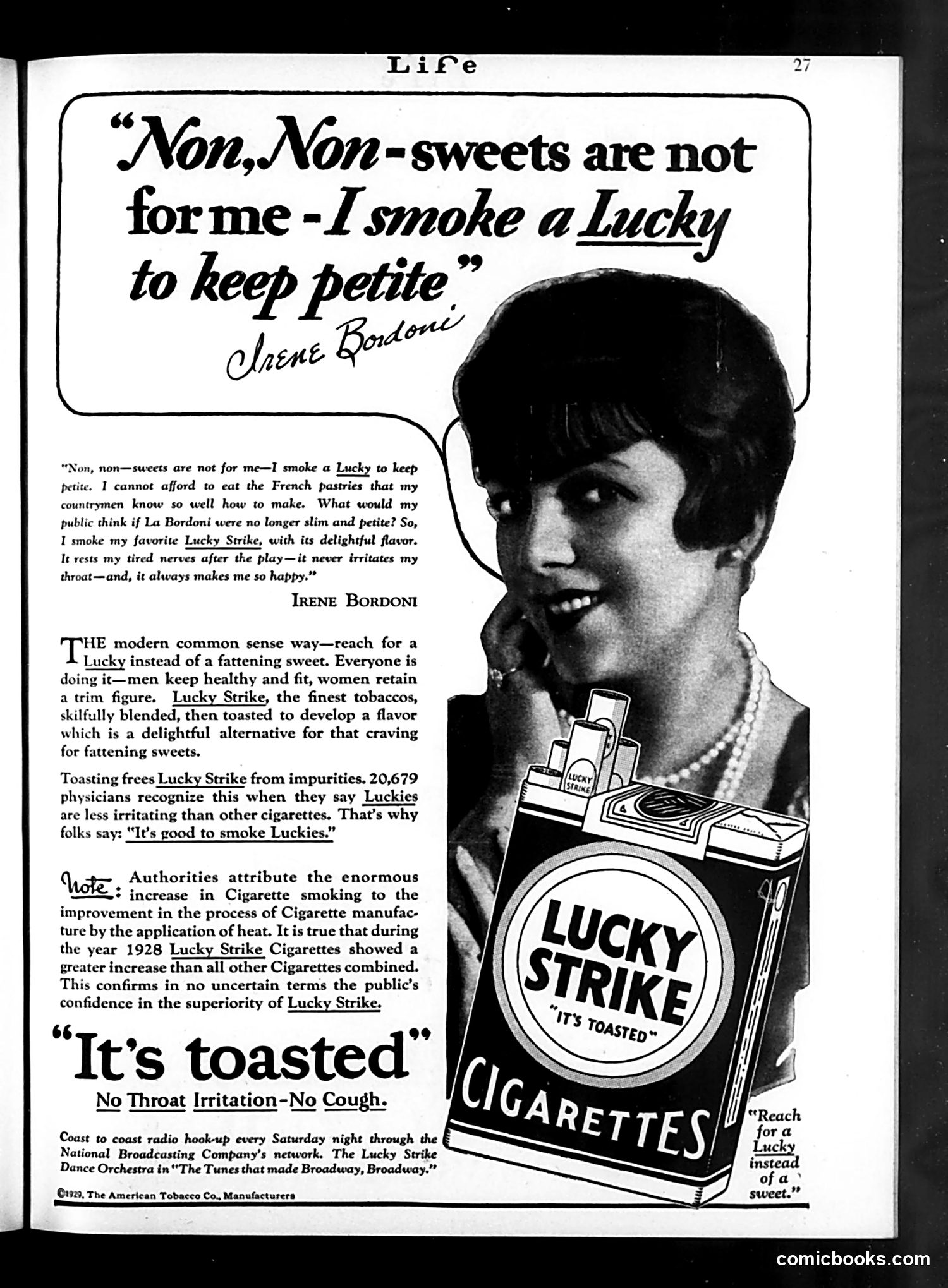
This is a **cigarette advertisement**, not satire—it's a genuine 1929 marketing campaign for Lucky Strike cigarettes. The page features **Irene Bordoni**, a real French-American entertainer, endorsing Lucky Strikes as a weight-control alternative to sweets. Her quote claims she smokes to "keep petite" rather than eat French pastries, framing cigarettes as a diet aid. The ad makes now-shocking health claims: that Lucky Strikes are "less irritating than other cigarettes" (citing 20,679 physicians), cause "no throat irritation" or cough, and that toasting removes impurities. **Historical context modern readers need**: This represents pre-FDA regulation advertising. Tobacco companies routinely made unsubstantiated health claims and used celebrity endorsements. Women were specifically targeted with messaging linking smoking to weight management and glamour—a marketing strategy later revealed as deliberate industry strategy. The "toasted" process was real but irrelevant to health; the health claims were entirely false.
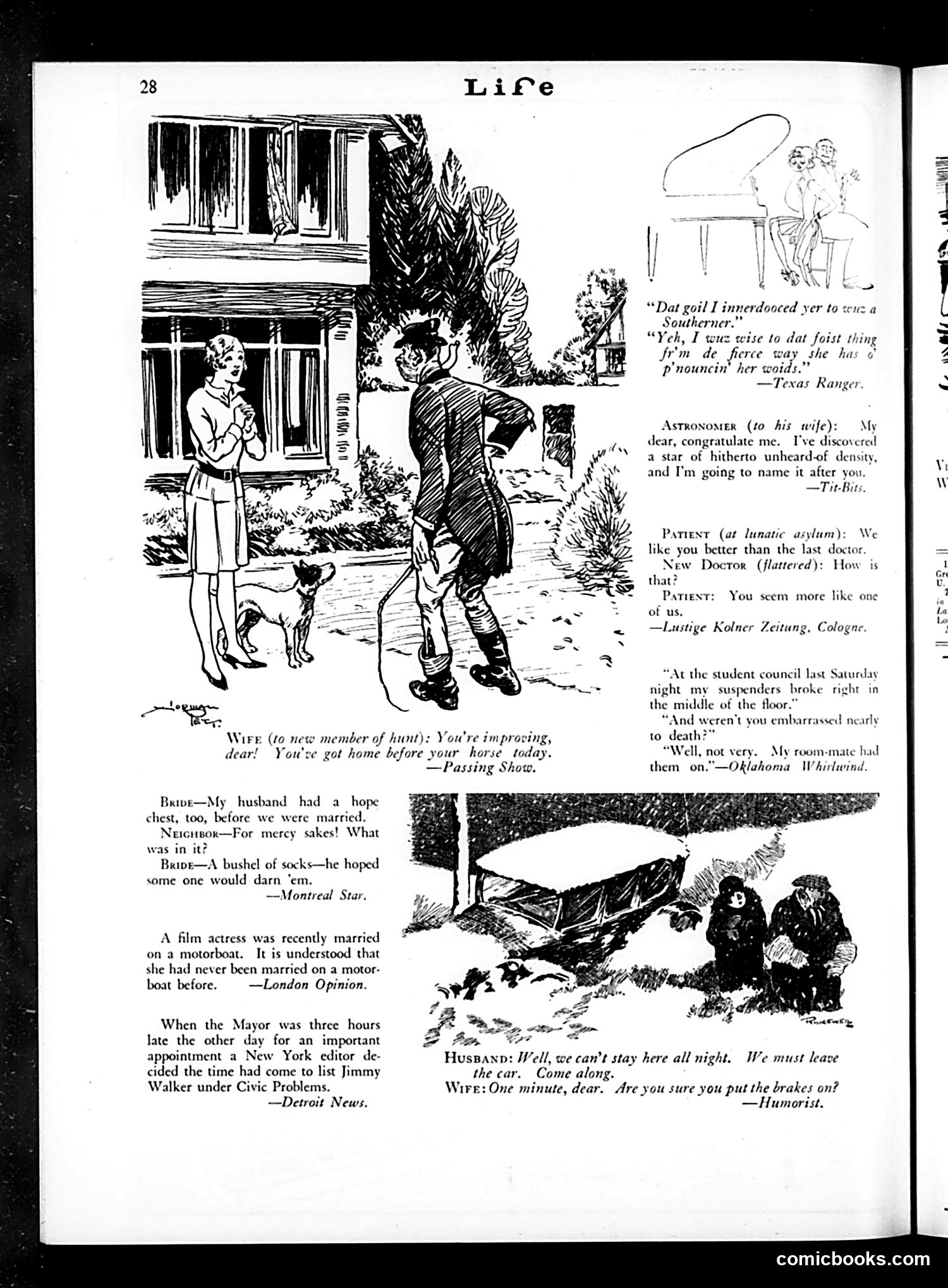
This page from *Life* magazine contains multiple short comic gags typical of the era's humor format: **Top cartoon**: A couple argues about a Southern woman the husband introduced. The joke relies on regional stereotyping—the wife understood from the woman's accent ("fierce way she p'nouncin' her words") that she was Southern, implying Southerners had distinctive, recognizable speech patterns. **Other gags** include: an astronomer naming a star after his wife (implying she's dense), a mental patient finding the new doctor "like one of us" (suggesting the doctor belongs in the asylum), a wife discovering her husband's "hope chest" contained only socks he hoped someone would darn, and a motorboat wedding joke playing on absurdist humor. **Bottom cartoon**: A stranded couple in a car—the wife asks if the husband engaged the brakes, a practical domestic comedy about automotive anxiety. The humor reflects early automotive-era concerns and relies heavily on regional accents, gender roles, and marital dynamics as comedic subjects.
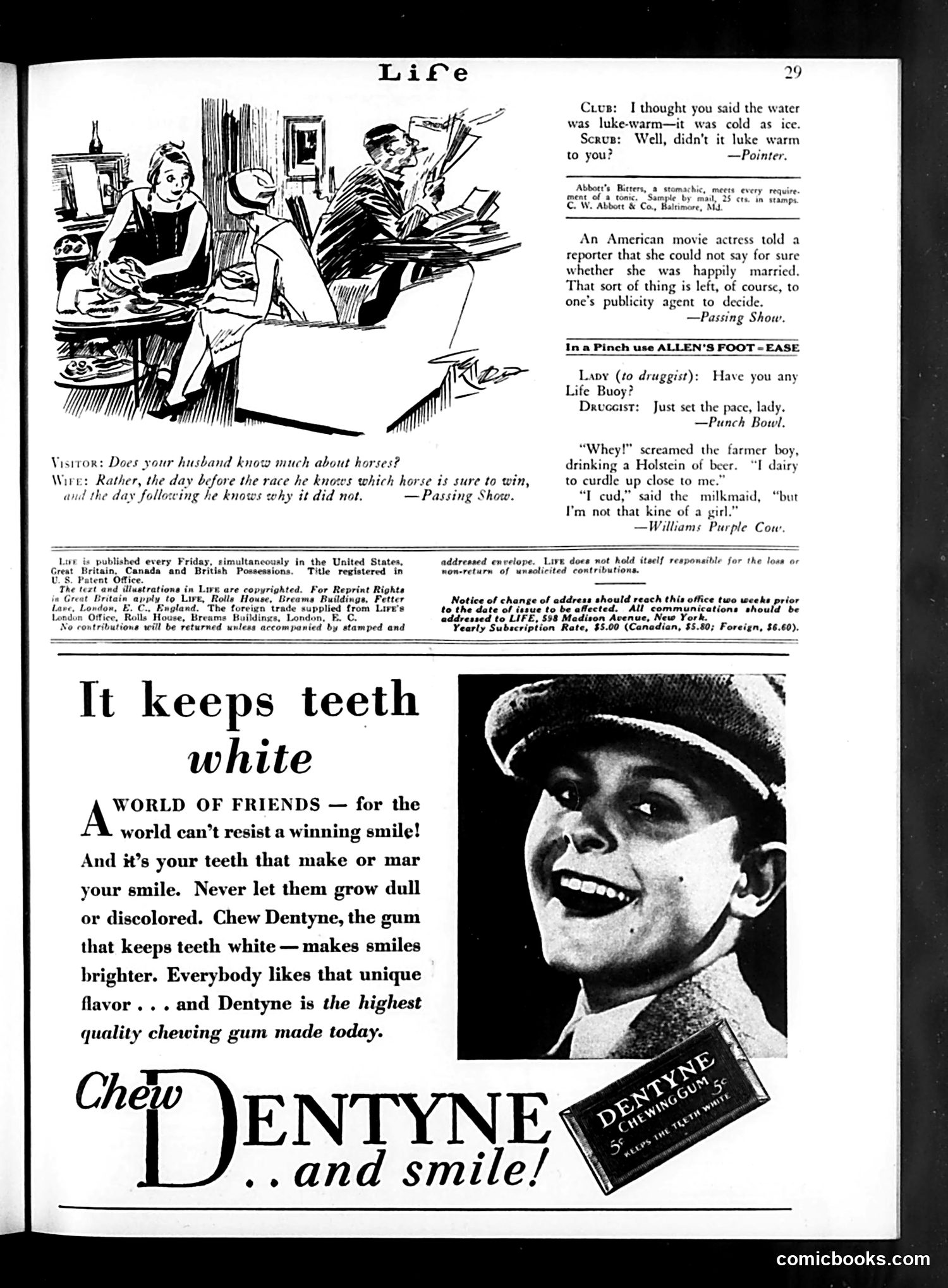
This page contains several short humorous anecdotes, primarily wordplay and mild social satire typical of early 20th-century magazines. The main cartoon shows a domestic scene where a husband discusses horses with a visitor—he claims to know which horse will win *before* the race and why it lost *after*. The joke satirizes husbands who pretend expertise they lack, using hindsight to appear knowledgeable. Other jokes mock: a Hollywood actress whose publicist controls whether she admits happiness in her marriage; puns on product names ("Life Buoy" as a druggist pun); and a farmboy's suggestive comment to a milkmaid. The page is dominated by a **Dentyne chewing gum advertisement** emphasizing tooth whiteness and social appeal—"a world can't resist a winning smile." This reflects period advertising's focus on personal grooming as essential to social success. The publication information indicates *Life* was a weekly satirical magazine distributed internationally, predating its later incarnation as a photo magazine.
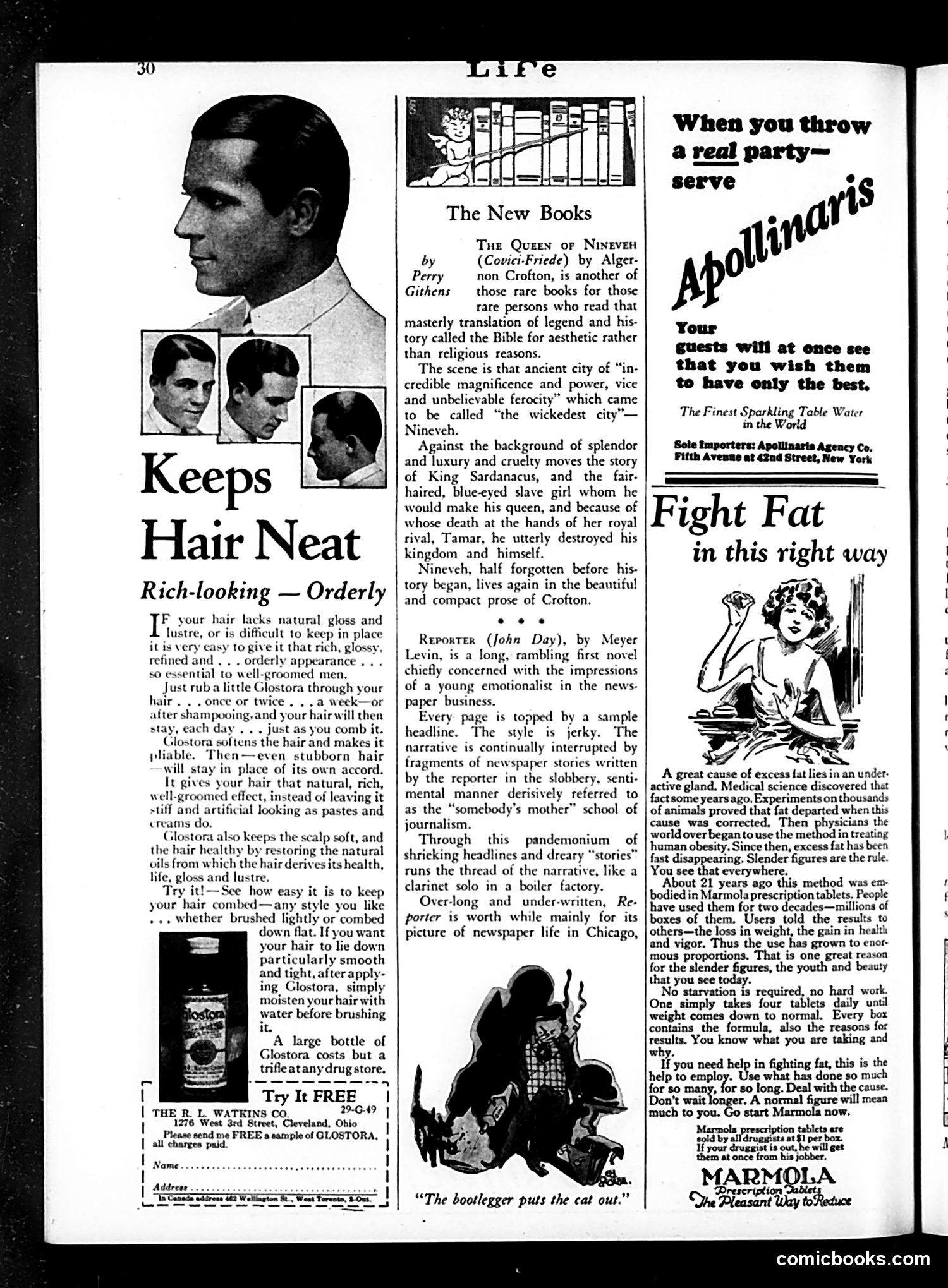
This page contains three distinct sections: a hair product advertisement, book reviews, and obesity treatment advertising. **Left side:** A Glostora hair product ad featuring a man's profile photograph with smaller head shots, promoting the pomade as creating a "natural, rich, well-groomed effect" for men's hair. **Center:** Book reviews of two novels—*The Queen of Nineveh* (set in ancient Mesopotamia with romantic tragedy) and *Reporter* (a Chicago newspaper novel whose style is mocked as disjointed, comparing its narrative to "a clarinet solo in a boiler factory"). **Right side:** Advertisements for Apollinaris sparkling water and Marmola weight-loss tablets. The Marmola ad references a "gland" discovery in obesity treatment, claiming the method has made "slender figures...the rule." The page reflects 1920s consumer culture: personal grooming standards for men, literary modernism, and weight-loss claims based on pseudoscientific glandular theories that were popular before modern endocrinology.
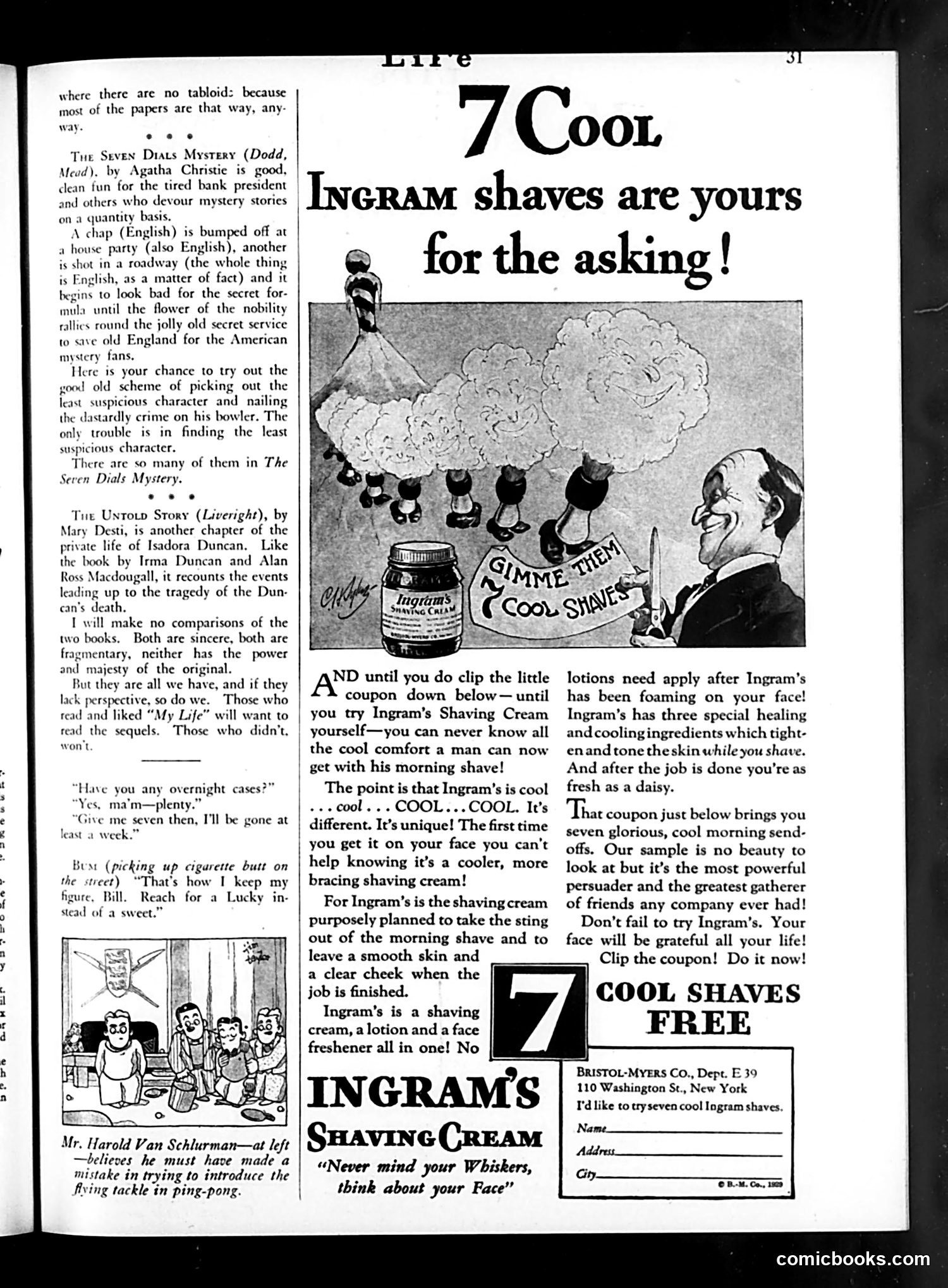
This page combines book reviews with a vintage advertisement for Ingram's Shaving Cream. **Book Reviews (Left Column):** The text discusses Agatha Christie's mystery novel *The Seven Dials Mystery* and Mary Desti's biographical work *The Untold Story* about dancer Isadora Duncan. The reviewer offers light commentary on mystery conventions—noting that readers enjoy guessing the culprit among suspicious characters. **Small Cartoons:** Two brief visual gags appear: one depicts someone discussing overnight cases; another shows a character picking up a cigarette butt, joking about maintaining his figure by reaching for Lucky cigarettes "instead of a sweet." **Advertisement (Right Side):** The dominant content is an Ingram's Shaving Cream advertisement featuring a man being shaved and the tagline "Never mind your Whiskers, think about your Face." The ad emphasizes the cream's cooling properties and multi-purpose benefits (shaving cream, lotion, and face freshener). A coupon offers "7 Cool Ingram Shaves Free"—a common direct-mail marketing strategy of that era. The page reflects 1920s-era advertising and consumer culture.
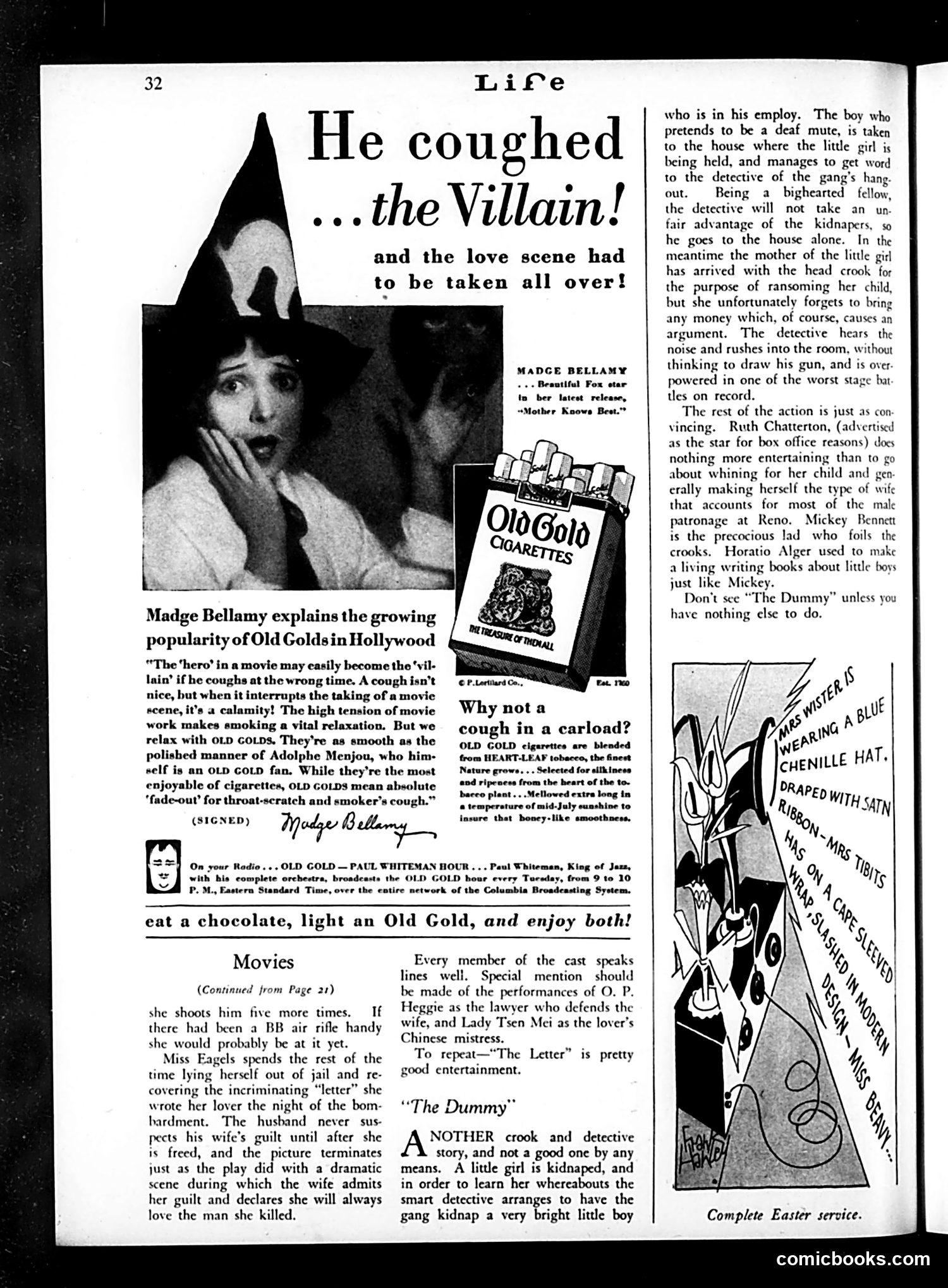
This page is primarily a **cigarette advertisement disguised as entertainment journalism**. The central feature quotes actress **Madge Bellamy** (a 1920s Fox film star), who endorses **Old Gold cigarettes** by claiming they provide "smooth" relaxation for Hollywood workers—specifically mentioning that a cough during filming ruins takes and requires reshooting expensive scenes. The advertisement references real radio personality **Paul Whiteman** ("King of Jazz") promoting the product on CBS broadcasts. Below are brief, dismissive movie reviews of "The Dummy" and "The Letter"—filler content typical of Life's entertainment coverage. **The satire**: The ad cynically exploits actors' real occupational anxiety (ruined takes) to sell cigarettes as a "solution," while ironically promoting smoking as workplace stress relief. The reviews' caustic tone suggests Life's ambivalence toward the movies themselves.
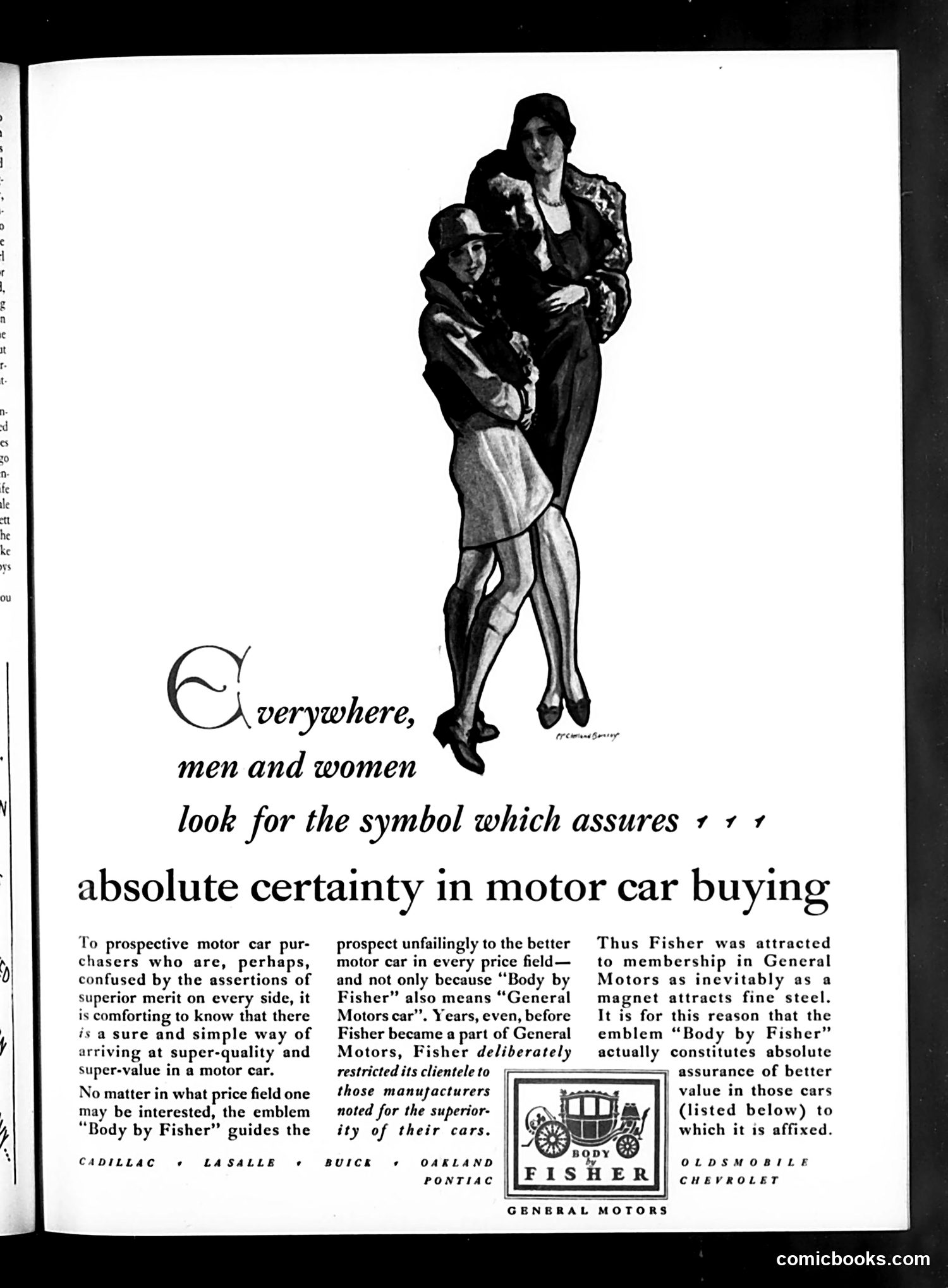
This is primarily a **General Motors advertisement**, not political satire. It promotes Fisher Body Company's car bodies as a quality mark across GM's multiple brands. The illustration shows a stylized woman holding a child, a visual metaphor for the trustworthiness and care Fisher Body provides. The ad argues that "Body by Fisher"—a manufacturing emblem—offers "absolute certainty" to confused car buyers navigating competing brand claims. The key claim: Fisher Body deliberately partnered only with quality automakers before merging with GM, so their name became a reliable seal of approval. The ad lists Fisher-bodied vehicles: Cadillac, LaSalle, Buick, Oakland, Pontiac, Oldsmobile, and Chevrolet. For modern readers: this represents early **branded quality assurance**—using a component manufacturer's prestige to reassure consumers across an entire product range, a common marketing strategy today.
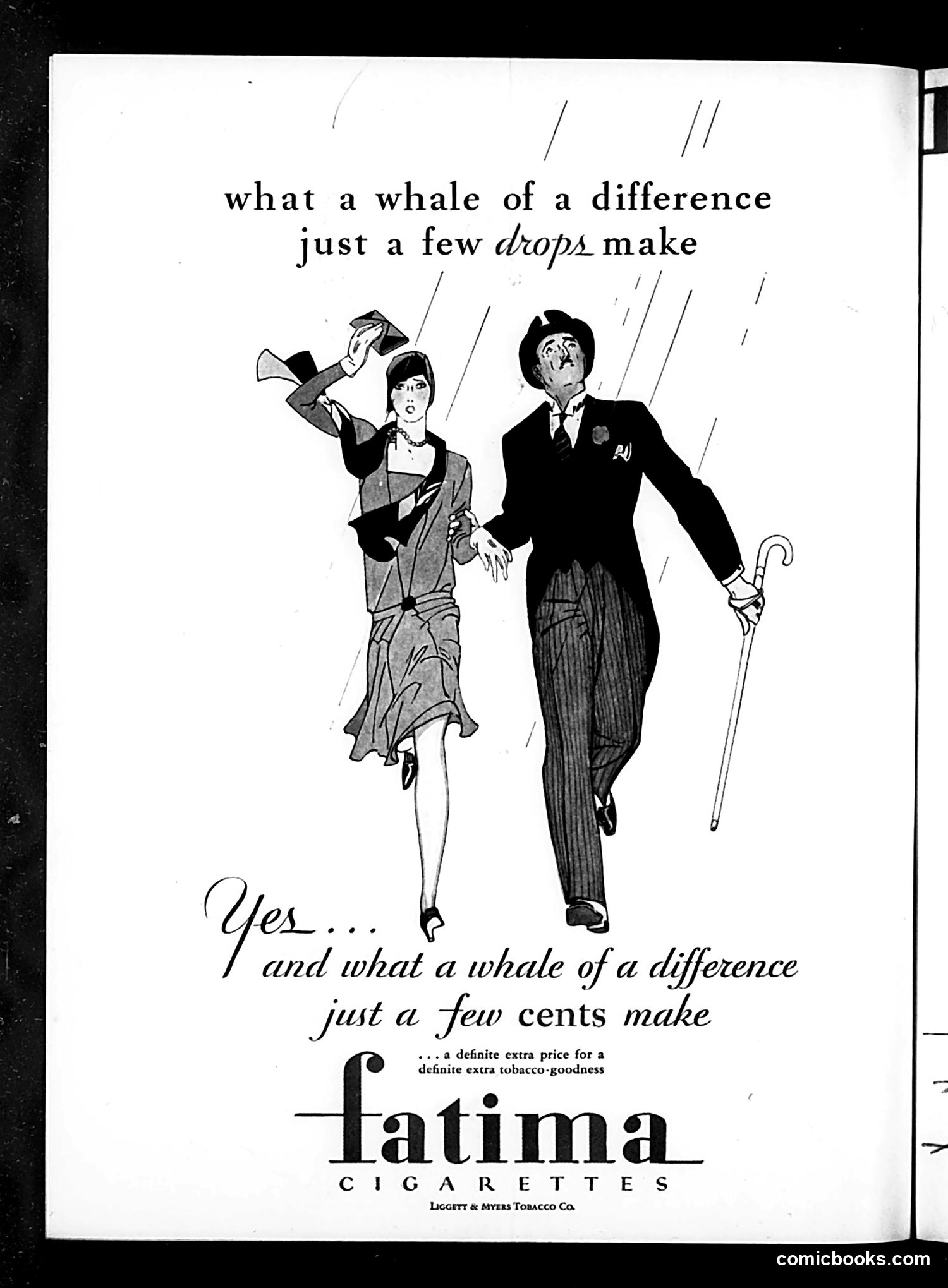
This is a **Fatima Cigarettes advertisement**, not a political cartoon. It uses a common advertising trope of the era: contrasting two scenarios to highlight product superiority. The image shows a well-dressed couple in rain—on the left, unprepared and disheveled; on the right, composed with an umbrella. The visual metaphor suggests that just as "a few drops" of preparation make a difference in weathering rain, "a few cents" extra spent on Fatima cigarettes provides noticeably superior tobacco quality. This reflects early-20th-century consumer marketing strategy: positioning premium products as worthwhile investments. The phrase "whale of a difference" was contemporary slang for "remarkable difference." There is no political satire here—it's straightforward product promotion emphasizing that modest additional expense yields significant quality improvement.