
Life, 1929-03-29 · page 23 of 36
Life — March 29, 1929 — page 23: what you’re looking at
What you’re looking at
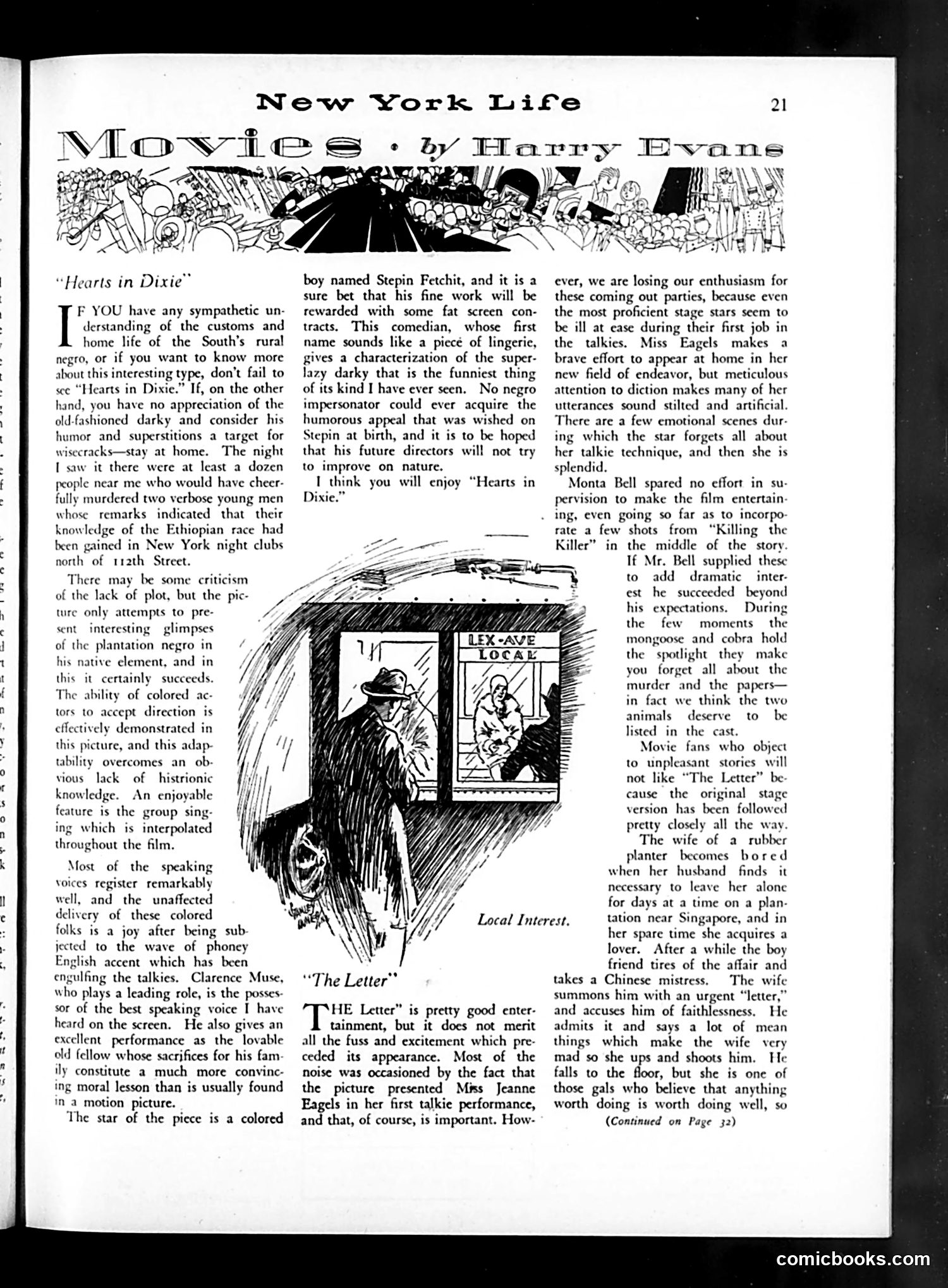
This page contains two film reviews by Harry Evans from what appears to be the late 1920s or early 1930s. **"Hearts in Dixie"** reviews an all-Black cast film. The critic praises the "natural" performances of Black actors, particularly Stepin Fetchit and Clarence Muse. However, the language reveals period racism: the reviewer uses the slur "darky" approvingly, celebrates stereotypical "lazy" characterizations as authentic, and expresses relief that Black actors speak without "phoney English accent." The piece treats Black rural Southern life as exotic entertainment for white audiences. **"The Letter"** reviews a talkie (early sound film) starring stage actress Jeanne Eagels. The critic finds her stage-to-screen transition awkward, noting her diction sounds "stilted and artificial" except during emotional scenes. Notably, he praises a mongoose-versus-cobra sequence as more engaging than the murder plot. Both reviews reflect 1920s-30s film criticism standards and racial attitudes of the era.
📄 Transcribed text from this page (OCR, searchable)
Machine-transcribed from the original scan — historical spelling and the odd misread are preserved.
New York Life “Hearts in Dixie” F YOU have any sympathetic un- I derstanding of the customs and home life of the South's rural negro, or if you want to know more about this interesting type, don’t fail to see “Hearts in Dixie.” If, on the other hand, you have no appreciation of the old-fashioned darky and consider his humor and superstitions a target for wisecracks—stay at home. The night I saw it there were at least a dozen people near me who would have cheer- fully murdered two verbose young men whose remarks indicated that their knowledge of the Ethiopian race had been gained in New York night clubs north of rath Street. There may be some criticism of the lack of plot, but the pic- ture only attempts to pre- interesting glimpses of the plantation negro in his native element, and in this it certainly succeeds. The ability of colored ac- tors to accept direction is effectively demonstrated in this picture, and this adap- tability overcomes an ob- lack of histrionic knowledge. An enjoyable feature is the group sing- ing which is interpolated throughout the film. sent vious Most of the speaking voices register remarkably well, and the unaffected delivery of these colored folks is a joy after being sub jected to the wave of phoney English accent which has been engulfing the talkies. Clarence Muse, who plays a leading role, is the posses- sor of the best speaking voice I have heard on the screen. He also gives an excellent performance as the lovable old fellow whose sacrifices for his fam ily constitute a much more convinc- ing moral lesson than is usually found in a motion picture. The star of the piece is a colored ° bY Harry Ewans boy named Stepin Fetchit, and it is a sure bet that his fine work will be rewarded with some fat screen con- tracts. This comedian, whose first name sounds like a piecé of lingerie, gives a characterization of the super- lazy darky that is the funniest thing of its kind I have ever seen. No negro impersonator could ever acquire the humorous appeal that was wished on Stepin at birth, and it is to be hoped that his future directors will not try to improve on nature. I think you will enjoy “Hearts in Dixie.” “The Letter” HE Letter” is pretty good enter- tainment, but it does not merit all the fuss and excitement which pre- ceded its appearance. Most of the noise was occasioned by the fact that the picture presented Miss Jeanne Eagels in her first talkie performance, and that, of course, is important. How- y A as ow ea REGAN die) ever, we are losing our enthusiasm for these coming out parties, because even the most proficient stage stars seem to be ill at ease during their first job in the talkies. Miss Eagels makes a brave effort to appear at home in her new field of endeavor, but meticulous attention to diction makes many of her utterances sound stilted and artificial. There are a few emotional scenes dur- ing which the star forgets all about her talkie technique, and then she is splendid. Monta Bell spared no effort in su- pervision to make the film entertain- ing, even going so far as to incorpo- rate a few shots from “Killing the Killer” in the middle of the story. If Mr. Bell supplied these to add dramatic _ inter- est he succeeded beyond his expectations. During the few moments the mongoose and cobra hold the spotlight. they make you forget all about the murder and the papers— in fact we think the two animals deserve to be listed in the cast. Movie fans who object to unpleasant. stories will not like “The Letter” be- cause the original stage version has been followed pretty closely all the way. The wife of a rubber planter becomes bored when her husband finds it necessary to leave her alone for days at a time on a plan- tation near Singapore, and in her spare time she acquires a lover. After a while the boy friend tires of the affair and takes a Chinese mistress. The wife summons him with an urgent “letter,” and accuses him of faithlessness. He admits it and says a lot of mean things which make the wife very mad so she ups and shoots him. He falls to the floor, but she is one of those gals who believe that anything worth doing is worth doing well, so (Continued on Page 32) comicbooks.com