
Life, 1929-06-21 · page 26 of 40
Life — June 21, 1929 — page 26: what you’re looking at
What you’re looking at
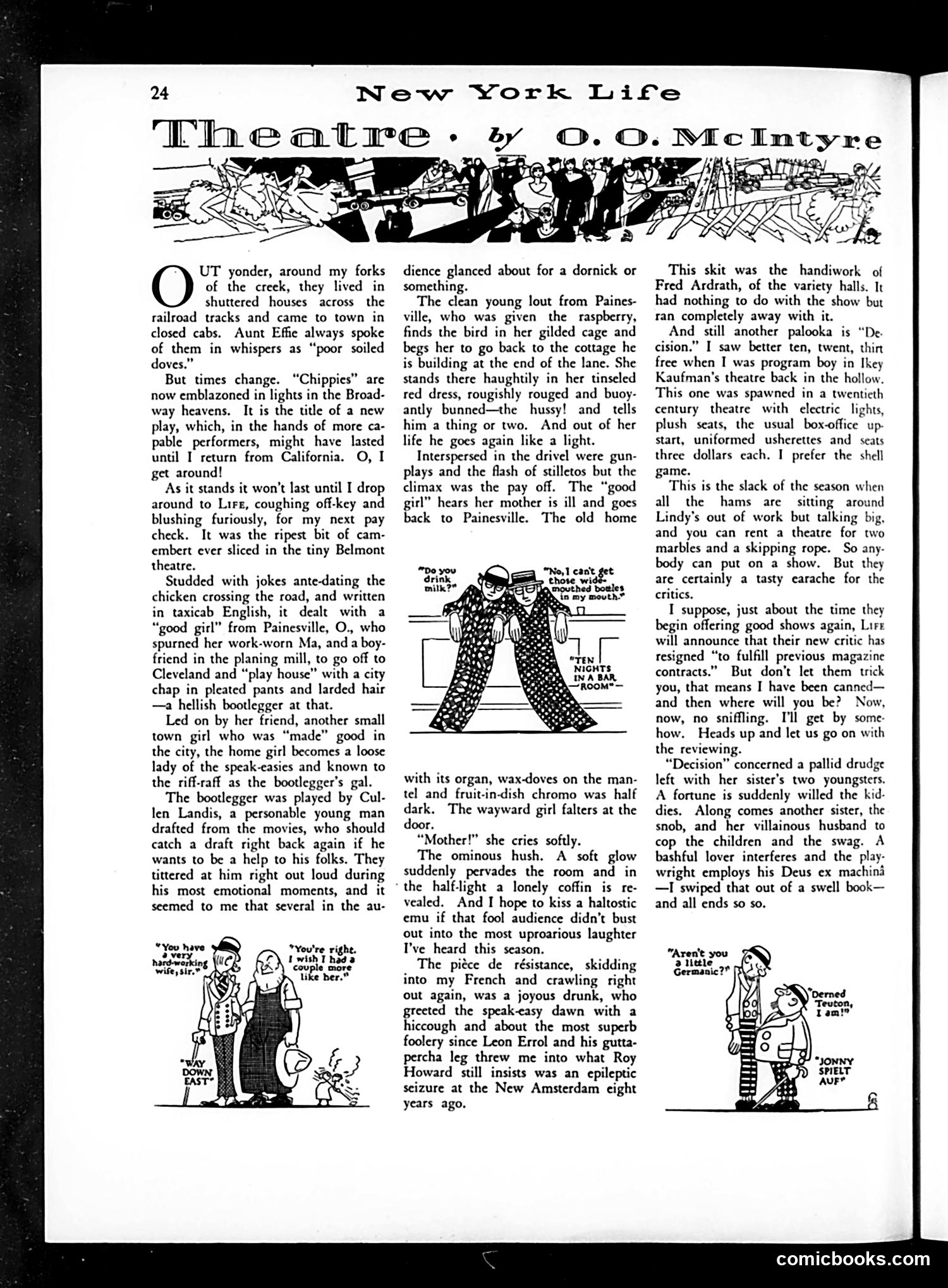
This theater review column satirizes both a mediocre Broadway play called "Chippies" and the broader state of theater during what appears to be an off-season slump. **The play itself:** A melodramatic morality tale about a small-town Ohio girl ("good girl" from Painesville) who becomes a prostitute in the city after being corrupted by another woman, only to return home to find her mother dying. The reviewer mocks its cheap sentimentality—the audience laughs hysterically at the coffin scene rather than being moved. **The satire:** McIntyre ridicules both the terrible writing and acting (calling the dialogue "taxicab English," the plot devices ancient), while also mocking theater-goers' poor taste. He notes that during the slow season, anyone can rent a theater cheaply, so amateur productions proliferate. **The small illustrations** show character sketches and dialogue from the play, emphasizing its corniness. The column's tone is one of weary sophistication—McIntyre positions himself as an experienced theater-goer who finds contemporary Broadway beneath contempt.
📄 Transcribed text from this page (OCR, searchable)
Machine-transcribed from the original scan — historical spelling and the odd misread are preserved.
24 UT yonder, around my forks O of the creek, they lived in shuttered houses across the railroad tracks and came to town in closed cabs. Aunt Effie always spoke of them in whispers as “poor soiled doves.” But times change. “Chippies” are now emblazoned in lights in the Broad- way heavens. It is the title of a new play, which, in the hands of more ca- pable performers, might have lasted until I return from California. O, I get around! As it stands it won't last until I drop around to Lire, coughing off-key and blushing furiously, for my next pay check. It was the ripest bit of cam- embert ever sliced in the tiny Belmont theatre. Studded with jokes ante-dating the chicken crossing the road, and written in taxicab English, it dealt with a “good girl” from Painesville, O., who spurned her work-worn Ma, and a boy- friend in the planing mill, to go off to Cleveland and “play house” with a city chap in pleated pants and larded hair —a hellish bootlegger at that. Led on by her friend, another small town girl who was “made” good in the city, the home girl becomes a loose lady of the speak-easies and known to the riff-raff as the bootlegger’s gal. The bootlegger was played by Cul- len Landis, a personable young man drafted from the movies, who should catch a draft right back again if he wants to be a help to his folks. They titered at him right out loud during his most emotional moments, and it seemed to me that several in the au- "You're right. 1 wish T had a couple more like her.” dience glanced about for a dornick or something. The clean young lout from Paines- ville, who was given the raspberry, finds the bird in her gilded cage and begs her to go back to the cottage he is building at the end of the lane. She stands there haughtily in her tinseled red dress, rougishly rouged and buoy- anty bunned—the hussy! and tells him a thing or two. And out of her life he goes again like a light. Interspersed in the drivel were gun- plays and the flash of stilletos but the climax was the pay off. The “good girl” hears her mother is ill and goes back to Painesville. The old home with its organ, wax-doves on the man- tel and fruit-in-dish chromo was half dark. The wayward girl falters at the door. “Mother!” she cries softly. The ominous hush. A soft glow suddenly pervades the room and in ~ the half-light a lonely coffin is re- vealed. And I hope to kiss a haltostic emu if that fool audience didn’t bust out into the most uproarious laughter I've heard this season. The pitce de résistance, skidding into my French and crawling right out again, was a joyous drunk, who greeted the speak-easy dawn with a hiccough and about the most superb foolery since Leon Errol and his gutta- percha leg threw me into what Roy Howard still insists was an epileptic seizure at the New Amsterdam eight years ago. New York Life This skit was the handiwork of Fred Ardrath, of the variety halls. It had nothing to do with the show but ran completely away with it. And still another palooka is “De. cision.” I saw better ten, twent, thin free when I was program boy in Ikey Kaufman’s theatre back in the hollow. This one was spawned in a twentieth century theatre with electric lights, plush seats, the usual box-office up- start, uniformed usherettes and seats three dollars cach. I prefer the shell game. This is the slack of the season when all the hams are sitting around Lindy’s out of work but talking big, and you can rent a theatre for two marbles and a skipping rope. So any- body can put on a show. But they are certainly a tasty earache for the critics. I suppose, just about the time they begin offering good shows again, Lire will announce that their new critic has resigned “to fulfill previous magazine contracts.” But don’t let them trick you, that means I have been canned— and then where will you be? Now, now, no sniffling. I'll get by some- how. Heads up and let us go on with the reviewing. “Decision” concerned a pallid drudge left with her sister's two youngsters. A fortune is suddenly willed the kid- dies. Along comes another sister, the snob, and her villainous husband to cop the children and the swag. A bashful lover interferes and the play- wright employs his Deus ex machina —I swiped that out of a swell book— and all ends so so. comicbooks.com