
Life, 1929-06-21 · page 27 of 40
Life — June 21, 1929 — page 27: what you’re looking at
What you’re looking at
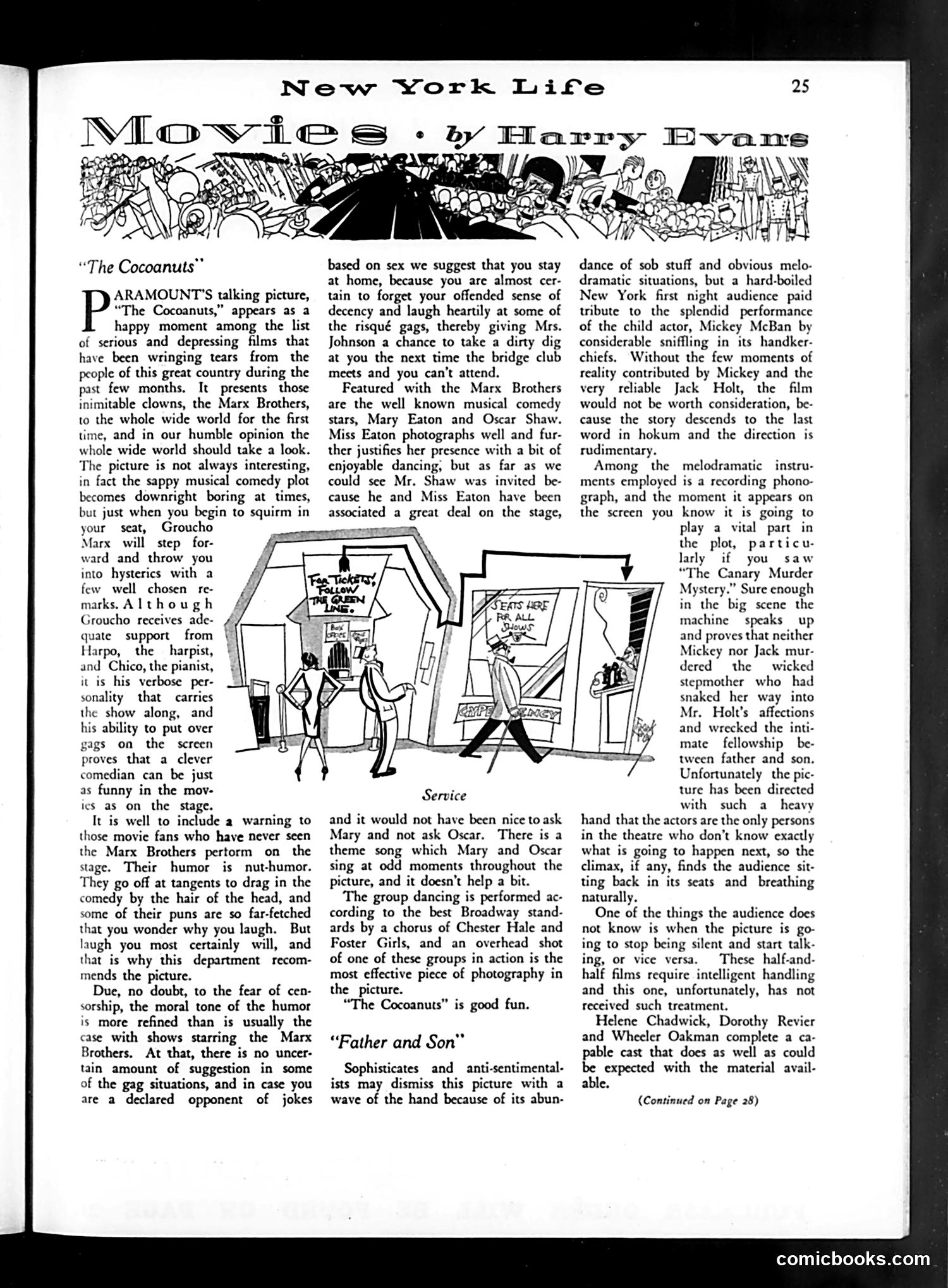
This page reviews two early talking pictures. **"The Cocoanuts"** is Paramount's film debut of the Marx Brothers—Groucho, Harpo, and Chico—whose vaudeville stage act was already famous. The reviewer praises Groucho's verbal comedy and quick wit as the film's strength, though the musical plot is "sappy" and boring. He warns prudish viewers that the humor contains risqué sexual innuendo that might offend, and notes the supporting cast (Mary Eaton, Oscar Shaw) adds little value. **"Father and Son"** features child actor Mickey McBan and Jack Holt in a melodrama heavy on emotional manipulation—what the critic dismissively calls "hokum." The review mocks the film's reliance on theatrical devices like a recording phonograph as plot mechanisms (referencing "The Canary Murder Mystery"). Both reviews capture early sound film's growing pains: stage comedians adapting to cinema, musical numbers disrupting narrative flow, and melodramatic conventions feeling overwrought in this new medium.
📄 Transcribed text from this page (OCR, searchable)
Machine-transcribed from the original scan — historical spelling and the odd misread are preserved.
New York Life 25 “The Cocoanuts” ARAMOUNT'S talking picture, Pz Cocoanuts,” appears as a happy moment among the list of serious and depressing films that have been wringing tears from the people of this great country during the past few months. It presents those inimitable clowns, the Marx Brothers, to the whole wide world for the first time, and in our humble opinion the whole wide world should take a look. The picture is not always interesting, in fact the sappy musical comedy plot becomes downright boring at times, but just when you begin to squirm in your seat, Groucho Marx will step for- ward and throw you into hysterics with a few well chosen re- marks. Although Groucho receives ade- quate support from Harpo, the harpist, and Chico, the pianist, it is his verbose per- sonality that carries the show along, and his ability to put over gags on the screen proves that a clever comedian can be just as funny in the mov- ies as on the stage. It is well to include a warning to those movie fans who have never scen the Marx Brothers pertorm on the stage. Their humor is nut-humor. They go off at tangents to drag in the comedy by the hair of the head, and some of their puns are so far-fetched that you wonder why you laugh. But laugh you most certainly will, and that is why this department recom- mends the picture. Due, no doubt, to the fear of cen- sorship, the moral tone of the humor is more refined than is usually the case with shows starring the Marx Brothers. At that, there is no uncer- tain amount of suggestion in some of the gag situations, and in case you are a declared opponent of jokes based on sex we suggest that you stay at home, because you are almost cer- tain to forget your offended sense of decency and laugh heartily at some of the risqué gags, thereby giving Mrs. Johnson a chance to take a dirty dig at you the next time the bridge club meets and you can’t attend. Featured with the Marx Brothers are the well known musical comedy stars, Mary Eaton and Oscar Shaw. Miss Eaton photographs well and fur- ther justifies her presence with a bit of enjoyable dancing, but as far as we could see Mr. Shaw was invited be- cause he and Miss Eaton have been associated a great deal on the stage, Service and it would not have been nice to ask Mary and not ask Oscar, There is a theme song which Mary and Oscar sing at odd moments throughout the picture, and it doesn’t help a bit. The group dancing is performed ac- cording to the best Broadway stand- ards by a chorus of Chester Hale and Foster Girls, and an overhead shot of one of these groups in action is the most effective piece of photography in the picture. “The Cocoanuts” is good fun. “Father and Son” Sophisticates and anti-sentimental- ists may dismiss this picture with a wave of the hand because of its abun- dance of sob stuff and obvious melo- dramatic situations, but a hard-boiled New York first night audience paid tribute to the splendid performance of the child actor, Mickey McBan by considerable sniffling in its handker- chiefs. Without the few moments of reality contributed by Mickey and the very reliable Jack Holt, the film would not be worth consideration, be- cause the story descends to the last word in hokum and the direction is rudimentary. Among the melodramatic instru- ments employed is a recording phono- graph, and the moment it appears on the screen you know it is going to play a vital part in the plot, particu- larly if you saw “The Canary Murder Mystery.” Sure enough in the big scene the machine speaks up and proves that neither Mickey nor Jack mur- dered the wicked stepmother who had snaked her way into Mr. Holt’s affections and wrecked the inti- mate fellowship _ be- tween father and son. Unfortunately the pic- ture has been directed with such a heavy hand that the actors are the only persons in the theatre who don’t know exactly what is going to happen next, so the climax, if any, finds the audience sit- ting back in its seats and breathing naturally. One of the things the audience does not know is when the picture is go- ing to stop being silent and start talk- ing, or vice versa. These half-and- half films require intelligent handling and this one, unfortunately, has not received such treatment. Helene Chadwick, Dorothy Revier and Wheeler Oakman complete a ca- pable cast that does as well as could x expected with the material avail- able. (Continued on Page 28) comicbooks.com