
Life, 1929-07-26 · page 15 of 36
Life — July 26, 1929 — page 15: what you’re looking at
What you’re looking at
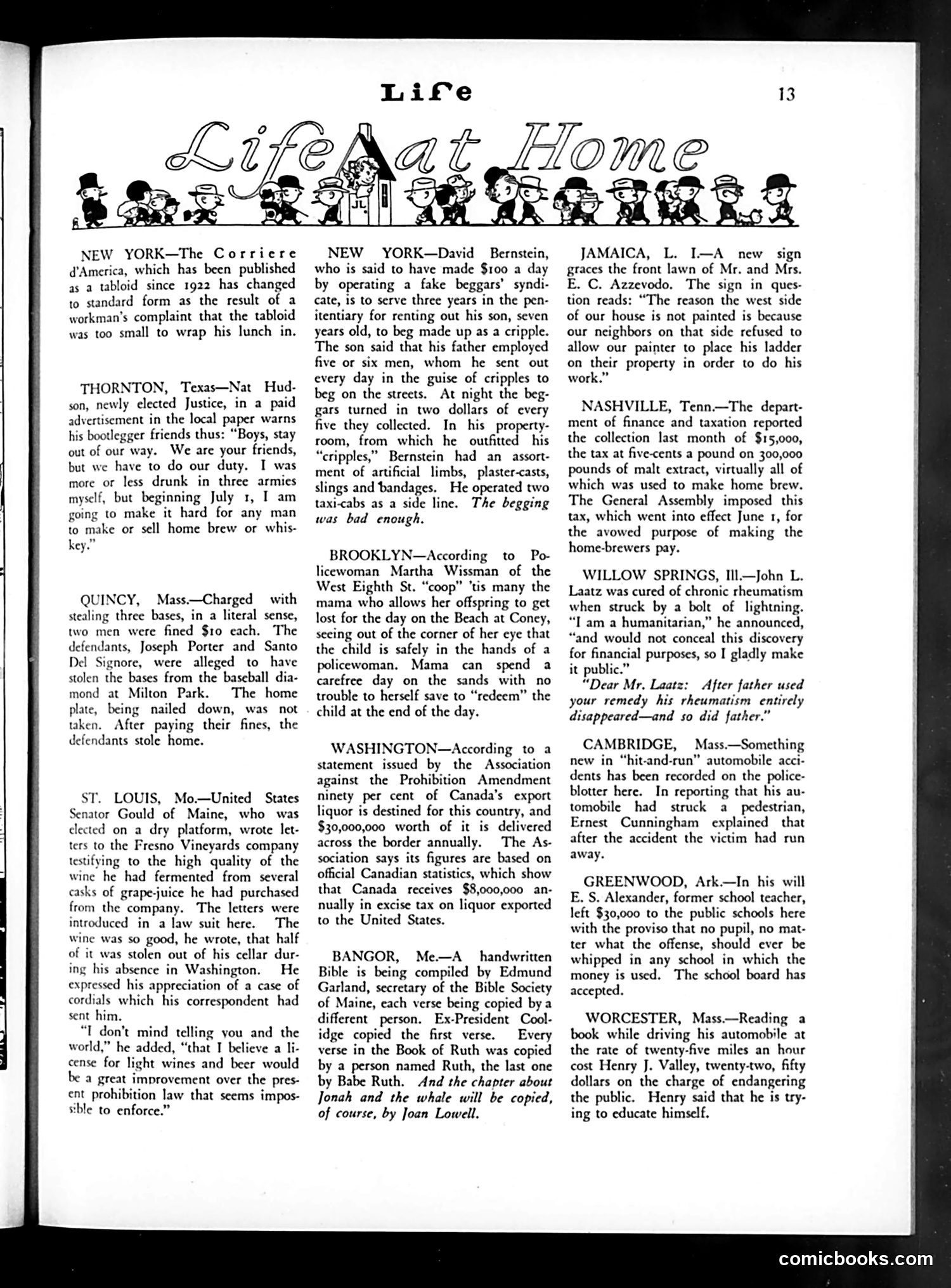
This page contains a column of humorous anecdotes rather than political cartoons. The header illustration shows a row of simplified figures representing domestic life. The stories satirize American social conditions during Prohibition (the "dry" period when alcohol was illegal): - A New York tabloid's shrinking size reflects economic decline - Multiple stories mock Prohibition enforcement and bootlegging (illegal alcohol production/sales) - A Texas justice warns against home brewing - A Maine senator's hypocrisy is highlighted: he fermented wine from grape juice he'd purchased, then claimed the wine was stolen when caught - A Maine Bible Society anecdote suggests absurdist copying practices The satire targets Prohibition's failures, highlighting how citizens circumvented alcohol bans and how enforcement remained selective or performative. These brief items reflect public frustration with unpopular, unenforceable laws.
📄 Transcribed text from this page (OCR, searchable)
Machine-transcribed from the original scan — historical spelling and the odd misread are preserved.
NEW YORK—The Corriere d’America, which has been published as a tabloid since 1922 has changed to standard form as the result of a workman’s complaint that the tabloid was too small to wrap his lunch in. THORNTON, Texas—Nat Hud- son, newly elected Justice, in a paid advertisement in the local paper warns his bootlegger friends thus: “Boys, stay out of our way. We are your friends, but we have to do our duty. I was more or less drunk in three armies myself, but beginning July 1, I am going to make it hard for any man to make or sell home brew or whis- key.” QUINCY, Mass.—Charged with stealing three bases, in a literal sense, two men were fined $10 each. The defendants, Joseph Porter and Santo Del Signore, were alleged to have stolen the bases from the baseball dia- mond at Milton Park. The home plate, being nailed down, was not taken. After paying their fines, the defendants stole home. ST. LOUIS, Mo.—United States Senator Gould of Maine, who was clected on a dry platform, wrote let- ters to the Fresno Vineyards company testifying to the high quality of the wine he had fermented from several casks of grape-juice he had purchased from the company. The letters were introduced in a law suit here. The wine was so good, he wrote, that half of it was stolen out of his cellar dur- ing his absence in Washington. He expressed his appreciation of a case of cordials which his correspondent had sent him. “I don’t mind telling you and the world,” he added, “that I believe a li- cense for light wines and beer would be a great improvement over the pres- ent prohibition law that seems impos- sible to enforce.” NEW YORK—David Bernstein, who is said to have made $100 a day by operating a fake beggars’ syndi- cate, 1s to serve three years in the pen- itentiary for renting out his son, seven years old, to beg made up as a cripple. The son said that his father employed five or six men, whom he sent out every day in the guise of cripples to beg on the streets. At night the beg- gars turned in two dollars of every five they collected. In his property- room, from which he outfitted his “cripples,” Bernstein had an assort- ment of artificial limbs, plaster-casts, slings and bandages. He operated two taxi-cabs as a side line. The begging was bad enough. BROOKLYN—According to Po- licewoman Martha Wissman of the West Eighth St. “coop” ‘tis many the mama who allows her offspring to get lost for the day on the Beach at Coney, seeing out of the corner of her eye that the child is safely in the hands of a policewoman. Mama can spend a carefree day on the sands with no trouble to herself save to “redeem” the child at the end of the day. WASHINGTON—According to a statement issued by the Association against the Prohibition Amendment ninety per cent of Canada’s export liquor is destined for this country, and $30,000,000 worth of it is delivered across the border annually. The As- sociation says its figures are based on official Canadian statistics, which show that Canada receives $8,000,000 an- nually in excise tax on liquor exported to the United States. BANGOR, Me.—A handwritten Bible is being compiled by Edmund Garland, secretary of the Bible Society of Maine, each verse being copied by a different person. Ex-President Cool- idge copied the first verse. Every verse in the Book of Ruth was copied by a person named Ruth, the last one by Babe Ruth. And the chapter about Jonah and the whale will be copied, of course, by Joan Lowell. JAMAICA, L. I—A_ new sign graces the front lawn of Mr. and Mrs. E. C. Azzevodo, The sign in ques- tion reads: “The reason the west side of our house is not painted is because our neighbors on that side refused to allow our painter to place his ladder on their property in order to do his work.” NASHVILLE, Tenn.—The depart- ment of finance and taxation reported the collection last month of $15,000, the tax at five-cents a pound on 300,000 pounds of malt extract, virtually all of which was used to make home brew. The General Assembly imposed this tax, which went into effect June 1, for the avowed purpose of making the home-brewers pay. WILLOW SPRINGS, IIl.—John L. Laatz was cured of chronic rheumatism when struck by a bolt of lightning. “Tam a humanitarian,” he announced, “and would not conceal this discovery for financial purposes, so I gladly make it public.” “Dear Mr, Laatz: After father used your remedy his rheumatism entirely disappeared—and so did father.” CAMBRIDGE, —Mass.—Something new in “hit-and-run” automobile acci- dents has been recorded on the police- blotter here. In reporting that his au- tomobile had struck a pedestrian, Ernest Cunningham explained that after the accident the victim had run away. GREENWOOD, Ark—In his will E. S. Alexander, former school teacher, left $30,000 to the public schools here with the proviso that no pupil, no mat- ter what the offense, should ever be whipped in any school in which the money is used. The school board has accepted. WORCESTER, Mass.—Reading a book while driving his automobile at the rate of twenty-five miles an hour cost Henry J. Valley, twenty-two, fifty dollars on the charge of endangering the public. Henry said that he is try- ing to educate himself. comicbooks.com