
A complete issue · 36 pages · 1929
Life — July 26, 1929
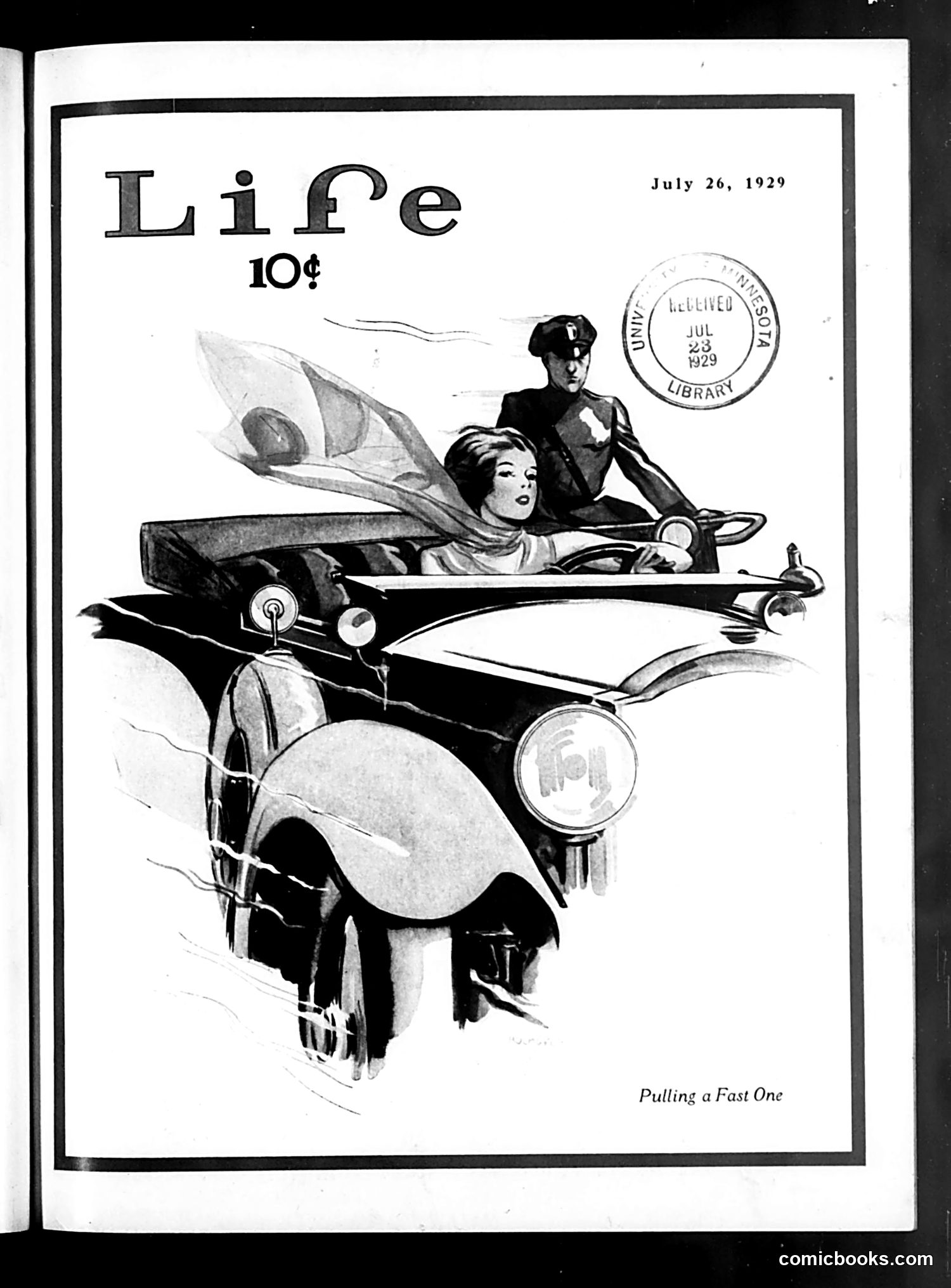
This is a **magazine cover**, not a political cartoon. The image shows a stylized illustration of a young woman driving a sporty convertible automobile with a man seated behind her. The woman's scarf and hair blow dramatically in the wind, emphasizing speed and motion. The caption reads "Pulling a Fast One," which appears to be a **double entendre**—both literally depicting fast driving and idiomatically suggesting deception or outwitting someone. Given the 1929 date (just before the stock market crash), this likely satirizes the era's **carefree attitudes about wealth, speed, and modern leisure**, possibly with undertones about reckless behavior or moral looseness associated with the Jazz Age and "flapper" culture that concerned conservative Americans.
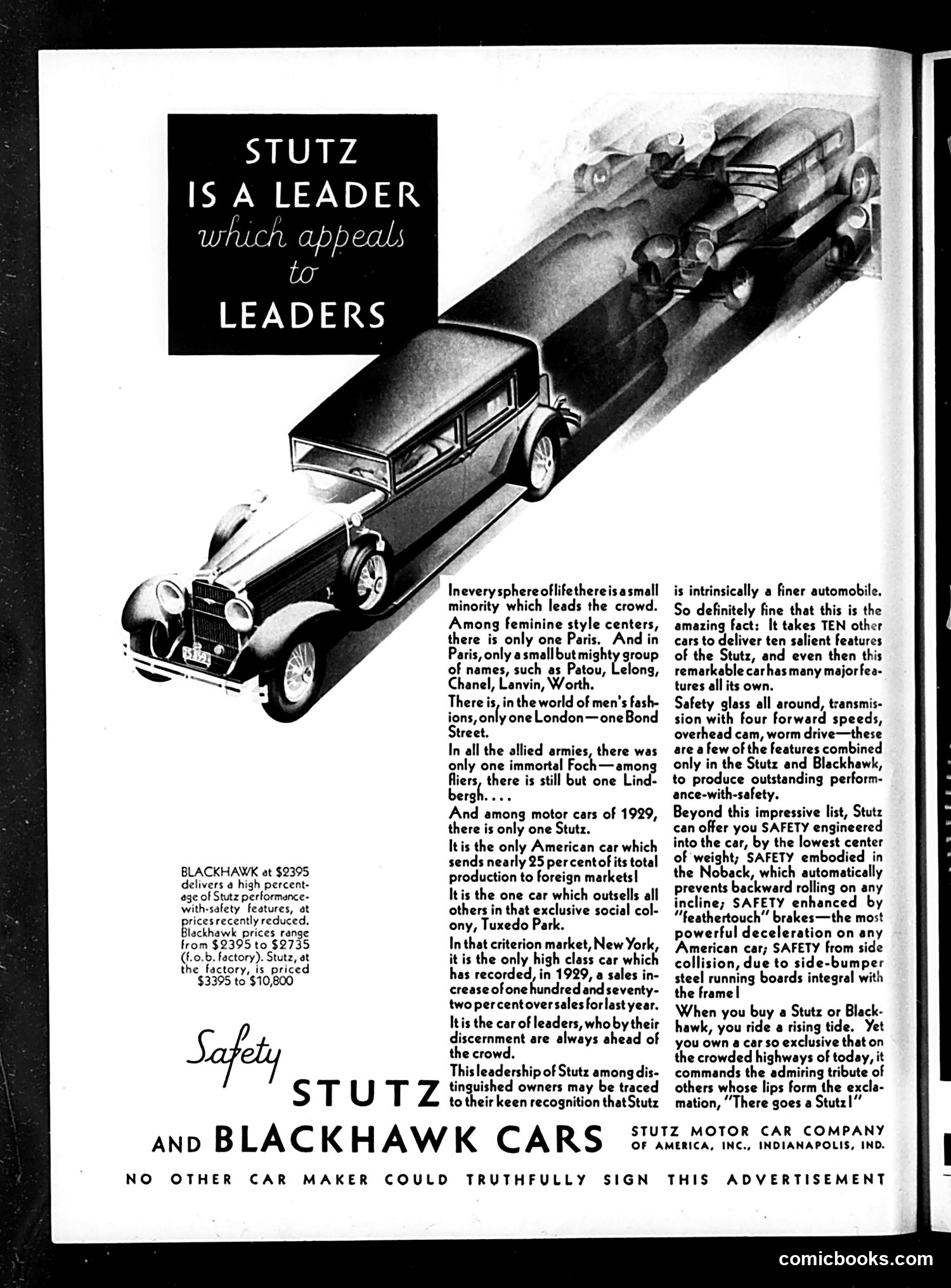
This is a **1929 automobile advertisement** for Stutz and Blackhawk cars—not a political cartoon. The page promotes luxury vehicles by claiming they are "leaders" that appeal to distinguished owners. The ad uses **social hierarchy language**: it references exclusive fashion centers (Paris, London's Bond Street) and claims Stutz outsells competitors among wealthy buyers. It lists technical features (safety glass, overhead cam, worm drive) to establish superiority. The illustration shows a lineup of cars demonstrating the brand's prominence. The entire page is commercial messaging, with the disclaimer at bottom stating "NO OTHER CAR MAKER COULD TRUTHFULLY SIGN THIS ADVERTISEMENT"—a boastful claim typical of 1920s luxury car marketing.
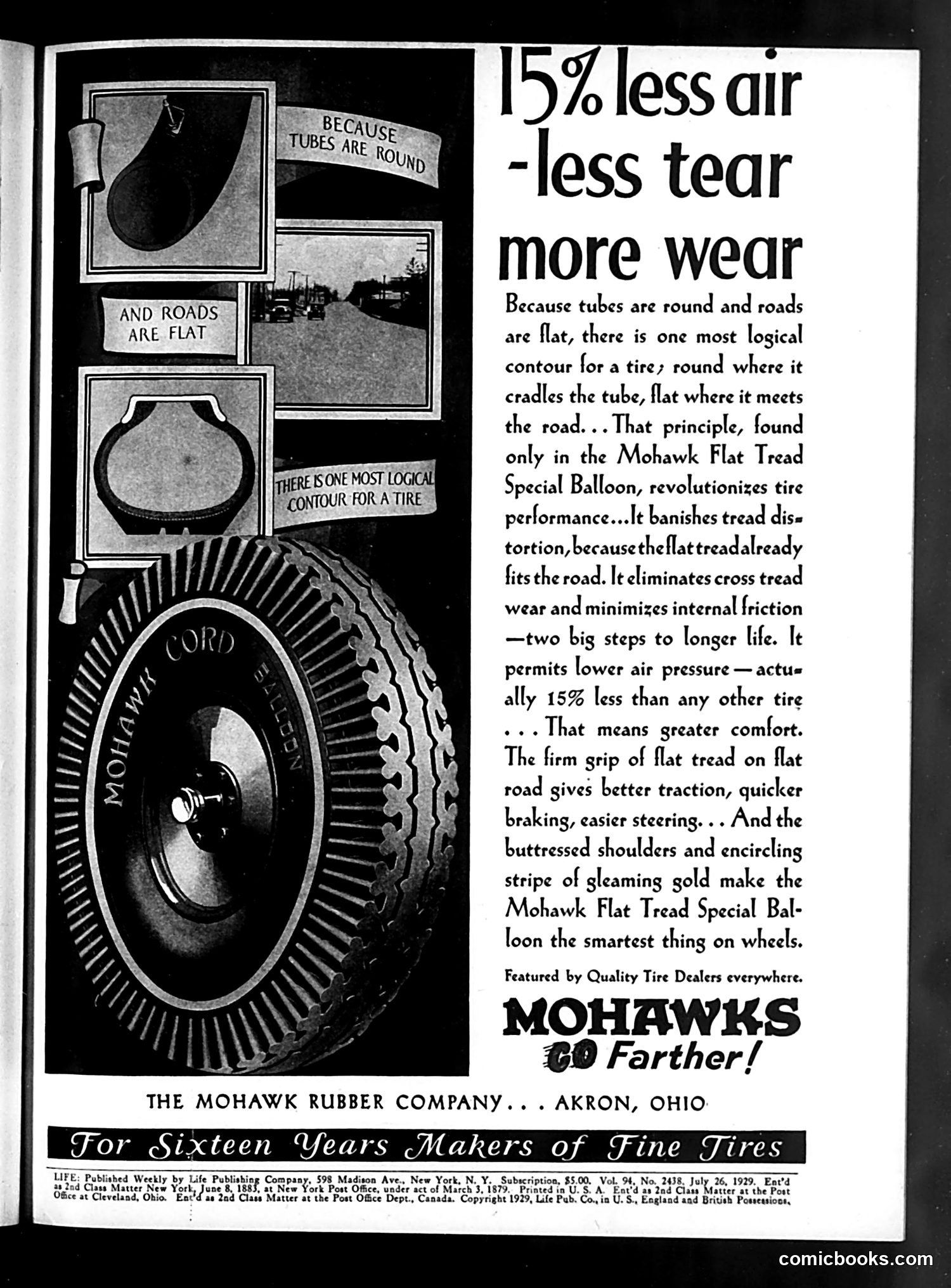
This page is **primarily a commercial advertisement**, not political satire. It's a Mohawk Rubber Company ad for their "Flat Tread Special Balloon" tire, published in *Life* magazine (dated July 26, 1929, based on the footer). The ad uses a pedagogical approach, with diagrams explaining that because "tubes are round and roads are flat," a flat tire tread logically matches road surfaces better. The copy claims this design reduces wear, permits lower air pressure (15% less), improves traction and braking, and offers greater comfort. The phrase "go Farther!" is Mohawk's slogan. The ad targets quality tire dealers and appears aimed at automobile owners during the late 1920s automotive boom. There is no political satire present—this is straightforward product promotion.
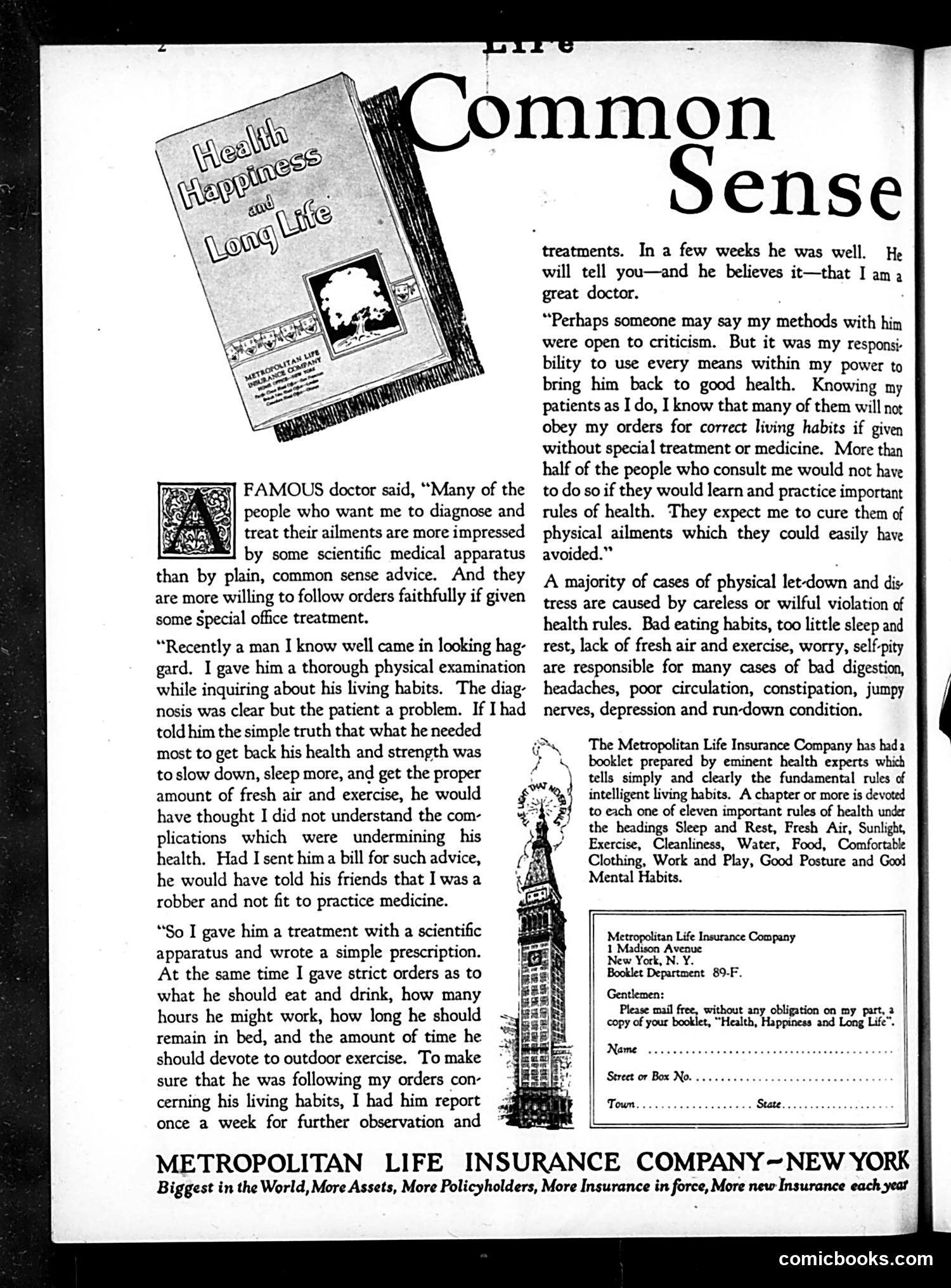
This page is primarily **advertising for Metropolitan Life Insurance Company**, not satire. The "Common Sense" article features an unnamed famous doctor discussing patient care philosophy. The doctor's anecdote criticizes patients who expect medical apparatus and prescriptions rather than accepting lifestyle advice—diet, sleep, fresh air, and exercise. When he told one patient this plain truth, the patient considered him a "robber." The doctor then prescribed the same advice *with* a "scientific apparatus" and formal orders, which the patient accepted and followed successfully. The satire is **subtle**: it mocks how people value medical authority and official-seeming treatments over identical practical advice given informally. The irony suggests patients prioritize *perceived* expertise over actual health fundamentals. The advertisement promotes Metropolitan Life's free health booklet on "eleven important rules of health."
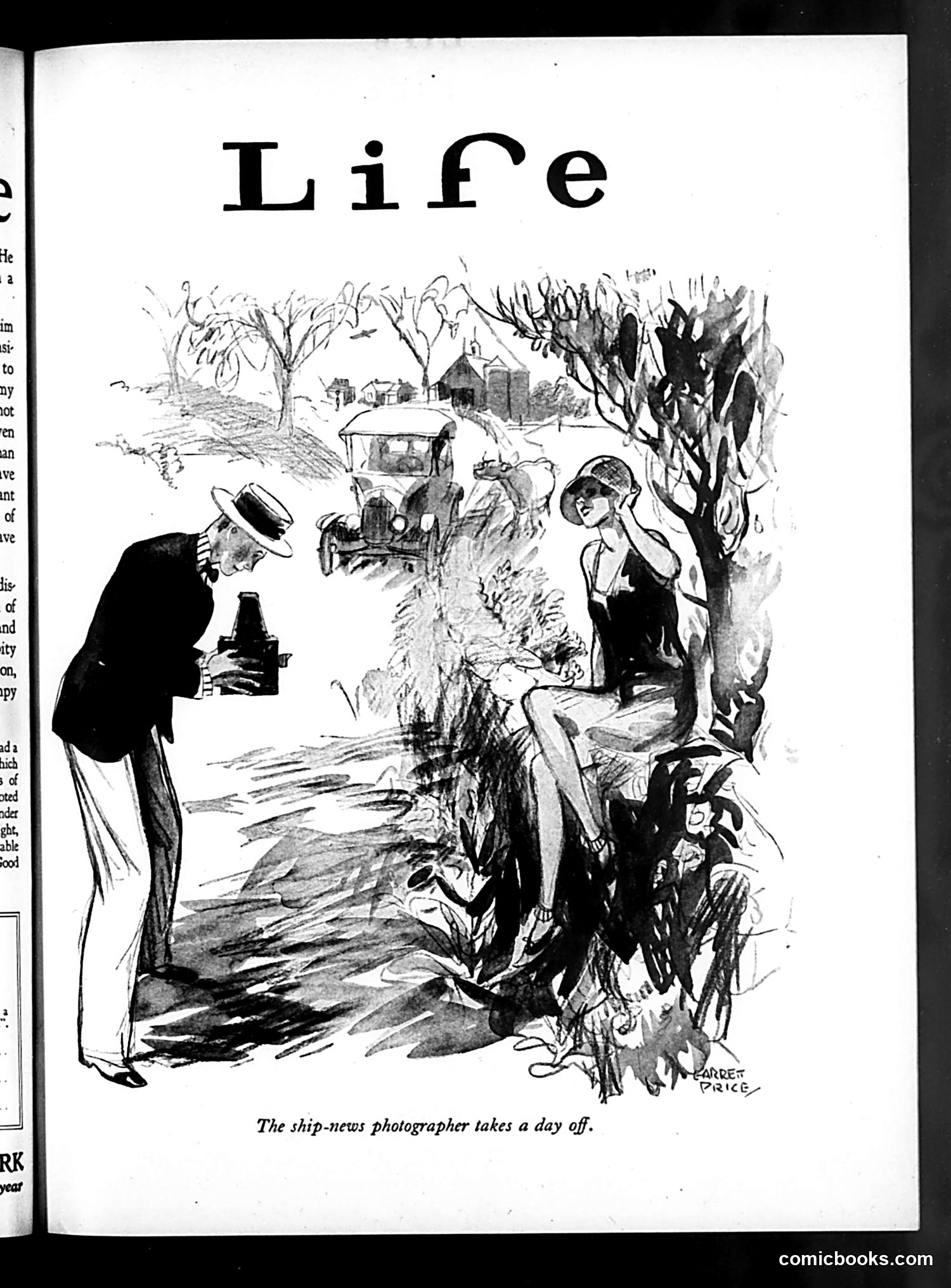
This satirical illustration from *Life* magazine presents "The ship-news photographer takes a day off." The cartoon depicts a newspaper photographer (left, holding a camera) encountering a romantic pastoral scene: a well-dressed couple relaxing by a tree near a rural homestead, with period automobiles visible in the background. The satire likely targets the contrast between the photographer's professional duty to capture "ship news" (maritime/harbor reporting) and the temptation of leisure. The irony suggests how news photographers were constantly searching for stories, even when supposedly off-duty. The idyllic countryside scene represents an escape from urban newspaper work—a humorous commentary on work-life balance and the always-on nature of journalism in this era.
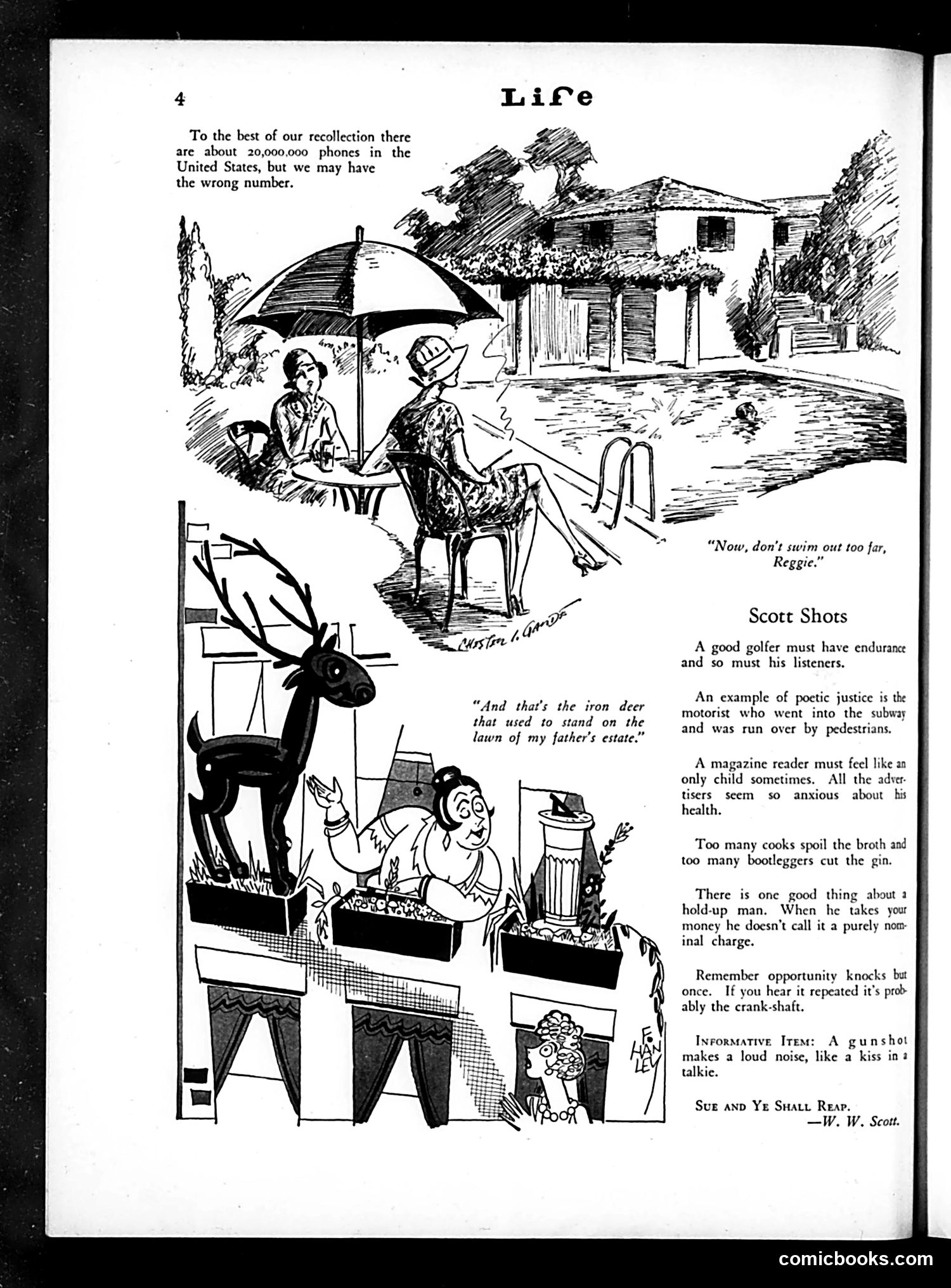
This page combines two separate satirical pieces from *Life* magazine. **Top cartoon**: Shows a poolside scene with the caption "Now, don't swim out too far, Reggie." The humor appears to reference anxieties about leisure activities and safety warnings. **Bottom cartoon**: Titled "Scott Shots," this is a collection of brief satirical observations on contemporary life. The visual gag features a mounted deer head above various figures (including what appears to be a hunter or taxidermist), playing on themes of hunting trophies and domestic life. The text includes aphorisms mocking golfers' tedious stories, pedestrian accidents, magazine readers, cooks, bootleggers, hold-up men, and opportunity. The final note about gunshots in talkies references early sound film technology. These reflect 1920s-30s American social satire targeting leisure activities, Prohibition-era crime, and modern entertainment anxieties.
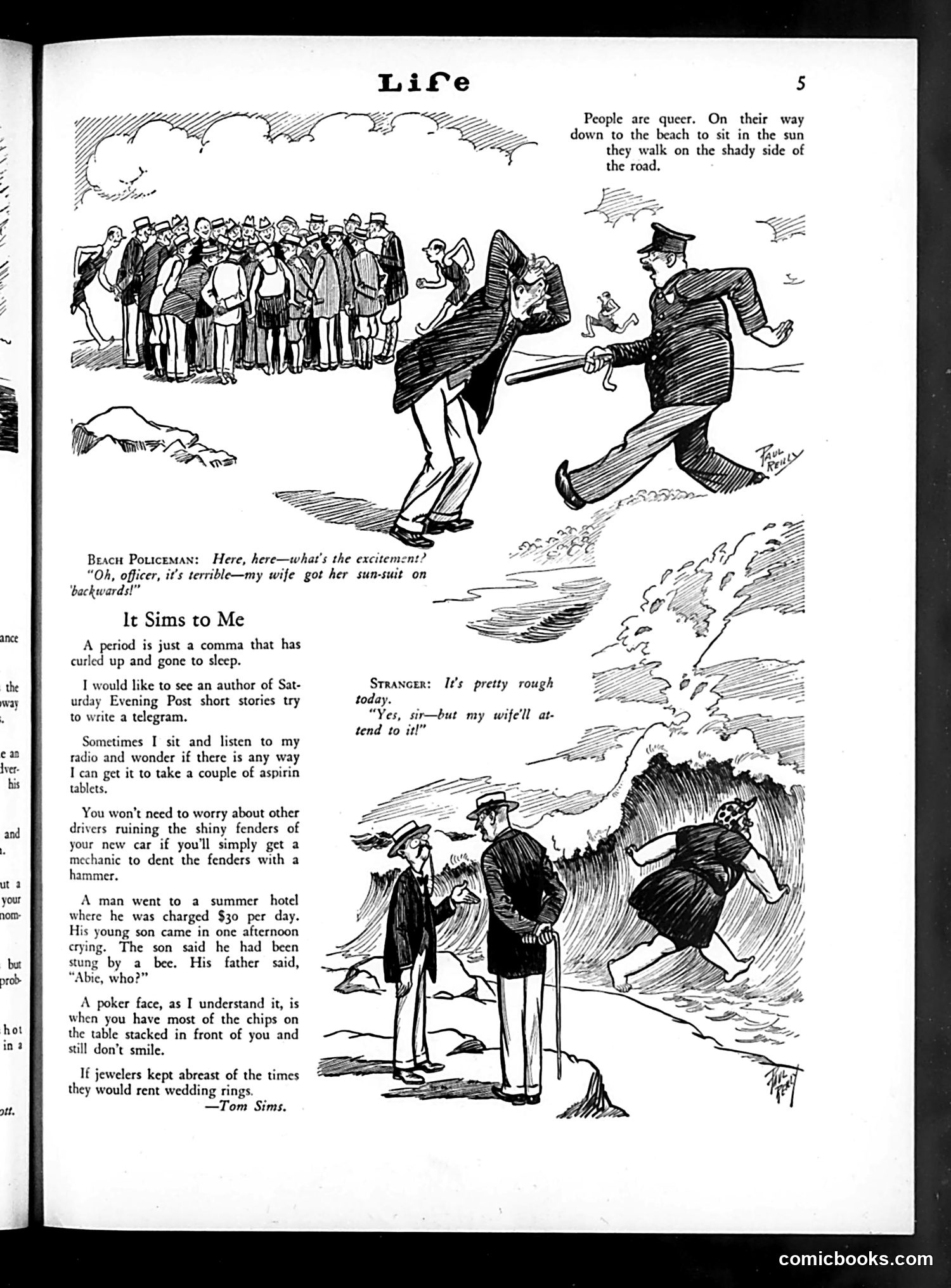
**Top Cartoon:** A beach policeman interrupts two men in a physical altercation, saying his wife "got her sunsuit on backwards." The humor targets the absurdity of 1920s-era beach fashion and social conventions—the policeman's concern about his wife's improper beachwear is presented as the "real" scandal worth interrupting a fight over, satirizing society's prudish anxieties about women's beach attire during an era when swimwear was becoming more revealing. **"It Sims to Me" Section:** A humorous column by Tom Sims offering satirical observations: complaints about radio, aspirin for social situations, car maintenance, hotel pricing, and the poker "chip stack" as a sign of composure. The beach scene below illustrates couples navigating rough surf, likely satirizing vacation mishaps and awkward social moments at seaside resorts.
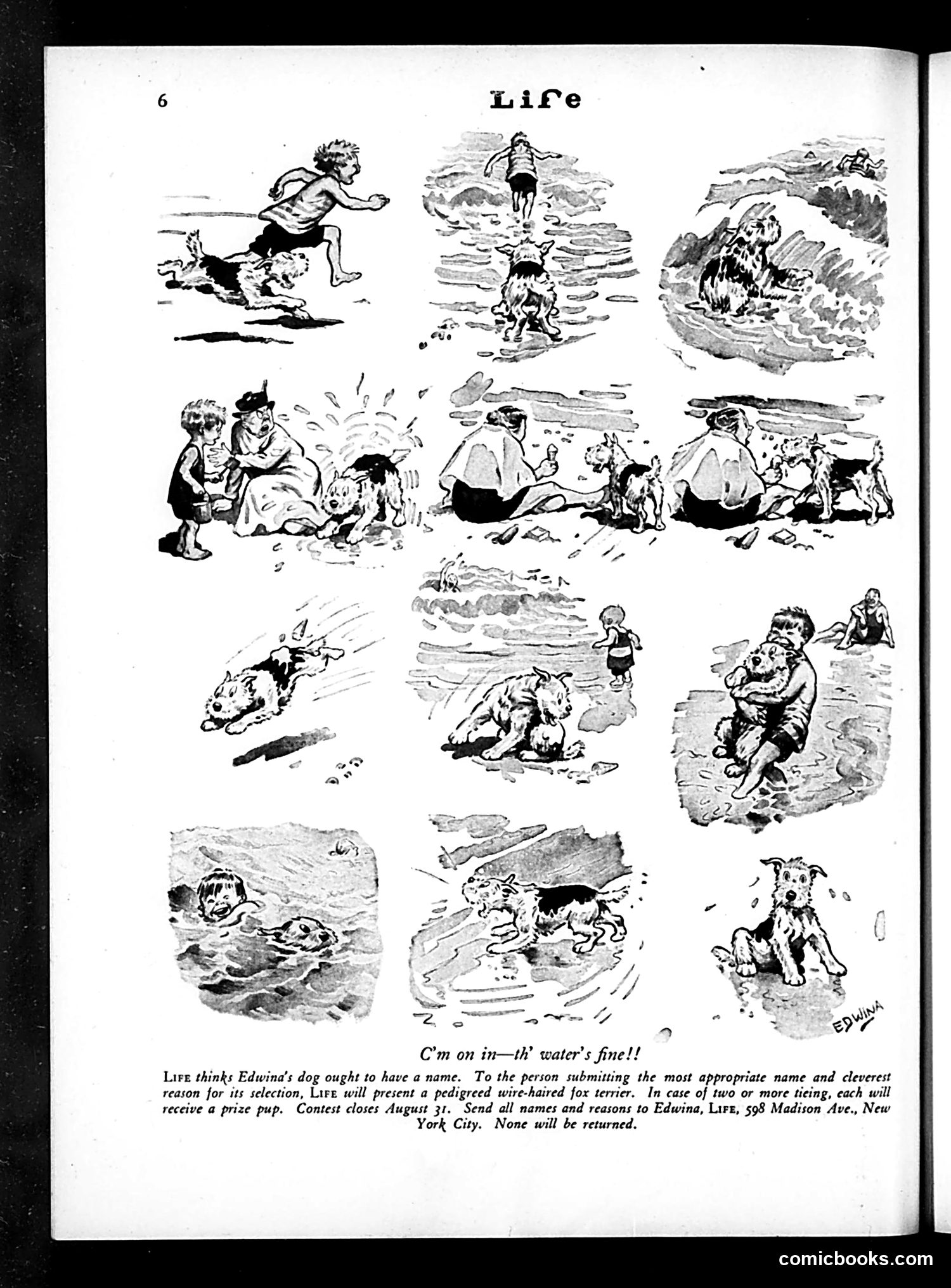
This is a humorous comic strip titled "C'm on in—th' water's fine!!" depicting a dog's various beach and water activities throughout a day. The strip shows the dog playing, swimming, running, and interacting with beachgoers in different scenarios. Below the comic, Life magazine announces a naming contest for "Edwin's dog," offering a pedigreed wire-haired fox terrier as the prize to whoever submits the most appropriate and clever name. The contest deadline is August 31, with entries sent to Life's New York office. This appears to be promotional content encouraging reader participation—a common engagement tactic in early 20th-century magazines. The humor derives from the dog's innocent mischief and the playful situations it creates at the beach, rather than political or social satire.
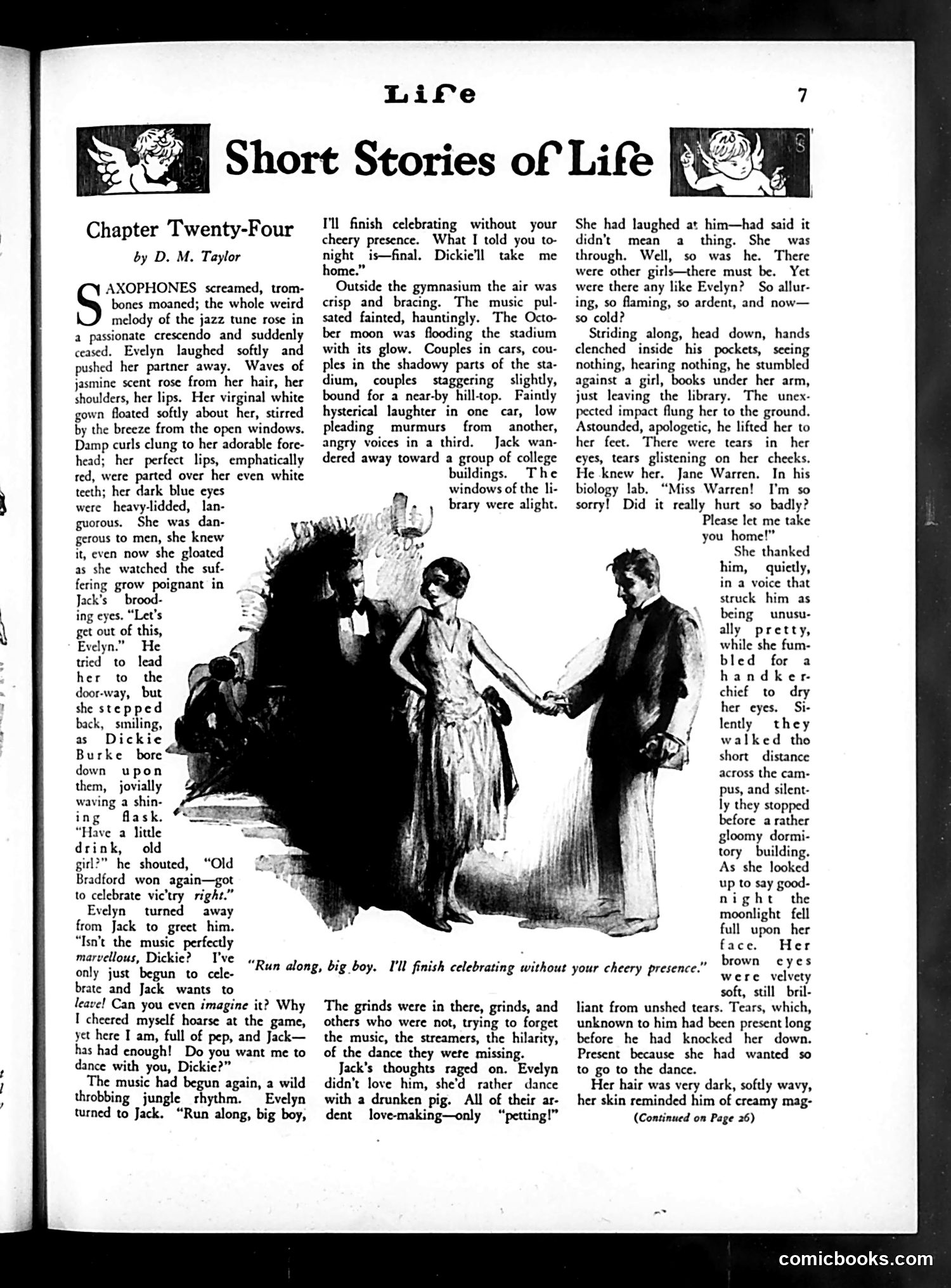
This page contains a short story by D.M. Taylor titled "Short Stories of Life," featuring a narrative about young people at what appears to be a college dance or social gathering. The accompanying illustration shows three figures in 1920s attire—a woman in a light dress between two men in dark suits. The caption reads: "Run along, big boy. I'll finish celebrating without your cheery presence." The story describes Evelyn, a young woman at a gymnasium dance, caught between competing suitors (Jack and Dickie Burke). The narrative explores romantic tension and social dynamics of the era, including period details like saxophones, jazz music, and casual dating customs. The overall tone is light romantic fiction typical of Life magazine's entertainment content during this period.
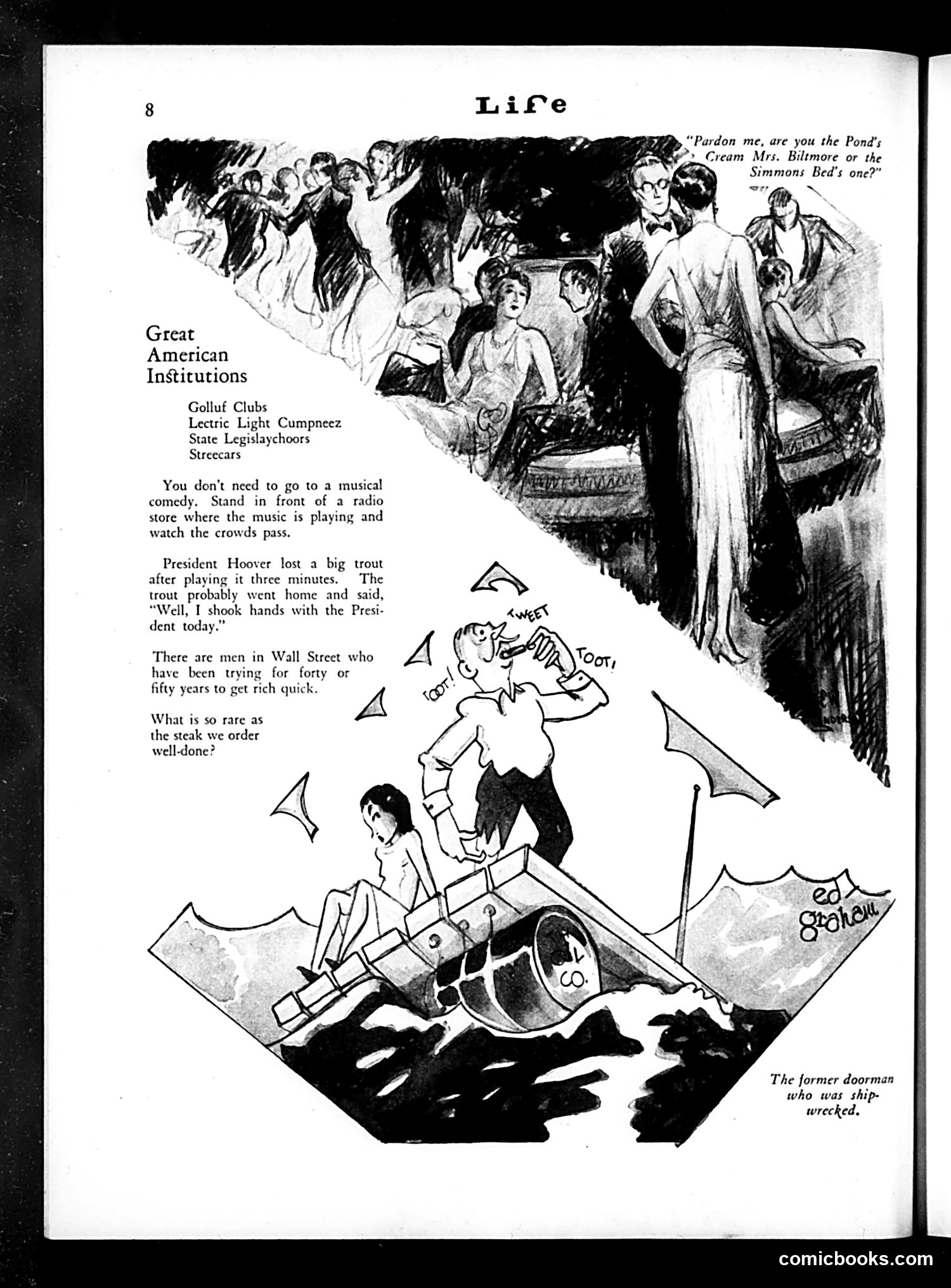
This page satirizes American wealth and social pretension during the Jazz Age. The upper illustration depicts an elegant social gathering—likely a high-society event—with the caption asking "Pardon me, are you the Pond's Cream Mrs. Biltmore or the Simmons Bed's one?" This mocks how wealthy socialites became walking advertisements, their identities merged with commercial products they endorsed. The lower cartoon shows a shipwrecked man optimistically toasting amid disaster, labeled "The former doorman who was shipwrecked." This appears to satirize working-class resilience or possibly the class contradictions of the era—even in catastrophe, the formerly humble maintain their spirits. The left column's brief anecdotes (Hoover fishing, Wall Street schemes, rare steaks) mock various American institutions and pretensions through sardonic observation.
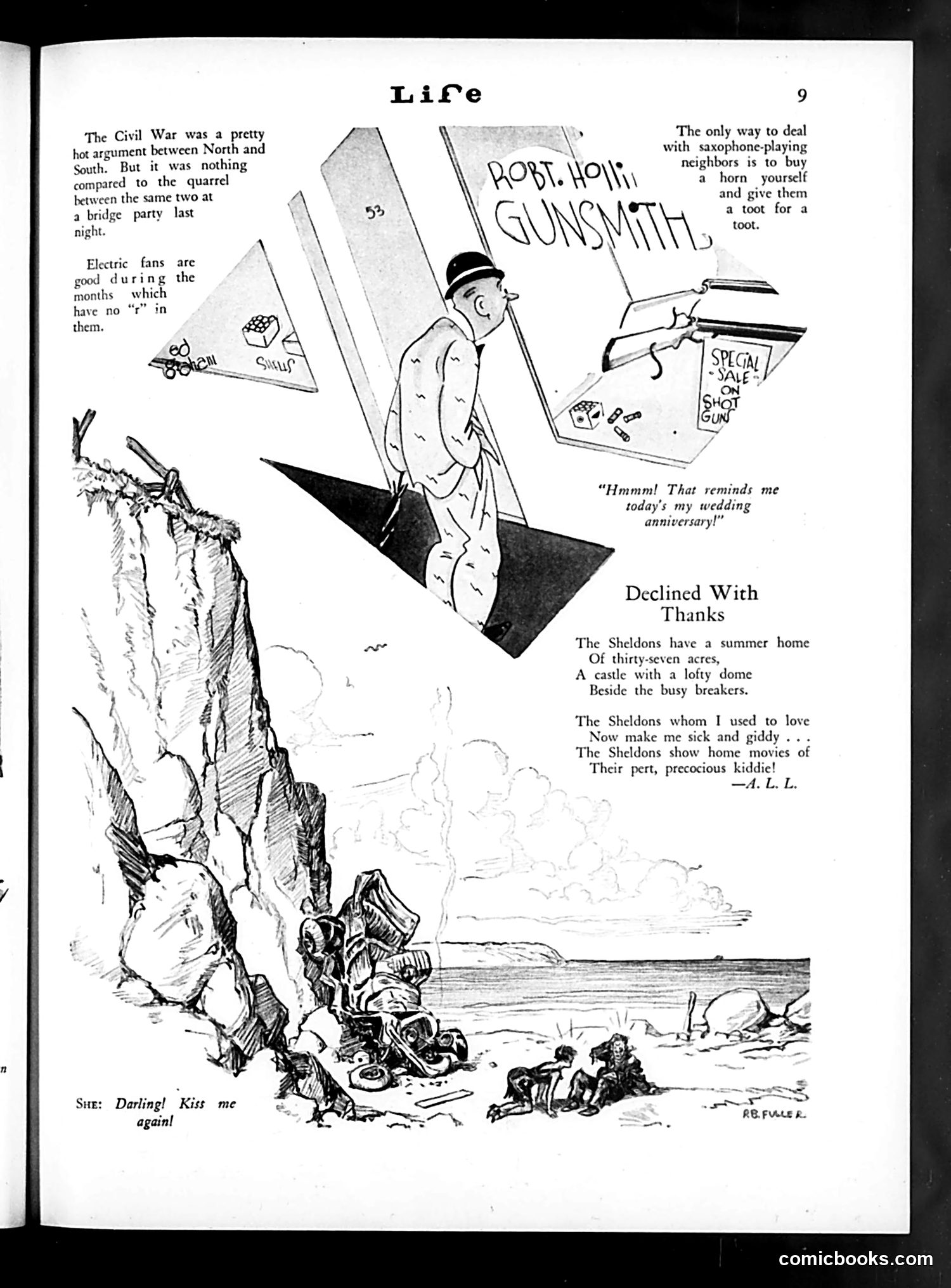
This page contains three satirical pieces: 1. **Top cartoon**: A man in a bowler hat encounters shop signs for "Prost. Horn Gunsmith" and "Special Sale Shot Gun," reminding him it's his wedding anniversary. The joke: the merchandise (horns and guns) humorously suggests marital discord—these items represent both noise complaints from neighbors and potential domestic conflict. 2. **Left cartoon**: A couple by a cliff with the caption "She: Darling! Kiss me again!" The darker implication appears to be dark humor about marital despair. 3. **"Declined With Thanks"**: A poem by A.L.L. about the Sheldons, wealthy neighbors with a summer estate who've become irritating. The author declines their invitation, claiming their "pert, precocious" children make them unbearable. The page satirizes marriage troubles and social pretension.
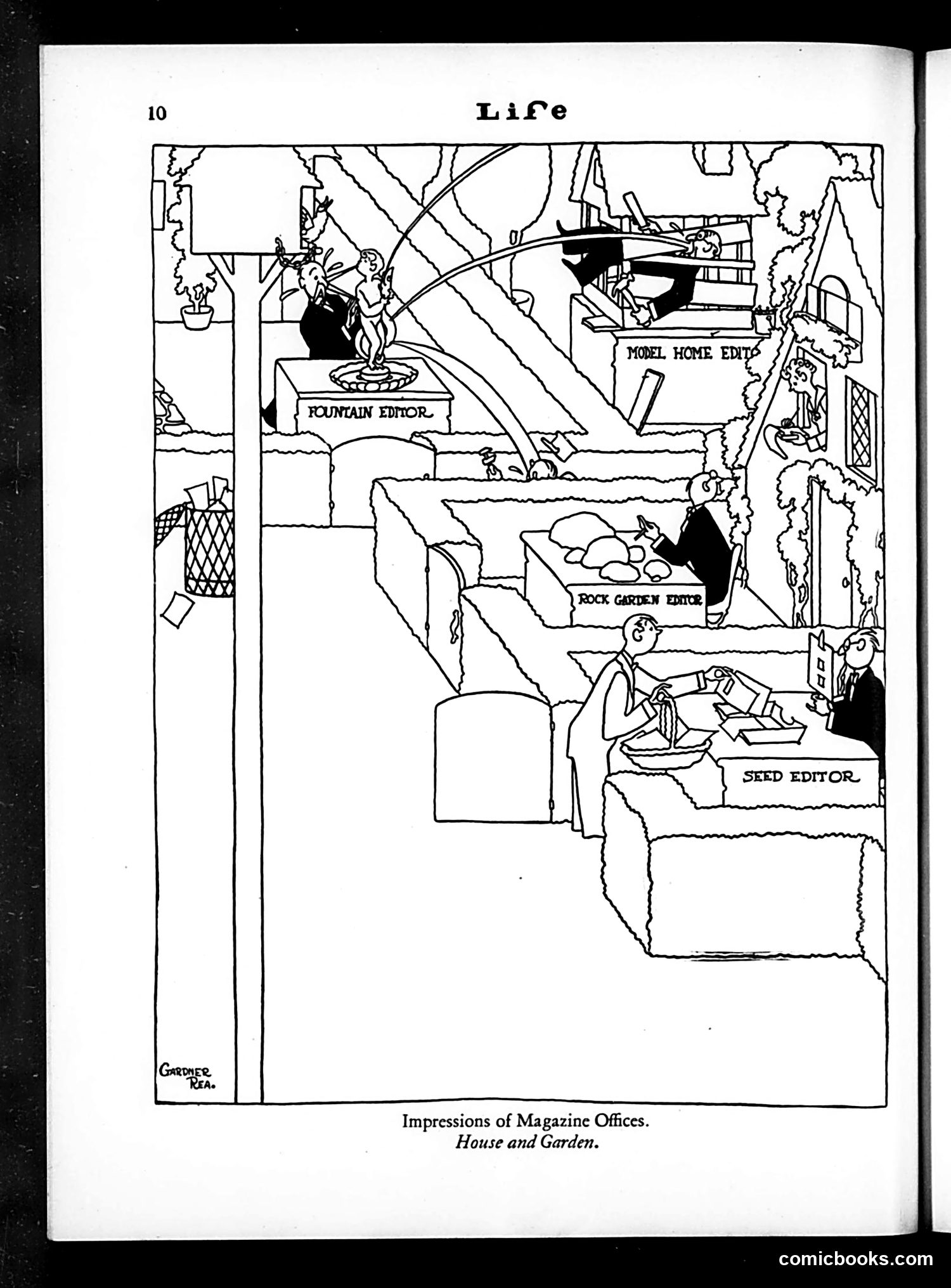
This is a satirical illustration of the *House and Garden* magazine offices, depicting four specialized editorial positions distributed throughout a home-like setting: - **Fountain Editor** (upper left): oversees decorative water features - **Model Home Editor** (upper right): manages showcase home content - **Rock Garden Editor** (center): handles gardening features - **Seed Editor** (lower right): manages seed/plant content The humor lies in depicting magazine editorial work as scattered throughout an actual house, literally illustrating how *House and Garden* magazine is organized by home and garden departments. Each editor occupies a different room or level, treating the magazine's offices as if they were rooms in the featured home itself—a visual pun on the magazine's subject matter and organizational structure.
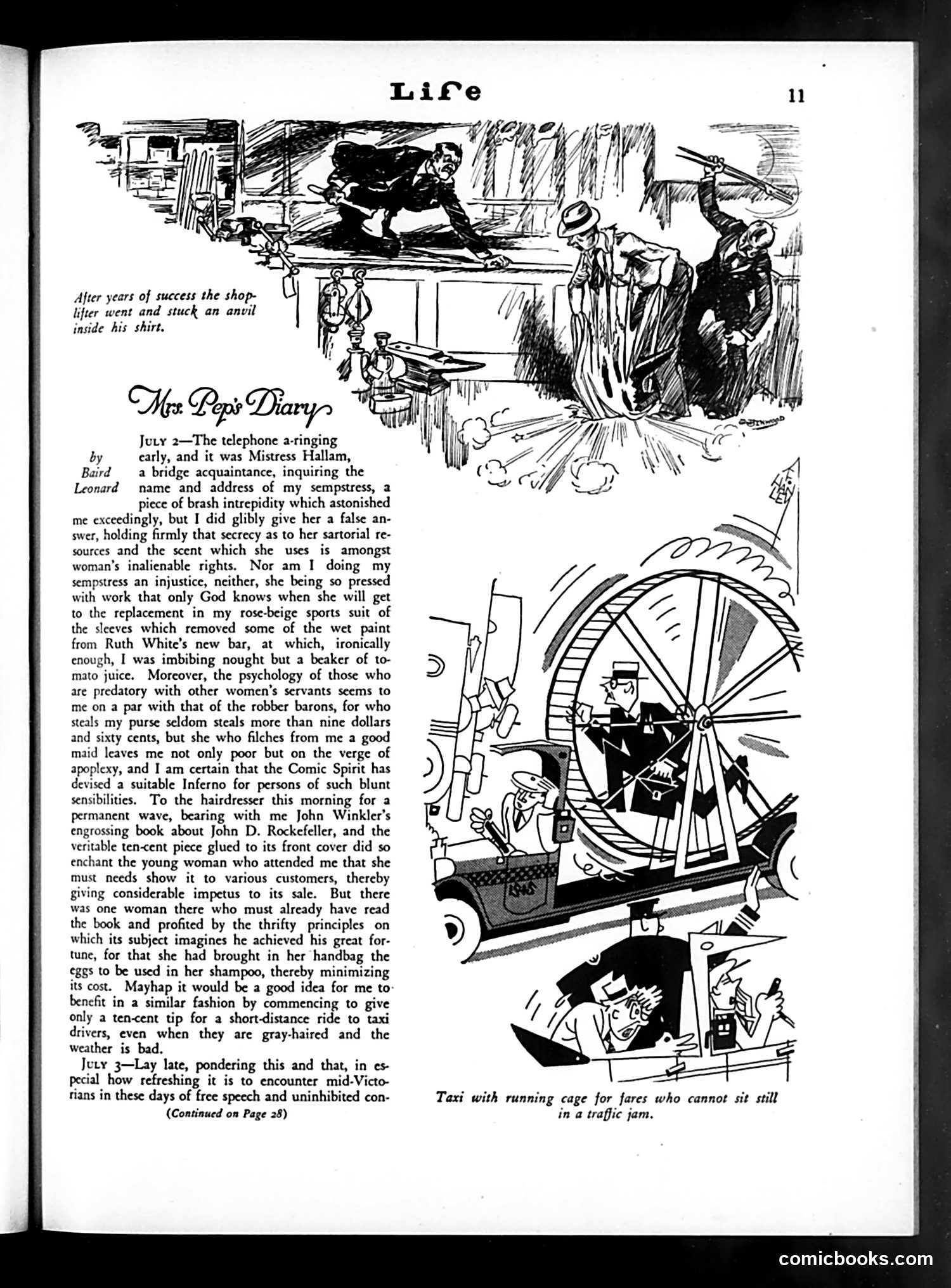
This page features a satirical diary entry by "Leonard" (author unclear) mocking domestic service and women's labor. The narrator—a shoplifter who now works as a servant—receives a call from "Mistress Hallam" demanding her name and address. The diarist sarcastically defends workers' privacy rights and criticizes the exploitative wages and conditions servants endure. The accompanying illustrations depict working-class scenarios: servants being treated dismissively by employers, and a taxi "cage" for crowded passengers unable to sit during traffic jams. The satire targets the hypocrisy and indignity of domestic service work, where employers treat servants as property while paying poverty wages. It's social commentary on class inequality and labor conditions in early 20th-century America.
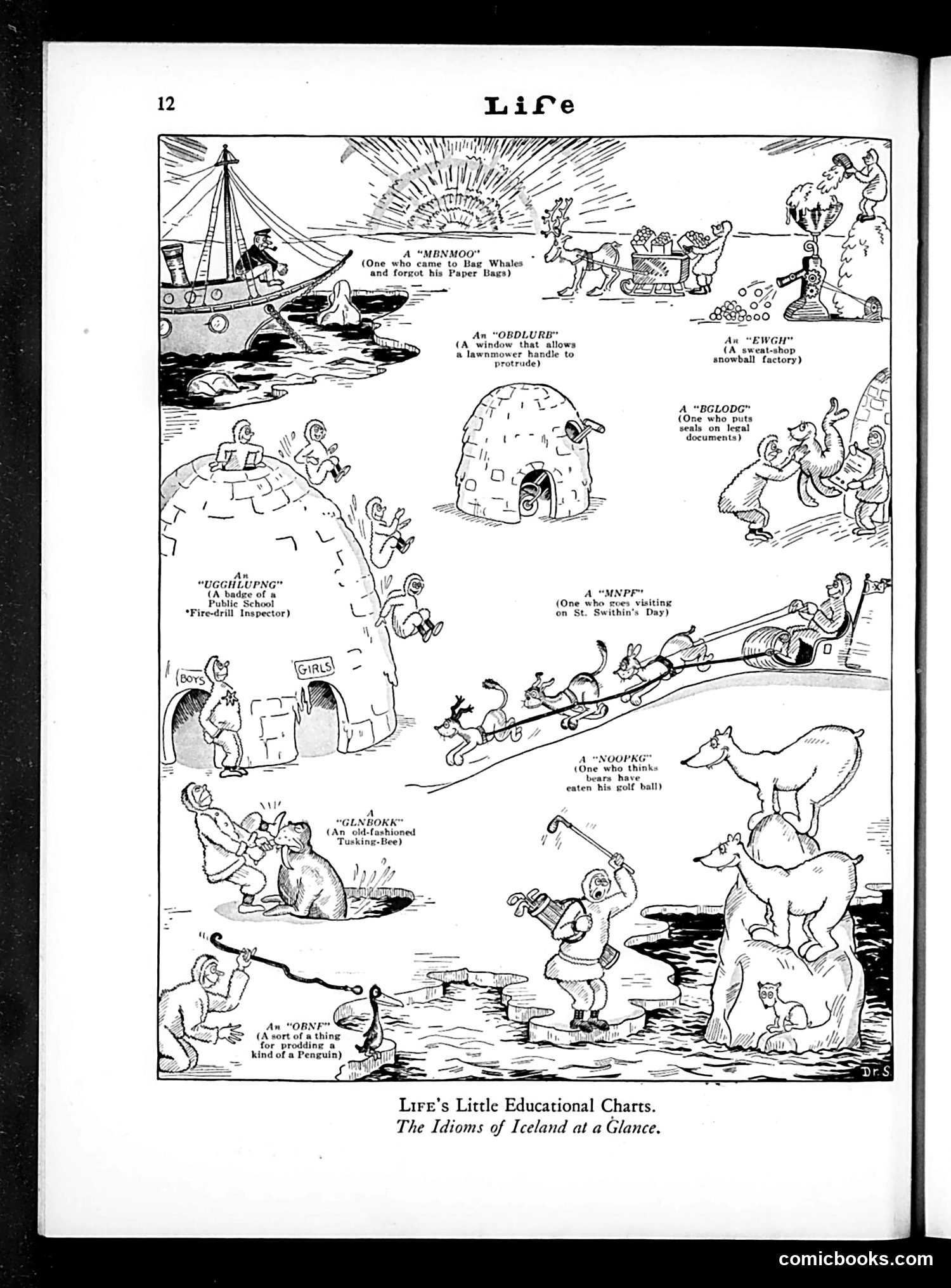
This is a humorous educational chart depicting Icelandic idioms through illustrated scenarios. Each vignette translates a figurative expression into a literal, absurd visual scene: - **"Crimshog"**: someone who came to the Whales and forgot the Bags - **"Norðlure"**: a window allowing a lawnmower to handle protrude - **"Eugh"**: a snowball factory - **"Beglodg"**: seals on legal documents - **"Minpt"**: someone visiting on St. Swithin's Day - **"Nopkc"**: one who thinks a dog has eaten his golf ball - **"Glsbook"**: old-fashioned Tusking-Bee - **"Orne"**: a device for prodding a kind of Penguin The satire mocks obscure foreign idioms by treating their literal translations as genuine cultural practices, creating absurdist humor through the disconnect between linguistic meaning and visual representation.
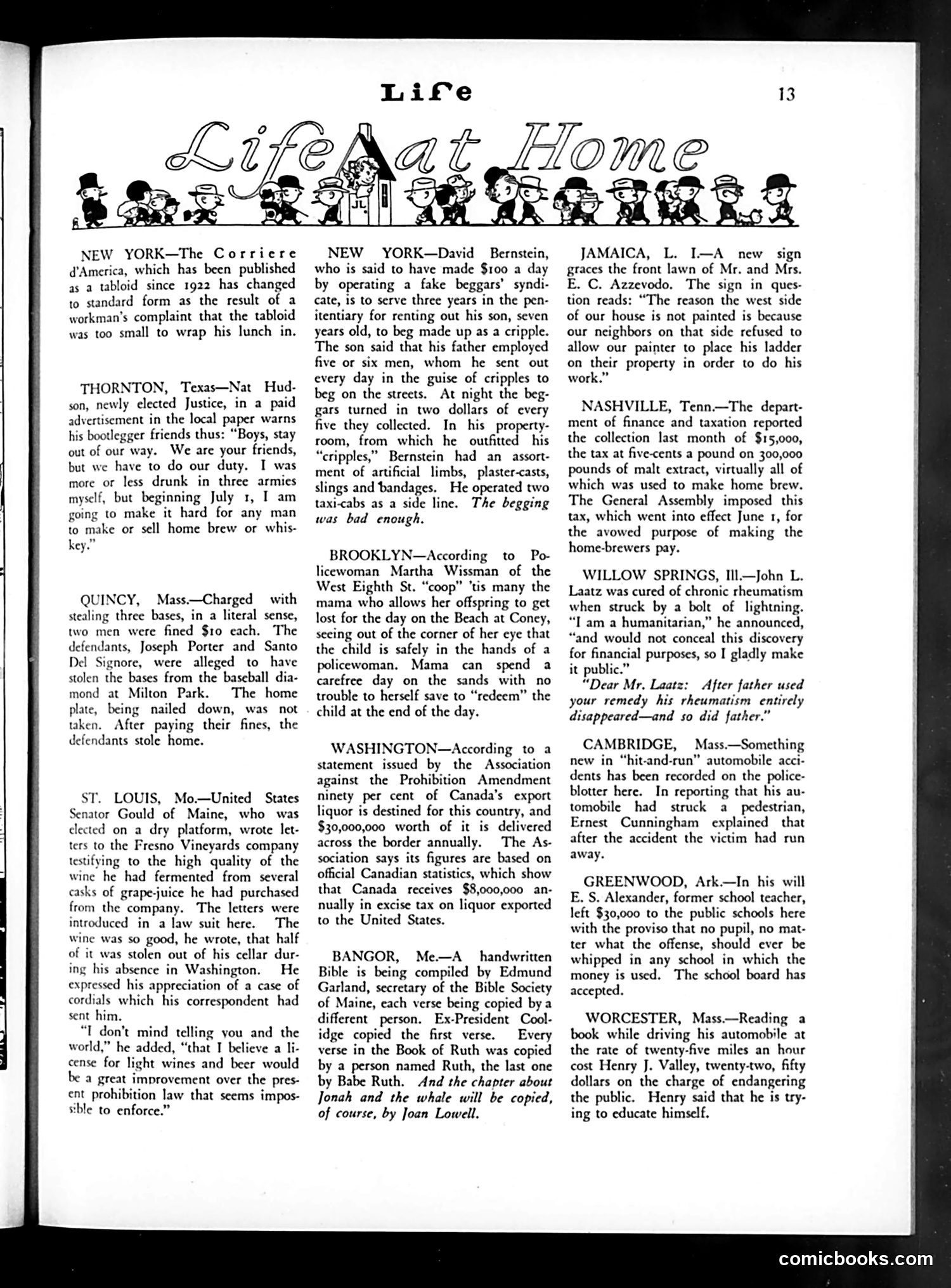
This page contains a column of humorous anecdotes rather than political cartoons. The header illustration shows a row of simplified figures representing domestic life. The stories satirize American social conditions during Prohibition (the "dry" period when alcohol was illegal): - A New York tabloid's shrinking size reflects economic decline - Multiple stories mock Prohibition enforcement and bootlegging (illegal alcohol production/sales) - A Texas justice warns against home brewing - A Maine senator's hypocrisy is highlighted: he fermented wine from grape juice he'd purchased, then claimed the wine was stolen when caught - A Maine Bible Society anecdote suggests absurdist copying practices The satire targets Prohibition's failures, highlighting how citizens circumvented alcohol bans and how enforcement remained selective or performative. These brief items reflect public frustration with unpopular, unenforceable laws.
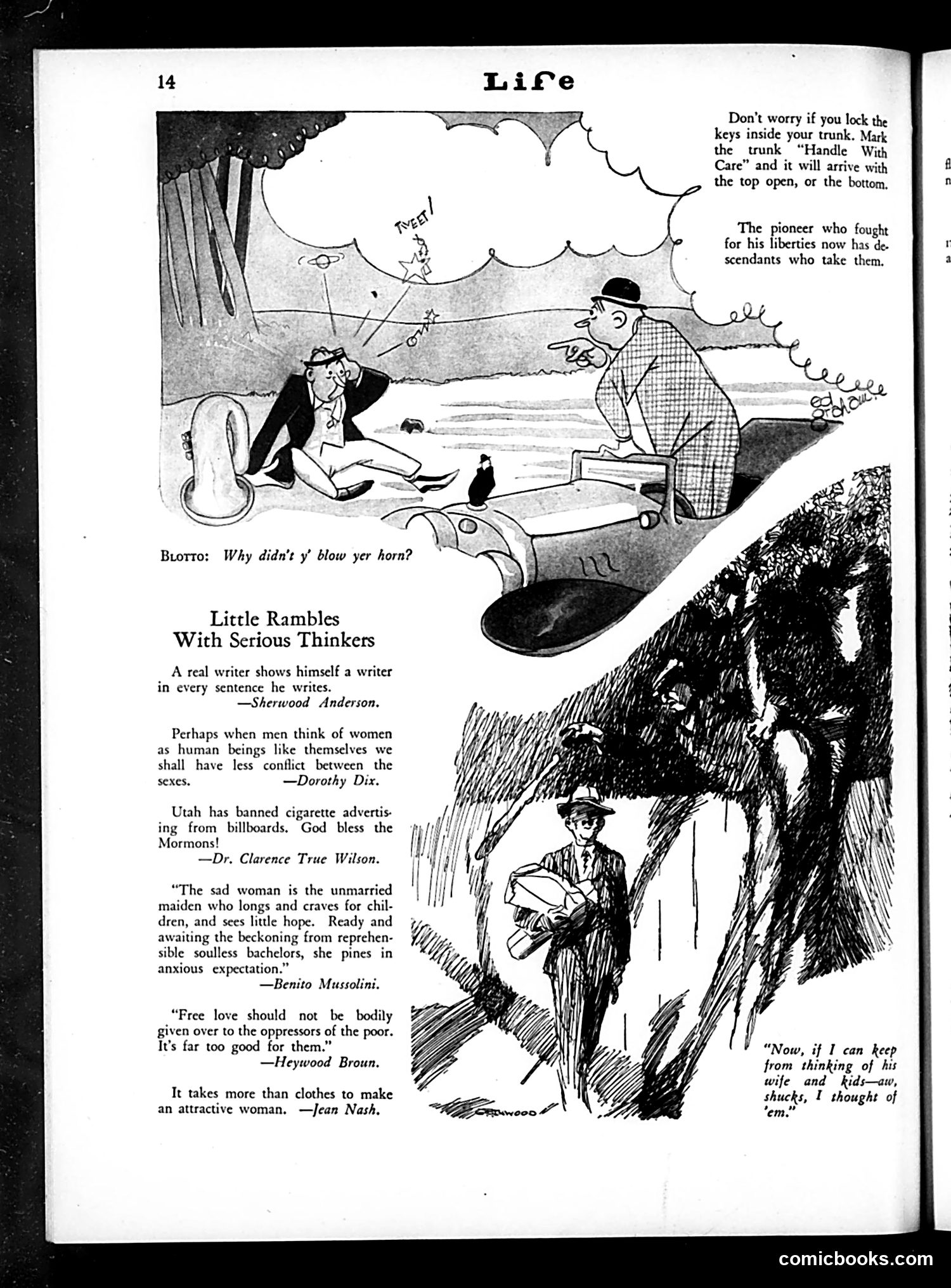
**Top Cartoon ("Blotto"):** Two men appear intoxicated near what looks like a car or vessel. One asks "Why didn't y' blow yer horn?" The joke relies on the double meaning of "horn"—both a vehicle warning device and slang for a drinking vessel. It's a Prohibition-era gag about drunk driving or reckless behavior by inebriated men. **"Little Rambles With Serious Thinkers":** This section collects brief quotes from notable figures (Sherwood Anderson, Dorothy Dix, Benito Mussolini, etc.) on topics like gender relations, women's independence, and social morality. The accompanying illustration shows a man hiding in bushes, thinking about avoiding thoughts of his wife and children. The page satirizes both urban vice and contemporary social commentary about changing gender roles and family life.
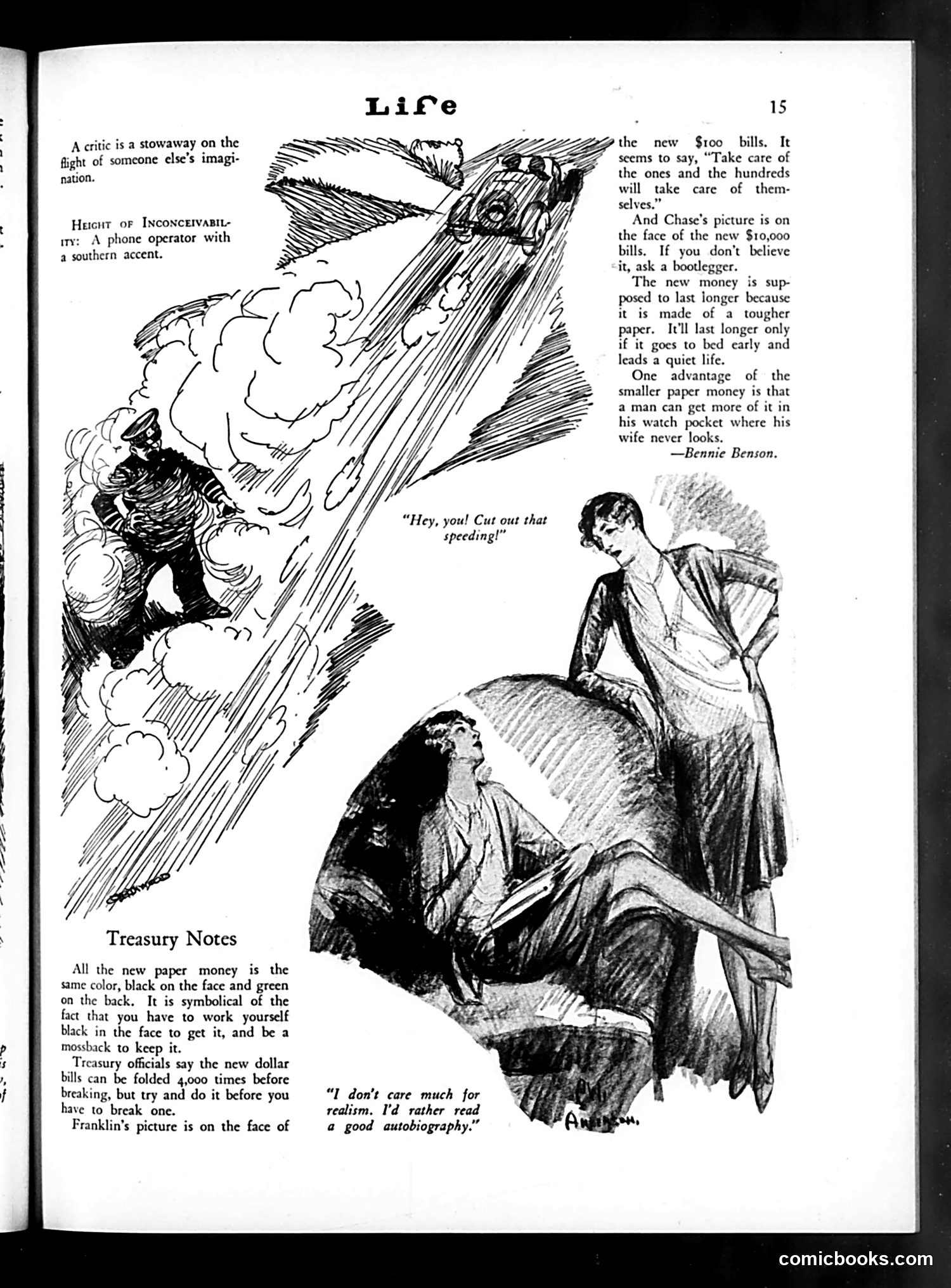
This page satirizes new U.S. paper currency design. The top cartoon shows a figure (appears to be Uncle Sam or a money personification) riding a speeding airplane labeled with dollar bills, with a smaller figure yelling "Hey, you! Cut out that speeding!"—mocking the rapid introduction of new currency. The bottom illustration depicts two men discussing the new bills, with one saying "I don't care much for realism. I'd rather read a good autobiography." This jokes that the new bills feature Franklin's portrait—suggesting Franklin's autobiography would be more interesting than his portrait's "realism." The accompanying text explains the new paper money's durability and color scheme (black face, green back), treating practical banking details with humorous commentary about wealth and marriage.
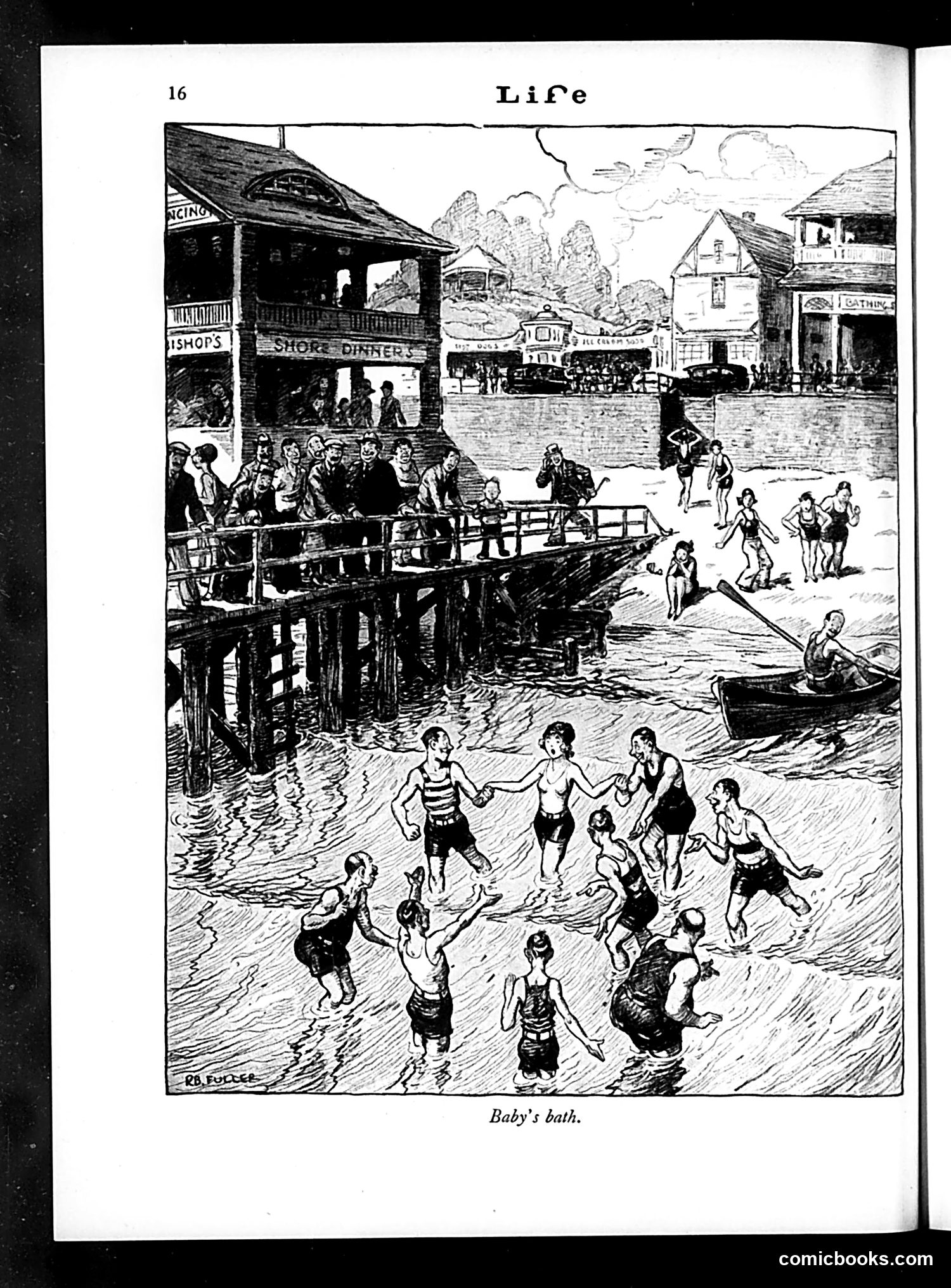
This illustration depicts a crowded beach scene at what appears to be an early 20th-century seaside resort. The caption "Baby's bath" is ironic—the image shows numerous children wading and playing in the ocean water together, suggesting the sea itself serves as a communal bathing area for infants and young children. The satire likely comments on public beach conditions and safety standards of the era. The pier-side buildings advertising "Shore Dinners" and other establishments suggest a commercial resort setting. The crowded, chaotic scene of unsupervised children bathing together in open water implies critiques of both hygiene practices and child welfare standards of the period—the "bath" being casual, unregulated, and somewhat hazardous by modern standards.
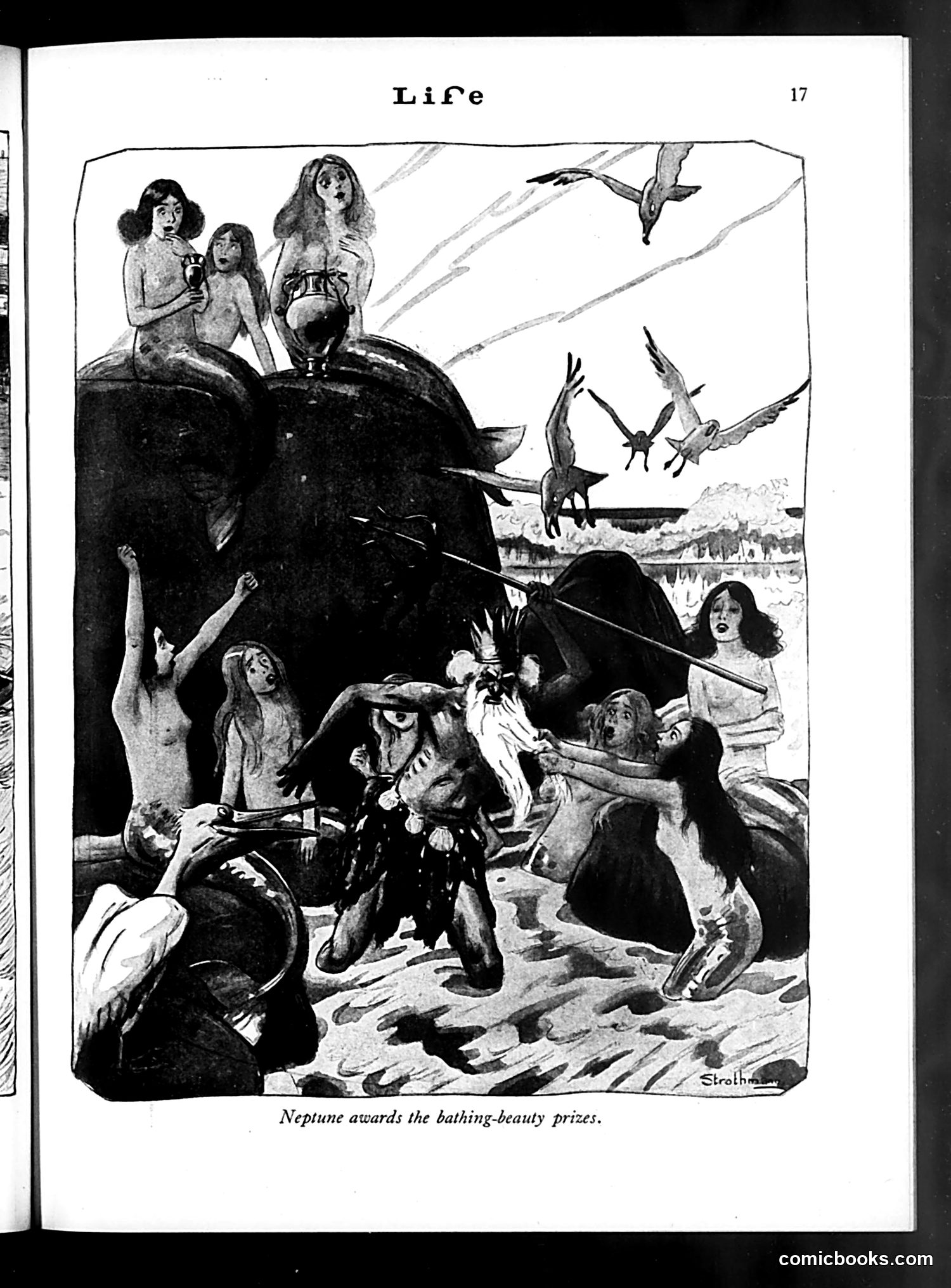
This is a satirical cartoon titled "Neptune awards the bathing-beauty prizes." The image depicts Neptune (identifiable by his trident, visible at left) presiding over a beach scene where mermaids and sea creatures are judging human female bathers. The satire mocks the popular "bathing beauty" pageants and contests that were prevalent in early 20th-century American culture. By having the mythological god of the sea and his aquatic subjects award prizes to human swimmers, the cartoon humorously suggests that beauty competitions are absurd spectacles—so ridiculous that even imaginary sea creatures might participate in judging them. The work appears to critique the objectification of women in these public competitions, using mythological fantasy to highlight the entertainment's frivolous nature.
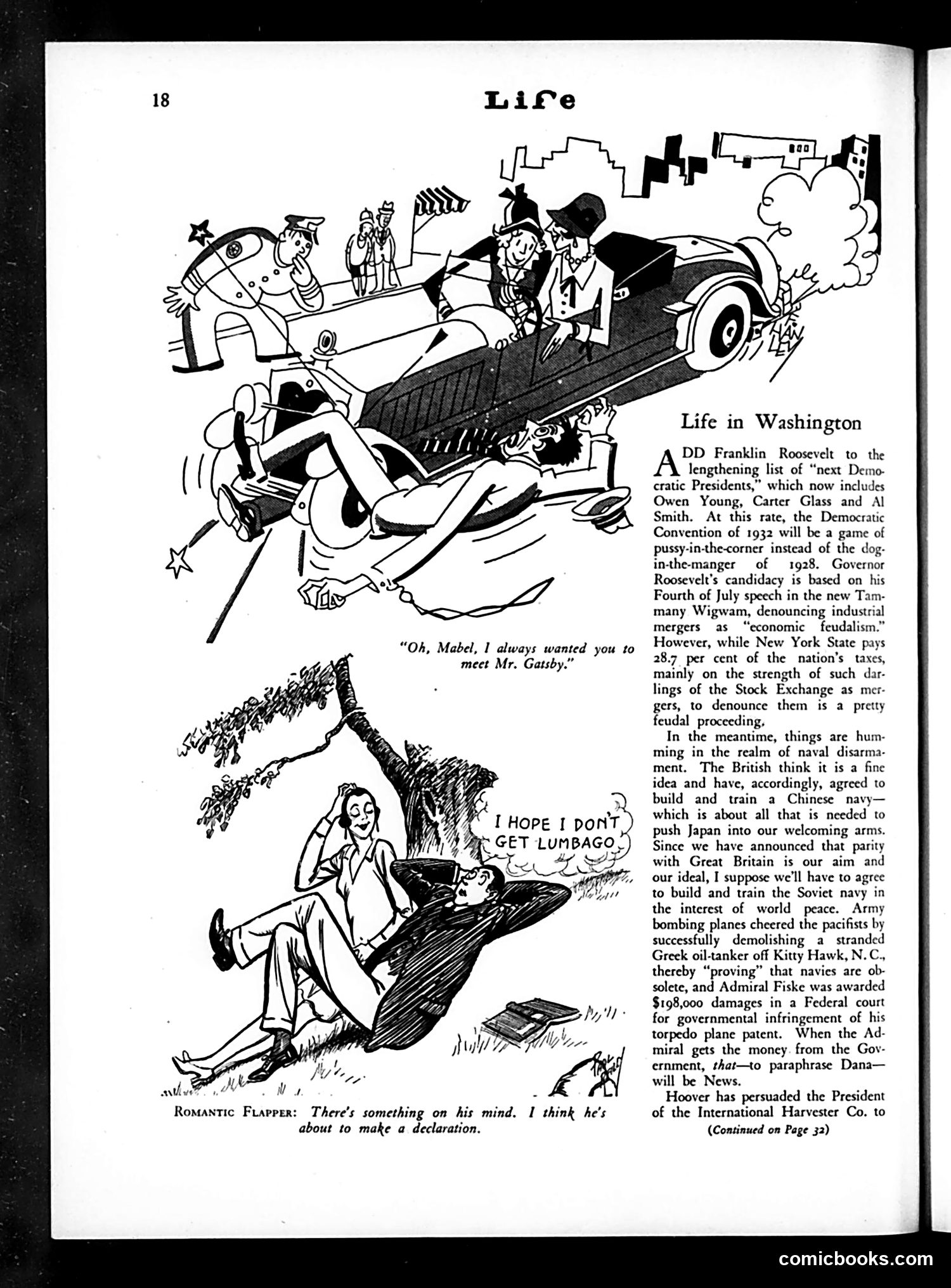
The top cartoon depicts Democratic political chaos, with Franklin Roosevelt adding figures like Owen Young, Carter Glass, and Al Smith to a list of potential 1932 presidential candidates. The image shows a car careening wildly with these political figures, suggesting the Democratic Convention will be disorganized ("a game of pussy-in-the-corner" rather than decisive leadership). The bottom cartoon, captioned "Romantic Flapper," shows a couple where the man worriedly says "I hope I don't get lumbago," while the woman comments he's "about to make a declaration"—a play on the double meaning of "declaration" (romantic proposal versus political statement). The accompanying article discusses Roosevelt's Fourth of July speech condemning industrial mergers as "economic feudalism," while criticizing such denunciations as hypocritical given New York's tax reliance on stock exchange revenues.
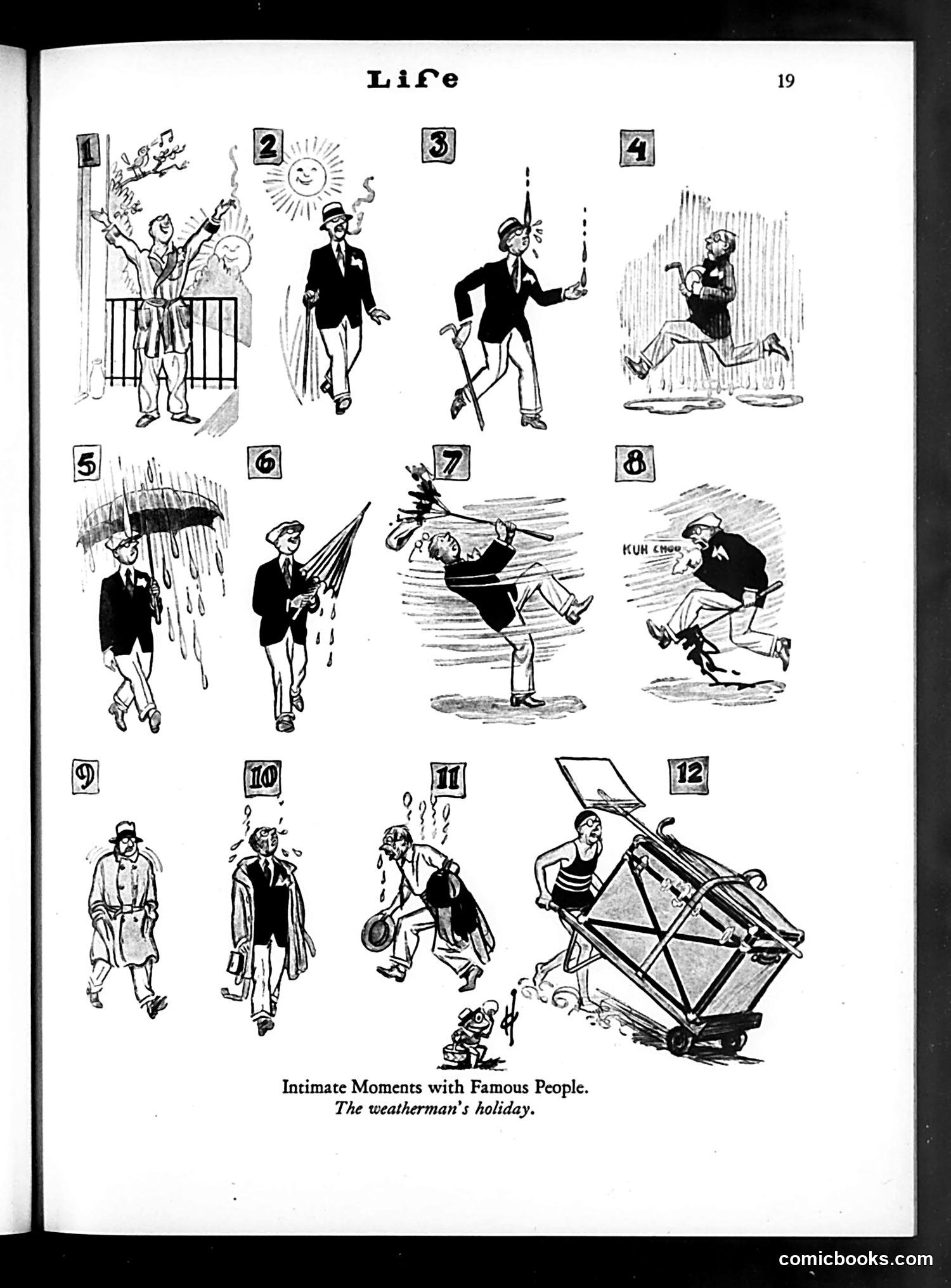
This page presents twelve cartoon vignettes satirizing how different types of famous people respond to various weather conditions during their holidays. The title "Intimate Moments with Famous People" suggests these are humorous character studies. Each numbered panel shows a person reacting to weather: someone celebrates sunshine (panel 2), another struggles with rain (panel 5), someone deals with wind (panel 6), and others experience snow or other conditions (panels 7-12). The satire works by showing how different professions or personality types—suggested by their clothing and demeanor—handle the same weather variations differently. Without identifying specific individuals, the cartoons mock the universal human complaint about weather ruining vacation plans, presented as "the weatherman's holiday" (the weather itself getting a vacation from being predictable).
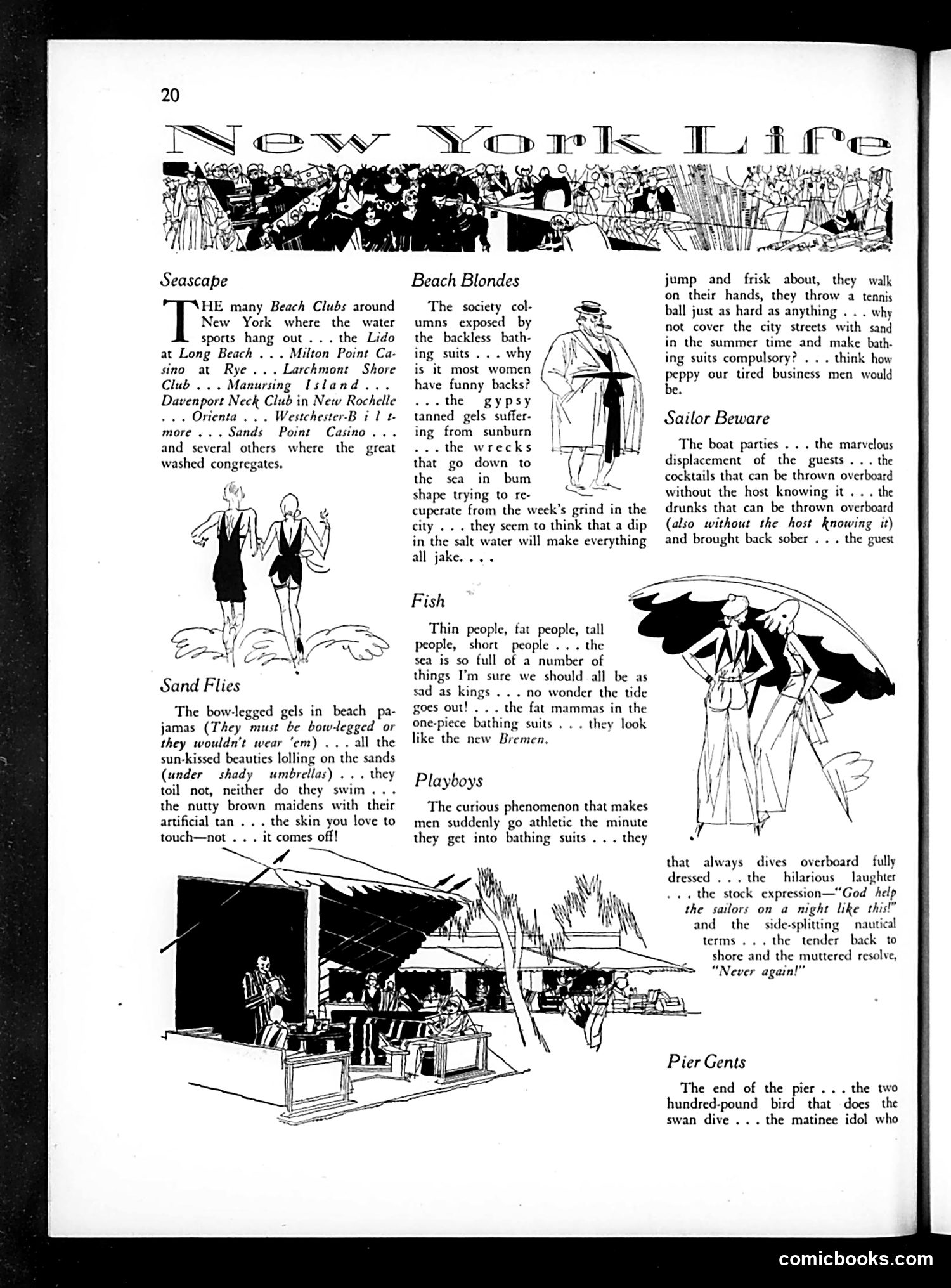
This 1920s humor piece mocks the social scene at exclusive New York beach clubs (Lido, Larchmont Shore Club, etc.) and the people who frequent them. The satire targets fashionable beach culture: women in "backless bathing suits" that expose their bodies (scandalous for the era), sun-tanned "beach blondes," men who suddenly act athletic in bathing suits, and drunk boat-party guests thrown overboard. The piece ridicules the artificiality—fake tans that "come off," women pretending not to swim, exhausted businessmen seeking recovery from city life. Key targets include social pretension, physical vanity, excessive drinking, and the contradiction between dignified society folk and their undignified beach behavior. The "Sailor Beware" and "Playboys" sections mock intoxication and crude behavior masquerading as sophistication. The illustrations show beachgoers in various comic poses—lounging, diving, congregating at beach huts—emphasizing their leisure and absurdity.
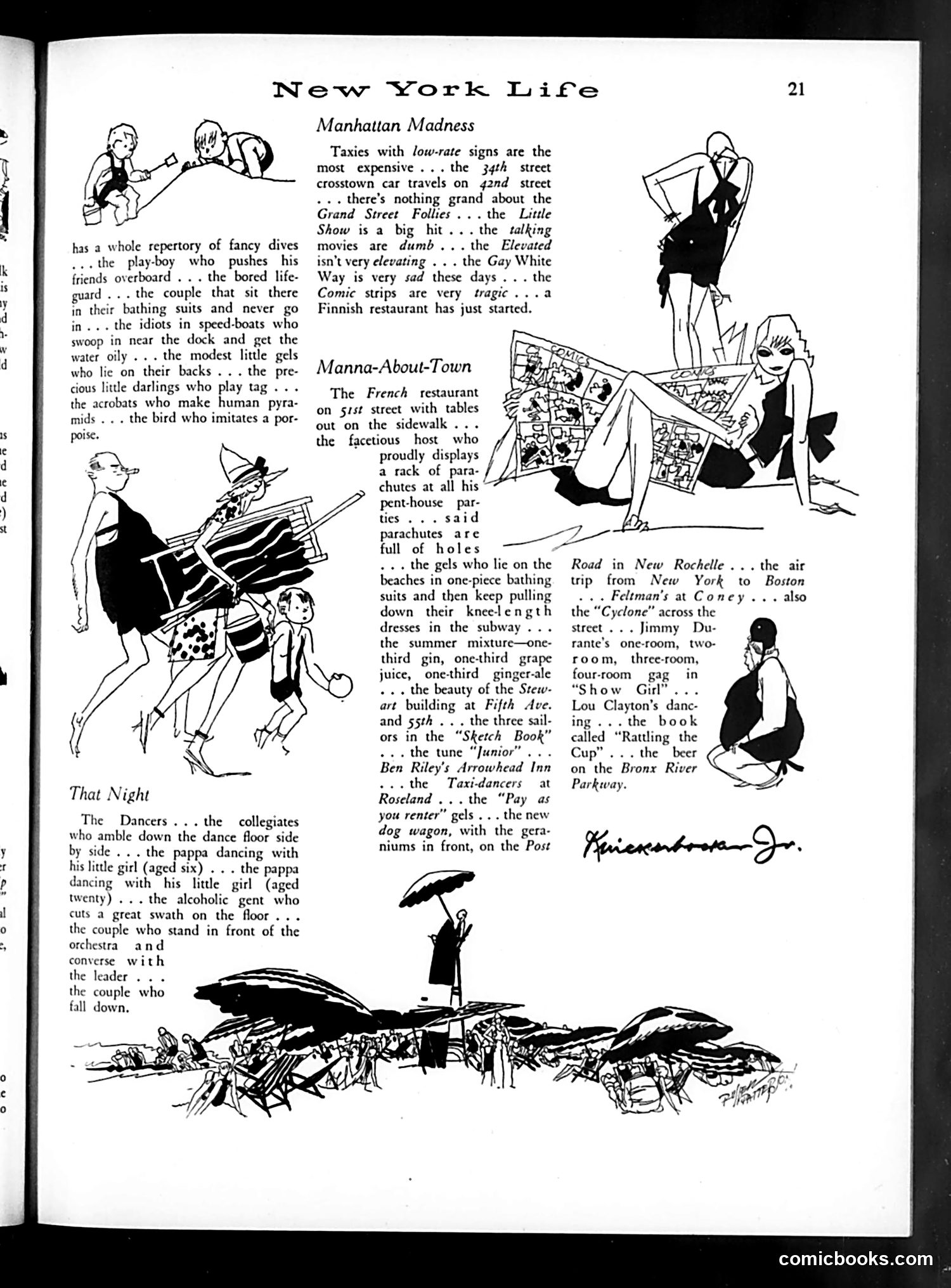
This page from *Life* magazine's "New York Life" column satirizes 1920s Manhattan social scenes through casual observation and irony. The content consists of three sections mocking urban pretension: **"Manhattan Madness"** lampoons city attractions as disappointing—expensive taxis, the "Grand Street Follies" lack grandeur, talking movies are "dumb," the "Gay White Way is very sad." **"That Night"** describes dance hall characters: playboys, bored lifeguards, couples in bathing suits, reckless speedboat drivers, and various dancing types—including couples who literally "fall down." **"Manna-About-Town"** catalogs Upper East Side affectations: a French restaurant displaying decorative parachutes with holes, women constantly adjusting hemlines, cocktail recipes, architectural landmarks, and amusement park attractions. The humor relies on deflating Jazz Age glamour through deadpan observation. Rather than celebrating New York excitement, the satirist presents it as absurd, pretentious, or fundamentally disappointing—typical of *Life's* sophisticated social comedy for educated urban readers.
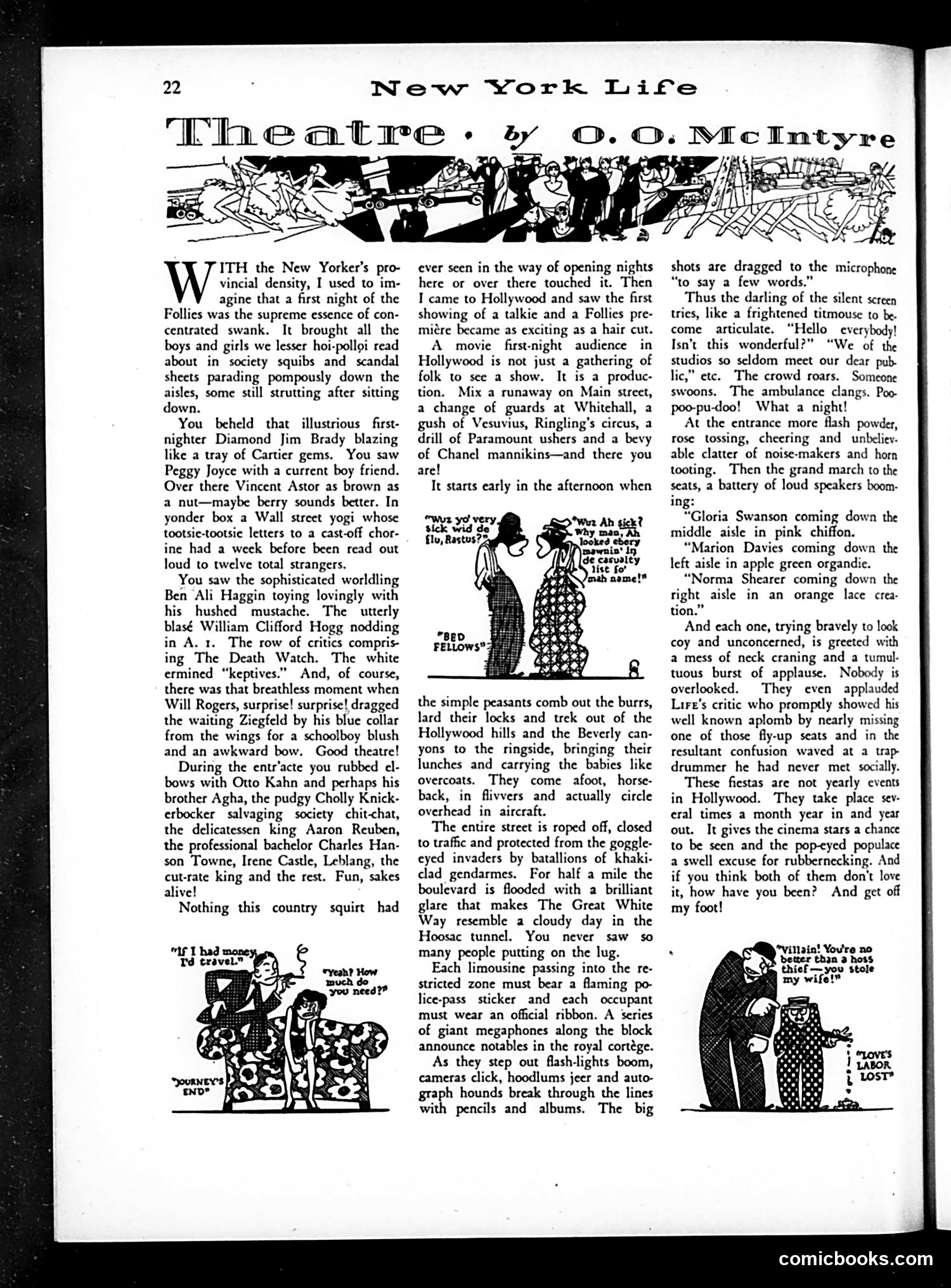
This satirical piece contrasts New York high society with Hollywood celebrity culture. The author compares attending a prestigious Broadway Follies premiere—where genuine socialites like Diamond Jim Brady, Peggy Joyce, and Vincent Astor mingled—to a Hollywood movie premiere. The satire targets Hollywood's manufactured spectacle: the controlled street closures, khaki-uniformed gendarmes, flaming police passes, megaphones announcing arrivals, and orchestrated chaos. McIntyre mocks the artificial pageantry and the struggling silent-film stars now forced to speak awkwardly into microphones ("Hello everybody! Isn't this wonderful?"). The small cartoons appear to illustrate comedic vignettes about theatrical first-nights and social pretension. The piece ridicules how Hollywood's "production" of a premiere—with its deliberate grandeur—paradoxically seems less authentic than New York's more organic display of wealth and status. The implication: New York society is genuinely elite, while Hollywood creates an illusion of importance through machinery and spectacle.
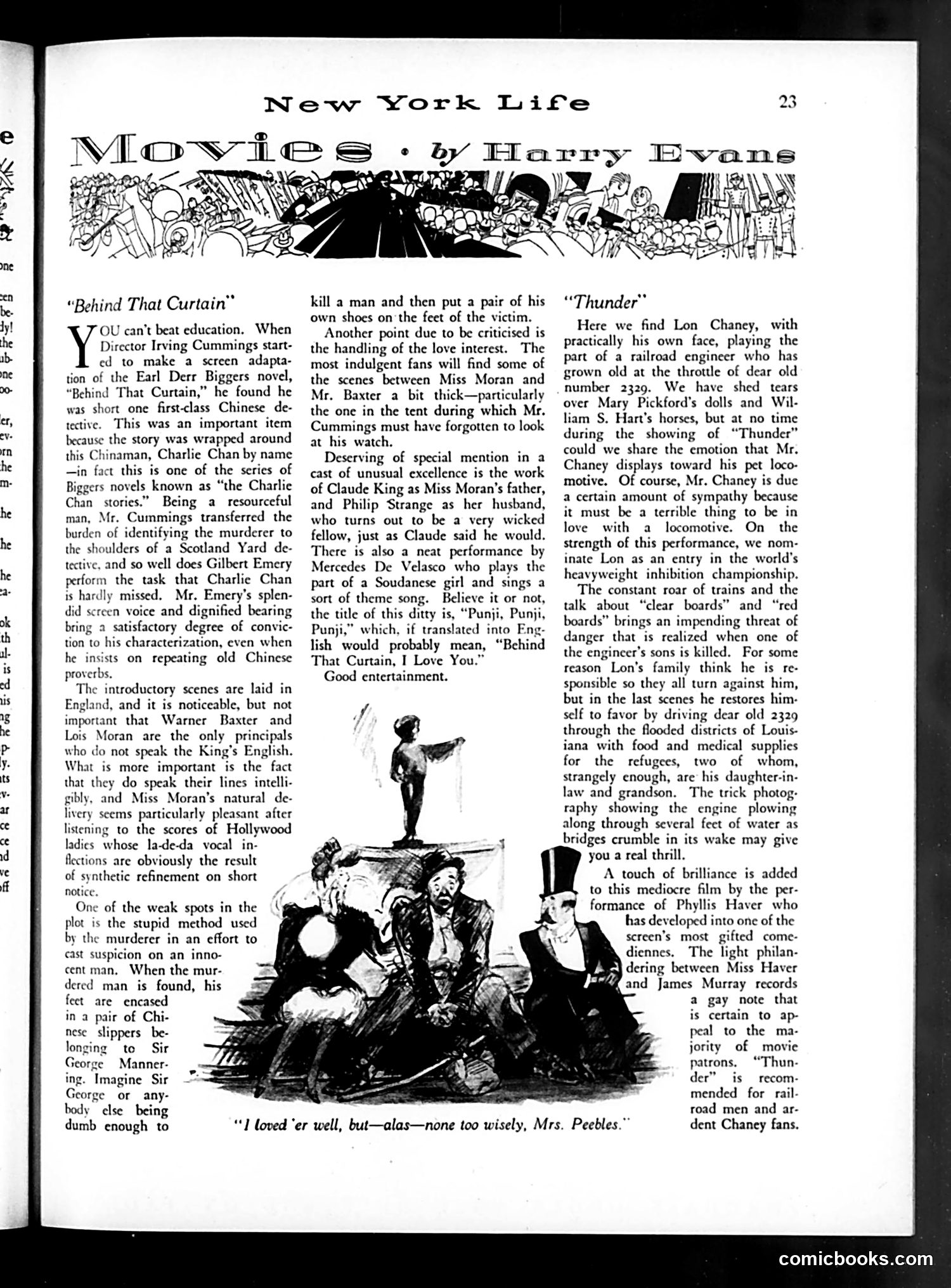
This page reviews two films: **"Behind That Curtain"** and **"Thunder."** The first review discusses an adaptation of an Earl Derr Biggers novel featuring detective Charlie Chan. The critic notes that director Irving Cummings replaced the Chinese protagonist with a Scotland Yard detective (Gilbert Emery), finding this substitution surprisingly effective. The review praises the diction of American actors Warner Baxter and Lois Moran against affectedly "refined" Hollywood actresses, and critiques the plot's implausibility—particularly a murderer framing someone by placing the victim in the killer's own Chinese slippers. The second review covers **"Thunder,"** starring Lon Chaney as an aging railroad engineer devoted to his locomotive. The critic humorously notes this sentimental attachment to machinery, then describes the plot: when Chaney's son dies in a train accident, his family blames him, though he eventually redeems himself. Evans treats both films as competent entertainment.
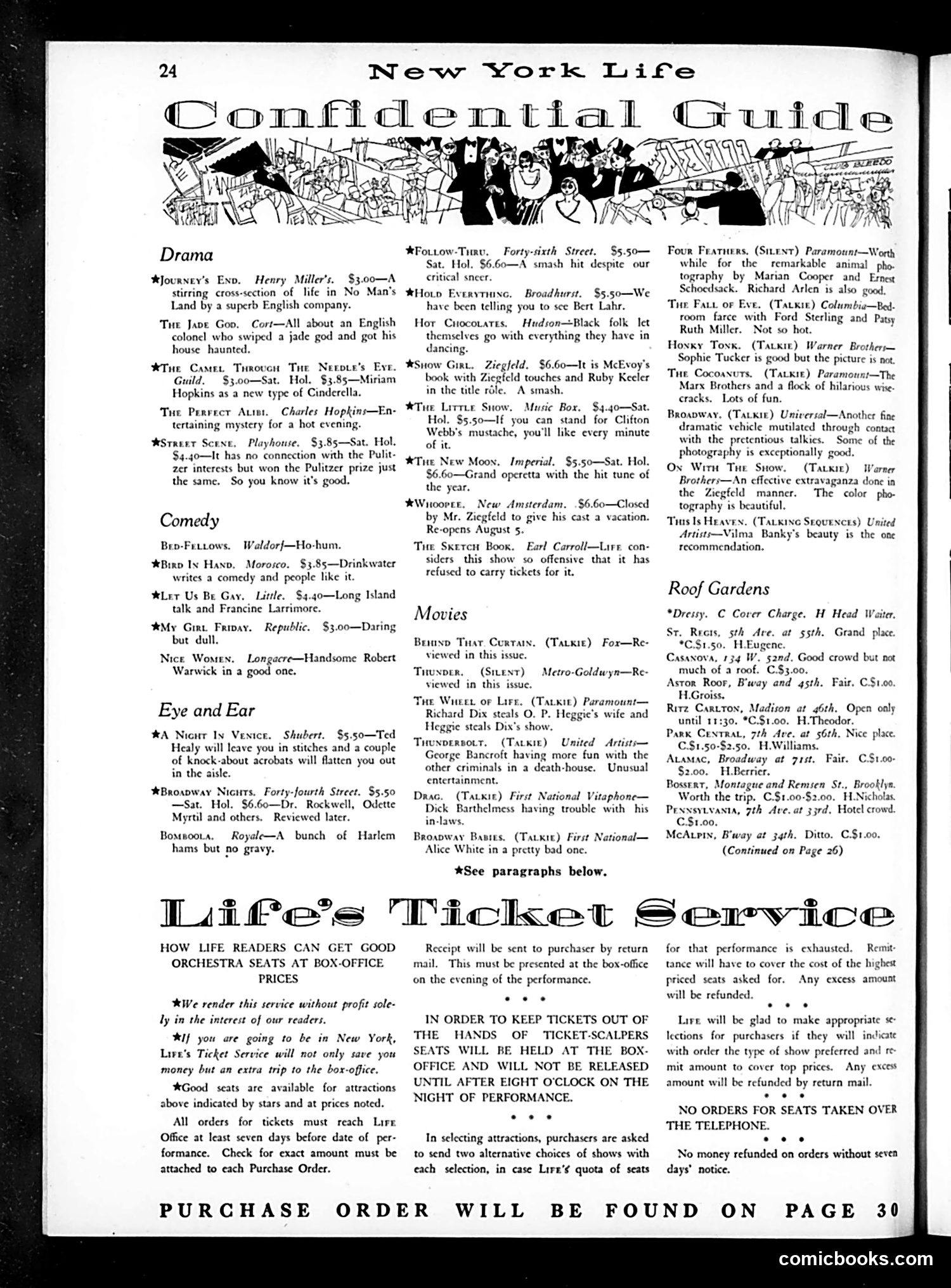
This is a theater and entertainment guide page from Life magazine's "Confidential Guide" section. It lists current Broadway plays, comedies, movies, and roof garden venues with brief critical reviews and ticket prices. The page contains no political cartoons or satire requiring historical context. Instead, it's a practical entertainment listing featuring: - **Drama** reviews (Journey's End, The Jade God, etc.) with prices ranging $3-$6.60 - **Comedy** theater recommendations with dismissive or enthusiastic one-liners ("Ho-hum," "A smash") - **Movies** including early "talkies" (sound films) like *Thunderbolt*, *The Cocoanuts* (Marx Brothers) - **Roof Gardens** venue information The asterisks (*) indicate Life's particular recommendations. The tone is cynical and witty—typical of 1920s satirical magazine style—but this page functions primarily as an entertainment directory rather than political commentary.
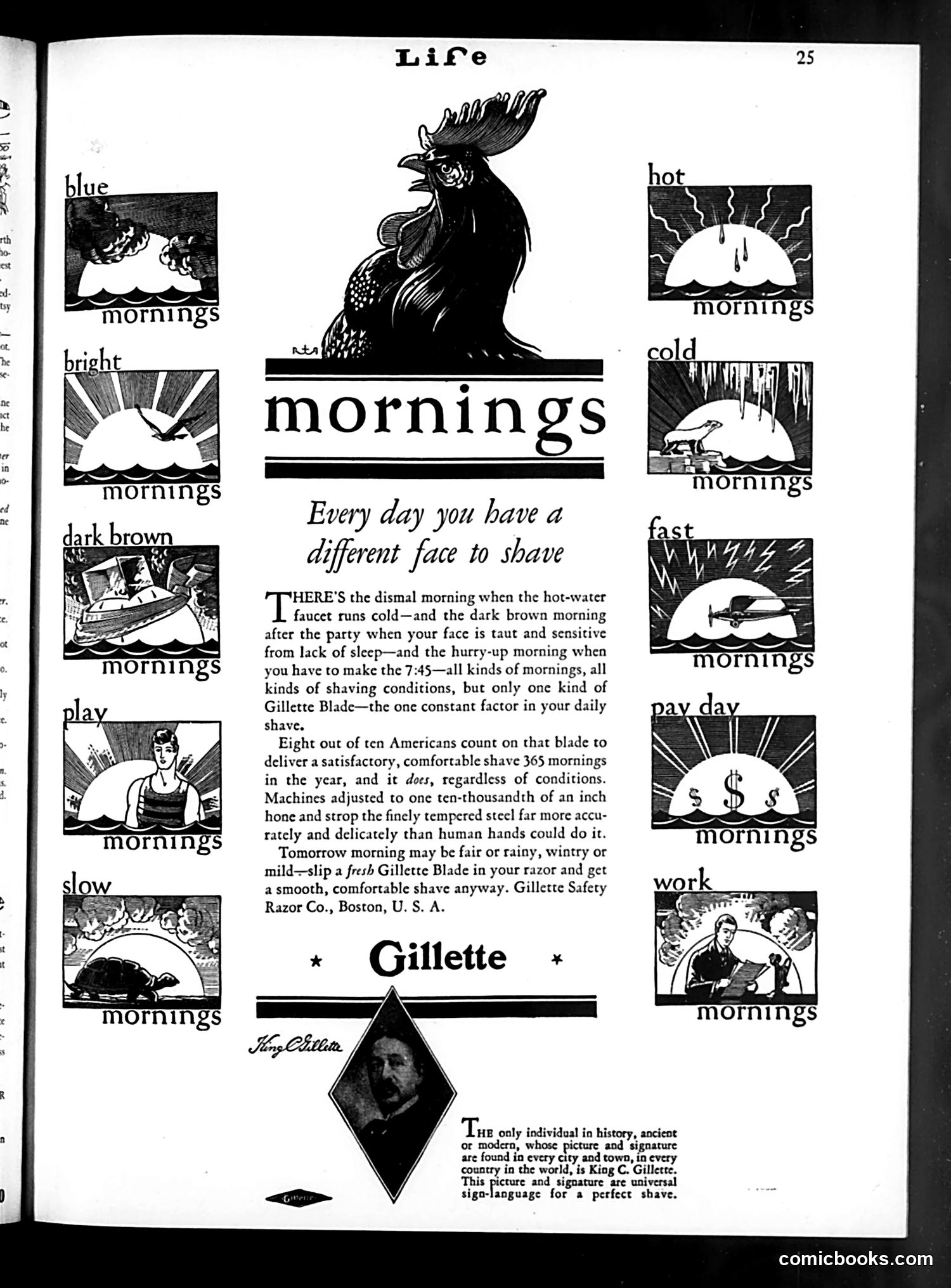
This is a **full-page advertisement**, not political satire. It promotes Gillette Safety Razor blades by illustrating different morning scenarios men face—"blue mornings" (sad), "hot mornings" (weather-related), "cold mornings," "fast mornings" (rushed), "pay day mornings," "work mornings," etc. The central figure is a **rooster**, symbolizing the daily morning routine and waking up. The ad's pitch: regardless of circumstances, Gillette blades deliver consistent, quality shaves because machines precision-engineer them to one ten-thousandth of an inch—superior to human craftsmanship. The bottom section features **King C. Gillette** (the razor's inventor), claiming his name and image are recognized worldwide as "universal sign-language for a perfect shave." This reflects early 20th-century advertising strategy: positioning a branded product as indispensable to daily male routine, while lionizing the founder as a visionary.
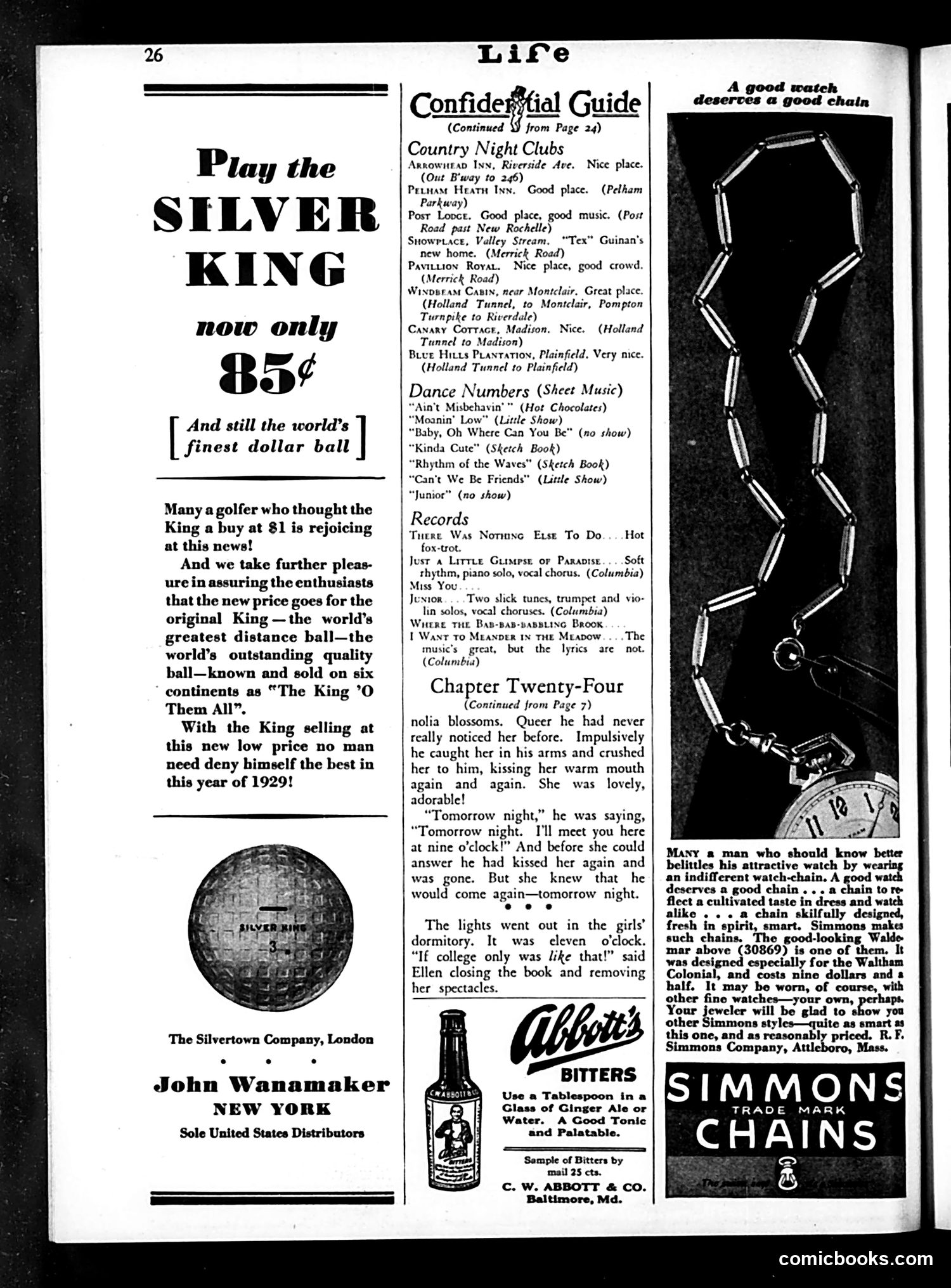
This page is primarily **advertising and serialized fiction**, not political satire. The dominant content includes: **Main Advertisement (left):** The "Silver King" golf ball, priced down to 85¢—marketed as "the world's finest dollar ball." The ad emphasizes value during 1929, reassuring golfers that quality hasn't diminished despite the lower price. **Central Content:** A continuation of a serialized romance novel ("Chapter Twenty-Four") featuring a kiss between two characters, ending with a female reader commenting that "college only was like that!"—suggesting wistful escapism. **Sidebars:** Advertisements for Simmons watch chains, Abbott's Bitters, and a "Confidential Guide" listing nightclubs (including "Tex" Guinan's speakeasy) and popular sheet music and records. The page reflects **1929 consumer culture and Prohibition-era entertainment**, with speakeasies openly advertised. There is no political cartoon or satirical commentary visible.
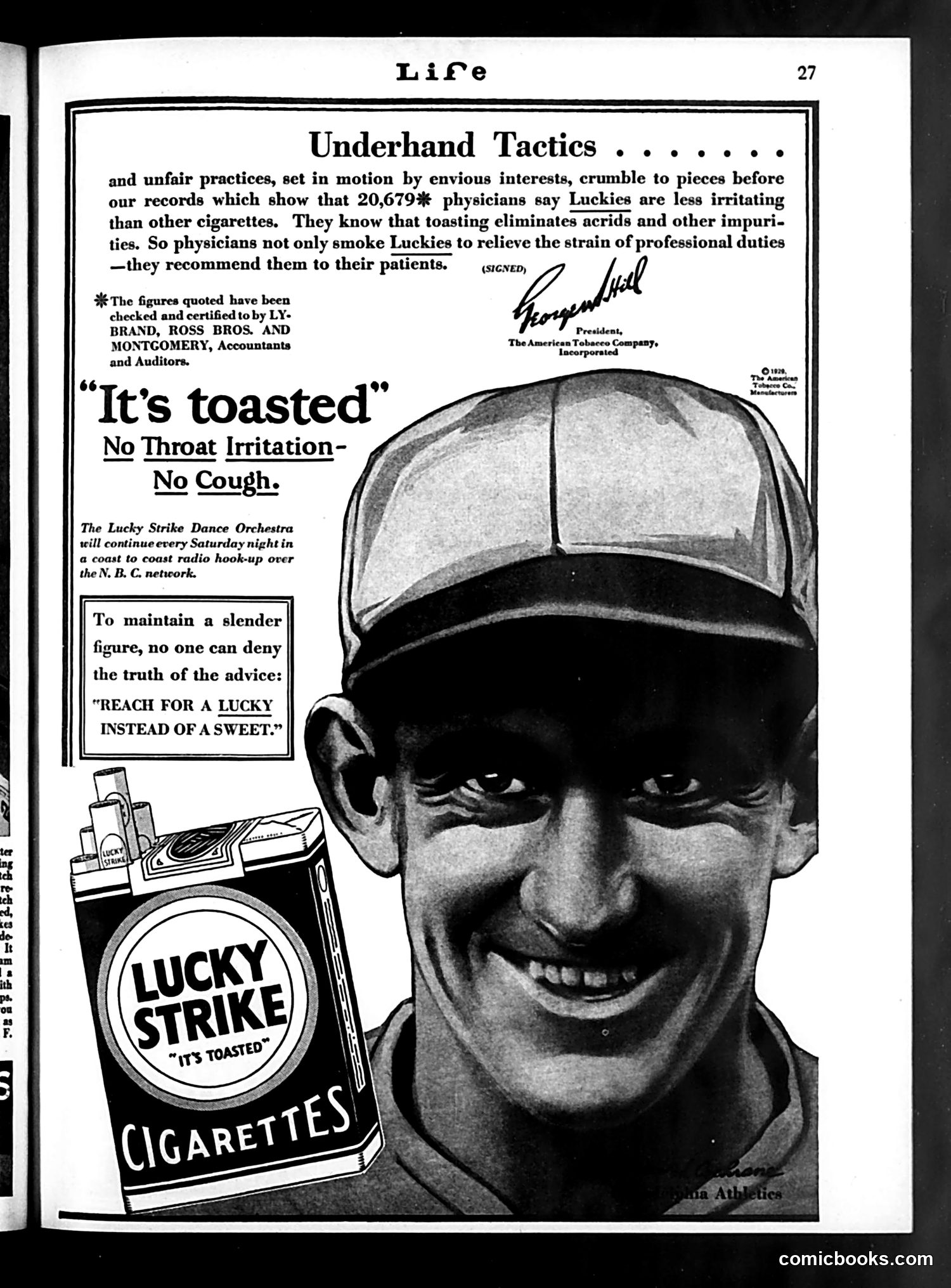
This is a **Lucky Strike cigarette advertisement** disguised as editorial content—a common advertising tactic of the era. The page satirizes cigarette marketing claims by presenting them with mock-serious authority. Key elements: - **The figure**: A smiling baseball player (sport celebrities were used to convey health/vitality) - **The claim**: 20,679 physicians endorse Lucky Strikes as "less irritating" - **The joke**: The asterisk reveals accountants "certified" these figures—implying the statistics are technically audited but inherently absurd (you can't have 20,679% anything) - **"It's toasted"**: The brand's invented health claim that toasting removes impurities - **"Reach for a Lucky instead of a sweet"**: A weight-loss pitch co-opting female body anxiety - **The satire**: Life is mocking tobacco industry's shameless use of fake physician endorsements, dubious statistics, and emotional appeals to sell cigarettes The page exposes how mid-century advertising exploited medical authority and consumer insecurity to market an inherently unhealthy product.
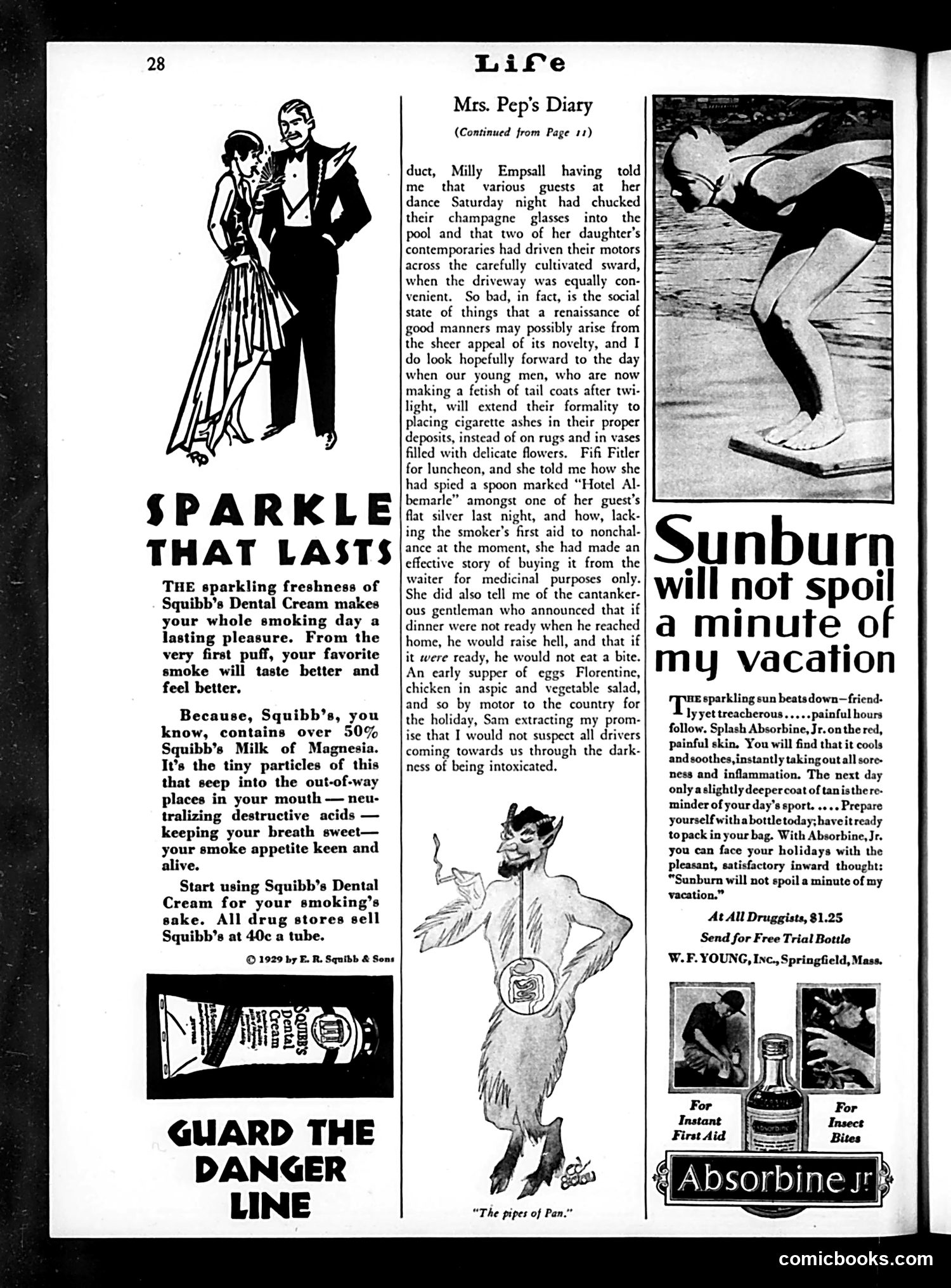
This page combines satirical editorial content with period advertisements, reflecting 1929 concerns about social decline and modern behavior. **"Mrs. Pep's Diary"** (upper right) satirizes wealthy society's deteriorating manners. It documents shocking behavior at a social dance: guests throwing champagne glasses in pools, guests driving cars across lawns. The diary voice—refined but exasperated—suggests that *good manners themselves* might become fashionable again simply because rudeness has become so extreme. The anecdotes about stolen hotel silverware and a cantankerous dinner guest reinforce the theme of general social breakdown. **The cartoon figure** ("The pipes of Pan," lower left) appears to reference Pan, the mythological pipe-player, though its exact satirical meaning is unclear from context alone. **Advertisements** for Squibb's Dental Cream and Absorbine Jr. occupy the remaining space, typical of Life's revenue model. Notably, the dental cream ad promotes smoking hygiene—advertising to smokers as an assumed readership without irony. The page overall reflects 1920s anxiety about post-WWI social disruption and "modern youth" abandoning Victorian propriety.
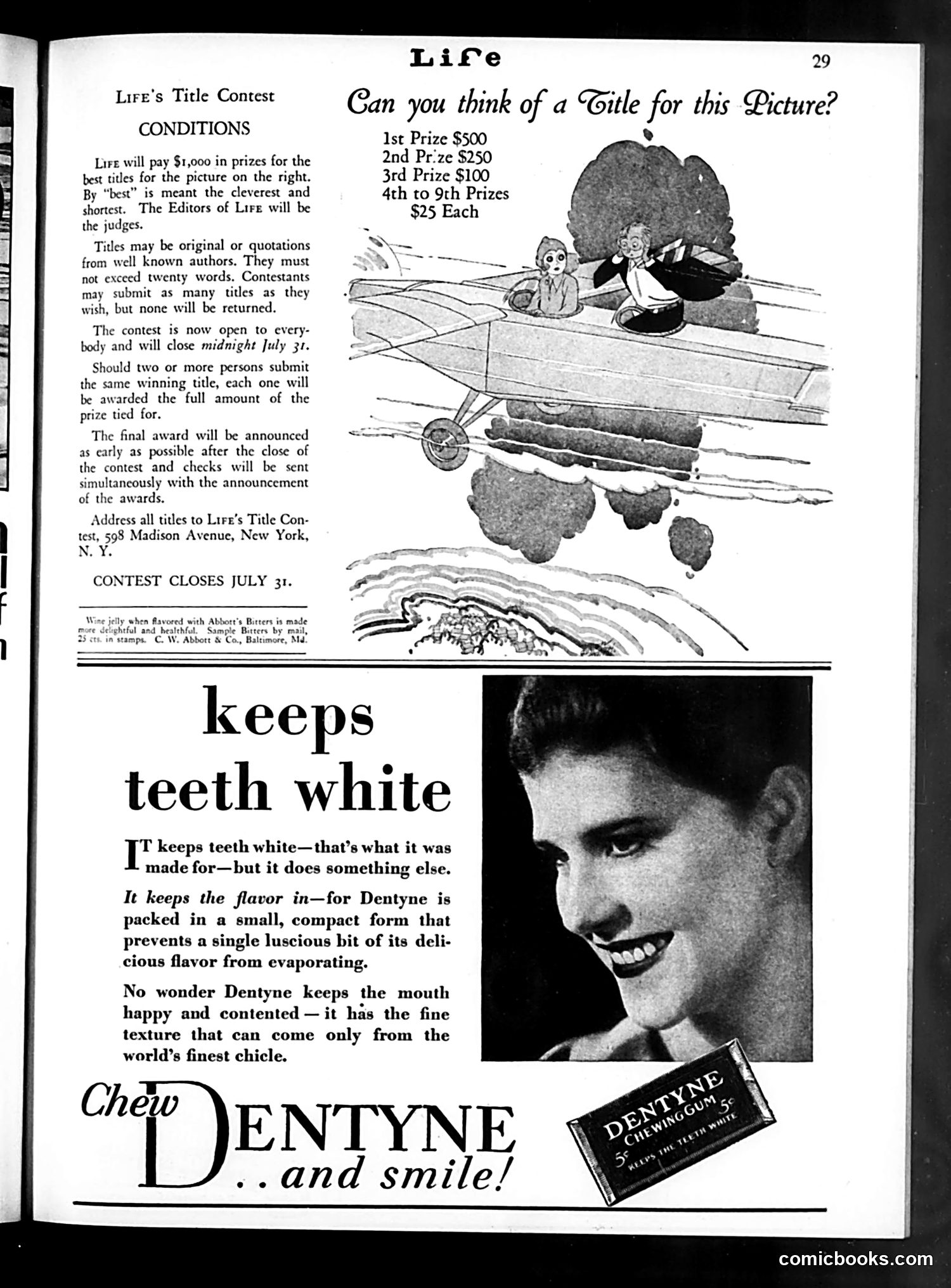
This page contains two distinct elements: a title-writing contest and a product advertisement. **The Contest:** Life magazine invites readers to submit clever, brief titles (max 20 words) for a whimsical cartoon showing two figures in what appears to be a makeshift flying contraption made of wood and fabric, crash-landing or tilting dangerously. The cartoon's absurdist humor—the rickety aircraft design and the passengers' predicament—suggests the joke lies in the situational comedy of failed flight. Readers compete for $1,000 in prizes, with the contest closing July 31 (year unclear from image). **The Advertisement:** Below is a Dentyne chewing gum ad emphasizing that the product keeps teeth white and maintains flavor through compact packaging. The ad uses a glamorous woman's smile as visual proof of the product's whitening claim, a common advertising tactic of the era. The page exemplifies early-20th-century *Life* magazine's blend of satirical humor and commercial content.
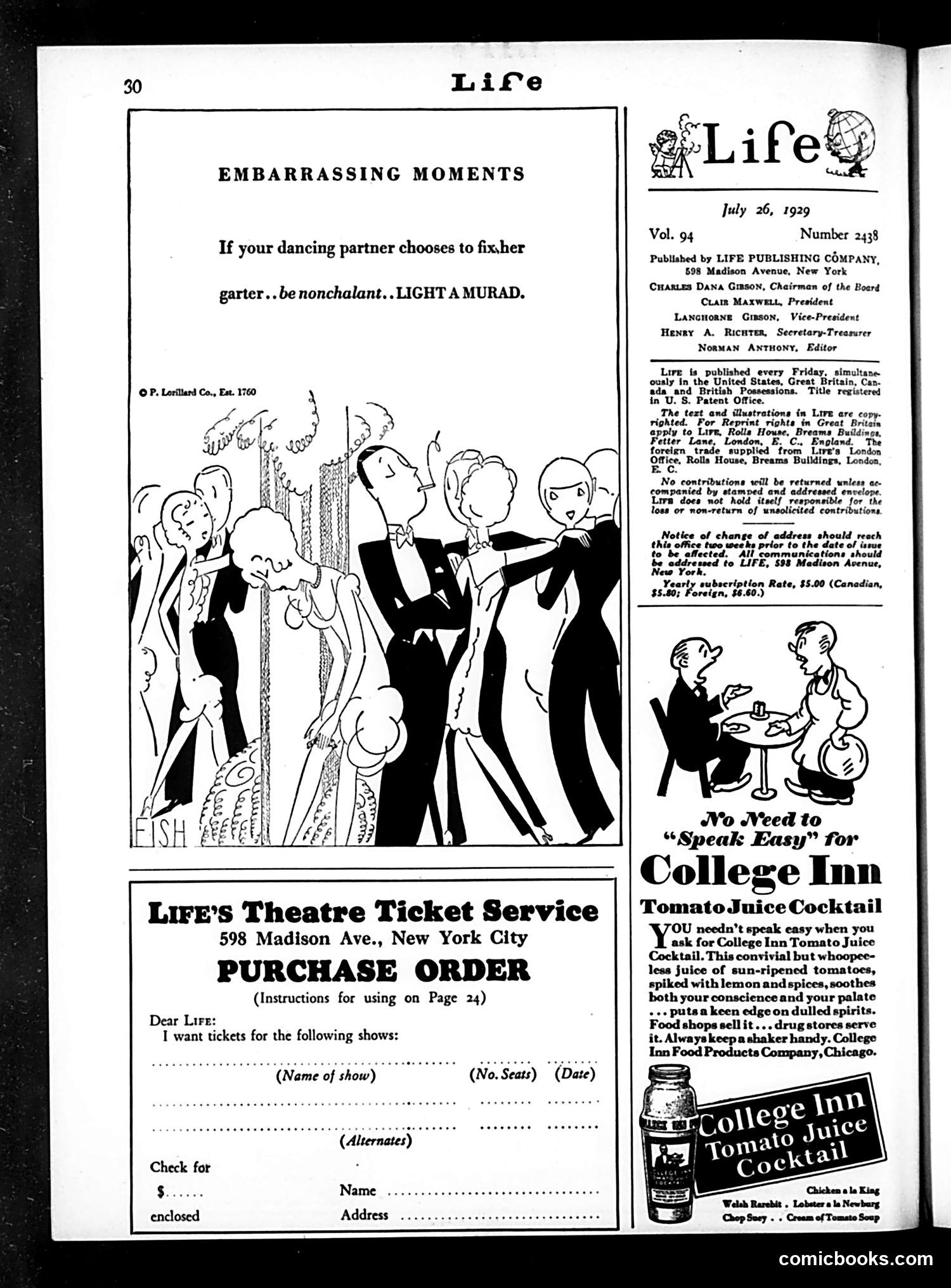
**The Main Cartoon** ("Embarrassing Moments") depicts a social scenario from 1929 etiquette: a man dancing with a woman whose garter has come loose or is visible. The caption advises him to stay cool and "light a Murad" (cigarette) to appear nonchalant rather than acknowledge the embarrassment. This reflects Jazz Age dating customs where physical contact during dancing was risqué, and any wardrobe malfunction would be mortifying for both parties. The humor relies on the uncomfortable social situation and the absurdity of smoking as a solution to social awkwardness. The cartoon is drawn by "Fish" (signature visible) and satirizes 1920s dating culture and masculine composure expectations. **The Advertisements** promote a College Inn tomato juice cocktail and Life's theater ticket service—typical magazine content of the era. The overall tone reflects upper-class social anxieties about propriety during the relatively liberated 1920s.
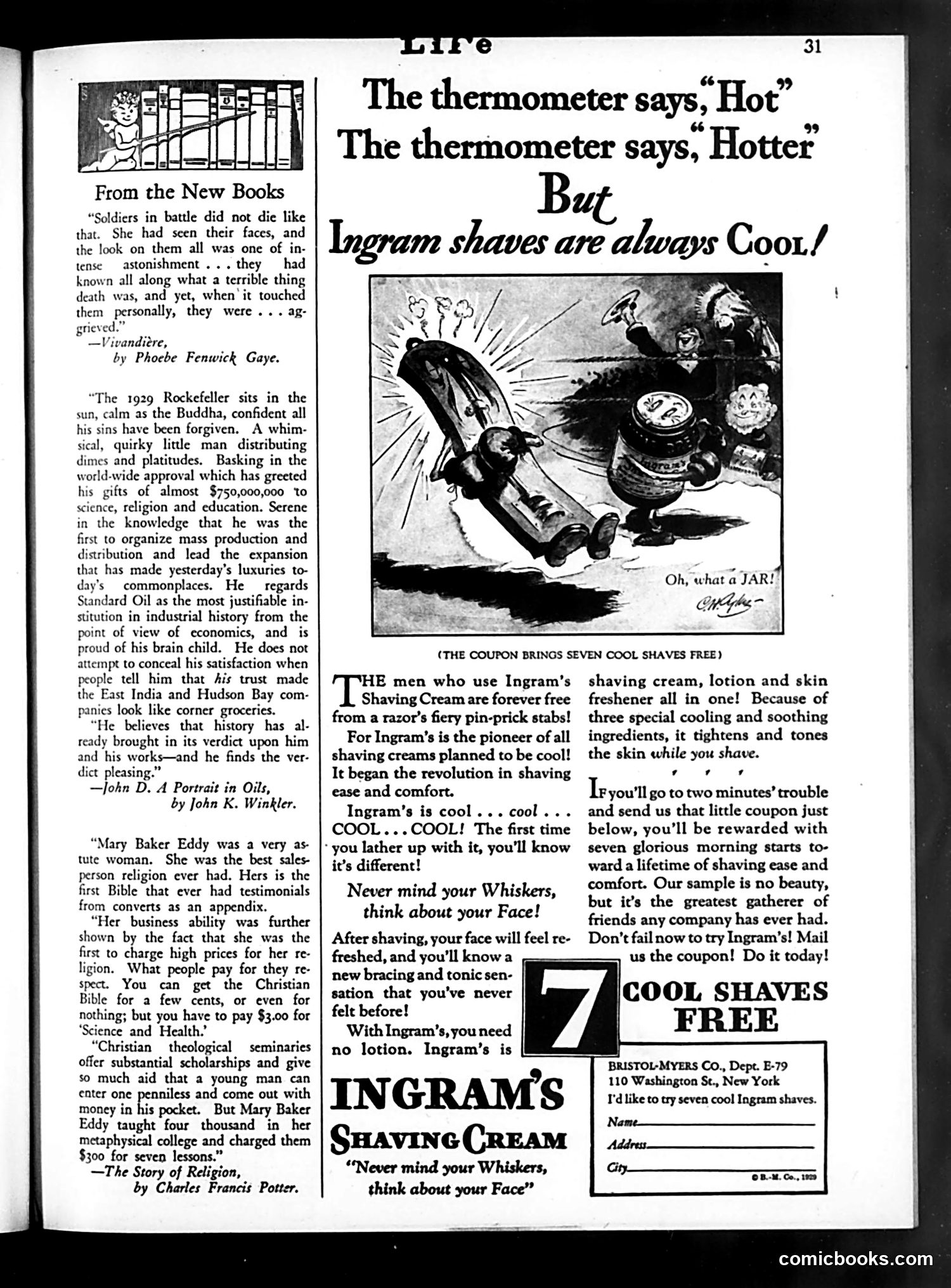
This page combines book reviews with advertising. The reviews critique prominent historical figures through satirical commentary: John D. Rockefeller is portrayed as self-satisfied despite his massive wealth and philanthropy ($750 million); Mary Baker Eddy is presented as a shrewd businesswoman who profited from religion by charging high fees ($300 for seven lessons) while conventional religious seminaries offered scholarships. The dominant content is an advertisement for Ingram's Shaving Cream. The cartoon shows a man in a car experiencing extreme heat, with the caption "Oh, what a JAR!" The ad's central claim—"Ingram shaves are always Cool"—plays on summer heat while promoting the product's cooling ingredients. The coupon offers seven free shaves, using the tagline "Never mind your Whiskers, think about your Face" to emphasize skin care benefits. This is straightforward product advertising typical of 1920s-era magazines, contrasting the editorial satire above it.
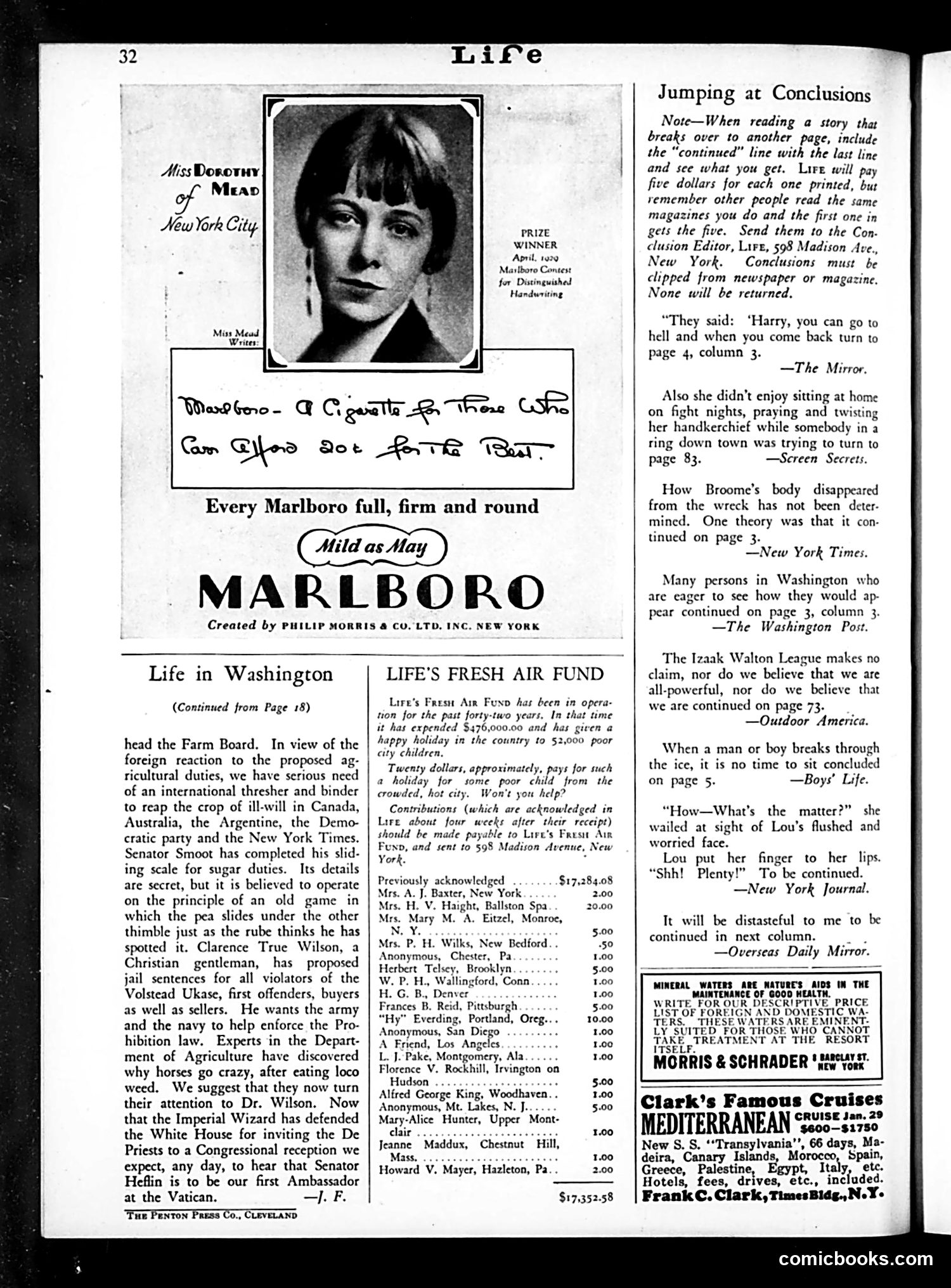
This page is primarily **advertising and reader engagement content** rather than political satire. The main elements are: 1. **Marlboro cigarette advertisement** featuring Miss Dorothy Mead of New York City, winner of a handwriting contest. This is straightforward product promotion. 2. **"Life in Washington" column** (continued from page 18) - satirical commentary on current political figures and policies, including Senator Smoot's tariff duties, Prohibition enforcement proposals, and diplomatic controversies. The satire targets Republican agricultural and prohibition policies of the era. 3. **"Jumping at Conclusions"** - a humorous reader-participation feature where Life pays $5 for accidentally juxtaposed text fragments from different articles that create unintended funny meanings. 4. **Life's Fresh Air Fund** - a charitable appeals section listing donations for a 42-year-old program providing country holidays to poor urban children. The page reflects 1920s-era concerns: tariffs, Prohibition, and social welfare, with relatively light satirical commentary rather than hard-hitting political cartooning.
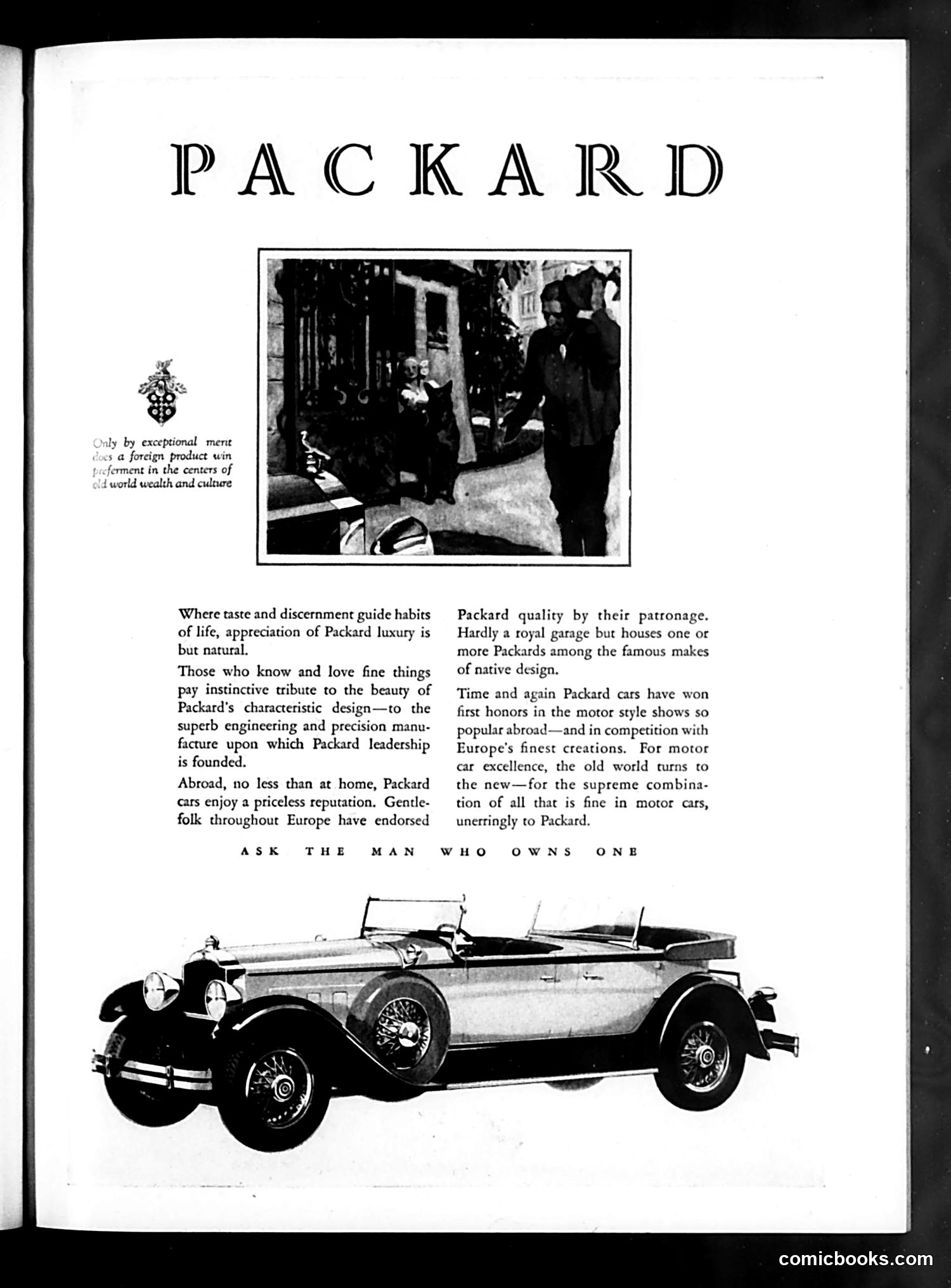
This is **not a cartoon or satire**—it's a **luxury automobile advertisement** for Packard cars, likely from the 1920s based on the vehicle's design. The page uses aspirational marketing targeting wealthy, refined consumers. The photograph shows an elegant European street scene, implying Packard's prestige abroad. The text emphasizes that European aristocracy ("gentlefolk," "royal garage") endorses Packard vehicles, positioning the American car as equal to or superior to European luxury brands. The famous tagline "Ask the Man Who Owns One" was Packard's actual advertising slogan, meant to suggest satisfied customers would enthusiastically recommend the product. The stated philosophy—that "exceptional merit" allows foreign products to succeed in centers of "old world wealth and culture"—positions American manufacturing as achieving Old World sophistication, a common early 20th-century advertising strategy.
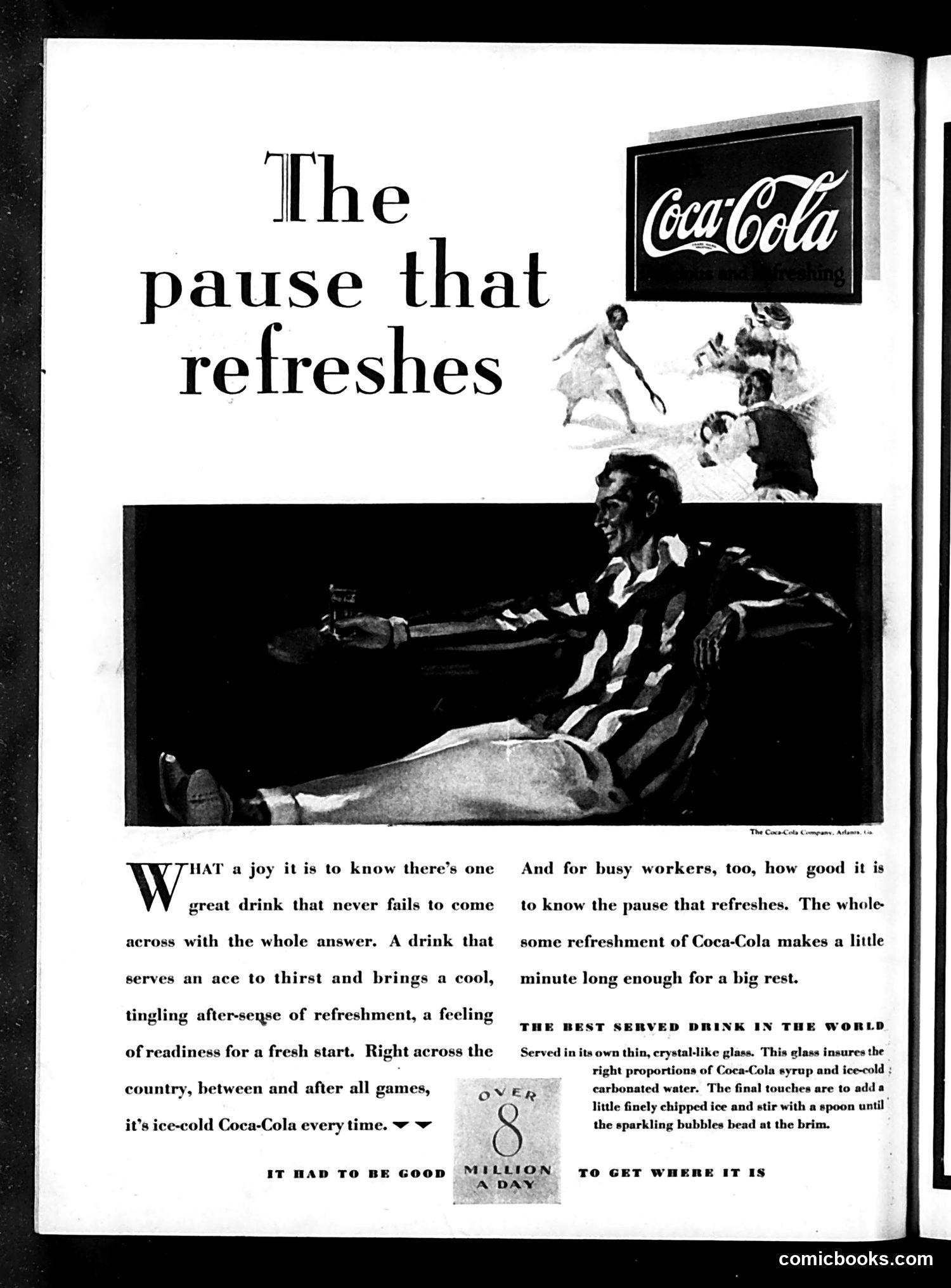
This is a **Coca-Cola advertisement**, not a political cartoon or satirical content. The page promotes Coca-Cola as "the pause that refreshes" through text and imagery. The advertisement shows a man relaxing on a couch while others play sports in the background, with a Coca-Cola sign visible. The copy emphasizes that Coca-Cola provides refreshment during breaks from work and leisure activities—"the pause that refreshes" being the company's actual marketing slogan from this era. The bottom notes the drink is "served in its own thin, crystal-like glass" and claims it's "the best served drink in the world." The "Over 8 Million a Day" refers to sales volume. This represents early 20th-century consumer advertising positioning soft drinks as essential to American leisure and productivity—a straightforward commercial message rather than satire.