
Pulp Fiction, 1921 · page 186 of 204
Adventure Magazine Cover — page 186: what you’re looking at
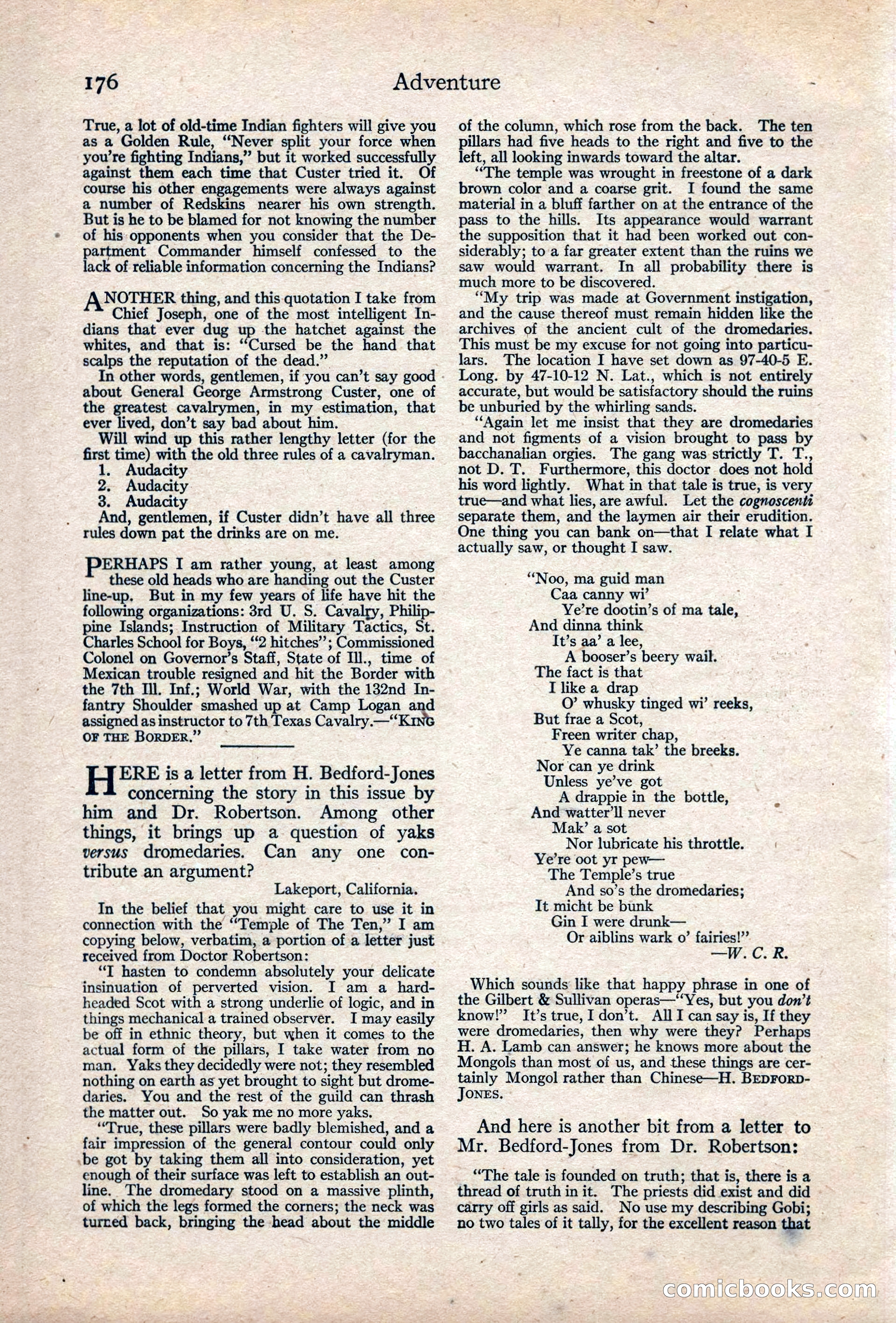
A restored page from Pulp Fiction, 1921. Page through the whole issue in the reader above.
📄 Transcribed text from this page (OCR, searchable)
Machine-transcribed from the original scan — historical spelling and the odd misread are preserved.
176 True, a lot of old-time Indian fighters will give you as a Golden Rule, “Never split your force when you're fighting Indians,’ ’ but it worked successfully against them each time that Custer tried it. Of course his other engagements were always against a number of Redskins nearer his own strength. But is he to be blamed for not knowing the number of his opponents when you consider that the De- partment Commander himself confessed to the lack of reliable information concerning the Indians? AN OTHER thing, and this quotation I take from Chief Joseph, one of the most intelligent In- dians that ever dug up the hatchet against the whites, and that is: ‘‘Cursed be the hand that scalps the reputation of the dead.” In other words, gentlemen, if you can’t say good - about General George Armstrong Custer, one of the greatest cavalrymen, in my estimation, that ever lived, don’t say bad about him. Will wind up this rather lengthy letter (for the first time) with the old three rules of a cavalryman. 1. Audacity 2. Audacity 3. Audacity _ And, gentlemen, if Custer didn’t have all three rules down pat the drinks are on me. PERHAPS I am rather young, at least among these old heads who are handing out the Custer line-up, But in my few years of life have hit the following organizations: 3rd _U. S. Cavalry, Philip- pine Islands; Instruction of Military Tactics, St. Charles School for Boys, ‘‘2 hitches”; Commissioned Colonel on Governor’s Staff, State of Ill., time of Mexican trouble resigned and hit the Border with the 7th Ill. Inf.; World War, with the 132nd we fantry Shoulder "smashed up at Camp Loga ns assigned as instructor to 7th Texas Cavalry.— OF THE BORDER.” _ ERE is a letter from H. Bedford-Jones concerning the story in this issue by him and Dr. Robertson. Among other things, it brings up a question of yaks versus dromedaries. Can any one con- tribute an argument? Lakeport, California. In the belief that you might care to use it in connection with the “Temple of The Ten,” I am copying below, verbatim, a portion of a letter just received from Doctor Robertson: “T hasten to condemn absolutely your delicate insinuation of perverted vision. I am a hard- headed Scot with a strong underlie of logic, and in things mechanical a trained observer. I may easily be off in ethnic theory, but when it comes to the actual form of the pillars, I take water from no man. Yaks they decidedly were not; they resembled nothing on earth as yet brought to sight but drome- daries. You and the rest of the guild can thrash the matter out. So yak me no more yaks, ‘True, these pillars were badly blemished, and a fair impression of the general contour could only .be got by taking them all into consideration, yet enough of their surface was left to establish an out- line. The dromedary stood on a massive plinth, of which the legs formed the corners; the neck was turned back, bringing the head about the middle Adventure 3 - of the column, which rose from the back. The ten pillars had five heads to the right and five to the left, all looking inwards toward the altar. “The temple was wrought in freestone of a dark brown color and a coarse grit. I found the same material in a bluff farther on at the entrance of the pass to the hills. Its appearance would warrant the supposition that it had been worked out con- siderably; to a far greater extent than the ruins we saw would warrant. In all probability there is much more to be discovered. “My trip was made at Government instigation, and the cause thereof must remain hidden like the archives of the ancient cult of the dromedaries. This must be my excuse for not going into particu- lars. The location I have set down as 97-40-5 E. Long. by 47-10-12 N. Lat., which is not entirely accurate, but would be satisfactory should the ruins be unburied by the whirling sands. ‘Again let me insist that they are dromedaries and not figments of a vision brought to pass by bacchanalian orgies. The gang was strictly T. T., not D. T. Furthermore, this doctor does not hold his word lightly. What in that tale is true, is very true—and what lies, are awful. Let the cognoscenti separate them, and the laymen air their erudition. One thing you can bank on—that I relate what I actually saw, or thought I saw. “Noo, ma guid man Caa canny wi’ Ye’re dootin’s of ma tale, And dinna think It’s aa’ a lee, A booser’s beery wail. The fact is that I like a drap O’ whusky tinged wi’ reeks, But frae a Scot, Freen writer chap, Ye canna tak’ the breeks. Nor can ye drink Unless ye’ve got A drappie in the bottle, And watter’ll never Mak’ a sot Nor lubricate his throttle. | Ye’re oot yr pew— The Temple’s true And so’s the dromedaries; It micht be bunk Gin I were drunk— Or aiblins wark o’ fairies!’’ —W.C. R. Which sounds like that happy phrase in one of the Gilbert & Sullivan operas—“Yes, but you don’t know!” It’s true, I don’t. All I can say is, If they were dromedaries, then why were they? Perhaps H. A. Lamb can answer; he knows more about the Mongols than most of us, and these things are cer- tainly Mongol rather than Chinese—H. BEpForD- JONES. And here is another bit from a letter to Mr. Bedford-Jones from Dr. Robertson: “The tale is founded on truth; that i is, there is a thread of truthinit. The priests did exist and did carry off girls as said. No use my describing Gobi; . no two tales of it tally, for the excellent reason that (EOLMMIC LOOKS () (EO) im