
Pulp Fiction, 1921 · page 187 of 204
Adventure Magazine Cover — page 187: what you’re looking at
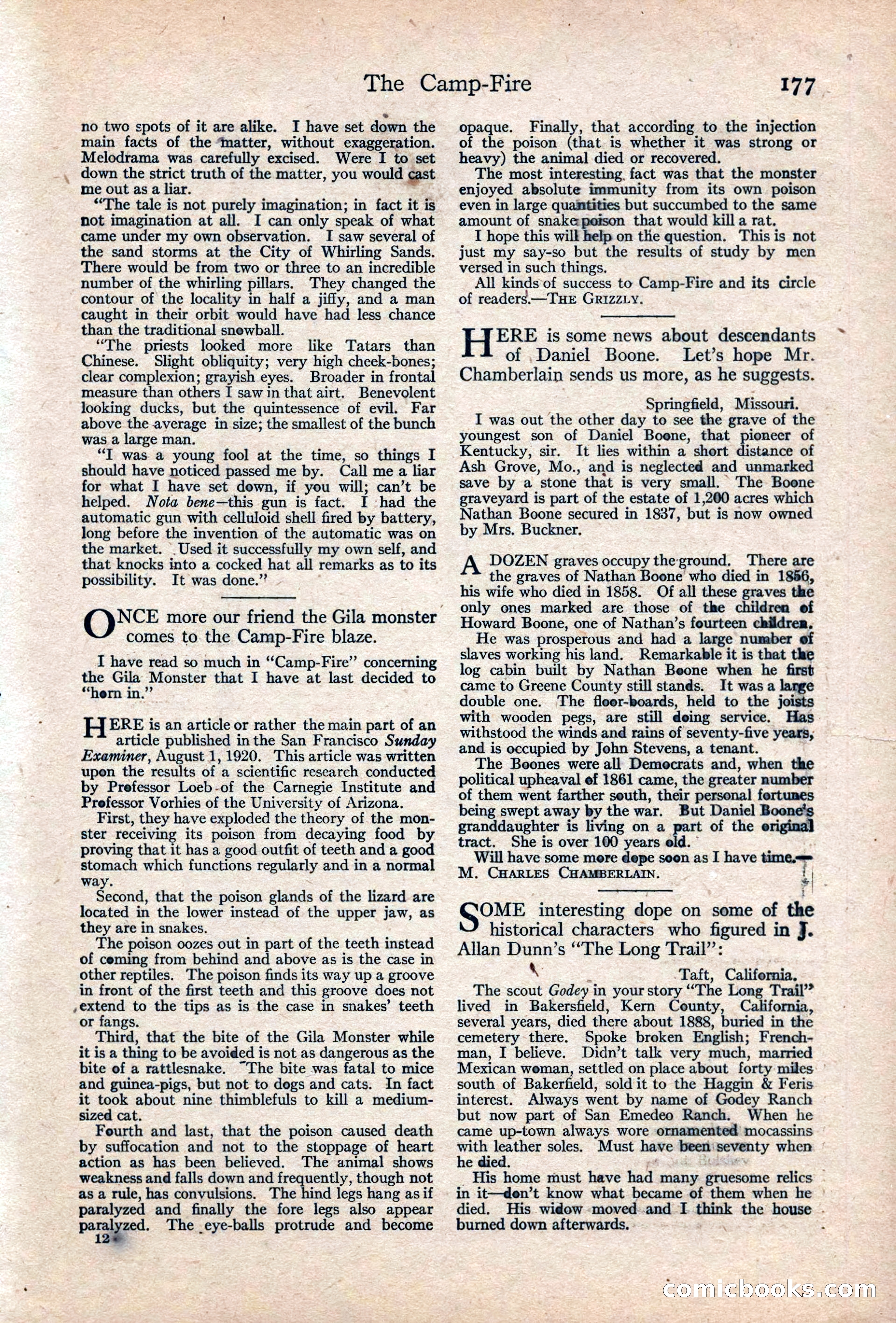
A restored page from Pulp Fiction, 1921. Page through the whole issue in the reader above.
📄 Transcribed text from this page (OCR, searchable)
Machine-transcribed from the original scan — historical spelling and the odd misread are preserved.
The Camp-Fire no two spots of it are alike. I have set down the main facts of the ‘matter, without exaggeration. Melodrama was carefully excised. Were I to set , down the strict truth of the matter, you would cast me out as a liar. | “The tale is not purely imagination; in fact it is not imagination at all. I can only speak of what came under my own observation. I saw several of the sand storms at the City of Whirling Sands. There would be from two or three to an incredible number of the whirling pillars. They changed the contour of the locality in half a jiffy, and a man caught in their orbit would have had less chance than the traditional snewball. “The priests looked more like Tatars than Chinese. Slight obliquity; very high cheek-bones; clear complexion; grayish eyes. Broader in frontal measure than others I saw in that airt. Benevolent looking ducks, but the quintessence of evil. Far above the average in size; the smallest of the bunch was a large man. “I was a young fool at the time, so things I should have noticed passed me by. Call me a liar for what I have set down, if you will; can’t be helped. Nota bene—this gun is fact. I had the automatic gun with celluloid shell fired by battery, long before the invention of the automatic was on the market. . Used it successfully my own self, and that knocks into a cocked hat all remarks as to its possibility. It was done.” NCE more our friend the Gila monster comes to the Camp-Fire blaze. I have read so much in “Camp-Fire” concerning the Gila Monster that I have at last decided to “hern in.” HERE is an article or rather the main part of an article published in the San Francisco Sunday Examiner, August 1, 1920. This article was written upon the results of a scientific research conducted by Prefessor Loeb-of the Carnegie Institute and Prefessor Vorhies of the University of Arizona. First, they have exploded the theory of the mon- ster receiving its poison from decaying food by proving that it has a good outfit of teeth and a good stomach which functions regularly and in a normal way. Second, that the poison glands of the lizard are located in the lower instead of the upper jaw, as they are in snakes. The poison oozes out in part of the teeth instead of ceming from behind and above as is the case in other reptiles. The poison finds its way up a groove in front of the first teeth and this groove does not ,extend to the tips as is the case in snakes’ teeth or fangs. Third, that the bite of the Gila Monster while it is a thing to be avoided is not as dangerous as the bite of a rattlesnake. ~The bite was fatal to mice and guinea-pigs, but not to dogs and cats. In fact it took about nine thimblefuls to kill a medium- sized cat. Fourth and last, that the poison caused death by suffocation and not to the stoppage of heart action as has been believed. The animal shows weakness and falls down and frequently, though not as a rule, has convulsions. The hind legs hang asif paralyzed and finally the fore legs also appear poralzed. The eye-balls protrude and become opaque. Finally, that according to the injection of the poison (that is whether it was strong or heavy) the animal died or recovered. The most interesting, fact was that the monster enjoyed absolute immunity from its own poison even in large quantities but succumbed to the same amount of snakepotson that would kill a rat. I hope this wilk help on the question. This is not just my say-so but the results of study by men versed in such things. All kindsof success to Camp-Fire and its circle of readers.—TuE GRIZZLY. ERE is some news about deseendants of _Daniel Boone. Let’s hope Mr. Chamberlain sends us more, as he suggests. Springfield, Missouri. I was out the other day to see the grave of the youngest son of Daniel Boene, that pioneer of Kentucky, sir. It lies within a short distance of Ash Grove, Mo., and is neglected and unmarked save by a stone that is very small. The Boone graveyard is part of the estate of 1,200 acres which Nathan Boone secured in 1837, but is now owned by Mrs, Buckner. A DOZEN graves occupy theground. There are the graves of Nathan Boone who died in 1856, his wife who died in 1858. Of all these graves the only ones marked are those of the children of Howard Boone, one of Nathan’s fourteen children. He was prosperous and had a large number of slaves working his land. Remarkable it is that the log cabin built by Nathan Beone when he first came to Greene County still stands. It was a lange double one. 3 with wooden pegs, are still deing service. Has withstood the winds and rains of seventy-five years, and is occupied by John Stevens, a tenant. The Boones were all Demecrats and, when the political upheaval ef 1861 came, the greater number of them went farther south, their personal fertunes being swept away by the war. But Daniel Boone's granddaughter is living on a P og of the eriginal tract. She is over 100 years eld. Will have some more depe soon as I have time, M. CHARLES CHAMBERLAIN. 177 The floor-boards, held to the joists — <j; . Gor interesting dope on some of the historical characters who figured in J. Allan Dunn’s “The Long Trail”: \ A Taft, California. The scout Godey in your story “The Long Trail’? lived in Bakersfield, Kern County, California, several years, died there about 1888, buried in the cemetery there. Spoke broken English; French- man, I believe. Didn’t talk very much, married Mexican woman, settled on place about forty miles — south of Bakerfield, sold it to the Haggin & Feris interest. Always went by name of Godey Ranch but now part of San Emedeo Ranch. When he came up-town always wore ornamented mocassins pec ate soles. Must have beeniseventy when he died. saa His home must have had many gruesome relics | in it—den’t know what became of them when he © the house - died. His widow moved .and I. think burned down afterwards. coe Eomichook (F@)