
Pulp Fiction, 1921 · page 197 of 204
Adventure Magazine Cover — page 197: what you’re looking at
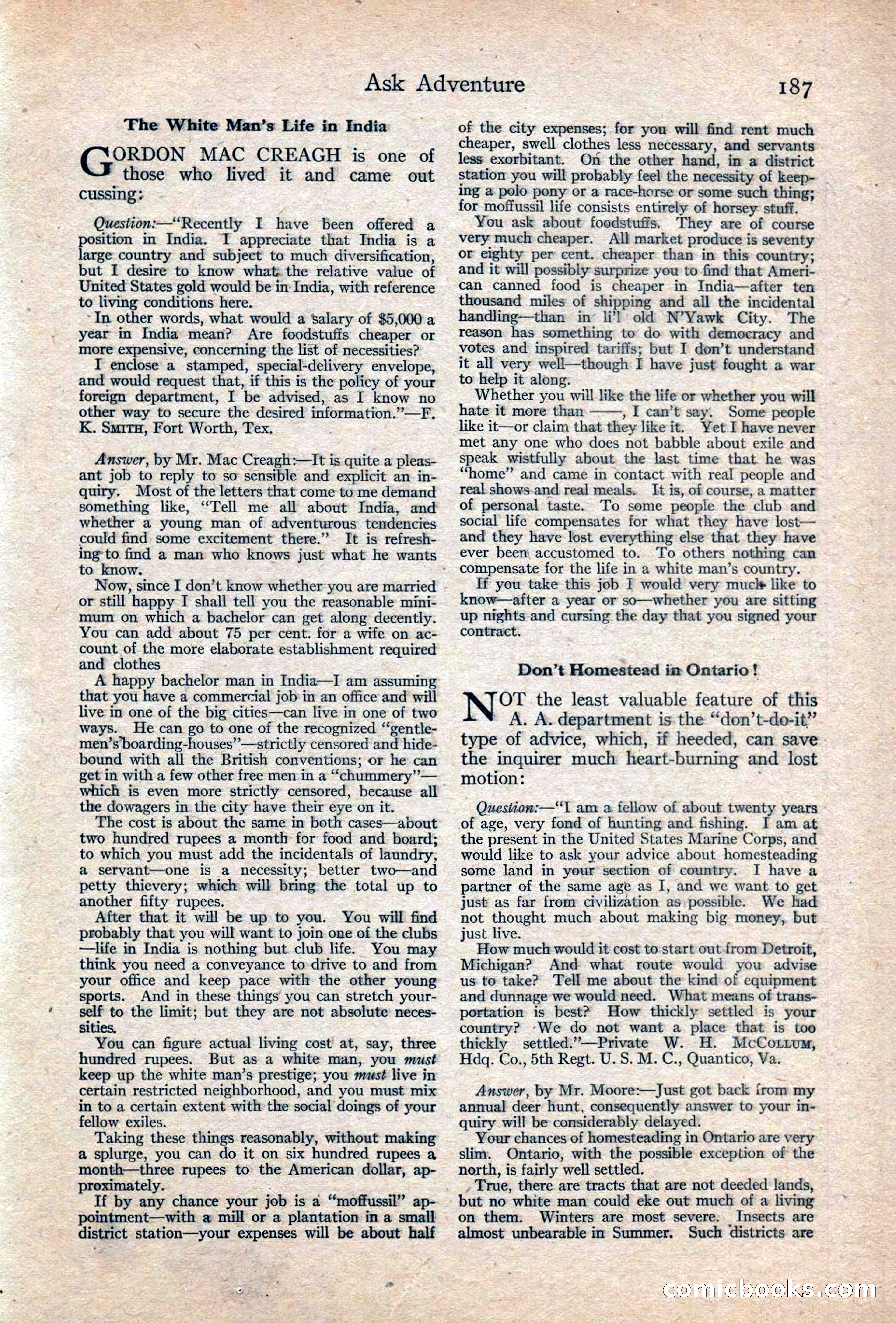
A restored page from Pulp Fiction, 1921. Page through the whole issue in the reader above.
📄 Transcribed text from this page (OCR, searchable)
Machine-transcribed from the original scan — historical spelling and the odd misread are preserved.
Ask Adventure The White Man’s Life in India ORDON MAC CREAGH is one of those who lived it and came out cussing: Question:—“Recently I have Been offered a position in India. I appreciate that India is a large country and subject to much diversification, but I desire to know what: the relative value of United States gold would be in India, with reference to living conditions here. ~In other words, what would a salary of $5,000 a year in India mean? Are foodstuffs cheaper or more expensive, concerning the list of necessities? IT en a stamped, special-delivery envelope, and would request that, if this is the policy of your foreign department, I be advised, as I know no other way to secure the desired information.”—F. K. Smairx, Fort Worth, Tex. Answer, by Mr. Mac Creagh:—It is quite a pleas- ant job to reply to so sensible and explicit an in- quiry. Most of the letters that come to me demand something like, ‘‘Tell me all about India, and whether a young man of adventurous tendencies could find some excitement there.” It is refresh- ing to find a man who knows just what he wants to know. Now, since I don’t know whether you are married - or still happy I shall tell you the reasonable mini- mum on which a bachelor can get along decently. You can add about 75 per cent. for a wife on ac- count of the more elaborate establishment required and clothes A happy bachelor man in India—I am assuming that you have a commercial job in an office and will live in one of the big cities—can live in one of two ways. He can go to one of the recognized “‘gentle- men’s boarding-houses”—strictly censored and hide- bound with all the British conventions; or he can get in with a few other free men in a “chummery’”’— which is even more strictly censored, because all the dowagers in the city have their eye on it. The cost is about the same in both cases—about two hundred rupees a month for food and board; to which you must add the incidentals of laundry, a servant—one is a necessity; better two—and petty thievery; which will bring the total up to another fifty rupees. After that it will be up to you. You will find probably that you will want to join one of the clubs —life in India is nothing but club life. You may think you need a conveyance to drive to and from your office and keep pace with the other young sports. And in these things you can stretch your- self to the limit; but they are not absolute neces- sities, You can figure actual living cost at, say, three hundred rupees. But as a white man, you must keep up the white man’s prestige; you must live in certain restricted neighborhood, and you must mix in to a certain extent with the social doings of your fellow exiles. Taking these things reasonably, without making a splurge, you can do it on six hundred rupees a month—three rupees to the American dollar, ap- proximately. If by any chance your job is a “moffussil” ap- pointment—with a mill or a plantation in a small district station—your expenses will be about half “ * ard 187 of the city expenses; for you will find rent much cheaper, swell clothes less necessary, and servants less exorbitant. On the other hand, im a district station you will probably feel the necessity of keep- ing a polo pony or a race-horse or some such thing; for moffussil life consists entirely of horsey: stuff. You ask about foodstuffs. They are of course very much cheaper. All market produce is seventy or eighty per cent. cheaper than in this: country; and it will possibly surprize you to find that Ameri- can canned food is cheaper in India—after ten thousand miles of shipping and all the incidental handling—than in’ li’! old N’Yawk City. The reason has something to do with democracy and votes and inspired tariffs; but I don’t understand it all very well—though I have just fought a war to help it along. Whether you will like the life or whether you will hate it more than , L can’t say. Some people like it—or claim that they like it. Yet I have never met any one who does not babble about exile and speak wistfully about the last time that he was “home” and came in contact with real people and real shows-and real meals. It is, of course, a matter of personal taste. To some people the club and social life compensates for what they have lost— and they have lost everything else that they have ever been accustomed to. To others nothing can compensate for the life in a white man’s country. If you take this job I would very muclt like to know—after a year or so—whether you are sitting up nights and cursing the day that you signed your contract. Don’t Homestead im Ontario! OT the least valuable feature of this -‘ A. A. department is the “don’t-do-it” type of advice, which, if heeded, can save. the inquirer much heart-burning and lost motion: Question: —“T am a fellow of about twenty years - of age, very fond of hunting and fishing. I am at the present in the United States Marine Corps, and would like to ask your advice about homesteading some land in your section of country. I have a partner of the same age as I, and we want to get just as far from civilization as: possible. We had not thought much about making big money, but just live. How much would it cost to-start out-from Detroit, Michigan? And what route would you advise us to take? Tell me about the kind of equipment and dunnage we would need. What means of trans- portation is best? How thickly settled is your country? -We do not want a place that is too thickly settled.’—Private W. H. McCortvom, Hdgq. Co., 5th Regt. U. S. M. C., Quantico, Va. Answer, by Mr. Moore:—Just got back from my annual deer hunt, consequently answer to your in- quiry will be considerably delayed. Your chances of homesteading in Ontario are very slim. Ontario, with the possible exception of the north, is fairly well settled. , True, there are tracts that are not deeded lands, -but no white man could eke out much of a living on them. Winters are most severe. Insects are almost unbearable in Summer. Such districts are EOPMIC OOO S 6)