
Pulp Fiction, 1921 · page 198 of 204
Adventure Magazine Cover — page 198: what you’re looking at
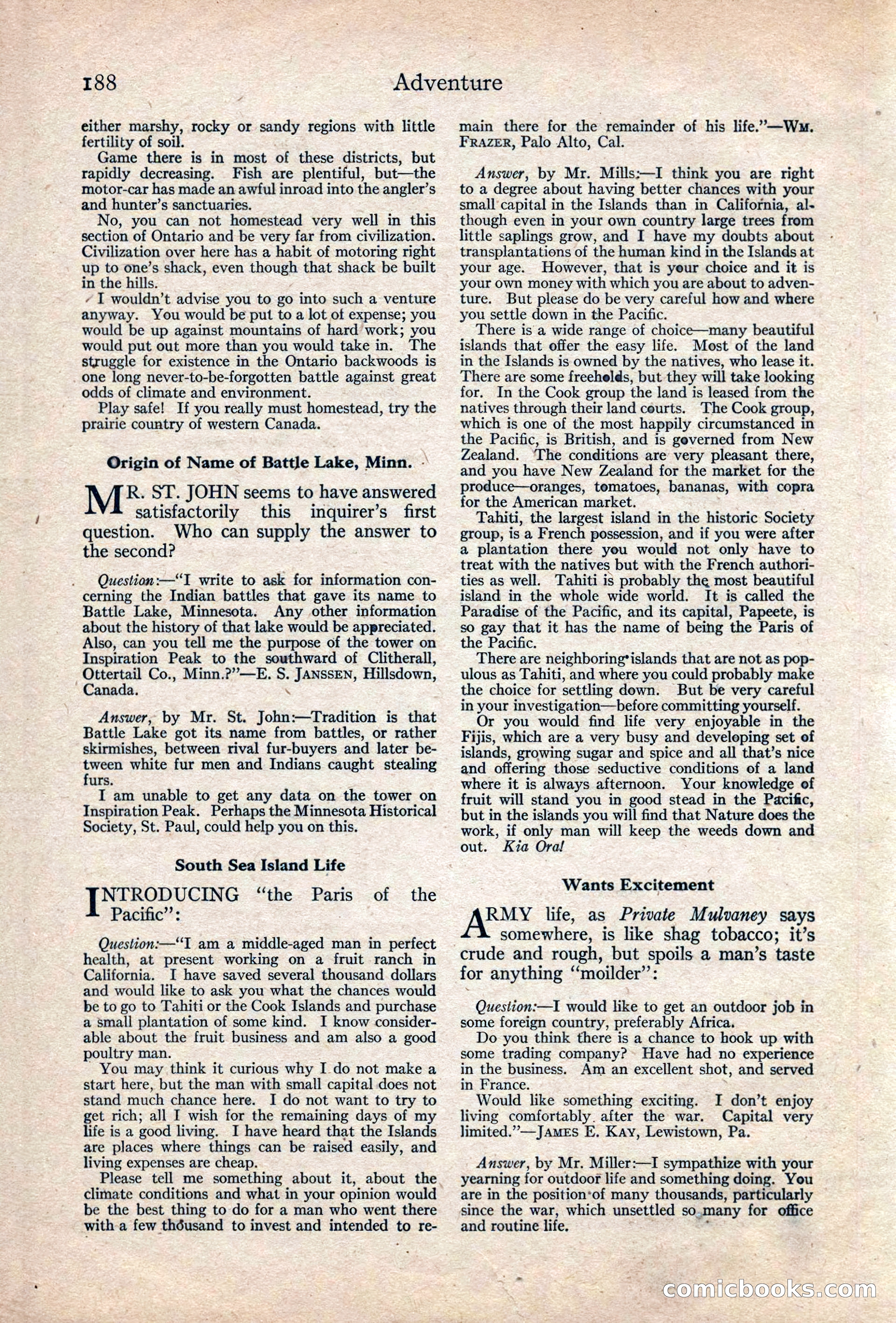
A restored page from Pulp Fiction, 1921. Page through the whole issue in the reader above.
📄 Transcribed text from this page (OCR, searchable)
Machine-transcribed from the original scan — historical spelling and the odd misread are preserved.
188 either marshy, rocky or sandy regions with little fertility of soil. Game there is in most of these districts, but rapidly decreasing. Fish are plentiful, but—the motor-car has made an awful inroad into the angler’s and hunter’s sanctuaries. No, you can not homestead very well in this section of Ontario and be very far from civilization. Civilization over here has a habit of motoring right up to one’s shack, even though that shack be built in the hills. - I wouldn’t advise you to go into such a venture anyway. You would be put to a lot of expense; you would be up against mountains of hard work; you would put out more than you would take in. The struggle for existence in the Ontario backwoods is one long never-to-be-forgotten battle against great odds of climate and environment. Play safe! If you really must homestead, try the prairie country of western Canada Origin of Name of Battle Lake, Minn. - ME: ST. JOHN seems to have answered satisfactorily this inquirer’s first question. Who can supply the answer to the second? Question:—“T write to ask for information con- cerning the Indian battles that gave its name to Battle Lake, Minnesota. Any other information about the history of that lake would be appreciated. Also, can you tell me the purpose of the tower on Inspiration Peak to the southward of Clitherall, Ottertail Co., Minn.?”—E. S. JANSSEN, Hillsdown, Canada. . Answer, by Mr. St. John:—Tradition is that Battle Lake got its name from battles, or rather skirmishes, between rival fur-buyers and later be- bes white fur men and Indians caught stealing urs. I am unable to get any data on the tower on Inspiration Peak. Perhaps the Minnesota Historical Society, St. Paul, could help you on this. South Sea Island Life NTRODUCING “the Pacific’’: Question: —“I am a middle-aged man in perfect health, at present working on a fruit ranch in California. I have saved several thousand dollars and would like to ask you what the chances would be to go to Tahiti or the Cook Islands and purchase a small plantation of some kind. I know consider- able about the fruit business and am also a good poultry man. You may think it curious why I do not make a start here, but the man with small capital does not stand much chance here. I do not want to try to get rich; aJl I wish for the remaining days of my life is a good living. I have heard that the Islands are places where things can be raised easily, and living expenses are cheap. Please tell me something about it, about the climate conditions and what in your opinion would be the best thing to do for a man who went there with a few théusand to invest and intended to re- Paris of the Adventure main there for the remainder of his life.”’—Wwx. FRAZER, Palo Alto, Cal. Answer, by Mr. Mills:—I think you are right to a degree about having better chances with your small capital in the Islands than in California, al- though even in your own country large trees from little saplings grow, and I have my doubts about transplantations of the human kind in the Islands at your age. However, that is yeur choice and it is your own money with which you are about to adven- ture. But please do be very careful how and where you settle down in the Pacific. There is a wide range of choice—many beautiful islands that offer the easy life. Most of the land in the Islands is owned by the natives, who lease it. There are some freehelds, but they will take looking for. In the Cook group the land is leased from the natives through their land courts. The Cook group, which is one of the most happily circumstanced in the Pacific, is British, and is geverned from New Zealand. ‘The conditions are very pleasant there, and you have New Zealand for the market for the produce—oranges, tomatoes, bananas, with copra for the American market. Tahiti, the largest island in the historic Society group, is a French possession, and if you were after a plantation there you would not only have to treat with the natives but with the French authori- ties as well. Tahiti is probably the most beautiful island in the whole wide world. It is called the Paradise of the Pacific, and its capital, Papeete, is so gay that it has the name of being the Paris of the Pacific. There are neighboring*islands that are not as pop- ulous as Tahiti, and where you could probably make the choice for settling down. But be very careful in your investigation—before committing yourself. Or you would find life very enjoyable in the Fijis, which are a very busy and develeping set of islands, growing sugar and spice and all that’s nice and offering those seductive conditions of a land where it is always afternoon. Your knowledge of fruit will stand you in good stead in the Pacific, but in the islands you will find that Nature does the work, if only man will keep the weeds down and out. Kza Oral Wants Excitement Ae life, as Private Mulvaney says somewhere, is like shag tobacco; it’s crude and rough, but spoils a man’s taste for anything ‘‘moilder”’: Question:—I would like to get an outdoor job in some foreign country, preferably Africa. Do you think there is a chance to hook up with some trading company? Have had no experience in the business. Am an excellent shot, and served in France. Would like something exciting. I don’t enjoy living comfortably. after the war. Capital very limited.”—JAmeEs E, Kay, Lewistown, Pa. Answer, by Mr. Miller:—I sympathize with your yearning for outdoor life and something doing. You are in the position‘of many thousands, particularly since the war, which unsettled so. many for office and routine life, JOO a (S) =) a