
Pulp Fiction, 1921 · page 59 of 204
Adventure Magazine Cover — page 59: what you’re looking at
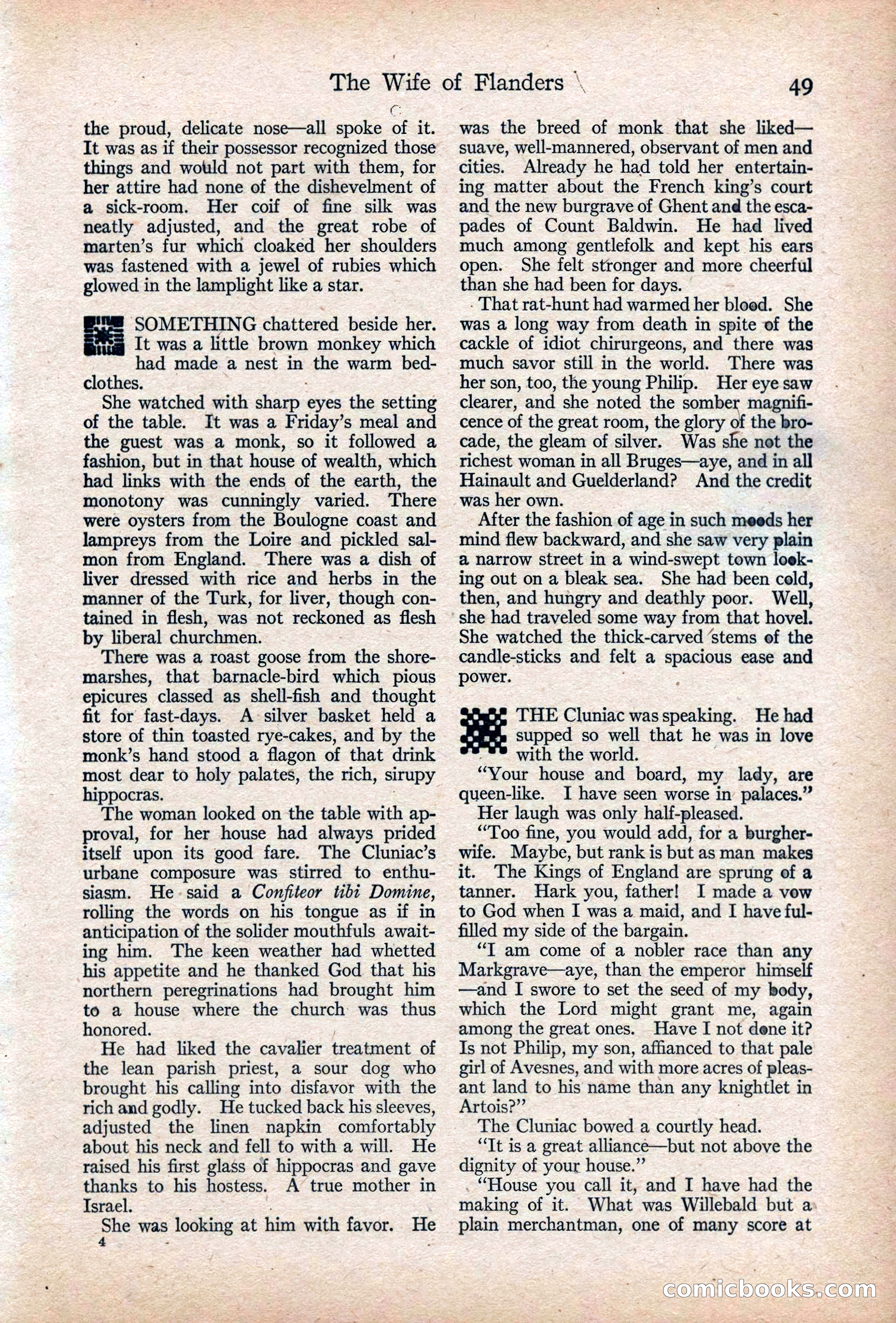
A restored page from Pulp Fiction, 1921. Page through the whole issue in the reader above.
📄 Transcribed text from this page (OCR, searchable)
Machine-transcribed from the original scan — historical spelling and the odd misread are preserved.
The Wife of Flanders \. = the proud, delicate nose—all spoke of it. It was as if their possessor recognized those things and wotld not part with them, for her attire had none of the dishevelment of a sick-room. Her coif of fine silk was neatly adjusted, and the great robe of marten’s fur which cloaked her shoulders was fastened with a jewel of rubies which glowed in the lamplight like a star. ith SOMETHING chattered beside her. “ea It was a little brown monkey which had made a nest in the warm bed- clothes. She watched with hi eyes the setting of the table. It was a Friday’s meal and the guest was a monk, so it followed a fashion, but in that house of wealth, which had links with the ends of the earth, the monotony was cunningly varied. There were oysters from the Boulogne coast and lampreys from the Loire and pickled sal- mon from England. There was a dish of liver dressed with rice and herbs in the manner of the Turk, for liver, though con- tained in flesh, was not reckoned as flesh by liberal churchmen. There was a roast goose esi the shore- marshes, that barnacle-bird which pious epicures classed as shell-fish and thought fit for fast-days. A silver basket held a store of thin toasted rye-cakes, and by the monk’s hand stood a flagon of that drink most dear to holy palates, the rich, sirupy hippocras. The woman looked on the table with ap- proval, for her house had always prided itself upon its good fare. The Cluniac’s urbane composure was stirred to enthu- siasm. He-said a Confiteor tibt Domine, rolling the words on his tongue as if in anticipation of the solider mouthfuls await- ing him. The keen weather had whetted his appetite and he thanked God that his northern peregrinations had brought him to a house where the church was thus honored. He had liked the cavalier treatment of the lean parish priest, a sour dog who brought his calling into disfavor with the rich and godly. He tucked back his sleeves, adjusted the linen napkm comfortably about his neck and fell to with a will. He raised his first glass of hippocras and gave thanks to his hostess. A true mother in Israel. She was looking at him with favor. He 49 was the breed of monk that she liked— suave, well-mannered, observant of men and cities. Already he had told her entertain- ing matter about the French king’s court and the new burgrave of Ghent and the esca- pades of Count Baldwin. He had lived much among gentlefolk and kept his ears open. She felt stronger and more cheerful than she had been for days. - That rat-hunt had warmed her bloed. She was a long way from death in spite of the cackle of idiot chirurgeons, and there was much savor still in the world. There was her son, too, the young Philip. Her eye saw clearer, and she noted the somber magnifi- cence of the great room, the glory of the bro- cade, the gleam of silver. Was she not the richest woman in all Bruges—aye, and in all Hainault and Guelderland? And the credit was her own. After the fashion of age in such meeds her mind flew backward, and she saw very plain a narrow street in a wind-swept town loek- ing out on a bleak sea. She had been cold, then, and hungry and deathly poor. Well, she had traveled some way from that hovel. She watched the thick-carved ‘stems of the candle-sticks and felt a spacious ease and power. THE Cluniac was speaking. He had supped so well that he was in love with the world. a “Your house and board, my lady, are queen-like. I have seen worse in palaces.” Her laugh was only half-pleased. “Too fine, you would add, for a burgher- wife. Maybe, but rank is but as man makes it. The Kings of England are sprung of a tanner. Hark you, father! I made a vow to God when I was a maid, and I have ful- filled my side of the bargain. “T am come of a nobler race than any Markgrave—aye, than the emperor himself —and I swore to set the seed of my body, which the Lord might grant me, again among the great ones. Have I not dene it? Is not Philip, my son, affianced to that pale girl of Avesnes, and with more acres of pleas- ant land to his name than any knightlet i in Artois?” The Cluniac bowed a courtly head. “Tt is a great alliance—but not above the dignity of your house.” “House you call it, and I have had the making of it. What was Willebald but a plain merchantman, one of many score at 0)(0\(6) GEomic <S* (E@