
Pulp Fiction, 1922 · page 14 of 202
Adventure Magazine Cover — page 14: what you’re looking at
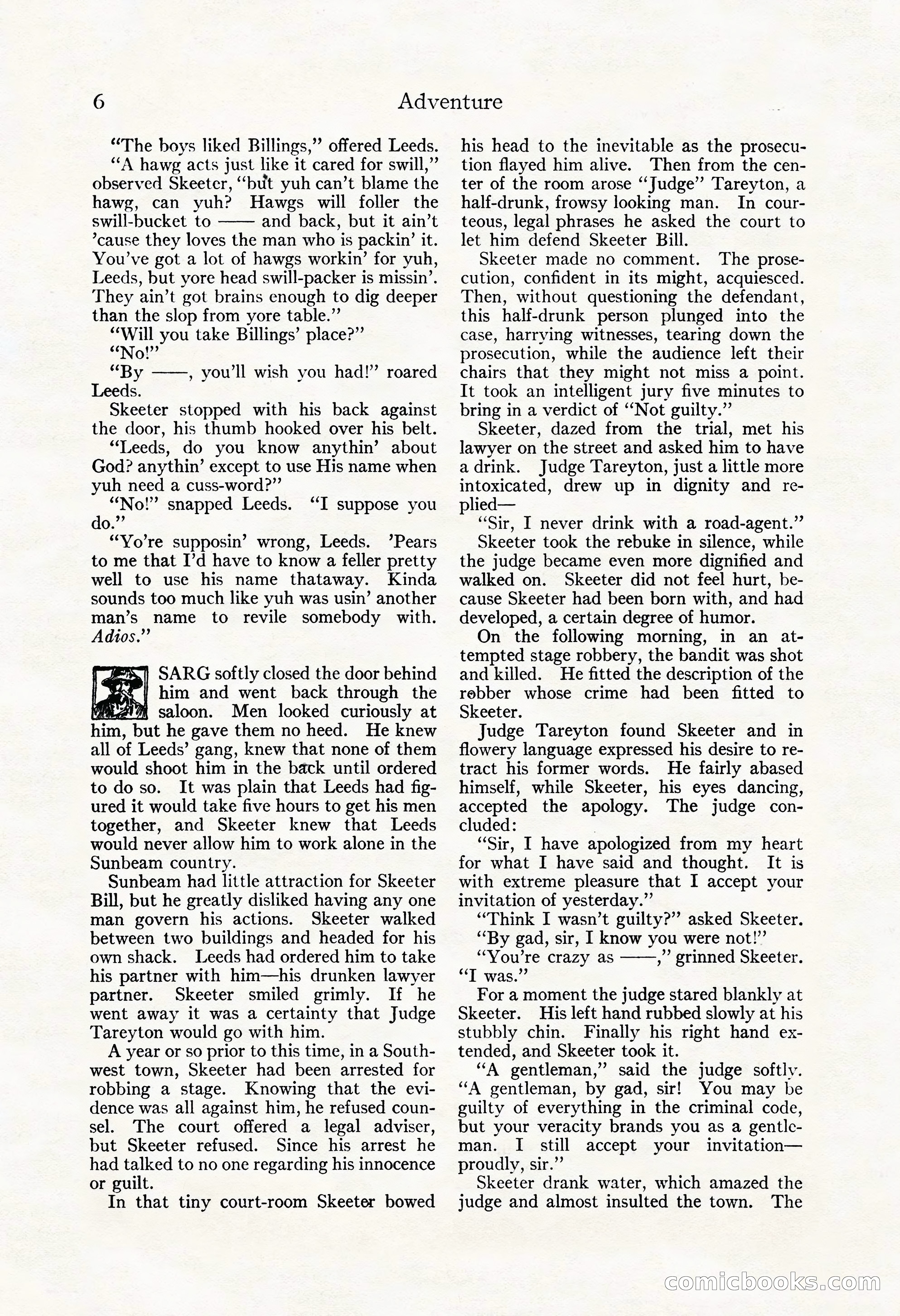
A restored page from Pulp Fiction, 1922. Page through the whole issue in the reader above.
📄 Transcribed text from this page (OCR, searchable)
Machine-transcribed from the original scan — historical spelling and the odd misread are preserved.
6 Adventure i he boys liked Billings,” offered Leeds. ‘“‘A hawg acts just like it cared for swill,” observed Skeeter, ‘but yuh can’t blame the hawg, can yuh? Hawgs will foller the swill-bucket to and back, but it ain’t cause they loves the man who is packin’ it. You’ve got a lot of hawgs workin’ for yuh, Leeds, but yore head swill-packer is missin’. They ain’t got brains enough to dig deeper than the slop from yore table.” ‘Will you take Billings’ place?” “No!” “By ——, you'll wish vou had!” roared Leeds. Skeeter stopped with his back against the door, his thumb hooked over his belt. ‘Leeds, do you know anythin’ about God? anythin’ except to use His name when yuh need a cuss-word?” “No!” snapped Leeds. do.”’ “Yo’re supposin’ wrong, Leeds. ’Pears to me that I’d have to know a feller pretty well to use his name thataway. Kinda sounds too much like yuh was usin’ another man’s name to revile somebody with. Adios.” “T suppose you ! him and went back through the § saloon. Men looked curiously at om ‘but he gave them no heed. He knew all of Leeds’ gang, knew that none of them would shoot him in the back until ordered to do so. It was plain that Leeds had fig- ured it would take five hours to get his men together, and Skeeter knew that Leeds would never allow him to work alone in the Sunbeam country. Sunbeam had little attraction for Skeeter Bill, but he greatly disliked having any one man govern his actions. Skeeter walked between two buildings and headed for his own shack. Leeds had ordered him to take his partner with him—his drunken lawyer partner. Skeeter smiled grimly. If he went away it was a certainty that Judge Tareyton would go with him. A year or so prior to this time, in a South- west town, Skeeter had been arrested for robbing a stage. Knowing that the evi- dence was all against him, he refused coun- sel. The court offered a legal adviser, but Skeeter refused. Since his arrest he had talked to no one regarding his innocence or guilt. In that tiny court-room Skeeter bowed his head to the inevitable as the prosecu- tion flayed him alive. Then from the cen- ter of the room arose “Judge” Tareyton, a half-drunk, frowsy looking man. In cour- teous, legal phrases he asked the court to let him defend Skeeter Bill. Skeeter made no comment. The prose- cution, confident in its might, acquiesced. Then, without questioning the defendant, this half-drunk person plunged into the case, harrying witnesses, tearing down the prosecution, while the audience left their chairs that they might not miss a point. It took an intelligent jury five minutes to bring in a verdict of ‘‘Not guilty.” Skeeter, dazed from the trial, met his lawyer on the street and asked him to have a drink. Judge Tareyton, just a little more intoxicated, drew up in dignity and re- plied— “Sir, I never drink with a road-agent.” Skeeter took the rebuke in silence, while the judge became even more dignified and walked on. Skeeter did not feel hurt, be- cause Skeeter had been born with, and had developed, a certain degree of humor. On the following morning, in an at- tempted stage robbery, the bandit was shot and killed. He fitted the description of the rebber whose crime had been fitted to Skeeter. Judge Tareyton found Skeeter and in flowery language expressed his desire to re- tract his former words. He fairly abased himself, while Skeeter, his eyes dancing, accepted the apology. The judge con- cluded: “Sir, I have apologized from my heart for what I have said and thought. It is with extreme pleasure that I accept your invitation of yesterday.”’ “Think I wasn’t guilty?” asked Skeeter. “By gad, sir, I know you were not!”’ “You’re crazy as , grinned Skeeter. “T was.” For a moment the judge stared blankly at Skeeter. His left hand rubbed slowly at his stubbly chin. Finally his right hand ex- tended, and Skeeter took it. “A gentleman,” said the judge softly. “A gentleman, by gad, sir! You may be guilty of everything in the criminal code, but your veracity brands you as a gentle- man. I still accept your invitation— proudly, sir.” Skeeter drank water, which amazed the judge and almost insulted the town. The GOMIIGooOo S (C@