
Pulp Fiction, 1922 · page 15 of 202
Adventure Magazine Cover — page 15: what you’re looking at
A restored page from Pulp Fiction, 1922. Page through the whole issue in the reader above.
📄 Transcribed text from this page (OCR, searchable)
Machine-transcribed from the original scan — historical spelling and the odd misread are preserved.
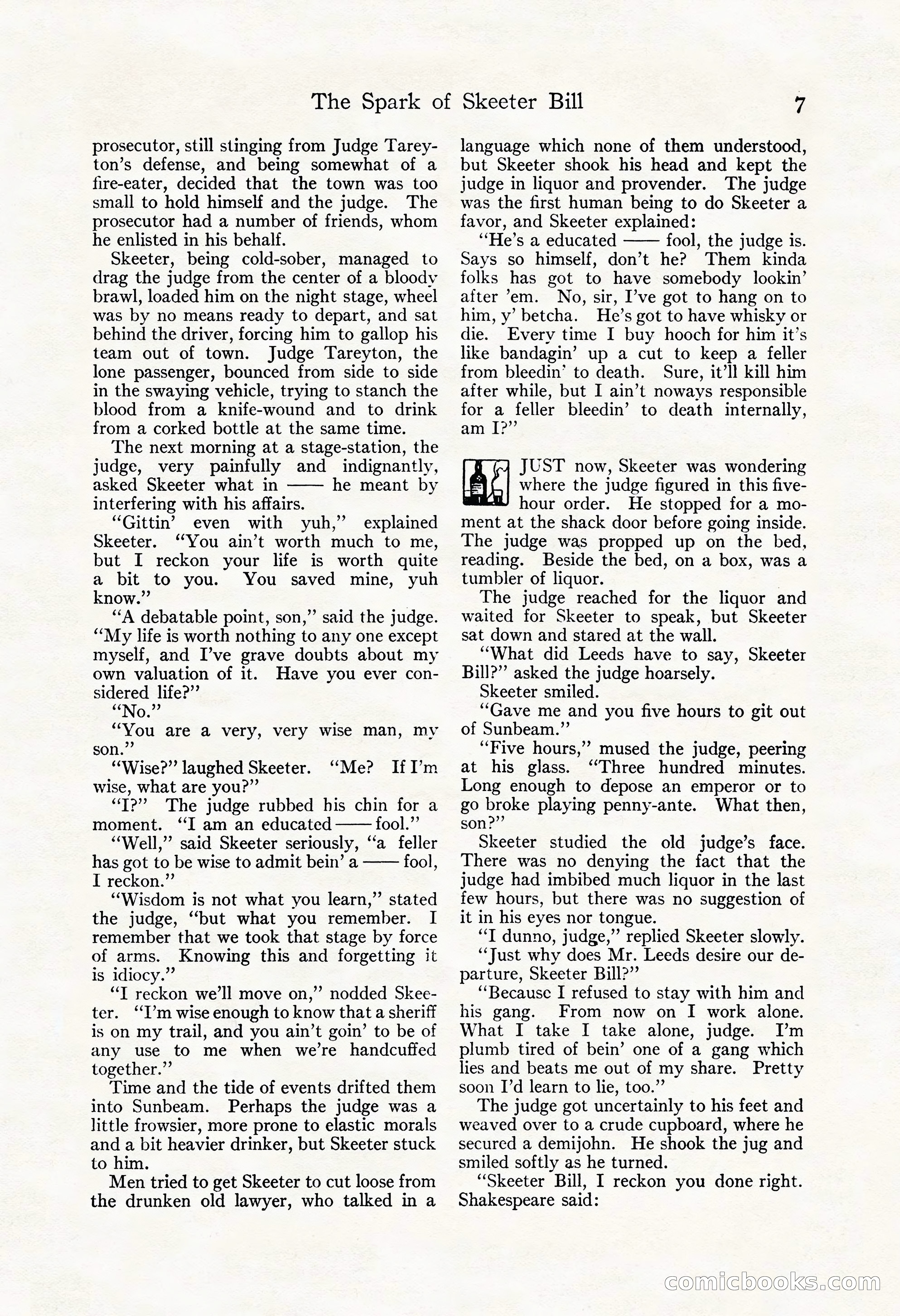
The Spark of Skeeter Bill 7 prosecutor, still stinging from Judge Tarey- ton’s defense, and being somewhat of a fire-eater, decided that the town was too small to hold himself and the judge. The prosecutor had a number of friends, whom he enlisted in his behalf. Skeeter, being cold-sober, managed to drag the judge from the center of a bloodv brawl, loaded him on the night stage, wheel was by no means ready to depart, and sat behind the driver, forcing him to gallop his team out of town. Judge Tareyton, the lone passenger, bounced from side to side in the swaying vehicle, trying to stanch the blood from a knife-wound and to drink from a corked bottle at the same time. The next morning at a stage-station, the judge, very painfully and indignantly, asked Skeeter what in he meant by interfering with his affairs. “Gittin? even with yuh,” explained Skeeter. ‘You ain’t worth much to me, but I reckon your life is worth quite a bit to you. You saved mine, yuh know.” 7 ‘“‘A debatable point, son,”’ said the judge. “My life is worth nothing to any one except myself, and I’ve grave doubts about my own valuation of it. Have you ever con- sidered life?’ “NO.” “You are a very, very wise man, my son.” ‘Wiser’ laughed Skeeter. wise, what are you?” “T?”? The judge rubbed his chin for a moment. “I am an educated fool.” ‘‘Well,”’ said Skeeter seriously, ‘‘a feller has got to be wise to admit bein’ a fool, I reckon.”’ ‘“‘Wisdom is not what you learn,” stated the judge, “but what you remember. I remember that we took that stage by force of arms. Knowing this and forgetting it is idiocy.” “T reckon we’ll move on,’’ nodded Skee- ter. ‘I’m wise enough to know that a sheriff is on my trail, and you ain’t goin’ to be of any use to me when we're handcuffed together.” Time and the tide of events drifted them into Sunbeam. Perhaps the judge was a little frowsier, more prone to elastic morals and a bit heavier drinker, but Skeeter stuck to him. Men tried to get Skeeter to cut loose from the drunken old lawyer, who talked in a “Me? Ifil’m language which none of them understood, but Skeeter shook his head and kept the judge in liquor and provender. The judge was the first human being to do Skeeter a favor, and Skeeter explained: ‘‘He’s a educated fool, the judge is. Says so himself, don’t he? Them kinda folks has got to have somebody lookin’ after em. No, sir, I’ve got to hang on to him, y’ betcha. He’s got to have whisky or die. Every time I buy hooch for him it’s like bandagin’ up a cut to keep a feller from bleedin’ to death. Sure, it’l! kill him after while, but I ain’t noways responsible for a feller bleedin’ to death internally, am I?” JUST now, Skeeter was wondering where the judge figured in this five- hour order. He stopped for a mo- ment at the shack door before going inside. The judge was propped up on the bed, reading. Beside the bed, on a box, was a tumbler of liquor. 7 The judge reached for the liquor and waited for Skeeter to speak, but Skeeter sat down and stared at the wall. “What did Leeds have to say, Skeeter Bill?” asked the judge hoarsely. Skeeter smiled. “Gave me and you five hours to git out of Sunbeam.”’ “Five hours,” mused the judge, peering at his glass. “Three hundred minutes. Long enough to depose an emperor or to go broke playing penny-ante. What then, son?” Skeeter studied the old judge’s face. There was no denying the fact that the judge had imbibed much liquor in the last few hours, but there was no suggestion of it in his eyes nor tongue. “T dunno, judge,” replied Skeeter slowly. ‘‘Just why does Mr. Leeds desire our de- parture, Skeeter Bill?” “Because I refused to stay with him and his gang. From now on I work alone. What I take I take alone, judge. I’m plumb tired of bein’ one of a gang which lies and beats me out of my share. Pretty soon I’d learn to lie, too.’’ The judge got uncertainly to his feet and weaved over to a crude cupboard, where he secured a demijohn. He shook the jug and smiled softly as he turned. “Skeeter Bill, I reckon you done right. Shakespeare said: GOMIIGooOo S C@