
Pulp Fiction, 1922 · page 170 of 202
Adventure Magazine Cover — page 170: what you’re looking at
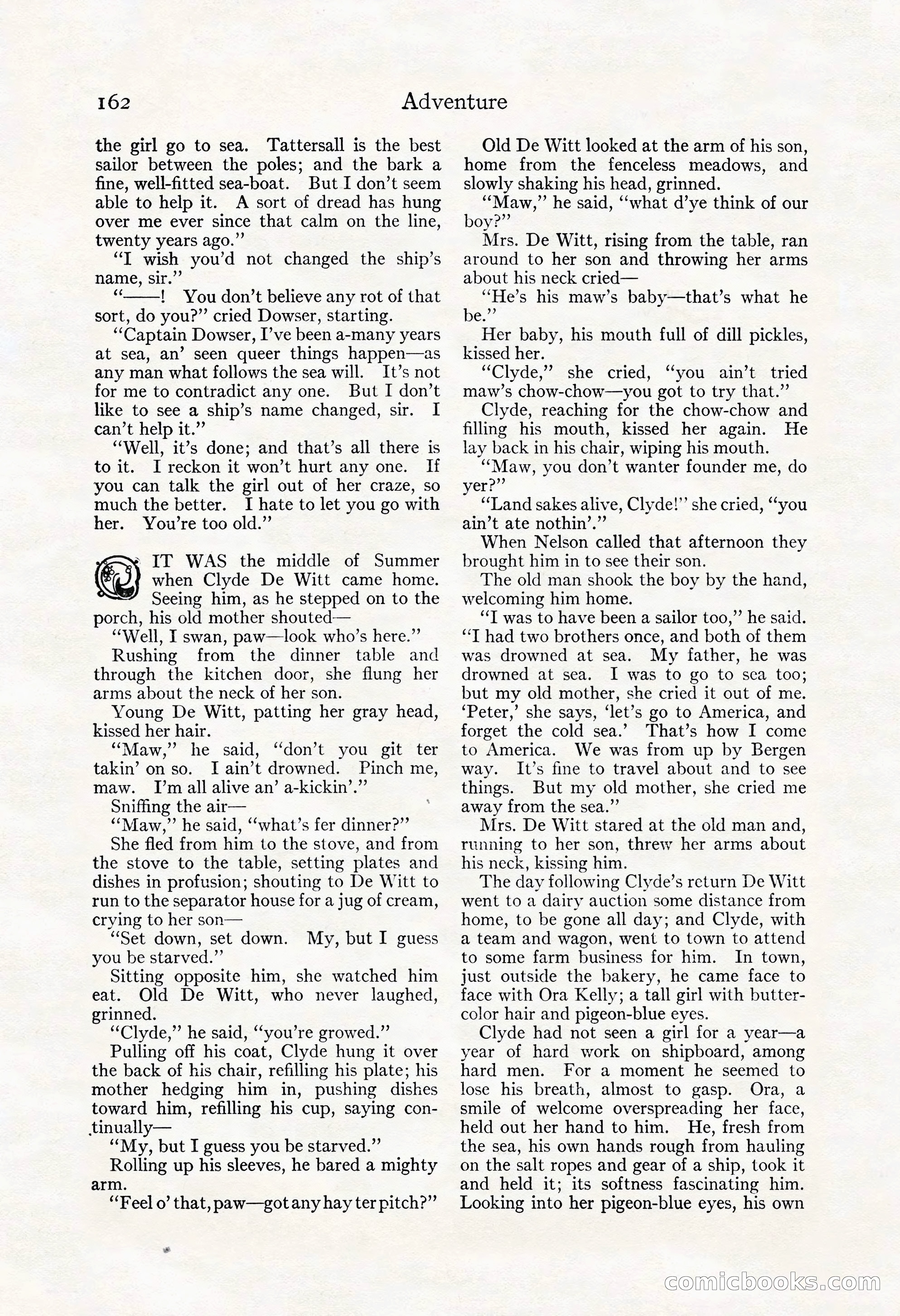
A restored page from Pulp Fiction, 1922. Page through the whole issue in the reader above.
📄 Transcribed text from this page (OCR, searchable)
Machine-transcribed from the original scan — historical spelling and the odd misread are preserved.
162 the girl go to sea. ‘Tattersall is the best sailor between the poles; and the bark a fine, well-fitted sea-boat. But I don’t seem able to help it. A sort of dread has hung over me ever since that calm on the line, twenty years ago.” “YT wish you’d not changed the ship’s name, sir.”’ ““____! ‘You don’t believe any rot of that sort, do you?” cried Dowser, starting. “‘Captain Dowser, I’ve been a-many years at sea, an’ seen queer things happen—as any man what follows the sea will. It’s not for me to contradict any one. But I don’t like to see a ship’s name changed, sir. I can’t help it.” “Well, it’s done; and that’s all there is to it. I reckon it won’t hurt any one. If you can talk the girl out of her craze, so much the better. I hate to let you go with her. You’re too old.” when Clyde De Witt came home. Seeing him, as he stepped on to the porch, his old mother shouted— “Well, I swan, paw—look who’s here.” Rushing from the dinner table and through the kitchen door, she flung her arms about the neck of her son. Young De Witt, patting her gray head, kissed her hair. “Maw,” he said, “domt=you git —ter takin’ on so. I ain’t drowned. Pinch me, maw. I’m all alive an’ a-kickin’.” Sniffing the air— ‘““Maw,”’ he said, ‘‘what’s fer dinner?”’ She fled from him to the stove, and from the stove to the table, setting plates and dishes in profusion; shouting to De Witt to run to the separator house for a jug of cream, crying to her son— ‘“Set down, set down. you be starved.” Sitting opposite him, she watched him eat. Old De Witt, who never laughed, grinned. “Clyde,” he said, “‘you’re growed.” Pulling off his coat, Clyde hung it over the back of his chair, refilling his plate; his mother hedging him in, pushing dishes toward him, refilling his cup, saying con- tinually— “My, but I guess you be starved.” Rolling up his sleeves, he bared a mighty arm. “Feel o’ that, paw—got any hay ter pitch?” (® IT WAS the middle of Summer My, but I guess Adventure Old De Witt looked at the arm of his son, home from the fenceless meadows, and slowly shaking his head, grinned. “Maw,” he said, ‘‘what d’ye think of our boy?” Mrs. De Witt, rising from the table, ran around to her son and throwing her arms about his neck cried— ‘“He’s his maw’s baby—that’s what he be.” Her baby, his mouth full of dill pickles, kissed her. “Clyde,” she cried, “‘you ain’t tried maw’s chow-chow—you got to try that.” Clyde, reaching for the chow-chow and filling his mouth, kissed her again. He lay back in his chair, wiping his mouth. ‘““Maw, you don’t wanter founder me, do er?” “Land sakes alive, Clyde!”’ she cried, “‘you ain’t ate nothin’.” When Nelson called that afternoon they brought him in to see their son. The old man shook the boy by the hand, welcoming him home. “T was to have been a sailor too,” he said. “‘T had two brothers once, and both of them was drowned at sea. My father, he was drowned at sea. I was to go to sca too; but my old mother, she cried it out of me. ‘Peter,’ she says, ‘let’s go to America, and forget the cold sea.’ That’s how I come to America. We was from up by Bergen way. It’s fine to travel about and to see things. But my old mother, she cried me away from the sea.” Mrs. De Witt stared at the old man and, running to her son, threw her arms about his neck, kissing him. The day following Clyde’s return De Witt went to a dairy auction some distance from home, to be gone all day; and Clyde, with a team and wagon, went to town to attend to some farm business for him. In town, just outside the bakery, he came face to face with Ora Kelly; a tall girl with butter- color hair and pigeon-blue eyes. Clyde had not seen a girl for a year—a year of hard work on shipboard, among hard men. For a moment he seemed to lose his breath, almost to gasp. Ora, a smile of welcome overspreading her face, held out her hand to him. He, fresh from the sea, his own hands rough from hauling on the salt ropes and gear of a ship, took it and held it; its softness fascinating him. Looking into her pigeon-blue eyes, his own (© DOOLK S C@ in