
Pulp Fiction, 1922 · page 171 of 202
Adventure Magazine Cover — page 171: what you’re looking at
A restored page from Pulp Fiction, 1922. Page through the whole issue in the reader above.
📄 Transcribed text from this page (OCR, searchable)
Machine-transcribed from the original scan — historical spelling and the odd misread are preserved.
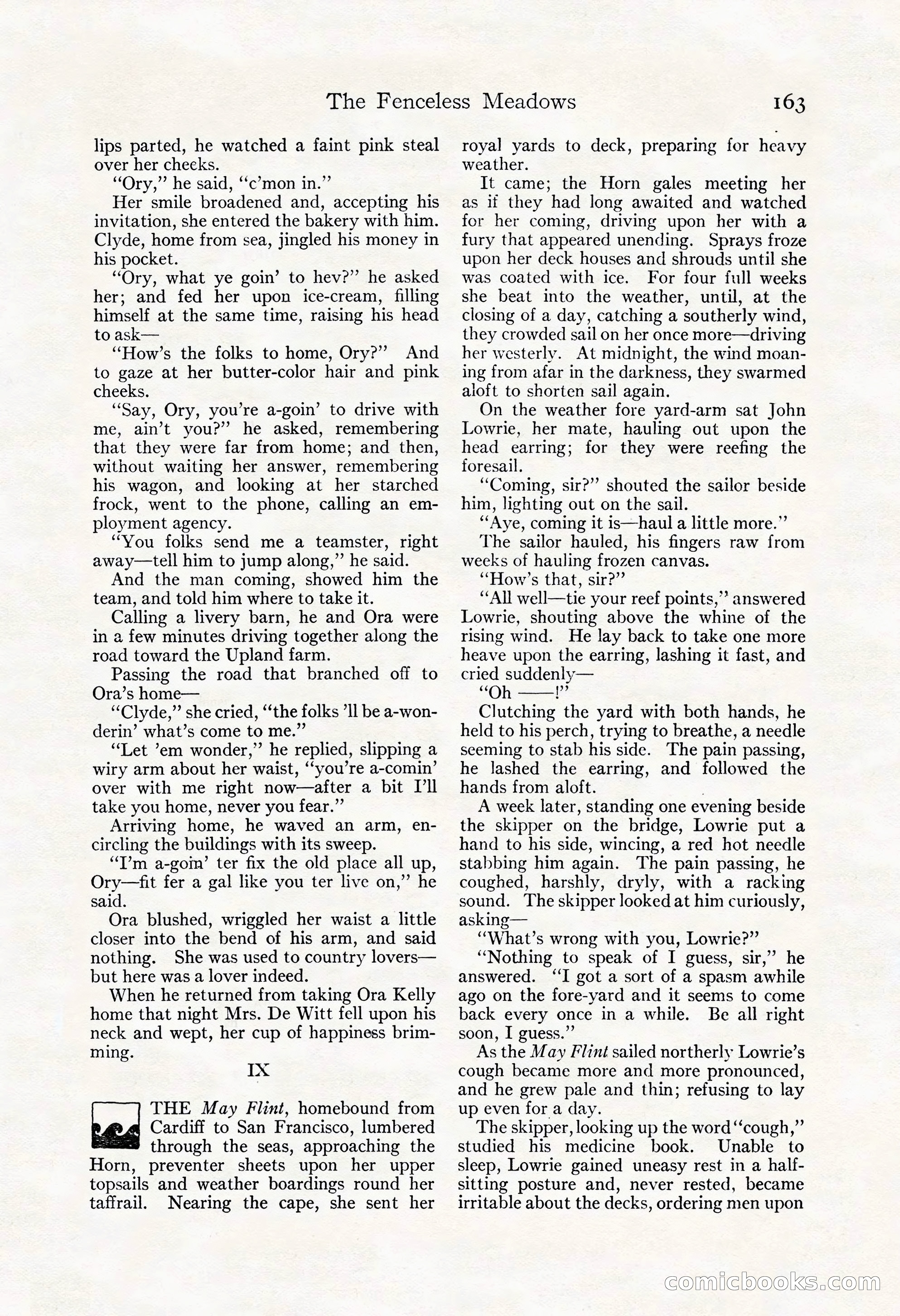
The Fenceless Meadows lips parted, he watched a faint pink steal over her checks. “Ory,” he said, ‘‘c’mon in.”’ Her smile broadened and, accepting his invitation, she entered the bakery with him. Clyde, home from sea, jingled his money in his pocket. “Ory, what ye goin’ to hev?” he asked her; and fed her upon ice-cream, filling himself at the same time, raising his head to ask— “How’s the folks to home, Ory?” And to gaze at her butter-color hair and pink cheeks. “Say, Ory, you’re a-goin’ to drive with me, ain’t you?” he asked, remembering that they were far from home; and then, without waiting her answer, remembering his wagon, and looking at her starched frock, went to the phone, calling an em- ployment agency. “You folks send me a teamster, right away—tell him to jump along,” he said. And the man coming, showed him the team, and told him where to take it. Calling a livery barn, he and Ora were in a few minutes driving together along the road toward the Upland farm. Passing the road that branched off to Ora’s home— “Clyde,” she cried, “‘the folks Il be a-won- derin’ what’s come to me.” “Let ’em wonder,” he replied, slipping a wiry arm about her waist, ‘‘you’re a-comin’ over with me right now—after a bit I'll take you home, never you fear.” Arriving home, he waved an arm, en- circling the buildings with its sweep. “T’m a-goin’ ter fix the old place all up, Ory—fit fer a gal like you ter live on,’’ he said. Ora blushed, wriggled her waist a little closer into the bend of his arm, and said nothing. She was used to country lovers— but here was a lover indeed. When he returned from taking Ora Kelly home that night Mrs. De Witt fell upon his neck and wept, her cup of happiness brim- ming. IX THE May Flint, homebound from ma Cardiff to San Francisco, lumbered esa through the seas, approaching the Horn, preventer sheets upon her upper topsails and weather boardings round her taffrail. Nearing the cape, she sent her 163 royal yards to deck, preparing for heavy weather. It came; the Horn gales meeting her as if they had long awaited and watched for her coming, driving upon her with a fury that appeared unending. Sprays froze upon her deck houses and shrouds until she was coated with ice. For four full weeks she beat into the weather, until, at the closing of a day, catching a southerly wind, they crowded sail on her once more—driving her westerly. At midnight, the wind moan- ing from afar in the darkness, they swarmed aloft to shorten sail again. On the weather fore yard-arm sat John Lowrie, her mate, hauling out upon the head earring; for they were reefing the foresail. ‘Coming, sir?”’ shouted the sailor beside him, lighting out on the sail. ‘“‘Aye, coming it is—haul a little more.” The sailor hauled, his fingers raw from weeks of hauling frozen canvas. ‘““How’s that, sir?” ‘‘All well—tie your reef points,’ answered Lowrie, shouting above the whine of the rising wind. He lay back to take one more heave upon the earring, lashing it fast, and cried suddenly— “Oh ee ag Clutching the yard with both hands, he held to his perch, trying to breathe, a needle seeming to stab his side. The pain passing, he lashed the earring, and followed the hands from aloft. 3 A week later, standing one evening beside the skipper on the bridge, Lowrie put a hand to his side, wincing, a red hot needle stabbing him again. The pain passing, he coughed, harshly, dryly, with a racking sound. The skipper looked at him curiously, asking— “What’s wrong with you, Lowrie?” “Nothing to speak of I guess, sir,” he answered. “I got a sort of a spasm awhile ago on the fore-yard and it seems to come back every once in a while. Be all right soon, I guess.” As the May Flint sailed northerly Lowrie’s cough became more and more pronounced, and he grew pale and thin; refusing to lay up even for a day. The skipper, looking up the word “‘cough,”’ studied his medicine book. Unable to sleep, Lowrie gained uneasy rest in a half- sitting posture and, never rested, became irritable about the decks, ordering men upon C@ DOOK S (© iin