
Pulp Fiction, 1922 · page 184 of 202
Adventure Magazine Cover — page 184: what you’re looking at
A restored page from Pulp Fiction, 1922. Page through the whole issue in the reader above.
📄 Transcribed text from this page (OCR, searchable)
Machine-transcribed from the original scan — historical spelling and the odd misread are preserved.
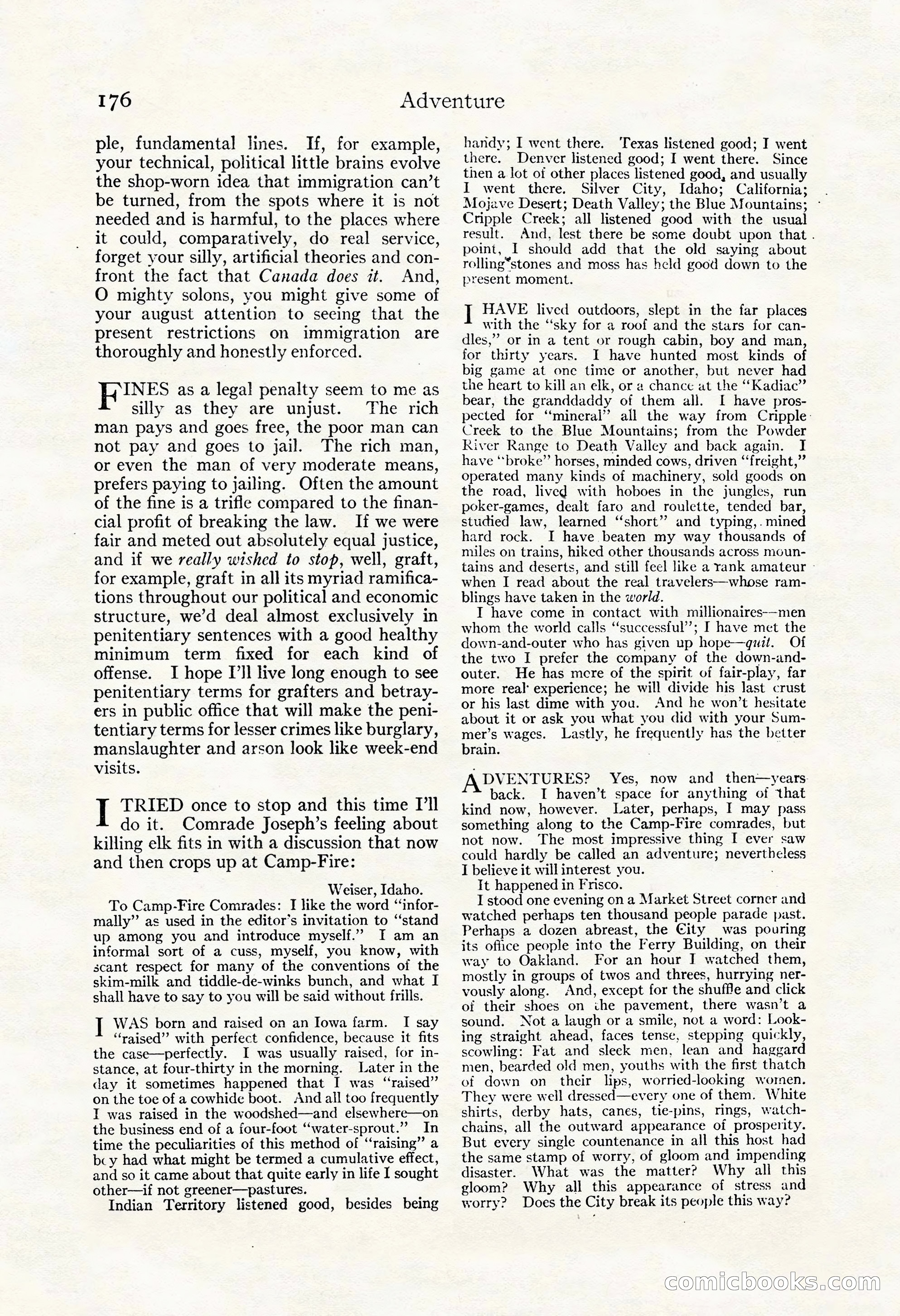
176 ple, fundamental lines. If, for example, your technical, political little brains evolve the shop-worn idea that immigration can’t be turned, from the spots where it is not needed and is harmful, to the places where it could, comparatively, do real service, forget your silly, artificial theories and con- front the fact that Canada does it. And, O mighty solons, you might give some of your august attention to seeing that the present restrictions on immigration are thoroughly and honestly enforced. PINE as a legal penalty seem to me as silly as they are unjust. The rich man pays and goes free, the poor man can not pay and goes to jail. The rich man, or even the man of very moderate means, prefers paying to jailing. Often the amount of the fine is a trifle compared to the finan- cial profit of breaking the law. If we were fair and meted out absolutely equal justice, and if we really wished to stop, well, graft, for example, graft in all its myriad ramifica- tions throughout our political and economic structure, we’d deal almost exclusively in penitentiary sentences with a good healthy minimum term fixed for each kind of offense. I hope IJ] live long enough to see penitentiary terms for grafters and betray- ers in public office that will make the peni- tentiary terms for lesser crimes like burglary, manslaughter and arson look like week-end visits. I TRIED once to stop and this time I’ll do it. Comrade Joseph’s feeling about killing elk fits in with a discussion that now and then crops up at Camp-Fire: Weiser, Idaho. To Camp-Fire Comrades: I like the word “‘infor- mally’? as used in the editor’s invitation to ‘“‘stand up among you and introduce myself.” I am an informal sort of a cuss, myself, you know, with scant respect for many of the conventions of the skim-milk and tiddle-de-winks bunch, and what I shall have to say to you will be said without frills. | WAS born and raised on an Iowa farm. I say “raised”? with perfect confidence, because it fits the case—perfectly. I was usually raised, for in- stance, at four-thirty in the morning. Later in the day it sometimes happened that I was “raised” on the toe of a cowhide boot. And all too frequently I was raised in the woodshed—and elsewhere—on the business end of a four-foot ‘‘water-sprout.” In time the peculiarities of this method of “raising” a bcy had what might be termed a cumulative effect, and so it came about that quite early in life I sought other—if not greener—pastures. Indian Territory listened good, besides being Adventure handy; I went there. Texas listened good; I went there. Denver listened good; I went there. Since then a lot of other places listened good, and usually I went there. Silver City, Idaho; California; Mojave Desert; Death Valley; the Blue Mountains; - . Cripple Creek; all listened good with the usual result. point, I should add that the old saying about rolling“stones and moss has held good down to the present moment. I HAVE lived outdoors, slept in the far places with the “sky for a roof and the stars for can- dles,” or in a tent or rough cabin, boy and man, for thirty years. I have hunted most kinds of big game at one time or another, but never had the heart to kill an elk, or a chance at the ‘‘Kadiac” bear, the granddaddy of them all. I have pros- And, lest there be some doubt upon that . pected for ‘‘mineral” all the way from Cripple: Creek to the Blue Mountains; from the Powder River Range to Death Valley and back again. I have ‘‘broke”’ horses, minded cows, driven “freight,” operated many kinds of machinery, sold goods on the road, lived with hoboes in the jungles, run poker-games, dealt faro and roulette, tended bar, studied law, learned ‘“‘short” and typing, . mined hard rock. I have beaten my way thousands of miles on trains, hiked other thousands across moun- tains and deserts, and still feel like a rank amateur - when I read about the real travelers—whose ram- blings have taken in the world. I have come in contact with millionaires-——-men whom the world calls ‘‘successful’’; I have met the down-and-outer who has given up hope—quil. Of the two I prefer the company of the down-and- outer. He has mere of the spirit of fair-play, far more real: experience; he will divide his last crust or his last dime with you. And he won’t hesitate about it or ask you what you did with your Sum- mer’s wages. Lastly, he frequently has the better brain. ADVENTURES? Yes, now and then—years. back. I haven’t space for anything of that kind now, however. Later, perhaps, I may pass something along to the Camp-Fire comrades, but not now. The most impressive thing I ever saw could hardly be called an adventure; nevertheless I believe it willinterest you. It happened in Frisco. I stood one evening on a Market Street corner and watched perhaps ten thousand people parade past. Perhaps a dozen abreast, the City was pouring its office people into the Ferry Building, on their way to Oakland. For an hour I watched them, mostly in groups of twos and threes, hurrying ner- vously along. And, except for the shuffle and click of their shoes on the pavement, there wasn’t a sound. Not a laugh or a smile, not a word: Look- ing straight ahead, faces tense, stepping quickly, scowling: Fat and sleek men, lean and haggard men, bearded old men, youths with the first thatch of down on their lips, worried-looking wornen. They were well dressed—every one of them. White shirts, derby hats, canes, tie-pins, rings, watch- chains, all the outward appearance of prosperity. But every single countenance in all this host had the same stamp of worry, of gloom and impending disaster. What was the matter? Why all this gloom? Why all this appearance of stress and worry? Does the City break its people this way? (© (Cc DOOKS (©) iin