
Pulp Fiction, 1922 · page 185 of 202
Adventure Magazine Cover — page 185: what you’re looking at
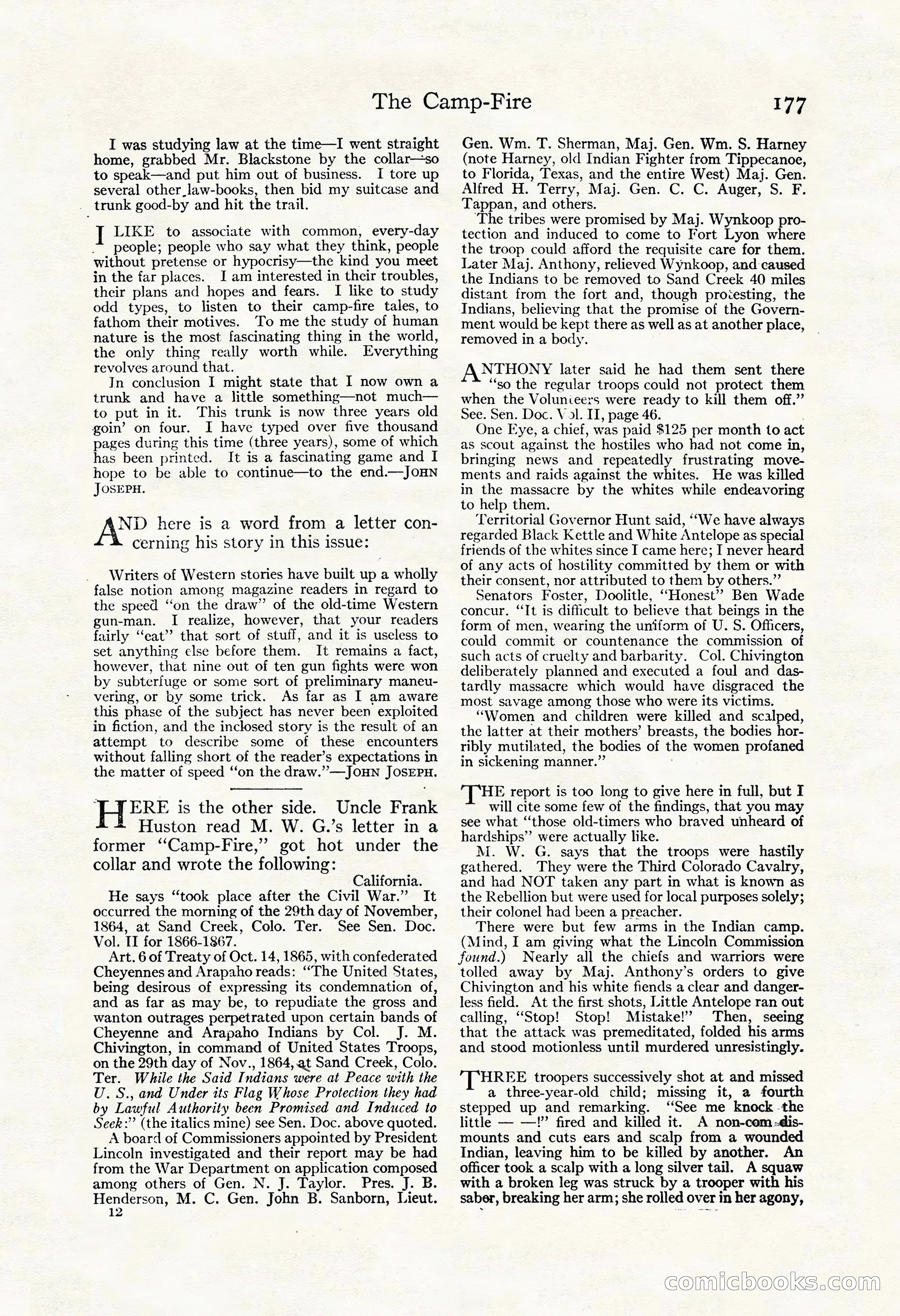
A restored page from Pulp Fiction, 1922. Page through the whole issue in the reader above.
📄 Transcribed text from this page (OCR, searchable)
Machine-transcribed from the original scan — historical spelling and the odd misread are preserved.
The Camp-Fire I was studying law at the time—I went straight home, grabbed Mr. Blackstone by the collar—so to speak—and put him out of business. I tore up several other law-books, then bid my suitcase and _ trunk good-by and hit the trail. I LIKE to associate with common, every-day ~ people; people who say what they think, people without pretense or hypocrisy—the kind you meet in the far places. I am interested in their troubles, their plans and hopes and fears. I like to study odd types, to listen to their camp-fire tales, to fathom their motives. To me the study of human nature is the most fascinating thing in the world, the only thing really worth while. Everything revolves around that. In conclusion I might state that I now own a trunk and have a little something—not much— to put in it. This trunk is now three years old goin’ on four. I have typed over five thousand pages during this time (three years), some of which has been printed. It is a fascinating game and I hope to be able to continue—to the end.—JOoHN JOSEPH. ND here is a word from a letter con- cerning his story in this issue: Writers of Western stories have built up a wholly false notion among magazine readers in regard to the speed ‘‘on the draw” of the old-time Western gun-man. I realize, however, that your readers fairly “eat” that sort of stuff, and it is useless to set anything else before them. It remains a fact, however, that nine out of ten gun fights were won by subterfuge or some sort of preliminary maneu- vering, or by some trick. As far as I am aware this phase of the subject has never been exploited in fiction, and the inclosed story is the result of an attempt to describe some of these encounters without falling short of the reader’s expectations in the matter of speed “‘on the draw.”—JOHN JOSEPH. : ERE is the other side. Uncle Frank Huston read M. W. G.’s letter in a former ‘‘Camp-Fire,” got hot under the collar and wrote the following: California. He says “took place after the Civil War.” It occurred the morning of the 29th day of November, 1864, at Sand Creek, Colo. Ter. See Sen. Doc. Vol. II for 1866-1867. Art. 6 of Treaty of Oct. 14, 1865, with confederated Cheyennes and Arapaho reads: “The United States, being desirous of expressing its condemnation of, and as far as may be, to repudiate the gross and wanton outrages perpetrated upon certain bands of Cheyenne and Arapaho Indians by Col. J. M. Chivington, in command of United States Troops, on the 29th day of Nov., 1864, at Sand Creek, Colo. Ter. While the Said Indians were at Peace with the U. S., and Under its Flag Whose Protection they had by Lawful Authority been Promised and Induced to Seek: (the italics mine) see Sen. Doc. above quoted. A board of Commissioners appointed by President Lincoln investigated and their report may be had from the War Department on application composed among others of Gen. N. J. Taylor. Pres. J. B. Henderson, M. C. Gen. John B. Sanborn, Lieut. 12 177 Gen. Wm. T. Sherman, Maj. Gen. Wm. S. Harney (note Harney, old Indian Fighter from Tippecanoe, to Florida, Texas, and the entire West) Maj. Gen. Alfred H. Terry, Maj. Gen. C. C. Auger, S. F. Tappan, and others. ‘The tribes were promised by Maj. Wynkoop pro- tection and induced to come to Fort Lyon where the troop could afford the requisite care for them. Later Maj. Anthony, relieved Wynkoop, and caused the Indians to be removed to Sand Creek 40 miles distant from the fort and, though protesting, the Indians, believing that the promise of the Govern- ment would be kept there as well as at another place, removed in a body. AN THONY later said he had them sent there “so the regular troops could not protect them when the Volunieers were ready to kill them off.” See. Sen. Doc. V ol. II, page 46. One Eye, a chief, was paid $125 per month to act as scout against the hostiles who had not come in, bringing news and repeatedly frustrating move- ments and raids against the whites. He was killed in the massacre by the whites while endeavoring to help them. Territorial Governor Hunt said, ‘‘We have always regarded Black Kettle and White Antelope as special friends of the whites since I came here; I never heard of any acts of hostility committed by them or with their consent, nor attributed to them by others.” Senators Foster, Doolitle, “Honest”? Ben Wade concur. ‘It is difficult to believe that beings in the form of men, wearing the uniform of U. S. Officers, could commit or countenance the commission of such acts of cruelty and barbarity. Col. Chivington deliberately planned and executed a foul and das- tardly massacre which would have disgraced the most savage among those who were its victims. “Women and children were killed and scalped, the latter at their mothers’ breasts, the bodies hor- ribly mutilated, the bodies of the women profaned in sickening manner.” HE report is too long to give here in full, but I will cite some few of the findings, that you may see what ‘“‘those old-timers who braved unheard of hardships”’ were actually like. M. W. G. says that the troops were hastily gathered. They were the Third Colorado Cavalry, and had NOT taken any part in what is known as the Rebellion but were used for local purposes solely; their colonel had been a preacher. There were but few arms in the Indian camp. (Mind, I am giving what the Lincoln Commission found.) Nearly all the chiefs and warriors were tolled away by Maj. Anthony’s orders to give Chivington and his white fiends a clear and danger- less field. At the first shots, Little Antelope ran out calling, “Stop! Stop! Mistake!’ Then, seeing that the attack was premeditated, folded his arms and stood motionless until murdered unresistingly. "THREE troopers successively shot at and missed a three-year-old child; missing it, a fourth stepped up and remarking. “See me knock -the little — —!” fired and killed it. A non-com-dis- mounts and cuts ears and scalp from a wounded Indian, leaving him to be killed by another. An officer took a scalp with a long silver tail. A squaw with a broken leg was struck by a trooper with his saber, breaking her arm; she rolled over in her agony, comlcooolk S C@