
Pulp Fiction, 1922 · page 187 of 202
Adventure Magazine Cover — page 187: what you’re looking at
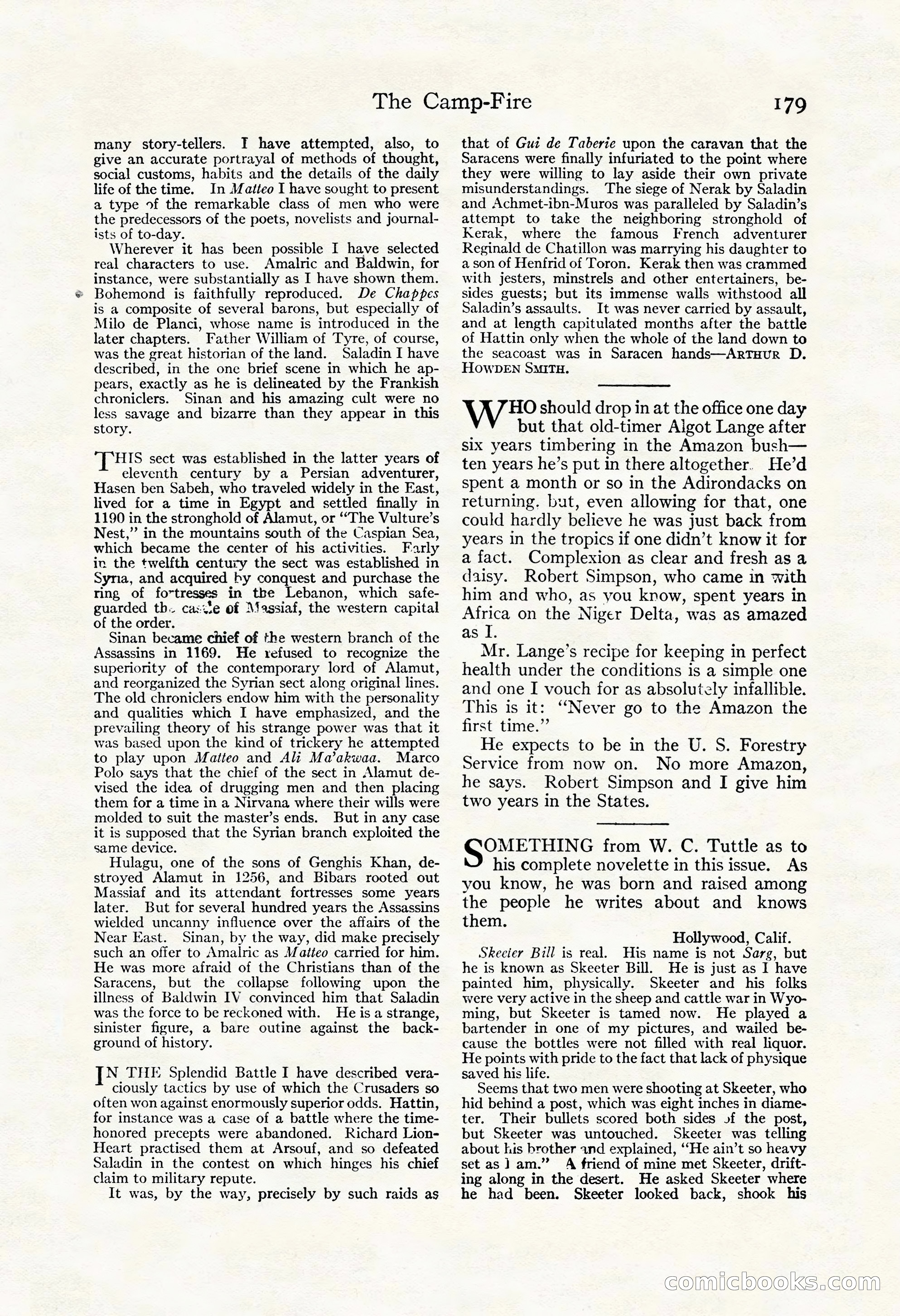
A restored page from Pulp Fiction, 1922. Page through the whole issue in the reader above.
📄 Transcribed text from this page (OCR, searchable)
Machine-transcribed from the original scan — historical spelling and the odd misread are preserved.
The Camp-Fire many story-tellers. I have attempted, also, to give an accurate portrayal of methods of thought, social customs, habits and the details of the daily life of the time. In Matteo I have sought to present a type of the remarkable class of men who were the predecessors of the poets, novelists and journal- ists of to-day. Wherever it has been possible I have selected real characters to use. Amalric and Baldwin, for instance, were substantially as I have shown them. >» Bohemond is faithfully reproduced. De Chappes is a composite of several barons, but especially of Milo de Planci, whose name is introduced in the later chapters. Father William of Tyre, of course, was the great historian of the land. Saladin I have described, in the one brief scene in which he ap- pears, exactly as he is delineated by the Frankish chroniclers. Sinan and his amazing cult were no less savage and bizarre than they appear in this story. HIS sect was established in the latter years of eleventh century by a Persian adventurer, Hasen ben Sabeh, who traveled widely in the East, lived for a time in Egypt and settled finally in 1190 in the stronghold of Alamut, or ‘“The Vulture’s Nest,” in the mountains south of the Caspian Sea, which became the center of his activities. Farly in the twelfth century the sect was established in Syria, and acquired hy conquest and purchase the ring of fortresses in the Lebanon, which safe- guarded tb. caste of Massiaf, the western capital of the order. Sinan became chief of the western branch of the Assassins in 1169. He refused to recognize the superiority of the contemporary lord of Alamut, and reorganized the Syrian sect along original lines. The old chroniclers endow him with the personality and qualities which I have emphasized, and the prevailing theory of his strange power was that it was based upon the kind of trickery he attempted to play upon Matteo and Ali Ma’akwaa. Marco Polo says that the chief of the sect in Alamut de- vised the idea of drugging men and then placing them for a time in a Nirvana where their wills were molded to suit the master’s ends. But in any case it is supposed that the Syrian branch exploited the same device. Hulagu, one of the sons of Genghis Khan, de- stroyed Alamut in 1256, and Bibars rooted out Massiaf and its attendant fortresses some years later. But for several hundred years the Assassins wielded uncanny influence over the affairs of the Near East. Sinan, by the way, did make precisely such an offer to Amalric as Matteo carried for him. He was more afraid of the Christians than of the Saracens, but the collapse following upon the illness of Baldwin IV convinced him that Saladin was the force to be reckoned with. He is a strange, sinister figure, a bare outine against the back- ground of history. [N THE Splendid Battle I have described vera- ciously tactics by use of which the Crusaders so often won against enormously superior odds. Hattin, for instance was a case of a battle where the time- honored precepts were abandoned. Richard Lion- Heart practised them at Arsouf, and so defeated Saladin in the contest on which hinges his chief claim to military repute. It was, by the way, precisely by such raids as 179 that of Gui de Taberie upon the caravan that the Saracens were finally infuriated to the point where they were willing to lay aside their own private misunderstandings. The siege of Nerak by Saladin and Achmet-ibn-Muros was paralleled by Saladin’s attempt to take the neighboring stronghold of Kerak, where the famous French adventurer Reginald de Chatillon was marrying his daughter to a son of Henfrid of Toron. Kerak then was crammed with jesters, minstrels and other entertainers, be- sides guests; but its immense walls withstood all Saladin’s assaults. It was never carried by assault, and at length capitulated months after the battle of Hattin only when the whole of the land down to the seacoast was in Saracen hands—ArTHuR D. HOWDEN SMITH. VV Ho should drop in at the office one day but that old-timer Algot Lange after six years timbering in the Amazon bush— ten years he’s put in there altogether. He’d spent a month or so in the Adirondacks on returning. but, even allowing for that, one could hardly believe he was just back from years in the tropics if one didn’t know it for a fact. Complexion as clear and fresh as a daisy. Robert Simpson, who came in with him and who, as you know, spent years in Africa on the Niger Delta, was as amazed as I. Mr. Lange’s recipe for keeping in perfect health under the conditions is a simple one and one I vouch for as absolutely infallible. This is it: “Never go to the Amazon the first time.” He expects to be in the U. S. Forestry Service from now on. No more Amazon, he says. Robert Simpson and I give him two years in the States. OMETHING from W. C. Tuttle as to his complete novelette in this issue. As you know, he was born and raised among the people he writes about and knows them. Hollywood, Calif. Skeeier Bill is real. His name is not Sarg, but he is known as Skeeter Bill. He is just as I have painted him, physically. Skeeter and his folks were very active in the sheep and cattle war in Wyo- ming, but Skeeter is tamed now. He played a bartender in one of my pictures, and wailed be- cause the bottles were not filled with real liquor. He points with pride to the fact that lack of physique saved his life. Seems that two men were shooting at Skeeter, who hid behind a post, which was eight inches in diame- ter. Their bullets scored both sides vf the post, but Skeeter was untouched. Skeeter was telling about his brother and explained, ‘He ain’t so heavy set as] am.” A friend of mine met Skeeter, drift- ing along in the desert. He asked Skeeter where he had been. Skeeter looked back, shook his (C DOOKS (C@